
Malaria is a big challenge in endemic areas, especially in developing countries throughout the world. Rapidly changing climatic conditions have brought about a major shift in the prevalence and spread of vector-borne diseases. Khyber Pakhtunkhwa province is known for seasonal outbreaks of malaria and shares borders with several malaria-endemic countries. The phylogeny of Plasmodium vivax is limited and poorly explored in this region. Therefore, this study was designed to address the limitation of the poorly explored phylogeny of P. vivax in three districts of Khyber Pakhtunkhwa. Blood samples were collected for seven months in 2018 from individuals who visited the district headquarters (DHQ) hospitals. The samples were successfully amplified with a band size of 945 bp for the merozoite surface protein-1 (pvmsp-1) gene. The phylogenetic analysis grouped P. vivax into two major clades with different subclades in each clade. The retrieved sequences from other countries were distributed in the subclades. The first clade was split up further into three subclades comprising isolates from China, India, Turkey, Azerbaijan, Iran, Myanmar, Afghanistan, South Korea, New Papua Guinea, and Pakistan. The second clade was comprised of isolates from D. I. Khan, Peshawar, and Kohat of Pakistan, Turkey, Bangladesh, Thailand, Korea, the UK, Australia, and Sal-I and Belem of Brazil. The phylogenetics of P. vivax represented a close relationship with the P. vivax population of Turkey, Bangladesh, Thailand, and Korea among others, suggesting a possible introduction of distinct variants in Khyber Pakhtunkhwa. Further studies with larger datasets and broader geographical settings should be carried out to better understand the phylogeny of P. vivax.
Research Article · Volume 57, Issue 3, 2 May 2025 · Open Access
Phylogeny of Plasmodium vivax in Malaria-Endemic Regions of Khyber Pakhtunkhwa, Pakistan
· · · · ·
Affiliations & Notes ⌄
- 1Molecular Parasitology and Virology Laboratory, Department of Zoology, Faculty of Biological Sciences, Kohat University of Science and Technology Kohat-26000, Khyber Pakhtunkhwa, Pakistan 2Department of Botany, Faculty of Biological Sciences, Kohat University of Science and Technology Kohat-26000, Khyber Pakhtunkhwa, Pakistan 3Aquatic Eco-Health Group, Fujian Key Laboratory of Watershed Ecology, Key Laboratory of Urban Environment and Health, Institute of Urban Environment, Chinese Academy of Sc
Article Info ⌄
- Journal:
- Pakistan Journal of Zoology
- Published:
- 2 May 2025

From the article
- Therefore, this study was designed to address the limitation of the poorly explored phylogeny of P. vivax in three malaria-endemic districts of Khyber Pakhtunkhwa.
- In summary, the P. vivax population circulating in Khyber Pakhtunkhwa is highly heterogeneous.
- P. vivax was split into two major clades with many subclades comprising P. vivax variants from neighboring countries.
- This may lead to a high emergence of antimalarial resistance in P. vivax.
Selected from the article's own text.
Abstract
INTRODUCTION
Malaria is one of the most severe health complications, especially in malaria-endemic areas throughout the world . Plasmodium vivax is the foremost reason of malaria illness while Plasmodium falciparum, among other species, is the main cause of mortality worldwide ; . P. vivax shows the emergence of resistance to antimalarial drugs and is a major obstacle in malaria control strategies . P. vivax exhibits extensive genetic diversity among all Plasmodium species and is the most genetically diversified species in Asia . This exceptional genetic diversity helped Plasmodium species adapt to human hosts . The genetic diversity of malaria parasites traces the origin and spread of new variants and can be used to evaluate the effectiveness of malaria control measures .
Pakistan is a malaria-endemic country with extreme weather conditions and four seasons a year, hence providing a suitable environment for vectors and vector-borne diseases. Malaria cases have been reported throughout the country in all four provinces . Khyber Pakhtunkhwa province is highly endemic to malaria due to the low socioeconomic status of the people in this province , 2021). Moreover, military operations against terrorism by the Pakistan Army in FATA, North and South Waziristan Agencies led to a huge influx of internally displaced persons (IDPs) into various districts of Khyber Pakhtunkhwa . The IDP influx resulted in the mass spread of various infectious diseases including malaria in the province ; . Khyber Pakhtunkhwa also shares a border with the malaria-endemic country Afghanistan and cross-border movement of people greatly facilitates the transmission of the disease . A massive migration of Afghan refugees took place to Pakistan in 1978, 1979, and 1992 after the communist coup, soviet invasion, and Najibullah government’s collapse, respectively. Consequently, Afghan refugees (approx. 3.2 million) came to Pakistan and 75%-80% settled down in Khyber Pakhtunkhwa and continuous cross-border shifts in population have been occurring ; , 2001; . Therefore, it is one of the key malaria-endemic areas of Pakistan and several studies have reported the existence of malaria in the province ; ; .
Several antimalarial drugs are ineffective against mutant malaria species in Pakistan and an estimated 50000 deaths occur due to malaria annually. Poor diagnosis by untrained laboratory personnel and improper medication, among others, are some of the common reasons for malaria persistence in Pakistan . Furthermore, synthetic drugs are generally perceived to have side effects and therefore, people in remote areas also rely on traditional therapies to treat diseases . Some of these medicinal plants can be abundantly found in the studied province and employed as traditional recipes for the treatment of malaria .
Phylogenies are usually used to represent the relationships among species on the tree of life. However, in this era of advanced DNA sequencing technologies, phylogenies are simultaneously used to describe the relationships among different genes, the demographic changes and migration patterns of species, and the evolutionary and epidemiological patterns of pathogens . Phylogenetic analysis helps in monitoring the genetic variations occurring in pathogens and this information can be used to investigate various outbreaks and epidemics. Monitoring of genetic variations can also be helpful to determine appropriate public health interventions for the control and prevention of infectious diseases ; . Therefore, understanding the prevailing Plasmodium species in endemic areas is always important and helpful in implementing effective control strategies. The prevalence and distribution of P. vivax and P. falciparum genotypes have been previously reported in different districts of the province ; ; . This study explores the phylogeny of P. vivax in three endemic districts of the province which will deepen our understanding about the phylogenetic relationships of P. vivax present in the province.
MATERIALS AND METHODS
Study area
Khyber Pakhtunkhwa districts, namely, Peshawar, Kohat, and Dera Ismail Khan (D.I. Khan) were chosen for sampling (Fig. 1). These are the areas, where mostly Afghan refugees and internally displaced persons (IDPs) are located and disease outbreaks of several infectious diseases have been observed over time ; . Most IDPs migrated to these regions after the Pakistan military operation . The province’s geographical area is 74, 521 km2 and comprised of 35 million people as per the latest census (https://www.pbs.gov.pk/content/population-census). This province is a malaria-endemic region and seasonal outbreaks frequently occur in different areas of the province .
Sample collection
Blood samples were collected to isolate P. vivax for culturing and in vitro evaluation of selected medicinal plants . The study population comprised individuals who were classified under the following categories: Gender (male and female), different age groups, and areas (rural/urban), and who visited the district headquarters (DHQ) hospitals for medical examination. For data collection, hospitals were visited twice a week for a period of seven months (April to October) in 2018. Patients with clinical signs and symptoms of malaria (fatigue, chills, sweats, headaches, and fever) were included. The exclusion criteria of Raza et al. (2013) were followed where pregnant women, children of age <3 years and those who did not provide consent to participate were excluded.
Intravenous blood (3 ml) in a sterile syringe was randomly collected in ethylene diamine tetra-acetic acid (EDTA) (BD, USA) vacutainers from patients who fulfilled the inclusion criteria. All blood samples were collected in the presence of medical practitioners. The samples were transported to the Molecular Parasitology and Virology Laboratory, Kohat University of Science and Technology Kohat (KUST), Khyber Pakhtunkhwa, Pakistan.
Consent and ethical approval
Patients/guardians were orally convinced to obtain written informed consent before taking the blood sample. The Research and Ethical Committee of KUST guaranteed approval for the study vide Ref. No. KUST/Ethical Committee/17-06.
Sample processing
Leishman’s staining was used to initially detect malaria infection as previously described . Blood smears were examined for further P. vivax confirmation and exclusion of mixed infections. The smears (thick and thin) were prepared using Giemsa stain for 2 min, air dried, and fixed in methanol for microscopy. The slides were gently rinsed with distilled water by using a dropper, air dried, and examined at an oil immersion magnification of 100X under a microscope (Olympus Binocular microscope) . Samples after initial analysis were stored for future study at a temperature of −20 °C .
Whole blood 250 µl was processed for DNA isolation using a Thermo Scientific DNA extraction kit. The pvmsp-1 gene sequence was amplified using the forward and reverse primers pvmsp-1-F 5’GCCAAGACGGTGAACTTCGACCTG3’ and pvmsp-1-R 5’CTTGTCAATTTCCCTTTTGAGGAC3’, respectively. The PCR amplification proceeded with an initial denaturation of 5 min at 95 oC, denaturation for 35 sec at 95 oC, annealing for 34 sec at 63 oC, and extension for 1 min at 72 oC, followed by a final extension for 5 min at 72 oC. The PCR reaction was comprised of a total volume of 25 µl including the master mix (12 µl), PCR water (10 µl), primers (0.5 µl each), and template DNA (2 µl). Blood samples from healthy individuals were used as a negative control. A UV transilluminator (Extra Gene®, USA) was used for PCR amplicon confirmation by using 2% agarose gel with ethidium bromide.
Sequencing and phylogenetic analysis
The target pvmsp-1 gene yielded a 945 base pairs (bp) band size after amplification. A gene-GET PCR purification kit (Thermo Fisher Scientific, USA Lithuania) was used for DNA purification and the amplicons were sent to Advance Bioscience International (Lahore, Pakistan) for Sanger sequencing and were sequenced in both forward and reverse directions. The obtained sequences were visually scanned, analyzed to remove ambiguous base pairs, and finally trimmed by using the software BioEdit (version 7.2) (https://bioedit.software.informer.com/7.2/). Consensus sequences were obtained for BLAST analysis and Nucleotide BLAST (BLASTn) (https://blast.ncbi.nlm.nih.gov/Blast.cgi) was used to analyze the sequenced samples. BLAST results of the highest similarity and query coverage were retrieved for further downstream process. Multiple sequence alignment was performed by using the MUSCLE algorithm in MEGA11 (version 11.0.11) software . Phylogenetic tree analysis was performed using the Neighbor-joining statistical method and bootstrap replications of 1000 ; . The substitution model was Maximum Composite Likelihood, gaps were treated as partial deletion and all positions with less than 75% site coverage were eliminated . The sequence data was submitted to the gene bank under the following accession numbers (OR452727, OR452728, OR452729).
RESULTS
All the samples were successfully amplified and produced a band size of 945 bp for the pvmsp-1 gene. The top hits and highly similar sequences (97%-99%) were retrieved for downstream phylogenetic tree construction. A dendrogram was constructed for pvmsp-1 and comprised sequences from 3 districts of Khyber Pakhtunkhwa and 69
published sequences of different geographical localities including China, India, Turkey, Azerbaijan, Iran, New Papua Guinea, Myanmar, Afghanistan, Bangladesh, Pakistan, Thailand, Korea, Brazil, UK, and Australia. The phylogenetic analysis grouped P. vivax into two major clades with different subclades in each (Fig. 2). The retrieved sequences from other countries were distributed in the subclades. The first clade is split up further into three subclades comprising isolates from Hainan, Liaoning, Fujian, Anhui, Yunnan of China, India, Turkey, Azerbaijan, Iran, Myanmar, Afghanistan, South Korea, New Papua Guinea, and Pakistan. The second clade has isolates from D.I. Khan, Peshawar, and Kohat of Pakistan, Turkey, Bangladesh, Thailand, Korea, UK, Australia, and Sal-I and Belem of Brazil.
DISCUSSION
Malarial infection is a big challenge in endemic areas throughout the world, especially in developing countries. Rapidly changing climatic conditions have brought about a major shift in the prevalence and spread of vector-borne diseases. Khyber Pakhtunkhwa province shares borders with several malaria-endemic countries and seasonal outbreaks of P. vivax malaria always remained a major health problem. The increased movement of people across borders dramatically changes the P. vivax population and transmission pattern in the area. However, the phylogeny of P. vivax is limited and poorly explored in Khyber Pakhtunkhwa. Therefore, this study was designed to address the limitation of the poorly explored phylogeny of P. vivax in three malaria-endemic districts of Khyber Pakhtunkhwa. In Pakistan, the overall estimated cases of malaria were reduced between 2019-2020, however, 18% of cases were due to P. vivax in 2020 (WHO, 2021). P. vivax and P. falciparum populations previously reported, from Khyber Pakhtunkhwa, are highly polymorphic and diverse allelic variants circulating in this region , 2021). Provincial estimates indicated that the highest percentage (30%) of malaria was reported from Khyber Pakhtunkhwa in comparison to other provinces of Pakistan. P. vivax is regarded as the leading cause of malarial infection in the Khyber Pakhtunkhwa and Punjab provinces ; .
The P. vivax genetic variations could appropriately be measured by using a promising vaccine candidate pvmsp-1 gene . This gene can differentiate the geographic distribution of the parasite by grouping it in different clades and further clusters according to its geographic origin . P. vivax genetic diversity has also been explored in the province of Punjab, Pakistan using distinct genetic markers ; ; . Genetic studies of P. vivax are available in many countries such as Colombia, India, Myanmar, and Korea ; ; ; Zakeri et al., 2010a). P. vivax is assumed to possess a more diversified genetic makeup in comparison to other Plasmodium species .
The phylogenetic analysis grouped P. vivax into two major clades with different subclades in each. Phylogeny of P. vivax isolates from Punjab inferred two major clades and many subclades containing isolates from distinct countries of the world . Similarly, the P. vivax population from China was also separated into two major groups and many subdivisions in each group . While P. vivax of Afghanistan was separated into three major clusters with many sub-clusters (Zakeri et al., 2010b). The geographical differences in the distribution of mosquito vectors show susceptibility to different P. vivax variants which greatly influence the geographical distribution of the parasite. The genetic diversity of the parasite may be correlated to the people’s migration within endemic areas , the influx of refugees from Afghanistan and the cross borders moments of people from other neighbouring countries as previously described by (Zakeri et al., 2010b). Individuals with different P. vivax variants can change the gene pool and thereby can lead to high genetic diversity in that area (Zakeri et al., 2010b).
Genetic diversity and gene mutations on different levels may probably lead to the emergence of antimalarial resistance in parasites. Among Plasmodium species, P. vivax exhibits high genetic diversity as well as the most diversified species in the Asian region . Plasmodium species have acquired the ability to show resistance to various trending drugs and multidrug-resistant strains have been reported . However, scientists are actively searching for new drugs to overcome the problem of drug resistance and ethnomedicine is one of the best alternatives to cope with this problem. The people of Pakistan rely on the use of ethnomedicine to treat malaria and many plant species and compounds are being used in remote areas . This mode of treatment suits the low socioeconomic conditions and could probably counter the problem of resistance to antimalarial drugs . However, one of the major challenges is the lack of standardized protocols for the evaluation of the efficacy and safety of medicinal plants . More rigorous clinical trials are direly needed to evaluate the effectiveness of medicinal plants against P. vivax malaria. Furthermore, there is limited information on the mechanisms of action of medicinal plants against P. vivax. Previous studies have identified specific compounds in medicinal plants that have antimalarial activity , but the underlying mechanisms of action are not well understood. Understanding these mechanisms is important for the development of new drugs and treatments , 2021). Finally, more comprehensive surveys are required of the traditional knowledge and use of medicinal plants for the treatment of P. vivax malaria. Many communities around the world use traditional medicinal plants to treat malaria, but there is limited information on the specific plants and their effectiveness . Collecting this information could help to identify new sources of antimalarial compounds and improve access to effective treatments for P. vivax malaria in developing and underdeveloped areas worldwide.
One of the major limitations of the study is the sample size; a small number of participants were selected, and the study duration was relatively shorter due to limited financial resources. Only representative samples from each district were processed for Sanger sequencing. Furthermore, the selection of only 3 districts out of 34 districts in the province is another limitation of the current study. We highly recommend the expansion of the study area by including other malaria-endemic districts and relatively large datasets to better understand the phylogeny of P. vivax.
CONCLUSION
In summary, the P. vivax population circulating in Khyber Pakhtunkhwa is highly heterogeneous. P. vivax was split into two major clades with many subclades comprising P. vivax variants from neighboring countries. The study demonstrates that cross-border movements and migration of internally displaced persons from war-affected areas could have resulted in the introduction of different variants of P. vivax. This may lead to a high emergence of antimalarial resistance in P. vivax.
ACKNOWLEDGEMENTS
The research work presented in this paper is part of the Doctor of Philosophy (PhD) thesis of Mr. Shehzad Zareen. We are indebted to all participants and lab technicians for their assistance during this study.
Funding
This study received no support from funding agencies in the public, commercial, or non-profit sectors.
IRB approval
The Research and Ethical Committee of KUST guaranteed approval for the study vide Ref. No. KUST/Ethical Committee/17-06.
Ethical statement
Patients/guardians were orally convinced to obtain written informed consent before taking blood samples. All participants were assured that the information would not be disclosed to any third party and would be used for research purposes only. All methods were performed following the relevant guidelines.
Statement of conflict of interest
The authors have declared no conflict of interest.
Figures
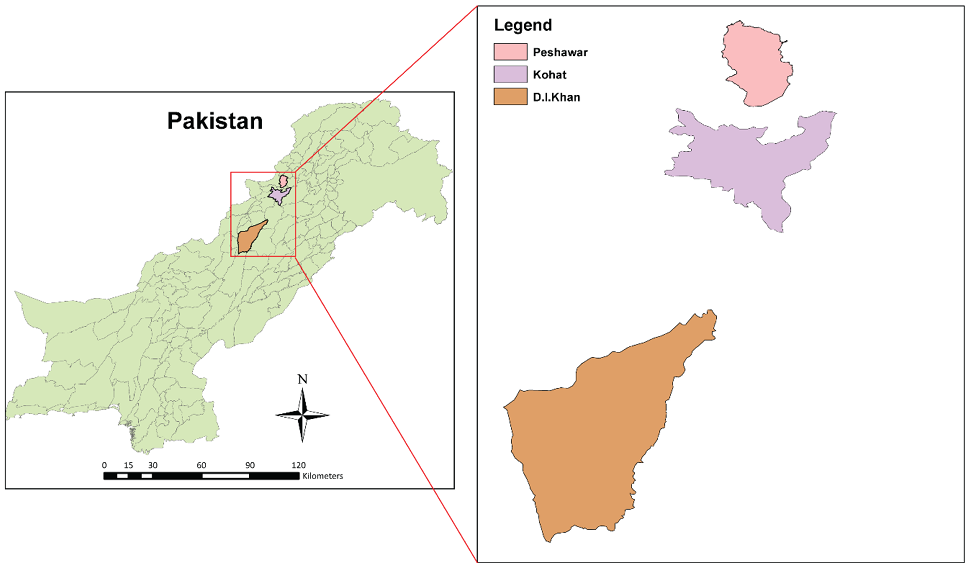
Map of Pakistan and geographic locations (sampling sites) of Peshawar, Kohat, and D.I. Khan (ArcGIS Desktop 10.8 Version: 10.7.0.10450).
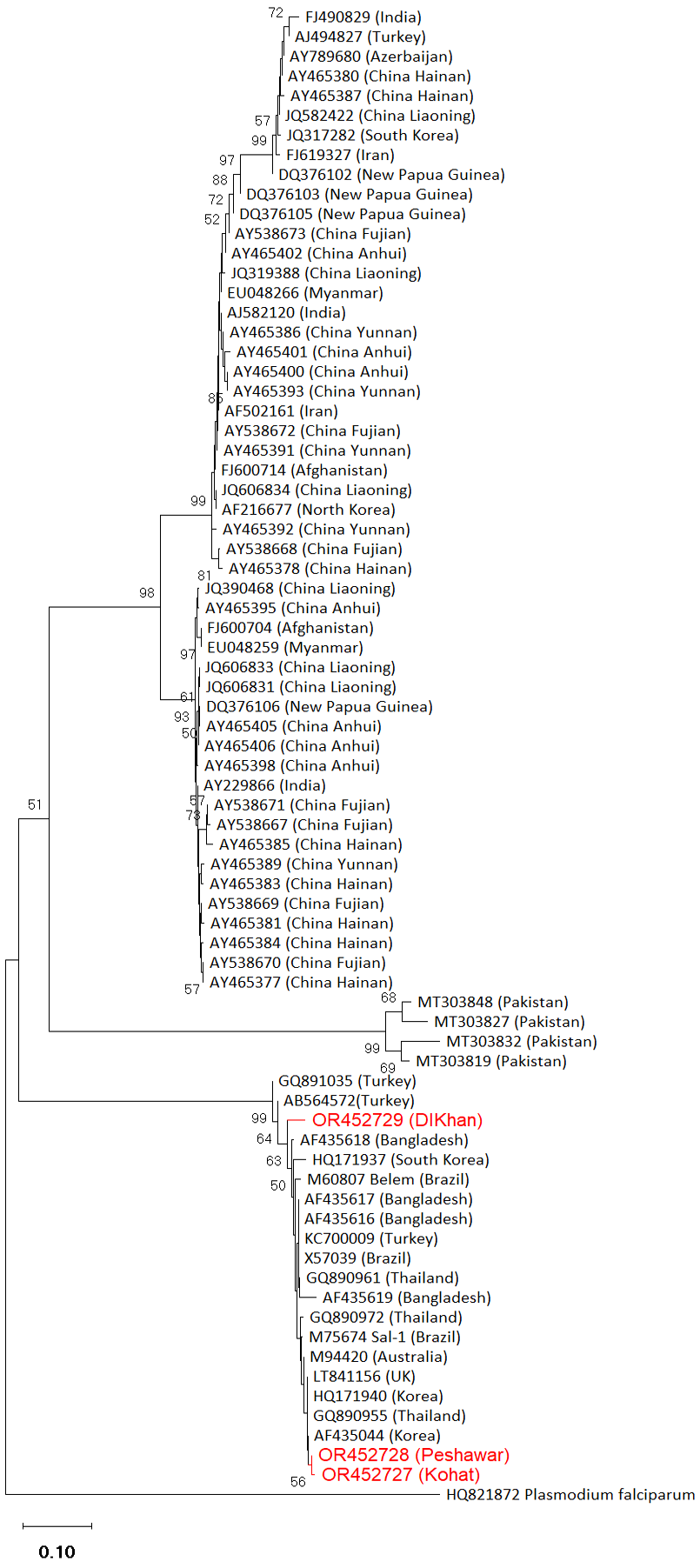
Phylogenetic tree of Plasmodium vivax based on pvmsp-1 gene. Evolutionary history was inferred using the Neighbor-Joining method. The percentage of replicate trees in which the associated taxa clustered together in the bootstrap test (1000 replicates) are shown next to the branches. Evolutionary analyses were conducted in MEGA11. The red-colored text represents sequences of the present study.
References
- Ahmad, S., Obaid, M.K., Taimur, M., Shaheen, H., Khan, S.N., Niaz, S., Ali, R. and Haleem, S., 2022. Knowledge, attitude, and practices towards cutaneous leishmaniasis in referral cases with cutaneous lesions: A cross-sectional survey in remote districts of southern Khyber Pakhtunkhwa, Pakistan. PLoS One, 17: e0268801. https://doi.org/10.1371/journal.pone.0268801[CrossRef]
- Ali, R., Khan, S., Khan, M., Adnan, M., Ali, I., Khan, T.A., Haleem, S., Rooman, M., Norin, S. and Khan, S.N., 2020. A systematic review of medicinal plants used against Echinococcus granulosus. PLoS One, 15: e0240456. https://doi.org/10.1371/journal.pone.0240456[CrossRef]
- Ali, R., Rooman, M., Mussarat, S., Norin, S., Ali, S., Adnan, M. and Khan, S.N., 2021. A systematic review on comparative analysis, toxicology, and pharmacology of medicinal plants against Haemonchus contortus. Front. Pharmacol., 12. https://doi.org/10.3389/fphar.2021.644027[CrossRef]
- Baird, J.K., 2004. Chloroquine resistance in Plasmodium vivax. Antimicrob. Agents Chemother., 48: 4075-4083. https://doi.org/10.1128/AAC.48.11.4075-4083.2004[CrossRef]
- Bibi, Z., Fatima, A., Rani, R., Maqbool, A., Khan, S., Naz, S. and Waseem, S., 2021. Genetic characterization of Plasmodium vivax isolates from Pakistan using circumsporozoite protein (pvcsp) and merozoite surface protein-1 (pvmsp-1) genes as genetic markers. Malar. J., 20: 112. https://doi.org/10.1186/s12936-021-03654-w[CrossRef]
- Carlton, J.M., Adams, J.H., Silva, J.C., Bidwell, S.L., Lorenzi, H., Caler, E., Crabtree, J., Angiuoli, S.V., Merino, E.F. and Amedeo, P., 2008. Comparative genomics of the neglected human malaria parasite Plasmodium vivax. Nature, 455: 757-763. https://doi.org/10.1038/nature07327[CrossRef]
- Cui, L., Escalante, A.A., Imwong, M. and Snounou, G., 2003a. The genetic diversity of Plasmodium vivax populations. Trends Parasitol., 19: 220-226. https://doi.org/10.1016/S1471-4922(03)00085-0[CrossRef]
- Cui, L., Mascorro, C.N., Fan, Q., Rzomp, K.A., Khuntirat, B., Zhou, G., Chen, H., Yan, G. and Sattabongkot, J., 2003b. Genetic diversity and multiple infections of Plasmodium vivax malaria in Western Thailand. Am. J. trop. med. Hyg., 68: 613-619. https://doi.org/10.4269/ajtmh.2003.68.613[CrossRef]
- Felsenstein, J., 1985. Confidence limits on phylogenies: An approach using the bootstrap. Evolution, 39: 783-791. https://doi.org/10.1111/j.1558-5646.1985.tb00420.x[CrossRef]
- Hassan, B.A.M.H., Nazir, H., Khalid, S., Bibi, S., Afzal, K., Al-Kharaman, Y.M., Ali, A., Ali, S., Shah, H.S., Khan, M.S., Akhtar Hussain, S.J., Farid Hasan, S.M., Hussain, I. and Rizvanov, A.A., 2019. Erupt of malaria, dengue and chikungunya in Pakistan: Recent insights about prevalence, diagnosis and treatment. Pak. J. Pharm. Sci., 32: 1545-1554.
- Huang, B., Huang, S., Su, X.Z., Guo, H., Xu, Y., Xu, F., Hu, X., Yang, Y., Wang, S. and Lu, F., 2014. Genetic diversity of Plasmodium vivax population in Anhui province of China. Malar. J., 13: 13. https://doi.org/10.1186/1475-2875-13-13[CrossRef]
- Hupalo, D.N., Luo, Z., Melnikov, A., Sutton, P.L., Rogov, P., Escalante, A., Vallejo, A.F., Herrera, S., Arévalo-Herrera, M. and Fan, Q., 2016. Population genomics studies identify signatures of global dispersal and drug resistance in Plasmodium vivax. Nat. Genet., 48: 953-958. https://doi.org/10.1038/ng.3588[CrossRef]
- Karim, A.M., Hussain, I., Malik, S.K., Lee, J.H., Cho, I.H., Kim, Y.B. and Lee, S.H., 2016. Epidemiology and clinical burden of malaria in the war-torn area, Orakzai Agency in Pakistan. PLoS Negl. Trop. Dis., 10: e0004399. https://doi.org/10.1371/journal.pntd.0004399[CrossRef]
- Karim, A.M., Yasir, M., Ali, T., Malik, S.K., Ullah, I., Qureshi, N.A., Yuanting, H., Azhar, E.I. and Jin, H.J. 2021. Prevalence of clinical malaria and household characteristics of patients in tribal districts of Pakistan. PLoS Negl. Trop. Dis. 15: e0009371. https://doi.org/10.1371/journal.pntd.0009371[CrossRef]
- Kazmi, J.H. and Pandit, K., 2001. Disease and dislocation: the impact of refugee movements on the geography of malaria in NWFP, Pakistan. Soc. Sci. Med., 52: 1043-1055. https://doi.org/10.1016/S0277-9536(00)00211-2[CrossRef]
- Khan, S.N., Ali, R., Khan, S., Rooman, M., Norin, S., Zareen, S., Ali, I. and Ayaz, S., 2021. Genetic diversity of polymorphic marker merozoite surface protein 1 (msp-1) and 2 (msp-2) genes of Plasmodium falciparum isolates from malaria endemic region of Pakistan. Front. Genet., 12: 751552. https://doi.org/10.3389/fgene.2021.751552[CrossRef]
- Khan, S.N., Khan, A., Khan, S., Ayaz, S., Attaullah, S., Khan, J., Khan, M.A., Ali, I. and Shah, A.H., 2014. PCR/RFLP-based analysis of genetically distinct Plasmodium vivax population of Pvmsp-3α and Pvmsp-3β genes in Pakistan. Malar. J., 13: 355. https://doi.org/10.1186/1475-2875-13-355[CrossRef]
- Khan, Z.A., 2012. Military operations in FATA and PATA: Implications for Pakistan. Strategic Studies.
- Khattak, A.A., Awan, U.A., Nadeem, M.F., Yaqoob, A. and Afzal, M.S., 2021. Chloroquine-resistant Plasmodium falciparum in Pakistan. Lancet Infect. Dis., 21: 1632. https://doi.org/10.1016/S1473-3099(21)00700-3[CrossRef]
- Kuesap, J., Rungsihirunrat, K., Chaijaroenkul, W. and Mungthin, M., 2022. Genetic diversity of Plasmodium vivax merozoite surface protein-3 alpha and beta from diverse geographic areas of Thailand. Jpn. J. Infect. Dis., 75: 241-248. https://doi.org/10.7883/yoken.JJID.2021.457[CrossRef]
- Li, X., Bai, Y., Wu, Y., Zeng, W., Xiang, Z., Zhao, H., Zhao, W., Chen, X., Duan, M., Wang, X., Zhu, W., Sun, K., Wu, Y., Zhang, Y., Qin, Y., Rosenthal, B.M., Cui, L. and Yang, Z., 2022. PvMSP-3α and PvMSP-3β genotyping reveals higher genetic diversity in Plasmodium vivax parasites from migrant workers than residents at the China-Myanmar border. Infect. Genet. Evol., 106: 105387. https://doi.org/10.1016/j.meegid.2022.105387[CrossRef]
- Lim, C.S., Kim, S.H., Kwon, S.I., Song, J.W., Song, K.J. and Lee, K.N., 2000. Analysis of Plasmodium vivax merozoite surface protein-1 gene sequences from resurgent Korean isolates. Am. J. trop. Med. Hyg., 62: 261-265. https://doi.org/10.4269/ajtmh.2000.62.261[CrossRef]
- Liu, W., Li, Y., Shaw, K.S., Learn, G.H., Plenderleith, L.J., Malenke, J.A., Sundararaman, S.A., Ramirez, M.A., Crystal, P.A. and Smith, A.G., 2014. African origin of the malaria parasite Plasmodium vivax. Nat. Commun., 5: 1-10. https://doi.org/10.1038/ncomms4346[CrossRef]
- Maestre, A., Sunil, S., Ahmad, G., Mohmmed, A., Echeverri, M., Corredor, M., Blair, S., Chauhan, V.S. and Malhotra, P., 2004. Inter-allelic recombination in the Plasmodium vivax merozoite surface protein 1 gene among Indian and Colombian isolates. Malar. J., 3: 4. https://doi.org/10.1186/1475-2875-3-4[CrossRef]
- Moon, S.U., Lee, H.W., Kim, J.Y., Na, B.K., Cho, S.H., Lin, K., Sohn, W.M. and Kim, T.S., 2009. High frequency of genetic diversity of Plasmodium vivax field isolates in Myanmar. Acta Trop., 109: 30-36. https://doi.org/10.1016/j.actatropica.2008.09.006[CrossRef]
- Mussarat, S., Ali, R., Ali, S., Mothana, R.A., Ullah, R. and Adnan, M., 2021. Medicinal animals and plants as alternative and complementary medicine in southern regions of Khyber Pakhtunkhwa, Pakistan. Front. Pharmacol., 12. https://doi.org/10.3389/fphar.2021.649046[CrossRef]
- Ndao, M., Bandyayera, E., Kokoskin, E., Gyorkos, T.W., MacLean, J.D. and Ward, B.J., 2004. Comparison of blood smear, antigen detection, and nested-PCR methods for screening refugees from regions where malaria is endemic after a malaria outbreak in Quebec, Canada. J. clin. Microbiol., 42: 2694-2700. https://doi.org/10.1128/JCM.42.6.2694-2700.2004[CrossRef]
- Price, R.N., Tjitra, E., Guerra, C.A., Yeung, S., White, N.J. and Anstey, N.M., 2007. Vivax malaria: Neglected and not benign. Am. J. trop. Med. Hyg., 77: 79-87. https://doi.org/10.4269/ajtmh.2007.77.79[CrossRef]
- Prugnolle, F., Rougeron, V., Becquart, P., Berry, A., Makanga, B., Rahola, N., Arnathau, C., Ngoubangoye, B., Menard, S. and Willaume, E., 2013. Diversity, host switching and evolution of Plasmodium vivax infecting African great apes. Proc. natl. Acad. Sci. U.S.A., 110: 8123-8128. https://doi.org/10.1073/pnas.1306004110[CrossRef]
- Qureshi, H., Khan, M.I., Ambachew, H., Pan, H.F. and Ye, D.Q., 2020. Baseline survey for malaria prevalence in Khyber Pakhtunkhwa Province, Pakistan. East. Mediterr. Hlth. J., 26: 453-460. https://doi.org/10.26719/emhj.19.015[CrossRef]
- Qureshi, N.A., Fatima, H., Afzal, M., Khattak, A.A. and Nawaz, M.A., 2019. Occurrence and seasonal variation of human Plasmodium infection in Punjab Province, Pakistan. BMC Infect. Dis., 19: 935. https://doi.org/10.1186/s12879-019-4590-2[CrossRef]
- Raza, A., Ghanchi, N.K., Thaver, A.M., Jafri, S. and Beg, M.A., 2013. Genetic diversity of Plasmodium vivax clinical isolates from southern Pakistan using pvcsp and pvmsp1 genetic markers. Malar. J., 12: 16. https://doi.org/10.1186/1475-2875-12-16[CrossRef]
- Rowland, M., 1999. Malaria control: bednets or spraying? Malaria control in the Afghan refugee camps of western Pakistan. Trans. R. Soc. trop. Med. Hyg., 93: 458-459. https://doi.org/10.1016/S0035-9203(99)90336-X[CrossRef]
- Rowland, M., 2001. Refugee health in the tropics. Malaria control in Afghan refugee camps: Novel solutions. Trans. R. Soc. trop. Med. Hyg., 95: 125-126. https://doi.org/10.1016/S0035-9203(01)90132-4[CrossRef]
- Rowland, M., Bouma, M., Ducornez, D., Durrani, N., Rozendaal, J., Schapira, A. and Sondorp, E., 1996. Pyrethroid-impregnated bed nets for personal protection against malaria for Afghan refugees. Trans. R. Soc. trop. Med. Hyg., 90: 357-361. https://doi.org/10.1016/S0035-9203(96)90505-2[CrossRef]
- Saitou, N. and Nei, M., 1987. The neighbor-joining method: A new method for reconstructing phylogenetic trees. Mol. Biol. Evol., 4: 406-425.
- Tamura, K., Nei, M. and Kumar, S., 2004. Prospects for inferring very large phylogenies by using the neighbor-joining method. Proc. natl. Acad. Sci. U.S.A., 101: 11030-11035. https://doi.org/10.1073/pnas.0404206101[CrossRef]
- Tamura, K., Stecher, G. and Kumar, S., 2021. MEGA11: molecular evolutionary genetics analysis version 11. Mol. Biol. Evol., 38: 3022-3027. https://doi.org/10.1093/molbev/msab120[CrossRef]
- Tariq, A., Adnan, M., Amber, R., Pan, K., Mussarat, S. and Shinwari, Z.K., 2016. Ethnomedicines and anti-parasitic activities of Pakistani medicinal plants against Plasmodia and Leishmania parasites. Annls Clin. Microbiol. Antimicrob., 15: 52. https://doi.org/10.1186/s12941-016-0170-0[CrossRef]
- Villabona-Arenas, C.J., Hanage, W.P. and Tully, D.C., 2020. Phylogenetic interpretation during outbreaks requires caution. Nat. Microbiol., 5: 876-877. https://doi.org/10.1038/s41564-020-0738-5[CrossRef]
- Villena, F.E., Sanchez, J.F., Nolasco, O., Braga, G., Ricopa, L., Barazorda, K., Salas, C.J., Lucas, C., Lizewski, S.E., Joya, C.A., Gamboa, D., Delgado-Ratto, C. and Valdivia, H.O., 2022. Drug resistance and population structure of Plasmodium falciparum and Plasmodium vivax in the Peruvian Amazon. Sci. Rep., 12: 16474. https://doi.org/10.1038/s41598-022-21028-3[CrossRef]
- Wang, X., Jordan, I.K. and Mayer, L.W., 2015. Chapter 29 -A phylogenetic perspective on molecular epidemiology. In: Molecular medical microbiology (Second Edition) (eds. Y.W. Tang, M. Sussman, D. Liu, I. Poxton and J. Schwartzman). Academic Press, Boston. pp. 517-536. https://doi.org/10.1016/B978-0-12-397169-2.00029-9[CrossRef]
- Warhurst, D.C. and Williams, J.E., 1996. ACP broadsheet no 148. July 1996. Laboratory diagnosis of malaria. J. clin. Pathol., 49: 533-538. https://doi.org/10.1136/jcp.49.7.533[CrossRef]
- WHO, 2021. World malaria report 2021: World Health Organization.
- Yang, Z. and Rannala, B., 2012. Molecular phylogenetics: Principles and practice. Nat. Rev. Genet., 13: 303-314. https://doi.org/10.1038/nrg3186[CrossRef]
- Zakeri, S., Raeisi, A., Afsharpad, M., Kakar, Q., Ghasemi, F., Atta, H., Zamani, G., Memon, M.S., Salehi, M. and Djadid, N.D. 2010a. Molecular characterization of Plasmodium vivax clinical isolates in Pakistan and Iran using pvmsp-1, pvmsp-3alpha and pvcsp genes as molecular markers. Parasitol. Int., 59: 15-21. https://doi.org/10.1016/j.parint.2009.06.006[CrossRef]
- Zakeri, S., Safi, N., Afsharpad, M., Butt, W., Ghasemi, F., Mehrizi, A.A., Atta, H., Zamani, G. and Djadid, N.D. 2010b. Genetic structure of Plasmodium vivax isolates from two malaria endemic areas in Afghanistan. Acta Trop., 113: 12-19. https://doi.org/10.1016/j.actatropica.2009.08.025[CrossRef]
- Zareen, S., Khan, S.N., Adnan, M., Haleem, S., Ali, R. and Alnomasy, S.F., 2021. Antiplasmodial potential of Eucalyptus obliqua leaf methanolic extract against Plasmodium vivax: An in vitro study. Open Chem., 19: 1023-1028. https://doi.org/10.1515/chem-2021-0091[CrossRef]
Services
Article usage statistics
Loading…