
Peste des petits ruminants virus (PPRV) causes a highly contagious disease in both domestic and wild small ruminants, and in camels. Based on sequence analysis of the nucleoprotein (N) gene, the PPRV has been classified into four lineages. Serological investigations in Tanzania indicate that peste des petits ruminants (PPR) was introduced in 2004 in Ngorongoro district bordering Ken- ya before official confirmation of the disease in most districts of Northern Tanzania in 2008. In 2011, the presence of PPRV in goats of southern Tanzania district of Tandahimba bordering Mozambique was reported. The aim of this study was to perform molecular typing of PPRV strains that caused outbreak in Tandahimba district in 2011. A total of 17 (sheep=0, goats=17) out of 27 (sheep=3, goats=24) were positive for PPRV N gene. The nucleotide sequence and phylogenetic analysis clus- tered the PPRV from Tandahimba into lineages II and IV. The results give evidence of at least two separate introductions of PPRV into Southern Tanzania, underlining the transboundary nature of the disease, particularly in regions with uncontrolled livestock movements.
Short Communication · Volume 2, Issue 1, 24 January 2015 · Open Access
Peste des Petits Ruminants Virus Lineage II and IV From Goats in Southern Tanzania During an Outbreak in 2011
· · · · ·
Affiliations & Notes ⌄
- 1Department of Veterinary Microbiology and Parasitology, Faculty of Veterinary Medicine, Sokoine University of Agriculture, P.O. Box 3019, Morogoro, Tanzania
- 2Higher Institute for Nursing and Biotechnology, VIVES University College, Wilgen- straat 32, 8800 Roeselare, Belgium
- 3Department of Biomedical Sciences and Veterinary Public Health, Swedish University of Agricultural Sciences, P.O. Box 7028, SE-750 07 Uppsala, Sweden
- 4The Pirbright Institute, The Pirbright Institute, Ash Road, Pirbright, Surrey, GU24 0NF, UK. E-mail | gmisinzo@gmail.com
Article Info ⌄
- Journal:
- Hosts and Viruses
- Published:
- 24 January 2015

From the article
- Peste des Petits Ruminants Virus Lineage II and IV From Goats in Southern Tanzania During an Outbreak in 2011.
- Abstract | Peste des petits ruminants virus (PPRV) causes a highly contagious disease in both domestic and wild small ruminants, and in camels.
- Serological investigations in Tanzania indicate that peste des petits ruminants (PPR) was introduced in 2004 in Ngorongoro district bordering Kenya before official confirmation of the disease in most districts of Northern Tanzania in 2008.
- In 2011, the presence of PPRV in goats of southern Tanzania district of Tandahimba bordering Mozambique was reported.
Selected from the article's own text.
Abstract
Acknowledgements
We thank Mariam Makange for excellent technical assistance. This study was supported by the Fund for Academic Fellowships of the Association of Educative and Scientific Authors (VEWA). TK was supported by a scholarship from the Wellcome Trust (Grant WT087546MA) to the Southern African Centre for Infectious Disease Surveillance (SACIDS), Sokoine University of Agriculture, Morogoro, Tanzania.
Figures
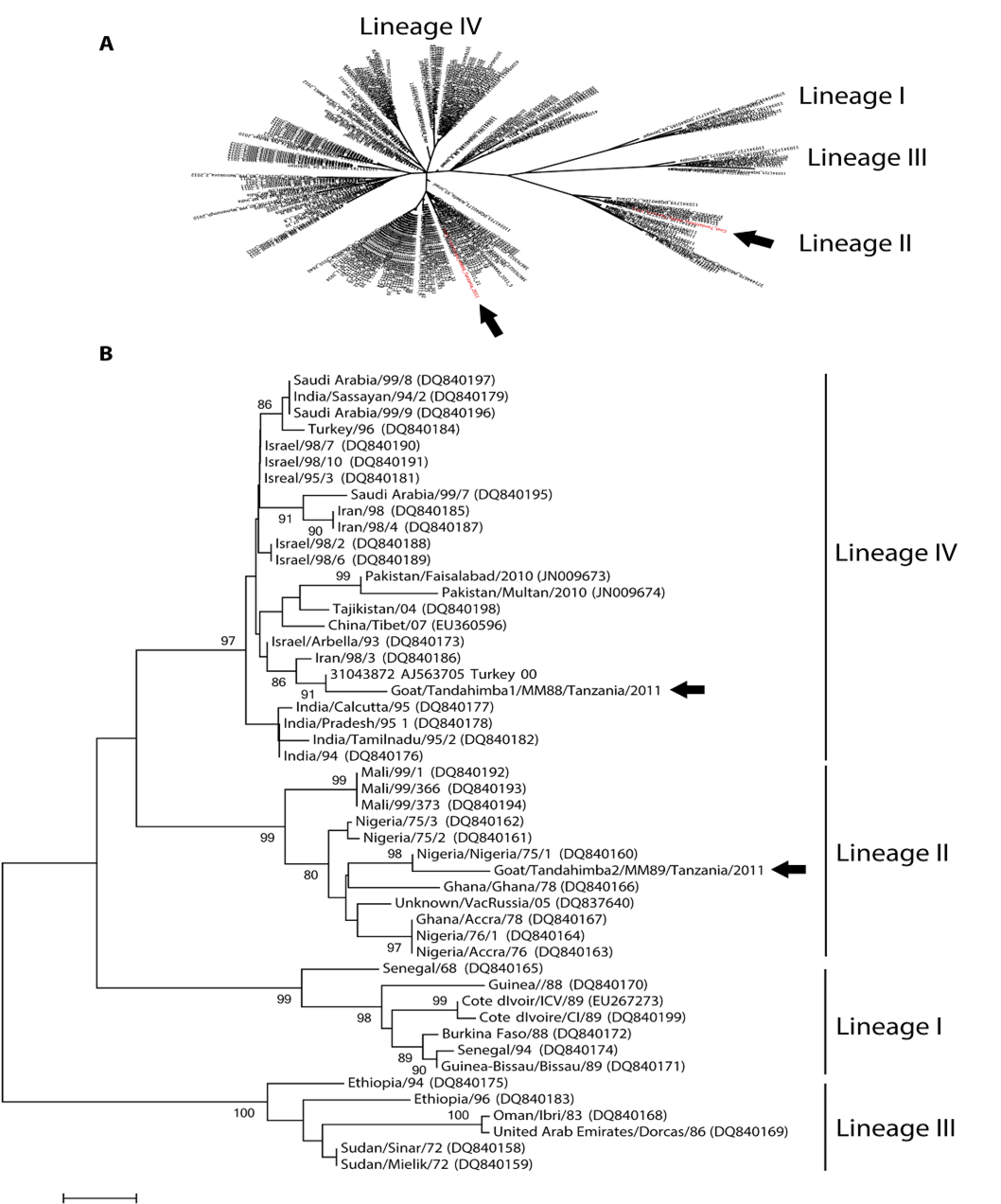
Majority rule consensus tree of Peste des petits ruminants viruses based on the variable region of the N gene (255 bp) constructed by Bayesian MCMC analysis implemented in MrBayes programme. A) Branching pattern of the Tanzanian PPRV strain against all available sequences in the GenBank. B) Tree topology of Tanzanian PPRV strain with selected sequences representing all the lineages. The samples used in this study are marked with black arrows.
References
- Couacy-Hymann. E., F. Roger, C. Hurard, J.P. Guillou, G. Libeau, and A. Diallo, 2002: Rapid and sensitive detection of peste des petits ruminants virus by a polymerase chain reaction assay. Journal of Virological Methods 100, 17-25.
- Karimuribo, E.D., P.M. Loomu, L.S.B. Mellau, and E.S. Swai, 2011: Retrospective study on sero-epidemiology of peste des petits ruminants before its official confirmation in northern Tanzania in 2008. Research Opinions in Animal and Veterinary Sciences 3, 184-187.
- Kwiatek, O., D. Keita, P. Gil, J. Fernández-Pinero, M. A. Jimenez Clavero, E. Albina, and G. Libeau, 2012: Quantitative one-step real-time RT-PCR for the fast detection of the four genotypes of PPRV. Journal of Virological Methods 165, 168-77.
- Luka, P.D., J. Erume, F.N. Mwiine, and C. Ayebazibwe, 2012: Molecular characterization of peste des petits ruminants virus from the Karamoja region of Uganda (2007-2008). Archives of Virology 157, 29-35.
- Maganga, G.D., D. Verrier, R.M. Zerbinati, C. Drosten, J.F. Drexler, E.M. Leroy, 2013: Molecular typing of PPRV strains detected during an outbreak in sheep and goats in south-eastern Gabon in 2011. Virology Journal 10, 82.
- Munir, M., S. Zohari, A. Saeed, Q.M. Khan, M. Abubakar, N. LeBlanc, and M. Berg, 2012a: Detection and phylogenetic analysis of peste des petits ruminants virus isolated from outbreaks in Punjab, Pakistan. Transboundary and Emerging Diseases 59, 85-93.
- Munir, M., S. Zohari, R. Suluku, N. Leblanc, S. Kanu, F.A. Sankoh, M. Berg, M.L. Barrie, and K. Ståhl, 2012b: Genetic characterization of peste des petits ruminants virus, Sierra Leone. Emerging Infectious Diseases 18, 193-195.
- Munir, M., S. Zohari, and M. Berg, 2013: Molecular biology and pathogenesis of peste des petits ruminants virus, 1st edn. Springer, New York.
- Muse, E.A., E.D. Karimuribo, G.C. Gitao, G. Misinzo, L.S.B. Mellau, P.L.M. Msoffe, E.S. Swai, and M.O. Albano, 2012: Epidemiological investigation into the introduction and factors for spread of Peste des Petits Ruminants, southern Tanzania. Onderstepoort Journal of Veterinary Research 79, 457.
- Swai, E.S., A. Kapaga, F. Kivaria, D. Tinuga, G. Joshua, and P. Sanka, 2009: Prevalence and distribution of peste des petits ruminants virus antibodies in various districts of Tanzania. Veterinary Research Communications 33, 927-936.
Services
Article usage statistics
Loading…