Research Article · Volume 10, Issue 8, 1 August 2022 · Open Access
Oral or Intrauterine N-Acetyl Cysteine Treatment as A Strategy for Improving the Reproductive Efficiency and Antioxidant Capacity of Lactating Cows
· ·
Affiliations & Notes ⌄
1Animal Production Research Institute, Agricultural Research Center, Nadi El Said, Dokki, Giza 12618, Egypt
2Animal Production Department, Faculty of Agriculture, Mansoura University, Mansoura 35516, Egypt. *Correspondence | Wael Mohamed Wafa, Animal Production Research Institute, Agricultural Research Center, Ministry of Agriculture and Land Reclamation, Nadi El Said, Dokki, Giza 12618, Egypt
This study aimed to determine the influence of N-Acetyl-Cysteine (NAC), as oral, intrauterine (IU) or oral plus IU administration at early postpartum period, on reproductive performance, antioxidant capacity, and health status of lactating cows. This study included 20 Friesian lactating cows (480±22.7 kg LBW, 2-4 parities and 4.5-6 years old). In day 15 postpartum, cows were divided into four groups, 5 cows/group. Cows in the 1st group represented the control group without treatment (G1). In G2, cows were orally treated with 1.2 g NAC/100 kg BW for 7 days, while 100 ml of 2% NAC solution was infused intrauterine for 3 days for each cow in G3. Cows in G4 were received 0.6 g NAC/100 kg BW orally for 7 days and IU infused by 100 ml of 1% NAC solution for three days. Results showed that cows in G4 showed the highest values of RBCs, Hb, PCV, WBCs, lymphocytes, basophils, total antioxidant capacity, SOD, GSH, catalase, and conception rate, and the lowest values of AST and ALT, creatinine, MDA, TNFα, IFN-γ, IL2, IL6, days-open and number of inseminations per conception. In most postpartum days of all groups, serum P4 and E2 concentrations were in association with conception rate. In conclusion, the dual treatment of lactating cows on day 15 postpartum with 0.6 NAC/kg (orally for 7 days) plus 1% NAC (IU infusion for 3 days) may improve the reproductive efficiency, health performance, antioxidant enzymes, and inflammatory reaction during the postpartum period.
N-acetyl-cysteine (NAC) is a stable derivative of cysteine amino acid that has antioxidant properties and it is required for the glutathione production from bodies . Glutathione and NAC are powerful antioxidants. Through acceleration of glutathione synthetase hormone (GSH) synthesis, oxidative stress was found to be inhibited, and consequently the prevention of hyperinsulinemia induced insulin resistance , and preservation of insulin receptors against oxidant agents. NAC probably influences insulin receptor activity, and results in an increase of glucose consumption, which is an indicator of the insulin sensitivity state .
Previous studies have shown that, administration of NAC reduces plasma homocystine levels and the viscosity of mucus by separating disulfide bonds in mucous proteins, removing purulent or non-purulent secretions from the body . Also, NAC has properties as antioxidant, cytoprotective medium, and anti-inflammatory agent ; . Milk or meat withdrawal time after NAC administration is 0 days according to European Medicinal Evaluation Agency (EMEA) data .
The NAC as a promising antioxidant is used for enhancing the efficacy of assisted reproductive technologies because it has positive impacts on in-vitro development of the ovarian follicles, maturation of oocytes, development and cryopreservation of embryos . In mares, it was stated that both the IU NAC administration and oral NAC administration improved pregnancy and prevents the reproductive problems, such reproductive problems are known to also have a negative impact on the productive efficiency of dairy farms .
Based on the above findings in mares concerning the beneficial effects of NAC on improving the uterine environment, the present study aimed to test this hypothesis in dairy cows by studying the effect of NAC as oral, IU, or oral and IU administrations at early postpartum period on reproductive variables, cytokines levels, antioxidant and healthy status of Friesian cows.
Materials and Methods
The experimental work of this study was conducted at Animal Production Experimental Station of El-Gemmezah, belonging to Animal Production Research Institute (APRI), Agricultural Research Center, Ministry of Agriculture and Land Reclamation, Egypt.
This experimental work was conducted under the Directive 2010/63/EU for animals protection which used for the scientific purposes (Official Journal of the European Union, 2010), and all effort has been made to reduce the animal suffering.
Animals and experimental design
Animals used in this experiment included total number of 20 Friesian dairy cows at early postpartum period having 480±22.7 kg live body weight (LBW), 4.5-6 years of age, and 2-4 parities. Animals were housed in semi-open sheds. In day 15 of postpartum period, animals were divided into 4 groups (5 in each) the 1st group was served as a control (G1) without treatment. At the same time, cows in G2 were orally treated with NAC (A7250: Sigma Aldrich Co. St. Louis, MO, USA) at a rate of 1.2 g/100 kg BW for seven consecutive days up to 21-day postpartum. Cows in G3 were received 100 ml of 2% NAC solution (20 g/L distilled water) in form of IU infusion for three consecutive days up to 17-day postpartum. In G4, cows received oral dose of 0.6 g NAC/100 kg BW for 7 days (up to 21-day postpartum) in combination with IU infusion of 100 ml of 1% NAC solution for 3 days up to day 17 of postpartum period.
Feeding system
Cows in each group were fed on ration of 7 kg concentrates (CFM; concentrate feed mixture), 2 kg berseem hay (BH; 2nd cut) and 3 kg of rice straw (RS). The CFM consist of un-corticated cottonseed cake (65%), wheat bran (9%), rice polish (20%), molasses (3%), limestone (2%), and common salt (1%). Animals were fed different feedstuffs daily (7 am and 3 pm). The feed amounts were adjusted weekly according to milk yield and LBW. Table 1 showed the chemical analysis of different feedstuffs. Cows were milked twice/day at 5 am and 5 pm by milking machine.
Experimental procedures
Reproductive management
During postpartum, estrus was observed twice/day to detect the postpartum 1st estrus interval. Cows observed in heat were artificially inseminated with thawed semen (0.5 ml French straws containing 20x106/ml sperm). In this study, animals in all groups required 1-3 services per conception. After 50 days of insemination, pregnancy was diagnosed using rectal palpation. Animals returned to estrus for at least two times were re-inseminated.
Reproductive traits
Postpartum 1st estrus interval (PPE; days) was recorded as an interval from calving to 1st estrous activity. Number of inseminations per conception (IPC; N), days open (DO; No.) as an interval from calving up to conception, and conception rate (CR; %) following each insemination were determined.
Blood samples
Two blood samples (5 ml/each) were collected from the jugular vein of each cow before the morning meal in on days 40, 55, 70, 85, and 100 of postpartum period; the 1st blood sample were collected in tubes with EDTA, as anticoagulant, for determining the hematological parameters including red blood cells (RBCs) and white blood cells (WBCs) count, hemoglobin (Hb) concentration, packed cell volume (PCV%), mean corpuscular volume (MCV), mean corpuscular hemoglobin (MCH), mean corpuscular hemoglobin concentration (MCHC), and WBCs differentiation (neutrophils, lymphocytes, monocytes, eosinophils and basophils). All haematological parameters were examined by a veterinary hematology analyzer (Exigo, Boule medical AB., Sweden), while the 2nd sample was collected in plain tubes and allowed to clot for 2 h, then centrifuged (4000 rpm for 15 min) to separate the serum. Serum samples were stored frozen (-20ºC) until analyses of antioxidant parameters, enzymes, cytokine markers, and hormonal profiles.
Table 1: Chemical analysis of CFM*, berseem hay, and rice straw (on DM basis. %).
Item
Dry matter
Organic matter
Crude protein
Crude fiber
Ether extract
Nitrogen free extract
Ash
CFM
90.04
90.80
17.30
9.86
3.23
60.41
9.20
Rice straw
91.9
80.63
3.24
37.61
1.49
38.29
19.37
Berseem hay
89.75
86.12
13.66
27.58
2.48
42.40
13.88
*CFM: Concentrate feed mixture.
Analytical methods
Serum progesterone (P4) and estradiol-17β (E2) concentrations were determined using commercial kits by RIA (Coat-A-Count® Siemens Medical Solutions Diagnostics, Los Angeles, CA, USA).
Serum aspartate (AST) and alanine (ALT) aminotransferases activities were measured using colorimetric method . However, kidney function markers including creatinine concentration were estimated according to Bartles et al. (1972).
Serum tumor necrosis factor-alpha (TNFα), interferon-γ (IFN-γ), interleukin-2 (IL2, RayBio® C-Series Bovine Cytokine Antibody Array Heidelberg, Germany), and interleukin-6 (IL6, Kamiya Biomedical Company, USA) were analyzed according to the manufacturers’ instructions.
Statistical analysis
The obtained data were statistically analyzed to test the effect of different NAC treatments using IBM SPSS analysis program as a completely random design (one-way ANOVA). Chi-square tests within SPSS program was used for analyzing the conception rate. Duncan’s Multiple Range Test was used to separate the significant differences among groups.
Results and Discussion
Reproductive efficiency
Reproductive traits
All NAC treatments did not affect PPE, while, these treatments significantly (P<0.05) decreased DO and significantly (P<0.05) increased CR within 100 day-postpartum. On the other hand, combined NAC treatment in G4 significantly (P<0.05) decreased IPC. In this concern, NAC in G4 showed the lowest DO and IPC, and the highest CR in comparison with other NAC treatments and control groups (Table 2).
Ovarian hormones
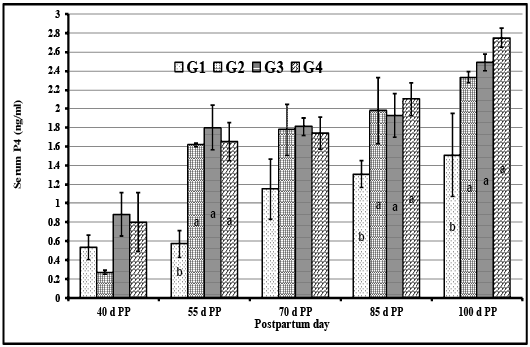
Results of serum P4 concentration through the postpartum period are illustrated in Figure 1 revealed that concentration of P4 in day 40 postpartum was <1 ng/ml in all groups without significant group differences. In day 55 postpartum, P4 concentration increased (P<0.05) in NAC groups (> 1 ng/ml, G2-G4) as compared to control (<1 ng/ml, G1). In day 70 postpartum, P4 concentration was >1 ng/ml and non-significant differences were observed among groups. Meanwhile, concentration of serum P4 increased (P<0.05) in all NAC groups in comparing with control (G1) in days 85 and 100 postpartum.
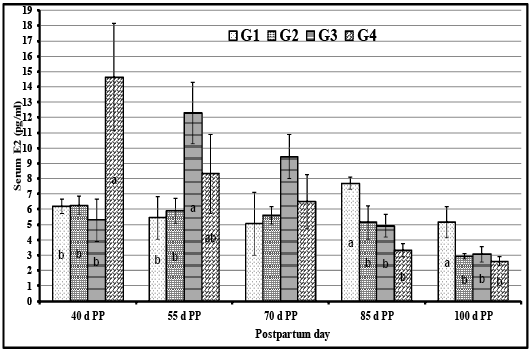
Results illustrated in Figure 2 showed that E2 concentration was higher (P<0.05) in G4 than in other groups (G1, G2, and G3) in day 40 postpartum. Concentration of E2 in G3 was the highest (P<0.05) as compared to other groups but did not differ significantly from G4 in 55 d postpartum. In day 70 postpartum, the differences in E2 concentration among groups were not significant. However, E2 concentration was lower (P<0.05) in all NAC groups than in G1 (control) in days 85 and 100 postpartum.
Haematological traits
Results in Table 3 revealed that PCV percent improved (P<0.05) by all NAC treatments (G2-G4), while basophils percent was increased (P<0.05) in NAC groups (G3 and G4). The more obvious effects were for G4 which showed the highest values of hematological parameters including RBCs, Hb, PCV, WBCs, lymphocytes, and basophils (P<0.05). However, MCV, MCH, MCHC, neutrophils, monocytes, and eosinophils were not affected significantly by NAC treatments.
Enzyme activity and creatinine level
Results in Table 4 showed that serum AST activity was reduced (P<0.05) in G3 and G4 in comparing with G1 or G2, while activity of serum ALT and concentration of creatinine were decreased (P<0.05) only by NAC in G4.
Antioxidant capacity
Total antioxidant capacity (TAC) was increased (P<0.05) in association with parallel increase (P<0.05) in activity of all antioxidant enzymes (SOD, GSH, and catalase) by all NAC treatments. Adversely, MDA level was decreased (P<0.05) only in G3 and G4 (Table 5).
Cytokines assay
Results of inflammatory markers presented in Table 6 showed that cows in G4 had the lowest (P<0.05) serum TNFα concentration as compared to other groups. However, NAC in G3 and G4 showed decreased (P<0.05) serum IFN-γ, IL2, and IL6 concentrations.
Table 2: Reproductive traits of lactating cows as affected by NAC treatments.
Item
G1 (Control)
G2 (Or-NAC)
G3 (Intra-NAC)
G4 (Or- and intra-NAC)
PPFEI (d)
55.00±3.54
50.00±3.26
55.80±1.93
48.80±1.39
NIC
2.00±0.32a
1.80±0.37ab
1.20±0.20ab
1.00±0.00b
Days open (Mean, d)
82.00±6.23a
68.20±5.60b
60.00±3.36bc
48.80±1.39c
DO (Range, d)
60-97
55-87
53-72
45-52
Conception rate+
20c
40b
60a
70a
a, b, and c: significant group differences at P<0.05. PP: Postpartum. PPFEI: Postpartum 1st estrus interval. NIC: Number of insemination cases per conception.+ Conception rate within 100 day-postpartum.
Table 3: Haematological parameters of lactating cows as affected by NAC treatments.
Item
G1 (Control)
G2 (Or-NAC)
G3 (Intra-NAC)
G4 (Or- and intra-NAC)
RBC (x106/mm3)
8.27±0.22b
8.90±0.36b
9.43±0.71ab
10.83±0.38a
Hb (g/dl)
9.57±0.88b
9.90±0.92ab
10.27±0.38ab
12.01±0.29a
PCV (%)
29.33±0.87d
32.50±0.77c
36.01±0.58b
39.17±0.60a
MCV (FL/cell)
35.57±1.80
36.70±2.28
38.64±3.18
39.9±1.95
MCH (pg/cell)
11.61±1.26
11.23±1.43
11.06±1.18
12.23±1.41
MCHC (g/dl)
32.73±3.44
30.36±2.15
27.84±1.95
30.64±1.51
WBC (x103/mm3)
6.47±0.18b
7.37±0.27b
8.07±0.59b
10.20±0.74a
Neutrophil (%)
33.27±2.51
30.83±3.98
26.67±4.71
22.50±4.80
Lymphocytes (%)
61.80±2.32b
62.86±2.82b
69.23±2.30ab
72.63±3.15a
Monocytes (%)
3.75±0.34
3.18±0.41
3.07±0.29
2.50±0.74
Eosinophils (%)
1.80±0.21
1.50±0.25
1.27±0.19
1.10±0.15
Basophils (%)
0.37±0.01c
0.41±0.02bc
0.46±0.02ab
0.51±0.03a
a, b, and c: significant group differences at P<0.05.
Table 4: Activity of transferases (AST and ALT), and creatinine concentration in blood serum of lactating cows as affected by NAC treatments.
Item
G1 (Control)
G2 (Or-NAC)
G3 (Intra-NAC)
G4 (Or- and intra-NAC)
AST (IU/L)
62.67±2.73a
58.33±2.33ab
50.01±2.89bc
44.66±2.40c
ALT (IU/L)
22.01±1.15a
19.33±1.45a
19.32±1.20a
13.33±1.33b
Creatinine (mg/dl)
1.24±0.09a
1.17±0.08ab
1.11±0.06ab
0.94±0.07b
a, b, and c: significant group differences at P<0.05.
Table 5: Total antioxidant activity, malondialdhyde and antioxidant enzymes in blood serum of lactating cows as affected by NAC treatments.
Item
G1 (Control)
G2 (Or-NAC)
G3 (Intra-NAC)
G4 (Or- and intra-NAC)
TAA (mmol/l)
2.17±0.43c
3.64±0.14b
4.24±0.20ab
5.04±0.22a
MDA (nmol/ml)
6.31±0.32a
5.41±0.56ab
4.67±0.43bc
3.40±0.36c
SOD (mg/dl)
13.35±0.61c
18.34±0.42b
22.11±0.62a
23.86±0.97a
GSH (mg/dl)
10.56±0.30d
15.48±0.56c
17.23±0.26b
19.13±0.37a
Catalase (mg/dl)
6.80±0.17c
9.83±0.49b
10.74±0.20b
16.21±0.40a
a, b, and c: significant group differences at P<0.05.
Table 6: Inflammatory markers (cytokines concentrations) in blood serum of lactating cows as affected by NAC treatments.
Item
G1 (Control)
G2 (Or-NAC)
G3 (Intra-NAC)
G4 (Or- and intra-NAC)
TNFα (ng/mL)
12.38±0.60a
12.07±0.47a
10.86±0.65a
8.61±0.44b
IFN-γ (ng/mL)
2.01±0.27a
1.82±0.16a
1.12±0.20b
0.51±0.14b
IL2 (ng/mL)
0.82±0.03a
0.78±0.06a
0.34±0.04b
0.27±0.04b
IL6 (ng/mL)
11.15±0.84a
10.87±0.62a
7.04±0.72b
6.32±0.53b
a, and b: significant group differences at P<0.05.
The reproductive disorders during postpartum period, especially the clinical endometritis and uterine discharges in the vagina but without systemic signs, may have negative effects on the productive efficiency and increasing economic losses in dairy farms. The NAC administration as a tool for covering these disorders at early postpartum either as oral treatment or IU infusion showed high successful rates in mares. The present results in our study on lactating cows indicated that cows in G4 treated with NAC (0.6 oral and 1% IU infusion) showed marked improvement in the haematological parameters, in term of the highest values of RBCs and WBCs counts, PCV percent, Hb concentration, and lymphocytes and basophils percent. In agreement with these results, a previous study reported an increase in lymphocytes and plasma cells on endometrial biopsy after NAC IU infusion in barren mares . Combined IU-oral administration of NAC decreased neutrophils percent from 33.27 to 22.50% but the difference was not significant. In this respect, NAC administration was recently found to decrease neutrophil number in uterine histological samples in normal mares . In addition to the positive impact of the combined NAC treatment (G4) on the hematological parameters, liver and kidney functions were improved by decreasing the activity of AST by 28.7% and ALT by 39.4% and a marked decrease in serum creatinine concentration. The NAC can have a hepato-protective activity in patients receiving trabectedin . According to de Oliveira et al. (2006), decreases of 70 and 90% were reported for AST and ALT activities, respectively, with the use of NAC treatment for 4 weeks. Huang et al. (2018) determined the effect of NAC on kidney function by significant reduction of NAC in serum creatinine . Furthermore, NAC may provide renal protection by acting as an antioxidant and arteriolar vasodilator via the nitrous oxide pathway .
In the present study, an improvement in activity of antioxidant enzymes such as SOD, GSH, and catalase by all NAC treatments, being more pronounced by the combined treatment. This was reflected in decreasing the MDA level and increasing TAC in blood serum of cows. Enzymes including SOD, peroxiredoxins , catalase, and glutathione peroxidase (GPx) are the main antioxidant cellular defenses. Intracellular GSH re-synthesis is needed and Cysteine (Cys) is the limiting substrate for de novo GSH synthesis , meaning that external Cys supply is critical. Hence, NAC provides a source of Cys to cope with acute GSH depletion . Catalase converts H2O2 to water and oxygen, while GPx catalyzes to lipid peroxides and H2O2 degradation . The NAC has a direct and indirect antioxidant functions; the antioxidant potential of NAC functions as a precursor of GSH . NAC as an antioxidant may increase the GSH level .
In specific cells of immune system (T-cells, B-cells and NK cells), cytokines (a large group of proteins, peptides or glycoproteins) such as interleukin and interferon are secreted. Cytokines are a category of signaling molecules which act as mediator and regulator of immunity, inflammation and hematopoiesis . In our study, the combined NAC treatment markedly decreased serum concentrations of cytokines (TNFα, IFN-γ, IL2, and IL6) to the minimal levels in blood serum of cows as compared to other treatments. Of the antioxidant characteristics of NAC is reducing pro inflammatory cytokines production, such as tumor necrosis factor and IL8 .
As a main objective of our study, all NAC treatments decreased the duration of DO, and increased CR, particularly those treated with the combined NAC. However, only the combined NAC in G4 decreased IPC. It is worthy to observe that increasing CR was in association with higher P4 concentration and low E2 level at different postpartum days being significantly higher in all NAC (the highest in G4) as compared to G1 on most postpartum days. This means that the combined NAC treatment showed the best impact on the reproductive performance of cows and ovarian hormones. In accordance with these findings, an IU infusion of a 3.3% solution of NAC in repeat breeder mares have indicated higher pregnancy rates of 81-85% . However, the CR of NAC treated cows was 66.7% . In mares, oral or IU treatment of NAC improved fertility rates. In the current study, the CR of cows was 100% for cows treated with the combined NAC following the 1st services. The observed higher CR of cows in our study and those obtained in mares as affected by NAC treatment may be due to NAC does differences used in treatment .
The positive impacts of NAC on pregnancy rate of cows, particularly in those treated with the combined NAC may be due to the protective effect on the tissues of the uterus and ovary against arsenic-induced genotoxicity which can lead to normal physiological function restoration of these organs under the oxidative stress . The later authors found that different doses of NAC significantly enhanced the normal histopathology of the ovaries and uteri by improving DNA degradation in the uterus in arsenic fed rats. Optimal dose of NAC for a long period can improve apoptosis of the follicles of the ovary caused by oxidative stress. Also, NAC has a protective role on the atresia of ovarian follicles and oocyte quality . Moreover, NAC treatment caused an increase in epithelial cell proliferation suggesting an evidence of NAC for endometrial regeneration . In this respect, NAC has a beneficial effect on conjunctival epithelial cell wound healing, anti-apoptosis, and anti-inflammation in the conjunctival epithelial cells . In excessively viscous mucous secretion cases of endometritis, the NAC treatment removed the excessive mucus and biofilm and reduced the mucus viscosity to facilitate sperm transport and increased the pregnancy rates . Recent in vitro study showed that NAC has a positive effect on development of the ovarian follicles and embryos as well as maturation of oocytes . In vivo studies of Chen et al. (2019) and Masjedi et al. (2020) indicated reactive oxygen species generation is associated with pathologies, polycystic ovary syndrome, and endometriosis. In addition, it was proposed that improving the pregnancy rates may be attributed to the potential of NAC, as a preventive, anti-inflammatory and immunomodulatory on formation of focal abscess and oxidative stress .
Conclusions and Recommendations
The dual oral administration of 0.6 NAC/kg plus IU infusion 1% NAC starting from day 15 postpartum improved the reproductive performance of lactating cows in association with improvement of the health status, antioxidant capacity, and inflammatory reaction. Further studies are needed to explore the effects of NAC on the histological structure of the endometrium in early postpartum cows.
Acknowledgments
Authors thank El-Gemmezah Animal Production Experimental Station, Animal Production Research Institute (APRI), Egypt for the allowing of animals which used in this experimental work.
Novelty statement
The dual treatment of lactating cows starting from day 15 postpartum with 0.6 NAC/kg (orally for 7 days) plus 1% NAC (IU infusion for 3 days) can improve the reproductive efficiency, health performance, antioxidant enzymes, and inflammatory reaction during the postpartum period.
Author‘s Contribution
WWM and AEA substantial contributions to conception and design. EHA and WWM acquisition of data. EHA and AEA analysis and interpretation of data. WWM and EHA statistical analyses. AEA and WWM drafting the manuscript. WWM and AEA manuscript critically revising for important content. All authors manuscript final approval for publication.
Conflict of interest
The authors have declared no conflict of interest.
Figures
Figure 1:.
Serum progesterone concentration in cows of experimental groups on different postpartum days. (a and b: Significances group differences at P<0.05).
Figure 2:.
Serum 17β-estradiol concentration in cows of experimental groups on different postpartum days. (a and b: Significances group differences at P<0.05).
References
Aebi H (1974). Catalase. In: (ed. H.U. Bergmeyer). Methods of Enzymatic Analysis, Verlag Chemie/Academic Press Inc., Weinheim/ NewYork, pp. 673-680. https://doi.org/10.1016/B978-0-12-091302-2.50032-3[CrossRef]
Barrozo LG, Paulino LRFM, Silva BR, Barbalho EC, Nascimento DR, Neto MFL, Silva JRV (2021). N-acetyl-cysteine and the control of oxidative stress during in vitro ovarian follicle growth, oocyte maturation, embryo development and cryopreservation. Anim. Reprod. Sci., 231: 106801. https://doi.org/10.1016/j.anireprosci.2021.106801[CrossRef]
Bartles H, Bohmer M, Heirli C (1972). Serum creatinine determination without protein preciptation. Clin. Chem. Acta, 37: 193-197. https://doi.org/10.1016/0009-8981(72)90432-9[CrossRef]
Caissie MD, Gartley CJ, Scholtz EL, Hewson J, Johnson R, Chenier T (2020). The effects of treatment with N-acetyl cysteine on clinical signs in persistent breeding-induced endometritis susceptible mares. J. Equine Vet. Sci., 92: 103142. https://doi.org/10.1016/j.jevs.2020.103142[CrossRef]
Chen C, Zhou Y, Hu C, Wang Y, Yan Z, Li Z, Wu R (2019). Mitochondria and oxidative stress in ovarian endometriosis. Free Radic. Biol. Med., 20(136): 22-34. https://doi.org/10.1016/j.freeradbiomed.2019.03.027[CrossRef]
CVMP (1996). Committee for veterinary medicinal products. Acetyl cysteine. Summary report. EMEA/MRL/96. European Agency for the Evaluation of Medicinal Products, London, UK.
Dash M, Maity M, Dey A, Perveen H, Khatun S, Jana L, Chattopadhyay S (2018). The consequence of NAC on sodium arsenite-induced uterine oxidative stress. Toxicol. Rep., 13(5): 278-287. https://doi.org/10.1016/j.toxrep.2018.02.003[CrossRef]
de Oliveira CP, Stefano JT, de Lima VM, de Sá SV, Simplicio FI, de Mello ES, Corrêa-Giannella ML, Alves VA, Laurindo FR, de Oliveira MG, Giannella-Neto D, Carrilho FJ (2006). Hepatic gene expression profile associated with non-alcoholic steatohepatitis protection by S-nitroso-N-acetylcysteine in ob/ob mice. J. Hepatol., 45(5): 725-733. https://doi.org/10.1016/j.jhep.2006.05.017[CrossRef]
Duncan DB (1955). Multiple range and multiple F tests. Biometrics, 11: 1-42. https://doi.org/10.2307/3001478[CrossRef]
Fulghesu AM, Ciampelli M, Muzj G, Belosi C, Selvaggi L, Ayala GF, Lanzone A (2002). N-acetyl-cysteine treatment improves insulin sensitivity in women with polycystic ovary syndrome. Fertil. Steril., 77(6): 1128-1135. https://doi.org/10.1016/S0015-0282(02)03133-3[CrossRef]
Gores-Lindholm AR, LeBlanc MM, Causey R, Hitchborn A, Fayrer-Hosken RA, Kruger M, Vandenplas ML, Flores P, Ahlschwede S (2013). Relationships between intrauterine infusion of N-acetylcysteine, equine endometrial pathology, neutrophil function, post-breeding therapy, and reproductive performance. Theriogenology, 80(3): 218-227. https://doi.org/10.1016/j.theriogenology.2013.03.026[CrossRef]
Grisanti S, Cosentini D, Tovazzi V, Bianchi S, Lazzari B, Consoli F, Roca E, Berruti A, Ferrari VD (2018). Hepatoprotective effect of N-acetylcysteine in trabectedin-induced liver toxicity in patients with advanced soft tissue sarcoma. Support Care Cancer, 26(8): 2929-2935. https://doi.org/10.1007/s00520-018-4129-x[CrossRef]
Gulati K, Guhathakurta S, Joshi J, Rai N, Ray A (2016). Cytokines and their role in health and disease: A brief overview. MOJ Immunol., 4(2): 00121. https://doi.org/10.15406/moji.2016.04.00121[CrossRef]
Hazelton GA, Hjelle JJ, Klaassen CD (1986). Effects of cysteine pro-drugs on acetaminophen-induced hepatotoxicity. J. Pharmacol. Exp. Therapeut., 237(1): 341-349.
Hoffmann U, Fischereder M, Krüger B, Drobnik W, Krämer BK (2004). The value of N-acetylcysteine in the prevention of radiocontrast agent-induced nephropathy seems questionable. J. Am. Soc. Nephrol., 15(2): 407-410. https://doi.org/10.1097/01.ASN.0000106780.14856.55[CrossRef]
Huang JW, Clarkin OJ, McCudden C, Akbari A, Chow BJW, Shabana W, Kanji S, Davis A, Hiremath S (2018). The effect of N-acetylcysteine on creatinine measurement: Protocol for a systematic review. Can. J. Kidney Health Dis., 24(5): 2054358118801017. https://doi.org/10.1177/2054358118801017[CrossRef]
IBM SPSS (2017). IBM Corp. Released, Statistics for Windows, Version 25.0. Armonk, NY: IBM Corp. https://www.ibm. com/support/pages/how-cite-ibm-spss-statistics-or-earlierversions-spss.
Kerksick C, Willoughby D (2005). The antioxidant role of glutathione and N-acetyl-cysteine supplements and exercise-induced oxidative stress. J. Int. Soc. Sports Nutr., 2(2): 38-44. https://doi.org/10.1186/1550-2783-2-2-38[CrossRef]
Khazaei M, Aghaz F (2017). Reactive oxygen species generation and use of antioxidants during in vitro maturation of oocytes. Int. J. Fert. Ster., 11(2): 63-70.
Kiefer P, Vogt J, Radermacher P (2000). From mucolytic to antioxidant and liver protection: new aspects in the intensive care unit career of N-acetylcysteine. Crit. Care Med., 28(12): 3935-3936. https://doi.org/10.1097/00003246-200012000-00037[CrossRef]
Koracevic D, Koracevic G, Djordjevic V, Andrejevic S, Cosic V (2001). Method for the measurement of antioxidant activity in human fluids. J. Clin. Pathol., 54(5): 356-361. https://doi.org/10.1136/jcp.54.5.356[CrossRef]
LeBlanc MM (2010). Advances in the diagnosis and treatment of chronic infectious and post-mating-induced endometritis in the mare. Reprod. Domest. Anim., 45(Suppl 2): 21-27. https://doi.org/10.1111/j.1439-0531.2010.01634.x[CrossRef]
LeBlanc MM (2012). How to use N-acetylcystine and Tricide® for the treatment of endometritis. In: Proceedings of the 18th annual meeting of the italian association of equine veterinarians, SIVE, Bologna, Italy. pp. 21-25.
Lu SC (2009). Regulation of glutathione synthesis. Mol. Aspects Med., 30(1–2): 42–59. https://doi.org/10.1016/j.mam.2008.05.005[CrossRef]
Madesh M, Balasubramanian KA (1998). Microtiter plate assay for superoxide dismutase using MTT reduction by superoxide. Indian J. Biochem. Biophys., 35(3): 184-188.
Masjedi F, Keshtgar S, Zal F, Talaei-Khozani T, Sameti S, Fallahi S, Kazeroni M (2020). Effects of vitamin D on steroidogenesis, production of reactive oxygen species and enzymatic antioxidant defense in human granulosa cells from normal and polycystic ovaries. J. Steroid Biochem. Mol. Biol., 197: 105521. https://doi.org/10.1016/j.jsbmb.2019.105521[CrossRef]
Melkus E, Witte T, Walter I, Heuwieser W, Aurich C (2012). Investigations on the endometrial response to intrauterine administration of N-acetylcysteine in oestrus mares. Reprod. Domest. Anim., 48(4): 591-597. https://doi.org/10.1111/rda.12131[CrossRef]
Moraes AJP, Andreato LV, Branco BHM, da Silva EL, Gonçalves MA, Dos Santos RZ, Becker AM, da Silveira Cavalcante L, da Silva Casagrande F, Benetti M (2018). Effects of N-acetylcysteine supplementation on cellular damage and oxidative stress indicators in volleyball athletes. J. Exerc. Rehabil., 14(5): 802-809. https://doi.org/10.12965/jer.1836152.076[CrossRef]
Official Journal of the European Union (2010). Directive 2010/63/ EU of 22 September 2010 on the protection of animals used for scientific purposes. L276/33-792010. http://eur-lex.europa.eu/LexUriServ/LexUriServ.do?uri=OJ:L:2010:276:0033:0079:en:PDF
Ohkawa H, Ohishi N, Yagi K (1979). Assay for lipid peroxides in animal tissues by thiobarbituric acid reaction. Anal. Biochem., 95(2): 351-358. https://doi.org/10.1016/0003-2697(79)90738-3[CrossRef]
Park JH, Kang SS, Kim JY, Tchah H (2015). The antioxidant N-acetylcysteine inhibits inflammatory and apoptotic processes in human conjunctival epithelial cells in a high glucose environment. Invest. Ophthalmol. Vis. Sci., 56: 5614-5621. https://doi.org/10.1167/iovs.15-16909[CrossRef]
Pei Y, Liu H, Yang Y, Yang Y, Jiao Y, Tay FR, Chen J (2018). Biological activities and potential oral applications of N-Acetylcysteine: progress and prospects. Oxid. Med. Cell. Longev., 22: 2835787. https://doi.org/10.1155/2018/2835787[CrossRef]
Prins HK, Loos JA (1969). In Glutathione, Bio-chemical methods in red cell genetics, edited by J. J. Yunis. Academic Press, New York, pp. 127-129.
Reitman S, Frankel S (1957). A colorimetric method for determination of serum glutamic oxaloacetic and glutamic pyruvic transaminases. Am. J. Clin. Pathol., 28: 56-63. https://doi.org/10.1093/ajcp/28.1.56[CrossRef]
Soltan-Sharifi MS, Mojtahedzadeh M, Najafi A, Reza Khajavi M, Reza Rouini M, Moradi M, Mohammadirad A, Abdollahi M (2007). Improvement by N-acetylcysteine of acute respiratory distress syndrome through increasing intracellular glutathione, and extracellular thiol molecules and anti-oxidant power: Evidence for underlying toxicological mechanisms. Hum. Exp. Toxicol., 26(9): 697-703. https://doi.org/10.1177/0960327107083452[CrossRef]
Tilly JL, Tilly KI (1995). Inhibitors of oxidative stress mimic the ability of follicle-stimulating hormone to suppress apoptosis in cultured rat ovarian follicles. Endocrinology, 136(1): 242-252. https://doi.org/10.1210/endo.136.1.7828537[CrossRef]
Tras B, Dinc DA, Uney K (2014). The effect of N-acetylcysteine on the treatment of clinical endometritis and pregnancy rate in dairy cows. Eurasian J. Vet. Sci., 30(3): 133-137. https://doi.org/10.15312/EurasianJVetSci.201436512[CrossRef]
Tsai J, Yang F, Wang C, Fang T, Lee R, Hsu B (2010). Effect of intravenous N-acetylcysteine on plasma total homocysteine and inflammatory cytokines during high flux heomodialysis. Tzu Chi Med. J., 22(2): 90-95. https://doi.org/10.1016/S1016-3190(10)60047-X[CrossRef]
Ventura P, Panini R, Pasini MC, Scarpetta G, Salvioli G (1999). N -Acetyl-cysteine reduces homocysteine plasma levels after single intravenous administration by increasing thiols urinary excretion. Pharmacol. Res., 40(4): 345-350. https://doi.org/10.1006/phrs.1999.0519[CrossRef]
Walsh SW, Williams EJ, Evans ACO (2011). A review of the causes of poor fertility in high milk producing dairy cows. Anim. Reprod. Sci., 123(3-4): 127-138. https://doi.org/10.1016/j.anireprosci.2010.12.001[CrossRef]
Witte TS, Melkus E, Walter I, Senge B, Schwab S, Aurich C, Heuwieser W (2012). Effects of oral treatment with N-acetylcysteine on the viscosity of intrauterine mucus and endometrial function in estrous mares. Theriogenology, 78(6): 1199-1208. https://doi.org/10.1016/j.theriogenology.2012.05.013[CrossRef]
Oral or Intrauterine N-Acetyl Cysteine Treatment as A Strategy for Improving the Reproductive Efficiency and Antioxidant Capacity of Lactating Cows · ResearchersLinks