Research Article · Volume 14, Issue 4, 31 March 2026 · Open Access
Ocimum basilicum Leaf Extract Attenuates Hypertension and Endothelial Dysfunction in Prednisone-Treated Rats by Modulating VCAM-1 and eNOS
· ·
Affiliations & Notes ⌄
1Doctoral Program of Medical Science, Faculty of Medicine, Airlangga University, Surabaya, 60286 East Java, Indonesia
2AKPER Dian Husada Mojokerto, Raya Teras, Tambak Agung, Puri, Mojokerto, 61363 East Java, Indonesia
3Department of Veterinary Science, Faculty of Veterinary Medicine, Universitas Airlangga, Surabaya, 66115 East Java, Indonesia
4Department of Internal Medicine, Faculty of Medicine, Airlangga University, Dr. Soetomo Teaching Hospital, Surabaya, 60286 East Java, Indonesia. *Correspondence | Widjiati Widjiati, Department of Veterinary Science, Faculty of Veterinary Medicine, Universitas Airlangga, Surabaya, 66115 East Java, Indonesia
The results confirm that induction with prednisone and NaCl significantly elevated blood pressure and led to endothelial dysfunction.
The Ocimum basilicum L. leaf extract exerts a potent endothelial-protective effect in a rat model of prednisone-induced hypertension.
It lowered blood pressure, reduced expression of the inflammatory marker VCAM-1, and increased expression of the vasodilatory enzyme eNOS.
These findings suggest the potential of O. basilicum as a complementary herbal intervention for hypertension-associated endothelial dysfunction.
Selected from the article's own text.
Abstract
Endothelial dysfunction, characterized by increased Vascular Cell Adhesion Molecule-1 (VCAM-1) and reduced endothelial Nitric Oxide Synthase (eNOS) is linked to hypertension. The aim of the study was to determine the effect of a standardized ethanol extract of Ocimum basilicum leaves on VCAM-1 and eNOS expression in prednisone-induced hypertensive rats and eNOS expression. In this experimental study, we used 40 male Wistar rats, randomly divided into five groups: A normal control (KN), a negative control (KP, induced with prednisone 1.5 mg/kg body weight and 2.5% NaCl), and three treatment groups (P1, P2, P3). The treatment groups received *O. basilicum* extract at doses of 100, 200, and 400 mg/kg BW, respectively, for 14 days. The extract was standardized for Total Phenolic Content (TPC). Blood pressure was measured using the CODA non-invasive tail-cuff system. The expression of VCAM-1 and eNOS in cardiac tissue was examined using immunohistochemistry (IHC). Prednisone induction significantly increased systolic blood pressure (SBP) and VCAM-1 expression, while reducing eNOS levels in the KP group compared to KN (p < 0.05). Treatment with *O. basilicum* extract significantly reduced SBP and VCAM-1 expression while dose-dependently increasing eNOS expression. The most pronounced effect was observed at the highest dose (400 mg/kg BW), reducing VCAM-1 expression by 47.1% and increased eNOS levels by 90.5% compared to the negative control, restoring endothelial function to near-normal levels. *Ocimum basilicum* leaf extract ameliorated endothelial dysfunction in prednisone-induced hypertension through suppression of VCAM-1 and stimulation of eNOS expression, indicating its vascular-protective potential.
Hypertension is a major global health concern and a significant cause of cardiovascular morbidity, leading to endothelial dysfunction and vascular remodeling ; . According to recent epidemiological reports, the number of hypertension cases is increasing, necessitating new methods of treatment . The pathophysiology is also linked to oxidative stress, where an imbalance between reactive oxygen species (ROS) and antioxidant defenses disrupts the vascular tone ; . A key mechanism is the dysregulation of the presence of Nitric Oxide (NO) which is a strong vasodilator synthesized by endothelial nitric oxide synthase (eNOS). The decrease in NO bioavailability causes vasoconstriction, and concomitant inflammation promotes the expression of adhesion molecules .
Particularly, Vascular Cell Adhesion Molecule-1 (VCAM-1) is pivotal in the early stages of vascular inflammation. VCAM-1 mediates leukocyte adhesion to the endothelium, which contributes to atherosclerosis . VCAM-1 is a robust predictive biomarker of cardiovascular events particularly at elevated levels . VCAM-1 has also emerged as a therapeutic target, with recent studies demonstrating its potential to preventing the Angiotensin II-induced hypertension ; .
The synthetic corticosteroid prednisone induces hypertension via mechanisms involving sodium retention, volume expansion, and activation of the renin-angiotensin-aldosterone system (RAAS) ; . In addition, emerging evidence suggests that glucocorticoids can directly impair endothelial function through inhibition of eNOS phosphorylation and increased superoxide generation through the activation of NADPH oxidase ; . This steroid-induced hypertension model replicates clinical conditions such as stress-induced and secondary hypertension, providing a relevant system for evaluating new therapeutic interventions ; .
Sweet Basil (Ocimum basilicum L.) is a plant belonging to the Lamiaceae family and has a long history of traditional use for various ailments ; . It contains bioactive compounds, including flavonoids, phenolics, and essential oils (linalool, eugenol) with strong antioxidant and anti-inflammatory effects ; . Past research indicates that flavonoids have the potential to enhance endothelial function and reduce blood pressure in different models of hypertension ; . However, the precise modulatory effects of O. basilicum on the VCAM-1/eNOS pathway in a corticosteroid-induced hypertensive model have not been fully elucidated.
MATERIALS AND METHODS
Study design and animals
The sample size was calculated using Federer’s formula, (t-1)(n-1) ≥ 15, where t is the number of groups and n is the number of replicates per group. This indicated a minimum of 5 rats per group. To ensure adequate statistical power and account for potential attrition, 8 rats were allocated to each group, resulting in a total of 40 male Wistar rats.
Plant material and extraction
Fresh leaves of the Ocimum basilicum L. were obtained from the UPT Laboratorium Herbal Materia Medica Batu, East Java, Indonesia. The plant species was taxonomically identified and authenticated using the Determinasi No: 000.9.3/2904/102.20/ 2024 of Materia Medica Batu. The leaves were collected, washed under running water, and dried in an oven at 50°C to a moisture content (drying loss) of 6.5% was attained. The dried leaves were crisped and ground into a fine powder (Batch No: 250114.KMG.F.BTU.042.018).
Extraction and standardization
The extract was prepared by maceration. Briefly, 120 g of powdered simplicia was macerated in 900 mL of 96% ethanol and allowed to stand overnight. The filtrate was concentrated using a rotary evaporator yielding a viscous extract with a 6.3% (w/w) yield.
For quality assessment, the extract was standardized by determining the Total Phenolic Content (TPC) through Folin-Ciocalteu method using Gallic acid as standard. The test was conducted within the UPT Laboratorium Herbal Materia Medica Batu ( Certificate No: 400.7.21.4/3315/102.20/2024). The linear regression equation obtained in the standard curve was Y= 0.0075X-0.0035; correlation coefficient (R²) = 0.9952. The total Phenolic Content of O. basilicum extract was 42.18mg/g extract GAE.
Experimental procedure
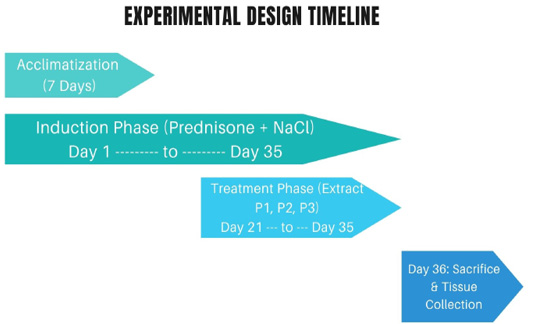
The study followed a specific timeline consisting of 7 days of acclimatization followed by a 35-day experimental period. A total of 40 rats were randomly divided into five groups (n=8):
Normal Control (KN): Received distilled water and standard feed throughout the study.
Negative Control (KP): Induced with Prednisone (1.5 mg/kg BW) and 2.5% NaCl orally for 35 days (Day 1 to Day 35).
Treatment Groups (P1, P2, P3): Induced with Prednisone and NaCl (Day 1 to Day 35) and treated with O. basilicum extract at doses of 100, 200, and 400 mg/kg BW, respectively. The extract was administered orally once daily from Day 21 to Day 35 (14 days). The experimental timeline is detailed in Figure 1.
Sample collection
On day 36, all rats were euthanized, and cardiac tissue was collected for analysis.
Following euthanasia on day 36, cardiac tissue was collected for immunohistochemistry (IHC) analysis. VCAM-1 and eNOS were determined using immunohistochemistry. Tissues were fixed, paraffin-embedded, and sectioned at 5 µm thickness. Sections were incubated with primary antibodies against VCAM-1 and eNOS, followed by the addition of appropriate secondary antibodies conjugated with a chromogen. Expression was quantified by determining the percentage of positively stained endothelial cells (brown chromogen) in the coronary arteries. Five random fields of view per slide were captured at 200x magnification. The analysis was conducted by a pathologist who was blinded to the treatment groups to prevent bias. Semi-quantitative analysis was performed using ImageJ software.
Statistical analysis
Data were analyzed using SPSS version 25.0. Data normality and homogeneity of variances were assessed using the Shapiro-Wilk and Levene’s tests, respectively. As VCAM-1 data violated the assumption of homogeneity of variances, the Brown-Forsythe test was used, followed by the Games-Howell post hoc test. eNOS data met the assumptions for one-way ANOVA, which was followed by the LSD post hoc test. A p-value < 0.05 was considered statistically significant.
RESULTS
Effect on blood pressure
Induction with prednisone and NaCl successfully induced hypertension. SBP was significantly higher in the KP group (142.75 ± 1.67 mmHg) compared to the KN group (132.13 ± 2.80 mmHg; p < 0.05). Administration of O. basilicum extract significantly reduced SBP in all treatment groups compared to the KP group (Table 1). The P3 group (400 mg/kg BW) exhibited the lowest SBP (135.00±0.76 mmHg) which is near the normal control value.
Table 1: Effect of O. basilicum extract on VCAM-1 expression.
Group
Mean ± SD
KN
1.700 ± 0.5127a
P3
3.225 ± 0.2053b
P2
4.150 ± 0.5632c
P1
5.100 ± 0.5555d
KP
6.100 ± 0.5014e
Note: Data are presented as Mean ± SD (n=8). Different superscript letters (a, b, c, d, e) within the same column denote statistically significant differences (p < 0.05). Statistical comparisons were performed using the Brown-Forsythe test followed by the Games-Howell post-hoc test, selected due to the violation of homogeneity of variance assumptions (Levene’s test p < 0.05).
Effect on VCAM-1 expression
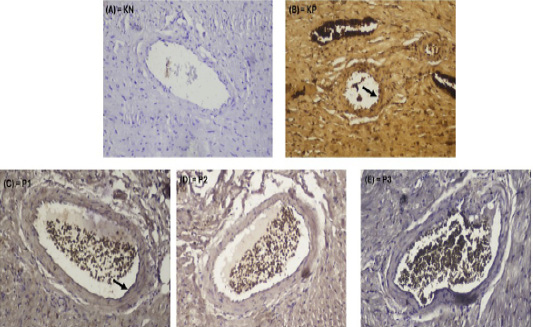
VCAM-1 expression was significantly elevated in the hypertensive (KP) group compared to the normal (KN) group (6.100 ± 0.50 vs. 1.700 ± 0.51; p < 0.001), indicating marked endothelial inflammation (Figure 2, Table 1) ; . Treatment with O. basilicum extract produced a significant, dose-dependent downregulation of VCAM-1 expression. VCAM-1 levels were significantly reduced at all treatment doses compared to the negative control (p < 0.05). Post-hoc analysis revealed that the 200 mg/kg BW dose (P2) was significantly more effective than the 100 mg/kg BW dose (P1) (p = 0.030), and the 400 mg/kg BW dose (P3) was significantly more effective than the 200 mg/kg dose (p = 0.012). The greatest reduction was observed in group P3 (3.225 ± 0.20), although expression remained significantly higher than in the normal control (p < 0.001).
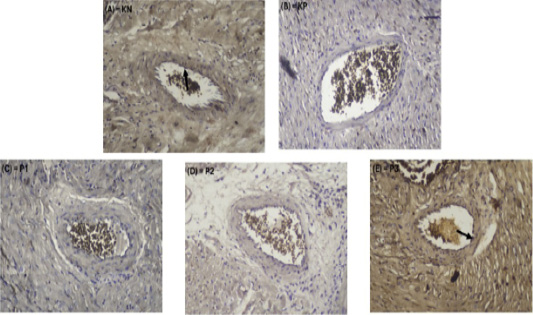
Effect on eNOS expression eNOS expression was significantly lower in the KP group (3.150 ± 0.72) compared to the KN group (6.350 ± 1.11; p < 0.001), consistent with endothelial dysfunction. As shown in Figure 3, treatment with O. basilicum extract restored eNOS levels. The P3 group showed the highest eNOS expression, which did not differ significantly from the normal control (6.000 ± 0.80 vs. KN; p = 0.158).
DISCUSSION
The results confirm that induction with prednisone and NaCl significantly elevated blood pressure and led to endothelial dysfunction. This is consistent with recent findings that excess glucocorticoids disrupt vascular homeostasis through multiple mechanisms . These pathological alterations were ameliorated by the administration of Ocimum basilicum L. in the form of leaf extract.
Table 2: Effect of O. basilicum extract on eNOS expression.
Group
Mean ± SD
KN
6.350 ± 1.115e
KP
3.150 ± 0.723a
P1
4.175 ± 0.781b
P2
5.462 ± 0.719c
P3
6.000 ± 0.800d
Note: Data are presented as Mean ± SD (n=8). The overall p-value < 0.001 (One-Way ANOVA). Different superscript letters (a, b, c, d, e) within the same column denote statistically significant differences (p<0.05) as determined by LSD post-hoc test.
The marked downregulation of VCAM-1 expression signals a robust anti-inflammatory response. Although we did not quantify specific signaling cascades, the standardized extract’s substantial phenolic load (42.18 mg GAE/g) offers a plausible biochemical rationale. Phenolic compounds are known repressors of the nuclear factor-kappa B (NF-κB) pathway , which governs the transcriptional activation of adhesion molecules . While nuclear translocation of NF-κB was not assessed directly, the downstream suppression of VCAM-1 mirrors this established mechanism . Concurrently, the restoration of eNOS protein levels implies a recovery of endothelial integrity. In glucocorticoid-induced hypertension, oxidative stress typically precipitates eNOS uncoupling by depleting the cofactor tetrahydrobiopterin (BH4). We postulate that the antioxidant constituents of O. basilicum preserve BH4 bioavailability, thereby sustaining eNOS coupling . Although direct oxidative markers (ROS, MDA) and BH4 levels were outside this study’s scope, the dual recovery of eNOS and blood pressure control aligns with data from comparable polyphenol-rich interventions.
Physiological mechanisms beyond direct vascular protection also warrant consideration. Prednisone-induced hypertension is driven significantly by mineralocorticoid receptor activation and subsequent sodium retention. While our focus remained on vascular markers, O. basilicum extract may exert concurrent diuretic or natriuretic effects contributing to antihypertensive outcomes. Historical pharmacological data suggest Ocimum species possess diuretic properties , though urine output and sodium fluxes were not quantified in this experiment. regarding bioactive principles, standardization via Total Phenolic Content (TPC) ensures batch consistency, yet specific metabolites like rosmarinic acid, linalool, and eugenol likely drive biological activity. Rosmarinic acid is a known VCAM-1 inhibitor , whereas eugenol may induce vasorelaxation via voltage-dependent calcium channel (VDCC) blockade, independent of the NO pathway. Thus, the observed vasoprotection likely stems from the synergistic action of these phytoconstituents.
Notably, although the highest dose significantly reduced VCAM-1 levels, it did not fully restore them to control levels (3.22 vs 1.70). This suggests that while O. basilicum is effective in attenuating acute inflammation, a complete resolution of vascular adhesion molecule expression might require a longer treatment duration or a higher dosage.
The upregulation of eNOS expression is crucial. In glucocorticoid-induced hypertension, oxidative stress induces eNOS uncoupling, shifting its production from NO to superoxide . This uncoupling is often driven by oxidation of the essential cofactor tetrahydrobiopterin (BH4) . We propose that the antioxidant activity of O. basilicum helps maintain BH4 bioavailability, a notion supported by studies on other polyphenol-rich extracts . Furthermore, eugenol, a constituent of basil, may contribute to vasorelaxation by blocking voltage-dependent calcium channels (VDCCs) in vascular smooth muscle ; ; .
Our findings are consistent with recent pharmacological reviews of the Lamiaceae family, highlighting the vasoprotective roles of terpenoids and flavonoids ; . O. basilicum appears to exert a dual protective effect, combining anti-inflammatory action with vasodilation through reactive oxygen species (ROS) scavenging and enhanced NO production.
Certain limitations in the current study design merit discussion to provide a balanced perspective. First, regarding pharmacokinetics, the use of a crude ethanolic extract standardized solely for TPC precludes the identification of the specific effector molecule, which would require detailed HPLC profiling. Second, the absence of metabolic data (urine output, sodium excretion, body weight) prevents the exclusion of volume-depletion mechanisms (diuresis or natriuresis) as contributors to blood pressure reduction. Third, mechanistically, our discussion regarding NF-κB inhibition and BH4 preservation relies on the extract’s antioxidant profile and existing literature, as direct molecular validation (e.g., NF-κB activation assays, tissue MDA, or BH4 quantification) was not performed. Finally, while immunohistochemistry confirmed the restoration of eNOS protein, this does not strictly reflect enzymatic turnover or nitric oxide bioavailability (nitrite/nitrate levels). Future investigations will integrate metabolic cage monitoring with comprehensive phytochemical profiling and circulating endothelial biomarkers to clarify the systemic pharmacodynamics of O. basilicum.
CONCLUSION
The Ocimum basilicum L. leaf extract exerts a potent endothelial-protective effect in a rat model of prednisone-induced hypertension. It lowered blood pressure, reduced expression of the inflammatory marker VCAM-1, and increased expression of the vasodilatory enzyme eNOS. The therapeutic effect of the 400 mg/kg BW was the most effective, restoring parameters to near-normotensive levels. These findings suggest the potential of O. basilicum as a complementary herbal intervention for hypertension-associated endothelial dysfunction.
ACKNOWLEDGEMENTS
The authors would like to express their sincere gratitude to the UPT Laboratorium Herbal Materia Medica Batu (East Java, Indonesia) for their facilities and technical assistance regarding plant identification, extraction, and standardization of the Ocimum basilicum L. extract. We also thank all laboratory staff who assisted in the animal care and experimental procedures. Furthermore, the authors gratefully acknowledge the support provided by The Indonesian Education Scholarship; the Center for Higher Education Funding and Assessment, Ministry of Higher Education, Science, and Technology of Republic Indonesia; and the Endowment Fund for Education Agency, Ministry of Finance of Republic Indonesia.
Novelty Statement
This study is the first to elucidate the dual mechanism of Ocimum basilicum L. leaf extract in attenuating prednisone-induced hypertension by simultaneously downregulating VCAM-1 and upregulating eNOS expression in a rat model.
AUTHOR’S CONTRIBUTION
HS: Conceptualization, methodology, investigation, formal analysis, data curation, writing original draft, visualization. DS: Methodology, validation, writing review and editing. W: Conceptualization, resources, supervision, project administration, writing review and editing. All authors have read and agreed to the published version of the manuscript.
Ethical approval
All experimental procedures and animal handling protocols in this study were approved by the Animal Care and Use Committee (ACUC), Faculty of Veterinary Medicine, Universitas Airlangga, Surabaya, Indonesia (Certificate No: 2.KEH.165.11.2024; Date: November 19, 2024). The study was conducted in strict accordance with the ethical guidelines for the care and use of laboratory animals.
Generative AI and AI-assisted technology statement
The authors used Large Language Models to improve the language and readability of the manuscript. The authors reviewed and edited the content and take full responsibility for its accuracy. No images were generated or manipulated using AI tools.
Conflict of interest
The authors have declared no conflict of interest.
Figures
Figure 1:.
Experimental design timeline illustrating the acclimatization, induction, and treatment phases. The study consisted of a 7-day acclimatization period, followed by 35 days of induction with prednisone and NaCl. Treatment with O. basilicum extract was administered orally from Day 21 to Day 35.
Figure 2:.
VCAM-1 protein expression in the coronary arteries of the hypertensive rat model. Immunohistochemical staining patterns were observed in five groups: (A) Normal Control (KN); (B) Negative Control (KP) showing intense brown staining indicating high VCAM-1 expression; (C) Treatment P1 (100 mg/kg BW); (D) Treatment P2 (200 mg/kg BW); and (E) Treatment P3 (400 mg/kg BW). Black arrows indicate VCAM-1 expression in endothelial cells (brown chromogen). (Immunohistochemistry staining; 200x magnification).
Figure 3:.
eNOS protein expression in the coronary arteries of the hypertensive rat model. Immunohistochemical staining patterns were observed in five groups: (A) Normal Control (KN) showing strong expression; (B) Negative Control (KP) showing weak expression indicating endothelial dysfunction; (C) Treatment P1 (100 mg/kg BW); (D) Treatment P2 (200 mg/kg BW); and (E) Treatment P3 (400 mg/kg BW). Strong positive reactions were restored in the P3 group, comparable to the normal control. Black arrows indicate eNOS expression in endothelial cells (brown chromogen). (Immunohistochemistry staining; 200x magnification).
References
Al-Malki AL (2021). Synergistic hepatoprotective and antioxidant effects of Ocimum basilicum and Olea europaea extracts in rats. J. King Saud Univ. Sci., 33(1): 101268.
Azizah NS, Irawan B, Kusmoro J, Adfa M (2023). Sweet basil (Ocimum basilicum L.). A review of its botany, phytochemistry, pharmacological activities, and biotechnological development. Plants, 12(24): 41-48. https://doi.org/10.3390/plants12244148[CrossRef]
Borges RS, Silva JKR, Maia JGS (2024). Therapeutic potential of Lamiaceae plants in cardiovascular diseases: A systematic review. Phytother. Res., 38(2): 412–428.
Chen J, Li W, Xu B (2023). Flavonoids as NF-κB inhibitors: Implications for inflammation and drug discovery. Biomed. Pharmacoth., 161: 114467.
Ciumărnean L, Milaciu MV, Runcan O, Vesa SC, Răchișan AL, Negrean V, Dogaru G (2020). The effects of flavonoids in cardiovascular diseases. Molecules, 25(18): 4320. https://doi.org/10.3390/molecules25184320[CrossRef]
Daiber A, Steven S, Weber A, Shuvaev VV, Muzykantov VR, Laher I (2021). Oxidative stress and inflammation in hypertension mechanisms and potential therapeutic targets. Br. J. Pharmacol., 178(18): 3618–3620.
Deng W, Wang H, Liu J (2022). Glucocorticoid-induced hypertension: Metabolic and vascular mechanisms. Endocrine Connect., 11(4): e210565. https://doi.org/10.1161/HYPERTENSIONAHA.121.18809[CrossRef]
Efentakis P, Varela A, Chavakis E (2022). Molecular mechanisms of vascular inflammation and potential therapeutic interventions. Int. J. Mol. Sciences, 23(5), 2688.
Goodwin JE, Neustadt M (2021). Glucocorticoid-induced hypertension: Mechanisms and management. Endocrinol. Metab. Clin., 50(4): 621–635.
Gortan D, Srecec S, Kremer D (2025). Emerging trends in herbal medicine for vascular health: A 2025 perspective. J. Ethnopharmacol., 318: 116980.
Guzik TJ, Touyz RM (2020). Oxidative stress, inflammation, and vascular aging in hypertension and related conditions. Hypertension, 76(4): 660–667. https://doi.org/10.1161/HYPERTENSIONAHA.117.07802[CrossRef]
Hsieh CJ, Juang YP, Kuo WW (2020). The effect of polyphenols on eNOS pathway and endothelial function. Nutrients, 12(9): 2842.
Jama HA, Muralitharan RR, Xu C, O’Donnell JA, Bertolino P, Kaye DM (2022). Rodent models of hypertension. Br. J. Pharmacol., 179(5): 918–937. https://doi.org/10.1111/bph.15650[CrossRef]
Konukoglu D, Uzun H (2022). Endothelial dysfunction and hypertension. Adv. Exp. Med. Biol., 1373: 43–58.
Lang PP, Bai J, Zhang YL, Yang F, Zhang Y, Li HH (2020). Blockade of intercellular adhesion molecule-1 prevents angiotensin II-induced hypertension and vascular dysfunction. Lab. Invest., 100(3): 378–386. https://doi.org/10.1038/s41374-019-0320-z[CrossRef]
Li M, Zhang Y, Xu C (2022). Mechanisms of glucocorticoid-induced endothelial dysfunction. Front. Physiol., 13: 954321.
Libby P, Ridker PM, Hansson GK (2023). The changing landscape of atherosclerosis. Nature, 616: 107–117.
Liu Y, Zhang X, Wang L (2024). Corticosteroids and cardiovascular risk: From bench to bedside. Circ. Res., 134(2): 205–220.
Luo C, Zou L, Sun H, Peng J (2020). Rosmarinic acid inhibits VCAM-1 expression via the suppression of the p38 MAPK/NF-κB signaling pathway. Molecules, 25(6): 1302.
Mills KT, Stefanescu A, He J (2020). The global epidemiology of hypertension. Nat. Rev. Nephrol., 16(4): 223–237. https://doi.org/10.1038/s41581-019-0244-2[CrossRef]
Mittal M, Siddiqui MR, Tran K, Reddy SP, Malik AB (2021). Reactive oxygen species in inflammation and tissue injury. Antioxid. Redox Signal., 35(4): 215–235.
Pan P, Wang H, Liu Q (2021). Regulation of the NF-κB pathway by natural products in inflammatory diseases. Frontiers in Pharmacology, 12, 645321.
Peixoto-Neves D, Silva-Alves KS, Leal-Cardoso JH (2021). Eugenol and its effects on the cardiovascular system: A review. Molecules, 26(15): 4575.
Qamar F, Sana A, Naveed S, Faizi S (2023). Phytochemical characterization, antioxidant activity and antihypertensive evaluation of Ocimum basilicum L. in L-NAME induced hypertensive rats and its correlation analysis. Heliyon, 9(4): e14644. https://doi.org/10.1016/j.heliyon.2023.e14644[CrossRef]
Risk NCD, Collaboration F (2021). Worldwide trends in hypertension prevalence and progress in treatment and control from 1990 to 2019: A pooled analysis of 1201 population-representative studies with 104 million participants. pp. 398.
Salehi B, Sharifi-Rad J, Quispe C (2024). Ocimum species: From farm to pharmacy. Ind. Crops Prod., 198: 116670. https://doi.org/10.1080/10942912.2020.1828456[CrossRef]
Shahrajabian MH, Sun W, Cheng Q (2020). Chemical components and pharmacological benefits of basil (Ocimum basilicum): A review. Int. J. Food Prop., 23(1): 1961–1970.
Silva RO, Santos MRV, Sousa DP (2023). Vasorelaxant activity of essential oils: A review of mechanisms. J. Pharma. Pharmacol., 75(3): 321–335.
Troncoso MF, Ortiz-Quintero J, Garrido-Moreno V, Sanhueza-Olivares F, Guerrero-Moncayo A, Chiong M, Castro PF, García L, Gabrielli L, Corbalán R, Garrido-Olivares L, Lavandero S (2021). VCAM-1 as a predictor biomarker in cardiovascular disease. Biochim. Biophys. Acta Mol. Basis Dis., 1867(9): 166170. https://doi.org/10.1016/j.bbadis.2021.166170[CrossRef]
Unger T, Borghi C, Charchar F, Khan NA, Poulter NR, Prabhakaran D, Ramirez A, Schlaich M, Stergiou GS, Tomaszewski M, Wainford RD, Williams B, Schutte AE (2020). 2020 International society of hypertension global hypertension practice guidelines. Hypertension, 75(6): 1334–1357. https://doi.org/10.1161/HYPERTENSIONAHA.120.15026[CrossRef]
Wang L, Zhang Y, Li H (2022). Vascular cell adhesion molecule-1 as a therapeutic target in cardiovascular disease. Front. Immunol., 13: 825459.
Wu KK, Meininger CJ (2022). Regulation of endothelial nitric oxide synthase activity by tetrahydrobiopterin. Arteriosc. Thromb. Vasc. Biol., 42(1): 25–32.
Yang S, Zhang J, Liu Y (2023). Glucocorticoids, RAAS, and hypertension: An updated review. Steroids, 192: 109180. https://doi.org/10.1038/s41440-023-01313-y[CrossRef]
Zhang Q, Liu J, Liu B, Xia J (2021). NF-κB signaling in inflammation and thrombosis: A link between VCAM-1 and cardiovascular disease. Front. Immunol., 12: 645.