Therefore, regular monitoring of the prevalence rate of coccidiosis is vital for the best selection of control and prevention strategies.
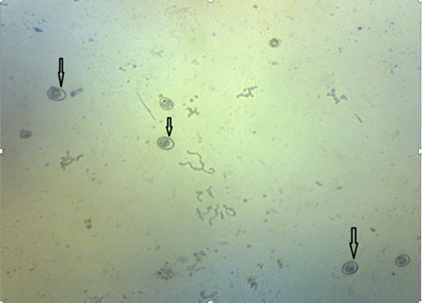
In our study out of total 384 samples examined; 316 samples were found positive for Eimeria protozoan parasites (Figure 1) giving a prevalence rate of 82.29 %.
The higher prevalence of coccidiosis in broilers in our research area may be brought on by increased production stress and prolonged litter contamination, which can provide coccidian oocysts the chance to sporulate and re-infect the birds.
Especially the subclinical form of coccidiosis has most significant economic effects due to impaired growth rate and feed conversion.
Selected from the article's own text.
Abstract
Broiler farming is dealing with a series of difficulties owing to various infectious and non-infectious diseases. The present study was designed to monitor the prevalence of coccidiosis in broiler chicken at randomly selected broiler poultry farms in Sylhet, Bangladesh. The study encompasses faecal examination and identification of Eimeria oocyst by microscopic examination. A Faecal flotation technique and McMaster technique were implemented on 384 faecal specimens and around 316 cases were positive for Eimeria oocyst giving the overall prevalence of 82.29%. In supplement, this study confirms that the prevalence of coccidiosis mainly in subclinical form is yet an immense burden in broiler farms, and bio-security measurement should be administered in every farm.
In recent times, poultry farming specially broiler production experiences one of the most compelling industries in agriculture sector of Bangladesh . Despite prevailing favorable agro-climatic conditions, the flourishing poultry industry is noticing a set of troubles due to diverse infectious and noninfectious diseases . Among these infectious diseases, coccidiosis is regarded as one of the major hazards for commercial broiler farming. It is one of the prevailing diseases in poultry, which is liable for major economic losses worldwide . Coccidiosis appears particularly after ingestion of sporulated oocysts in vulnerable hosts. Both clinically affected and healed birds shed oocysts in their poops, which contaminate feed, dust, water, litter, and soil.
Coccidiosis is caused by various species of Eimeria, an Apicomplexa protozoan parasite and occurs in the epithelial cells of the intestine. Most Eimeria spp. affect birds between 3 and 18 weeks of age and can cause high mortality in young chicks. To take preventive measures against coccidiosis it is necessary to understand the prevalence rate of coccidia in a certain area in each population. The present study is conducted to understand the rate of prevalence of coccidia in broiler chickens through coprological examination.
Materials and Methods
Study area and period
This study was conducted in and around Sylhet Metropolitan city of Bangladesh. All the research works were performed in the laboratory of Dept. of Parasitology, Faculty of Veterinary, Animal and Biomedical Sciences, Sylhet Agricultural University, Bangladesh during the period from July 2018 to April 2019.
Study design, population, and sample size determination
Simple random sampling method was used to select the broiler chickens from the target population of selected farms. The minimum sample size (N= 384) required for this study was determined by using the sample determination formula as described by .
Collection of samples and coprological examination
Each of the birds faecal samples was collected with a spatula from freshly voided faces into sampling bottles with proper identification and then immediately put in a cool box. One fresh dropping every two to five places was collected depending on the size of the tube. Each tube was then properly capped, labelled and the contents were thoroughly mixed by vigorous shaking to break the faecal clumps. The samples thus collected were labelled, transported to the laboratory, and refrigerated at 4 oC until further process.
Examination of faecal sample
The presence of oocyst in the faecal samples were examined by the flotation method using saturated solution of salt and a modified McMaster technique as described by Sharma et al. (2015). The faecal sample diluted with saturated salt solution was taken for the identification of oocysts. A sample was transferred from the centre level of the beaker into a 2-chambered McMaster chamber (FEC Source, U.S.A) and unsporulated oocysts were identified based on morphology described by Soulsby (1982) with the help of a compound photo microscope (Model No: MD82ES10, Omax, USA) at 10X objective.
Statistical analysis
The prevalence was calculated for all data by using the following formula:
Equation 1.
Results and Discussion
Coccidiosis, together with related illnesses and intestinal worms, poses serious economic risks to the global chicken business. The economic impact of coccidiosis is multifaceted due to poor management practices and its high prevalence in hot, humid climates . Since they have a direct life cycle, ascarid worms continue to be a serious issue for poultry flocks. Therefore, regular monitoring of the prevalence rate of coccidiosis is vital for the best selection of control and prevention strategies. In our study out of total 384 samples examined; 316 samples were found positive for Eimeria protozoan parasites (Figure 1) giving a prevalence rate of 82.29 %.
The findings of this study were in line with those in reported in Iran by Shirad et al. (2011) and in Romania who reported prevalence rate of 75% and 72.16%, respectively in intensive farming condition.
The results, however, are higher than the prevalence rates of coccidiosis that have been found in South Ethiopia, Pakistan, Nigeria, India, Turkey, and Algeria of 20.10%, 23.8%, 35.2%, 39.58%, 54.3%, and 63.26%, respectively ; ; ; ; ; ; .
Differences in prevalence from earlier research can be explained by a variety of factors, such as the kind of controls utilized, the timing of the sample, animal husbandry, and geographic variation . The higher prevalence of coccidiosis in broilers in our research area may be brought on by increased production stress and prolonged litter contamination, which can provide coccidian oocysts the chance to sporulate and re-infect the birds. The greater incidence rate in adult broilers may be brought on by their crowded behaviour, cramped surroundings, build-up of oocytes, and wetting of the litter with watery droppings.
Conclusions and Recommendations
Coccidiosis still a constraint of the poultry industry. Especially the subclinical form of coccidiosis has most significant economic effects due to impaired growth rate and feed conversion. Disease of broiler chickens has many additional direct and indirect impacts on human nutrition, community development, and socio-cultural and in the reduction in farm income, contributing to food insecurity and poor nutrition. The main limitations of our research are that we were not able to identify the individual species of Eimeria protozoa. Further study is recommended to identify the sporulated oocyst of Eimeria.
Acknowledgements
The authors are cordially acknowledged to the SAURES authority, SAU, Sylhet for providing financial supports of successful implementations during the period of research work. Also, we would like to thanks to poultry farmers, MS students and staff the studied laboratories of Parasitology, Faculty of Veterinary, Animal and Biomedical Sciences, Sylhet Agricultural University, Sylhet-3100, Bangladesh.
Novelty Statement
This research has determined the prevalence rate of Coccidiosis in Broiler Chickens in Different Farms at Sylhet which is unique.
Author’s Contribution
Real Datta, Apurbo Kumar Mondal, Md. Kazi Mehetazul Islam, Md. Jamal Uddin Bhuiyan: Prepared the experimental design, wrote, and revised the article, and managed the research.
Poritosh Ranjon Talukder, Eva Saha: Performed the experiments.
Md- Tariqul Islam: Analyzed the data.
Conflict of interest
The authors have declared no conflict of interest.
Figures
Figure 1:.
Unsporulated oocyst of Eimeria spp.
References
Ali MS, Hossain MM (2010). Factors influencing the performance of farmers in broiler production of Faridpur District in Bangladesh. J. World’s Poult. Sci., 66(1): 123-131. https://doi.org/10.1017/S0043933910000127[CrossRef]
Györke A, Po L, Cozma V (2013). Prevalence and distribution of Eimeria species in broiler chicken farms of different capacities. Parasite, 20: 50. https://doi.org/10.1051/parasite/2013052[CrossRef]
Haug A, Gjevre AG, Thebo P, Mattsson JG, Kaldhusdal M (2008). Coccidial infections in commercial broilers: epidemiological aspects and comparison of Eimeria species identification by morphometric and polymerase chain reaction techniques. Avian Pathol., 37(2): 161-170. https://doi.org/10.1080/03079450801915130[CrossRef]
Islam A, Trisha AA, Das M, Amin MR (2009). Retrospective study of some poultry diseases at Gaibandha district in Bangladesh. Bangladesh J. Vet. Med., 7(1): 239-247. https://doi.org/10.3329/bjvm.v7i1.5067[CrossRef]
Karaer Z, Guven E, Akcay A, Kar S, Nalbantoglu S, Cakmak A (2012). Prevalence of subclinical coccidiosis in broiler farms in Turkey. Trop. Anim. Health Prod., 44: 589–594. https://doi.org/10.1007/s11250-011-9940-z[CrossRef]
Lawal JR, Jajere SM, Ibrahim UI, Geidam YA, Gulani IA, Musa G (2016). Prevalence of coccidiosis among village and exotic breed of chickens in Maiduguri Nigeria. Vet. World, 9: 653–659. https://doi.org/10.14202/vetworld.2016.653-659[CrossRef]
Lee BH, Kim WH, Jeong J, Yoo J, Kwon YK, Jung BY, Kwon JH, Lillehoj HS, Min W (2010). Prevalence and cross-immunity of Eimeria species on Korean chicken farms. J. Vet. Med. Sci., 72(8): 985-989. https://doi.org/10.1292/jvms.09-0517[CrossRef]
Mokhtar HP, Yagoob G (2016). Prevalence of coccidiosis in broiler chicken farms in and around Marand City, Iran. J. Entomol. Zool. Stud., 4(3): 174–177. https://www.entomoljournal.com/archives/2016/vol4issue3/PartC/4-3-111.pdf
Negash A, Mohamed A, Wondimu K (2015). Study on prevalence and risk factors associated with poultry coccidiosis in and around Hawassa Town, South Ethiopia. Br. Poult. Sci., 4(2): 34–43. https://idosi.org/bjps/4(2)15/2.pdf
Rashid M, Akbar H, Bakhsh A, Rashid MI, Hassan MA, Ullah R, Hussain T, Manzoor S, Yin H (2019). Assessing the prevalence and economic significance of coccidiosis individually and in combination with concurrent infections in Pakistani commercial poultry farms. Poult. Sci., 98(3): 1167-1175. https://doi.org/10.3382/ps/pey522[CrossRef]
Razmi GR, Kalideri GA (2000). Prevalence of subclinical coccidiosis in broiler-chicken farms in the municipality of Mashhad, Khorasan, Iran. Prev. Vet. Med., 44(3-4): 247-253. https://doi.org/10.1016/S0167-5877(00)00105-7[CrossRef]
Sharma S, Iqbal A, Azmi S, Mushtaq I, Wani ZA, Ahmad S (2015). Prevalence of poultry coccidiosis in Jammu Region of Jammu & Kashmir State. J. Parasit. Dis., 39(1): 85–89. https://doi.org/10.1007/s12639-013-0286-5[CrossRef]
Shirzad MR, Seifi S, Gheisari HR, Hachesoo BA, Habibi H, Bujmehrani H (2011). Prevalence and risk factors for subclinical coccidiosis in broiler chicken farms in Mazandaran province, Iran. Trop. Anim. Health Prod., 43(8): 1601-1604. https://doi.org/10.1007/s11250-011-9876-3[CrossRef]
Soulsby EJL (1982). Helminth, arthropods and protozoa of domesticated animals, Bailliere Tindall Press, London, UK.
Thrusfield M (2005). Veterinary epidemiology. 3rd ed. UK, Black well science Ltd. pp. 233.
Yousaf A, Shahnawaz R, Jamil T, Mushtaq A (2018). Prevalence of coccidiosis in different broiler poultry farms in Potohar region (distract Rawalpindi) of Punjab-Pakistan. J. Dairy Vet. Anim. Res., 7(3): 87–90. https://doi.org/10.15406/jdvar.2018.07.00196[CrossRef]