
Research Article · Volume 37, Issue 1, 17 March 2022 · Open Access
New Record of Latrodectus tredecimgutatus (Family: Theridiidae:) the Most Medically Important Spider Species from Qom Province, Iran
· · ·
Affiliations & Notes ⌄
- 1Department of Vector Biology and Control, Faculty of Public Health, Kerman University of Medical Sciences, Kerman, Iran. 2Research Center of Tropical and Infectious Diseases, Kerman University of Medical Sciences, Kerman, Iran. 3Department of Medical Entomology and Vector Control, School of Public Health, Urmia University of Medical Sciences, Urmia, Iran. 4Student Research Committee, Qom University of Medical Sciences, Qom, Iran. 5Department of Public Health, Faculty of Health, Qom University of
Article Info ⌄
- Journal:
- Punjab University Journal of Zoology
- Published:
- 17 March 2022

From the article
- Totally, six black widow spiders (Latrodectus tredecimguttatus) were captured.
- These specimens were collected from sub-rocks in barley farms in Khalajestan district, Chahak village in Qom province (Figure 2).
- This species of spider identified in this province has medical significance and the people of the region should be aware of the danger of being bitten by this poisonous spider.
Selected from the article's own text.
Abstract
Introduction
Spiders are one of the most important order of Arachnids, about 48,000 species of spiders have been reported around the world. About 200 species are dangerous to humans ; ; ; ; . Except for the families Uloboridae and Holarchaeidae, the rest are classified as venomous spiders. There are 51 families and 763 species of spiders in Iran, the families of Theridiidae and Sicariidae, are dangerous to humans and the former is more common ; ; . Latrodectus widow spiders are found all over the world . Latrodectus is also known in the world as black widow spider and is considered as one of the most venomous spiders in the world except Antarctica ; ; ; . This genus comprises 32 species in the world , which five out of them have been reported in Iran . Spider bites are common worldwide, and the most frequent of spider bites have been reported in countries of Italy, Spain, and the United States . Spiders bites have been reported in some provinces of Iran ; , b). The aim of this study is to survey the presence this dangerous spider species in central of Iran, Qom province.
Materials and Methods
Study area and specimens’ collection
Qom Province is bordered by Tehran province to the north, Isfahan province to the south, Semnan province to the east and Markazi province to the west, with an area of approximately 11,240 square kilometres. This has five districts including: Kahak, Markazi, Salafchegan, Jafarieh and Khalajestan.
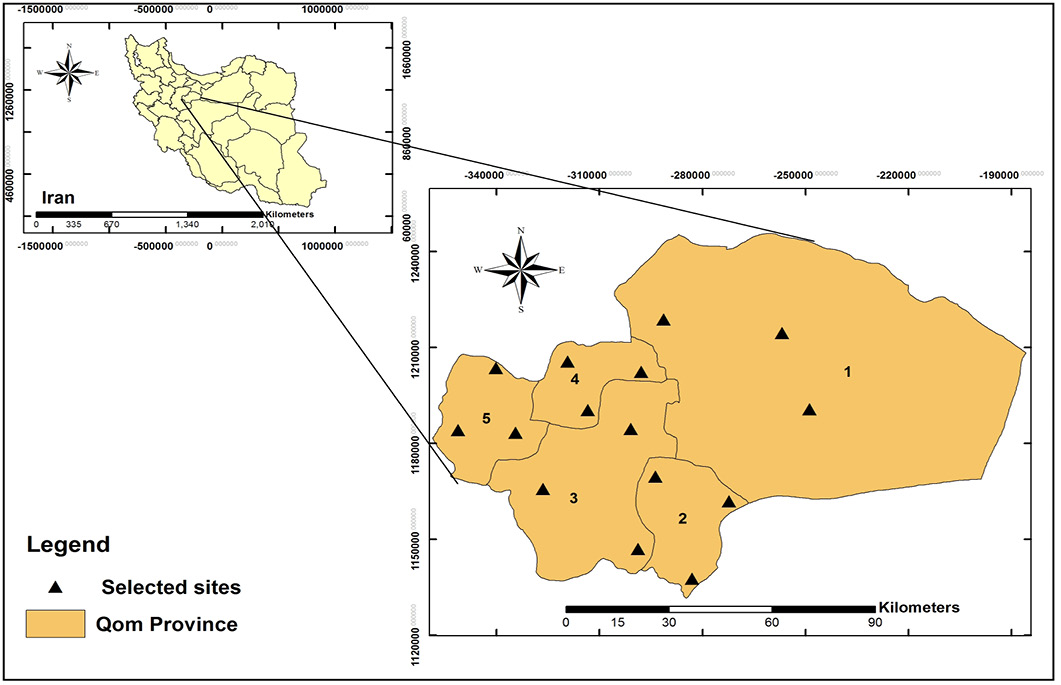
In order to collect samples and complete coverage of Qom province, villages and parts of the north, south, east and west of the province (Figure 1) were selected from April 2020 to September 2021.
Spider specimens were collected from climatic regions using method of moving rocks (rock rolling) in various habitats, including under-rocks, tree foliage, inside beetle and rodent nests using pliers forceps. The collected samples are preserved in tubes containing 70 % alcohol and transferred to the entomology laboratory of Qom School of Health.
Samples were transferred to the plastic tubes containing 70° alcohol. Then specimens sent to the Entomology Laboratory of School of Public Health, Qom University of Medical Sciences, Qom, Iran. Due to the lack of identification key for Iranian spiders, the collected samples were identified based on a valid identification key in the world. Then species distribution map was introduced using GIS software version 10.6.1.
Results and Discussion
Totally, six black widow spiders (Latrodectus tredecimguttatus) were captured. These specimens were collected from sub-rocks in barley farms in Khalajestan district, Chahak village in Qom province (Figure 2).
Family theriididae
The members of this family have eight eyes, eyes are not integrated and in two rows and at a distance from each other, the eyes of the front row are located in a nearly straight line in the forehead area. In the members of this family the toe has three nails, the middle toe is smaller, also the comb is made of thick and sawn hair.
The most important medical genus of this family is Latrodectus, which has two rows of eyes on the front of the head, separate lateral eyes from the rest of the eyes. In this genus a row of coarse comb-like hair on the underside of the fourth toe, the first legs usually longer than the fourth legs, spider abdomen the material is spherical, bulky and usually has a colored spot with an hourglass design on the abdominal surface.
Latrodectus tredecimgutatus
This species of genus latrodectus has a black belly with bright appearance and two types of thorns. Long, thick, curved thorns with unique short conical thorns with a lateral branch and it is called black widow spider. Males are much smaller than females so that males have a maximum body length of 3 mm and females have a body length of 8 to 13 mm.
Toxic spider bites are very important issue in medicine in Iran . Latrodectus widow spiders are globally distributed . Latrodectus bites are often painful at first . Neurotoxins and alpha-latrotoxins in spider venom are produced in 50% of people who are hospitalized for excruciating pain for one to three days . The genus Latrodectus is widespread in tropical and temperate regions of the world near human settlements . The bites of these spiders can cause cramps and abdominal pain, vomiting, nausea and muscle cramps . Mohammadi et al. (2020) reported new data on Latrodectus tredecimguttatus (Araneae: Theridiidae) from North West of Iran. This genus has five species in Iran. Latrodectus tredecimguttatus (black widow spider or “Dolmak”) is one of the most poisonous spiders in Iran . Mohammadi et al. (2020) have reported this species in northwestern Iran (collected five adult female spiders from Germi and Ardabil cities (Ardabil Province), Ahar County (East Azerbaijan province), and Urmia city (West Azerbaijan province), Iran . In 1997, Rafinejad reported four species including L. tredecimgottatus, L. dahli, L. geometricus and L. pallidus from Khorasan province, northeastern Iran . In addition to the venom of this spider has neurotoxin properties, it also has cytotoxic properties .
Conclusions and Recommendations
This species of spider identified in this province has medical significance and the people of the region should be aware of the danger of being bitten by this poisonous spider.
Acknowledgments
We are sincerely grateful to the health staff of Qom Health Centers for helping in the field activities. This project received financial support from Vice Chancellor for Research, Qom University of Medical Sciences IR.MUQ. REC.1399.27
Conflict of interest
The authors have declared no conflict of interest.
Figures

The study area and collection sites; 1: Markazi, 2: Kahak district, 3: Salafchegan district, 4: Jafarieh district and 5: Khalajestan district.

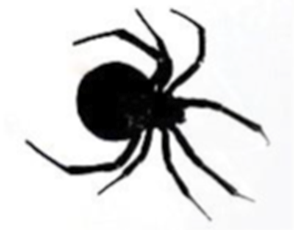
Latrodectus tredecimguttatus (from central of Iran) Qom Province, 2020-2021. (Photo by: Abedin Saghafipour)
References
- Bildik, F., Çomruk, B., Yüksek, B., Aslaner, M.A., and Türkeş, T., 2021. Mediterranean black widow spider (Latrodectus tredecimguttatus) poisoning in a metropolitan city in Turkey. J. Emerg. Med. Case Rep., 12: 48-51. https://doi.org/10.33706/jemcr.837733[CrossRef]
- Bonnet, M.S., 1999. The toxicology of the Latrodectus hasselti spider the Australian red back spider. Br. Homeopathol. J., 88: 2–6. https://doi.org/10.1054/homp.1999.0246[CrossRef]
- Caruso, M.B., Lauria, P.S., Souza, C.M., Casais-e-Silva, L.L., and Zingali, R.B., 2021. Widow spiders in the New World: A review on Latrodectus Walckenaer, 1805 (Theridiidae) and latrodectism in the Americas. J. Venom. Anim. Toxins Incl. Trop. Dis., 27: e20210011. https://doi.org/10.1590/1678-9199-jvatitd-2021-0011[CrossRef]
- Dehghani, R., 2015. Venomous animals are they important in Iran. Int. Arch. Hlth. Sci., 2: 167-169.
- Dehghani, R., Talaee, R., Rafeenejad, J., Rezvani, S.R., and Karimi, F., 2017. Brown widow spider bite (Loxosceles sp., Araneae, Sicariidae): A case report from Kashan, Iran. Iran. J. Dermatol., 20: 32-35.
- Graudins, A., Padula, M., Broady, K., and Nicholson, G.M., 2001. Red-back spider (Latrodectus hasselti) antivenom prevents the toxicity of widow spider venoms. Ann. J. Emerg. Med., 37: 154–160. https://doi.org/10.1067/mem.2001.113033[CrossRef]
- Hahn, I.H., 2015. Arthropods. In: Goldfrank’s toxicologic emergencies (eds. R.S. Hoffman, M.A. Howland, N.A. Lewin, L.S. Nelson, L.R. Goldfrank). 10th ed. New York, New York: McGraw-Hill, pp. 1461–1479.
- Isbister, G.K., and Fan, H.W., 2011. Spider bite. Lancet, 378: 2039-2047. https://doi.org/10.1016/S0140-6736(10)62230-1[CrossRef]
- Levi, H.W., 1959. The spider genus Latrodectus (Araneae, Theridiidae). Trans. Am. Microscopical. Soc., 78: 7–43. https://doi.org/10.2307/3223799[CrossRef]
- Mirshamsi, O., Marusik, Y., Zamani, A., Moradmand, M., and Kashefi, R., 2015. Annotated checklist of the spiders of Iran (Arachnida: Araneae). Iran. J. Anim. Biosyst., 2015: 1-108.
- Mohammadi B.M., Shafaie, S., Chavshin, A., Dabiri, F., Badakhshan, M., Naghian, A., Entezar, M.R., Seyyed-Zadeh, S., Rafinejad, J., Saeedi, S., and Rasegh, P., 2021. New data on Latrodectus tredecimguttatus Rossi, 1790, the Medically Important Spider Species (Araneae: Theridiidae) from Iran. Arch. Razi Inst., 76: 385-390.
- Platnick, N.I., 2019. World spider catalog. Version 22.5 available at: https://wsc.nmbe.ch/
- Rafinejad, J., 1997. An investigation on the systematic, biology and ecology of widow spiders (Latrodectus spp.) in Khorasan province, Iran. [PhD dissertation]. School of Public Health, Tehran University of Medical Sciences, Iran.
- Rahmani, F., Khojasteh, S.M., Bakhtavar, H., Nia, K., Roohi, A., Massoud, A., Najafi, F.B. and Shahbazi, S., 2014. Identification of widow spider in East Azerbaijan, Iran: Case series. Med. J. Tabriz Univ. Med. Sci. Hlth. Ser., 36: 82-86.
- Sanaei-Zadeh, H., 2017. Spider bite in Iran. Electron. Phys., 9: 4703-4707. https://doi.org/10.19082/4703[CrossRef]
- Vetter, RS., Vincent, L.S., Danielsen, D.W., Reinker, KI., Clarke, D.E., Itnyre, A.A., Kabashima, J.N. and Rust, MK., 2012. The prevalence of brown widow and black widow spiders (Araneae: Theridiidae) in urban southern California. J. Med. Entomol., 49: 947-951. https://doi.org/10.1603/ME11285[CrossRef]
- Zamani, A., 2016. The field guide of spiders and scorpions of Iran. Iran shenasi Publication, pp. 360.
- Zamani, A., and Marusik, Y.M., 2021. Two new species of Theridiidae from Iran, and the revalidation of Enoplognatha submargarita Yaginuma and Zhu, 1992 (Arachnida: Araneae). J. Arachnol., 18: 957-964. https://doi.org/10.13156/arac.2021.18.8.957[CrossRef]
- Zamani, A., and Rafinejad, J., 2014. First record of the mediterranean recluse spider Loxosceles rufescens (Araneae: Sicariidae) from Iran. J. Arthropod Borne Dis., 8: 228–231.
- Zamani, A., and Rafinejad, J., 2014b. First Record of the Mediterranean Recluse Spider Loxosceles rufescens (Araneae: Sicariidae) from Iran. J. Arthropod Borne Dis., 8: 228-231.
- Zamani, A., Mirshamsi, O., Savoji, A., and Shahi, M., 2014a. Contribution to the distribution of spiders with significant medical importance (Araneae: Loxosceles and Latrodectus) in Iran, with a new record for the country. Iran. J. Anim. Biosyst., 10: 57-66.
Services
Article usage statistics
Loading…
