Research Article · Volume 10, Issue 2, 11 June 2022 · Open Access
Monthly Evaluation of Testicular Biometry and Sexual Behavior With Respect to Seminal Aspects of Arabian Stallions Under Subtropical Conditions in Kuwait
· · · ·
Affiliations & Notes ⌄
1Department of Theriogenology, Faculty of Veterinary Medicine, Zagazig University, Zagazig 44519, Egypt
2Veterinary diagnostic lab center, Public Authority of Agriculture Affairs and Fish Resources, Kuwait City 13075, Kuwait. *Correspondence | Ayman Mesalam, Department of Theriogenology, Faculty of Veterinary Medicine, Zagazig University, Zagazig 44519, Egypt
In the current study we evaluated the influence of year months and seasons on testicular biometry, sexual behaviors and semen parameters of Arabian purebred stallions under subtropical conditions in Kuwait.
These findings are matching with our finding reported that the number of mounts per ejaculation, reaction time, time to erection, ejaculation times and time to ejaculation were significantly lower in summer season compared with other seasons.
Also, the results of current study demonstrated that there was a significant correlation between the spermatic parameters and the testicular parameters.
The testicular biometry and sexual behavior during spring and summer showed better characteristic than that during winter.
Selected from the article's own text.
Abstract
Many factors, including the environmental temperature, photoperiod and the season of year have been shown to influence stallion reproductive performance. As latitudes greatly affect these factors, the current study aimed to, evaluate the influence of year months and seasons on testicular biometry, sexual behaviors and semen parameters of purebred Arabian stallions in Kuwait. Nine fertile stallions aged 4–22 years were used for assessment of testicle biometry, sexual behaviors and semen quality collected using artificial vagina throughout the year. Our results showed a clear monthly differences with higher semen quality (P < 0.05) especially in semen volume, sperm count, livability, and motility during June and July. Similarly, the length, width, height and volume of testes as well as the width of total scrotum were higher (P < 0.05) during August, July and September. Moreover, the number of mounts per ejaculation, reaction time, time to erection, ejaculation times and time to ejaculation were significantly lower during summer and spring seasons (P < 0.05). A positive correlation (P < 0.05) between sperm parameters and testicular parameters and negative correlation between the sperm parameters and sexual behaviors were recorded. These data suggest that, the testicular biometry and sexual behavior during summer and spring showed better characteristic than that during winter.
Keywords | Kuwait, Arabian stallions, Testicle biometry, Sexual behaviors;, Semen characters.
Introduction
Photoperiod has been reported as the most important signal regulating the seasonal reproductive activity . Horses, long-day seasonal breeders, exhibit annual cycles of breeding activity. Many physiological and ambient factors, as environmental temperature and length of photoperiod, affect reproductive activity of stallion. Seasonal changes in sperm production and testicular size , seminal pH and sex drive represented by number of mounts/ejaculate and reaction time have been recorded .
Horses show better reproductive performance during spring and summer, when the environmental temperature and daylight are very appropriate and good quality food is available, as these factors reduce reproductive activity in winter months . In stallions, variations among seasons were found to greatly affect sexual behavior, volume of semen and sperm motility, which were higher in summer and spring than winter .
During a certain seasons of the year, stallions show some difference in their reproductive performance, as testicular size, reproductive behavior and sperm production ; . For stallion, the width of total scrotum (WTS) was measured as a representative index of testicular size ; . Stallion testicular weight was significantly correlated with spermatozoal output . Moreover, the width of each testicle has been reported as the best correlates with testicle weight .
Evaluation of the reproductive behavior is an essential part of during assessment of breeding potential or evaluation of reproductive problems in stallions . The sexual behavior of Arabian stallions during seasons of the year in Egypt has been evaluated and was the best during summer season under Egyptian environmental conditions . Although stallions with poor libido may have excellent semen quality, the fertility of those stallions may be reduced.
Based on the fact that latitudes greatly affects the photoperiods, this study aimed to evaluate the changes in sexual behaviors, testicular biometry and semen characteristics in Arabian purebred stallions during year months and different seasons under environmental conditions in Kuwait.
Materials and methods
Ethics statement
All of the experimental procedures and methods were conducted following the Ethics for Humane Treatment of Animal Use in Research Guidelines.
Data location
The study was conducted in Subhan, Kuwait (latitudes 28.45° - 30.05° north and longitudes 46.30° - 48.30° east and subtropical climate predominance). Average temperature, humidity, precipitation, sunshine and daylight is shown in (Table 1). Kuwait has a climate of desert type, which is characterized by a long dry hot summer and warm short winter sometimes rainy and hardly noticeable secondary seasons (spring and autumn). The year seasons in Kuwait are winter (from December 6 to February 15), spring (from February 16 to May 20), summer (from May 21 to November 4) and autumn (from November 5 to December 5).
Animals
Nine fertile stallions aged 4–22 years were housed in closed stables provided with open yard for exercise. They were fed on a balanced ration composed of hay, barley and wheat bran throughout the year in addition to green fodder during winter season and they got water ad libitum.
Testicular biometry
Testicle biometry was evaluated twice monthly (every 14 days) throughout one year (December 2019 to November 2020). Length (distance between cranial and caudal pole), width (distance between the lateral and the medial side), height (distance between the dorsal and the ventral surfaces) were recorded using digital caliper for each testis and testicular volume (width x height x length x 0.5333) was recorded according to ; . Thickness of scrotal skin (TS) was recorded using digital caliper and width of total scrotum (WTS; the width across both testes together) was recorded using plastic meter according to ; .
Sexual behavior parameters
The sexual behaviors were recorded twice monthly throughout one year from December 2019 to November 2020 as presented by ; . Sexual behavior parameters were as follows: Number of mounts/ejaculation, Reaction time (interval between introducing the mare and ejaculatory mount), Time to erection (interval between introducing the mare and full erection), Time to ejaculation (interval from erection to full emission of semen), and ejaculation time (interval from intromission to complete emission of semen).
Semen collection
Ejaculates were collected from all stallion, monthly throughout one year using a Missouri model artificial vagina (Minitüb comp.) pre-warmed up to 42 °C and lubricated with white vaseline. After collection immediately, the semen was transferred and examined in the laboratory.
Semen evaluation
The collected semen was assessed for total volume (ml) and gel free volume (ml) using graduated cylinder as previously described . The sperm concentration x 106 /ml was estimated using SpermaCue® (semen analyzer, Minitube) as previously mentioned and the total sperm count x 109 /ejaculate (Con/ejac) was evaluated by multiplying sperm concentration by semen volume. The pH was determined with the waterproof pocket pH tester (HI98107, Hanna, USA). The sperm viability % was estimated using eosine-nigrosine stain, while sperm motility % and progressive motility % were assessed using conventional microscopy after dilution with an isotonic buffer and then examined on a phase contrast microscope ; ; .
Table 2: Monthly changes in semen parameters of Arabian stallions
TSV
GV
GFV
Con/ml
Con/ej
Liv %
Motil %
Psm %
December
36.56 ± 1.51ef
4.67 ± 0.41cd
31.89 ± 1.24ef
294.44 ± 8.84a
9.32 ± 0.22de
69.67 ± 1.15d
64.67 ± 0.94c
59.89 ± 0.93e
January
36.56 ± 1.51ef
4.67 ± 0.41cd
31.89 ± 1.24ef
293.33 ± 10.54a
9.26 ± 0.12de
72.33 ± 1.17bcd
64.67 ± 0.94
60.44 ± 1.07e
February
35 ± 2.6f
4.78 ± 0.46cd
30.22 ± 2.53f
287.78 ± 9.25a
8.64 ± 0.7e
72.67 ± 1.57bcd
69.11 ± 1.03ab
60.89 ± 0.99e
March
43.78 ± 1.53bcd
5.22 ± 0.4bcd
38.56 ± 1.31bcd
270 ± 16.07a
10.32 ± 0.56bcd
74.33 ± 1.33abc
70.11 ± 1.24ab
64.89 ± 1.2bcd
April
48.22 ± 1.64abc
6.11 ± 0.61abc
42.11 ± 1.82abc
271.11 ± 16.11a
11.22 ± 0.34abc
76.11 ± 1.43ab
71.56 ± 1.32ab
67.11 ± 1.42ab
May
48.78 ± 2.36ab
6 ± 0.53abc
42.78 ± 2.3ab
272.22 ± 14.32a
11.55 ± 0.7ab
75.67 ± 1.47abc
71.22 ± 1.08ab
65 ± 0.58bcd
June
50.11 ± 2.06a
6.78 ± 0.36a
43.33 ± 2.04ab
276.67 ± 13.12a
11.89 ± 0.59ab
77.22 ± 1.75a
73.11 ± 1.7a
66.56 ± 1.46abc
July
52.67 ± 2a
6.78 ± 0.36a
45.89 ± 1.8a
271.11 ± 14.57a
12.3 ± 0.52a
78.11 ± 1.82a
73.11 ± 1.7a
67.78 ± 2.18ab
August
47.67 ± 2.46abc
6.28 ± 0.52ab
41.39 ± 2.02abc
257.78 ± 16.31a
10.53 ± 0.59bcd
77.33 ± 1.12a
73 ± 1.09a
69.11 ± 0.93a
September
42.22 ± 2.08cde
5.22 ± 0.4bcd
37 ± 1.74cde
268.89 ± 14.67a
9.89 ± 0.56cde
74.33 ± 1.33abc
69.44 ± 1.18ab
62.67 ± 0.82de
October
39.56 ± 2.02def
4.78 ± 0.46cd
34.78 ± 1.57def
272.22 ± 13.41a
9.42 ± 0.51de
72.44 ± 0.97bcd
67.44 ± 1.17bc
61.44 ± 1.03de
November
37.78 ± 1.7def
4.22 ± 0.36d
33.56 ± 1.43def
281.11 ± 12.96a
9.36 ± 0.42de
71.44 ± 1.34cd
68 ± 1.72bc
63 ± 1.25cde
TSV; Total semen volume, GV; Gel volume, GFV; Gel-free semen volume, Con/ml; Concentration/ml x 106, Con/ej; Concentration/ejaculate x 109, Liv; Livability, Motil; Motility, Psm; Progressive sperm motility
Statistical analysis
Data were analyzed using the SPSS software (IBM, SPSS Statistics, Version 22, USA). The data were expressed as mean ± standard error of means (SEM). One-way ANOVA was used to compare the effect of year months and four year seasons (spring, summer, autumn and winter). Duncan Multiple Range test was used to differentiate between significant means at P < 0.05.
Table 3: Testicular biometry of Arabian stallions along year seasons
Seasons
Length (cm)
Width (cm)
Height (cm)
TV (cm3)
TS (mm)
WTS (cm)
Spring
9.67 ± 0.02b
6.99 ± 0.07b
5.66 ± 0.02b
397.0 ± 4.3b
9.2 ± 0.03b
13.51 ± 0.18a
Summer
9.96 ± 0.06a
7.33 ± 0.08a
5.81 ± 0.05a
419.0 ± 4.46a
8.94 ± 0.04c
13.87 ± 0.16a
Autumn
9.68 ± 0.03b
7.0 ± 0.07b
5.44 ± 0.03c
383.11 ± 5.47c
9.3 ± 0.04b
13.47 ± 0.11a
Winter
9.36 ± 0.02c
6.5 ± 0.05c
5.38 ± 0.03c
339.78 ± 3.84d
9.41 ± 0.03a
12.49 ± 0.07b
TV; Testicular volume, TS; Thickness of scrotal skin, WTS; Width of total scrotum
Values with different superscripts in the same column are significantly different (P < 0.05)
Table 4: The effect of year seasons on sexual behaviors of Arabian stallions
Seasons
No. of M/E
RT (min)
T to erection (min)
T to Ej (min)
Ej times (sec)
Spring
2.33 ± 0.14c
4.17 ± 0.2c
2.73 ± 0.11c
2.65 ± 0.16c
60.41 ± 1.79c
Summer
1.78 ± 0.13d
2.93 ± 0.14d
1.84 ± 0.1d
1.74 ± 0.09d
45.85 ± 1.87d
Autumn
2.85 ± 0.15b
6.09 ± 0.27b
3.2 ± 0.12b
3.87 ± 0.15b
85.93 ± 1.81b
Winter
3.7 ± 0.15a
8.48 ± 0.37a
3.7 ± 0.19a
5.69 ± 0.29a
96.85 ± 1.71a
No. of M/E; Number of mounts/ejaculation, RT; Reaction time, T; time, Ej; Ejaculation
Values with different superscripts in the same column are significantly different (P < 0.05)
Results
Monthly evaluation of semen parameters, testicular biometry and sexual behavior of Arabian stallions
Data in Table 2 showed that the maximum (P < 0.05) TSV, GV, GFV and Con/ejac were recorded during June and July, while the minimal values were recorded during December, January and February. Moreover, the maximum (P < 0.05) Liv %, Motil % and Psm % were recorded during August, July and June, while the minimal values were recorded during December and January. Contrary, the Con/ml did not show significantly (P > 0.05) variation throughout the year.
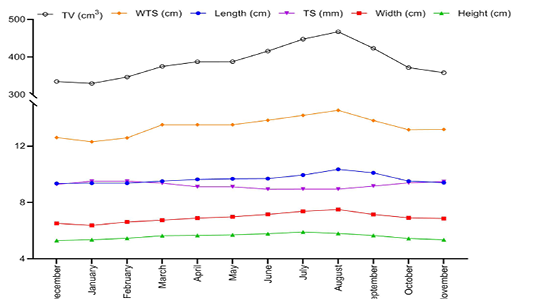
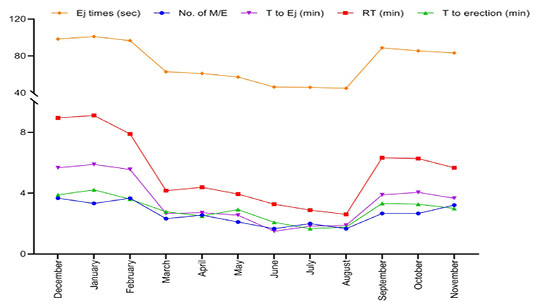
Moreover, the maximum (P < 0.05) length, width, height and volume of testes were recorded during August, July and September, while the minimal values were recorded during December and January (Figure 1). Similarly, the maximum (P < 0.05) width of total scrotum was recorded during August and July, while the minimal values were recorded during December, February and January (Figure 1). Contrary, the thickness of scrotal skin was significantly lower during August, July and June (P < 0.05) compared with other months (Figure 1). Furthermore, the number of mounts per ejaculation, reaction time, time to erection, ejaculation times and time to ejaculation were significantly (P < 0.05) lower during August, July and June compared with December, February and January (Figure 2).
Effect of season on testicular biometry and sexual behavior of Arabian stallions
Data in Table 3 showed that the length, width, height and volume of testes were significantly (P < 0.05) lower in winter season compared with other seasons. Similarly, the width of total scrotum was significantly (P < 0.05) lower in winter season compared with other seasons. However, the thickness of scrotal skin was significantly (P < 0.05) higher in winter season compared with other seasons.
Table 5: Pearson correlation coefficients between testicular biometry and semen parameters of Arabian stallions
TSV
GV
GFV
Con/ej
Liv %
Motil %
Psm %
Length (cm)
0.447*
0.379*
0.426*
0.310*
0.383*
0.379*
0.406*
Width (cm)
0.479*
0.384*
0.461*
0.397*
0.481*
0.531*
0.510*
Height (cm)
0.619*
0.525*
0.590*
0.428*
0.442*
0.470*
0.478*
TV (cm3)
0.558*
0.490*
0.528*
0.424*
0.503*
0.522*
0.517*
WTS (cm)
0.515*
0.376*
0.504*
0.425*
0.469*
0.527*
0.538*
TV; Testicular volume, WTS; Width of total scrotum, TSV; Total semen volume, GV; Gel volume, GFV; Gel-free semen volume, Con/ej; Concentration/ejaculate x 109, Liv; Livability, Motil; Motility, Psm; Progressive sperm motility
* Correlation is significant at the 0.01 level
Table 6: Pearson correlation coefficients between sexual behaviors and semen parameters of Arabian stallions
TSV
GV
GFV
Con/ej
Liv %
Motil %
Psm %
No. of M/E
-0.493**
-0.302**
-0.494**
-0.355**
-0.255**
-0.313**
-0.351**
RT (min)
-0.512**
-0.340**
-0.507**
-0.426**
-0.406**
-0.488**
-0.530**
T to erection (min)
-0.491**
-0.371**
-0.478**
-0.355**
-0.225*
-0.342**
-0.424**
T to Ej (min)
-0.545**
-0.365**
-0.540**
-0.376**
-0.405**
-0.492**
-0.506**
Ej times (sec)
-0.580**
-0.408**
-0.570**
-0.451**
-0.468**
-0.538**
-0.588**
No. of M/E; Number of mounts/ejaculation, RT; Reaction time, T; time, Ej; Ejaculation, TSV; Total semen volume, GV; Gel volume, GFV; Gel-free semen volume, Con/ej; Concentration/ejaculate x 109, Liv; Livability, Motil; Motility, Psm; Progressive sperm motility
* Correlation is significant at the 0.05 level
** Correlation is significant at the 0.01 level
Additionally, data in Table 4 showed that the number of mounts per ejaculation, reaction time, time to erection, time to ejaculation and ejaculation times were significantly (P < 0.05) lower in Summer season compared with other seasons.
Correlation between testicular biometry and semen parameters of Arabian stallions
Interestingly, there was a significant correlation between the spermatic parameters and the testicular parameters (Table 5), especially between the testicular height and the total semen volume (r = 0.62). Similarly, there was a significant correlation between the spermatic motility and the testicular biometry.
Correlation between sexual behaviors and semen parameters of Arabian stallions
There was a significant correlation between the spermatic parameters and the sexual behaviors (Table 6), especially between the ejaculation times (sec) and the total semen volume (r = -0.58). Similarly, there was a significant negative correlation between the spermatic motility and the sexual behaviors.
Discussion
Males have been recognized to show variation in their reproductive performance as size of testis, production of sperm and reproductive behaviour . The seasonal change in length of day considered as the main regulating factor of reproductive activity . Stallions, a long-day breeders, have a maximum reproductive capacity during the seasons with prolonged photoperiod. Some studies suggest that reproductive activity of equine varies according to the local photoperiod length, as the fertile period in the Northern Hemisphere takes place from April to September . In the current study we evaluated the influence of year months and seasons on testicular biometry, sexual behaviors and semen parameters of Arabian purebred stallions under subtropical conditions in Kuwait. Similar studies investigated influence of day length on seasonal reproductive activity of stallions .
Our results demonstrated that, the length, width, height and volume of testes as well as the width of total scrotum were higher during August and July. This was comparable with previous reports showed that testicular size, and sperm production were significantly affected by season, and the best values were recorded in May, June, or July . We also reported that the testicle biometry as well as the width of total scrotum were higher during summer season compared with other seasons, which is in agreement with previous studies reported that stallions have higher testicular measurements during summer and spring, which subsequently leads to increase sperm production and libido .
Meanwhile, we found that the width of total scrotum and testicle biometry were significantly higher during breeding (spring and summer) season, which is matching with previous finding reported that testicular size, production of sperm and libido increase during breeding season . In the same way, testicular weight was reported to increase during the periods corresponding to the photoperiod variations ; .
The seasonal changes in sperm production has been recorded . Our results showed that the semen quality was higher during June and July. These results are in line with previous studies reported that seminal parameters as semen volume, sperm concentration and sperm motility increase during the breeding season . Similarly, it has been reported that size of testis, sperm production and libido increase during the breeding season ; . It has been reported that environmental temperature may also play a role in semen quality, as gel-free volume was reported to be highest in spring and summer and lowest in winter due to positive influences of environmental temperature on metabolism and many enjoyable horse-related activities are available during summer months ;; .
Assessment of the sexual behavior of stallion is critically important as it is closely linked to reproductive efficiency . The sexual beheviour is the highest in summer and spring, however it is usually reduced in winter . Additionally, sexual behavior, ejaculate volume, total sperm output and motility were found to be higher during summer and spring compared to winter . These findings are matching with our finding reported that the number of mounts per ejaculation, reaction time, time to erection, ejaculation times and time to ejaculation were significantly lower in summer season compared with other seasons. We also found a significant correlation between the spermatic parameters and the sexual behaviors, such effect is also reported by previous study found that number of mounts as well as collection time greatly affected fresh semen fertility . Also, the results of current study demonstrated that there was a significant correlation between the spermatic parameters and the testicular parameters. Which is in line with previous studies reported that total scrotal width is positively correlated with daily sperm output .
Conclusion
From the presented results, testicular biometry can be used for assessment of breeding soundness of Arabian Stallions under subtropical conditions. Data generated from our study provided valuable information on the stallions’ reproductive efficiency in the subtropics and devise superior strategies for equine breeding selection especially for artificial insemination program in a subtropical environment. The testicular biometry and sexual behavior during spring and summer showed better characteristic than that during winter.
acknowledgements
We would like to thank Dr Adel-Rahman El-Rewashedh, the Technical director of Arabian Equine Farm for his help to fulfil this study.
Conflicts of interest
There is no conflicts of interest.
Author contribution
All the authors contributed to this manuscript; GS, TMB and AAA conceived and designed the experiments. AAA and AMS performed the experiments. AM and GS analyzed the data. AM wrote the first draft of the manuscript, revised and edited the manuscript.
Figures
Figure 1. Figure 1.
Monthly testicular biometry of Arabian stallions. TV; Testicular volume, WTS; Width of total scrotum, TS; Thickness of scrotal skin,
Figure 2.
Monthly sexual behaviors of Arabian stallions. Ej; Ejaculation, No. of M/E; Number of mounts/ejaculation, T; time, RT; Reaction time.
References
Abou-Ahmed M, El-Belely M, Ismail S, El-Baghdady Y , Hemeida N (1993). Influence of age and season on certain biochemical constituents of seminal plasma of Arabian horses. Anim. Reprod. Sci. 32: 237-244. https://doi.org/10.1016/0378-4320(93)90095-9[CrossRef]
Aurich C (2016). Seasonal influences on cooled-shipped and frozen-thawed stallion semen. J. Equine Vet. Sci. 43: S1-S5 https://doi.org/10.1016/j.jevs.2016.07.007.[CrossRef]
Bronson FH (2009). Climate change and seasonal reproduction in mammals. Philos. Trans. R. Soc. Lond. B Biol. Sci. 364: 3331-40. https://doi.org/10.1098/rstb.2009.0140[CrossRef]
Chemineau P, Guillaume D, Migaud M, Thiéry J-C, Pellicer‐Rubio M-T , Malpaux B (2008). Seasonality of reproduction in mammals: intimate regulatory mechanisms and practical implications. Reprod. Domest. Anim. 43: 40-47. https://doi.org/10.1111/j.1439-0531.2008.01141.x[CrossRef]
Clay CM, Squires EL, Amann RP , Pickett BW (1987). Influences of season and artificial photoperiod on stallions: testicular size, seminal characteristics and sexual behavior. J. Anim. Sci. 64: 517-25. https://doi.org/10.2527/jas1987.642517x[CrossRef]
Faber NF, Roser JF (2000). Testicular biopsy in stallions: diagnostic potential and effects on prospective fertility. J. Reprod. Fertil. Suppl.: 31-42.
Gebauer M, Pickett B , Swierstra E (1974). Reproductive physiology of the stallion. II. Daily production and output of sperm. J. Anim. Sci. 39: 732-736. https://doi.org/10.2527/jas1974.394732x[CrossRef]
Gerlach T, Aurich JE (2000). Regulation of seasonal reproductive activity in the stallion, ram and hamster. Anim. Reprod. Sci. 58: 197-213. https://doi.org/10.1016/S0378-4320(99)00093-7[CrossRef]
Hind H, Farida B-A , Zoubir B (2021). Biometric Testicular and Hormonal Serum Profiles of Arabian Stallion during Breeding Season in Algeria. Anim. Biotechnol. 59: 137-142 https://doi.org/10.21608/assjm.2021.192149.[CrossRef]
Hughes J, Stabenfeldt G , Evans J (1975). The oestrous cycle of the mare. J. Reprod. Fertil. Suppl.: 161-166.
Janett F, Thun R, Niederer K, Burger D , Hassig M (2003). Seasonal changes in semen quality and freezability in the Warmblood stallion. Theriogenology. 60: 453-61. https://doi.org/10.1016/S0093-691X(03)00046-3[CrossRef]
Johnson L (1985). Increased daily sperm production in the breeding season of stallions is explained by an elevated population of spermatogonia. Biol. Reprod. 32: 1181-1190 https://doi.org/10.1095/biolreprod32.5.1181.[CrossRef]
Jones LS , Berndtson WE (1986). A quantitative study of Sertoli cell and germ cell populations as related to sexual development and aging in the stallion. Biol. Reprod. 35: 138-48. https://doi.org/10.1095/biolreprod35.1.138[CrossRef]
Kandiel MMM, El Khawagah ARM (2018). Evaluation of semen characteristics, oxidative stress, and biochemical indices in Arabian horses of different ages during the hot summer season. Iran J. Vet. Res. 19: 270-275.
Köhne M, Brüning P, Stuhtmann G, Tönissen A, Martinsson G, Burger D , Sieme H (2020). Semen quality evaluation in young stallions–feasibility and comparison of two different protocols. Pferdeheilkunde Equine Med. 36: 11-19. https://doi.org/10.21836/PEM20200102[CrossRef]
Love C, Garcia M, Riera F , Kenney R (1991). Evaluation of measures taken by ultrasonography and caliper to estimate testicular volume and predict daily sperm output in the stallion. J. Reprod. Fertil. Suppl. 44: 99-105.
Mccue PM 2021. Measurement of Testicular Size and Estimation of Daily Sperm Output. Equine Reprod. Procedu. 507-509 https://doi.org/10.1002/9781119556015.ch135.[CrossRef]
Najjar A, Benaoun B, Ezzaouia M, Ben Maâtoug A, Magistrini M , Ben Mrad M (2010). Determination of semen and sexual behavior parameters of Arabian stallions to be selected for an artificial insemination program under Tunisian conditions. Am. Eur. J. Agric. Environ. Sci. 8: 173-177.
Najjar A, Benaoun B, Ezzaouia M , Ben Mrad M (2012). Evaluation of testicular measurement and sperm production of Tunisian Arab stallions using ultrasonography. Asian J. Anim. Vet. Adv. 7: 205-209.https://doi.org/10.3923/ajava.2012.205.209[CrossRef]
Pickett BW (2018). The Stallion: Retrospective Analyses and Opinions. Biol. Reprod. 52: 547-564. https://doi.org/10.1093/biolreprod/52.monograph_series1.547[CrossRef]
Rua MaS, Quirino CR, Bastos R, Junior AB, Santoro PN, Da Silva Ribeiro M, Matos LF , Barreto MaP (2015). Evaluation of the sexual behavior and testosterone concentrations of Mangalarga Marchador stallions. Appl. Anim. Behav. Sci. 171: 101-107. https://doi.org/10.1016/j.applanim.2015.08.014[CrossRef]
Schmidt K, Deichsel K, De Oliveira RA, Aurich J, Ille N , Aurich C (2017). Effects of environmental temperature and season on hair coat characteristics, physiologic and reproductive parameters in Shetland pony stallions. Theriogenology. 97: 170-178. https://doi.org/10.1016/j.theriogenology.2017.04.035[CrossRef]
Shawki G, Barakat TM, Samy AM, Al-Mejren AA , Mesalam A (2021). Effects of age and season on semen characteristics in Arabian stallions under subtropical conditions of Kuwait. Slovenian Vet. Res. 58: 307–314.
Suliman Y, Becker F, Tuchscherer A , Wimmers K (2020). Seasonal variations in quantitative and qualitative sperm characteristics in fertile and subfertile stallions. Arch Anim. Breed. 63: 145-154. https://doi.org/10.5194/aab-63-145-2020[CrossRef]
Thompson DL, Jr., Pickett BW, Squires EL , Amann RP (1979). Testicular measurements and reproductive characteristics in stallions. J. Reprod. Fertil. Suppl.: 13-7.
Waddington B, Penitente-Filho JM, Neves J, Pinho RO, Chaya AY, Maitan PP, Silveira CO, Neves MG, Guimaraes S, De Carvalho GR , Guimaraes JD (2017). Testosterone serum profile, semen characteristics and testicular biometry of Mangalarga Marchador stallions in a tropical environment. Reprod. Domest. Anim. 52: 335-343. https://doi.org/10.1111/rda.12918[CrossRef]
Waheed MM, Ghoneim IM , Abdou MS (2015). Sexual behavior and hormonal profiles in Arab stallions. J. Equine Vet. Sci. 35: 499-504. https://doi.org/10.1016/j.jevs.2015.01.022[CrossRef]
Zeidan A, El-Sharabassy A, Mekkawy M , El-Nady I (2017). Sexual Behavior of Arabian stallions as affected by age and season of the year under the Egyptian environmental conditions. J. Anim. Poult. Prod. 8: 79-82. https://doi.org/10.21608/jappmu.2017.45779[CrossRef]
Zervos IA, Lavrentiadou SN, Tsantarliotou MP, Georgiadis MP, Kokolis NA , Taitzoglou IA (2010). Seasonal variation of plasminogen activator activity in spermatozoa and seminal plasma of boar, buck, bull and stallion. Reprod. Domest. Anim. 45: e440-6. https://doi.org/10.1111/j.1439-0531.2010.01597.x[CrossRef]
Monthly Evaluation of Testicular Biometry and Sexual Behavior With Respect to Seminal Aspects of Arabian Stallions Under Subtropical Conditions in Kuwait · ResearchersLinks