Najjar Amel1, Ben Said Samia2, Kalamoun Soumaya2, Benaoun Belgacem3, Ben Haj Aissa Sonia1, Ezzaouia Mohamed3
1National Institute of Agronomy of Tunisia; 2High School of Agricultural of Kef, Tunisia; 3National Stud Farm, Sidi Thabet, Tunisia.
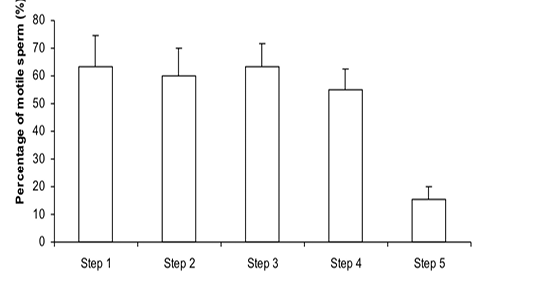
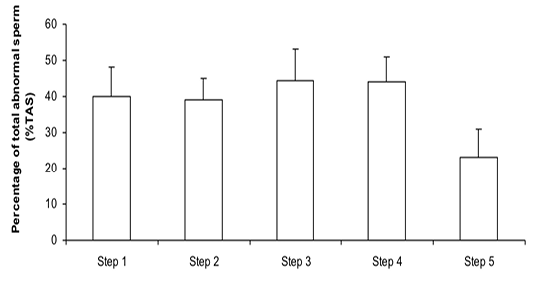
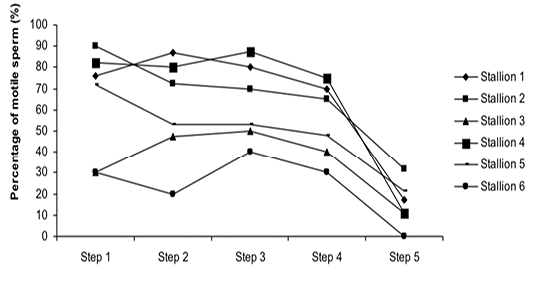
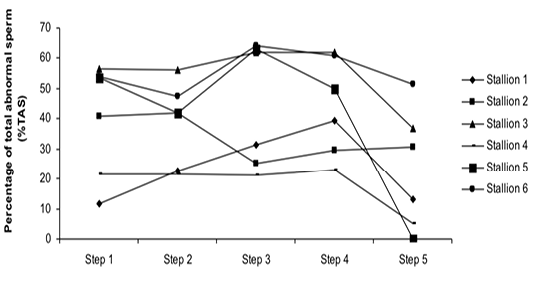
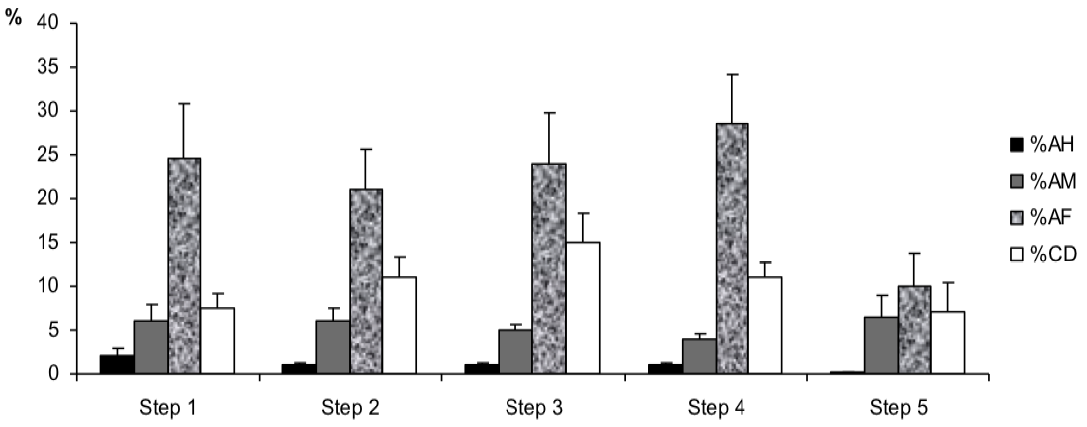
Abstract | The aim of the current study was to determine the influence of steps involved in the freezing–thawing protocol on semen quality of Arab stallions. A total of 48 ejaculates were collected (step 1) and undergone the first dilution in INRA96® at +37°C, followed by incubation at +22°C (step 2). A second dilution with INRA Freeze® was carried out after centrifugation and supernatant removal (step 3). The diluted semen was kept at +4°C, then packaged in straws of 0.5 ml (step 4) and frozen into liquid nitrogen at – 196°C. After 48 hours of storage, the semen was thawed (step 5). The percentages of motile sperm (%MS), abnormal head (%AH), mid-piece (%AM), flagella (%AF), cytoplasmic droplets (%CD) and abnormal sperm (%TAS) were studied at each step. Results showed that the %MS and %TAS were higher in steps 1, 2, 3 and 4 as compared to those of step 5 (p<0.05). The %AM was higher in step 5 as compared to that of the other steps (p<0.1). However, the %CD and %AF were higher respectively in the step 3 (p<0.01) and step 4 (p<0.05) than those of the other steps. Consequently, the semen quality of Arab stallions was affected during the freezing–thawing protocol. So, it is recommended to study the contribution of molecules in extenders such as vitamin C or glutamine to improve sperm motility and avoid increasing abnormal sperm during the freezing-thawing protocol.
Keywords | semen quality, freezing, thawing, steps, Arab stallions