
Genus Chrotogonus has been reported to cause massive damage to agricultural crops where it exists. In past many of its sibling species were misidentified on morphological examination. However, DNA-based species assignments has now made it possible to overcome this barrier. In this study we present CO1 gene data set on the 6 species of Chrotogonus i.e. Chrotogonus (Chrotogonus) homalodemus homalodemus (Blanchard, 1836) with two forms: long winged form and short winged form, C. (Chrotogonus) homalodemus (Blanchard, 1836), C. (Chrotogonus) trachypterus trachypterus (Blanchard, 1836), C. (Chrotogonus) trachypterus robertsi Kirby, 1914 with two forms: long winged form and short winged form, C. (Chrotogonus) trachypterus (Blanchard, 1836) and C. (Chrotogonus) turanicus Kuthy, 1905. However, some closely related species i.e. C. (Chrotogonus) hemipterus Schaum, 1853 with C. (Chrotogonus) h. homalodemus (Blanchard, 1836), and C. (Chrotogonus) senegalensis (Krauss, 1877) with C. (Chrotogonus) t. robertsi Kirby, 1914 were identified as same species i.e. C. (Chrotogonus) h. homalodemus (Blanchard, 1836) and C. (Chrotogonus) t. robertsi Kirby, 1914 respectively. Their lineages indicating negligible genetic divergence and very close resemblance with 99.85% identity between C. (Chrotogonus) h. homalodemus (SWF and LWF) against RID-MMV2XTNY114 and 99.85% identity between C. (Chrotogonus) t. robertsi (SWF and LWF) against RID-MMVW0MTF114. Finally, we discuss the possible taxonomic implication of our DNA sequencing results and point out future research directions.
Short Communication · Volume 54, Issue 4, 25 April 2022 · Open Access
Molecular Identification of Chrotogonus spp. (Pyrgomorphidae: Caelifera: Orthoptera)
· ·
Affiliations & Notes ⌄
- 1Department of Zoology, University of Sindh, Jamshoro, Pakistan 2Institute of Apicultural Research, CAAS, Beijing-China * Corresponding author: riffat.sultana@usindh.edu.pk
Article Info ⌄
- Journal:
- Pakistan Journal of Zoology
- Published:
- 25 April 2022

From the article
- Chrotogonus having body rough, with tubercles and granules distinctly flattened and it occurs in wide range of habitat including garden due to this appearance many of Chrotogonus species showed very close resemblance with each other.
- From these 8 different sequences group 5 sequence (RID A6XZE43H114) was compared with other groups 7, 8, 10, 11, 13, 14 and 15 of Chrotogonus through NCBI blast online.
- C. homalodemus homalodemus (SWF) showed 100% Query cover and Max.
- C. homalodemus homalodemus (group 5) sequence with Query ID: Query_134081 consists on Query length 659 was used for BLAST with 7 subject sequences consists on Subject length: 4613 on the basis of COX1 gene.
Selected from the article's own text.
Abstract
Materials and methods
Specimens were collected during day time from 08:00 Am to 11:30 Am in months of July-2017 to March-2018 from selected localities of Khairpur Mir’s i-e Khairpur, Kot diji and Kingri. Collected specimens were killed with cyanide. DNeasy Blood and Tissue kit (Qiagen) was used for genomic DNA extraction. DNA was stored at -20oC and later used for DNA amplification of CO1 gene using primers forward: 5/ GACTGTTAATTCGAGCAGA 3/and reverse: 5/ GATTCAATTTTTCCTCTTTCTT3/. The PCR mixture total 25-μl volume contained: 11-μl water, 5-μl buffer solution, 2.5-μl dNTPs, 2-μl Mg, 2-μl DNA, 1+1-μl forward-and reverse- primers, 0.25-μl BSA, 0.25-μl Taq DNA polymerase. The thermal cycle comprise an initial denaturing at 94 °C for 3(three) min amplification cycles 35 for 1 (one) min. at 95 °C, 30 cycles for 10s at 98°C, For 10 s at 52 °C and for 1(one) min. at 65 °C and for 5(five) min. at 65°C. Further, Agarose Gel DNA Extraction Kit (MiniBEST) Ver.4.0 (Ta-Ka-Ra Co., Dalian China) was used for purified DNA fragment. PCR product run on 1.5 % agarose and 300 bp obtained was cut out. PCR product of Chrotogonus was sent to Institute of Apicultural Research, CAAS, Beijing, China for sequencing. After DNA sequencer 3730xI DNA Analyzer we have received ABI file for further analysis. In order to trace the similarities/ differences between cryptic/ sibling species sequences of each species was uploaded on NCBI and compared with already uploaded sequences through online portal of NCBI. Further, construction of Neighbour joining tree was also through MEGA7 of each species. Finally, results were accorded on BOLD (www.barcodinglife.org) and NCBI (www.ncbi.nlm.nih.gov) and manual sequence was noted.
Results
During the present survey 826 specimens were collected and morphological sorted out into Chrotogonus (Chrotogonus) homalodemus homalodemus (Blanchard, 1836), C. (Chrotogonus) homalodemus (Blanchard, 1836), C. (Chrotogonus) trachypterus trachypterus (Blanchard, 1836), C. (Chrotogonus) trachypterus robertsi Kirby, 1914, Chrotogonus (Chrotogonus) trachypterus (Blanchard, 1836), C. (Chrotogonus) turanicus Kuthy, 1905, C. (Chrotogonus) senegalensis (Krauss, 1877) and C. (Chrotogonus) hemipterus Schaum, 1853. Chrotogonus having body rough, with tubercles and granules distinctly flattened and it occurs in wide range of habitat including garden due to this appearance many of Chrotogonus species showed very close resemblance with each other. During present study COI gene sequences were generated for 105 specimens of genus Chrotogonus from these 105 sequences 8 different sequences were separated which are indicated by group number in ascending order (5, 7, 8, 10, 11, 13, 14 and 15 which were indicated: C. homalodemus homalodemus (LWF), C. trachypterus trachypterus, C. trachypterus, C. homalodemus homalodemus (SWF), C. trachypterus robertsi (LWF), C. homalodemus, C.turanicus, and C. trachypterus robertsi (SWF), respectively). These 8 different sequences were upload in MEGA7 Alignment Explorer for manual sequence. Aligned has been done through “Align by Muscle” method. Aligned sequences of these 8 species were exported in FASTA format (Fig. 1).
From these 8 different sequences group 5 sequence (RID A6XZE43H114) was compared with other groups 7, 8, 10, 11, 13, 14 and 15 of Chrotogonus through NCBI blast online. The Blast results showed closest identity of C. homalodemus homalodemus LWF-(group 5) with C. homalodemus homalodemus SWF-(group 10) by resulting 1185 (Maximum score) with 99.85% identity against Query_134083. Each sequence query as well as subject consisted on 659 base pairs (bp). The least closet species is C. turanicus with maximum score 738 and 85.02% against Query_134089 through NCBI BLASTIN 2.9.0+ (Table I). C. homalodemus homalodemus (SWF) showed 100% Query cover and Max. Score 1185 with E Value 0.0 and whereas C. turanicus showed 99% Query cover and Max. Score 738 with E Value 0.0. C. homalodemus homalodemus (group 5) sequence with Query ID: Query_134081 consists on Query length 659 was used for BLAST with 7 subject sequences consists on Subject length: 4613 on the basis of COX1 gene. Distribution of 19 blast hits on 7 subject sequences which are shown in
Table I. Maximum and total score of Alignment of 7 subject sequences.
| Description | Maximum score of alignment | Total score of alignment | Querycover | E Value | Per. Identity | Accession |
| C. homalodemus homalodemus (SWF) | 1185 | 1236 | 100% | 0.0 | 99.85% | Query_134083 |
| C. trachypterus roberstsi (LWF) | 1144 | 1195 | 100% | 0.0 | 98.48% | Query_134086 |
| C. trachypterus trachypterus | 1144 | 1195 | 100% | 0.0 | 98.48% | Query_134085 |
| C. homalodemus | 1144 | 1195 | 100% | 0.0 | 98.48% | Query_134084 |
| C. trachypterus | 1140 | 1191 | 100% | 0.0 | 98.33% | Query_134088 |
| C. trachypterus robertsi (SWF) | 1140 | 1191 | 100% | 0.0 | 98.33% | Query_134087 |
| C. turanicus | 738 | 738 | 99% | 0.0 | 85.02% | Query_134089 |
graphic summary after BLAST through NCBI online in which C. homalodemus homalodemus (LWF) showed the closest identity.
Chrotogonus has very close resemblance with each other therefore, their identification on the basis of morphology is too complex so in order to know its exact status 70 Nucleotide sequence of 8 species has been done. Through, MEGA7 alignment of these sequences its Phylogenetic tree was constructed. It was examined that many cryptic species which look differ on morphologically bases proved as identical species on the DNA sequencing such as C. (Chrotogonus) hemipterus Schaum, 1853 with C. (Chrotogonus) h. homalodemus (Blanchard, 1836) and C. (Chrotogonus) senegalensis (Krauss, 1877) with C. (Chrotogonus) t. robertsi Kirby, 1914. Hence DNA sequences classified as 6 species: C. (Chrotogonus) h. homalodemus have two morphological forms, Long Winged Form (RID_A6XZE43H114) and Short Winged Form (Query_134083) but same species, C. (Chrotogonus) homalodemus (Query_134084), C. (Chrotogonus) t. trachypterus (Query_134085), C. (Chrotogonus) t. robertsi have two morphological forms, Long Winged Form (Query_134086) and Short Winged Form (Query_134087), C.(Chrotogonus) trachypterus (Query_134088) and C. (Chrotogonus) turanicus (Query_134089) (Table II). Morphologically C (Chrotogonus) homalodemus homalodemus (LWF) and C (Chrotogonus) homalodemus homalodemus (SWF) were considered as different species but Neighbor-joining tree on the basis of their DNA sequence confirmed as a single species with two different morphological forms (Short Winged Form and Long Winged Form). Similarly, C (Chrotogonus) trachypterus robertsi (LWF) and C (Chrotogonus) trachypterus robertsi (SWF) were considered as different species but Neighbor- joining tree on the basis of their DNA sequence confirmed as a single species with two different morphological forms (Fig. 2).
While on the bases of morphological examination specimens were sorted out into following species/ sub-species of Chrotogonus. Its identification key is under:
Key to various species and sub-species of Chrotogonus.
| 1 | Pronotum is crown shaped from upper surface and slightly darker border line …......................................homalodemus |
| _ | Pronotum is not crown shaped from upper surface but whitish border line ……........ homalodemus homalodemus |
| 2 | Median carina of pronotum dim in male it characterize with sharply defined pronotum borders before the principal sulcus irregularly trilobite…...............trachypterus robertsi |
| _ | Not as above…….......................trachypterus trachypterus |
| 3 | Pronotum lateral and median carinae having broader border lines……......................................................... trachypterus |
| _ | Pronotum lateral and median carinae having narrower border lines……................................................. turanicus |
Discussion
It was noticed that abundance and diversity of collected specimens varied over the collection period. The pattern of bigger and diverse catches in earlier than later
Table II. Traditional and DNA based identification of Chrotogonus species.
| Morphological identification | Molecular identification | Subject/Query ID |
| C (Chrotogonus) h. homalodemus | C (Chrotogonus) h. homalodemus (LWF) | RID_A6XZE43H114 |
| C (Chrotogonus) hemipterus | C (Chrotogonus) h. homalodemus (SWF) | Query_134083 |
| C (Chrotogonus) homalodemus | C (Chrotogonus) homalodemus | Query_134084 |
| C (Chrotogonus) t. trachypterus | C (Chrotogonus) t. trachypterus | Query_134085 |
| C (Chrotogonus) t. robertsi | C (Chrotogonus) t. robertsi (LWF) | Query_134086 |
| C (Chrotogonus) senegalensis | C (Chrotogonus) t. robertsi (SWF) | Query_134087 |
| C (Chrotogonus) trachypterus | C (Chrotogonus) trachypterus | Query_134088 |
| C (Chrotogonus) turanicus | C (Chrotogonus) turanicus | Query_134089 |
months of the year coincided with a rise in temperature from March to September and fall from October to January. Weather is known to influence both spatial and temporal patterns of insect communities ; it is also known that insect emergence is driven by temperature that also affects their development, survival and abundance . There are four important limitations for morphological identification on the basis of morphological diagnosis; first, morphologically confusing taxa are common in insect groups so this technique is not successful to differentiate these taxa. Second, phenotypic plasticity and genetic variability in the characters employed for species recognition can lead to incorrect identification. Third, on the basis of morphological keys all stages of life of insects cannot be identified so keys have limited role for species identification. Finally, misdiagnosis is common during identification of species on the basis of keys because it needs high level of expertise that cannot be common . Species identification of Chrotogonus (Pyrgomorphidae: Orthoptera) based on morphological characteristics remain confused from many decades. Its sibling species offered very close resemblance on the bases of morphological characteristics so it is too difficult to identify them. DNA barcoding might facilitate the identification of sibling specimens, verify the identification of fresh caught specimens in the absence of taxonomic experts and aid in the identification of large numbers of specimens form any specific area. So far, however, only very few dedicated barcoding studies worldwide have targeted orthopteran , and COX1 data are available only for a small number of Asian species. Despite some limitations, our barcoding data set is useful for a wide range of applications in conservation management and ecology. It will facilitate the otherwise difficult identification of Chrotogonus species.
Acknowledgements
We are indebted to Higher Education Commission, Islamabad, Pakistan for finding Project No. 6737 SINDH /NRPU /R & D/ HEC.
Statement of conflict of interest
The authors have declared no conflict of interest.
Figures
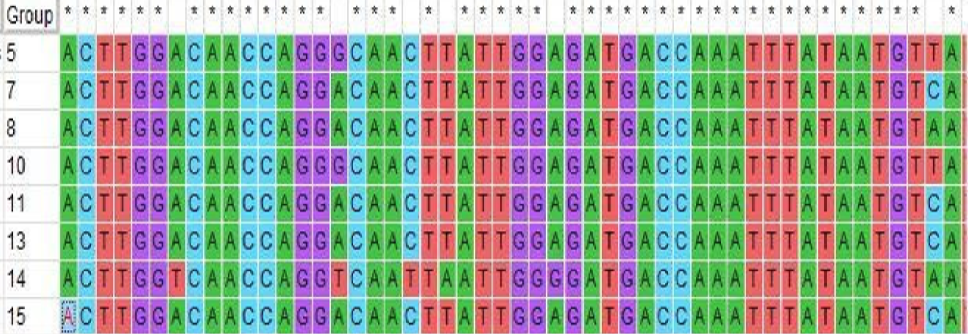
Alignment of 8 subject sequences with C. homalodemus homalodemus through MEGA7
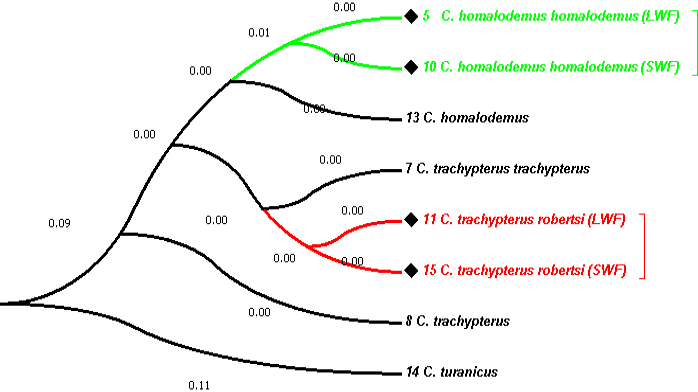
Neighbor-Joining tree for genus Chrotogonus representing 6 species
References
- Ashfaq, M., Akhtar, S., Rafi, M.A., Mansoor, S. and Hebert, P.D.N., 2017. PLoS One, 12: 1-13.
- Bale, J.S, Masters, G.J., Hodkinson, I.D., Awmack, C., Bezemer, T.M., Brown, V.K., Butterfield, J., Buse, A., Coulson, J.C., Farrar, J., Good, J.E.G., Harrington, R., Hartley, S., Jones, T.H., Lindroth, R.L., Press, M.C., Symmioudis, I., Watt, A.S. and Whittaker, J. B., 2002. Glob. Change Biol., 8: 1-16.
- Blackith, R.E. and Kevan, D.K.Mc.E., 1967. Evolut. Int. J. Org., 21: 76-84.
- Gandhi, K.J.K., Gilmore, D.W., Katovich, S.A., Mattson, W.J., Spence, J.R. and Seybold, S.J., 2017. Environ. Rev., 15: 113-152.
- Gupta, J.C., 1972. Pl. Prot. Bull., 20: 36-38.
- Haldhar, S.M., Swaminathan, R. and Rathore, P.S., 2017. Int. J. Trop. Agric., 25: 681-688.
- Hawlitschek, O., Moriniere, J., Lehmann, G.U.C., Lehmann, A.W., Kropf, M., Dunz, A., Glaw, F., Detcharoen, M., Schmidt, Hausmann, S.A., Szucsich, N.U., Caetano-Wyler, S.A. and Haszprunar, G., 2017. Mol. Ecol. Resour., 17: 1037-105.
- Hebert, P.D.N., Cywinska, A., Ball, S.L. and Waard, J.R.D., 2003. Proc. R. Soc. Lond. [Biol.], 270: 313–321.
- Hebert, P.D.N., de Waard, J.R. and Landry, J-F., 2009. Biol. Lett., 23: 359–362.
- Huang, J., Zhang, A., Mao, S. and Huang, Y., 2013. PLoS One, 8: 201e82400:17.
- Khaembas, B.M., 1979. Kenya Entomol. Newsl., pp. 3-6. http://hdl.handle.net/11295/81617
- Khan, M.I., Usmani, M.K., Usmani, S. and Naz, H., 2018. J. Threat. Taxa. 10: 12953-12968.
- Kumar, H., Usmani, M.K. and Reenu, K., 2014. J. entomol. Res. Soc., 16: 21-26.
- Poonia, F.S. and Bhati, N., 2011. J. Pestol., 33: 24-29.
- Poonia, F.S. and Choudhary, S., 2008. J. appl. Zool. Res., 19: 17-21.
- Riffat, S., Yawar, S.W. and Wagan, M.S., 2013. Pakistan J. Zool., 45: 299-304.
- Riffat, S. and Wagan, M.S., 2015. Grasshoppers and locusts of Pakistan. ISBN 978-969-417- 180-7: 180.1st ed. HEC-Pakistan.
- Riffat, S., Soomro, I., Wagan, M.S. and Panhwar, W.A., 2015a. Pakistan J. Zool., 47: 739-743.
- Riffat, S. Panhwar, W.A. and Wagan, M.S., 2015b. Pakistan J. Zool., 47: 1361-1364.
- Sahebzadeh, N., Moghaddam, M.G. and Sabagh, S.K., 2017. Jordan J. biol. Sci., 10: 49-55.
- Wilson, J.J., Sing, K.W., Floyd, R.M., Hebert, P.D.N., 2017. In: Insect biodiversity: Science and society (eds. R.G. Foottit and P.H. Adler). Vol. 1, 2nd Edition. Blackwell Publishing Ltd., Oxford.
- Zhao, L., Lin, L.L. and Zheng, Z.M., 2016. ZooKeys, 582: 111-120.
- Zohdy, N.Z.M., Rahman, K.M.A., Amer, N.R. and Sayed, N.E.W., 2016. Species Int. J., 17: 150-159.
Services
Article usage statistics
Loading…