
Dimond Back Moth (Plutella xylostella) is highly destructive for cruciferous crops globally and resistant against different chemicals and biopesticides. DBM has shown resistance against 12 different strains of Bacillus thuringiensis (Bt) and 91 active ingredients of agricultural chemicals globally. Alternative ways should be explored to control DBM. Berberine is an insect toxic alkaloid and produced by plants of family Berberidaceae. Berberine Bridge Enzyme (BBE) gene involved in the synthesis of berberine was isolated from Berberis lyceum and over expressed in Arabidopsis thaliana. The integration of the BBE gene in transgenic lines was confirmed through PCR while the expression was confirmed by Reverse Transcriptase PCR. Whole plant bioassay confirmed 100% mortality in DBM within 72 hours. The present investigation concludes that the metabolic engineering of berberine in plants is an effective strategy to protect plants from herbivorous insects and this pathway should further be evaluated for possible application in agriculture.
Research Article · Volume 36, Issue 2, 23 May 2020 · Open Access
Metabolic Engineering of Berberine in Plants Can Confer Resistance to Insects
· · ·
Affiliations & Notes ⌄
- 1National Institute for Genomics and Advanced Biotechnology, Pakistan drgmali5@gmail.com
Article Info ⌄
- Journal:
- Sarhad Journal of Agriculture
- Published:
- 23 May 2020
Abstract
Introduction
DBM is chewing insect and belongs to order Lepidoptera. It is the universal insect and present all over the world where cruciferous hosts are present . DBM costs the global economy by estimated US$4 -5 billion annually and furthermore its impacts on local biodiversity and habitats in exotic ranges are unknown . In Pakistan, the cruciferous crops of entire regions of Punjab have been severely affected by this pest, furthermore this pest is frequently found in Hyderabad and Karachi regions of Sindh .
DBM is very destructive and most studied insect pest globally . Its control is very difficult, and it is the first insect that developed resistance to DDT . Integrated pest management (IPM) approach has been developed which includes self-limiting gene technique, mating disruption and Sterile Insect Technique (SIT). Although these techniques are not harmful and pesticide free, but these methods are very costly and developing countries cannot afford these methods and frequent use of SIT is challenged by different hurdles such as sterilization through irradiation which affects the performance of insect and targeting only male members on large scale is another challenging task .
By transferring the insecticidal genes in a variety of cash crops have enhanced the crop yield and resolved the environmental issues. Recently number of insect resistant genes were isolated from various sources like animals, plants and microbes and incorporated in a variety of crops that can induce resistance against major insect pests . Developing of insect resistant cotton harboring Bt toxins is a well-known adopted technology globally ; . Cry1Ac Cry2Ab, Cry 1F, Cry 2Ab from Bt were effective against insect resistance but their frequent application lead to development of resistance in ; ; . Single gene in DBM has shown resistance against four different strains of Bt .
It is therefore advisable to explore novel genes to which insects have not been exposed so far in order to delay resistance in insect population and to minimize the crop losses. Berberine is an insect toxic alkaloid and produced by plants of family Berberidaceae . In response to wound latex berberine immediately spills out of leaves and binds to alpha 2 receptors. The complex of berberine and alpha 2 receptors adjust itself in between the synaptic cleft of nerve cells and cause the disruption of function of nervous system of insects . BBE is central enzyme catalyzes the oxidative cyclization of the N-methyl moiety of (S)-reticuline to the berberine bridge carbon C-8 of (S)-scoulerine that is further oxidized to berberine , 2009). In the present investigation BBE gene was isolated from B. lyceum and over expressed in A. thaliana. The resultants transgenics were analyzed for toxicity against DBM. In present study it was investigated that can metabolic engineering of berbrine in plants be an effective strategy to protect plants from herbivorous insects?
Materials and Methods
Gene isolation and cloning
The nucleotide sequences of Berberine Bridge Enzyme genes were retrieved from NCBI and primers were designed from conserved region. The sequences of forward and reverse primers were 5’ATGATGTGCAGAAGCTTAACATTACGTT3’ and 5’CTACAATTCCTTCAACATGTAAATTTCC3’ respectively. Genomic DNA was extracted from the Berberis lycium using trizol reagent (Life Technologies Cat # 15596-018). The 50 ul Master Mix was prepared by mixing USB® FideliTaq mix TM PCR Master Mix (2x), forward primer, reverse primer, ddH2O and template DNA to the required concentration following the manufactures’ instruction. PCR profile was comprised of initial denaturation for 5 minutes at 94°C followed by 35 cycles of 95°C for 1 minute, 50°C for 1 minute and 68°C for 2 minutes. Final extension was allowed for 7 minutes at 68°C.The amplified product was analyzed by gel documentation system. The amplified product was gel eluted using Gene JET gel extraction kit (K0692) and cloned in pTZ57R/T vector (Thermo Scientific Insta TA clone#K1214) according to the advised procedure and was sequenced from MACROGEN (Korea). The new isolated nucleotide sequence of the BBE gene was submitted to NCBI GenBank Accession No.MG601874.
Construction of expression vector
For construction of p35S-BBE-mYFP expression vector by gateway cloning, BBE gene was amplified from pTZ57R/T plasmid using primers containing attB sites at the 5’end. The sequence of forward primer was 5’GGGGACAAGTTTGTACAAAAAA GCAGGCT’ATGATGTGCAGAAGCTTAA CATTACGTT3’ and reverse primer was 5’GGGGACCACTTTGTACAAGAAAGCTGGGTC CTACAATTCCTTCAACATGTAAATTTCC3’. To generate the entry clone BP recombination reaction was carried out between attP sites of pDONAR™ 201 (Invitrogen) and attB sites of amplified PCR product. Further to develop the expression construct LR recombination reaction of attL and attR sites was performed between entry clone and destination binary vector pXCSG-mYFP. Designated p35S-BBE-mYFP construct was transformed into Agrobacteriumstrain GV3101 (pMP90RK) by electroporation.
Genetic transformation and screening of transformed plants of Arabidopsis thaliana
Floral dip method of transformation was used for genetic transformation of Arabidopsis thaliana as followed by Clough and Bent (1998). Infection was given after 30 days of sowing at maximum bolting stage. Seeds of T0 plants were harvested at maturity and T1 plants were screened through spraying BASTA (120 mg/L solution) twice a week. Transformation efficiency was observed 1.98%. Transformed plants were advanced to next four generations to get homozygous lines for BBE.
Molecular analysis of transformed plants
Transformed plants of every generation were confirmed through PCR using already mentioned primers and procedure. For transcript analysis, total RNA was extracted from leaves of nine different transformed events and one wild-type isogenic line through Trizol reagent (Life Technologies Cat # 15596-018). First-strand of cDNA was synthesized from 10ng of RNA extracted from each transgenic and wild type isogenic line using oligo (dt) primers through AMV Reverse transcriptase. 2.5ul of resultant reaction product was used to amplify BBE gene in 50ul PCR reaction using 5’GTACGAGGTGGTGATGTT3’ and 5’CAAGCACGGATACCGTAA3’ primers of BBE gene. 18S rRNA forward primer 5’TGCATGGCCGTTCTTAGTTG3’ and reverse primer 5’ATTGCCTCAAACTTCCGTCG3’ were used as internal control.
Insect bioassays of transformed plants
Both the transformed (T3) and wild type isogenic lines were subjected to insect bioassays. Each line was exposed to 3 second instars larvae of P. xylostella. There were four replications and each replication was consisted of three plants. Weights of larvae before and after bioassays were compared. Mortality percentage of P.xylostella was also determined on transformed and wild type isogenic lines after 12, 24, 48 and 72 hrs of exposure. Statistix 8.1 was used to analyze the data. Least significant difference test (LSD) was carried to compare the means.
Results and Discussion
BBE gene isolation and cloning
Developments of plant transformation construct
BP and LR reactions were carried out to develop a plant transformation construct. BP recombination reaction was carried out between attP sites of pDONAR™ 201(Invitrogen) and attB sites of amplified PCR product and entry clone was generated and confirmed through PCR (Figure 2a) LR recombination reaction of attL and attR sites was carried out between entry clone and destination binary vector pXCG-mYFP and plant transformation vector was developed (Figure 2b) and confirmed by PCR and sequencing. Physical map of plant transformation construct is given in (Figure 3).
Transformation of Agrobacterium strain GV 3101(pMP90RK)
Designated p35S-BBE-mYFP construct was transformed into Agrobacterium strain GV3101 (pMP90RK) by electroporation and confirmed by PCR (Figure 4).
Genetic transformation and molecular analysis of transformed Arabidopsis thaliana
The Photographic illustration of floral dip method is given in Figure 5. Muffins were prepared, and seeds were sown (Figure 5a). Infection was given after 30 days of sowing at the maximum bolting stage (Figure 5b and 5c). T1 plants were sprayed basta and survived plants were confirmed for transgene through PCR (Figure 6). Reverse transcriptase PCR showed that BBE gene was successfully transcribed in transformed lines while no such amplification was observed in non-transformed negative control plant. Expression of 18S rRNA gene in both transformed and non-transformed plant is shown in the lower panel of Figure 7. Results indicated that BBE gene is not only stably incorporated in the genome but also expressed to varying levels in different transgenic events (Figure 7).
Insect bioassays of transformed plants
Statistical analysis revealed that the weight of 2nd instar larvae of DBM was significantly increased on wild type isogenic line after 72 hrs compared to larvae introduced on different transformed events (Table 1). The average weight of larvae increased from 0.56 mg to 1.125 mg on wild type isogenic line after 72 hrs of introduction while reduced weights were observed on different transformed lines (Table 1). Increased weight of larvae on wild type isogenic line after 72 hrs of introduction is shown in Figure 8b while reduced weights of larvae on different transformed events can also be observed in Figure 8d, 8f, and 8h.
Table 1: Weight and mortality of 2nd instar larvae of Plutela xylostela.
| Lines | Larvae weight (mg)* Mortality percentage time after introduction (h) | ||||||
| 0 | 72 | 12 | 24 | 48 | 72 Means | ||
| NT | 0.5613±0.003 | 1.125±0.014a | 0 | 0 | 0 | 0 | 0.00 |
| Line1 | 0.5633±0.003 | 0.243±0.001c | 30 | 50 | 80 | 90 | 60DE |
| Line 2 | 0.5593±0.001 | 0.235±0.000b | 60 | 70 | 80 | 96 | 76B |
| Line 3 | 0.5637±0.001 | 0.259±0.000b | 15 | 10 | 50 | 80 | 43F |
| Line 4 | 0.5653±0.002 | 0.244±0.0017c | 13 | 30 | 80 | 90 | 55E |
| Line 5 | 0.56±0.0005 | 0.244±0.002c | 43 | 50 | 88 | 100 | 70BC |
| Line 6 | 0.5627±0.002 | 0.2577±0.002b | 50 | 70 | 75 | 80 | 68C |
| Line 7 | 0.5613±0.001 | 0.236±0.000b | 30 | 60 | 80 | 94 | 66CD |
| Line 8 | 0.562±0.0008 | 0.2427±0.001c | 20 | 40 | 80 | 100 | 60DE |
| Line 9 | 0.559±0.0005 | 0.239±0.00cd | 70 | 85 | 86 | 100 | 85A |
| Means 33.0D 48.0C 70.0B 83.8A | |||||||
*Mean of four replicates and each replicate was consisted of 3 insects; Means followed by same letters are not significantly different at p=0.05. LSD0.05 for mortality percentage =6.62, LSD0.05 for different lines =4.184.
Different transformed events showed variable resistance to 2nd instar larvae of DBM and Line 5, 8 and 9 showed 100% mortality of DBM after72hrs and found more effective compared to other transformed lines (Table 1). Wild type isogenic line did not cause any death of 2nd instar larvae of DBM (Table 1). Dead larvae on different transformed events are encircled in Figure 8d, 8f and 8h.
Besides effective control on herbivorous insects, frequent application of synthetic pesticides has resulted in toxicity to non-target organisms, caused environmental pollution and harmful effects on human health (Damala, 2011; . Environmentally friendly biopesticides based on Bt formulations were also extensively applied to control herbivorous insects but the natural ability of pests to evolve resistance challenged the benefits achieved by synthetic pesticides and biopesticides . DBM is a highly destructive insect and has become resistant to all important classes of insecticides including Bt toxins.
Transgenic plants expressing single and double toxins are effectively used to control the damages caused by lepidopteron insects . Each of Cry 2Ab and Cry1Ac toxin in transgenic Bollgard II cotton has unique receptor sites in the insects. This two-gene pyramid remained effective in delaying insect resistance because at least two independent mutations are required for insects to develop resistance against it .
Due to the natural potential of insects to develop resistance, Helicoverpa armigera showed resistance to cotton expressing both Cry1Ac and Cry2Ab toxins . Field evolved resistance developed by herbivorous insects to different Bt toxins threatens the worth of Bt crops . Novel neurotoxic Hvt gene from Hadrony cheversuta was characterized for this purpose and transgenic expression confirmed its effectiveness against two lepidopteron insects . Translational fusion of Hvt from Hadrony cheversuta and Cry1Ac from Bt was developed and characterized for long lasting resistance in transgenic crops. Pyramiding distinctly related toxins from different sources has been an effective strategy to delay resistance and we further required to explore new toxins with unique mode of action to equip crop plants with more durable resistance against lepidopteron pests in future .
Berbrine is the isoquinoline alkaloid (secondary metabolite) present in all members of Berberidaceae family . Berbrine is toxic to insects and restrains the growth of bactaria, fungi and viruses. It intercalates GC contents of DNA; affects the reverse transcriptase and DNA synthesis. Furthermore, these allelochemical activities are involved in chemical defense in response to microorganism, viruses and herbivores .
In current study the BBE gene (Central enzyme involved in the berberine synthetic pathway) was isolated from B. lyceum and over expressed in At. resultant transformed lines were assayed for toxicity against 2nd instar larvae of P. xylostella. Three transformed lines showed 100% mortality of larvae within 72hrs while other transformed lines also showed promising results with more than 80% mortality within 72 hrs. Reverse transcriptase PCR analysis showed more transcripts in transformed lines with 100 % mortality compared to others. Increased weights of larvae were observed on wild type isogenic lines compared to average weights of larvae noticed on transformed lines.
Our results suggest that over expression of novel BBE gene from B. lyceum in At. is a promising genetic resource to enhance the metabolic pathway of berberine biosyn thesis. No mortality of larvae in wild type isogenic lines and at least 80 % mortality in every transformed line is dedicated to enhanced production of berberine due to over expression of BBE gene in transformed lines. The study showed that transgenic expression of single gene in metabolic pathway has the potential to improve the production of useful plant secondary metabolites like (Berberine). It will delay resistance in lepedoptron insects especially in DBM as transgenic plants expressing toxins with unique mode of action from each other have more potential to delay resistance in insects .
Berbrine Bridge Enzyme (BBE) is central enzyme catalyzes the oxidative cyclization of the N-methyl moiety of (S)-reticuline to the berberine bridge carbon C-8 of (S)-scoulerine that is further oxidized to berbrine , 2009). Berbrine accumulates in the lactifers in the form of latex (Schmelleret al., 1997; ; . Latex is a white sap which exudates from wound or point of damage caused by herbivorous insects . In response to wound latex berbrine immediately spills out of leaves and binds to alpha 2 receptors of insects. The complex of berbrine and alpha 2 receptors adjust itself in between the synaptic cleft of nerve cells and cause the disruption of function of nervous system of insects . Our study demonstrated that metabolic engineering of berbrine in plants is an effective strategy to protect plants from herbivorous insects and this pathway should further be explored for possible application in agriculture.
Acknowledgements
This research was conducted in National Institute for Genomics and Advanced Biotechnology and was supported by ingenuous Ph.D. scholarship as well as six month IRSIP program awarded by Higher Education Commission of Pakistan.
Novelty Statement
The investigation corroborates the berberine to be an imperative tool having the crucial role toward the control of the herbivores and acquiring important positive fallout on crop improvement techniques through genetic manipulation and breeding approaches.
Author’s Contribution
Anila Latif conceived, designed and conducted all the experiments during research. Dr. Ghulam Muhammed Ali Director NIGAB/ NARC supervised, facilitated and guided until the completion of research project. Dr Zaheer Abbas Senior Scientific Officer NARC, who has been the massive source of guidance, has always tried to remove hindrances that came while conducting the research. Dr Farhat Ullah Assistant Professor in AUP arranged the experimental data, proofread and finalized the manuscript.
Conflict of interest
There is no conflict of interest.
Figures
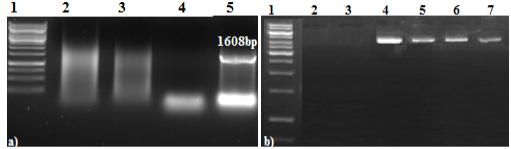
Isolation and cloning of BBE gene. a) Agarose gel electrophoresis of amplified product from DNA of B. lyceum; b) Agarose gel electrophoresis of pTZ57 R/T harboring BBE gene.
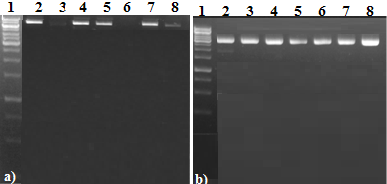
Developments of plant transformation construct. a) Agarose gel electrophoresis of entry clone isolated from transformed colonies; b) Agarose gel electrophoresis of plant transformation vector isolated from transformed colonies.

Physical map of complete cassette. LB, Left boarder; RB, Right boarder; CaMV 35S, Cauliflower mosaic virus 35 S promoter; YFP, Yeast fluorescent protein; BBE, Cloned barbarian bridge enzyme gene; P nose, P nose promoter; Pat, Phosphinothricin acetyle transferase gene; NOS, NOS terminator.
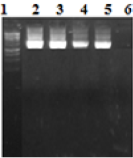
Transformation of Agrobacterium strain GV 3101 (pMP90RK). Lane M, 1kb DNA ladder (Fermentas); lane 1 and 2, 3 and 4 are amplified products from transformed colonies of Agrobacterium Lane 6 is non transformed colony.
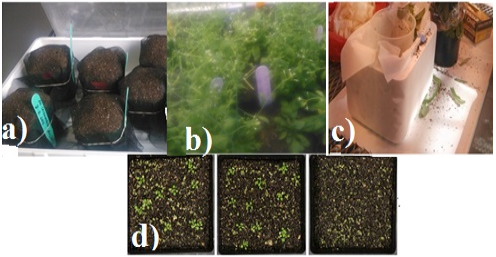
Different steps of floral dip transformation. a, Muffin preparation and seeds sowing; b, Maximum bolting stage prior to infection with transformed Agrobacterium; c, Infection with transformed Agrobacterium culture; d, Screening of transformants with basta spray.
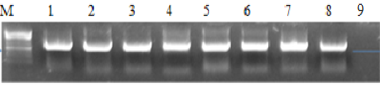
Agarose gel electrophoresis of amplified products from transformed plants.
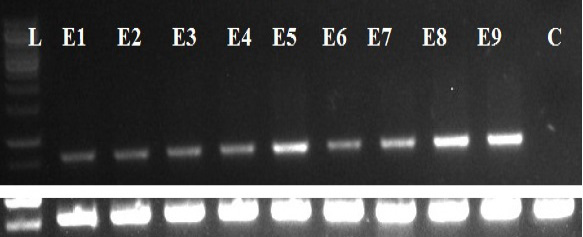
Expression analysis of BBE gene. Lane E1 to E9, amplifications of BBE gene from the reverse transcription reactions product from different transformed events; lane C, no amplification of BBE gene from the reverse transcription reaction product of wild type isogenic line. Lower panel shows the expression of 18S rRNA gene.
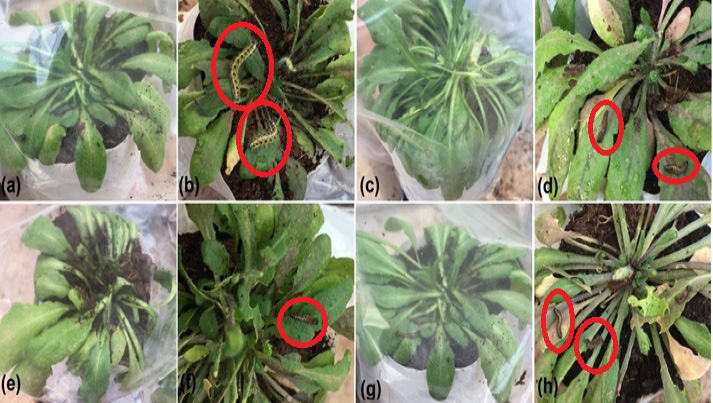
Insect bioassay of transformed and wild type isogenic line. a, wild type isogenic line exposed to 2nd instar larvae (photograph was taken just after introduction of larvae); b, wild type isogenic line (photograph was taken after 72 hours); c, e and g are transformed events 5, 8 and 9 respectively (photographs were taken just after introduction of insects); d, f and h are transformed events 5, 8 and 9 respectively (photographs were taken after 72 hours).
References
- Abbas, Z., Y. Zafar, S.A. Khan and Z.A. Mukhtar. 2013. Chimeric protein encoded by synthetic genes shows toxicity to Helicoverpaarmigera and Spodoteralittoralis larvae. Int. J. Agric. Biol. 15: 325- 330.
- Abbas, Z., Y. Zafar, S.A. Khan and Z.A. Mukhtar. 2016. Transgenic expression of Translational fusion of synthetic Cry1Ac and Hvt Gene in Tobacco confers to Helicoverpaarmigera and Spodoteralittoralis larvae. Pak. J. Agri. Sci. 53(4): 809- 816. https://doi.org/10.21162/PAKJAS/16.4010[CrossRef]
- Ankersmit, G.W., 1953. DDT-resistance in Plutellamaculipennis (Curt.) (Lep.) in Java. Bull. Entomol. Res. 44: 421-426. https://doi.org/10.1017/S0007485300025530[CrossRef]
- Philips, C.R., Z. Fu, T.P. Kuhar, A.M. Shelton and R.J. Cordero. 2014. Natural history, ecology, and management of diamondback moth (Lepidoptera: Plutellidae), with emphasis on the United States. J. Integr. Pest. Manag. 5(3): 1–11. https://doi.org/10.1603/IPM14012[CrossRef]
- Tabashnik, B.E. and Y. Carrière. 2009. Insect resistance to genetically modified crops. In: A. Gatehouse and N. Ferry (eds.), Environmental impact of genetically modified and novel crops. Wallingford, UK: CABI; pp. 74–100. https://doi.org/10.1079/9781845934095.0074[CrossRef]
- Ranjith, M.T., A. Prabhuraj and Y.B. Srinivasa. 2010. Survival and reproduction of natural populations of Helicoverpaarmigera on Bt-cotton hybrids in Raichur, India. Curr. Sci. 99: 1602-1606.
- Abro, G.H., A.L. Jayo and T.S. Syed. 1994. Ecology of diamondback moth, Plutellaxylostella (L.) in Pakistan. Host plant preference. Pak. J. Zool. 26: 35-38.
- Clough, S.J and F. Bent. 1998. Floral dip: A simplified method for Agrobacterium-mediated transformation of Arabidopsisthaliana. Plant J. 16: 735-743. https://doi.org/10.1046/j.1365-313x.1998.00343.x[CrossRef]
- Damalas, C.A., 2011. Potential uses of turmeric (’Curcuma longa) products as alternative means of pest management in crop production. Plant Omics., 4: 136–141.
- Gahan, L.J., Y.T. Ma, M.L.M. Cobble, F. Gould, W.J. Moar and D.G. Heckel. 2005. Genetic basis of resistance to Cry 1Ac and Cry 2Aa in Heliothisvirescens (Lepidoptera: Noctuidae). J. Eco. Ent. 98: 1357-1368. https://doi.org/10.1603/0022-0493-98.4.1357[CrossRef]
- Gill, H.K. and H. Garg. 2014. Pesticides: environmental impacts and management strategies. In Pesticides-Toxic Aspects. In. Tech.
- Gorval, L. and V. Grishkovets. 1999. Alkaloids of some species of the genus Berberis introduced into the Crimea. Chem. Nat. Compd. 35(2): 223-224. https://doi.org/10.1007/BF02234944[CrossRef]
- Harcourt, D.G., 1962. Biology of cabbage caterpillars in Eastern Ontario. Proc. Ent. Soc. Ontario. 93: 67-75.
- Harvey-Samuel, T., N. Morrison, A. Walker, T. Marubbi, J. Yao, H. Collins, K. Gorman, T. Davies, N. Alphey, S. Warner, A. Shelton and L. Alphey. 2015. Pest control and resistance management through release of insects carrying a male-selecting transgene. BMC. Biol. 13: 1-15. https://doi.org/10.1186/s12915-015-0161-1[CrossRef]
- Khan, S.A., Y. Zafar, R.W. Briddon, K.A. Malik and Z. Mukhtar. 2006. Spider venom toxin protects plants frominsect attack. Transgenic Res.15: 349-357 https://doi.org/10.1007/s11248-006-0007-2[CrossRef]
- Jackson, R.E., J.R. Bradley and J.W.V. Duyn. 2003. Field performance of transgenic cottons expressing one or two Bacillus thuringiensis endotoxins against bollworm, Helicoverpazea(Boddie). J. Cotton Sci. 7: 57-64.
- James, C., 2012. Global status of commercialized Biotech/ GM crops. ISAAA Brief No. 44, ISAAA: Ithaca, NY.
- Legwaila, M., D. Munthali, M. Obopile and B. Kwerepe. 2014. Effectiveness of Spinosad against Diamondback Moth (PlutellaxylostellaL.) Eggs and Larvae on Cabbage under Botswana Conditions. Int. J. Insect Sci. 6: 15-213. https://doi.org/10.4137/IJIS.S12531[CrossRef]
- Lewinsohn, T.M., 1991. The geographical distribution of plant latex. Chemoecol. 2: 64–68.
- Qayyum, M.A., W. Wakil, M.J. Arif and S.T. Sahi. 2015. Bacillus thuringiensis and nuclear polyhedrosis virus for the enhanced biocontrol of Helicoverpaarmigera. Int. J. Agric. Biol. 17: 1043‒1048. https://doi.org/10.17957/IJAB/15.0025[CrossRef]
- Sauka, D.H. and G.B. Benintende. 2008. Bacillus thuringiensis: general aspects. An approach to its use in the biological control of lepidopteran insects behaving as agricultural pests. Rev. Argent. Microbiol. 40: 124–140.
- Schmeller, T., B. Latz-Brüning and M. Wink. 1997. Biochemical activities of berberine, palmatine and sanguinarine mediating chemical defence against microorganisms and herbivores. Phytochem. 44(2): 257-266. https://doi.org/10.1016/S0031-9422(96)00545-6[CrossRef]
- Shitan, N., I. Bazin, K. Dan, K. Obata, K. Kigawa, K. Ueda, F. Sato, C. Forestier and K. Yazaki. 2003. Involvement of CjMDR1, a plant multidrug-resistance-type ATP-binding cassette protein, in alkaloid transport in Coptis japonica. Proc. Nat. Acad. Sci. 100(2): 751-756. https://doi.org/10.1073/pnas.0134257100[CrossRef]
- Tabashnik, B., 1994. Evolution of resistance to Bacillus thuringiensis. Annu. Rev. Ento. 39(1): 47-79. https://doi.org/10.1146/annurev.en.39.010194.000403[CrossRef]
- Tabashnik, B., Y. Liu, N. Finson, L. Masson, and D. Heckel. 1997. One gene in diamondback moth confers resistance to four Bacillus thuringiensis toxins. Proc. Nat. Acad. Sci. 94(5): 1640-1644. https://doi.org/10.1073/pnas.94.5.1640[CrossRef]
- Winkler, A., A. Lyskowski, S. Riedl, M. Puhl, T. Kutchan, P. Macheroux, and K. Gruber. 2008. A concerted mechanism for Berberine Bridge Enzyme. Nat. Chem. Biol. 4(12): 739-741. https://doi.org/10.1038/nchembio.123[CrossRef]
- Winkler, A., M. Puhl, H. Weber, T. Kutchan, K. Gruber and P. Macheroux. 2009. Berberine bridge enzyme catalyzes the six-electron oxidation of (S)-reticuline to dehydroscoulerine. Phytochem. 70(9): 1092-1097. https://doi.org/10.1016/j.phytochem.2009.06.005[CrossRef]
- Yazaki, K., N. Shitan, H. Takamatsu, K. Ueda, and F. Sato. 2001. A novel Coptis japonica multidrug‐resistant protein preferentially expressed in the alkaloid‐accumulating rhizome1. J. Exp. Botany. 52(357): 877-879. https://doi.org/10.1093/jexbot/52.357.877[CrossRef]
- Zalucki, M.P., A. Shabbir, R. Silva, D. Adamson, L. Shu-shen, M.J. Furlong. 2012. Estimating the economic cost of one of the world’s major insect pests, Plutellaxylostella (Lepidoptera: Plutellidae): Just How Long Is a Piece of String? J. Econo. Ent. 105: 1115–1129. https://doi.org/10.1603/EC12107[CrossRef]
Services
Article usage statistics
Loading…