
To observe the effect of Bushen Zhuyun Decoction (BSZYD) on rat pituitary cells (RFC), and to investigate the mechanism of BSZYD in treating infertility due to luteal phase defect (LPD), a GnRH-receptor (GnRHR) antagonized model of pituitary cells was established by using the blocking agent of Cetrorelix. The cells were treated with BSZYD-containing cerebrospinal fluid (CSF). Thus, a total of five groups of cells, including blank (+) group, Cetrorelix (+) group, CSF with BSZY (+) group, model-treated (+) group and corresponding blocker-treated group were established. Secretion levels of related hormone and their mRNAs were detected in the supernatant of each group. The mRNA and protein levels of GnRHR, the hub genes and key transcription factors in the downstream cAMP-PKA signaling pathways in RPC cells were also detected. The secretion and transcription levels of FSH and LH in Cetrorelix group were significantly decreased, while the expression of GnRHR was significantly increased compared to the blank group (p<0.05). Use of CSF with BSZYD alone showed no significant effect on the secretion of RPC, and the expressions of GnRHR and related hub genes in cAMP-PKA pathway. However, it exerted an effect on the model-treated group. Further, no significant difference was found in the content of cAMP and the levels of mRNA and protein of PKA in the supernatant between model-treated group and Cetrorelix group, while there was significant difference in the expression of CREB and Egr-1 between the two groups (p<0.05). Pituitary is one of the effective targets of BSZYD. BSZYD, by interacting with the GnRHR of pituitary gland, can activate cAMP-PKA signal transduction pathway, and in turn affect the downstream factors CREB and Egr-1 to regulate the secretion and transcription of FSH and LH. This pharmacological mechanism can redress luteal function and improve endometrial receptivity, and thus increase the clinical pregnancy rate.
Research Article · Volume 51, Issue 2, 24 February 2019 · Open Access
Mechanisms of Bushen Zhuyun Decoction Regulating Pituitary Cell GnRH Receptor and Downstream cAMP-PKA Signaling Pathway in Treating Infertility Due to Luteal Phase Defect
· · · · · · · ·
Affiliations & Notes ⌄
- 1Affiliated Hospital, Nanjing University of Chinese Medicine, Nanjing, 210029, China 2The First Clinical School, Nanjing University of Chinese Medicine, Nanjing, 210023, China , Bei Liu and Yanli Hong have contributed equally to this work. , * Corresponding author: zhouhuifang2011301@163.com
Article Info ⌄
- Journal:
- Pakistan Journal of Zoology
- Published:
- 24 February 2019

From the article
- The results from our study demonstrated that Cetrorelix inhibited the expression of pituitary GnRHR from both the transcriptional and translational levels.
- Our results also showed that the CSF with BSZYD could significantly rescue the effect of Cetrorelix on GnRHR on RPC cells and increase the expression of FSH and LH.
- BSZYD can affect the GnRHR in pituitary gland, and intervene with the transcriptional and translational levels of GnRHR.
- By regulating the GnRHR, BSZYD activates the downstream signal transduction pathway of cAMP-PKA and affects downstream transcription factors, and thus improves secretion of FSH and LH and luteal function.
Selected from the article's own text.
Abstract
Introduction
The incidence of infertility is increasing year by year. Dysfunction of female reproductive axis caused by multiple factors is the main mechanism of infertility. Although in vitro fertilization and embryo transfer technology in modern medicine has obtained great development, the clinical pregnancy rate is less than 50%, accompany by a high price and considerable side effects. Not only is it difficult for patients to accept psychologically, but it is also controversial whether the health of the offspring is affected or not ; .
Bushen Zhuyun Decotion (BSZYD), the original name Fuyun-1, the Auxiliary Pregnancy Decotion (Zhuyun Tang) or mixture (Zhuyun Heji), was Xia Lao’s empirical formula based on the theory of “heart, kidney and uterus axis”. The formula was screened and refined by professor Huifang Zhou, who was in charge of the project. The prescription is composed of eight herbs, and clinical research showed that BSZYD can effectively improve kidney deficiency and partial Yang, and luteal dysfunction infertility with liver depression .
The previous results of in vivo and in vitro experiments in our project suggested that BSZYD can improve the endometrial receptivity and the secretory function of ovarian cells, and thus promote embryo implantation effectively ; a, b; . Animal experiments showed that BSZYD can effectively regulate the expression of pituitary GnRH receptor and key transduction factors and transcription molecules in its downstream signaling pathway in the LPD rat model, improve the levels of FSH and LH in serum, and promote the changes of serum GnRH level a, b; . CAMP-PKA signaling pathway is an important pathway downstream of GnRH receptor ; .
Based on our animal experiments, a rat pituitary cell (RPC) model was established in our study, the GnRH receptors of which were antagonized by Cetrorelix. The purpose is to observe the effect of BSZYD on pituitary gonadotropin secretion, and the responses of GnRH receptor and cAMP (cyclic adenosine monophosphate) signal pathway. Additionally, we also explore the interaction sites between the BSZYD and RPC preliminarily.
Materials and methods
Cells and main culture reagents
RPC, nerve cell growth stock (NGS), penicillin and streptomycin solution (P/S Solution) were all purchased from Sciencell, USA. Fetal bovine serum (FBS) was purchased from Gibco.
Animals for preparation of BSZYD-containing CSF
Female SPF SD rats (50) with 8-week old and the weight of 200±20 g were provided by the Experimental Animal Center of Nanjing University of Traditional Chinese Medicine (SYXK(Su) 2013-0003) and the certificate number of the experimental animals was 201708062. The animals are bred in the experimental animal center of Nanjing University of Chinese Medicine Laboratory with SPF grade environment.
All animal experiments were approved by the Experimental Animal Center of Nanjing University of Traditional Chinese Medicine and performed according to animal ethical guidelines of the Chinese National Health and Medical Research Council.
Experimental reagents
Gonadotropin-releasing hormone (GnRH) was purchased from Sigma, USA. Cetrorelix was purchased from Baxter Oncology GmbH, Germany. BSZYD is composed of eight kinds of traditional Chinese medicines, including Huai Yam 15g, Cornus officinalis 10g, Fried Paeonia lactiflora 10g, Vinegar Fried Bupleurum 6g, Cuscuta chinensis 15g, Lujiao Tablet 10g, etc. Chinese medicine slices were purchased from Bai Cao Tang, Nanjing University of Traditional Chinese Medicine.
RPC cell culture
RPC cells were cultured in high glucose DMEM medium containing 1% NGS growth medium, 10% fetal bovine serum and 1% P/S solution in an incubator at 37°C, 5% CO2 and saturated humidity. The cells in logarithmic growth phase were harvested and seeded in 12-well plate with a cell density of 1×10⁶/mL and cultured for another 24 h before the further experiment.
Construction of pituitary cell model with GnRHR antagonism
RPC cells were cultured with a density of 1×10⁶/mL on a 24-well plate , the specific dosing method and grouping information were shown in Table I. Cells and culture supernatant were collected and stored at -70°C for use.
Table I.- Cell grouping and dosing method.
| Drug Grouping | SQ22536 (100 μmol/L) | CSF with BSZYD (10%) | Cetrorelix (10-6 mol/L) | GnRH (20 nmol/L) |
| Blank(-) | - | - | - | 6h |
| Cetrorelix(-) | - | - | 6h | 6h |
| Model-treated(-) | - | 18h | 6h | 6h |
| CF with BSZYD(-) | - | 24h | - | 6h |
| Blank(+) | 72h | - | - | 6h |
| Cetrorelix(+) | 72h | - | 6h | 6h |
| Model therapy(+) | 72h | 18h | 6h | 6h |
| CF with BSZYD(+) | 72h | 24h | - | 6h |
CSF cerebrospinal fluid, BSZYD Bushen Zhuyun Decoction.
Determination of the levels of FSH, LH and cAMP in culture supernatant
The concentrations of FSH and LH in RPC cells were determined by ELISA double sandwich method. The ELISA kit was purchased from Wuhan Ellerite Biological Technology Co., Ltd.. Multifunctional microplate reader system was used to detect and collect analyzed data.
Detection of the mRNA levels of related molecules in RPC by qPCR
The transcription levels of FSHβ, LHβ, GnRHR, CREB, Egr-1 and PKA in RPC were determined by qPCR. The sequence of mRNA was obtained via the NCBI database (Table II).
Table II.- Primer sequences.
| Gene | Upstream primer sequence (5`-3`) | Downstream primer sequence (5`-3`) | Product (bp) |
| FSHβ | GGACCCAGCTAGACCAAACA | ACAGTGGCATTCAGTGGCTA | 133 |
| LHβ | CTGAGCCCAAGTGTGGTGT | ATGCTGGTGGTGAAGGTGAT | 122 |
| GnRHR | GTGGTGATTAGCCTGGATCG | ATAACTGTGGTCCCGCAAAG | 130 |
| Egr-1 | AACACTTTGTGGCCTGAACC | AGGCAGAGGAAGACGATGAA | 118 |
| CREB | GATTCTAGTGCCCAGCAACC | GGAGGACGCCATAACAACTC | 118 |
| PKA | TACCTCCATTCCCTCGACCT | CCTTGACTCTCTTGGCGAAC | 112 |
Table III.- FSH, LH and cAMP levels in pituitary cell supernatants (x̅+ s).
| Group | n | FSH (mIU/ml) | LH (mIU/ml) | cAMP(pmol/ml) |
| Blank(+) | 6 | 3.91±0.36 | 8.94±0.57 | 18.58±1.92 |
| Cetrorelix(+) | 6 | 2.26±0.22* | 3.35±0.59** | 10.94±3.37* |
| CF with BSZYD(+) | 6 | 4.40±0.31# | 12.79±0.60*## | 18.8±4.84# |
| Model-treated(+) | 6 | 3.95±0.28# | 8.66±1.07## | 17.18±2.11# |
| Blank(-) | 6 | 3.56±0.27 | 6.72±0.37 | 10.14±2.58 |
| Cetrorelix(-) | 6 | 2.39±0.35& | 2.48±0.45&& | 5.62±1.23@ |
| CF with BSZYD(-) | 6 | 4.21±0.36@ | 7.44±1.23@@ | 7.24±3.76 |
| Model-treated(-) | 6 | 3.43±0.32@ | 3.43±0.67 | 6.61±2.58 |
* P<0.05, ** P<0.01 compared to the blank(+) group. # P<0.05, # P<0.01 compared to the Cetrorelix(+) group. &P<0.05, &&P<0.01 compared to the blank(-) group.@P<0.05, @@P<0.01 compared to the blank(-) group.
Detection of protein expression in RPC by western blot
The expression levels of RPC-related proteins were determined by western blot. Protein contents were determined according to the instruction of the BCA Protein Assay Kit. The protein concentrations were balanced and denatured at 100°C. ImageLab, Photoshop and other software were used for processing images and obtaining optical density data.
Statistical methods
Normally distributed data were shown as x̅±SD, while non-normally distributed data were shown as M (IQR). Comparison of normally distributed data between two groups were determined via t-test, while One-Way analysis of variance was used to compare among groups. All p values were considered statistically significant if p < 0.05.
Results
Effect of BSZYD on secretion of FSH, LH and cAMP in pituitary cells
The results were shown in Table III. The levels of FSH, LH and cAMP in the cell supernatant in Cetrorelix(-) group were significantly decreased compared to the blank(-) group (p<0.05), while the LH level in the CSF(-) group was significantly increased (p<0.05). Compared to the Cetrorelix(-) group, the levels of FSH, LH and cAMP in the culture supernatants in the CSF(-) group and the model-treated(-) group were all significantly increased (p<0.05).
The levels of FSH, LH and cAMP in the supernatant in the Cetrorelix(+) group were significantly decreased while the LH level in the supernatant in the CSF(+) group increased significantly (p<0.05) when compared with the blank(+) group. The levels of FSH and LH in the CSF(+) group and that of FSH in model-treated(+) group were all significantly higher than those in the Cetrorelix(+) group (p<0.05). No significantly difference in the levels of LH and cAMP was shown between the model-treated(+) group and the Cetrorelix group (p>0.05).
Table IV.- The levels of sex hormones and their receptors in pituitary cells of rats [(x̅±s) /IQR].
| Group | n | FSHβ mRNA | LHβ mRNA |
| Blank(+) | 6 | 0.93±0.13 | 0.96±0.25 |
| Cetrorelix(+) | 6 | 0.56±0.16** | 0.29±0.17** |
| CF with BSZYD(+) | 6 | 1.25±0.29## | 1.29±0.21## |
| Model-treated(+) | 6 | 0.87±0.27# | 1.03±0.26# |
| Blank(-) | 6 | 0.71±0.26 | 0.57±0.18 |
| Cetrorelix(-) | 6 | 0.42±0.13&& | 0.24±0.11&& |
| CF with BSZYD(-) | 6 | 1.07±0.34@@ | 0.78±0.32@@ |
| Model-treated(-) | 6 | 0.69±0.16@ | 0.38±0.17 |
*P<0.05, ** P<0.01 compared to the blank(+) group. # P<0.05, #P<0.01 compared to the Cetrorelix(+) group. @P<0.05, @@P<0.01 compared to the blank(-) group. @P<0.05, @@P<0.01 compared to the blank(-) group.
Effect of BSZYD-containing CSF on mRNAs levels of FSH and LH in pituitary cells
The results are shown in Table IV. The expression of mRNAs in FSH and LH were consistent with those secretions when no specific blocker was given. Compared with the blank(-) group, the mRNA levels of FSH and LH in the Cetrorelix(-) group were significantly decreased (p<0.01). The mRNA level of FSH in the model-treated(-) group was significantly increased compared to the Cetrorelix(-) group (p<0.05), while not significantly difference was shown in the mRNA level of LH between the two groups (p> 0.05).
Transcription and translation levels of GnRHR in RPC cells
The results were shown in Figure 1. The mRNA and protein levels of GnRHR in blank group, CSF group and model-treated group were all significantly higher than those in the Cetrorelix group (p<0.05).
The transcription and translation levels of PKA in RPC cells
The results were shown in Figure 2. The mRNA and protein levels of PKA in the Cetrorelix(-) group were both significantly down-regulated compared to the blank(-) group (*p<0.05). The levels of mRNA and protein of PKA were significantly up-regulated in the model-treated(-) group and the CSF(-) group compared with the Cetrorelix(-) group (*p<0.05). No significant difference was found in the levels of mRNA and protein of PKA among the three groups of Cetrorelix(+) group, the model-treated(+) group and the CSF(+) group after treated with a blocker (##p>0.05).
Transcription and translation levels of CREB and Egr-1 in RPC cells
The results were shown in Figure 3. The mRNA and protein levels of CREB and Egr-1 in the Cetrorelix(-) group were both significantly down-regulated compared to the blank(-) group (*p<0.05), while the model-treated(-) group and the CSF(-) group could significantly up-regulate the mRNA and protein levels of CREB and Egr-1 compared to the Cetrorelix(-) group (*p<0.05).
Compared to the blank(+) group, the mRNA and protein levels of CREB and Egr-1 in the Cetrorelix(+) group were significantly down-regulated (&p<0.05), while those of CREB and Egr-1 in the model-treated(+) group and CSF(+) group were significantly up-regulated compared to the Cetrorelix(+) group (##p < 0.05).
Discussion
Cetrorelix is a third-generation GnRH antagonist (GnRHA). As a decapeptide hormone like GnRH, the first, second, third, 6th and 10th amino acid of Cetrorelix is different from the structure of GnRH. The mechanism by which Cetrorelix works is the substitution of amino acids at different sites, which can inhibit pituitary gland axis directly and rapidly by blocking GnRH receptor competitively. The serum levels of FSH and LH decreased significantly within a few hours after Cetrorelix administration. No pituitary stimulation was shown at the initial stage of administration due to the lack of GnRH-like effect ; ; ; . The results from our study demonstrated that Cetrorelix inhibited the expression of pituitary GnRHR from both the transcriptional and translational levels. Since Cetrorelix has no function of GnRH, the transcription of FSH and LH cannot be activated through the signal transduction mechanism when it binds to the GnRHR. Thus, the function of GTH secretion by the pituitary gland is inhibited. Our results also showed that the CSF with BSZYD could significantly rescue the effect of Cetrorelix on GnRHR on RPC cells and increase the expression of FSH and LH. Additionally, intervention by the CSF alone indicated that the relevant indicators of normal cells were not influenced.
In our study, CSF with BSZYD could regulate the abnormal secretion and mRNA expression levels of FSH and LH induced by Cetrorelix in RPC cells. The CSF can improve the abnormal secretion and transcription of FSH in RPC cells after adding the blocker. However, no significant improvement was observed for the secretion and transcription of LH. The review of literature indicates that the GnRHR on the pituitary GTH cell membrane activates G protein when binding to GnRH, and in turn activates the downstream effectors of proteins. The Ga family of mammalian genomes includes 4 subfamily members of Gas, Gaq/11, Ga12/13 and Gai/o. Of which, Gas can activate adenylate cyclase to catalyze the production of cAMP, and activate the cAMP-PKA signaling pathway ; ; . Several studies have found that both Gaq and Gas play an auxiliary role in the regulation of LHβ expression by GnRHR ;; . The induced expression of FSHβ gene mainly depends on Gaq/11, while the expression of LHβ gene depends on Gas ; . Therefore, BSZYD may affect the secretion and expression levels of LH through Gas-activated cAMP-PKA signaling pathway.
The pathway of cAMP-PKA is a signal transduction pathway downstream of the GnRH and functions by activating the PKA system. cAMP facilitates the conformation change of PKA and dissociate its catalytic subunit into nucleus, which in turn phosphorylate the serine/threonine residues in substrate proteins. CREB is the key transcription factor of the substrate proteins, and performs transcriptional regulation to the downstream genes through inducing expression ; ; ; ; . In our research, both the mRNA and protein levels of PKA in the RPC cells and the content of cAMP in the supernatant were significantly lower than those in the blank group (p<0.05), while the CSF with BSZYD could regulate the abnormal expression pattern positively.
Both the cAMP content and the transcription and translation levels of PKA in the supernatant showed no statistically difference between the CSF group and the Cetrorelix group after giving the blocker treatment, which indicated that BSZYD could regulate the secretion of cAMP and the transcription and translation of PKA by acting on the GnRHR.
The mRNA and protein levels of CREB and Egr-1 in RPC cells were significantly lower than those in the blank group (p<0.05) under the influence of Cetrorelix, while the CSF with BSZYD could redress the abnormal expression. Even with the addition of the blocker, the CSF still improve the decrease in transcription and translation of CREB, Egr-1 in RPC cells induced by Cetrorelix. The review of literature also indicates that PKC-MAPK and CAM-Ca2+ signal transduction systems were involved in regulating the synthesis and secretion of GTH after GnRH binds to the receptor in addition to through the cAMP-PKA pathway.
CREB can also be activated by JNK pathway-a branch of MAPKs pathway, and Egr-1 can be activated by both PKC-MAPK and cAMP-PKA pathways ; ; . These suggest that BSZYD may regulate the expression of CREB and Egr-1 and the secretion of GTH through interacting with GnRHR and activation of cAMP-PKA and two other pathways.
Conclusion
Conclusively, pituitary is one of the effective targets of BSZYD. BSZYD can affect the GnRHR in pituitary gland, and intervene with the transcriptional and translational levels of GnRHR. By regulating the GnRHR, BSZYD activates the downstream signal transduction pathway of cAMP-PKA and affects downstream transcription factors, and thus improves secretion of FSH and LH and luteal function. These changes ultimately promote the improvement of endometrial receptivity and enhancement of clinical pregnancy rate.
Acknowledgements
This article is funded by the National Science and Natural Funds (No. 81473713, 81774354), and Major Projects of Jiangsu Provincial Bureau of Traditional Chinese Medicine (No. ZD201702).
Statement of conflict of interest
Authors have declared that there is no conflict of interests regarding the publication of this article.
Figures
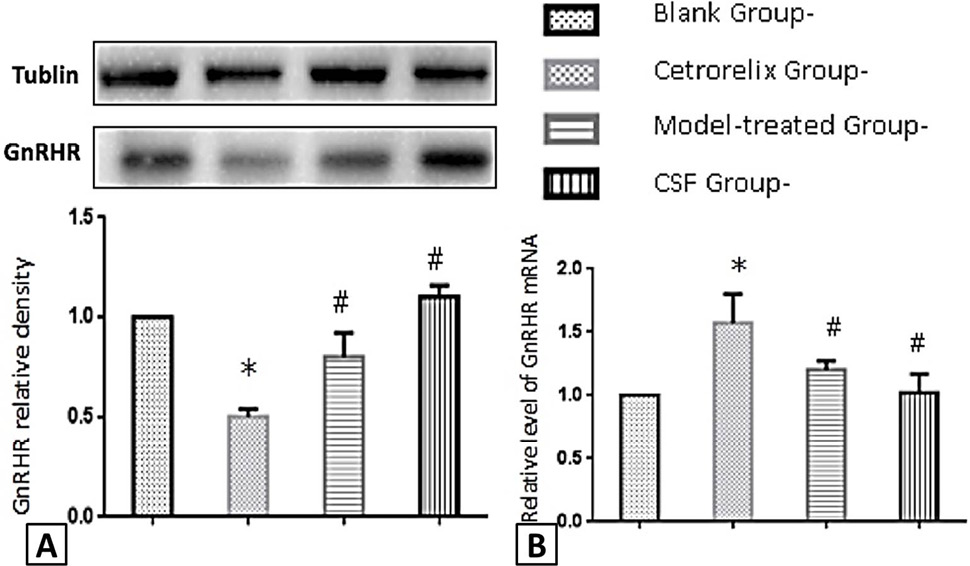
Comparison of mRNA and protein levels of GnRHR in RPC cells. A, mRNA levels of GnRHR in RPC cells; B, protein levels of GnRHR in RPC cells. *p<0.05 conpared to the blank group, #p<0.05 compared to the model-treated group.
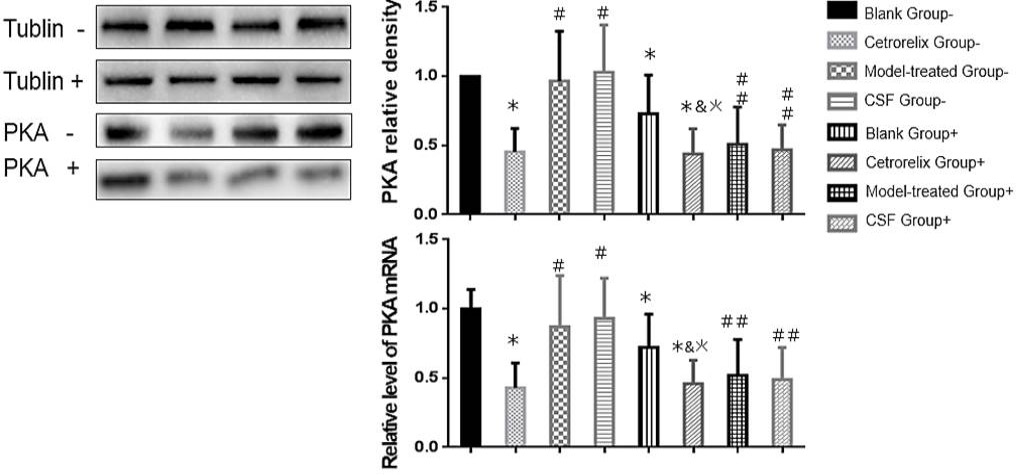
Comparison of mRNA and protein levels of PKA in RPC cells. *p<0.05 compared to the blank(-) group, #p<0.05,*p>0.05 compared to the Cetrorelix(-) group. &p<0.05 compared to the blank(+) group, ##p>0.05 compared to the Cetrorelix(+) group.
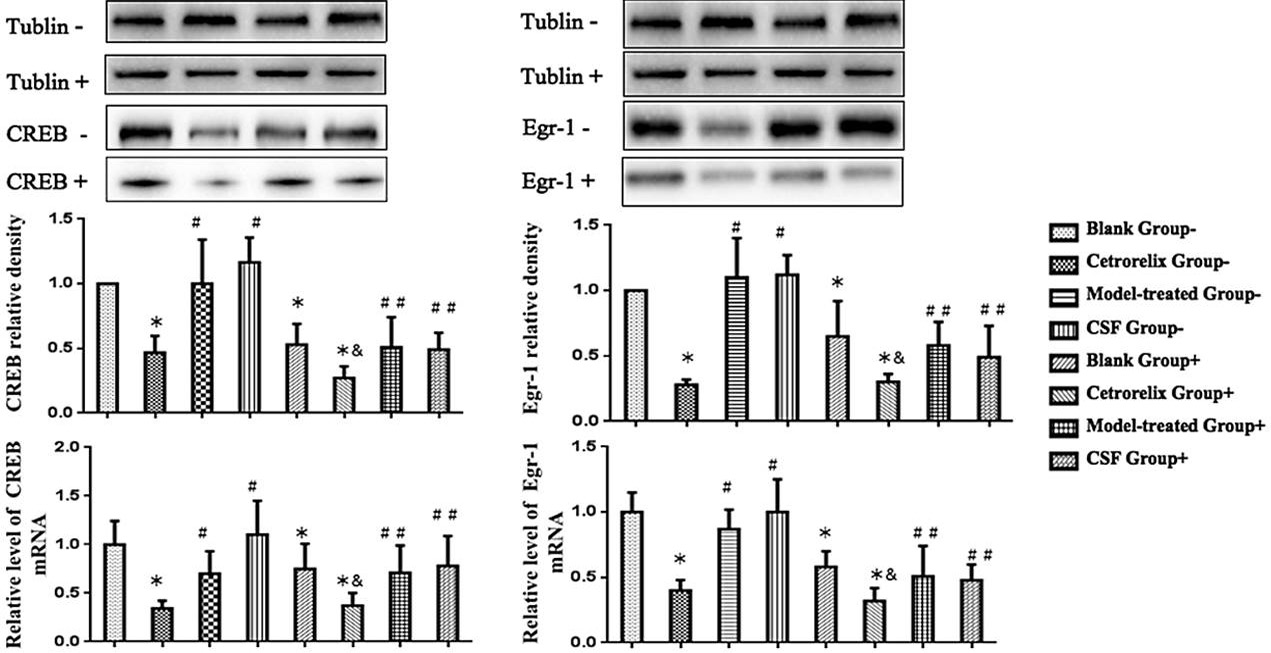
Comparison of mRNA and protein levels of CREB and Egr-1 in RPC cells. *p<0.05 compared to the blank(-) group, #p<0.05, *p>0.05 compared to the Cetrorelix (-) group. &p<0.05 compared to the blank(+) group,##p>0.05 compared to the Cetrorelix (+) group.
References
- Choi, S.G., Jia, J., Pfeffer, R.L. and Sealfon, S.C., 2012. G proteins and autocrine signaling differentially regulate gonadotropin subunit expression in pituitary gonadotrope. J. biol. Chem., 287: 21550-21560. https://doi.org/10.1074/jbc.M112.348607[CrossRef]
- Ciccone, N.A., Xu, S., Lacza, C.T., Carroll, R.S. and Kaiser, U.B., 2010. Frequency-dependent regulation of follicle-stimulating hormone by pulsatile gonadotropin-releasing hormone is mediated by functional antagonism of bZIP transcription factors. Mol. Cell. Biol., 30: 1028-1040. https://doi.org/10.1128/MCB.00848-09[CrossRef]
- Cui, W., 2010. Mother or nothing: The agony of infertility. Bull. World Hlth. Org., 88: 881-882. https://doi.org/10.2471/BLT.10.011210[CrossRef]
- Jiang, X., Zhou, H., Shi, M., Zhou, B., Liu, B., Yuan, Y., Shan, J., Xu, J. and Xie, T., 2018. Bu-shen-zhu-yun decoction promotes synthesis and secretion of FSHbeta and LHbeta in anterior pituitary cells in vitro. Biomed. Pharmacother., 102: 494-501. https://doi.org/10.1016/j.biopha.2018.02.003[CrossRef]
- Kasper, L.H., Lerach, S., Wang, J., Wu, S., Jeevan, T. and Brindle, P.K., 2014. CBP/p300 double null cells reveal effect of coactivator level and diversity on CREB transactivation. EMBO J., 29: 3660-3672. https://doi.org/10.1038/emboj.2010.235[CrossRef]
- Kida, S. and Serita, T., 2014. Functional roles of CREB as a positive regulator in the formation and enhancement of memory. Brain Res. Bull., 105: 17-24. https://doi.org/10.1016/j.brainresbull.2014.04.011[CrossRef]
- Lai Q, Hu J, Zeng D, Hu, J., Cai, F., Yang, F., Chen, C.,He, X.,He, X., Yang, P., Yu, Q., Zhang, S., Xu, J. and Wang, C., 2014. Assessing the optimal dose for cetrorelix in Chinese women undergoing ovarian stimulation during the course of IVF-ET treatment. Am. J. Transl. Res., 6: 78-84.
- Luisa, D.P.M. and Tatiana, F., 2013. GnRH-Induced Ca2+signaling patterns and gonadotropin secretion in pituitary gonadotrophs. Functional adaptations to both ordinary and extraordinary physiological demands. Front. Endocrinol., 4: 1-13.
- Maggi, R., Cariboni, A.M., Montagnani, M.M., Moretti, R.M., Andrè, V., Marzagalli, M. and Limonta, P., 2016. GnRH and GnRH receptors in the pathophysiology of the human female reproductive system. Hum. Reprod. Update, 22: 358-381. https://doi.org/10.1093/humupd/dmv059[CrossRef]
- Ma, Y., Qi, X., Song, S., Zhao, Z., Zhu, Z., Qi, J., Zhang, X., Xiao, H., Teng, Y. and Han, Z., 2005. cDNA microarray reveals signaling pathways involved in hormones expression of human pituitary. Gen. comp. Endocrinol., 143: 184-192. https://doi.org/10.1016/j.ygcen.2005.03.011[CrossRef]
- Naor, Z. and Huhtaniemi, I., 2013. Interactions of the GnRH receptor with heterotrimeric G proteins. Front. Neuroendocrinol., 34: 88-94. https://doi.org/10.1016/j.yfrne.2012.11.001[CrossRef]
- Perrett, R.M. and Mcardle, C.A., 2013. Molecular mechanisms of gonadotropin-releasing hormone signaling: Integrating cyclic nucleotides into the network. Front. Endocrinol, 4: 1-15. https://doi.org/10.3389/fendo.2013.00180[CrossRef]
- Poel, S.Z.V.D., 2012. Historical walk: The HRP special programme and infertility. Gynecol. Obstet. Invest., 74: 218-227. https://doi.org/10.1159/000343058[CrossRef]
- Seghatoleslam, A., Ferro, V.A., Mansourian, M., Kargar, M., Hosseini, M.H., Manavian, M., Ayman, G.Z. and Mostafavi-PourMehdi, N., 2014. Evaluation of immunocastration conjugates based on GnRH linked to carrier molecules in a male rodent model. Comp. clin. Pathol., 23: 805-811. https://doi.org/10.1007/s00580-013-1693-9[CrossRef]
- Son, Y.L., Ubuka, T., Millar, R.P., Kanasaki, H. and Tsutsui, K., 2012. Gonadotropin-inhibitory hormone inhibits GNRH-induced gonadotropin subunit gene transcriptions by inhibiting AC/CAMP/PKA-dependent ERK pathway in lβt2 cells. Endocrinology, 153: 2332-2343. https://doi.org/10.1210/en.2011-1904[CrossRef]
- Song, H., Zheng, Y. and Wang, X., 2013. Regulation and function of CREB signal pathway in nervous system. Chin. J. Biochem. mol. Biol., 29: 797-804.
- Sun, G., Jiang, F., Zhou, B., Wang, J. and Zhou, H., 2014. Effects of Bushen zhuyun recipe on the expression levels of MMP-9mRNA, Caspase-3mRNA in rat endometrum cells and MMP-9, TIMP-1 in cell supernatant. Lishizhen. Med. Mater. med. Res., 25: 1780-1783.
- Sun, Y. and Wu, Y., 2013. Application of gonadotropin-releasing hormone antagonist in assisted reproductive technology. J. Reprod. Med., 22: 3-8.
- Takemori, H. and Okamoto, M., 2008. Regulation of CREB-mediated gene expression by salt inducible kinase. J. Steroid Biochem. mol. Biol., 108: 287-291. https://doi.org/10.1016/j.jsbmb.2007.09.006[CrossRef]
- Taylor, S.S., Ilouz, R., Zhang, P. and Kornev, A.P., 2012. Assembly of allosteric macromolecular switches: lessons from PKA. Nat. Rev. Mol. cell. Biol., 13: 646-658. https://doi.org/10.1038/nrm3432[CrossRef]
- Thompson, I.R., Ciccone, N.A., Xu, S., Zaytseva, S., Carroll, R.S. and Kaiser, U.B., 2013. GnRH pulse frequency-dependent stimulation of FSH transcription is mediated via activation of PKA and CREB. Mol. Endocrinol., 27: 606-618. https://doi.org/10.1210/me.2012-1281[CrossRef]
- Thompson, I.R. and Kaiser, U.B., 2014. GnRH pulse frequency-dependent differential regulation of LH and FSH gene expression. Mol. cell. Endocrinol., 385: 28-35. https://doi.org/10.1016/j.mce.2013.09.012[CrossRef]
- Thompson, I.R., Ciccone, N.A., Zhou, Q., Xu, S., Khogeer, A., Carroll, R.S. and Kaiser, U.B., 2016. GnRH pulse frequency control of FSHB gene expression is mediated via ERK1/2 regulation of ICER. Mol. Endocrinol., 30: 348-360. https://doi.org/10.1210/me.2015-1222[CrossRef]
- Tsutsumi, R., Mistry, D. and Webster, N.J., 2010. Signaling responses to pulsatile gonadotropin-releasing hormone in LbetaT2 gonadotrope cells. J. biol. Chem., 285: 20262-20272. https://doi.org/10.1074/jbc.M110.132662[CrossRef]
- Wang, J. and Zhou, H., 2013. Research progress on the effect of traditional Chinese medicine intervention on the secretion function of ovarian granulose cells and the expression of related factors. Chin. J. Integr. Trad. West. Med., 33: 614-617.
- Wang, X., Tan, J., Lai, X., Wan, Z. and Wei, X., 2010. The observation of the primary culture in vitro of rats adenopituicytes and their secretion of GTH. J. Qingdao Agric. Uni. (Nat. Sci.), 27: 305-308. https://doi.org/10.3969/J.ISSN.1674-148X.2010.04.013[CrossRef]
- Zeinalzadeh, M., Yousefniapasha, Y., Jorsaray, G. and Firoozpour, M., 2014. Comparison of GnRH antagonist versus GnRH agonist on ART outcomes in patients with poor ovarian response. Iran. J. Reprod. Med., 12: 58-59.
- Zhou, H., 2001. The treatment of “Zhuyun Decoction” of luteal dysfunction infertility. Jiangsu J. Tradit. Chin. Med., 22: 8-9.
- Zhou, H., Jiang, F., Dun, W. and Tan, Y., 2009. Effect of Bushen zhuyun recipe on the morphology of endometrum and ovaries during implantation in rats. Shananxin J. Tradit. Chin. Med., 30: 117-118.
- Zhou, H., Li, A. and Tan, Y., 2009. Effects of Bushen zhuyun recipe on rrotein Expressions of estrogen receptor,progesterone receptor and Integrin α5 and β3 in endometrum of rats at the implantation stage. Chin. J. Integr. Trad. West. Med., 29: 628-631.
- Zhou, B., Zhou, H., Liu, B., Zhu, H., Dai, J., Xu, J. and Xie, T., 2017. Effect of Bushen zhuyun formula on pitultary GnRH receptor and signal transduction system in LPD rats. J. Nanjing Univ. Tradit. Chin. Med., 33: 554-559.
- Zhou, B., Zhou, H., Liu, B., Jiang, X., Xu, J., and Jiang, M., 2017. The effect of bushen zhuyun prescription on gonadotropic hormone secretion and key transcription factor expression in rat pituitary cells. Nanosci. Nanotechnol. Lett., 9: 1596-1603. https://doi.org/10.1166/nnl.2017.2506[CrossRef]
Services
Article usage statistics
Loading…