
Walnut trees infested with plant parasitic nematodes were treated with different organic amendments pigeon manure, horse dung, cow dung, duck manure and castor oil cakes at the rate of 8 Kg/tree and saw dust at the rate of 10kg/tree, respectively. Untreated trees were kept for the comparison. Soil samples and sub samples of both treated and untreated trees after 3, 6 and 12 month from Abbottabad and Mansehra by using Bearmann funnel technique. After Quantitative analysis of both treated and untreated trees, it was observed that treated trees samples showed decline in nematode number as compared to untreated trees. Organic amendments effectively controlled the nematode population. Among all applied organic amendments castor oil cakes and cow dung were found more effective and saw dust was least effective. The studies showed that organic amendments were significantly effective against nematodes.
Short Communication · Volume 50, Issue 4, 16 July 2018 · Open Access
Management of Plant Parasitic Nematodes Associated with Walnut (Juglans regia L.) by using Organic Amendments
· · · ·
Affiliations & Notes ⌄
- 1Department of Zoology, Hazara University, Mansehra, Khyber Pakhtunkhwa 2Department of Zoology, University of Swabi, Swabi, Khyber Pakhtunkhwa 3Department of Genetics, Hazara University, Mansehra, Khyber Pakhtunkhwa 4Department of Zoology, Abdulwali Khan University, Mardan, Khyber Pakhtunkhwa 5Department of Zoology, University of Buner, Buner, Khyber Pakhtunkhwa , * Corresponding author: muzafarphd@hotmail.com
- 2n_saeed83@hotmail.com
Article Info ⌄
- Journal:
- Pakistan Journal of Zoology
- Published:
- 16 July 2018

From the article
- Analysis of the data showed that organic amendments were found effective against the parasitic nematode infestation to walnut trees in both Abbottabad and Mansehra.
- Cow dung effectively reduced the number of parasitic nematodes associated with walnut trees.
- Among organic amendments applied castor oil cakes and cow dung were found more effective as compared to the pigeon manure, horse manure, duck manure and sawdust.
- Sawdust was found least effective in managing plant parasitic nematodes.
Selected from the article's own text.
Abstract
Materials and methods
Soil samples from walnut trees of different localities of Hazara division were studied for nematode infestation. Initial population of plant parasitic nematodes associated with walnut trees was noted.
Walnut trees infested with plant parasitic nematodes are divided in two groups in both Abbottabad and Mansehra. One group labeled as treated ones and other as controlled group. Walnut trees were treated with cow dung, horse manure, pigeon manure, duck manure and castor oil cakes at the rate of 8 kg/tree and saw dust at the rate of 10 kg/tree. Soil around the tree trunk was dig and amendments were applied around it. Thoroughly mix the soil with amendment with the help of spade and water the soil. Just water the plant and do not use pesticide, nematicide or herbicide on treated trees up to 12 months. Soil samples and sub samples were collected from the base of the tree trunk of both groups by digging around the trunk up to one foot deep. About 300 to 500 g soil is required for a sample. Soil samples were taken after 3 month, 6 month and 12 month, respectively. Soil samples taken in properly labeled air tight polythene bags. Process the soil sample by using Modified Bearmann funnel technique . Observe the samples under the stereoscope microscope for quantitative and qualitative analysis of both treated and controlled group soil samples. Comparison was done between the nematode population of both treated and controlled groups after 3 month, 6 month and 12 month. Data recorded of each amendment from both Abbottabad and Mansehra was subjected to histogram graphs and ANOVA.
Results and discussion
Analysis of the data showed that organic amendments were found effective against the parasitic nematode infestation to walnut trees in both Abbottabad and Mansehra. Recorded data of organic amendments including cow dung, horse manure, pigeon manure, castor oil cakes, duck manure and saw dust were analyzed in both Abbottabad and Mansehra on walnut trees. Figures 1 and 2 show the effect of organic amendments including cow dung, horse manure, pigeon manure, castor oil cakes, duck manure, and saw dust against nematode infestation in Abbottabad (Fig. 1) and Mansehra (Fig. 2). ANOVA of the recorded data of all amendments showed that p value for all amendments in both Abbottabad and Mansehra was found significant.
Cow dung effectively reduced the number of parasitic nematodes associated with walnut trees. Therefore, it was found effective against parasitic infestation. Galadima et al. (2015) found use of cow dung effective against nematode infestation in the same way as in this study. Study of Ismail and Youssef (1997) showed that duck manure and horse manure reduced the population of plant parasitic nematodes as in this study. Study of Khan et al. (2001)
are in relevance to this study on the management of plant parasitic nematodes by using pigeon manure and sawdust.
Castor oil cakes also reduced the plant parasitic nematodes. Rehman et al. (2014) showed that castor oil cakes effectively manage the plant parasitic nematodes. Sawdust was found least effective in controlling nematode infestation. This finding is similar as to the finding of the study carried out by Hassan et al. (2010) in the use of sawdust for the management of plant parasitic nematodes. Mishra and Gupta (1997) also found sawdust less effective as compared to the oil cakes against the plant parasitic nematode infestation. Organic manures on decomposition releases several components like nitrogen, magnesium, potassium and calcium in the soil. These components are important for the proper plant growth and yield. As a result, plant growth increases because of reduced nematode population and improved soil texture. Plant yield also increases with the passage of time because of reduced nematode infestation. The pH of the soil increases because of the decomposition of the organic amendments making the soil less suitable for the plant parasitic nematode growth and reproduction. Among organic amendments castor oil cakes and cow dung were found more effective as compared to the other applied amendments against nematode infestation while sawdust was found very less effective.
Conclusion
Among organic amendments applied castor oil cakes and cow dung were found more effective as compared to the pigeon manure, horse manure, duck manure and sawdust. Sawdust was found least effective in managing plant parasitic nematodes. Organic amendments have positive effect on walnut trees health, growth and yield as well. As organic manures are environment friendly in nature and free of any chemicals, therefore their use against plant parasitic nematodes should be encouraged in horticulture practices.
Statement of conflict of interest
Authors have declared no conflict of interest.
Figures
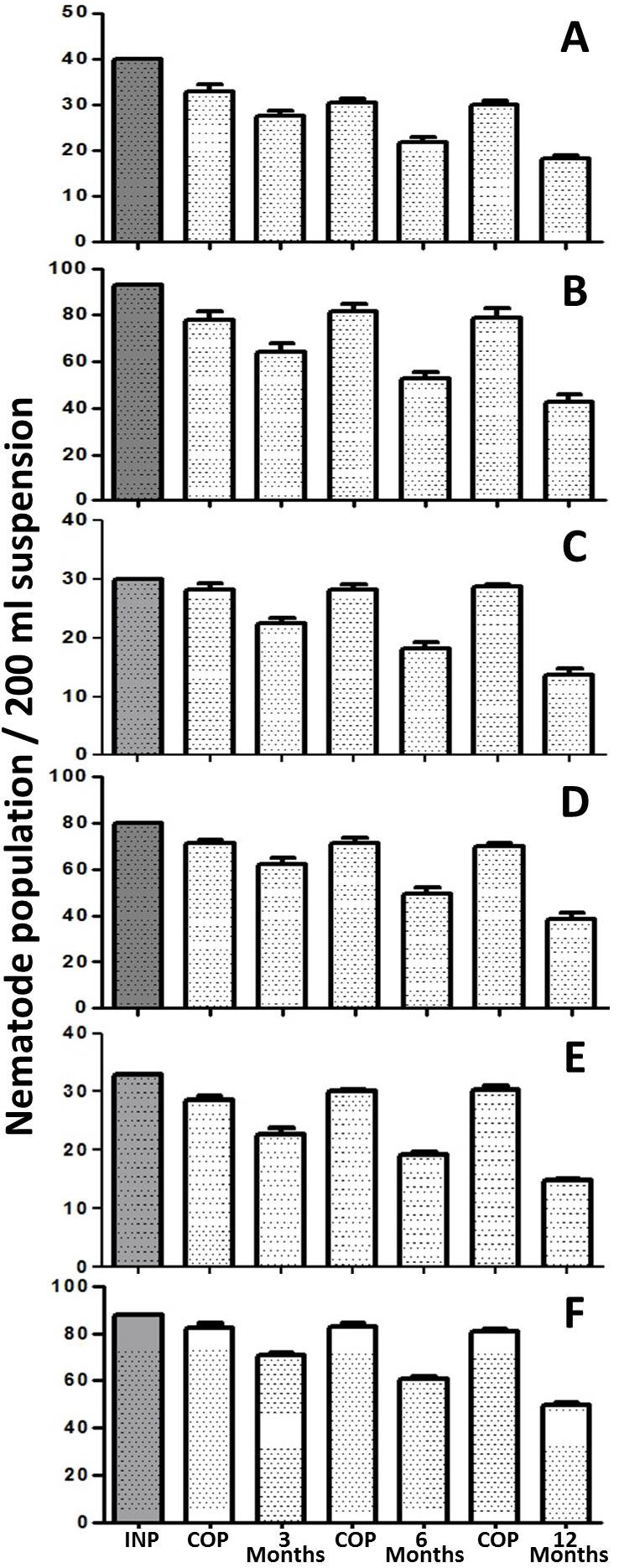
Effect of cow dung (A), horse manure (B), Pigeon manure (C), duck manure (D), castor oil cakes (E) and saw dust (F) on nematode population in Abbottabad. INP, initial population; COP, controlled population.
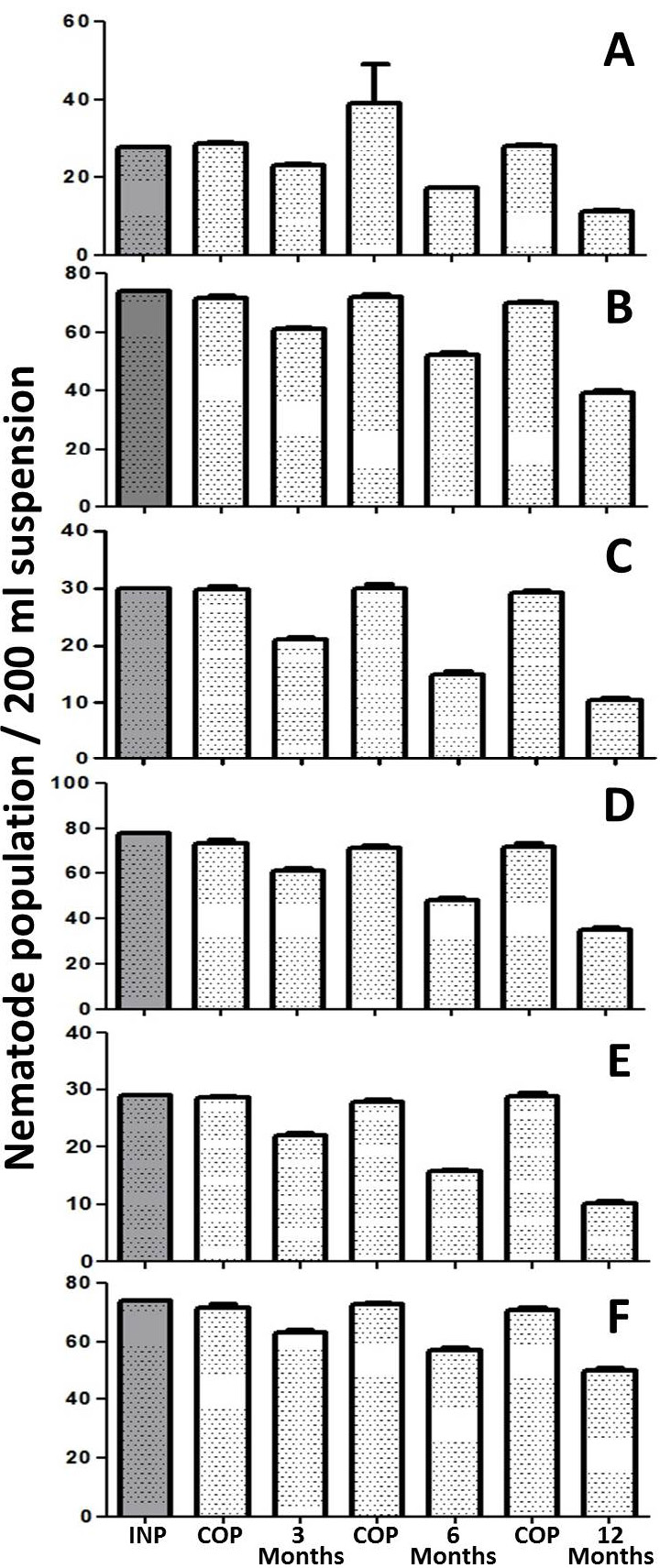
Effect of cow dung (A), horse manure (B), Pigeon manure (C), duck manure (D), castor oil cakes (E) and saw dust (F) on nematode population in Mansehra. INP, initial population; COP, controlled population.
References
- Abolusoro, S.A. and Abolusoro, P.F., 2012. Scient. J. Agric., 1: 138-144I.
- Abolusoro, S.A., Abolusoro, P.F., Mathew, F.O. and Izuogu, N.B., 2013. World J. Agric. Res., 1: 104-107.
- Chaudhary, K.K. and Kaul, R.K., 2013. J. Agric. Sci. Tech, 15: 617-626.
- Daramola F.Y., Afolami S.O., Idowu A.A. and Odeyemi I.S., 2013. Int. J. agric. Sci., 3: 298-307.
- Galadima, I.B., Auwal, H.M., Abubakar, I., Madu, J. and Joseph, P., 2015. Open Access Library J., 2: e1779. https://doi.org/10.4236/oalib.1101779[CrossRef]
- Hassan, M.A., Chindo, P.S., Marley, P.S. and Alegbejo, M.D., 2010. Pl. Protect. Sci., 46: 34-38. https://doi.org/10.17221/1/2009-PPS[CrossRef]
- Ismail, A.E. and Youssef, M.M.A., 1997. Anz. Schädlingsk., 70: 58-61.
- Khan, A., Shaukat, S.S., Qamar, F., Islam, S., Hakro, A.A. and Jaffry, A.H., 2001. Pakistan J. biol. Sci., 4: 417-418.
- Khan, A., Shaukat, S. and Shahid, M., 2011. Indian J. Nematol., 41: 1-3.
- Kleynhans, K.P.N., Van den Berg, E., Swart, A., Marais, M. and Buckley, N.H., 1996. Collecting and preserving nematodes. Plant Protection Research Institute, ARC, Pretoria, pp. 2-14.
- McSorley, R., 2011. J. Nematol., 43: 69-81.
- Mishra, S.M. and Gupta, P., 1997. Indian Phytopath., 50: 131-132.
- Nicholson, F.A., Chambers, B.J. and Smith, K.A., 1996. Bioresour. Technol., 58: 279-284. https://doi.org/10.1016/S0960-8524(97)86087-7[CrossRef]
- Osunlola, O.S. and Fawole, B., 2015. Int. J. Agron., 1: 1-5. https://doi.org/10.1155/2015/725363[CrossRef]
- Rahman, L., Whitelaw-Weckert, M.A. and Orchard, B., 2014. Soil Res., 52: 604-619. https://doi.org/10.1071/SR14041[CrossRef]
- Rehman, B., Ganai, M.A., Parihar, K., Asif, M. and Siddiqui, M.A., 2014. Europ. J. appl. Sci., 6: 57-63.
- Rizvi, R., Mahmood, I. Tiyagi, S.A. and Khan, Z., 2012. Brazil. Arch. Biol. Technol., 55: 801-808. https://doi.org/10.1590/S1516-89132012000600001[CrossRef]
- Sara, A., Jara, P. and Fulgencio, S., 2007. Europ. Fd. Res. Technol., 227: 425-431.
- Southey, J.F., 1970. Minist. Agric. Fish. Fd. Tech. Bull., 2: 148.
- Umar, I. and Simon, S.Y., 2008. Agric. J., 3:349-352.
- Wani, A.H. and Bhat, M.Y., 2012. J. Biopest, 5: 255-258.
Cited by 1 article
In journals published by ResearchersLinks.
Services
Article usage statistics
Loading…