
Artemisia vulgaris, a medicinal plant with various pharmacological properties, has a longstanding history of global utilization. The biochemical components substantially impact the economy and pharmacological sector, providing various advantages. Nepetin, a flavonoid found in Artemisia plants, has been shown to possess various biological effects including anti-oxidant, anti-inflammatory, anti-cancer, and anti-apoptotic properties. In this study, nepetin as yellowish powder was isolated from A. vulgaris extract through column chromatography. Structure of the compound was elucidated through various spectroscopic techniques such as Mass and NMR (1D and 2D).
Research Article · Volume 74, Issue 1, 11 October 2024 · Open Access
Isolation of Nepetin (6-Methoxyluteolin) from Artemisia vulgaris and Spectroscopic Characterization: A Bioactive Flavonoid
·
Affiliations & Notes ⌄
- 1Chemistry Branch, Biological Science Research Division, Pakistan Forest Institute Peshawar, Peshawar, Khyber Pakhtunkhwa, Pakistan
- 2Central Department of Chemistry Tribhuvan University Kirtipur, Kathmandu, Nepal. *Correspondence | Salim Saifullah, Chemistry Branch, Biological Science Research Division, Pakistan Forest Institute Peshawar, Peshawar, Khyber Pakhtunkhwa, Pakistan
- 3Email: salim_saifullah28@yahoo.com
Article Info ⌄
- Journal:
- Pakistan Journal of Forestry
- Published:
- 11 October 2024

From the article
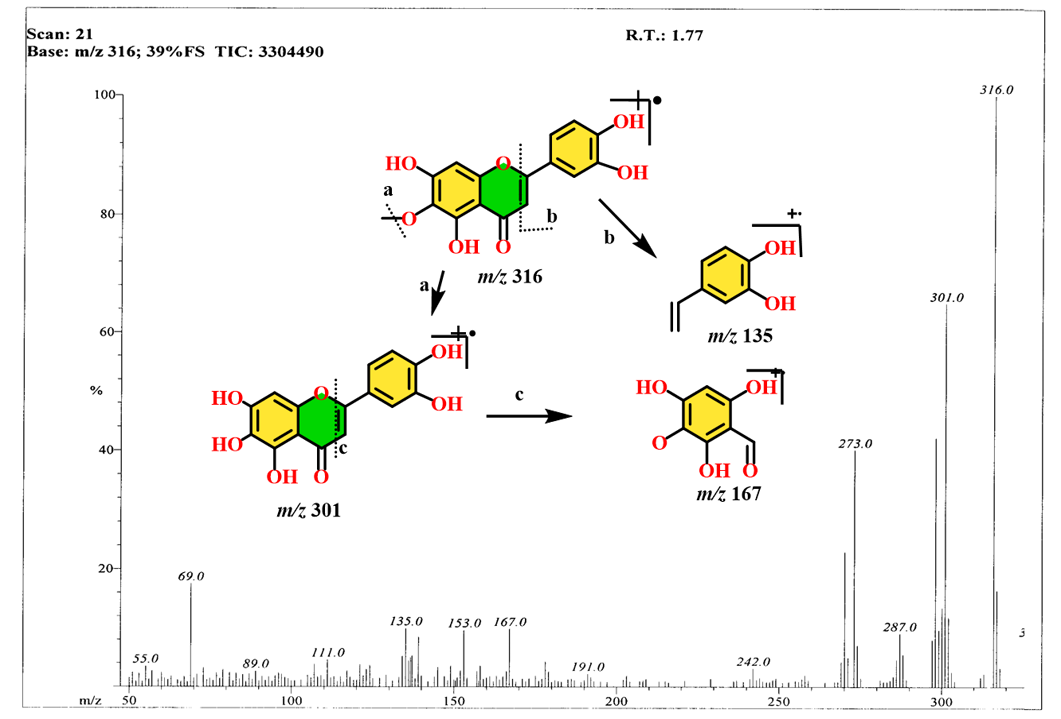
- Nepetin’s EI-MS spectrum showed the base peak and a [M+H] at m/z 316 (Figure 3).
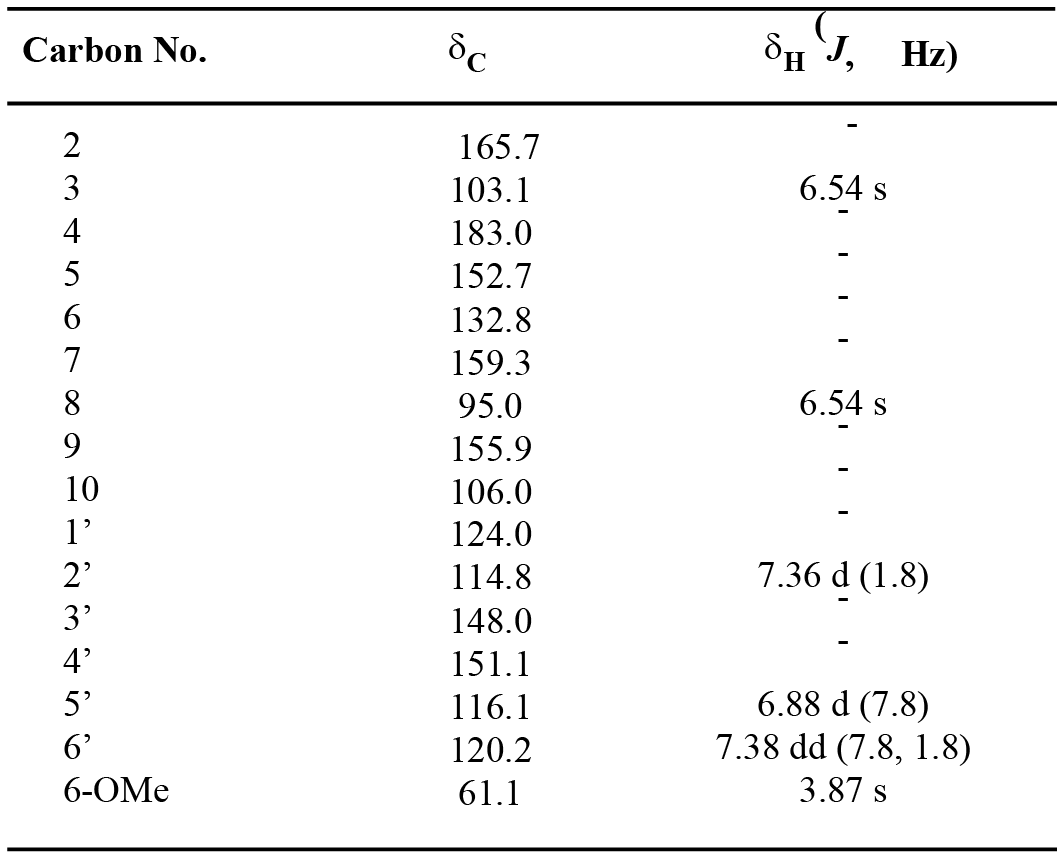
- The 1H-NMR spectrum of nepetin, as presented in Table 1, exhibited a resonance at δ 3.87, which was assigned to the protons of the methoxy group linked to C-6.
- The results reveal that extracts from A. vulgaris are a rich source of nepetin, a bioactive flavonoid.
- Nepetin has exhibited several biological effects, including antioxidant, anti-inflammatory, anti-cancer, and anti-apoptotic activities.
Selected from the article's own text.
Abstract
Introduction
Artemisia vulgaris (A. vulgaris), a significant medical plant species in the genus Artemisia, is known for its volatile essential oils. The biological and chemical variety of the genus Artemisia, along with the discovery and isolation of the potential malarial treatment compound artemisinin, have drawn the great attention . Herbal remedies from A. vulgaris have been used globally for treating various diseases, including malaria, inflammation, infection prevention, hepatoprotective, immunomodulatory, hypertensive, cancer, and anti-oxidant . These remedies are primarily based on organic acids, acetylenes, coumarins, sesquiterpene lactones, phenolic acids, flavonoids, and other secondary metabolites . There has been a considerable increase in studies relating to its phytochemistry, anatomy, and morphology to better understand the formation and accumulation of medicinal chemicals in A. vulgaris. The medicinal potential of bioactive substances derived from A. vulgaris has been recently supported by pharmacological and phytochemical studies ; ; . These results add to the growing body of information that should be considered when trying to synthesize more affordable alternatives to existing anti-malarial medications through the discovery and isolation of new chemicals.
Nepetin, referred to as 6-Methoxyluteolin or Eupafolin, is a naturally occurring flavonoid found in several plant species, including the Artemisia herb . Nepetin has demonstrated a range of biological effects such as anti-oxidant, anti-inflammatory, anti-cancer and anti-apoptotic properties ; . It demonstrated a strong capacity to inhibit bone resorption and osteoclast differentiation in vitro, while also providing protection to mice against Ti particle–induced calvarial osteolysis through decreasing both the activity and quantity of osteoclasts . Nepetin minimizes the expression of virulence factors by specifically targeting ClpP in the context of multi-drug-resistant S. aureus-induced pneumonia infection . Yoon et al. (2022) discovered that nepetin, a multi-targeting inhibitor of Protein Tyrosine Phosphatases (PTPs), decreases the catalytic activity of PTPs in vitro and enhances glucose absorption in mature 3T3-L1 adipocytes, indicating its potential as a therapeutic candidate for type 2 diabetes treatment . Herein, we reported the detail procedure of isolation of nepetin (6-Methoxyluteolin) from A. vulgaris and its structure elucidation through various spectroscopic techniques.
Materials and Methods
General experimental
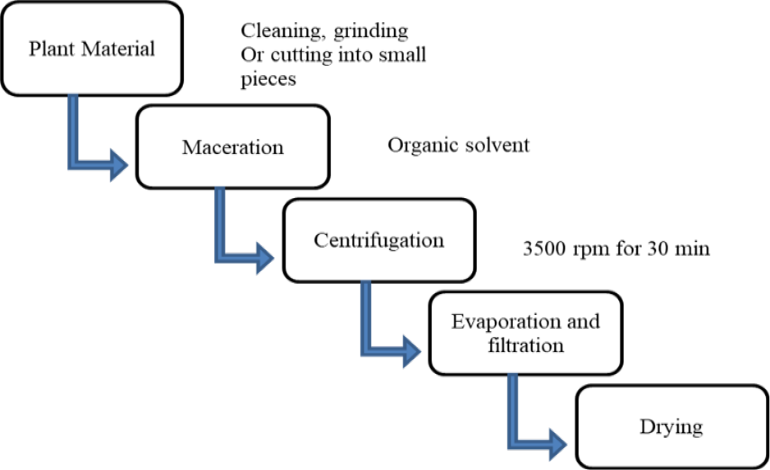
2.75 kg of air-drying plant material is ground or chopped into small fragments to form a homogeneous powder and subsequently macerated at a ratio of 1 g to 10 mL in methanol. The following flowchart delineates the extraction process (Figure 1).
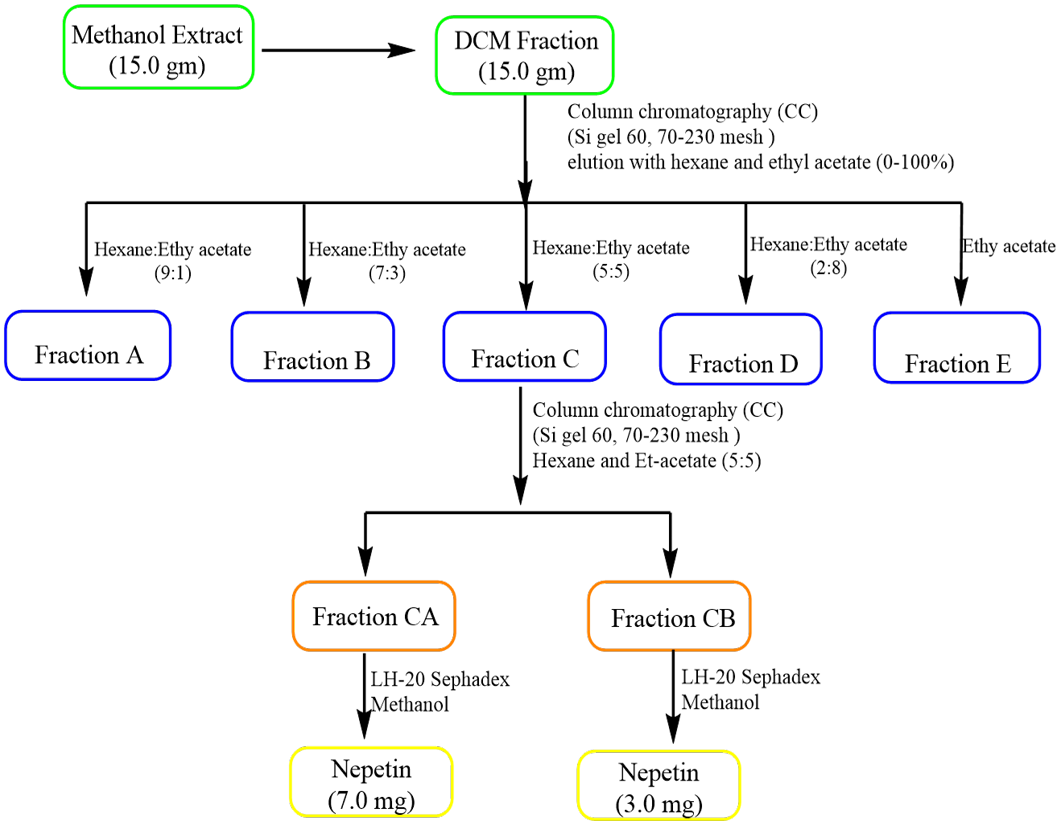
The crude extract was filtered using a silica gel and Merck alumina column, while semi-pure fractions underwent chromatography on an LH-20 Sephadex packed column (Figure 2). Thin-layer chromatography was employed to identify and quantify chemicals. Silica gel-coated TLC plates were employed to assess the purity of chemicals in extracts or their pure forms. The compounds were examined under UV light for fluorescence quenching and fluorescent staining, with their spots seen using ceric (IV) sulfate for flavonoid testing.
Spectroscopic techniques
The study employed a mass spectrometer to get EI-MS spectra, utilizing the Jeol MS pathway in conjunction with TSS 2000. Bruker Avance instruments were employed to acquire 1H-NMR and 13C-NMR spectra at different frequencies. The multiplicity of carbon signals was assessed using DEPT 90° and 135° tests, while the impacts of homo-nuclear 1H-1H connection were determined by the COSY 45° experiment. HSQC and HMBC studies were performed to ascertain one-bond and two- and three-bond 1H-13C connectivity.
Results and Discussion
Homogenized plant material of A. vulgaris was macerated with 100% methanol for three days. After dissolving the extract in distilled water, it underwent fractionation using hexanes. 15.0 gm of DCM fraction has been obtained by extracting the watery layer with CH2Cl2, and removed the remaining 20 gm of watery layer with ethyl acetate. LH-20 sephadex and silica gel columns were used for chromatography of the ethyl acetate fractions and DCM, respectively. The yellow solid known as nepetin (6-methylluteolin) was obtained by employing column chromatography of the DCM fraction with a mobile phase consisting of hexane: Ethylacetate (1:1) and methanol (1:2) ratio. After spurting with cerric sulphate spray, it was observed as a yellow pustule on a silica gel TLC plate.
Nepetin’s EI-MS spectrum showed the base peak and a [M+H] at m/z 316 (Figure 3). A breakdown of nepetin produced the important fragment ions at m/z 135, 167, 301, and 316. The isolated component was determined to be a flavonoid based on the fragment sequence.
The 1H-NMR spectrum of nepetin, as presented in Table 1, exhibited a resonance at δ 3.87, which was assigned to the protons of the methoxy group linked to C-6. The signal observed at δ 6.54 s was attributed to H-8 and H-3, respectively. Three downfield signals were observed at 7.38dd (J2’, 6’=1.8 Hz; J5’, 6’ =7.8,), 6.88d (J6’, 5’=7.8 Hz), and δ 7.36d (J6’, 2’=1.8 Hz) which were assigned to protons H-6’, H-5’, and H-2’, respectively. The comprehensive analysis of the DEPT and BB 13C-NMR spectra (Table 1) indicated the presence of resonance for sixteen distinct carbon atoms, comprising ten quaternary carbon centers, five methine units, and one methyl group.
In order to conform the structure of nepetin and determine the location of the methoxy group, 2D NMR (NOESY, COSY, HMBC, and HSQC) spectroscopy was utilized (Figure 4). Figure 4 clearly demonstrated the location of the methoxy group in the molecule as the HMBC interaction between protons and carbons resonated at δ 132.8 (C-6) and δ 3.87. The isolated compound correlates with previously reported compound nepetin in all spectroscopic and physical measurements .
Conclusion and Recommendations
The results reveal that extracts from A. vulgaris are a rich source of nepetin, a bioactive flavonoid. Nepetin has exhibited several biological effects, including antioxidant, anti-inflammatory, anti-cancer, and anti-apoptotic activities. Consequently, the extract of A. vulgaris may serve as a foundational component for the production of herbal products to treat diseases.
Acknowledgements
We would like to thank Dr. Khaga Raj Sharma, Central Department of Chemistry Tribhuvan University, for helping in the collection of plant.
Novelty Statement
Nepetin, a flavonoid found in Artemisia plants, has been isolated and its structure elucidated using spectroscopic techniques, showing potential in various biological applications.
Author’s Contribution
Salim Saifullah: Conceptualization, methodology, data curation, data interpretation, data visualization.
Achyut Adhikari: Conceptualization, supervision, plant material collection, reviewing and editing original draft and revision and writing first draft and writing revised drafts.
Conflict of interest
The authors have declared no conflict of interest.
Figures
Extraction process.
1H- and 13C-NMR chemical shift values of nepetin.
Isolation of nepetin from A. vulgaris.
Characteristics EI-MS fragmentation of nepetin.
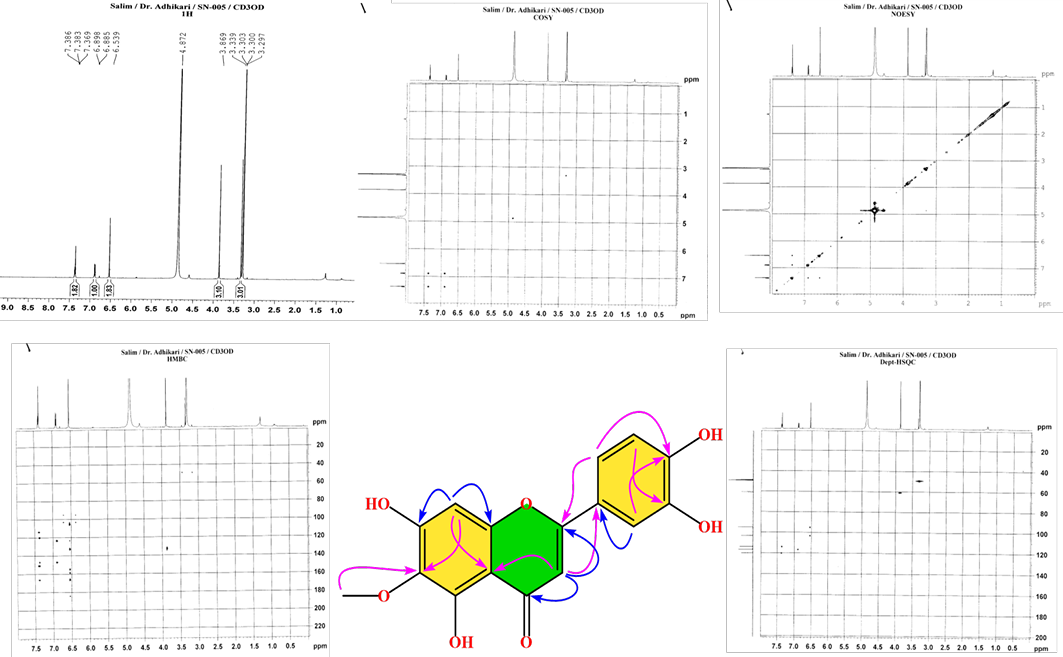
1D and 2D NMR spectra and characteristic HMBC correlations of nepetin.
References
- Abiri, R., Silva, A.L.M., de Mesquita, L.S.S., de Mesquita, J.W.C., Atabaki, N., de Almeida Jr, E.B., Shaharuddin, N.A. and Malik, S., 2018. Towards a better understanding of Artemisia vulgaris: Botany, phytochemistry, pharmacological and biotechnological potential. Food Res. Int., 109: 403-415. https://doi.org/10.1016/j.foodres.2018.03.072[CrossRef]
- Chu, B., Chen, S., Zheng, X., Ye, J., Cheng, X., Zhang, L., Guo, D., Wang, P., Hong, D., and Hong, Z., 2020. Nepetin inhibits osteoclastogenesis by inhibiting RANKL-induced activation of NF-κB and MAPK signalling pathway, and autophagy. J. Cell. Mol. Med., 24(24): 14366-14380. https://doi.org/10.1111/jcmm.16055[CrossRef]
- Ekiert, H., Pajor, J., Klin, P., Rzepiela, A., Ślesak, H. and Szopa, A., 2020. Significance of Artemisia vulgaris L. (Common Mugwort) in the history of medicine and its possible contemporary applications substantiated by phytochemical and pharmacological studies. Molecules, 25(19): 4415. https://doi.org/10.3390/molecules25194415[CrossRef]
- Jing, S., Ren, X., Wang, L., Kong, X., Wang, X., Chang, X., Guo, X., Shi, Y., Guan, J., Wang, T., Wang, B., Song, W. and Zhao, Y., 2022. Nepetin reduces virulence factors expression by targeting ClpP against MRSA-induced pneumonia infection. Virulence, 13(1): 578-588. https://doi.org/10.1080/21505594.2022.2051313[CrossRef]
- Liu, K., Park, C., Chen, H., Hwang, J., Thimmegowda, N., Bae, E.Y., Lee, K.W., Kim, H.G., Liu, H. and Soung, N.K., 2015. Eupafolin suppresses prostate cancer by targeting phosphatidylinositol 3-kinase-mediated Akt signaling. Mol. Carcinogen., 54(9): 751-760. https://doi.org/10.1002/mc.22139[CrossRef]
- Maas, M., Deters, A.M. and Hensel, A., 2011. Anti-inflammatory activity of Eupatorium perfoliatum L. extracts, eupafolin, and dimeric guaianolide via iNOS inhibitory activity and modulation of inflammation-related cytokines and chemokines. J. Ethnopharmacol., 137(1): 371-381. https://doi.org/10.1016/j.jep.2011.05.040[CrossRef]
- Sharma, K.R. and Adhikari, S., 2023. Phytochemical analysis and biological activities of Artemisia vulgaris grown in different altitudes of Nepal. Int. J. Food Prop., 26(1): 414-427. https://doi.org/10.1080/10942912.2023.2166954[CrossRef]
- Shim, S.Y., Park, J.R. and Byun, D.S., 2012. 6-Methoxyluteolin from Chrysanthemum zawadskii var. latilobum suppresses histamine release and calcium influx via down-regulation of $ Fc {\varepsilon} RI $${\alpha} $ chain expression. J. Microbiol. Biotechnol., 22(5): 622-627. https://doi.org/10.4014/jmb.1111.11060[CrossRef]
- Singh, N.B., Devi, M.L., Biona, T., Sharma, N., Das, S., Chakravorty, J., Mukherjee, P.K. and Rajashekar, Y., 2023. Phytochemical composition and antimicrobial activity of essential oil from the leaves of Artemisia vulgaris L. Molecules, 28(5): 2279. https://doi.org/10.3390/molecules28052279[CrossRef]
- Siwan, D., Nandave, D. and Nandave, M., 2022. Artemisia vulgaris Linn: An updated review on its multiple biological activities. Future J. Pharma. Sci., 8(1): 47. https://doi.org/10.1186/s43094-022-00436-2[CrossRef]
- Yoon, S.Y., Ahn, D., Kim, J.K., Seo, S.O. and Chung, S.J., 2022. Nepetin acts as a multi-targeting inhibitor of protein tyrosine phosphatases relevant to insulin resistance. Chem. Biodiv., 19(1): e202100600. https://doi.org/10.1002/cbdv.202100600[CrossRef]
- Zhang, H., Chen, M.K., Li, K., Hu, C., Lu, M.H. and Situ, J., 2017. Eupafolin nanoparticle improves acute renal injury induced by LPS through inhibiting ROS and inflammation. Biomed. Pharmacother., 85: 704-711. https://doi.org/10.1016/j.biopha.2016.11.083[CrossRef]
Services
Article usage statistics
Loading…