
The mandarin voles (Lasiopodomys mandarinus) is a subterranean rodent that spends its entire life underground in burrow systems, having to endure a hypoxic environment. In this study, we used the embedded artificial tunnel method in a natural burrow system to measure oxygen (O2) and carbon dioxide (CO2) concentrations and the temperature and humidity in the underground burrows of mandarin voles in Xinzheng, Henan Province, China during the spring and summer of 2015. Our results show that 1) the depth and complexity of the burrow were higher during summer than during spring; 2) maximal CO2 levels (2.55%) and minimal O2 levels (16.04%) were recorded in the underground burrows during summer; and 3) the temperature and humidity in the underground burrows were relatively stable during spring and summer. In conclusion, mandarin voles face hypoxic/hypercapnic stress predominantly during summer. The humidity and temperature of the burrows were relatively stable and were not affected by seasonal variation. The burrow system of mandarin voles was more complex and deeper during the rainy summer season. Our study provides a basis for further investigations regarding the evolutionary, physiological, and molecular basis of hypoxia-hypercapnia inmandarin voles.
Research Article · Volume 51, Issue 4, 18 May 2019 · Open Access
Investigation on Oxygen and Carbon Dioxide Fluctuations in Lasiopodomys mandarinus Burrows
· · · · · ·
Affiliations & Notes ⌄
- 1School of Life Sciences, Zhengzhou University, No. 100 Science Avenue, Zhengzhou, Henan Province 450001, P.R. China 2Institute of Forensic Science, Ministry of Public Security, No.17, South Muxidi Lane, Xicheng District, Beijing 100038, P.R. China , Sun Hong and Zhang Yifeng have contributed equally in this article. , * Corresponding author: wzl@zzu.edu.cn
Article Info ⌄
- Journal:
- Pakistan Journal of Zoology
- Published:
- 18 May 2019

From the article
- As strict and widespread subterranean rodents, mandarin voles face hypoxic/hypercapnic stress in their underground burrows.
- Our results indicate that the characteristics of these burrow systems are affected by the seasons, however, additional studies examining other conditions, such as cold snowy winters, are required to complement our findings.
- Our study lays the foundation for further investigations into the evolution, physiology, and molecular basis of the tolerance of mandarin voles to hypoxia-hypercapnia and darkness.
Selected from the article's own text.
Abstract
Introduction
Subterranean rodents are rodents that live in an underground burrow ecotope throughout their life ; ; . Subterranean rodents can be classified into 25 genera, five families, three subfamilies and approximately 160 species . They are widely distributed in Asia, Africa, America, and Europe. The habitats of subterranean rodents are tropical grasslands, grasslands, mountains, arid and semi-arid areas, dense thickets, and forests. The specific climate, soil type, and vegetation pattern in a habitat determine the morphological traits and microclimate of burrows .
All subterranean rodents utilise a unique tunnel system ; , which affords them several favourable conditions such as relatively stable temperatures, humidity and protection from many predators in the sealed burrows ; . However, subterranean rodents are exposed to multiple stresses including low O2 levels (hypoxia), high CO2 levels, darkness and energy costs of digging . Hypoxic/hypercapnic conditions and darkness are the most stressful challenges all subterranean rodents face in the burrow environment ; ; ; ; . Previous reports have shown that Spalax carmeli inhabiting heavy clay soil can survive under minimal O2 levels (7.2%) and maximal CO2 levels (6.1%) ; the extreme gas concentration values in golden hamsters reach 10.0% O2 and 10.8% CO2 ; and Heterocephalus glaber (naked mole-rat) can tolerate hours of extreme hypoxia and survive 18 min of total oxygen deprivation (anoxia) without any apparent injury . Previous research has demonstrated that subterranean mammals have evolved complex adaptive mechanisms that allow them to cope with severe hypoxia including physiological strategies, molecular biological mechanisms and adaptive evolution ; ; ; ; . These include improved oxygen delivery and high blood haemoglobin and haematocrit concentrations ; ; . The naked mole-rat has even evolved the ability to use fructose to fuel vital organs, such as the heart and brain, during anoxia ; .
The mandarin voles (Lasiopodomys mandarinus) is a typical subterranean rodent species found in central China, the southern and central Korean Peninsula, north and central Mongolia and the adjacent areas of Siberia south of Lake Baikal in the Russian Federation ; ; ; ; . Mandarin voles are wild, territorial and solitary rodents and are one of the main rodents causing damage to fields in central China ; .
Similar to other subterranean rodents, the most stressful challenges faced by mandarin voles are hypoxic/hypercapnic conditions in their underground environment. Mandarin voles have developed unique physiological and molecular mechanisms to deal with hypoxic stress not present in other above-ground rodents ; ; . An increase in haemoglobin concentration can enhance oxygen delivery in mandarin voles, and their platelet number is significantly lower than in mice . Furthermore, the expression of hypoxic related genes, such as HIF-1α, vascular endothelial growth factor (VEGF) , period circadian clock 3 (PER3), thrombospondin 1 (THBS1), and hexokinase 1 (HK1), is enhanced under hypoxia. Transcription data has shown that following exposure to hypoxic conditions; genes that control functions such as oxygen transportation, angiogenesis, anti-angiogenesis, DNA repair, apoptosis and autophagy were up-regulated in the brains of mandarin voles .
The habitat of mandarin voles in China is situated in temperate monsoon areas with a highly seasonal rainfall distribution , the dry season includes winter and spring, and the rainy season occurs during summer and autumn ; . This persistent seasonal rainfall constitutes an important stress for this subterranean species, the water-logged soil becomes airtight, resulting in high CO2 and low O2 concentrations in the burrow. In this study, we measured the O2 and CO2 fluctuations and temperature and humidity in burrows during spring and rainy summer, and examined the stress of rain on subterranean rodents. The findings of this study further elucidate the natural basis of the physiological and molecular adaptations of mandarin voles enabling hypoxia-hypercapnia tolerance.
Materials and methods
Excavation of burrow systems
Measurements were carried out during spring (April-May) and summer (June-August) of 2015 in farmland (113.73°E, 34.40°N) in Xinzheng, Henan province, China. Burrow systems were excavated manually with a spade to expose the entire tunnel system ; . Tunnel length and burrow depth were measured using a tape measure. The measurement dates were presented as average value and SEM. Nests were defined as areas filled with nesting material such as dry grass, the granary was defined as the area in the tunnel system containing large amounts of food resources such as peanuts, wheat, and geophyte, and the blind-ended tunnel packed with faeces was regarded as the toilet .
Measurement of gases, temperature, and humidity
The burrow systems of mandarin voles were identified by the presence of fresh mounds on the surface, and the tunnels were then excavated ; ; . If the tunnel became blocked in a short time, we judged that it was being used by mandarin voles. The location of underground tunnels or chambers was determined by piercing the soil with a 10 mm (diameter) steel rod. Once a tunnel was located, a hard PVC pipe was immediately and correctly inserted into the tunnel. To obtain gas samples, a plastic tube, with a length greater than 50cm, was attached to the underground PVC pipe wall. The other end of the plastic tube was attached to a clip and exposed to the air.
O2 and CO2 concentrations were measured using a pump suction O2 detector and pump suction CO2 detector (ADKS, Electromechanical Instruments, Slater, Qingdao, China) with sensitivity ranging from 0-50 000 ppm ± 3% F.S. for CO2 and 0-30% ± 3% F.S. for O2. Soil volumetric water content (volume of liquid water per volume of soil, %) was measured using a soil moisture measuring apparatus (Tsingtao Toky Instruments, China) with a 40 cm probe. The humidity in the tunnel was measured using a hygrometer with a 20 cm probe. Burrow and air temperature were measured using a high precision digital thermometer (-50–300 °C ± 0.1).
All measurements were carried out from 08:00–18:00, at 8:00, 12:00, 14:00 and 18:00, and measurements were conducted at least for a week.
Statistical analysis
Statistical analysis was performed using SPSS for Windows (version 13.0). The mean or maximal and minimal absolute values of the daily measurements were used for subsequent comparative analysis. Comparisons between data sets were performed using a mixed model, with P < 0.05 as the criterion of significance.
Results
The burrow systems
The burrow systems of the mandarin voles contained nest chambers, toilet, granary, and tunnels (Fig. 1). Central tunnels were connected to the nest area, toilet, and granary, and secondary tunnels, including a number of shallow tunnels, were used to obtain food and for courtship. Shallow tunnels generally led off from the main deeper tunnels. Burrow systems were generally comprised of tunnels at different depths. Main central tunnels had a depth of 35–68 cm, whereas shallow tunnels had a depth of 10-30 cm. The main nest used in summer (56 ±0.33 cm, n = 6) was deeper than that used in spring (47.66 ±0.19 cm, n = 5). The average tunnel depth in spring and summer was 21.33 ±0.84 cm and 24.66 ±0.84 cm, respectively (n = 12). The length of the burrows system in summer was relatively longer than in spring. Three to five fresh mounds were produced per burrow system.
Temperature and humidity in the burrow system and soil moisture content
The temperature in the underground burrows was relatively stable and lower than the corresponding air temperature both in spring and summer (F = 96.676, df = 85, P < 0.01; Fig. 2). However, the temperature in the burrows during summer was higher than that during spring (F = 96.676, df = 85, P < 0.01). There was no significant difference in burrow temperature during summer for the four measurement time points (F = 1.132, df = 196, P > 0.05); however, there was a significant change in burrow temperature between the four measurement time points in spring (F = 20.007, df = 16, P < 0.01).
No significant difference was observed between burrow humidity in spring and summer (F = 171.285, df = 95, P > 0.05), and the humidity in the burrows was maintained at a stable level. However, the humidity in the burrows was significantly higher than in the air (F = 171.285, df = 95, P < 0.01). Soil moisture at a depth of 40 cm was significantly higher in summer than in spring (F = 92.199, df = 47, P < 0.01; Fig. 3).
Fluctuations in O2 and CO2
The burrow systems of mandarin voles exhibited fluctuations in gas composition. Minimal O2 levels (16.04%) were measured during the heavy rainy summer (Fig. 3). Rain had a significant influence on O2 concentration in the burrows of mandarin voles (F = 216.370, df = 66, P < 0.01). Overall, measurement time had no significant influence on O2 concentration (Wald Z = 0.909, P > 0.05); however, the O2 concentration at 8:00 was lower than at 12:00 and 18:00 during spring (P < 0.05).
Maximal CO2 levels (2.55%) were also measured during the heavy rainy summer. The CO2 concentration in the burrows was significantly higher than in the air (F = 89.027, df = 61, P < 0.01) (Fig. 3). However, time of measurement had no effect on CO2 concentration (F = 0.516, df = 61, P > 0.05). Tunnel and air CO2 concentration did not markedly change during rainy summer (P > 0.05). However, the CO2 concentration at 8:00 was lower than that at 12:00 and 18:00 during spring (P < 0.01).
Discussion
The underground ecotope
Many studies investigating the burrow characteristics of subterranean rodents have examined differences between seasons, burrow size and complexity appear to be correlated with colony size . The Chinese zokor (Myospalax fontanieri) digs most frequently during the spring breeding season, thus, the tunnel is longer in spring . The burrow structure of the eusocial Damaraland mole-rat (Fukomys damarensis) and naked mole-rat is affected by larger colony sizes, this is part of a foraging strategy aimed at expanding their food resources. The mandarin vole is a type of subterranean rodent, which spends its entire life in closed underground burrow systems several metres in length . The burrow systems of mandarin voles are influenced by the season; the burrow systems are relatively longer in spring because this is the mating and reproduction season of mandarin voles, and they need to keep digging the burrows to seek their partners . In addition, hoarded foodstuffs are consumed in winter, and so mandarin voles may need to search for germinating plant roots. However, the nest appears deeper and more complex (with additional branches) in rainy summer than in spring; this may be caused by the rain collapsing shallow tunnels and the higher air temperature during rainy summer. Another reason may be related to tunnel humidity, the high air temperature in the rainy season leads to soil desiccation, and so deeper nests may be important for maintaining suitable humidity. Thus, mandarin voles require deeper and more complex burrows to avoid the heavy rain and high temperature environment.
Temperature and humidity in the burrow system and soil moisture content
The temperature in the burrow depends on soil type, depth, and above ground temperature . The temperature in mandarin vole burrows remains relatively stable and lower than the air temperature. However, the temperature in the burrow changes in correlation with the outside temperature and soil moisture content. Although increased water content reduces breathability, no significant differences in burrow temperature were observed throughout the day in the rainy season. In contrast, in spring, the soil has high breathability and the temperature undergoes significant changes during the day. Subterranean rodents do not drink water in the field, individuals require an intake of exogenous water to maintain their homeostasis, and the body temperature of subterranean rodents increases especially while digging and when low-water content food resources are consumed ; . Thus, the humidity in the burrow system of subterranean rodents is maintained at a high and stable level. The humidity in the burrows of mandarin voles was also significantly higher than in the air, and the humidity in burrows was not affected by soil moisture. High humidity in the burrow microenvironment contributes to maintaining the water balance, moreover, subterranean mammals can reduce water usage by minimizing evaporative cooling from the lung surface and can satisfy their water requirements from food ; . This result demonstrates that burrows constitute an underground, relatively closed system ; . In addition, we conclude that mandarin voles are afforded with some favourable conditions by living under relatively stable temperatures, humidity, and shelter protection, similar to other subterranean rodents.
Fluctuations in O2 and CO2`
Tolerating low O2 (hypoxia) and high CO2 (hypercapnia) in the burrows is the most stressful challenge facing subterranean rodents . As subterranean rodents, mandarin voles experience an atmosphere that is different from the atmosphere above-ground. The burrows exhibited lower O2 and higher CO2 concentrations than those in the air during both seasons. O2 and CO2 concentrations were simultaneously lower at 8:00 during spring, and we hypothesise that this phenomenon may be related to gas flux in soil . The day and night temperatures in spring differed greatly, and the low temperature at 08:00 in spring reduced the oxygen and carbon dioxide flux in soil, while the relatively high temperature during the day increased gas emissions from the soil. In contrast, the day and night temperature in summer differed only slightly.
The O2 concentration was lower and the CO2 concentration was higher during rainy summer than during spring. The maximal measured concentration of CO2 in mandarin vole burrows was 2.55% at a depth of 40–50 cm, and, simultaneously, 16.04% O2 was measured in high water content soil. Gas exchange between these two atmospheres depends on diffusion related to soil water content and burrow depth. The heavy rains in summer cause the soil to retain more water and thus, the soil has less air space for gas diffusion. During the rainy summer season, the burrows were sometimes flooded and collapsed, the digging activity and animal metabolism of the mandarin voles increased, leading to a rise in O2 consumption and CO2 production. It has been suggested that lower O2 and higher CO2 in burrows are associated with high soil water content and flourishing soil flora during the rainy, high temperature season .
We hypothesise that the gas concentrations measured in this study are far from the actual extreme values that exist in the burrows. This may be because the pipe was inserted into the tunnels at a depth of 40–50 cm, and deeper burrows may have lower O2 and higher CO2; however, our equipment would have destroyed the nest structures at these depths. An additional reason may be that the soil is covered by snow in winter, causing the soil to harden and subsequently leading to a food shortage. These phenomena limit the activities of mandarin voles and increase oxygen consumption in the tunnel; therefore, gas concentrations could reach much higher values than those reported here. The dynamic changes in O2 and CO2 concentrations observed in the burrows of mandarin voles were similar to those reported for Spalax living in light soil . Furthermore, laboratory experiments have shown that L. mandarinus maintain good physical condition under 15% O2 (unpublished).
In this study, we examined a subspecies found in China; mandarin voles inhabiting north central Mongolia and the Russian Federation experience extremely low temperatures in winter, and the large amount of snow in these regions results in extensively frozen soil. We hypothesise that these conditions will result in lower O2 and higher CO2 concentrations.
Adaptive hypoxia-tolerance in mandarin voles
This study presents new data regarding the tunnel parameters of mandarin voles in their natural environment; the most stressful challenges mandarin voles face are low levels of O2 (hypoxia) and high levels of CO2. The hypoxic–hypercapnic adaptation mechanisms of other subterranean rodents have been studied previously ; ; ; ; . Mandarin voles also possess strategies for hypoxia tolerance. These include physiological mechanisms, such as decreased red blood cell volume, increased haemoglobin concentration and erythropoietin (EPO) level and decreased platelet counts compared with Mus musculus . In addition, the haematocrit (HCT), mean corpuscular volume (MCV) and mean corpuscular haemoglobin (MCHC) are all significantly higher in mandarin voles than in mice. These adaptive changes in mandarin voles would result in viscosity and blood circulation resistance. At the molecular level, the expression of hypoxia-related genes, such as HIF-1α and VEGF, is significantly enhanced in response to hypoxia stress. HIF-1α mRNA can promote the development of the O2 delivery system, and regulates the gene expression of VEGF, which may be involved in vasculogenesis and angiogenesis for the maintenance of existing blood vessels. The enhanced expression of HIF-1α simultaneously promotes the transcription of the downstream P53 gene, which eventually improves hypoxia adaptation abilities . Transcription data has revealed that Period circadian clock 3 (PER3), Thrombospondin1 (THBS1), Hexokinase-1 (HK1), Metalloproteinase inhibitor 3 (TIMP3), Early growth response protein 1 (EGR-1) and Serine Protease Inhibitor (SEPRIN) gene expression is up-regulated under hypoxia compared with normoxia conditions. These gene functions are involved in oxygen transportation, angiogenesis, anti-angiogenesis, DNA repair, apoptosis, and autophagy .
Taken together, these results indicate that mandarin voles can survive under hypoxic and hypercapnic stress and possess positive hypoxia adaption strategies. Therefore, mandarin voles constitute a suitable model for further investigations into the physiological, molecular, and evolutionary basis of hypoxia-hypercapnia tolerance.
Conclusions
As strict and widespread subterranean rodents, mandarin voles face hypoxic/hypercapnic stress in their underground burrows. Our results indicate that the characteristics of these burrow systems are affected by the seasons, however, additional studies examining other conditions, such as cold snowy winters, are required to complement our findings. Our study lays the foundation for further investigations into the evolution, physiology, and molecular basis of the tolerance of mandarin voles to hypoxia-hypercapnia and darkness.
Acknowledgments
This work was supported by the National Natural Science Foundation of China (Grant Number. 31372193).
Statement of conflict of interest
These authors contributed equally to this work.
Figures
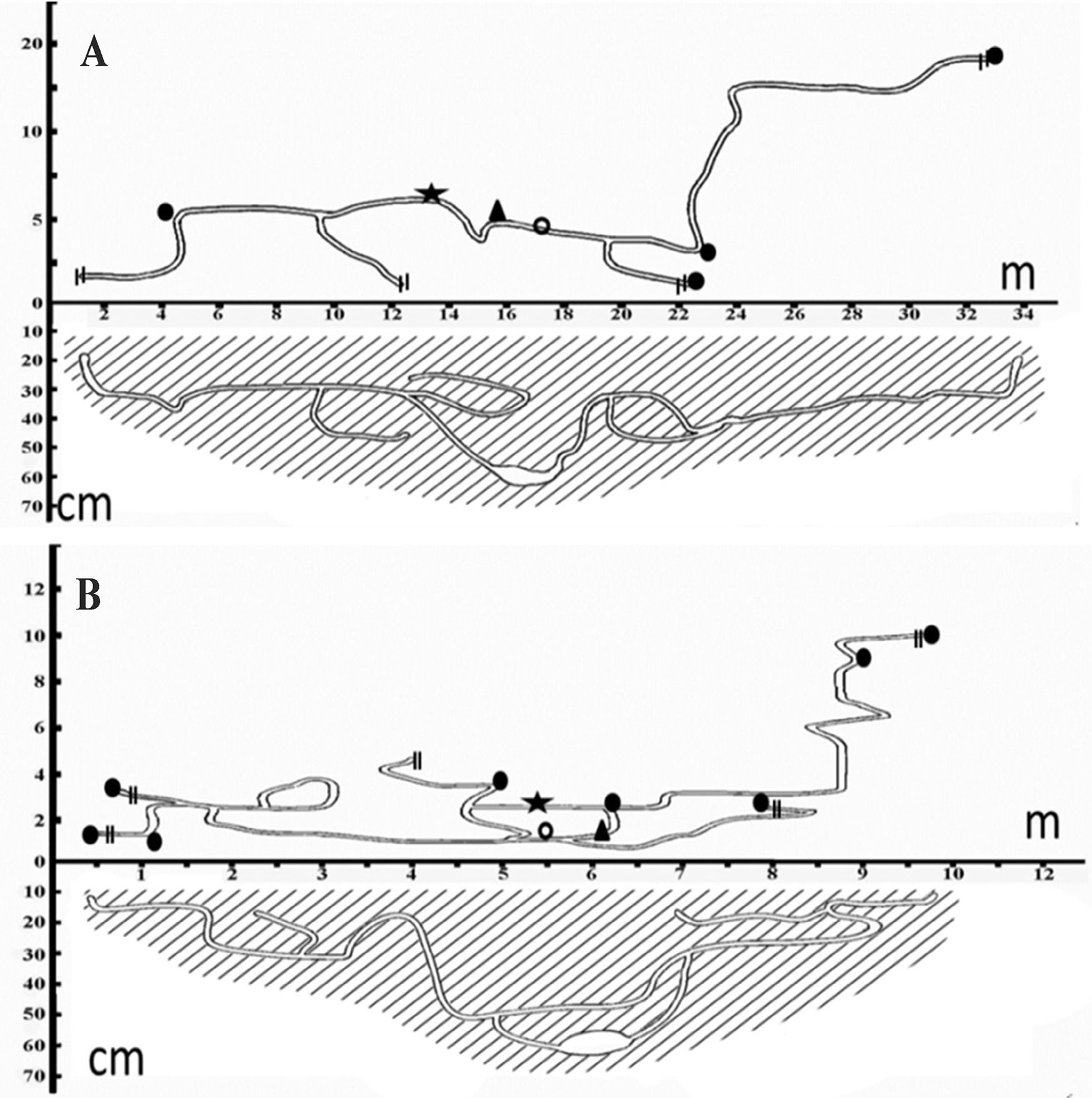
Mandarin vole burrow systems in spring (A) and summer (B). Black slashes represent the soil, black circles indicate mounds, lines indicate the ending of the tunnel, a triangle indicates a nest, circles indicate the granary and the star indicates the toilet.
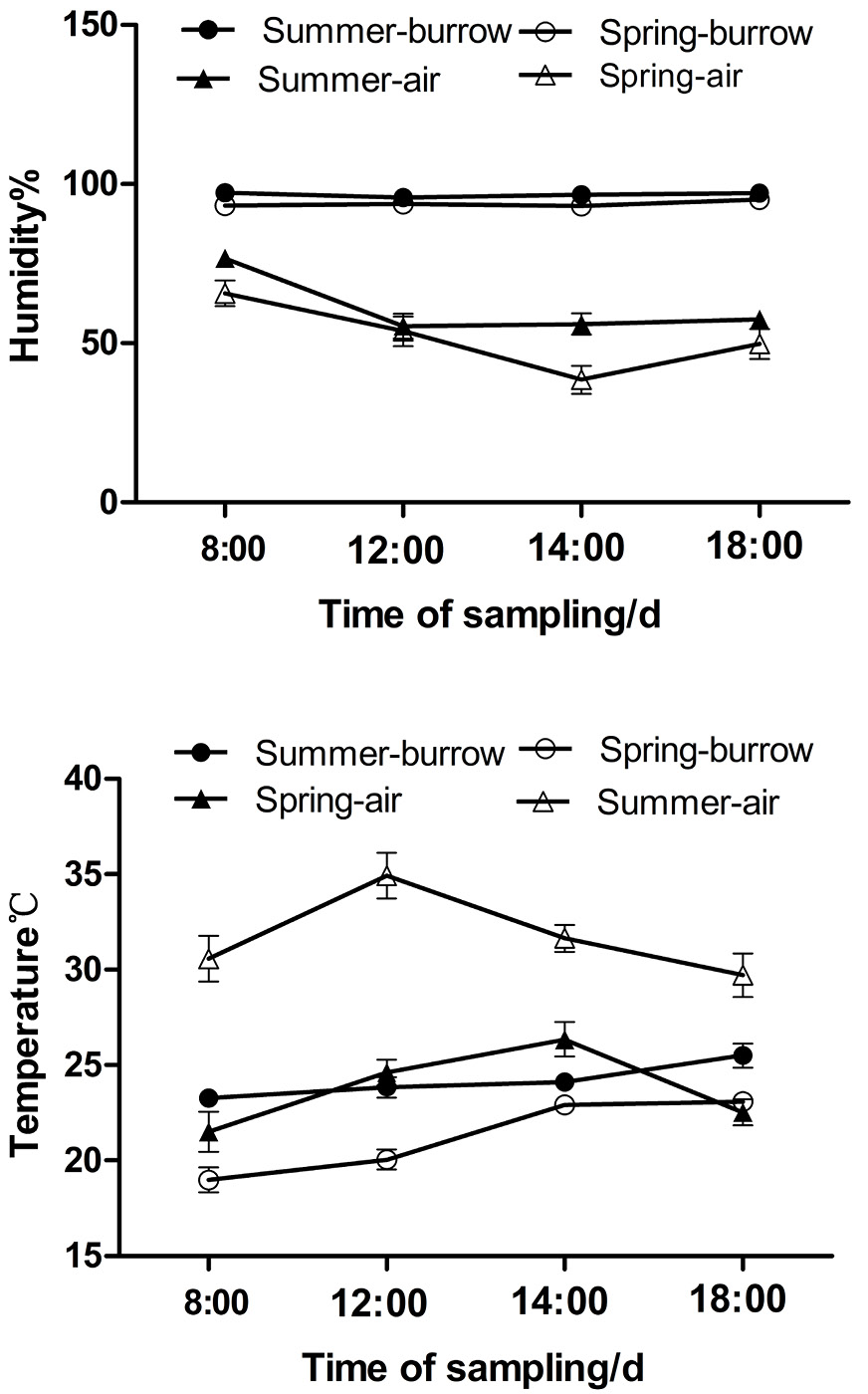
Temperature and humidity variation in burrows and corresponding air during spring and summer.
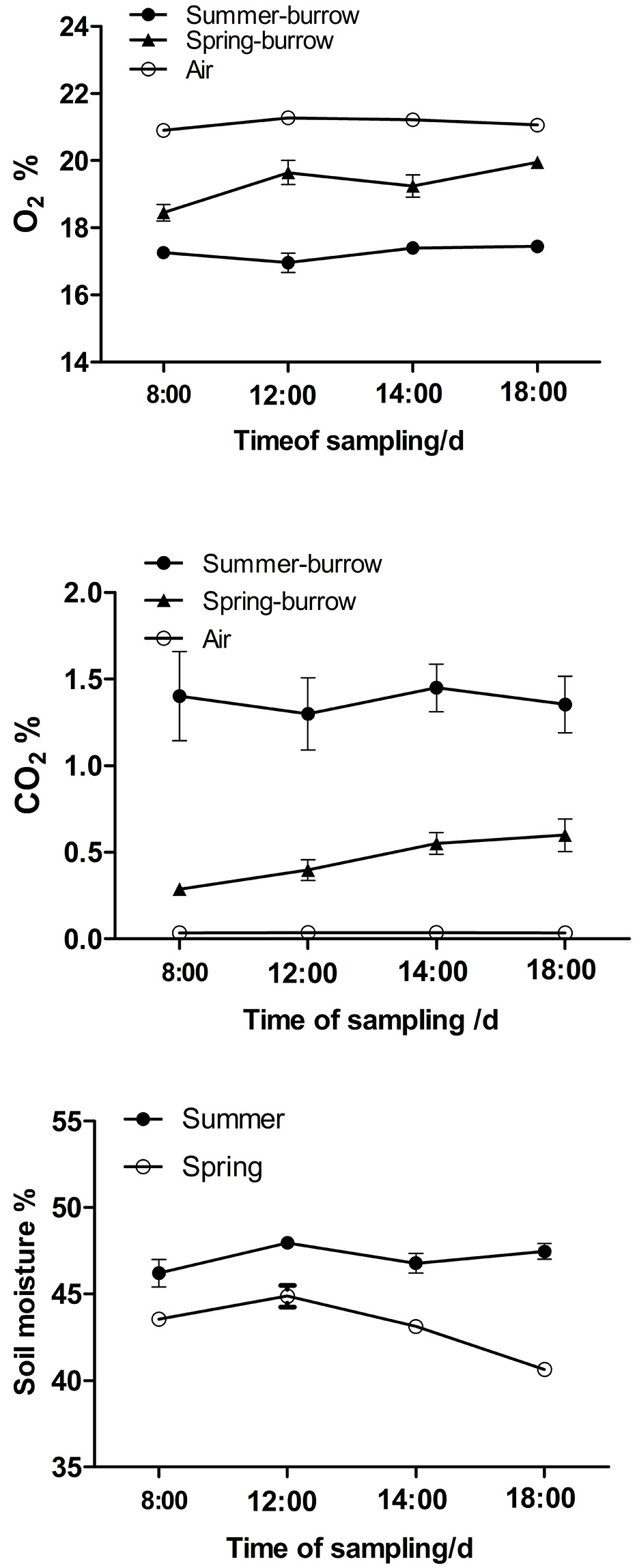
Gas composition (O2 and CO2) and soil water content in spring and summer.
References
- Antenucci, D. and Busch, C., 1992. Burrow structure in the subterranean rodent Ctenomys talarum. Mammal. Biol., 57: 163-168.
- Anyan, J.J., Seney, M.L., Holley, A., Bengston, L., Goldman, B.D., Forger, N.G. and Holmes, M.M., 2011. Social status and sex effects on neural morphology in damaraland mole-rats, Fukomys damarensis. Brain Behav. Evolut., 77: 291-298. https://doi.org/10.1159/000328640[CrossRef]
- Ar, A., 1987. Physiological adaptations to underground life in mammals. Oncology, 2: 208-221. https://doi.org/10.1159/000413967[CrossRef]
- Arieli, R., 1979. The atmospheric environment of the fossorial mole rat (Spalax ehrenbergi): Effects of season, soil texture, rain, temperature and activity. Comp. Biochem. Physiol. A: Physiol., 63: 569-575. https://doi.org/10.1016/0300-9629(79)90197-X[CrossRef]
- Arieli, R. and Nevo, E., 1991. Hypoxic survival differs between two mole rat species (Spalax Ehrenbergi) of humid and arid habitats. Comp. Biochem. Physiol. A: Physiol., 100: 543-545. https://doi.org/10.1016/0300-9629(91)90367-L[CrossRef]
- Avivi, A., Gerlach, F., Joel, A., Reuss, S., Burmester, T., Nevo, E. and Hankeln, T., 2010. Neuroglobin, cytoglobin, and myoglobin contribute to hypoxia adaptation of the subterranean mole rat spalax. Proc. natl. Acad. Sci., 107: 21570-21575. https://doi.org/10.1073/pnas.1015379107[CrossRef]
- Baldo, M.B., Antenucci, C.D. and Luna, F., 2015. Effect of ambient temperature on evaporative water loss in the subterranean rodent Ctenomys talarum. J. Therm. Biol., 53: 113-118. https://doi.org/10.1016/j.jtherbio.2015.09.002[CrossRef]
- Baldo, M.B., Luna, F. and Antenucci, C.D., 2016. Does acclimation to contrasting atmospheric humidities affect evaporative water loss in the South American subterranean rodent Ctenomys talarum? J. Mammal., 97: 1312-1320. https://doi.org/10.1093/jmammal/gyw104[CrossRef]
- Begall, S., Burda, H. and Schleich, C.E. (eds.), 2007. Subterranean rodents: News from underground. Springer-Verlag, Heidelberg, Berlin, pp. 3-9. https://doi.org/10.1007/978-3-540-69276-8_1[CrossRef]
- Burda, H., Šumbera, R. and Begall, S., 2007. Microclimate in burrows of subterranean rodents-revisited. In: Subterranean rodents: News from underground. Springer-Verlag, Heidelberg, Berlin, pp. 21-33. https://doi.org/10.1007/978-3-540-69276-8_3[CrossRef]
- Caballero, B., Tomás-Zapico, C., Vega-Naredo, I., Sierra, V., Tolivia, D., Hardeland, R., Rodríguez-Colunga, M.J., Joel, A., Nevo, E. and Avivi, A., 2006. Antioxidant activity in Spalax ehrenbergi: A possible adaptation to underground stress. J. comp. Physiol. A: Sens. Neural. Behav. Physiol., 192: 753-759. https://doi.org/10.1007/s00359-006-0111-z[CrossRef]
- Davies, K.C. and Jarvis, J.U.M., 2015. The burrow systems and burrowing dynamics of the mole-rats Bathyergus suillus and Cryptomys hottentotus in the fynbos of the South-Western Cape, South Africa. J. Zool., 209: 125-147. https://doi.org/10.1111/j.1469-7998.1986.tb03570.x[CrossRef]
- Ema, M., Taya, S., Yokotani, N., Sogawa, K., Matsuda, Y. and Fujii-Kuriyama, Y., 1997. A novel bHLH-PAS factor with close sequence similarity to hypoxia-inducible factor 1α (HIF1α ) regulates the VEGF, expression and is potentially involved in lung and vascular development. Proc. natl. Acad. Sci., 94: 4273-4278. https://doi.org/10.1073/pnas.94.9.4273[CrossRef]
- Fang, X., Nevo, E., Han, L., Levanon, E.Y., Zhao, J., Avivi, A., Larkin, D., Jiang, X., Feranchuk, S. and Zhu, Y., 2015. Corrigendum: Genome-wide adaptive complexes to underground stresses in blind mole rats Spalax. Nat. Commun., 6: 1723-2041. https://doi.org/10.1038/ncomms9051[CrossRef]
- Fanjul, M.S., Zenuto, R.R. and Busch, C., 2006. Seasonality of breeding in wild Tuco-Tucos Ctenomys talarum in relation to climate and food availability. Acta Theriol., 51: 283-293. https://doi.org/10.1007/BF03192680[CrossRef]
- Huang, S.N., Huang, F. and Huang, J., 2009. The spatial and temporal variation of seasonal evolution of dominant drought/flood patterns in rainy season over China. J. Ocean Univ. China, 39: 1158-1164.
- Jiang, L., Yao, Z., Wei, Y., Liu, Z. and Wu, S.U., 2013. Analysis on the spatio-temporal variability of rainy season precipitation in Henan Province. J. Geogr. Inf. Sci., 15: 395-400. https://doi.org/10.3724/SP.J.1047.2013.00395[CrossRef]
- Jike, Z.Y.L., 2002. The biological characteristics of subterranean rodents and their roles in ecosystem. Acta Theriol. Sin., 22: 144-154.
- Kuhnen, G., 1986. O2 and CO2 concentrations in burrows of euthermic and hibernating golden hamsters. Comp. Biochem. Physiol. A: Physiol., 84: 517-522. https://doi.org/10.1016/0300-9629(86)90359-2[CrossRef]
- Lacey, E.A., Patton, J.L., Cameron, G.N., Lacey, E.A., Patton, J.L. and Cameron, G.N., 2010. Life underground: The biology of subterranean rodents. Ethology, 107: 559-560.
- Li, Y., 2017. Studies of hypoxia adaptations between Lasiopodomys mandarinus and L. brandtii based on comparative transcriptome analysis. PhD thesis, Zhengzhou University, Zhengzhou, China.
- Listed, N., 2009. Evolution of subterranean mammals at the organismal and molecular levels. Proceedings of the Fifth International Theriological Congress. Rome, Italy, August 22-29, 1989. Psychol. Rep., 105: 707-713.
- Liu, B., Wang, Z. L. and Lu, J., 2010. Response to chronic intermittent hypoxia in blood system of mandarin vole (Lasiopodomys mandarinus). Comp. Biochem. Physiol. A: Mol. Integr. Physiol., 156: 469-474. https://doi.org/10.1016/j.cbpa.2010.03.034[CrossRef]
- Liu, S., Li, Y.X., Sun, X.Y., Wang, Y.F., Gao, X.Z. and Qin, X.B., 2013. Effects of temperature and soil moisture on greenhouse gases emission of temperate forest soil. Ecol. Environ. Sin., 22: 1093-1098.
- Maina, J.N., Gebreegziabher, Y., Woodley, R. and Buffenstein, R., 2010. Effects of change in environmental temperature and natural shifts in carbon dioxide and oxygen concentrations on the lungs of captive naked mole-rats (Heterocephalus glaber): A morphological and morphometric study. J. Zool., 253: 371-382. https://doi.org/10.1017/S0952836901000346[CrossRef]
- Marcy, A.E., Fendorf, S., Patton, J.L. and Hadly, E.A., 2013. Morphological adaptations for digging and climate-impacted soil properties define pocket gopher (Thomomys spp.) distributions. PLoS One, 8: e64935. https://doi.org/10.1371/journal.pone.0064935[CrossRef]
- Nevo, E., 2013. Stress, adaptation, and speciation in the evolution of the blind mole rat, Spalax, in Israel. Mol. Phylogenet. Evol., 66: 515-525. https://doi.org/10.1016/j.ympev.2012.09.008[CrossRef]
- Park, T.J., Reznick, J., Peterson, B.L., Blass, G., Omerbašić, D., Bennett, N.C., Phjl, K., Zasada, C., Browe, B.M. and Hamann, W., 2017. Fructose-driven glycolysis supports anoxia resistance in the naked mole-rat. Science, 356: 307-311. https://doi.org/10.1126/science.aab3896[CrossRef]
- Qian, W., Kang, H.S. and Lee, D.K., 2002. Distribution of seasonal rainfall in the East Asian monsoon region. Theor. appl. Climatol., 73: 151-168. https://doi.org/10.1007/s00704-002-0679-3[CrossRef]
- Schleich, C.E. and Antenucci, D.C., 2009. Sound transmission and burrow characteristics of the subterranean rodent Ctenomys talarum (Rodentia: Ctenomyidae). Acta Theriol., 54: 165-170. https://doi.org/10.1007/BF03193172[CrossRef]
- Shams, I., Avivi, A. and Nevo, E., 2004. Hypoxic stress tolerance of the blind subterranean mole rat: Expression of erythropoietin and hypoxia-inducible factor 1 alpha. Proc. natl. Acad. Sci., 101: 9698-9703. https://doi.org/10.1073/pnas.0403540101[CrossRef]
- Shams, I., Avivi, A. and Nevo, E., 2005. Oxygen and carbon dioxide fluctuations in burrows of subterranean blind mole rats indicate tolerance to hypoxic–hypercapnic stresses. Comp. Biochem. Physiol. A: Mol. Integr. Physiol., 142: 376-382. https://doi.org/10.1016/j.cbpa.2005.09.003[CrossRef]
- Shams, I., Nevo, E. and Avivi, A., 2005. Ontogenetic expression of erythropoietin and hypoxia-inducible factor-1 alpha genes in subterranean blind mole rats. Fed. Am. Soc. exp. Biol. J., 19: 307-309.
- Shang, X.Z., 2016. Effects of acute hypoxic exposure on expression of P53 in brain tissue of Lasiopodomys mandarinus. ZhengZhou University, Zhengzhou, China.
- Shouqin, F.N.G., 1981. The structure of the tunnel system of the Chinese Zoker. Acta Theriol. Sin., 1: 67-72.
- Thomas, H.G., Swanepoel, D. and Bennett, N.C., 2016. Burrow architecture of the damaraland mole-rat (Fukomys damarensis) from South Africa. Afri. Zool., 51: 29-36. https://doi.org/10.1080/15627020.2015.1128355[CrossRef]
- Tian, F.D. and Wang, T.Z., 2001. Social organization of mandarin voles burrow system. Acta Theriol. Sin., 21: 50-56.
- Wei, D.B., Wei, L. and Zhang, J,M., 2007. research progress in adaptive mechanisms of subterranean rodents to burrow environment. J. Qinghai Univ., 25: 54-57.
- Widmer, H.R., Hoppeler, H., Nevo, E., Taylor, C.R. and Weibel, E.R., 1997. Working underground: Respiratory adaptations in the blind mole rat. Proc. natl. Acad. Sci., 94: 2062-2067. https://doi.org/10.1073/pnas.94.5.2062[CrossRef]
- Zhang, X.G., 2016. Study on gas change in burrow of Plateau Zokor. Lanzhou University, Lanzhou, China.
- Zheng, Y.F., 2007. Effect of climate change on plant spring phenology and its simulation. J. agric. Sci. Cambridge, 16: 4711-4713.
- Zhang, J., Su, H.L. and Shi, Y.G., 1984. Study on age composition and fecundity of Lasiopodomys mandarinus. Chinese J. Zool., 1: 5-10.
Services
Article usage statistics
Loading…