
Arecoline is the main pharmacological alkaloid of areca (betel) nut, which is a traditional medical herb widely used in tropical and subtropical countries, and has several cholinomimetic effects with parasympathetic features. This study was aimed to determine the role of arecoline on systemic blood pressure (BP) modulation and the modulatory characteristics. After rats were anaesthetized, saline or arecoline was intravenously administrated, and the systemic BP signals were recorded. We calculated the reaction times, the mean arterial pressure (MAP), the maximum changes in MAP, and the area under the curve (AUC; MAP change relative to the reaction time) due to arecoline stimulations. The results showed that arecoline induced biphasic modulations in BP, including an initial downregulation (Period 1) and a subsequent upregulation (Period 2), with a concentration-dependent prolonging of reaction times, decreased MAP in Period 1 and increased MAP in Period 2, and elevated maximum changes in MAPs and AUCs. This study provides important evidence that arecoline causes biphasic modulations on systemic BP, which provide basic data for future investigations on the pharmacological characteristics and mechanisms of arecoline action, and raise great concerns regarding the cardiovascular effects of arecoline treatment in clinical practice.
Research Article · Volume 54, Issue 1, 16 November 2021 · Open Access
Intravenous Administration of Arecoline Induces Biphasic Modulations in Blood Pressure in Anaesthetized Rats
· · · · · · ·
Affiliations & Notes ⌄
- 1School of Educational Sciences and Guangdong Provincial Key Laboratory of Development and Education for Special Needs Children, Lingnan Normal University, 29 Cunjing Road, Zhanjiang 524048, Guangdong Province, China. 2Department of Oncology, Affiliated Hospital of Integrated Traditional Chinese and Western Medicine, Nanjing University of Chinese Medicine, Hongshan Road Shizi Street 100, Nanjing, Jiangsu 210028, P.R. China. , * Corresponding author: peilingzhouvip@163.com, robertluoyi@126.com
Article Info ⌄
- Journal:
- Pakistan Journal of Zoology
- Published:
- 16 November 2021

From the article
- Compared with saline treatment (Fig. 2A), intravenous injection of arecoline caused biphasic BP regulations, including an initial downregulation (Period 1) and a subsequent upregulation (Period 2; Fig. 2B–D).
- Statistical analyses revealed no significant differences in the latency of BP changes between groups following arecoline treatment (0.06 mg/kg: 7.66 ± 0.66; 0.2 mg/kg: 8.02 ± 0.72; 0.6 mg/kg: 9.02 ± 0.71 s; F2,45 = 0.886, P = 0.419; Fig. 3A).
- Statistical analyses also revealed that the percentage of MAP changes in Period 1 was more intense (~3-fold) than those observed in Period 2.
- The present study showed that intravenous injection of arecoline induced systemic BP modulations with dose-dependent effects.
Selected from the article's own text.
Abstract
Introduction
Arecoline (molecular formula shown in Fig. 1) is a major pharmacological alkaloid of areca (betel) nut, a chewable fruit endemic to South and Southeast Asia that is reported to produce effects of anti-depression, anti-fatigue, attention-focusing, and relaxation . Areca nut also acts as a traditional herbal medicine widely used for vermifuge and as a digestant in tropical and subtropical countries . Arecoline has several cholinomimetic effects on the parasympathetic nervous system , 2018). Because of the cholinergic features, arecoline is a therapeutic treatment for patients with Alzheimer’s dementia (AD), and ameliorates the symptoms of psychosis and schizophrenia ; ; ; ; .
Notably, cholinergic actions exert significant effects on cardiovascular activities, but with complicated phenotypes. For example, administration of acetylcholine into specific brain regions induced the blood pressure (BP) depressor response ; ; , activation of the muscarinic or nicotinic acetylcholine receptors in the rostral or caudal ventrolateral medulla led to BP pressor or depressor responses ; . Studies regarding arecoline on BP modulations have also been published. For example, intraperitoneal (i.p.) injection of arecoline produced cardiodepression in rats and dogs ; , and a meta-analysis demonstrated that chewing areca nut increased the risk of cardiovascular disorders ; .
This study was designed to determine the effects of arecoline on systemic BP modulations, as well as the modulatory characteristics on such effects to provide basic data for physiopharmacological investigations, and to provide perspectives of the cardiovascular concerns associated with arecoline use in clinical practice.
Materials and Methods
Animals
Young adult male Sprague–Dawley rats (2 months, 240 ± 20 g; n = 30) were obtained from Jinan Pengyue Experimental Animal Breeding Co. LTD (Jinan, China) and used in this study. The animals were housed in a temperature-controlled (25 ± 1°C) environment with a 12/12 h light/dark-cycle with ad libitum food and water. All animal experiments were conducted according to the National Institutes of Health Guide for the Care and Use of Laboratory Animals (NIH Publication No. 80-23, revised in 1996), and were approved by the Academic and Ethics Committee of Lingnan Normal University (LNU20191018). All efforts were made to minimize the number of animals used, as well as their suffering.
Surgical procedures
The BP recording methods followed those detailed in our previous reports ; . Briefly, rats were anesthetized with urethane (1.4 g/kg body weight i.p. injection; Sinopharm Chemical Reagent Co. Ltd., Shanghai, China) and processed for cervical surgery using tracheal intubation. The carotid artery pressure was recorded using a catheter (BL-2020; Taimeng Sci-Tec Co., Ltd., Chengdu, China) that was connected to a signal collecting and processing apparatus (BL-420F, Taimeng Sci-Tech Co., Ltd.) via a BP transducer (PT-100, Taimeng Sci-Tech Co., Ltd.).
BP measurements
Once the BP was stable, saline (0.9% NaCl) and arecoline (at 0.06, 0.2, and 0.6 mg/kg/0.2ml) were injected separately (~10 s) into the vein. Repeated injections were administered at ≥60 min intervals, according to the persistent period from our preliminary experiments in cardiovascular recordings and prior reports on behavioral tests and metabolic examinations ; , to avoid mutual interference between arecoline administrations. In general, each animal received 3–5 different drug injections, and the BPs that failed to return to basal values (deviated by >15% of the basal levels) were excluded.
The drug effects on BP regulation were considered substance-specific if they were reversible and reproducible. The mean arterial pressure (MAP), maximum decreased MAP (MDMAP), maximum increased MAP (MIMAP), the latency for arecoline-induced BP changes, the BP reaction time for Period 1 (the duration from the onset of BP decrease to recovery), BP reaction time for Period 2 (the duration from the onset of BP increase to recovery), and the area under the curve (AUC; the changes in MAP relative to the reaction time, as calculated using Graph Pad Prism 5.0 software; Graph Pad Software Inc., San Diego, CA) in response to the drug stimulations were analyzed. As no alterations in BP were observed upon saline treatment, the MAPs in Period 1 and Period 2 for the saline treatment group were calculated from two 60-s BP sequences beginning at 10 s and 100 s, respectively. The pre-test MAPs were calculated form a 60-s BP sequence prior to injections.
Statistical analysis
All data are presented as the mean ± standard error. A one-way analysis of variance followed by a Fisher’s least significant difference post-hoc test was conducted for statistical analyses. P values <0.05 were considered significant.
Results
Compared with saline treatment (Fig. 2A), intravenous injection of arecoline caused biphasic BP regulations, including an initial downregulation (Period 1) and a subsequent upregulation (Period 2; Fig. 2B–D). Statistical analyses revealed no significant differences in the latency of BP changes between groups following arecoline treatment (0.06 mg/kg: 7.66 ± 0.66; 0.2 mg/kg: 8.02 ± 0.72; 0.6 mg/kg: 9.02 ± 0.71 s; F2,45 = 0.886, P = 0.419; Fig. 3A). However, a dose-dependent increase in reaction time in Period 1 (0.06 mg/kg: 42.97 ± 2.54; 0.2 mg/kg: 55.47 ± 2.59; 0.6 mg/kg: 135.73 ± 11.10 s; F2,45 = 69.627, P < 0.001; Fig. 3B) and Period 2 (0.06 mg/kg: 251.41 ± 17.45; 0.2 mg/kg: 414.74 ± 27.32; 0.6 mg/kg: 773.65 ± 66.81 s; F2,45 = 44.221, P < 0.001; Fig. 3C) was observed in response to arecoline stimulations. The durations of Period 2 were 5–8 fold longer than those of Period 1. The overall BP changes recovered within 15 min (Fig. 3B and C; seen also in Fig. 6A), which was consistent with previous reports of arecoline-induced behavioral changes and serum arecoline examinations ; ; .
The MAPs were not significantly different between groups before treatment (saline: 107.23 ± 1.65, 0.06 mg/kg: 109.71 ± 1.17; 0.2 mg/kg: 109.69 ± 1.69; 0.6 mg/kg: 108.91 ± 1.84 mmHg; F3,58 = 0.507, P = 0.679; Fig. 4), while a significant dose-dependent decrease was observed in Period 1 (saline: 107.89 ± 1.86, 0.06 mg/kg: 82.62 ± 1.20; 0.2 mg/kg: 66.50 ± 1.60; 0.6 mg/kg: 62.72 ± 2.44 mmHg; F3,58 = 127.061, P < 0.001; Fig. 4), and a significant increase was observed in Period 2 (saline: 108.27 ± 1.64, 0.06 mg/kg: 117.01 ± 1.15; 0.2 mg/kg: 122.31 ± 1.87; 0.6 mg/kg: 124.40 ± 1.94 mmHg; F3,58 = 16.597, P < 0.001; Fig. 4). Statistical analyses also revealed that the percentage of MAP changes in Period 1 was more intense (~3-fold) than those observed in Period 2.
Moreover, MDMAP in Period 1 and MIMAP in Period 2 exhibited significant dose-dependent effects (MDMAP: 0.06 mg/kg 47.20 ± 1.99, 0.2 mg/kg 63.25 ± 3.42, 0.6 mg/kg 80.94 ± 4.34 mmHg, F2,45 = 23.318, P < 0.001, Fig. 5A; MIMAP: 0.06 mg/kg 15.31 ± 0.83, 0.2 mg/kg 29.02 ± 1.50, 0.6 mg/kg 39.47 ± 2.42 mmHg, F2,45 = 52.027, P < 0.001, Fig. 5B), which were more drastic (2-3 fold) in MDMAP than MIMAP. Furthermore, the total AUC (the changes in MAP relative to the reaction time) also exhibited significant dose-dependent increases (0.06 mg/kg: 1186.34 ± 65.31, 0.2 mg/kg: 3093.05 ± 250.96, 0.6 mg/kg: 6987.85 ± 327.44; F2,45 = 141.410, P < 0.001; Fig. 6A1–A3 and 6B1), which included dose-dependent increases in the BP downregulation (0.06 mg/kg: 461.09 ± 33.12; 0.2 mg/kg: 973.81 ± 86.62; 0.6 mg/kg: 2460.15 ± 160.73; F2,45 = 104.797, P < 0.001; 6B2) and more intense (~2 fold relative to the downregulation) increases in BP upregulations (0.06 mg/kg 725.76 ± 68.67; 0.2 mg/kg 2120.27 ± 193.57; 0.6 mg/kg 4529.15 ± 340.87; F2,45 = 73.566, P < 0.001; 6B3).
Discussion
Arecoline is the main pharmacological alkaloid from areca nut , and is a therapeutic drug for various ailments, and in particular, for parasitic diseases, digestive disorders, depression, and potentially for AD and schizophrenia treatments ; ; . Arecoline primarily exhibits parasympathomimetic features and cardiovascular actions ; .
The present study showed that intravenous injection of arecoline induced systemic BP modulations with dose-dependent effects. Such effects were reversible and reproducible (Fig. 2), indicating that arecoline exerts substance-specific roles on the regulation of BP. Our current findings demonstrate that arecoline evokes biphasic BP regulations in rats, with an initial downregulation and a subsequent upregulation. However, some reports demonstrated that arecoline only reduced BP in dogs and humans ; , or a sole BP elevation in rats . The discrepancies between the current and previous studies may be due to differences in arecoline doses (a low dose of arecoline may exhibit a primarily depressor response) or sampling times (arecoline induces a transitory BP depression following a longer BP elevation phase; Figs. 3 and 6). Remarkably, the latency of arecoline-induced BP changes via intravenous injection is within 10 seconds in the current study (Fig. 3A), while the onset of cardiovascular activities following areca nut chewing was ~2 minutes ; thus indicating that different routes of arecoline administration may modulate blood pressure modulation differently.
As arecoline can cross the blood brain barrier , arecoline-mediated BP modulations could be exerted through the central (the brain) and peripheral (mainly the cardiovascular) nervous systems. The downregulation in PB may be due to arecoline activation of the vagal neural circuit, which relaxes the aorta endothelium and improves vasorelaxation ; all such factors correlate with BP depressor responses. Conversely, the upregulation may be due to sympathoadrenal responses since arecoline can activate the hypothalamic-pituitary-adrenal (HPA) axis, which stimulates adrenocorticotropic hormones and corticosterone release ; thus, leading to a pressor response as proven in many reports ; . Such hypotheses are also supported by evidence that chewing areca nut promotes cadiovascular activities that are associated with sympathoadrenal activation (Chu, 1993, 2002). However, determinations of the exact mechanisms require further investigations.
In summary, this study found that arecoline induced biphasic BP modulations, including an initial downregulation followed by upregulation. Nevertheless, further investigations are required to determine the exact mechanisms controlling such fluctuations in BP.
Acknowledgements
This work was supported by grants from the National Natural Science Foundation of China (81871062, 81773947), the Natural Science Foundation of Guangdong Province (2019A1515010331), Natural Science Foundation of Guangdong Provincial Education Bureau (NO. 2017KTSCX117), and the Special Foundation for Talents of Lingnan Normal University (ZL1819).
Statement of conflict of interest
The authors have declared no conflict of interest.
Figures
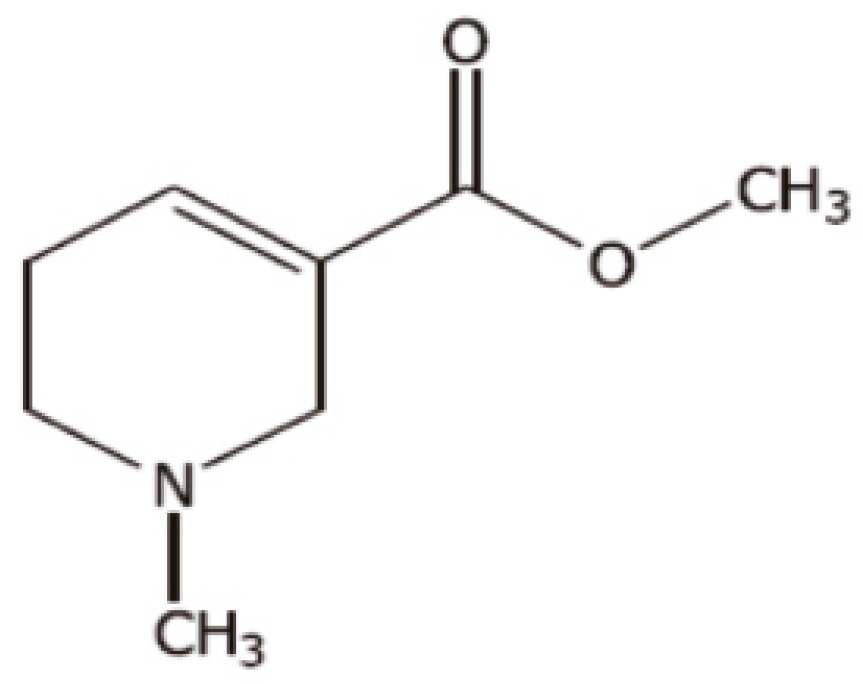
The molecular formula of arecoline.
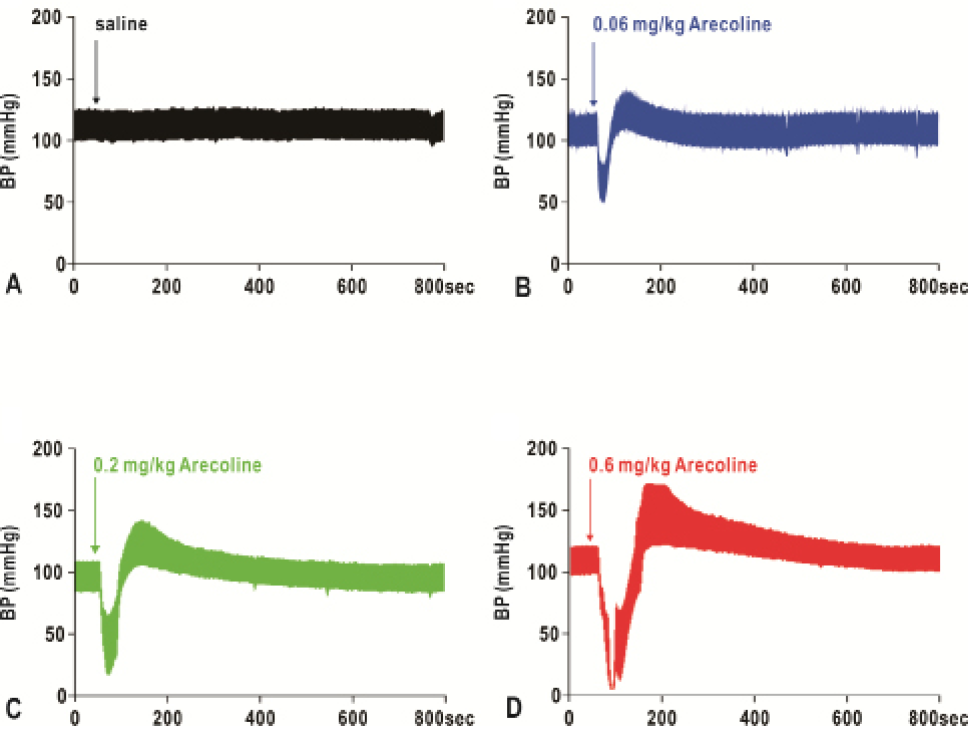
Representative recordings of blood pressure (BP) changes after intravenous injections of arecoline. (A) saline; (B-D) 0.06, 0.2 and 0.6 mg/kg arecoline, respectively, in which the BP exhibited biphasic regulations: an initial downregulation followed by a subsequent upregulation. Arrow: time of injection. iv: intravenous injection.
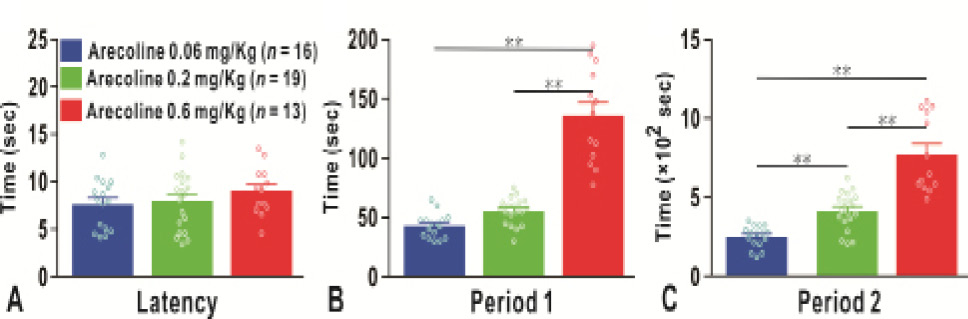
The reaction time for BP changes after intravenous injection of arecoline. (A) The latency of BP changes; (B) the duration of BP downregulation in Period 1; (C) the duration of BP upregulation in Period 2. The circles denote raw data; numbers presented in parentheses denote the number of measurements. **P < 0.01.
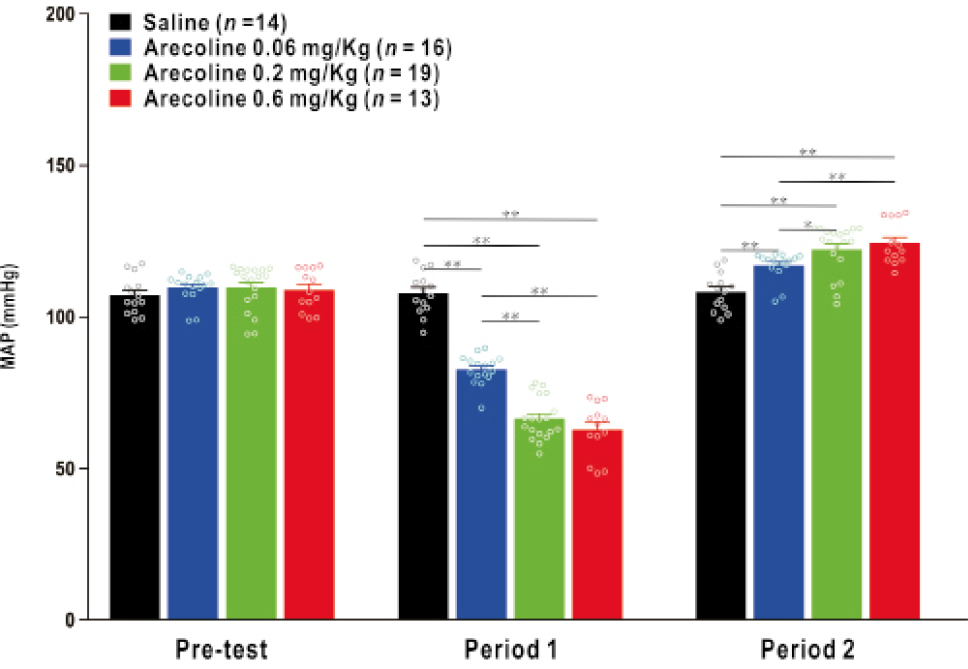
Mean arterial pressure (MAP) changes after intravenous injection of arecoline. No significant differences were observed among groups (0.06, 0.2 and 0.6 mg/kg of arecoline) in the pre-test, but a remarkable decrease was observed in Period 1 followed by a marked increase in Period 2, after intravenous arecoline treatments. *P < 0.05; **P < 0.01.
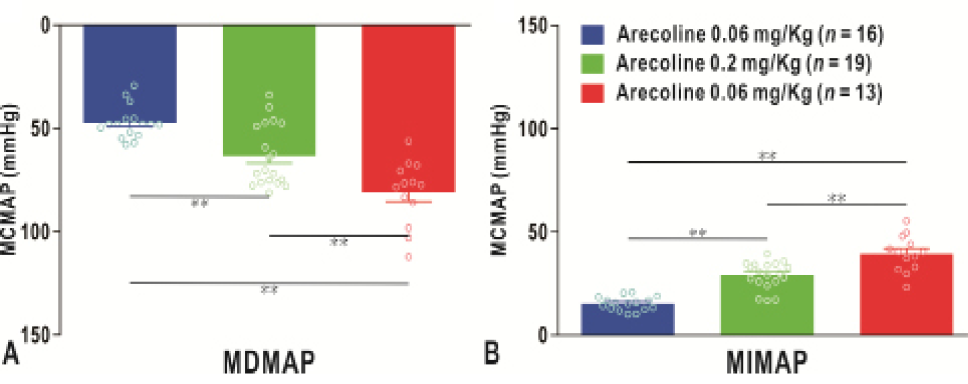
The maximum changes in MAP after intravenous injection of arecoline. (A) Dose-dependent increases in MDMAP; (B) dose-dependent increases in MIMAP. MDMAP: maximum decreased MAP; MIMAP: maximum increased MAP. **P < 0.01.
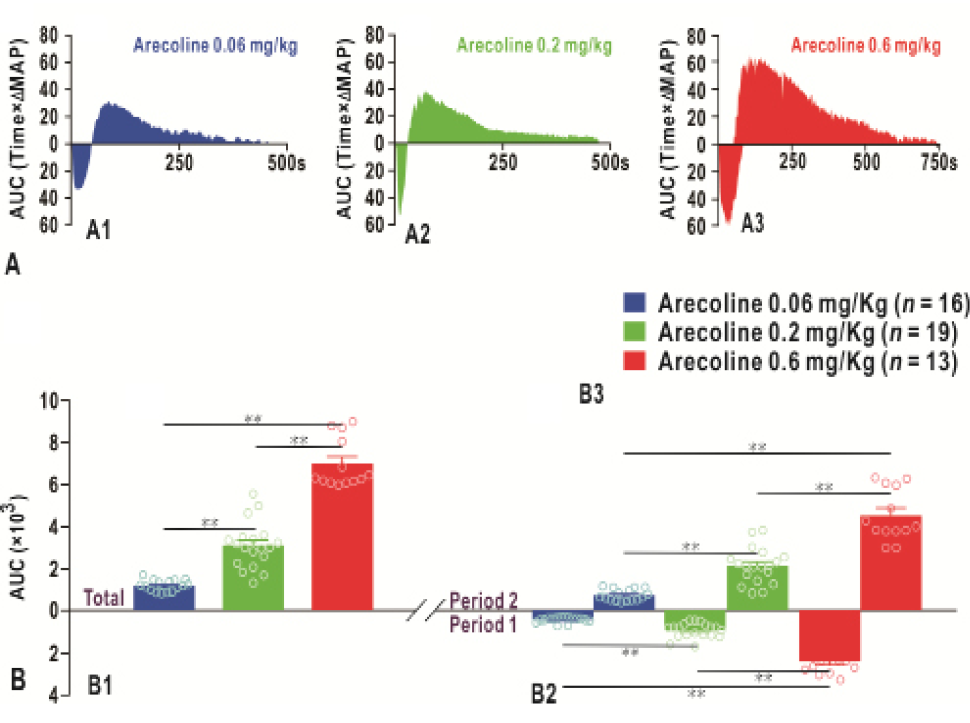
The area under curve (AUC, MAP change relative to the reaction time) after intravenous injections of arecoline. (A) Representative AUCs of different treatment groups (0.06, 0.2 and 0.6 mg/kg of arecoline). (B) Histograms of the AUCs among groups; B1, the total AUC; B2, AUC in Period 1; B3, AUC in Period 2. *P < 0.05; **P < 0.01.
References
- Aberger, K., Chitravanshi, V.C. and Sapru, H.N., 2001. Cardiovascular responses to microinjections of nicotine into the caudal ventrolateral medulla of the rat. Brain Res., 892: 138-146. https://doi.org/10.1016/S0006-8993(00)03250-9[CrossRef]
- Bales, A., Peterson, M.J., Ojha, S., Upadhaya, K., Adhikari, B. and Barrett, B., 2009. Associations between betel nut (Areca catechu) and symptoms of schizophrenia among patients in Nepal: A longitudinal study. Psychiat. Res., 169: 203-211. https://doi.org/10.1016/j.psychres.2008.06.006[CrossRef]
- Barnes, J.C. and Roberts, F.F., 1991. Central effects of muscarinic agonists and antagonists on hippocampal theta rhythm and blood pressure in the anaesthetised rat. Eur. J. Pharmacol., 195: 233-240. https://doi.org/10.1016/0014-2999(91)90540-7[CrossRef]
- Beil, M.E., Goodman, F.R., Shlevin, H.H. and Smith, E.F., 1986. Evaluation of the cardiovascular effects of arecoline in the anesthetized dog. Drug Dev. Res., 9: 203-212. https://doi.org/10.1002/ddr.430090304[CrossRef]
- Calogero, A.E., Kamilaris, T.C., Gomez, M.T., Johnson, E.O., Tartaglia, M.E., Gold, P.W. and Chrousos, G.P., 1989. The muscarinic cholinergic agonist arecoline stimulates the rat hypothalamic pituitary adrenal axis through a centrally-mediated corticotropin-releasing hormone dependent mechanism. Endocrinology, 125: 2445-2453. https://doi.org/10.1210/endo-125-5-2445[CrossRef]
- Chandra, J.N.N.S., Manish, M., Sadashiva, C.T., Subhash, M.N. and Rangappa, K.S., 2008. Effect of novel arecoline thiazolidinones as muscarinic receptor 1 agonist in Alzheimer’s dementia models. Neurochem. Int., 52: 376-383. https://doi.org/10.1016/j.neuint.2007.07.006[CrossRef]
- Chiou, S.S. and Kuo, C.D., 2008. Effect of chewing a single betel-quid on autonomic nervous modulation in healthy young adults. J. Psychopharmacol., 22: 910-917. https://doi.org/10.1177/0269881107083840[CrossRef]
- Christie, J.E., Shering, A., Ferguson, J. and Glen, A.I., 1981. Physostigmine and arecoline: effects of intravenous infusions in Alzheimer presenile dementia. Br. J. Psychiat., 138: 46-50. https://doi.org/10.1192/bjp.138.1.46[CrossRef]
- Chu, N.S., 1993. Cardiovascular responses to betel chewing. J. Formos. med. Assoc., 92: 835-837.
- Chu, N.S., 2002. Neurological aspects of areca and betel chewing. Addict. Biol., 7: 111-114. https://doi.org/10.1080/13556210120091473[CrossRef]
- Dahl, R.E., Ryan, N.D., Perel, J., Birmaher, B. and Puig-Antich, J., 1994. Cholinergic REM induction test with arecoline in depressed children. Psychiat. Res., 51: 269-282. https://doi.org/10.1016/0165-1781(94)90014-0[CrossRef]
- Dasgupta, R., Chatterjee, A., Sarkar, S. and Maiti, B.R., 2017. Arecoline aggravates hypothyroidism in metabolic stress in mice. Arch. Physiol. Biochem., 123: 105-111. https://doi.org/10.1080/13813455.2016.1267228[CrossRef]
- Dasgupta, R., Saha, I., Maity, A., Ray, P.P. and Maiti, B.R., 2018. Arecoline ameliorates hyperthyroid condition in mice under cold stress. Arch. Physiol. Biochem., 124: 436-441. https://doi.org/10.1080/13813455.2017.1420665[CrossRef]
- Dasgupta, R., Saha, I., Pal, S., Bhattacharyya, A., Sa, G., Nag, T.C., Das, T. and Maiti, B.R., 2006. Immunosuppression, hepatotoxicity and depression of antioxidant status by arecoline in albino mice. Toxicology, 227: 94-104. https://doi.org/10.1016/j.tox.2006.07.016[CrossRef]
- Kumar, N.N., Ferguson, J., Padley, J.R., Pilowsky, P.M. and Goodchild, A.K., 2009. Differential muscarinic receptor gene expression levels in the ventral medulla of spontaneously hypertensive and Wistar-Kyoto rats: role in sympathetic baroreflex function. J. Hypertens., 27: 1001-1008. https://doi.org/10.1097/HJH.0b013e3283282e5c[CrossRef]
- Liu, Y.J., Peng, W., Hu, M.B., Xu, M. and Wu, C.J., 2016. The pharmacology, toxicology and potential applications of arecoline: a review. Pharm. Biol., 54: 1-8. https://doi.org/10.3109/13880209.2016.1160251[CrossRef]
- Núñez, H., Ruiz, S., Soto Moyano, R., Navarrete, M., Valladares, L., White, A., Pérez, H., 2008. Fetal undernutrition induces overexpression of CRH mRNA and CRH protein in hypothalamus and increases CRH and corticosterone in plasma during postnatal life in the rat. Neurosci. Lett., 448: 115-119. https://doi.org/10.1016/j.neulet.2008.10.014[CrossRef]
- Pan, H., Huang, L., Li, Y., Zhou, X., Lu, Y. and Shi, F., 2017. Liquid chromatography-tandem mass spectrometric assay for determination of unstable arecoline in rat plasma and its application. J. Chromatogr. B., 1070: 112-116. https://doi.org/10.1016/j.jchromb.2017.10.026[CrossRef]
- Peng, W., Liu, Y.J., Wu, N., Sun, T., He, X.Y., Gao, Y.X. and Wu, C.J., 2015. Areca catechu L. (Arecaceae): A review of its traditional uses, botany, phytochemistry, pharmacology and toxicology. J. Ethnopharmacol., 164: 340-356. https://doi.org/10.1016/j.jep.2015.02.010[CrossRef]
- Pomara, N. and Sidtis, J.J., 2010. Alzheimer’s disease. N. Engl. J. Med., 362: 1844-1845. https://doi.org/10.1056/NEJMc1002323[CrossRef]
- Sarbani, G., Idle, J.R., Chi, C. T., Mark, Z., Krausz, K.W. and Gonzale, F.J., 2006. A metabolomic approach to the metabolism of the areca nut alkaloids arecoline and arecaidine in the mouse. Chem. Res. Toxicol., 19: 818-827. https://doi.org/10.1021/tx0600402[CrossRef]
- Scoggins, B.A., Whitworth, J.A., Coghlan, J.P., Denton, D.A. and Mason, R.T., 1983. Vasodilator prostanoids and ACTH-dependent hypertension. Lancet, 1: 1275. https://doi.org/10.1016/S0140-6736(83)92720-4[CrossRef]
- Shafei, M.N., Niazmand, S., Enayatfard, L., Hosseini, M. and Daloee, M.H., 2013. Pharmacological study of cholinergic system on cardiovascular regulation in the cuneiform nucleus of rat. Neurosci. Lett., 549: 12-17. https://doi.org/10.1016/j.neulet.2013.05.046[CrossRef]
- Soncrant, T.T., Holloway, H.W., Greig, N.H. and Rapoport, S.I., 1989. Regional brain metabolic responsivity to the muscarinic cholinergic agonist arecoline is similar in young and aged Fischer-344 rats. Brain Res., 487: 255-266. https://doi.org/10.1016/0006-8993(89)90830-5[CrossRef]
- Volgin, A.D., Bashirzade, A., Amstislavskaya, T.G., Yakovlev, O.A., Demin, K.A., Ho, Y.J., Wang, D., Shevyrin, V.A., Yan, D., Tang, Z., Wang, J., Wang, M., Alpyshov, E.T., Serikuly, N., Wappler-Guzzetta, E.A., Lakstygal, A.M. and Kalueff, A.V., 2019. DARK classics in chemical neuroscience: Arecoline. ACS Chem. Neurosci., 10: 2176-2185. https://doi.org/10.1021/acschemneuro.8b00711[CrossRef]
- Xu, Z., Adilijiang, A., Wang, W., You, P., Lin, D., Li, X. and He, J., 2019. Arecoline attenuates memory impairment and demyelination in a cuprizone-induced mouse model of schizophrenia. Neuroreport, 30: 134-138. https://doi.org/10.1097/WNR.0000000000001172[CrossRef]
- Zhang, C., Luo, W., Zhou, P. and Sun, T., 2016. Microinjection of acetylcholine into cerebellar fastigial nucleus induces blood depressor response in anesthetized rats. Neurosci. Lett., 629: 79-84. https://doi.org/10.1016/j.neulet.2016.06.063[CrossRef]
- Zhang, L.N., Yang, Y.M., Xu, Z.R., Gui, Q.F. and Hu, Q.Q., 2010. Chewing substances with or without tobacco and risk of cardiovascular disease in Asia: A meta-analysis. J. Zhejiang Univ. Sci. B., 11: 681-689. https://doi.org/10.1631/jzus.B1000132[CrossRef]
- Zhou, P., Zhu, Q., Liu, M., Li, J., Wang, Y., Zhang, C. and Hua, T., 2015. Muscarinic acetylcholine receptor in cerebellar cortex participates in acetylcholine-mediated blood depressor response in rats. Neurosci. Lett., 593: 129-133. https://doi.org/10.1016/j.neulet.2015.03.036[CrossRef]
- Zhu, Q., Zhou, P., Wang, S., Zhang, C. and Hua, T., 2015. A preliminary study on cerebellar acetylcholine-mediated blood pressure regulation in young and old rats. Exp. Gerontol., 63: 76-80. https://doi.org/10.1016/j.exger.2015.02.003[CrossRef]
Services
Article usage statistics
Loading…