
Mealybug Drosicha mangiferae (Pseudococcidae: Hemiptera) is one of the destructive insect pests of many agricultural and horticultural crops including citrus. Extensive and injudicious use of conventional synthetic insecticides against D. mangiferae have led to many environmental and health problems urging to seek out environment-friendly and safe alternate strategies to control D. mangiferae. To this end, the present study evaluated the methanolic extracts and essential oils of eight indigenous plant species for their insecticidal potential against 2nd instar D. mangiferae individuals. Standard twig-dip method was used for toxicity bioassays according to Completely Randomized Design. Mortality of mealybug individuals varied with plant materials and increased along with the extract concentration and exposure time. Botanical extracts of Azadirachta indica (neem) and Gardenia jasminoides (gardenia) were the most effective with minimum LC50 (20.00 and 42.19%, respectively) and LT50 (47.97 and 71.26 h, respectively) values followed by Nerium indicum (oleander). Moreover, the essential oils of Datura alba (dhatura) and Syzygium aromaticum (clove bud) were the most effective against D. mangiferae with minimum LC50 (0.80 and 0.90%, respectively) and LT50 (61.30 and 68.58 h, respectively) values. These findings substantiate the relative effectiveness of indigenous plant extracts as environment-friendly alternates to hazardous synthetic insecticides and, hence, are recommend to be integrated in pest management programs against D. mangiferae and other sucking insect pests.
Research Article · Volume 51, Issue 5, 27 June 2019 · Open Access
In-vitro Toxicity Evaluation of some Phytoextracts against Mealybug Drosicha mangiferae (Hemiptera: Pseudococcidae) Infesting Citrus Orchards in Pakistan
· · ·
Affiliations & Notes ⌄
- 1Department of Entomology, College of Agriculture, University of Sargodha, 40100 Sargodha , * Corresponding author: hafizabdulghafoor@yahoo.com
Article Info ⌄
- Journal:
- Pakistan Journal of Zoology
- Published:
- 27 June 2019

From the article
- Results revealed a significant effect of botanical extracts and plant essential oils on the mortality of mealybug nymphs as compared to control and this mortality increased along with the treatments (concentration and time).
- Among the tested botanical extracts, A. indica (neem) and G. jasminoides (gardenia) were found to be the most effective ones against 2nd instar D. mangiferae mealybugs.
- Based on the results of this study, it is concluded that although lacking quick knockdown effect, indigenous plant extracts and essential oils can be effectively employed against sucking insect pests such as D. mangiferae.
- Moreover, the bioactive constituents of these phyto-extracts responsible for the observed mealybug mortality should be focused for their potential characterization in future research.
Selected from the article's own text.
Abstract
Introduction
Citrus is an important fruit crop all over the world including Pakistan. It is being cultivated on approximately 8 million hectares with an annual citrus production of about 122 million metric tonnes (FAO, 2016). Mandarins (Citrus reticulata cv. feutrill’s early and kinnow) and sweet oranges (Citrus sinensis cv. blood red and mosambi) are the most widely cultivated and appraised cultivars of citrus. Pakistan ranks among top citrus producing and exporting countries with an average area and production of about 206,569 hectares and 2.36 million metric tonnes, respectively . Sweet oranges, kinnow mandarins, grapefruits and lime are major citrus cultivars of the country. Mandarins (C. reticulata) constitute about 80% of citrus production in Pakistan. The province of Punjab and particularly district Sargodha are the production hubs of citrus in Pakistan sharing approximately 95 and 70% of total citrus production of the country, respectively .
Although Pakistan is famous worldwide for its best production of kinnow mandarins, per unit area production is far behind other citrus producing countries. Incidence of insect pests and diseases is one of the major reasons for citrus decline in Pakistan . Under agro-climatic conditions of district Sargodha (Punjab, Pakistan), canker, slow decline, anthracnose and greening are the major citrus diseases , while major insect pests attacking citrus plants include fruit flies (Bactocera dorsalis and B. minax), leafminers (Phyllocnistis citrella), psyllids (Diaphorina citri) and mealybugs (Drosicha mangiferae and Planococcus citri) . Among these, mealybugs (Hemiptera: Pseudococcidae) are appearing as regular sucking pests of citrus orchards since last decade. Moreover, a recent survey in district Sargodha has found that among mealybug species infesting citrus plants, Drosicha mangiferae is the most dominant and prevalent species incurring substantial loss to citrus production both in terms of quantity and quality .
Table I.- Different botanical extracts evaluated under laboratory conditions against 2nd instar nymphs of mealybug Drosicha mangiferae Green.
| Botanical name | Common/ Vernacular name | Family | Major bioactive constituents | Extraction type | Plant parts extracted |
| Azadirachta indica | Neem | Meliaceae | Azadirechtins and triterpenoids | Botanical extract | Leaves and fruits |
| Cymbopogon citratus | Lemon grass | Poaceae | Citral, citronellol, citronella, myrcene | Essential oil | Leaves |
| Datura alba | Dhatura | Solanaceae | Tropane alkaloids(Moniraand Munan, 2012) | Essential oil | Leaves and seeds |
| Dodonaea viscosa | Sanatha | Sapindaceae | Flavonoids, phenols, tannins, saponins, lupeol, and stigmasterol( | Botanical extract | Tender stems |
| Gardenia jasminoides | Gardenia | Rubiaceae | Iridoid glycosides | Botanical extract | Leaves and stems |
| Nerium indicum | Kaner | Apocynaceae | Oleandrin and oleandrigenin | Botanical extract | Leaves |
| Parthenium hysterophorus | Parthenium | Asteraceae | Parthenin (sesquiterpene derivatives) | Botanical extract | Leaves and tender stems |
| Syzygium aromaticum | Clove bud | Myrtaceae | Eugenol and E-caryophyllene | Essential oil | Buds |
D. mangiferae is one of the most economic exotic insect pests of a wide range of agricultural and horticultural crops in South East Asia including Pakistan. Although it is predominantly a pest of mango orchards but for last few decades, it has attained the status of major pest of citrus orchards in the district Sargodha . Every year, this mealybug species infests and incurs considerable qualitative and quantitative loss to indigenous citrus crop ; . These mealybugs are considered as ‘hard-to-kill’ pests because these are difficult to eradicate with synthetic insecticides and have least absorption of pesticides due to presence of waxy mealy powder on dorsal surface of body . Usually, there is no effective and operative chemical control option available against D. mangiferae mealybugs infesting different horticultural crops including citrus . Farmers utilize various synthetic insecticides to eradicate D. mangiferae infestations and often use over-dose rates (often double or triple) because of unsatisfactory and partial control of D. mangiferae . Most of these pesticides are highly persistent and cause problems of pesticide residues and environmental contamination .
Therefore, it is imperative to seek out new control tactics for mealybug control on citrus plants which would be more biorational and environment-friendly than conventional synthetic chemicals. In this regard, plant-derived insecticidal compounds appear as one of the biorational pest control potions. For instance, botanical extracts of many plants have been demonstrated to effectively control various phytophagous insect pests including mealybugs ; ; ; ; . Keeping in view the above cited situation, the present study was aimed to screen out some indigenous plant extracts and essential oils for their toxicity against D. mangiferae nymphs under laboratory conditions.
Materials and methods
Culture of mealybugs
Third instar female individuals of D. mangiferae were collected from citrus (C. reticulata cv. kinnow mandarin) orchard (32°08’21”N; 72°40’11”E) located in the vicinity of the College of Agriculture, University of Sargodha. Collection was carried out during the 1st fortnight of January upon emergence of early batches of mealybugs and it was ensured that no pesticidal application was made in the orchard against mealybugs yet. These individuals were brought to the laboratory under cool conditions and were reared at 27±2°C and 65±5% relative humidity in plastic cages (90 x 60 cm) up to F2 generation on the young seedlings of C. reticulata. For bioassays, only healthy and active 2nd instar individuals were utilized.
Extraction of botanicals
Toxicity potential of essential oils and botanical extracts of eight indigenous plant species (Table I) was assessed under laboratory conditions against 2nd instar nymphs of D. mangiferae. For this purpose, different plant parts as described in Table I were collected from the vicinity of the College of Agriculture, University of Sargodha and washed with clean tap-water and were shade-dried for about a week at room temperature (26°C) and then were powdered using an electric blender. Soxhlet apparatus (Sigma-Aldrich, Germany) was used for the botanical extracts using 1:10 (w/v) methanol as extraction solvent, while essential oils were extracted by hydro-distillation using clevenger-type apparatus. Excess of extraction solvent was removed from the crude plant extracts using a rotary evaporator (Büchi R-3000; Büchi Laboratoriums-Technik, Flawil, Switzerland) set at 41°C. Plant essential oils and extracts were stored in dark colored hermetic glass vials in the refrigerator at 4°C until their utilization in toxicity bioassays.
Bioassays
Standard twig-dip bioassays were conducted to determine the toxicity of botanical extracts and essential oils against 2nd instar nymphs of D. mangiferae. In brief, unsprayed 5 cm long twig-tips of C. reticulata plants were collected washed with clean tap-water and were dried at room temperature (26°C). Their stems were wrapped in moist cotton plug to ensure their freshness for at least three days. Bioassays were laid out according to their label-recommended dose rates according to CRD design with 5 replications per treatment. Twigs were dipped for 5-10 sec in three different concentrations of essential oils (2.0, 1.0 and 0.5% v/v) and botanical extracts (40, 20 and 10% v/v) and after air-drying for 30 min were transferred to Petri plates (diameter 9 cm). Control treatment included distilled water used for the preparation of botanical concentrations. Using camelhair brushes, ten healthy and active 2nd instar mealybug nymphs were released on treated citrus twigs and Petri plates were incubated at 27±2°C and 65±3% relative humidity in an environment chamber set with 16:8 h light–dark photoperiod. Data regarding the mortality of mealybug individuals were recorded at 12, 24, 48 and 72 h post-treatment.
Statistical analysis
Statistical analysis of data was carried out using SPSS® version 20.0 (IBM Corp., Armonk, NY, USA). Data regarding percent mortality of mealybugs in response to plant essential oils and methanolic extracts insecticides were subjected to factorial analysis of variance (ANOVA) followed by Fischer’s least significant difference (LSD) test at 5% probability level in order to compare the treatments. Prior to ANOVA, mortality data was corrected using Abbott’s formula. Median lethal concentration (LC50) and median lethal time (LT50) values were calculated by probit regression analysis using POLO-PC®.
Results
Toxicity of botanical extracts to mealybugs
Results of toxicity bioassay performed with different concentrations of botanical extracts revealed that all botanical extracts caused significant mortality of mealy individuals (F4, 160 = 36.96; p < 0.001) and this mortality response was concentration and time dependent as it augmented along with the concentration of botanical extracts and with different time exposures (Fig. 1). In addition, the interaction of time and concentration had as well a significant impact on the mortality of mealybugs for all botanical extracts (Supplementary Table I).
At 12 h post-exposure, maximum mortality of mealybugs was exhibited by 40% extract of A. indica (10%), followed by D. viscosa (6.67%) and P. hysterophorus (6.67%), while N. indicum and G. jasminoides caused minimum mortality (Fig. 1). Extracts of A. indica was more effective with maximum mortality (26.67%) against mealybugs according to observation at 24 h post-treatment, followed by G. jasminoides and D. viscosa (13.33%). In the same way, maximum average mortality of mealybugs was exhibited by A. indica (50%) followed by G. jasminoides (46.67%) and P. hysterophorus (26.67%). Similar trend of mortality was recorded for 48 and 72 h time intervals. Minimum mortality was recorded for 10% extracts varying from zero at 12 h post-exposure for N. indicum, D. viscosa and G. jasminoides to 23.33% for A. indica, followed by G. jasminoides observed at 72 h post-treatment (13.33%; Fig. 1). Nevertheless, factorial analysis and LSD test revealed that, on overall basis, extracts of A. indica and G. jasminoides were the most effective and toxic against 2nd instar D. mangiferae nymphs showing significantly higher mortality than other three extracts (Fig. 1).
Moreover, probit analysis corroborated the same trend of toxicity of botanical extracts against mealybugs. According to probit regression, at 48 h post-exposure, A. indica was the most effective followed by P. hysterophorus with LC50 values of 38.20 and 81.80%, respectively. Similarly, the extract of A. indica showed minimum LC50 value (20.00 %) at 72 h post-treatment, followed by the extract of G. jasminoides, N. indicum and P. hysterophorus (Table II). Similar trend was found in case of median lethal time (LT50) values (Table III). For 20% concentrations, minimum LT50 values were recorded for the extracts of A. indica (68.91 h) and N. indicum (92.65 h), while maximum ones were found for the extracts of P. hysterphorus (124.45 h) and D. viscosa (121.30 h). For 40% extracts, A. indica (47.97 h) and G. jasminoides (71.26 h) were most effective with minimum LT50 values followed by N. indicum and D. viscosa (Table III).
Response of mealybugs to plant essential oils
According to the results, all essential oils exhibited a significant mortality of mealy individuals (F2, 120 = 6.42; p = 0.002) and this mortality response was concentration and time dependent as it increased along with the concentration of essential oils and exposure time (Fig. 2). In addition, the interaction of time and concentration had as well a significant impact on the mortality of mealybugs for all essential oils (Supplementary Table II).
At 12 and 24 h time intervals, maximum mortality of mealybug individuals was recorded by 2.00% essential oil of D. alba (6.67 and 23.33%, respectively) and S. aromaticum (6.67 and 16.67%, respectively), while minimum mortality was given by 0.50% concentrations ranged from zero for all essential oils at 12 h to 3.33% for S. aromaticum and C. citratus at 24 h (Fig. 2). In the similar way, maximum average mortality of mealybugs was exhibited by D. alba (30.01%), followed by S. aromaticum (23.33%) and C. citratus (16.67%). Similar trend of mortality was recorded for 72 h time interval.
At 72 h, maximum mortality was exhibited by 2.00% extracts of D. alba 63.33%), followed by S. aromaticum (56.67%) and C. citratus (43.33%). Nevertheless, according to factorial analysis and LSD test, on overall basis, the essential oil of D. alba and S. aromaticum were the most effective and toxic against 2nd instar D. mangiferae nymphs showing significantly higher mortality than C. citratus (Fig. 2).
Table II.- Median lethal concentration (LC50) values of different plant extracts and essential oils bioassayed against 2nd instar nymphs of mealybug Drosicha mangiferae Green.
| Treatment | Observation time (h) | LC50 (%) | Lower and Upper 95% Fiducial Limits (%) | X2 (df = 7)* | P |
| Botanical extracts | |||||
| A. indica | 48 | 38.20 | 29.74 – 60.56 | 18.24 | 0.011 |
| 72 | 20.00 | 17.13 – 23.35 | 15.45 | 0.031 | |
| D. viscosa | 48 | 646.87 | Incalculable | - | - |
| 72 | 48.45 | 32.97 – 151.49 | 34.05 | < 0.001 | |
| G. jasminoides | 48 | 148.94 | Incalculable | - | - |
| 72 | 42.19 | 31.87 – 111.98 | 28.06 | < 0.001 | |
| N. indicum | 48 | 99.61 | 55.98 – 885.56 | 24.43 | 0.001 |
| 72 | 44.70 | 33.40 – 61.12 | 18.19 | 0.011 | |
| P. hysterophorus | 48 | 81.80 | 49.20 – 513.87 | 28.31 | < 0.001 |
| 72 | 59.20 | 39.32 – 202.74 | 30.42 | < 0.001 | |
| Essential oils | |||||
| S. aromaticum | 48 | 6.31 | 2.92 – 43.41 | 9.98 | 0.190 |
| 72 | 0.90 | 0.65 – 1.98 | 51.64 | < 0.001 | |
| C. citratus | 48 | 12.25 | Incalculable | - | - |
| 72 | 1.27 | 1.07 – 1.63 | 4.02 | 0.778 | |
| D. alba | 48 | 2.16 | 1.24 – 18.67 | 28.51 | < 0.001 |
| 72 | 0.80 | 0.69 – 0.98 | 20.91 | 0.004 |
*Since the significance level is less than 0.15, a heterogeneity factor is used in the calculation of confidence limits.
Table III.- Median lethal time (LT50) values of different plant extracts and essential oils bioassayed against 2nd instar nymphs of mealybug Drosicha mangiferae Green.
| Treatment | Botanical Concentration (%) | LT50 (h) | Lower and Upper 95% Fiducial Limits (h) | X2 (df = 10)* | P |
| Botanical extracts | |||||
| A. indica | 20 | 68.91 | 59.64 – 84.71 | 41.01 | < 0.001 |
| 40 | 47.97 | 43.81 – 52.61 | 20.89 | 0.022 | |
| D. viscosa | 20 | 121.30 | 86.46 – 432.45 | 74.24 | < 0.001 |
| 40 | 76.93 | 66.58 – 95.26 | 32.75 | < 0.001 | |
| G. jasminoides | 20 | 94.85 | 74.53 – 175.64 | 83.16 | < 0.001 |
| 40 | 71.26 | 63.47 – 93.33 | 48.27 | < 0.001 | |
| N. indicum | 20 | 92.65 | 79.50 – 121.96 | 38.52 | < 0.001 |
| 40 | 74.92 | 65.85 – 87.97 | 37.29 | < 0.001 | |
| P. hysterophorus | 20 | 124.45 | 93.28 – 245.32 | 35.89 | < 0.001 |
| 40 | 86.21 | 71.80 – 117.72 | 37.34 | < 0.001 | |
| Essential oils | |||||
| S. aromaticum | 1.0 | 102.47 | 83.47 – 153.41 | 39.50 | < 0.001 |
| 2.0 | 68.58 | 57.86 – 89.07 | 65.63 | < 0.001 | |
| C. citratus | 1.0 | 112.35 | 85.78 – 225.96 | 54.51 | < 0.001 |
| 2.0 | 81.34 | 69.14 – 105.80 | 43.16 | < 0.001 | |
| D. alba | 1.0 | 115.69 | 89.42 – 202.95 | 38.12 | < 0.001 |
| 2.0 | 61.30 | 53.46 – 73.14 | 43.74 | 0.003 |
*Since the significance level is less than 0.150, a heterogeneity factor is used in the calculation of confidence limits.
Probit analysis showed similar trend of toxicity of plant essential oils against mealybugs as depicted by analysis of variance. According to probit analysis, the essential oil of D. alba was the most effective at 48 h, followed by S. aromaticum with LC50 values of 2.16 and 6.31%, respectively, while the essential oil of C. citratus revealed maximum LC50 value (12.25%). At 72 h post-treatment, essential oil of D. alba and S. aromaticum were more toxic (LC50 = 0.80 and 0.90%, respectively) than oil of C. citratus (LC50 = 1.27%; Table II). Similar trend was found in case of median lethal time (LT50) values (Table III). For 1.00% oil concentrations, minimum LT50 values were found for the essential oils of S. aromaticum (102.47 h), while maximum was recorded for the essential oil of D. alba (115.69 h). For 2.0% essential oil concentrations, D. alba essential oil was most effective with minimum LT50 value of 61.30 h, followed by S. aromaticum (68.58 h) and C. citratus (81.34 h; Table III).
Discussion
D. mangiferae is a damaging pest of different agricultural and horticultural crops including citrus. It has become problematic to control with synthetic insecticides, most probably due to reduced penetration of pesticides and field-acquired resistance ; . Therefore, it is imperative to seek out new control tactics for mealybug control on citrus plants which would be more biorational and environment-friendly than conventional synthetic chemicals. The present study was aimed to screen out some plant-based chemicals for their toxicity against D. mangiferae nymphs.
Results revealed a significant effect of botanical extracts and plant essential oils on the mortality of mealybug nymphs as compared to control and this mortality increased along with the treatments (concentration and time). However, no considerable mortality of mealybug nymphs was observed at 12 and 24 h post-treatment for all and even till 48th h for the extracts of D. viscosa (sanatha) and N. indicum (kaner) and for all three essential oils. This delayed toxicity might result from the slow uptake of botanical constituents by the mealybugs as manifested in case of ineffectiveness of chemical insecticides against most of the mealybugs ; .
Among the tested botanical extracts, A. indica (neem) and G. jasminoides (gardenia) were found to be the most effective ones against 2nd instar D. mangiferae mealybugs. These findings are in conformity with the work of many previous researchers. For instance, seeds and leaves extracts of A. indica have been shown to exhibit excellent insecticidal, repellent and antifeedant properties against a number of insect pest species ; . Likewise, Prishanthini and Vinobaba (2014), Badshah et al. (2017) and Majeed et al. (2018) demonstrated the effectiveness of A. indica extracts against cotton mealybug (Phenococcus solenopsis). Moreover, the methanolic extract of G. jasminoides has been found effective against many sucking pests including Myzus persicae, Tetranychus urticae and Aphis gossypii (Kim et al., 2005; . Similarly, Li and Fang (2010) showed high contact toxicity of petroleum ether extracts of G. jasminoides to 3rd instar nymphs of brown planthopper Nilaparvata lugens causing ≥ 80% mortality.
Among three essential oils tested in this study, D. alba (dhatura) and S. aromaticum (clove bud) were the most effective ones against D. mangiferae nymphs. Many previous researchers have reported the detrimental effects of extracts and essential oils of D. alba on mealybugs , stored grain pests , aphids , subterranean termites and mosquitos . Different alkaloids, particularly tropane alkaloids, are the major bio-constituents of genus Datura plants which are responsible to exert anti-insect effects ; .
Conclusion
Based on the results of this study, it is concluded that although lacking quick knockdown effect, indigenous plant extracts and essential oils can be effectively employed against sucking insect pests such as D. mangiferae. Botanical extracts of A. indica (neem) and G. jasminoides (gardenia) and essential oils of D. alba (dhatura) and S. aromaticum (clove bud) appeared to be the most effective against 2nd instar D. mangiferae individuals with minimum LT50 and LC50 values, hence, are suggested to be incorporated in future biorational management programs for mealybugs, particularly in horticultural and green-house crops. Moreover, the bioactive constituents of these phyto-extracts responsible for the observed mealybug mortality should be focused for their potential characterization in future research.
Acknowledgement
This laboratory work was financial supported by the research project (No. 6702) funded by the Higher Education Commission of Pakistan under its National Research Program for Universities (NRPU). Authors acknowledge the assistance and help by Prof. Dr. Sohail Ahmed for his valuable comments and proof-reading of the manuscript.
Supplementary material
There is supplementary material associated with this article. Access the material online at: http://dx.doi.org/10.17582/journal.pjz/2019.51.5.1815.1822
Statement of conflict of interest
The authors declare no conflict of interest.
Figures
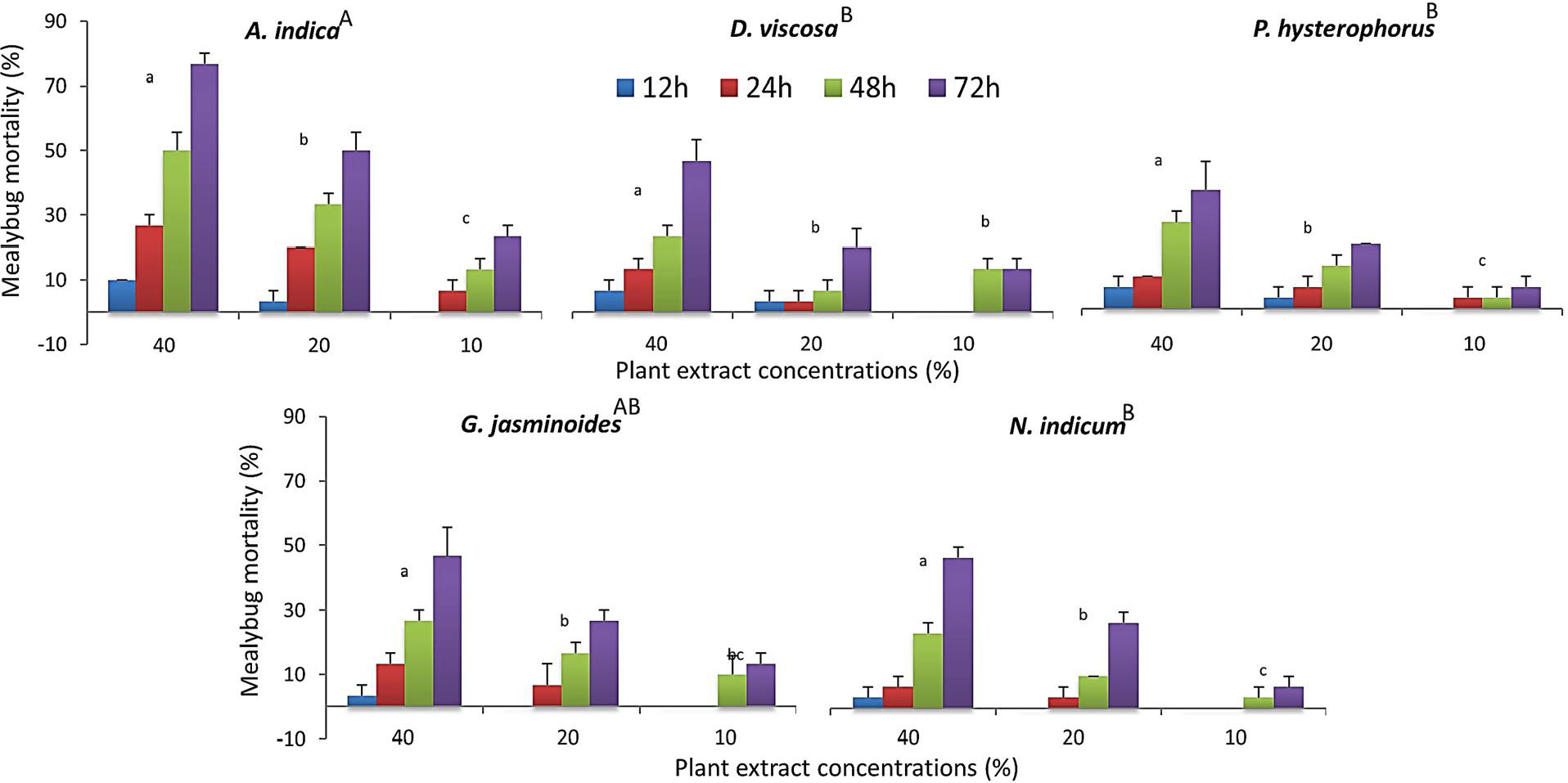
Percent mortality of 2nd instar nymphs of mealybug Drosicha mangiferae exposed to methanolic extracts of different plants. Columns represent average percent mortality of mealybug individuals ± standard error (n=5). For each botanical extract, small alphabets indicate statistical difference among the concentrations (two-way ANOVA; LSD at α = 0.05), while capital alphabets indicate statistical difference among botanical extracts (factorial ANOVA; LSD at α = 0.05).
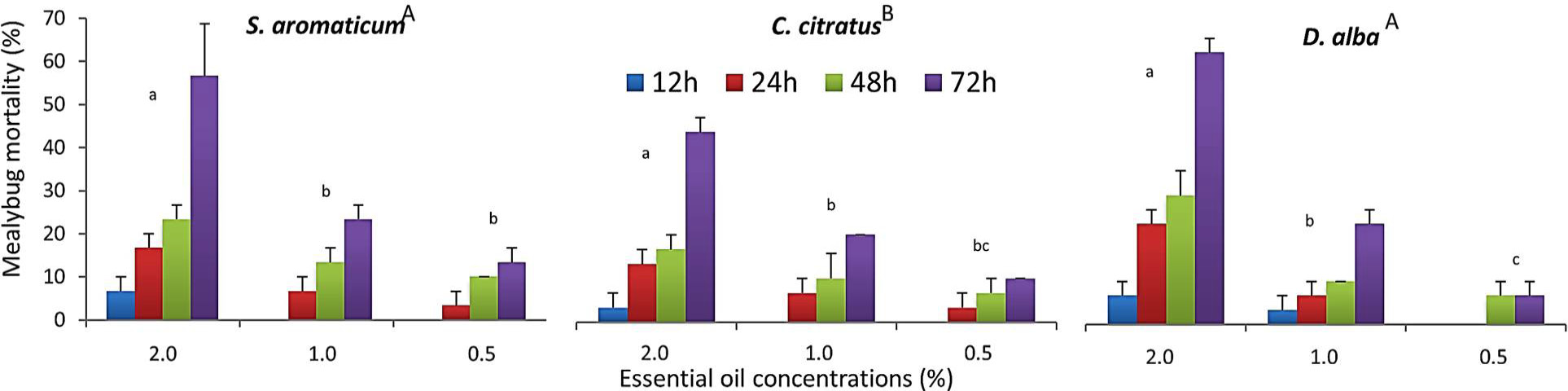
Percent mortality of 2nd instar nymphs of mealybug Drosicha mangiferae exposed to different plant essential oils. Columns represent average percent mortality of mealybug individuals ± standard error (n=5). For each essential oil, small alphabets indicate statistical difference among the concentrations (two-way ANOVA; LSD at α = 0.05), while capital alphabets indicate statistical difference among essential oils (factorial ANOVA; LSD at α = 0.05).
References
- Afzal, M.B.S., Sikandar, Z., Banazeer, A., Khan, M.N., Aziz, A., Salik, M.R. and Nawaz, S., 2018. Efficacy of different insecticides under laboratory conditions against Drosicha mangiferae Green (Homoptera: Margarodidae) collected from citrus orchards of Sargodha, Pakistan. J. Ent. Zool. Stud., 6: 2855-2858.
- Ahmad, B., Mehdi, M., Ghafoor, A. and Anwar, H., 2018. Value chain assessment and measuring export determinants of citrus fruits in Pakistan: An analysis of primary data. Pakistan J. agric. Sci., 55: 691-698. https://doi.org/10.21162/PAKJAS/18.6056[CrossRef]
- Ahmed, S. and Din, N., 2009. Leaf powders of Basil (Ocimum basilicum L.), Lantana (Lantana camara L.) and Gardenia (Gardenia jasminoides Ellis) affect biology of Callosobruchus chinensis L. (Coleoptera: Bruchidae). Pakistan Entomol., 31: 5-9.
- Ahmed, S., Fiaz, S., Riaz, M.A. and Hussain, A., 2005. Comparative efficacy of Datura alba nees, Calotropis procera and imidacloprid on termites in sugarcane at Faisalabad. Pakistan Entomol., 27: 11-14.
- Ali, A., Ahmad, F., Biondi, A., Wang, Y. and Desneux, N., 2012. Potential for using Datura alba leaf extracts against two major stored grain pests, the khapra beetle Trogoderma granarium and the rice weevil Sitophillus oryzae. J. Pest Sci., 85: 359-366. https://doi.org/10.1007/s10340-012-0426-1[CrossRef]
- Al-Snafi, A.E., 2017. A review on Dodonaea viscosa: A potential medicinal plant. IOSR J. Pharm., 7: 10-21. https://doi.org/10.9790/3013-0702011021[CrossRef]
- Anjum, T. and Javaid, A., 2005. Major diseases of citrus in Pakistan: A review. Int. J. Biol. Biotechnol., 2: 793-796.
- Arshad, M., Majeed, M.Z., Ullah, M.I., Ahmad, K., Tayyab, M. and Yahya, M., 2015. Laboratory evaluation of some insecticides against citrus mealybug Planococcus citri (Homoptera: Pseudococcidae). J. Ent. Zool. Stud., 3: 20-23.
- Badshah, H., Ullah, F., Calatayud, P.A., Ullah, H. and Ahmad, B., 2017, Can toxicants used against cotton mealybug Phenacoccus solenopsis be compatible with an encyrtid parasitoid Aenasius bambawalei under laboratory conditions? Environ. Sci. Pollut. Res., 24: 5857-5867. https://doi.org/10.1007/s11356-016-8293-6[CrossRef]
- Benelli, G., Canale, A., Toniolo, C., Higuchi, A., Murugan, K., Pavela, R. and Nicoletti, M., 2017. Neem (Azadirachta indica): Towards the ideal insecticide? Nat. Prod. Res., 31: 369-386. https://doi.org/10.1080/14786419.2016.1214834[CrossRef]
- Chaudhari, V.V., 2012. Evaluation of entomopathogenic fungi and botanicals for the management of mealybug and scale insect. Doctoral dissertation, Department of Entomology, College of Agriculture, Dapoli, India, pp. 66.
- Dodia, D.A., Patel, I.S. and Patel, G.M., 2010. Botanical pesticides for pest management. Scientific Publishers, Jodhpur, India, pp. 354.
- Edwards, C.A., 2013. Environmental pollution by pesticides, Vol. 3. Springer Science & Business Media, New York, pp. 542. https://doi.org/10.1007/978-1-4615-8942-6[CrossRef]
- Fang, C.Z., 2009. Research of insecticidal activity of Datura metel L. extracts. Master dissertation, Huazhong Agricultural University, China, pp. 188.
- FAO, 2016. FAO database. Food and Agriculture Organization, Rome. http://www.fao.org/faostat/en/#data/QC (accessed on 30 September, 2017).
- Franco, J.C., Suma, P., DaSilva, E.B., Blumberg, D. and Mendel, Z., 2004. Management strategies of mealybug pests of citrus in Mediterranean countries. Phytoparasitica, 32: 507-522. https://doi.org/10.1007/BF02980445[CrossRef]
- GoP, 2017. Labor force survey 2015-16. Pakistan Federal Bureau of Statistics, Government of Pakistan, Islamabad, Pakistan.
- Khan, S.A., Ranjha, M.H., Khan, A.A., Sagheer, M., Abbas, A. and Hassan, Z., 2019. Insecticidal efficacy of wild medicinal plants, Dhatura alba and Calotropis procera, against Trogoderma granarium (Everts) in wheat store grains. Pakistan J. Zool., 51: 289-294.
- Kim, D.I., Park, J.D., Kim, S.G., Kuk, H., Jang, M.S. and Kim, S.S., 2005. Screening of some crude plant extracts for their acaricidal and insecticidal efficacies. J. Asia-Pac. Ent., 8: 93-100.
- Kuganathan, N., Saminathan, S. and Muttukrishna, S., 2008. Toxicity of Datura alba leaf extract to aphids and ants. Internet J. Toxicol., 5: 1559-3916.
- Lanjar, A.G., Rustamani, M.A. and Solangi, A.W., 2015. Effect of botanical extract against mango mealy bug, Drosicha mangiferae (Green). Sci. Int., 27: 343-346.
- Li, L., Zou, J., Xia, Q., Cui, H., You, S., Liu, Y. and Wang, Q., 2018. Anti-TMV and insecticidal potential of four iridoid glycosides from Gardenia Jasminoides fruit. Chem. Res. Chinese Univ., 34: 697-699. https://doi.org/10.1007/s40242-018-8197-8[CrossRef]
- Li, X. and Fang, J., 2010. Insecticidal activity of extracts from eighteen Chinese traditional herbal plants against Nilaparvata lugens Stǻl (Homoptera: Delphacidae) and Spodoptera exigua (Lepidoptera: Noctuidae). Acta. Ent. Sin., 53: 298-306.
- Mahmood, R., Rehman, A. and Ahmad, M., 2014. Prospects of biological control of citrus insect pests in Pakistan. J. agric. Res., 52: 229-244.
- Majeed, M.Z., Nawaz, M.I., Khan, R.R., Farooq, U. and Ma, C.S., 2018. Insecticidal effects of acetone, ethanol and aqueous extracts of Azadirachta indica (A. Juss), Citrus aurantium (L.), Citrus sinensis (L.) and Eucalyptus camaldulensis (Dehnh.) against mealybugs (Hemiptera: Pseudococcidae). Trop. Subtrop. Agroecosyst., 21: 421-430.
- Mani, M., and Shivaraju, C. (eds.), 2016. Mealybugs and their management in agricultural and horticultural crops. Springer, New Delhi. https://doi.org/10.1007/978-81-322-2677-2[CrossRef]
- Mehdi, S.H., Qamar, A., Khan, I. and Jacob, P., 2012. Larvicidal and IGR potential of Ocimum tenuiflorum and Datura alba leaf extracts against malaria vector. Eur. J. exp. Biol., 2: 1370-1375.
- Monira, K.M. and Munan, S.M., 2012. Review on Datura metel: A potential medicinal plant. Glob. J. Res. Med. Pl. Indig. Med., 1: 123-132.
- Mourier, M., 1997. Effects of neem (Azadirachta indica) kernel water extracts on cassava mealybug, Phenacoccus manihoti (Hom., Pseudococcidae). J. appl. Ent., 121: 231-236.
- Prishanthini, M. and Vinobaba, M., 2014. Efficacy of some selected botanical extracts against the cotton mealybug Phenacoccus Solenopsis (Tinsley) (Hemiptera: Pseudococcidae). Int. J. Sci. Res. Publ., 4: 1-6.
- Regnault-Roger, C., 1997. The potential of botanical essential oils for insect pest control. Integr. Pest Manage. Rev., 2: 25-34. https://doi.org/10.1023/A:1018472227889[CrossRef]
- Sreerag, R.S., Nishanth, K.S. and Jayaprakas, C.A., 2016. Characterization of mealy substance secreted by the tuber crops pest mealy bug, Rhizoecus amoprhophalli. Arch. Phytopathol. Pl. Prot., 49: 149-156. https://doi.org/10.1080/03235408.2016.1140610[CrossRef]
- Tahir, H.M., Nazarat, I., Naseem, S., Butt, A., Yaqoob, R., Mukhtar, M.K. and Samiullah, K., 2015. Seasonal dynamics of spiders and insect pests in citrus orchards of district Sargodha, Pakistan. Pakistan J. Zool., 47: 1673-1681.
- Tanwar, R.K., Jeyakumar, P. and Monga, D., 2007. Mealybugs and their management. Technical Bulletin 19, September, 2007. National Centre for Integrated Pest Management, New Delhi, India, pp. 16. Available at: http://www.ncipm.res.in/NCIPMPDFs/Publication/Bulletin-Mealybugs%20(English).pdf (Accessed on 25 March, 2019).
- Zeng, L., Lao, C.Z., Cen, Y.J. and Liang, G.W., 2010. Study on the insecticidal activity compounds of the essential oil from Syzygium aromaticum against stored grain insect pests. Julius-Kühn-Archiv., 425: 766-771.
Supplementary material
Cited by 1 article
In journals published by ResearchersLinks.
Services
Article usage statistics
Loading…