Research Article · Volume 41, Issue 4, 6 November 2025 · Open Access
In Vitro Evaluation of Abiotic and Biotic Agents Against Tomato Early Blight Disease Caused by Alternaria Solani
· · · · · · ·
Affiliations & Notes ⌄
1Department of Plant Pathology, University College of Agriculture, University of Sargodha (40100), Pakistan
2Department of Plant Pathology, University of Agriculture, Faisalabad
3Pakistan
4Citrus Research Institute, Sargodha, Punjab, Pakistan
5Oilseeds Research Institute, Ayub Agriculture Research Institute Faisalabad, Pakistan
6Department of Plant Pathology, Faculty of Agricultural Sciences & Technology, Bahauddin Zakariya University Multan, Pakistan
7Department of Plant Pathology, Faculty of Agricultural Sciences & Technology, University of Layyah, Layyah (31200) Pakistan. *Correspondence | Salman Ahmad, Department of Plant Pathology, University of Agriculture Faisalabad, Pakistan. Email: salman.ahmad@uos.edu.pk
The fungus that causes tomato early blight disease was characterized by colony morphology and microscopic observation.
The results of the present study showed that all evaluated fungicides and fungal biocontrol agents are effective against A. solani; however, their efficacy varies with the day’s interval.
Among fungicides, a mixture of Metalaxyl and Mancozeb was found to be most effective against the pathogenic fungus A. solani.
The results of the present research demonstrate how abiotic and biotic agents, such as synthetic fungicides and fungal BCA, can be utilized to provide an efficient and ecologically sustainable method for controlling tomato early blight disease.
Selected from the article's own text.
Abstract
Tomatoes are a crop that is extensively grown and has a substantial economic value. However, the pathogen Alternaria solani causes early blight disease, which significantly reduces yield. The purpose of the present research was to assess the effectiveness of specific abiotic agents, such as synthetic chemical fungicides, and biotic agents, including fungal biological control agents (BCAs), against A. solani in a controlled environment. Affected leaves and fruits of tomato were used for isolation of causal organism of the disease, which was later recognized using structural features and microscopy. Both the poison food methodology and the dual culture approach were employed to evaluate several fungicides, comprising Metalaxyl+Mancozeb, Topsin-M, Nativo, Copper Oxychloride, and Success, and fungal BCAs, comprising Trichoderma harzianum, T. atroviridae, T. viridae, T. asperrellum, and Paecilomyces lilacinus. Metalaxyl + Mancozeb considerably reduced the development of A. solani compared to the other fungicides, showing a maximum percent inhibition of 86.4% at 150 ppm concentration, and 85.08% at 100 ppm, and 82.01% at 50 ppm on the 7th day after treatment. T. harzianum demonstrated the strongest opposing action compared to the other BCAs, with a maximum percent inhibition of 84.86% against A. solani. The results indicate that tomato early blight disease can be effectively managed using either chemical or biological methods, with fungal BCAs providing an affordable and environmentally beneficial substitute.
rcity prevails.
Introduction
Tomato (Solanum lycopersicum L.), highly desirable for both its nutritive and economic value, has become an extensively grown and consumed vegetable worldwide. The Food and Agriculture Organization (FAO, 2023) reports that over 189 million tons of tomatoes were produced worldwide. Many biological stressors significantly impair its yield, with A. solani-induced early blight being one of the most destructive. Loss of leaves, fruit rots, and distinctive circular patches on leaves are the results of this necrotrophic fungus infection, which eventually results in its reduced productivity . Due to rising temperatures and unsustainable agricultural practices, the infection has become increasingly common in recent years, and it thrives in moist, hot environments .
Scientifically, Alternaria is classified as belonging to the Ascomycota phylum, Pezizomycotina subdivision, Dothidiomycetes class, Pleosporales order, and Pleosporaceae family. It forms lengthy or branching strands from the eukaryotic darkly colored spores. Fungal hyphae have cross-walls and are haploid. In terms of morphology, it has a branching structure and is brown during the initial stages of growth, whereas a fully developed colony is black. Spores are produced individually, have a beak-like structure, and are black in appearance . Although A. solani’s non-sexual stages can produce spores, the species’ sexual stages have yet to be identified. They produce chlamydospores, although they only grow in unfavorable environments. They are fragile organisms that may live as saprotrophs (organisms that feed on dead organic matter). The production of variable spores, which can be solitary or extensive branching strands with parallel and vertical cross walls, along with longer or shorter projections, is a characteristic of the genus Alternaria. Ascospores, which are formed in bitunicate asci, are what distinguish this species . Temperature between twenty-five to thirty degrees Celsius and pH values between six to seven are ideal for growing A. solani .
Synthetic fungicides, such as chlorothalonil, Difenoconazole, and Mancozeb, have been a significant component of conventional management methods against early blight disease. Fungicides such as Antracol, Captan, and Dithane M-45 are effective in inhibiting the mycelial growth of A. solani, which causes early blight disease in tomatoes . Even though these artificial substances inhibit the disease quickly and effectively, their widespread and careless usage has led to significant concerns about chemical resistance and pollution .
Appropriate and environmentally safe methods of managing diseases are becoming increasingly important in light of these issues. The application of fungal BCAs, such T. viride and T. harzianum has proved to be more effective as compared to others. T. harzianum is a biological control agent that is most effective against A. solani, causing early blight of tomato . Other Trichoderma strains, such as T. longibrachiatum, T. harzianum, T. viride, and T. atroviridae, work effectively against Alternaria species .
The purpose of the current investigation was to assess the effectiveness of certain chemical-based fungicides and fungal BCAs in a controlled environment towards A.solani, the leading cause of tomato early blight. The primary objectives of this research were to evaluate mycelial growth suppression, to assess the relative effectiveness of chemical and biological treatments, and to explore the potential of combining these methods for disease prevention.
Materials and Methods
Sample collection and pathogen isolation
From several farms, diseased tomato leaves and fruits displaying the classic indications of blight were gathered. Following several rinses in distilled water, infected leaves and fruit cuttings were put on PDA after being surface-sterilized with one percent of sodium hypochlorite. For five to seven days, plates were placed in an incubator at 25 ± 2 °C. Through microscopy, causal organism of the disease was recognized visually as A. solani after being purified utilizing an individual spore approach.
Pathogenicity test
The infection of pathogen was confirmed by the fulfillment of Koch’s postulates. After being injected with fungal spores, leaves and fruits were placed in a moist environment. Within five to seven days, symptoms appeared and the fungus was verified by re-isolating it from the diseased leaves and fruits.
Poisoned food technique
Fungicides including Metalaxyl+Mancozeb, Topsin-M, Nativo, Copper Oxychloride and Success were selected to check their activity against A.solani through poisoned food technique. Utilizing sterilized distilled water, various concentrations of fungicide such as 50, 100 and 150 ppm were prepared. Before the PDA solidified, liquid PDA was mixed with the necessary fungicide concentrations. A 5 mm plug of the pathogen under study was placed in the center of each plate. Fungicides were not used in control treatments. Fungicides used as treatment are shown in Table 1. On seven day of incubation at 25 ± 2 °C, radial expansion of pathogen was measured in the plates. Percentage inhibition of the pathogen was calculated by formula:
Figure 1.
Where ‘C’ is the radial growth of pathogen in control and ‘T’ is the radial growth of pathogen in treatment.
Table 1: Details of fungicides used in the study, including their trade name, active ingredient, and manufacturing company.
Sr. No.
Fungicide
Active ingredient
Company name
1
Metalaxyl+Mancozeb
Metalaxyl+Mancozeb
Green zone
2
Topsin-M
Thiophanate methyl
Arysta
3
Nativo
Tebuconazole
Bayer
4
Copper oxychloride
Copper oxychloride
Capricorn
5
Success
Chlorothalonil and metalaxyl
Arysta
Preparation of fungal BCAs
Fungal BCAs including T. harzianum, T. atroviridae, T. viridae, T. asperrellum and Paecilomyces lilacinus were acquired from the Plant Pathology Laboratory, University College of Agriculture, University of Sargodha culture collection. After being developed on PDA, they were maintained for seven days at 26 ± 2 °C.
Dual culture technique
The dual culture approach was used to assess the fungal BCAs’ opposing effects against pathogen i.e; A. solani. One side of a PDA plate had a 5 mm mycelial plug of pathogen, while the other end had a plug of the BCA. Fungal BCAs were not used in control treatments. Plates were kept in an incubator for seven days at 25 ± 2 °C. The percentage of inhibition was computed by measuring the infectious agent’s radial expansion.
Statistical analysis
All the data was analyzed statistically using Statistix 8.1 software.
Results and Discussion
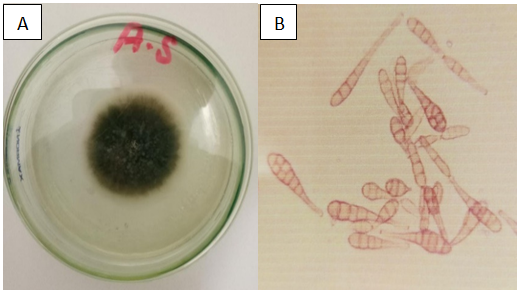
Characterization of isolated fungal pathogen. The fungus that causes tomato early blight disease was characterized by colony morphology and microscopic observation. Pathogenic fungus was isolated from diseased samples and identified as A. solani. Figure 1 shows a pure culture of A.solani and its spores.
Potential of fungicides against A.solani
Results of in vitro study showed that all fungicides
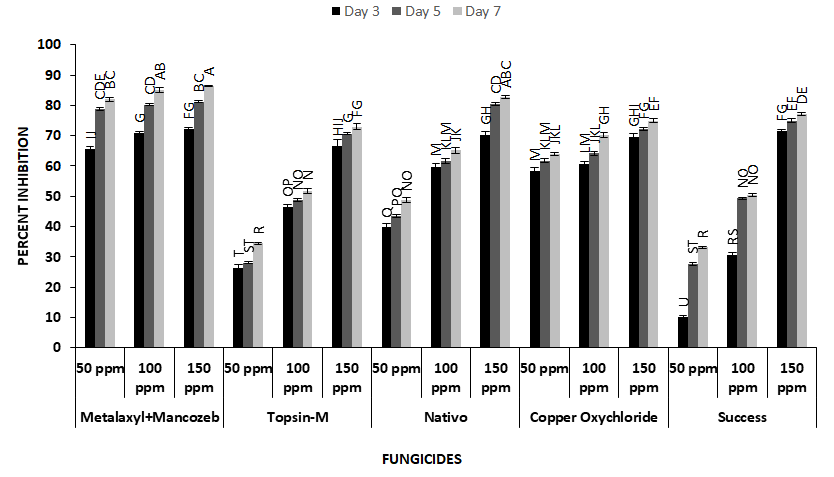
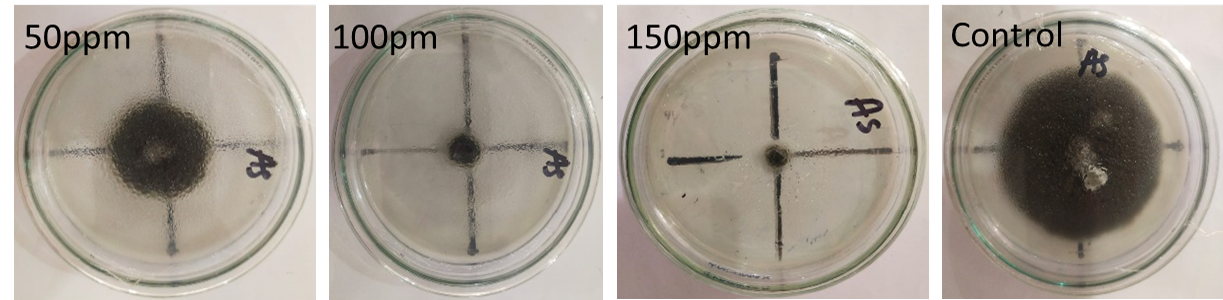
significantly (P<0.05) inhibited mycelial growth of A. solani at 50, 100 and 150 ppm concentrations; however, their efficacy varied with the number of days. Among all the fungicidal treatments, Metalaxyl+Mancozeb was found to be the most effective as compared to others.
Virulence of isolated pathogen
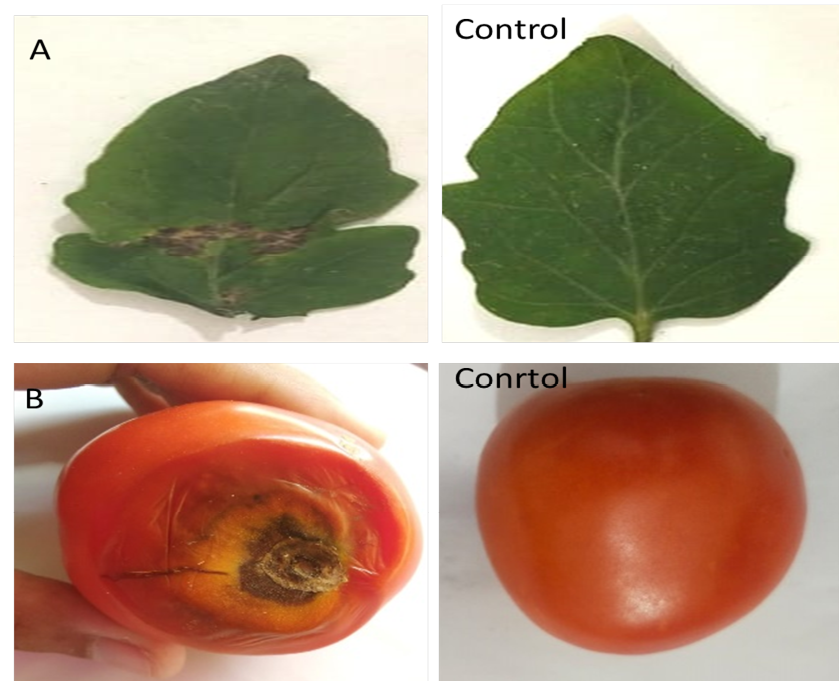
The results of the pathogenicity test showed that pathogen A. solani infected tomato leaves and fruit in the moist chamber, as well as in detached leaf and fruit assays. Table 2 and Figure 2 showed the lesion diameter (cm) on detached leaves and fruit.
Table 2: Lesion diameter (cm) of A. solani on detached leaf and fruit.
Pathogenicity test
Lesion diameter (cm)
Control
Leaves
1.40±0.05 A
0±0 B
Fruits
2.23±0.12 A
0±0 B
In the current study, fungicides with their ability to inhibit the growth of pathogenic fungus (A. solani) were used by using the poison food technique. This is a straightforward technique for in vitro evaluation . Among the tested fungicides, Metalaxyl + Mancozeb yielded the highest percent inhibition against A. solani. It is a systemic and protective fungicide, providing reasonable control against fungus in previous studies, by Bais et al. (2019) and Dhal et al. (2016). Dhal et al. (2016) evaluated different fungicides, including Metalaxyl and Mancozeb, against A. solani using the poison food technique. They reported that Metalaxyl + Mancozeb significantly inhibited the mycelial growth of A. solani.
They further noted that the efficacy of Metalaxyl + Mancozeb increased with increasing concentration. Bais et al. (2019) employed a poison food technique to assess the efficacy of different fungicides against A. solani, the causal agent of early blight disease in tomatoes. They reported that among the tested fungicides, Metalaxyl+Mancozeb was the most effective fungicide at higher concentrations. They also reported that the efficacy of Metalaxyl+Mancozeb increased with increasing time intervals.Potential of fungal BCAs against A.solani.
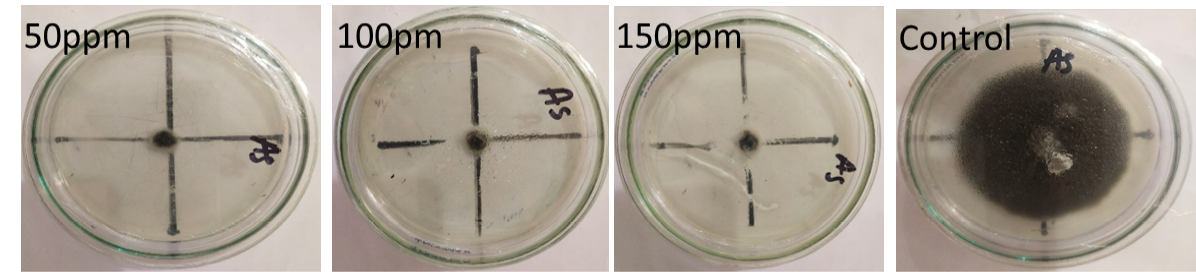
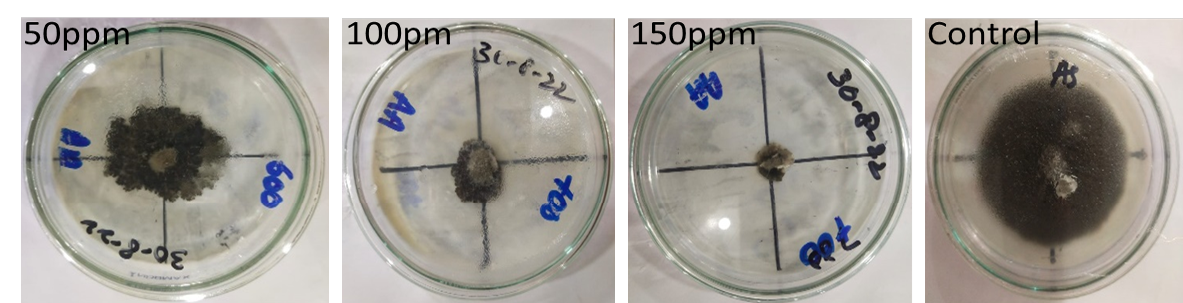
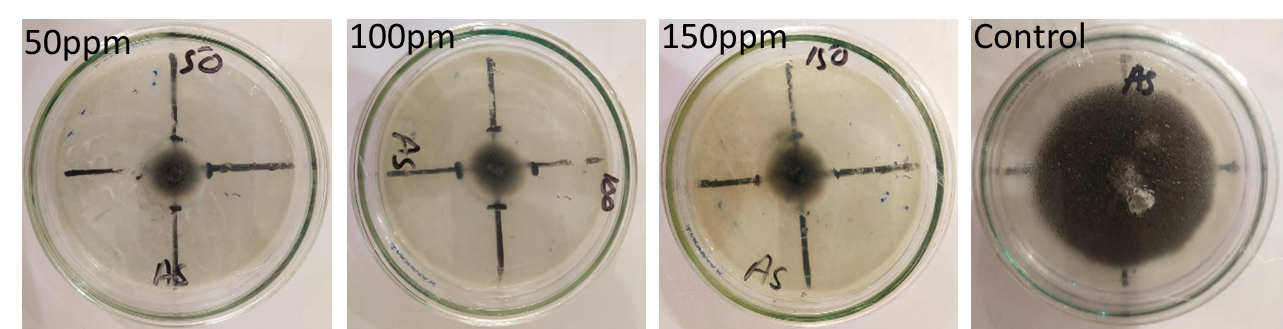
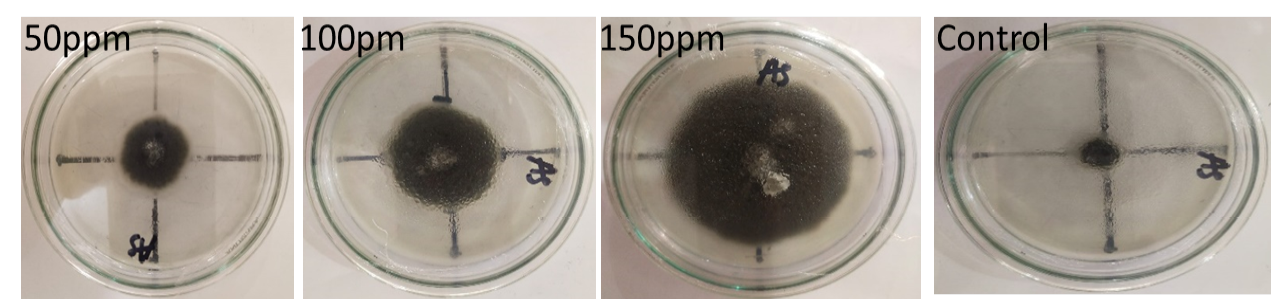
It showed maximum percent inhibition (86.4%) on the day after treatment at 150 ppm concentration, followed by the same fungicide when used at 100 ppm (85.08%) and 50 ppm concentration (82.01%), as well as Nativo when used at 150 ppm concentration (82.67%) on the seventh day after treatment. Topsin-M and Success were the least effective fungicides (Figures 3-Figures 8).
In the current study, fungal biocontrol agents with their ability to suppress pathogenic fungi (A. solani) were used by using in vitro dual culture antagonistic assays Naik et al. (2020) and Limtong et al. (2020). T. harzianum was inhibiting A. solani the maximum. These results were similar to the studies conducted previously by Metz and Hausladen (2022); Matrood and Rhouma, (2021) and Srivastava et al. (2012). Matrood and Rhouma (2021), evaluated T. harziamum and P. lilacinus against A. solani causing blight disease of eggplant. They reported that T. harzianum gave maximum inhibition of pathogen.
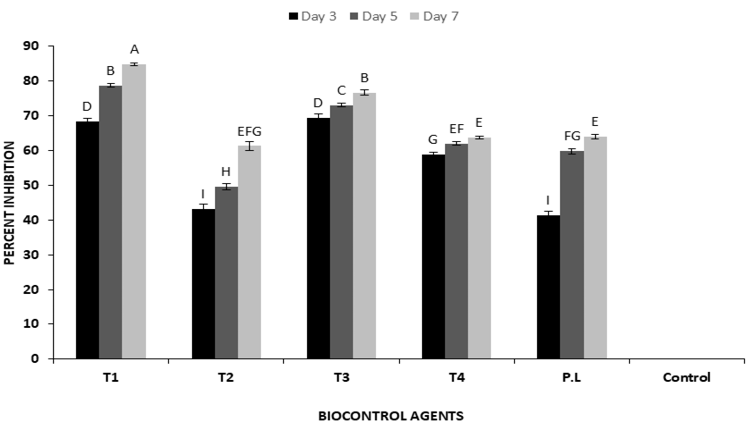
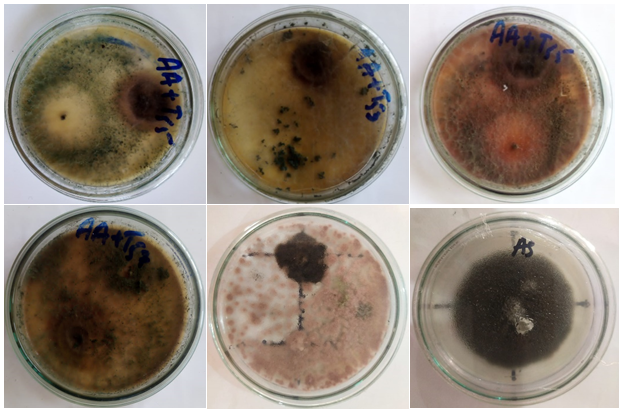
Results of in vitro study showed that all biological control agents significantly (P<0.05) inhibited the mycelial growth of A. solani at 3rd, 5th and 7th day. Percent inhibition was lower after 3rd day of treatment and gradually increased at 5th and 7th day. T1 (T. harzianum) gave maximum percent inhibition (84.86%) against the pathogen A. solani as compared to other biological control agents. T3 was the second best biological control agent against A. solani and it showed 76.74% inhibition. T2 gave least inhibition (61.39%) of pathogen (Figures 9 and Figures 10).
Srivastava et al. (2012) used dual culture assay to check the efficacy of Trichoderma isolates against Alternaria spp causing leaf spot of chilies. They concluded that T. harzianum significantly inhibited the growth of pathogen. Metz and Hausladen, (2022) reported that Trichoderma spp were effective against A. solani in potato.
Conclusions and Recommendations
The results of the present study showed that all evaluated fungicides and fungal biocontrol agents are effective against A. solani; however, their efficacy varies with the day’s interval. Among fungicides, a mixture of Metalaxyl and Mancozeb was found to be most effective against the pathogenic fungus A. solani. Among biocontrol agents, T. harzianum proved to be the most effective. The results of the present research demonstrate how abiotic and biotic agents, such as synthetic fungicides and fungal BCA, can be utilized to provide an efficient and ecologically sustainable method for controlling tomato early blight disease.
These coordinated strategies can reduce ecological risks, delay the emergence of fungicide resistance, and decrease the frequency and volume of chemical-based treatments.
Acknowledgements
The authors extend their gratitude to the University College of Agriculture, University of Sargodha, for providing the necessary facilities and research environment to conduct this study.
Novelty Statement
This study offers a unique comparative analysis of both chemical fungicides and fungal biological control agents for managing tomato early blight disease. It specifically identifies Metalaxyl+Mancozeb as the most effective chemical agent and Trichoderma harzianum as the most effective biological agent, proposing an environmentally conscious alternative to traditional chemical treatments.
Author’s Contribution
Rabia Safdar: Conducted the research, performed analysis, and contributed to the initial draft of the manuscript
Salman Ahmad: Designed the research and prepared the manuscript and supervision of the manuscript
Muhammad Atiq: Contributed to the study’s conceptualization and provided critical review.
Nasir Ahmed Rajput: Assisted with experimental design and conducted statistical analysis.
Malik Abdul Rehman: Executed the laboratory and field activities.
Muhammad Ehetisham ul Haq: Helped with data collection and preliminary analysis.
Hafiz Muhammad Aatif: Provided technical assistance and helped with literature review.
Yasir Ali: Contributed to data analysis and proofreading of the manuscript.
Generative AI or AI assisted technology statement
The authors declare that no generative AI or AI-assisted technology has been used in the writing of this manuscript.
Conflict of interest
The authors have no conflict of interest.
Figures
Figure 1:.
Pure culture of A. solani on PDA media (A) and microscopic view of spores (B)
Figure 2:.
In vitro pathogenicity test of A.solani on detached leaves (A) and fruit (B) with their control treatments.
Figure 3:.
Percent inhibition (mean±se) of mycelial growth of a. solani on pda amended with different fungicides at different concentrations and different time intervals after treatment. means with similar letter are not significantly different at p<0.05.
Figure 4:.
Pictorial views of A. solani colonies on PDA amended with metalaxyl+mancozeb at 7th day after treatment.
Figure 5:.
Pictorial views of A. solani colonies on PDA amended with topsin-M at 7th day after treatment.
Figure 6:.
Pictorial views of A. solani colonies on PDA amended with nativo at 7th day after treatment.
Figure 7:.
Pictorial views of A. solani colonies on PDA amended with copper oxychloride at 7th day after treatment.
Figure 8:.
Pictorial views of A. solani colonies on PDA amended with success at 7th day after treatment.
Figure 9:.
Percent inhibition (mean±se) of mycelial growth of a. solani with trichoderma species and paecilomyces lilacinus at different time interval after treatment.
Figure 10:.
Dual cultures of pathogenic A. solani with biocontrol agents (Trichoderma species and Paecilomyces lilacinus) and their control.
References
Ajmal, M.S., I. Rashid and R.T. Bajwa. 2023. In vitro management of the early blight of tomato by various chemical fungicides and plant products. Phytopathogen. Dis. Cont., 2(1):1-6. https://doi.org/10.22194/Pdc/2.102.[CrossRef]
Alhussaen, K.M. 2012. Morphological and physiological characterization of Alternaria solani isolated from tomato in Jordan Valley. Res. J. Biol. Sci., 7(8):316-319. https://doi.org/10.3923/rjbsci.2012.316.319[CrossRef]
Bais, R.K., V. Ratan, S. Kumar and A. Tiwari. 2019. Comparative analysis of various strategies for management of early blight of tomato incited by Alternaria solani (Ellis and Martin) Jones and Grout. Pharma Innov. J., 8(12): 15-20.
Bose, T.K. and M.G. Som. 1986. Vegetable crops in India.
Dhal, A., S.K. Beura, N. Ranasingh, B. Khamari and M. Satpathy. 2016. Efficacy of fungicides on inhibition of mycelial growth of Alternaria solani, the incitant of Early blight disease of Tomato. J. Mycopathol. Res., 54(3): 435-438.
FAO. 2023. FAOSTAT. Food and Agriculture Organization of the United Nations.
Imran, M., K.A. Abo-Elyousr, M.A. Mousa and M.M. Saad. 2022. Screening and biocontrol evaluation of indigenous native Trichoderma spp. against early blight disease and their field assessment to alleviate natural infection. Egypt. J. Biol. Pest Cont., 32(1): 40. https://doi.org/10.1186/s41938-022-00544-4.[CrossRef]
Imran, M., K.A. Abo-Elyousr, M.A. Mousa and M.M. Saad. 2023. Use of Trichoderma culture filtrates as a sustainable approach to mitigate early blight disease of tomato and their influence on plant biomarkers and antioxidants production. Front. Plant Sci., 14:1192818. https://doi.org/10.3389/fpls.2023.1192818.[CrossRef]
Lamichhane, J.R., C. Durr, A.A. Schwanck, M.H. Robin, J.P. Sarthou, V. Cellier and J.N. Aubertot. 2017. Integrated management of damping-off diseases. A review. Agron. Sustain. Dev., 37(10): 1-25. https://doi.org/10.1007/s13593-017-0417-y.[CrossRef]
Limtong, S., P. Into and P. Attarat. 2020. Biocontrol of rice seedling rot disease caused by Curvularia lunata and Helminthosporium oryzae by epiphytic yeasts from plant leaves. Microorgan., 8(5): 647. https://doi.org/10.3390/microorganisms8050647.[CrossRef]
Matrood, A.A. and A. Rhouma. 2021. Evaluation of the efficiency of Paecilomyces lilacinus and Trichoderma harzianum as biological control agents against Alternaria solani causing early blight disease of eggplant. Pak. J. Phytopathol., 33(1): 171-176. https://doi.org/10.33866/phytopathol.033.01.0673.[CrossRef]
Metz, N. and H. Hausladen. 2022. Trichoderma spp. as potential biological control agent against Alternaria solani in potato. Biol. Control., 166: 104820. https://doi.org/10.1016/j.biocontrol.2021.104820[CrossRef]
Moustafa, M., A. ALkolaly and H. El-Dakar. 2018. Impact of Bioagents and organic acids on Alternaria solani, the causal organism of tomato early blight disease and their side effect assessment. Glob. J. Adv. Res., 5(7): 234-242. https://doi.org/10.21608/EJP.2021.68687.1027.[CrossRef]
Naik, S.C., T.K. Narute, T.T. Narute and P.B. Khaire. 2020. In-vitro efficacy of biocontrol agents against Alternaria solani (Early Blight of Tomato). J. Pharmacogn. Phytochem., 9(5S): 550-552.
Neeraj, V.S. and S. Verma. 2010. Alternaria diseases of vegetable crops and new approaches for its control. Asian J. Exp. Biol. Sci., 1(3): 681-692.
Shoaib, A., Z.A. Awan and K.A. Khan. 2019. Intervention of antagonistic bacteria as a potential inducer of disease resistance in tomato to mitigate early blight. Sci. Hortic., 252: 20-28. https://doi.org/10.1016/j.scienta.2019.02.073.[CrossRef]
Srivastava, A.K., R.N. Singh, S. Kumar, P.L. Kashyap and D.K. Arora. 2012. Growth promotion and management of Alternaria leaf spot in chilli by Trichoderma harzianum. Int. J. Innov. Hortic., 1(2): 158-163.
Sultana, N. and A. Ghaffar. 2013. Effect of fungicides, microbial antagonists an oil cakes in the control of Fusarium oxysporum, the cause of seed rot and root infection of bottle gourd and cucumber. Pak. J. Bot., 45(6): 2149-2156.