
This study investigated the antibacterial efficacy of hydroxamic acid extracted from Azam maize root powder. The methanolic extract was tested for the availability of hydroxamic acid as an antibacterial agent through In-Vitro and In-Vivo tests in locally isolated E. coli strain-infected broiler chicks. In-Vivo experiment, 280-day-old broiler (Cobb) chicks were distributed into 7 experimental groups each with 4 replicates (10 birds/replicate) e.g. CON (control), PC (positive control), Enro (enrofloxacin drug of choice against E. coli 5mg/kg body weight), SC (sweet corn dried roots not having any hydroxamic acid, 1000mg/kg feed), FD (freeze dried Azam maize roots, 1000mg/kg feed); SD (sun-dried Azam maize roots,1000mg/kg feed) and OD (oven dried Azam maize roots,1000mg/kg feed). Methanolic extract of Azam maize roots showed a significant reduction/inhibition in the growth of E. coli strain in which group FD in the range of 11.66 to 0.005mg and groups SD and OD in the range of 11.66 to 5.83 mg were effective. In-vivo tests, feed intake, body weight gain, and FCR were significantly improved in the FD group than in the PC, SC, SD, and OD groups during the post-infection phase. Similarly, the mortality index (%) showed a significant reduction in the FD group as compared to the PC, SC, SD, and OD treatment groups. Blood biochemistry parameters e.g., HB, PCV, RBCs, and WBCs were significantly affected in the FD group. Similarly, liver and kidney function tests e.g., AST, ALT, creatinine, and blood urea showed more potential antioxidant effects in the FD group as compared to the PC, SC, SD, and OD treatment groups. The histopathological examination of liver, kidney, and intestine tissues in infected birds showed significantly different architectural structures. The FD group showed normal sectional architectural study as compared to other treatment groups. Based on the above facts, it is concluded that among the different methods of methanolic extract of Azam maize roots, the FD group has a good antimicrobial effect as well as improved performance and serum biochemistry against locally isolated E. coli strain-infected broiler chicks.
Research Article · Volume 57, Issue 4, 14 June 2025 · Open Access
In-Vitro and In-Vivo Antibacterial Effects of Hydroxamic Acid in Broilers
· · · · · · · ·
Affiliations & Notes ⌄
- 1Department of Poultry Science, Faculty of Animal Husbandry and Veterinary Sciences, The University of Agriculture, Peshawar, Pakistan 2Arid Zone Small Ruminants Research Institute, Ghulam Banda, Kohat, Pakistan 3Higher Education Department Khyber Pakhtunkhwa, Peshawar 4Gomal University, Dera Ismail Khan, Pakistan 5Livestock Fisheries and Cooperative Department, Khyber Pakhtunkhwa, Pakistan 6Vaccine Production Unit Sindh Tandojam, Livestock and Fisheries Department Government of Sindh 7College of
Article Info ⌄
- Journal:
- Pakistan Journal of Zoology
- Published:
- 14 June 2025

From the article
- It is indicated from the MIC test outcomes that the root powder of Azam maize freeze-dried having hydroxamic acid was effective in the range of 11.66 to 0.005mg.
- The first 2 wells of Azam maize sun-dried root extract and Azam maize oven-dried root extract showed .
- The overall performance in broiler chicks at the post-infection phase was found significant in a group of birds that were treated with methanolic extract of freeze-dried Azam roots powder in induced locally isolated E. coli strain infection as compared to other treatment groups.
- Liver, kidney, and intestinal samples of broiler chicks offered with freeze-dried Azam maize roots showed no histological deviations in contrast with the control group.
Selected from the article's own text.
Abstract
INTRODUCTION
Commercial poultry farming is gradually progressing and contributes to the provision of protein sources as well as employment either directly or indirectly but still, this sector is facing many challenging diseases like colibacillosis which generates hurdles in the progress of this sector . Collibacillosis results in significant economic losses every year around the globe due to its high morbidity and mortality rates . Systemic infection caused by Escherichia coli is the main reason for mortality . E. coli is a commensal facultative anaerobic microorganism that can grow in the lower intestinal tract of broiler birds shortly after birth and acts as a symbiont, helping in the synthesis of necessary vitamins for the host . Avian colibacillosis causes perihepatitis, airsacculitis, and pericarditis, although other syndromes such as coligranuloma, omphalitis, cellulitis, osteomyelitis/arthritis, and especially diarrhea may be noticed . Collibacillosis can occur as a secondary bacterial infection alongside other bacterial infections .
Pakistan produces about 7.9 million tonnes of maize annually and its production has increased 6% during 2019-2020. It contributes 0.6 % to the GDP . Maize is being grown on an area of 1.016 million hectares with a typical grain yield of 2,864 kg/ha. Because of its protein composition, interest in the domesticated animals and poultry feed industry has increased. Azam maize is a medicinal plant so its chemical composition is the main concern for the research . Hydroxamic acid is the obvious proof of its medicinal composition. Hydroxamic acid is prepared from a chemical compound an ester (via Lossen rearrangement reaction) or chlorides (by a reaction with hydroxylamine salts) as well as from aldehydes and sulfonyl hydroxylamine (via the Angeli-Rimini reaction). Hydroxamic acid and its chemically modified derivatives are efficient iron binders, bacterial protein synthesis inhibitors, and growth factor blockers and are good legends as well as metal chelators . They can remove heavy metals from the body easily through their excellent metal-binding ability (Bhawani et al., 2014). Hydroxamic acid possesses in-vitro antibacterial properties . Many researchers have worked on the beneficial chemical effects of hydroxamic acids against microbial activities, and anti-cancer and anti-fungal properties as well . The medicinal properties of hydroxamic acid are solving many complicated drug resistance issues through its unique binding and chelating actions as well as anti-bacterial functions against different bacterial species and fungi . Syed et al. (2020) reported about the antibacterial activity of heterocyclic hydroxamic acids against some species of bacteria and fungi. Shekhawat and Rajput (2012) reviewed the same activity of hydroxamic acids against microbes and stated that they are efficient chelators, iron and lead binding agents. Therefore, this study was designed to determine the in-vitro and in-vivo antibacterial efficacy of hydroxamic acid extracted from the Azam maize plant in induced E. coli infection in broiler chicks.
MATERIAL AND METHODS
Study area
The experiments were performed for the investigation of in-vitro and in-vivo antibacterial effects of hydroxamic acids in the Azam variety of maize roots against the locally isolated E. coli strain-challenged broiler birds. The experiments were conducted at the poultry farm unit, Department of Poultry Science while the lab work was executed at the College of Veterinary Science, the University of Agriculture, Peshawar, Pakistan in the Pharmacology and Histopathology Labs.
Sample collection and maize seeds cultivation procedure
For the extraction of hydroxamic acid, local varieties of maize seeds i.e., Azam maize and sweet corn seeds were cultivated in a Petri plate using tissue paper as an anchor material. Ten seeds per petri plate were cultivated. For proper activation of the seeds, the Petri plate was kept completely dark with no light access. After a few days, the dormancy of the seeds was finished and became activated. On day 7 of the cultivation, the roots of these Azam maize plants and sweet corn plants were separated and collected. After collection, these roots were dried in equal amounts following three different drying procedures, namely freeze drying, oven drying, and sun drying procedure. After drying maize roots were crushed into powder through a grinding mill. Then using a sonicator machine methanolic extract was prepared from both the sweet corn and Azam maize roots powder for an in vitro test against E. coli. Two-fold dilutions were performed for 11.66 mg concentrations of methanolic extracts in vitro test against E. coli. There were 7 experimental groups e.g., control (CON), positive control (PC), enrofloxacin group (ENRO), sweet corn (SC) dried roots powder group, Azam maize freeze-dried (FD) roots powder group, Azam maize sun-dried (SD) roots powder group, Azam maize oven dried (OD) roots powder group with 4 replicates in each group.
Methodology for the collection and preparation of E. coli culture
Proper confirmation on API strip, locally isolated E. coli strain was collected from infected broiler visceral organs as per already established samples collection protocol . After the collection of E. coli bacteria, proper culturing of E. coli bacteria (107 CFU) in nutrient broth was made and the culture was kept overnight at 37 °C.
In-vitro antibacterial bioassay of the hydroxamic acids in broiler
The minimum inhibitory concentration test was performed to explore the in-vitro antibacterial impacts of hydroxamic acid extracted from Azam maize roots and sweet corn roots against locally isolated strains of E. coli. The in-vitro antibacterial bioassay was performed using the broth dilution method as described by Neal et al. (2012) with some modifications: Nutrient broth 100 μl was added to each/96 wells of microtitration plate. These wells were properly labeled and sterilized as well. In the 1st row, only broth and in the 2nd row only E. coli was added. In the 3rd row, the drug of choice, Enrofloxacin, and E. coli bacteria were added. In the 4th row, 11.66 μl sweet corn root extract and locally isolated E. coli strain were added, and a 2-fold dilution up to well 12 was prepared. In the 5th row, 11.66 μl Azam maize freeze-dried roots extract and E. coli bacteria were added and 2-fold dilution was prepared up to well number 12. In the 6th row, 11.66 μl Azam maize oven-dried roots extract and E. coli bacteria were added and 2-fold dilution was prepared up to well number 12. In the 7th row, 11.66 μl Azam maize sun-dried roots extract and E. coli bacteria were added and a 2-fold dilution was prepared up to well number 12. Then incubated in an oven for 1 to 2 days at 37°C. The bacterial growth was assessed by measuring optical density (OD) 600 nm with the help of a spectrophotometer at 24 h post-inoculation.
In-vivo antibacterial bioassay of the hydroxamic acids in broiler against E. coli
For in-vivo bioassays, from a commercial hatchery, 280 broiler chicks (Cobb) were purchased and distributed randomly into 7 experimental groups e.g., CON, PC, ENRO, SC dried roots powder group, Azam maize FD roots powder group, Azam maize SD roots powder group, Azam maize OD roots powder group with 4 replicates in each group having 10 broilers. The required data was collected on 2nd week of the trial and the total duration of the experimental trials was 35 days. After an adaptation period of 7 days, all the experimental groups were infected with locally isolated E. coli strain except the control group. After 2 to 3 days post-infection, the ENRO group was treated with the drug of choice enrofloxacin @ 5mg/kg body weight, and the SC group with sweet corn dried roots powder @1000mg/kg. FD, SD, and OD experimental groups were fed with Azam maize freeze, sun, and oven-dried roots powder @ 1000mg/kg feed accordingly for 7 days.
Production performance parameters
Feed intake (FI), body weight gain (BWG), feed conversion ratio (FCR), and mortality were recorded weekly as described by Shuaib et al. (2020). FI and BWG were calculated. The FCR was calculated by using the formula; total FI ÷ total BWG.
Hematology and serum biochemical analysis
At 2nd week of the trial, broiler chicks were slaughtered and both the blood and tissue samples were collected in sterile test tubes from 3 birds per replicate in each group. Whole blood samples were used for the determination of the hematological profile of the diseased broiler and to correlate the result with the good health status of the healthy birds. Total red blood cells (RBCs) and total white blood cells (WBCs) count, hemoglobin (HB) concentration, and packed cell volume (PCV) from the blood were determined using standard procedures . Using 4000 rpm centrifugation for 10 min, serum was separated from the blood sample, which was used to foster biochemical analysis, and liver and kidney function tests according to the protocols adapted by IFCC. Commercially available kits (Sigma) were preferred for these tests according to the manufacturer’s instructions.
Histopathology
After 1 week of the trial, three birds per replicate were slaughtered within each group. Postmortem was performed and gross lesions were observed and recorded in different locations especially visceral organs. The samples from the liver, kidney, and digestive tract/intestine were taken and fixed in 10% buffered formalin for histopathological examination as per standard protocol of Bancroft et al. (1994). Hematoxylin and eosin (H and E) were the basic stains preferred in this process. The slides were observed for any alterations in the morphology and also microscopic lesions on tissue. The digital camera was used for saving pictures.
Data analysis
Complete randomized design (CRD) was used for the statistical analysis of data. The least significant test at 5% probability was carried out to distinguish the mean differences. For analysis of the data, the statistical package statistics 8.1 was used.
RESULTS
The results regarding the minimum inhibitory concentration (MIC) for the growth of locally isolated E. coli strain against different dilutions are presented in Table I. Parent concentration of methanolic extract at 11.66 to 0.005 mg of Azam maize roots showed significant reduction/inhibition in growth of locally isolated E. coli strain. It is indicated from the MIC test outcomes that the root powder of Azam maize freeze-dried having hydroxamic acid was effective in the range of 11.66 to 0.005mg. The first 2 wells of Azam maize sun-dried root extract and Azam maize oven-dried root extract showed
Table I. Minimum inhibitory concentration of hydroxamic acid against Escherichia coli.
| Group | Concentration (mg) | |||||||||||
| 11.66 | 5.83 | 2.91 | 1.45 | 0.72 | 0.36 | 0.18 | 0.091 | 0.045 | 0.022 | 0.011 | 0.005 | |
| CON | 0.042b | 0.048c | 0.039c | 0.042c | 0.032c | 0.048d | 0.030c | 0.038c | 0.020c | 0.054c | 0.037c | 0.041c |
| PC | 0.640a | 0.454b | 0.425a | 0.494a | 0.699a | 0.611a | 0.613a | 0.521a | 0.728a | 0.860a | 0.462b | 0.607a |
| Enro | 0.060b | 0.062c | 0.065c | 0.041c | 0.052c | 0.052d | 0.051c | 0.063c | 0.060c | 0.070c | 0.033c | 0.044c |
| SC | 0.640a | 0.631a | 0.425a | 0.494a | 0.699a | 0.611a | 0.613a | 0.521a | 0.728a | 0.864a | 0.462b | 0.607a |
| FD | 0.040b | 0.062c | 0.065c | 0.041c | 0.052c | 0.052d | 0.051c | 0.063c | 0.060c | 0.070c | 0.038c | 0.040c |
| SD | 0.080b | 0.096c | 0.282b | 0.217b | 0.300b | 0.230 c | 0.266b | 0.425b | 0.635b | 0.607b | 0.521a | 0.635a |
| OD | 0.040b | 0.06c | 0.259b | 0.520a | 0.500b | 0.520b | 0.317b | 0.466b | 0.574b | 0.429b | 0.483b | 0.368b |
| SEM | 0.44 | 0.55 | 0.98 | 0.84 | 0.73 | 0.77 | 0.97 | 0.95 | 0.91 | 0.66 | 0.89 | 0.97 |
| P. value | 0.027 | 0.018 | 0.012 | 0.022 | 0.034 | 0.027 | 0.023 | 0.020 | 0.031 | 0.014 | 0.019 | 0.033 |
Means in the similar column with various superscripts are varies at (p<0.05). CON, Control; PC, Positive control (bacteria effected); Enro, Enrofloxacin shows the drug of choice against E. coli bacteria (5mg/kg body weight); SC, Sweet corn dried roots not having any hydroxamic acid (1000mg/kg feed); FD, Freeze dried Azam maize roots having hydroxamic acid (1000mg/kg feed); SD, Sun dried Azam maize roots (1000mg/kg feed); OD, Oven dried Azam maize roots (1000mg/kg feed).
Table II. Antibacterial effects of hydroxamic acid on overall performance of broiler chicks during E.coli infection.
| Groups | Performance parameters | |||
| FI (g) | BWG (g) | FCR | Mortality (%) | |
| CON | 550.1a | 399a | 1.37c | 0.00c |
| PC | 436.5d | 243d | 1.79a | 54.29a |
| Enro | 528.1b | 379b | 1.39c | 0.00c |
| SC | 430.12d | 244d | 1.76a | 53.30a |
| FD | 518.23b | 373b | 1.38c | 0.00c |
| SD | 475.15c | 303c | 1.50b | 20.00b |
| OD | 470.39c | 308c | 1.52b | 16.60b |
| SEM | 9.25 | 18.33 | 0.43 | 4.35 |
| P value | 0.001 | 0.001 | 0.004 | 0.001 |
Means in the similar column with various superscripts are varies at (p<0.05). BWG, Body weight gain; FI, Feed intake; FCR, Feed conversion ratio. For groups description see Table I.
antibacterial effects. Table II shows the results regarding the antibacterial activity of hydroxamic acid on the production performance parameters like FI, BWG, FCR, and mortality in broiler chicks. A significant improvement in FI, BWG, and FCR in the post-infection phase was recorded in the CON group as compared to all other groups. Among all other groups, ENRO and FD groups showed better results. Similarly, a significant reduction in mortality was recorded in the CON, ENRO, and FD groups than in the remaining groups. The results on hematological parameters like RBCs and WBCs, HB, and PCV are presented in Table III. The Hb was calculated significantly higher in the CON and FD groups while PCV in the PC and SC groups but RBCs in the CON and WBCs in the FD diet groups as compared to all other groups. Table IV shows the results regarding the blood biochemical parameters e.g., AST, ALT creatinine, and blood urea level in broiler chicks. A significantly higher AST, ALT creatinine, and blood urea were calculated in the PC and SC diet groups as compared to all other groups. The results regarding the histopathological examination of the internal visceral organs like the liver, intestine, and kidney are described in Figures 1, 2, and 3. The liver sample of the FD group demonstrated no histological reflection in contrast with a control group
Table III. Antibacterial effects of hydroxamic acid on overall blood profile of broiler chicks during E.coli infection.
| Groups | Blood profile | |||
| Hb (g/dL) | PCV (%) | RBC (1012/μL) | WBC (109/μL) | |
| CON | 9.62a | 30.22c | 3.56a | 3.40b |
| PC | 6.57d | 43.21a | 2.56d | 2.89d |
| Enro | 9.33b | 27.67c | 2.94b | 3.39b |
| SC | 6.60d | 42.22a | 2.57d | 2.92d |
| FD | 9.70a | 28.01c | 3.01b | 3.49a |
| SD | 8.70c | 36.60b | 2.77c | 3.17c |
| OD | 8.73c | 38.62b | 2.79c | 3.20c |
| SEM | 1.60 | 1.10 | 1.67 | 1.46 |
| P value | 0.812 | 0.030 | 0.010 | 0.080 |
Means in the similar column with various superscripts are varies at (p<0.05). Hb, Hemoglobin; PCV, Pack cell volume; RBC, Red blood cells; WBC, White blood cells. For groups description see Table I.
Table IV. Antibacterial effects of hydroxamic acid on blood biochemical parameters of broiler chicks during E. coli infection.
| Groups | Blood biochemical parameters | |||
| AST (IU/ml) | ALT (IU/ml) | Creatinine (mg/dL) | Blood urea (mg/dL) | |
| CON | 18.1c | 27.5c | 0.55c | 13.9c |
| PC | 69.5a | 67.0a | 1.49a | 37.9a |
| Enro | 26.4c | 25.3c | 0.45c | 11.7c |
| SC | 64.5a | 66.0a | 1.35a | 32.9a |
| FD | 23.4c | 25.3c | 0.44c | 14.2c |
| SD | 54.0b | 50.9b | 1.01b | 23.6b |
| OD | 57.6b | 58.8b | 1.07b | 26.9b |
| SEM | 2.33 | 1.17 | 1.18 | 1.30 |
| P value | 0.851 | 0.151 | 0.225 | 0.001 |
Means in the similar column with various superscripts are varies at (p<0.05). AST, Aspartate aminotransferase; ALT, alanine aminotransferase. For groups description see Table I.
and the hepatocytes showed a typical appearance in every cell as compared to other treatment groups as presented in Figure 1. Similarly, an intestinal sample of the FD group demonstrated no histological reflection in contrast with a control group and the villi showed typical histology having pointed zenith and more extensive basal parts as compared to other treatment groups as shown in Figure 2. Similarly, the kidney sample of broiler chicks in the FD group demonstrated no histological reflection in contrast with the control group and all the cells showed normal glomerulus and distal convoluted tubules as compared to other treatment-provided groups as presented in Figure 3.
DISCUSSION
In vitro, antibacterial bioassay (MIC) of hydroxamic acid against E. coli shows that freeze-dried root powder of Azam maize was successful against the tried micro-organism (E. coli). The base inhibitory concentration of this concentrate against E. coli was 11.66 to 0.005 mg. The findings of the present study are in agreement with the results of Zaltron et al. (2020), Ramisetty et al. (2016), and Jahangirian et al. (2011). Usually, hydroxamic acid and their derivatives are prepared from a chemical compound an ester (via lossen rearrangement reaction), or chlorides by a reaction with hydroxylamine salts as well as from aldehydes and sulfonylhydroxylamine via the Angeli-Rimini reaction. Hydroxamic acid and its derivatives can remove heavy metals from the body easily through their excellent metal binding ability . The overall performance in broiler chicks at the post-infection phase was found significant in a group of birds that were treated with methanolic extract of freeze-dried Azam roots powder in induced locally isolated E. coli strain infection as compared to other treatment groups. Our findings agree with the results of Ebeid et al. (2021) who reported that overall performance was improved with the supplementation of organic acids in water or feed. Similarly, our results agree with the findings of Adil et al. (2010, 2011) who stated that FCR and weight gain were improved with supplementation of the organic acids in poultry feed. Similarly, our results agree with the findings of Saaf et al. (2008) who reported that weight gain increases with the supplementation of organic acids in broilers. The improvement in body weight gain in infected broiler chicks might be due to the anti-E. coli activity of hydroxamic acid. The decrease in E. coli activity may be due to the unavailability of growth-regulating factors (free iron) in the body. No free iron availability in the body may be due to the hydroxyamic acid conjugation with the free iron available in the body . Hydroxamic acid is denatured by heat treatment which is why the oven and sun-dried azam maize roots show low hydroxamic acid activates as compared to freeze-dried (freezing compacts the hydroxamic acid concentration). The decrease in E. coli infection may be due to its enzyme deactivation by the hydroxamic acid. The role of hydroxamic acid against E. coli may be due to its peptide deformylase enzyme-blocking activity . In-vitro exploration was the obvious proof that hydroxamic acids and their chemically modified derivatives are efficient iron binders, bacterial protein synthesis inhibitors, and growth factor blockers and are good legends as well as metal chelators.
Liver, kidney, and intestinal samples of broiler chicks offered with freeze-dried Azam maize roots showed no histological deviations in contrast with the control group. Our findings agree with the findings of Rodríguez et al. (2012) who stated that organic acid (1.0% sorbic acid and 0.2% citrus extract) supplementation fundamentally raised the villus width, height, and region of the duodenum, jejunum, and ileum of oven chicks at 14 days old enough. The findings of the current study agree with Garcıá et al. (2007) who announced that broilers took care of diets containing formic acid had the longest villi (1273 and 1250 µm for 0.5 and 1.0% formic acid, individually) contrasted with control (1088µm). Our result agrees with the findings of Saaf et al. (2008) who concluded that the liver capabilities didn’t antagonistically change in light of the increase in organic acidifiers. Similarly, our finding is in line with Rizwan et al. (2014) who reported that an increase of organic acids in the drinking water did not show any effect on the strength of and kidney.
All these investigations and examinations revealed that freeze-dried Azam maize is a powerful medicinal plant with antibacterial characteristics both in vitro and in vivo research world. The Azam maize plant is extremely protected to utilize as it did not have any toxicopathogical impacts in the broiler. Sun-dried roots and oven-dried roots of the Azam maize plant have a very small quantity of hydroxamic acid, which can be concluded that the decreased amount of hydroxamic acid in sun-dried and oven-dried roots of the Azam maize plant may be due to damage done by heat in both the groups during the drying procedure. Sweet corn dried roots did not show any antibacterial activity as it was double muted and did not possess any hydroxamic acid.
CONCLUSION
It is concluded that Azam maize roots powder dried through freeze method possess In-vitro antibacterial (E. coli) property in the range of 0.005 to 11.66 mg and has significantly improved the production performance, hematology and serum biochemistry parameters and intestinal histopathology and can be used at the range of 0.005 to 11.66 in the E. coli infected broiler chicks.
ACKNOWLEDGMENT
The authors would like to thank the staff of the Department of Poultry Science, The University of Agriculture Peshawar, for the laboratory and technical assistance.
Funding
Not applicable.
IRB approval
The experimental work was approved by the Advanced Studies and Research Board (No.219/PS/UAP) dated June 2022, The University of Agriculture Peshawar, KP, Pakistan.
Ethical statement
The study was approved by the ethical committee of the Faculty of Animal Husbandry and Veterinary Sciences, The University of Agriculture, Peshawar, before the practical execution of this experiment.
Statement of conflict of interest
The authors have declared no conflict of interest.
Figures
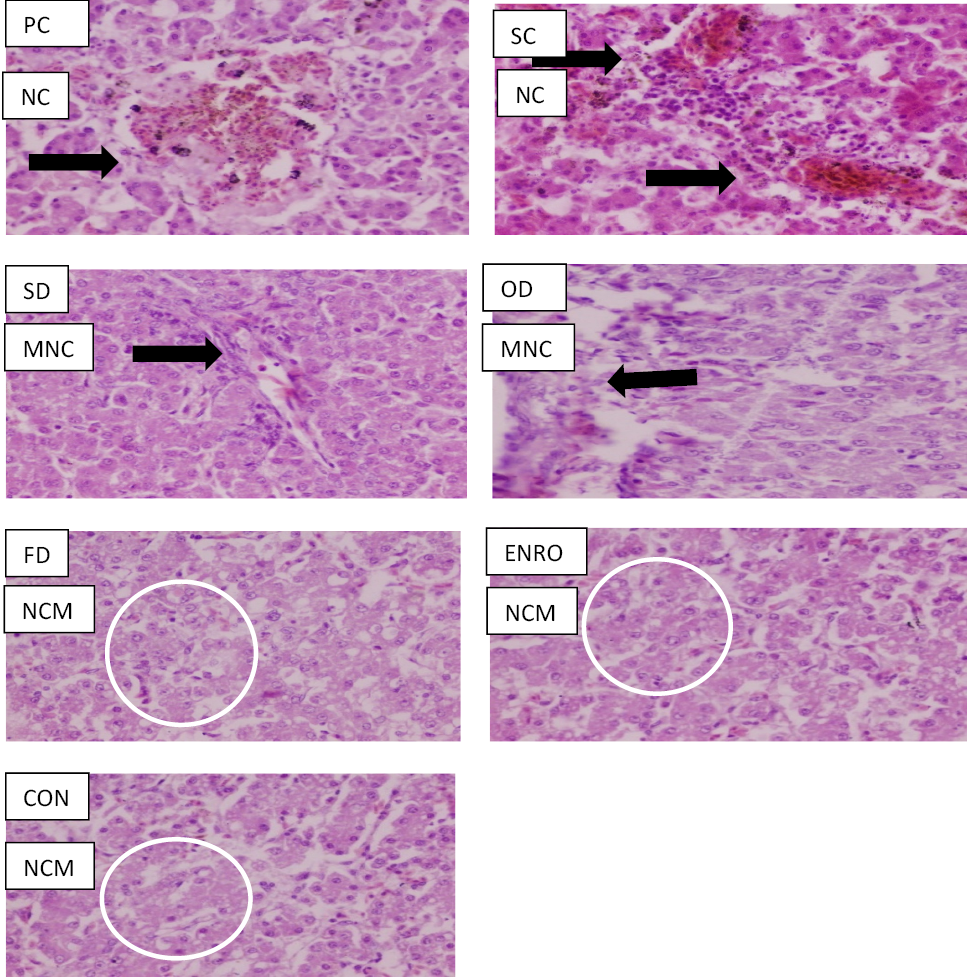
A: NC (necrotic cell) hepatocyte pyknotic nuclei of E. coli affected broiler liver. B: NC (necrotic cell and hemorrhages) broiler liver treated with sweet corn roots powder. C: MNC (mild necrosis of cell) broiler liver treated with sun dried roots powder. D: MNC (mild necrosis of cell) broiler liver treated with oven dried roots powder. E: NCM (normal cell morphology) broiler liver treated with freeze dried roots powder. F: NCM (normal cell morphology) broiler liver treated with enrofloxacin. G: NCM (normal cell morphology) broiler liver of control group.
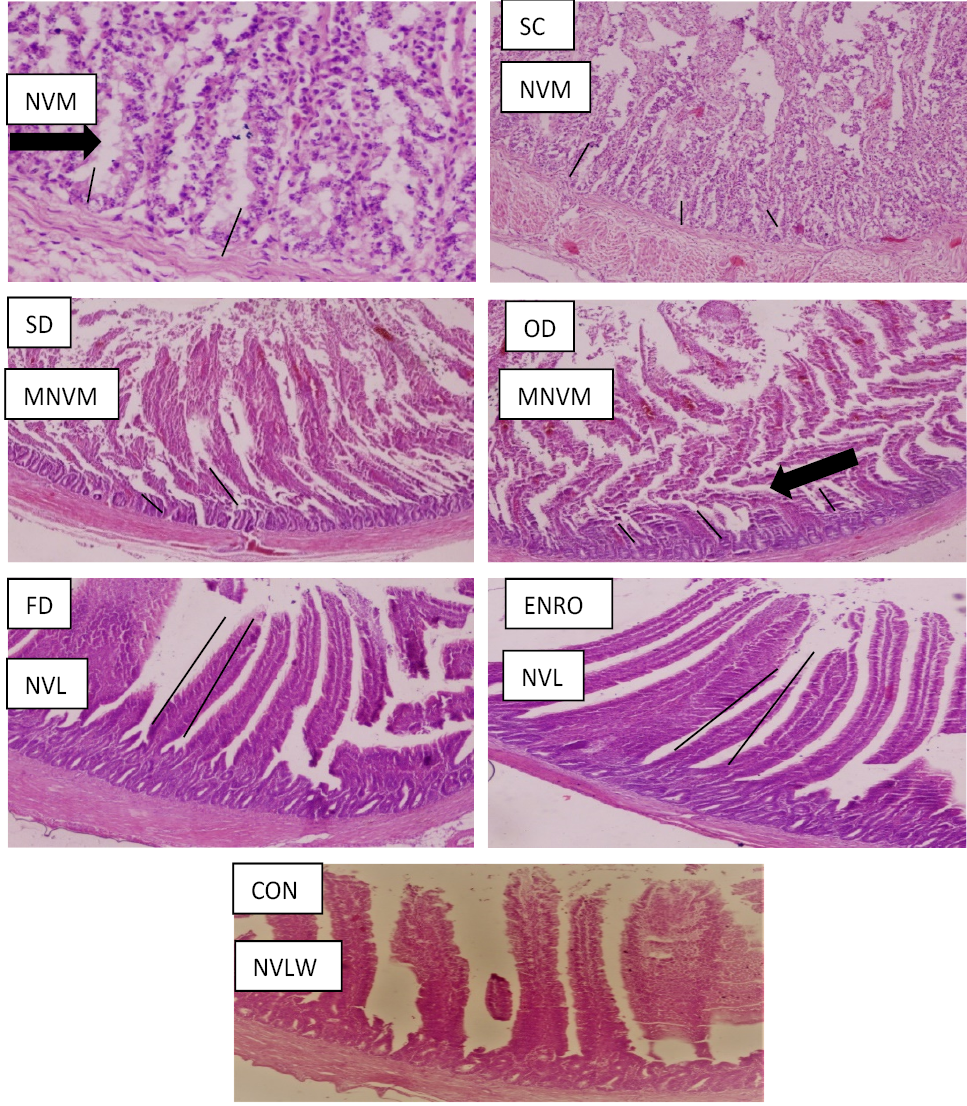
A: NVM (necrosed villus morphology and effected crypt) E. coli affected broiler intestine. B: NVM (necrosed villus morphology and effected crypt) broiler intestine treated with sweet corn roots powder. C: MNVM (mild necrosed villus morphology and effected crypt) broiler intestine treated with sun dried roots powder. D: MNVM (mild necrosed villus morphology and effected crypt) broiler intestine treated with oven dried roots powder. E: NVLW (normal villus length and width) broiler intestine treated with freeze dried roots powder: intestine L 0.190mm, 0.006mm width. F: NVLW (normal villus length and width) broiler intestine treated with enrofloxacin: intestine L 0.200mm, 0.007mm width. G: NVLW (normal villus length and width) broiler intestine of control group: intestine L 0.194mm, 0.008mm width.
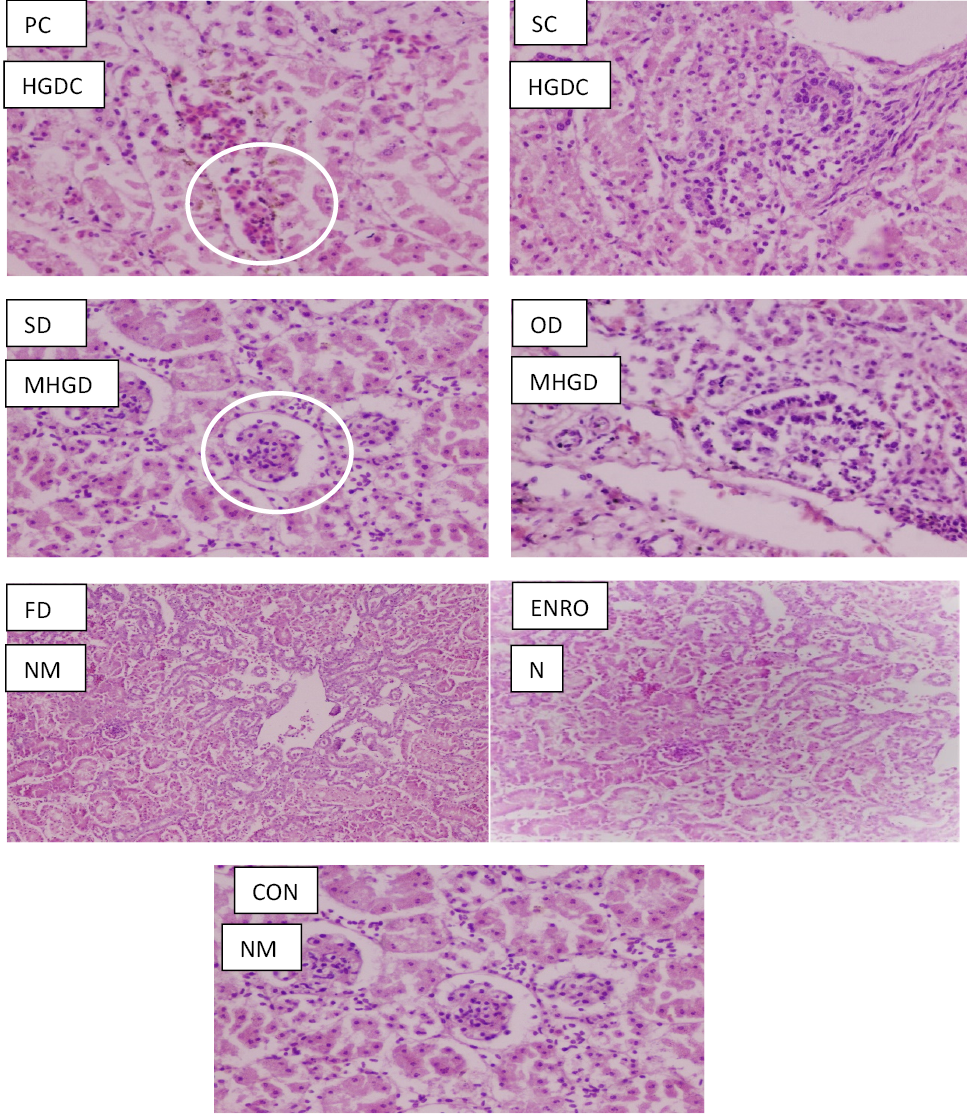
A: HGDC (hemorrhagic glomerulus and distal convoluted tubules) E. coli effected broiler kidney. B: HGDC (hemorrhagic glomerulus and distal convoluted tubules) broiler kidney treated with sweet corn roots powder. C: MHGDC (mild hemorrhagic glomerulus and distal convoluted tubules) broiler kidney treated with sun dried roots powder. D: MHGDC (mild hemorrhagic glomerulus and distal convoluted tubules) broiler kidney treated with oven dried roots powder. E: NM (normal morphology) broiler kidney treated with freeze dried roots powder: F: NM (normal morphology) broiler kidney treated with enrofloxacin intestine. G: NM (normal morphology) broiler kidney of control group.
References
- Adil, S., Banday, M. T., Bhat, G. A., Khan, I. and Bhat, M.I., 2010. A study on the profitability of broiler chicken fed diets supplemented with organic acids. Indian J. Poult. Sci., 45: 220-223. https://doi.org/10.4061/2010/479485[CrossRef]
- Adil, S., Banday, M., Bhat, G., Qureshi, S. and Wani, S., 2011. Effect of supplemental organic acids on growth performance and gut microbial population of broiler chicken. Livest. Res. Rural Dev., 3: 203-214.
- Amanullah, K.I., Jan, A., Jan, M.T., Khalil, S.K., Shah, Z. and Afzal, M., 2015. Compost and nitrogen management influence productivity of spring maize (Zea mays L.) under deep and conventional tillage systems in semi-arid regions. Commun. Soil Sci. Pl. Anal., 46: 1566-1578. https://doi.org/10.1080/00103624.2015.1043462[CrossRef]
- Apostolakos, I., Laconi, A., Mughini-Gras, L., Yapicier, Ö.Ş. and Piccirillo, A., 2021. Occurrence of colibacillosis in broilers and its relationship with avian pathogenic Escherichia coli (APEC) population structure and molecular characteristics. Front. Vet. Sci., 8: 737720. https://doi.org/10.3389/fvets.2021.737720[CrossRef]
- Bancroft, J.D., Cook, H.C. and Stirling, R.W., 1994. Manual of histological techniques and their diagnostic application. In: Manual of histological techniques and their diagnostic application. pp. 457-457.
- Baranwal, A., Singh, N.P., Kumar, A., Kumar, A., Upadhyaya, P.K. and Srivastava, A.K., 2019. Colibacillosis in broilers: A case report. J. Ent. Zool. Stud., 7: 163-166.
- Citarella, A., Moi, D., Pinzi, L., Bonanni, D. and Rastelli, G., 2021. Hydroxamic acid derivatives: From synthetic strategies to medicinal chemistry applications. ACS Omega, 6: 21843-21849. https://doi.org/10.1021/acsomega.1c03628[CrossRef]
- Ebeid, T., Al-Homidan, I., Fathi, M., Al-Jamaan, R., Mostafa, M., Abou-Emera, O. and Alkhalaf, A., 2021. Impact of probiotics and/or organic acids supplementation on growth performance, microbiota, antioxidative status, and immune response of broilers. Ital. J. Anim. Sci., 20: 2263-2273. https://doi.org/10.1080/1828051X.2021.2012092[CrossRef]
- Garcia, V., Catala-Gregori, P., Hernandez, F., Megias, M.D. and Madrid, J., 2007. Effect of formic acid and plant extracts on growth, nutrient digestibility, intestine mucosa morphology, and meat yield of broilers. J. appl. Poult. Res., 16: 555-562. https://doi.org/10.3382/japr.2006-00116[CrossRef]
- Griffith, D.M., Li, H., Werrett, M.V., Andrews, P.C. and Sun, H., 2021. Medicinal chemistry and biomedical applications of bismuth-based compounds and nanoparticles. Chem. Soc. Rev., 50: 12037-12069. https://doi.org/10.1039/D0CS00031K[CrossRef]
- Guabiraba, R. and Schouler, C., 2015. Avian colibacillosis: Still many black holes. FEMS Microbiol. Lett., 362: fnv118. https://doi.org/10.1093/femsle/fnv118[CrossRef]
- Hussain, J., Rabbani, I., Aslam, S. and Ahmad, H.A., 2015. An overview of poultry industry in Pakistan. World’s Poult. Sci. J., 71: 689-700. https://doi.org/10.1017/S0043933915002366[CrossRef]
- Indu, S., Hemlata, K., Sunil, K., Arun, K., Suman, L. and Ashok, K., 2010. Synthesis of new coumarin derivatives as antibacterial agents. Int. J. Chem. Tech. Res., 2: 1745-1752.
- Jahangirian, H., Haron, J., Silong, S., Yusof, N., Shameli, K., Eissazadeh, S. and Jafarzade, M., 2011. Antibacterial effect of phenyl fatty hydroxamic acids synthesized from canola oil. J. Med. Pl. Res., 5: 4826-4831.
- Khan, A.G., Imran, M., Khan, A.U.H., Fares, A., Šimůnek, J., Ul-Haq, T. and Ali, S., 2021. Performance of spring and summer-sown maize under different irrigation strategies in Pakistan. Sustainability, 13: 2757. https://doi.org/10.3390/su13052757[CrossRef]
- Mansour, S.M., Ali, H., Chase, C.C. and Cepica, A., 2015. Loop-mediated isothermal amplification for diagnosis of 18 World Organization for Animal Health (OIE) notifiable viral diseases of ruminants, swine and poultry. Anim. Hlth. Res. Rev., 16: 89-106. https://doi.org/10.1017/S1466252315000018[CrossRef]
- Neal, A.L., Ahmad, S., Gordon-Weeks, R. and Ton, J., 2012. Benzoxazinoids in root exudates of maize attract Pseudomonas putida to the rhizosphere. PLoS One, 7: 35498. https://doi.org/10.1371/journal.pone.0035498[CrossRef]
- Pal, D. and Saha, S., 2012. Hydroxamic acid- A novel molecule for anticancer therapy. J. Adv. Pharm. Technol. Res., 3: 92-99. https://doi.org/10.4103/2231-4040.97281[CrossRef]
- Panth, Y., 2019. Colibacillosis in poultry: A review. J. Agric. Natl. Resour., 2: 301-311. https://doi.org/10.3126/janr.v2i1.26094[CrossRef]
- Parveen, P., Brundavani, K.D., Mahathi, K., Bhavani, M.S. and Shaheda Sultana, S.K., 2019. Gene silencing and DNA methylation. Am. J. Phytomed. clin. Therapeut., 2: 1-12.
- Ramisetty, B.C.M., Raj, S. and Ghosh, D., 2016. Escherichia coli MazEF toxin-antitoxin system does not mediate programmed cell death. J. Basic Microbiol., 56: 1398-1402. https://doi.org/10.1002/jobm.201600247[CrossRef]
- Rizwan, S., Naqshbandi, A., Farooqui, Z., Khan, A.A. and Khan, F., 2014. Protective effect of dietary flaxseed oil on arsenic-induced nephrotoxicity and oxidative damage in rat kidney. Fd. Chem. Toxicol., 68: 99-107. https://doi.org/10.1016/j.fct.2014.03.011[CrossRef]
- Rodríguez-Lecompte, J.C., Yitbarek, A., Brady, J., Sharif, S., Cavanagh, M.D., Crow, G. and Camelo-Jaimes, G., 2012. The effect of microbial-nutrient interaction on the immune system of young chicks after early probiotic and organic acid administration. J. Anim. Sci., 90: 2246-2254. https://doi.org/10.2527/jas.2011-4184[CrossRef]
- Saaf, E.S.M., El-Mednay, N. and Abdel-Azeem, F., 2008. Thyroid activity, some blood constituents, organs morphology and performance of broiler chicks fed supplemental organic acids. Int. J. Poult. Sci., 7: 215-222. https://doi.org/10.3923/ijps.2008.215.222[CrossRef]
- Sanderson, J.H. and Phillips, C.E., 1981. An atlas of laboratory animal haematology. Clarendon Press.
- Shekhawat, S. and Rajput, S.K., 2012. Mechanistic investigation for the acidic hydrolysis of p-methyl benzyl-2-theno hydroxamic acid. Chem. Sci. J., ink.gale.com/apps/doc/A335292529/AONE?u=anon~3d1c3cb5andsid=googleScholarandxid=ace41367.
- Shuaib, M., Ullah, N., Hafeez, A., Alhidary, I.A., Abdelrahman, M.M. and Khan, R.U., 2020. Effect of dietary supplementation of wild Cumin (Bunium persicum) seeds on performance, nutrient digestibility and circulating metabolites in broiler chicks during the finisher phase. Anim. Biotechnol., 33: 871-875. https://doi.org/10.1080/10495398.2020.1844222[CrossRef]
- Syed, Z., Sonu, K., Dongre, A., Sharma, G. and Sogani, M., 2020. A review on hydroxamic acids: Widespectrum chemotherapeutic agents. Int. J. Biol. Biomed., 14: 75-88. https://doi.org/10.46300/91011.2020.14.12[CrossRef]
- Weinberg, E.D., 1984. Iron withholding: A defense against infection and neoplasia. Physiol. Rev., 64: 65-102. https://doi.org/10.1152/physrev.1984.64.1.65[CrossRef]
- Zaltron, A., Merano, M., Mistura, G., Sada, C. and Seno, F., 2020. Optical tweezers in single-molecule experiments. Eur. Phys. J. Plus, 135: 896. https://doi.org/10.1140/epjp/s13360-020-00907-6[CrossRef]
Services
Article usage statistics
Loading…