Moreover, significant improvements were observed in the economic and biological parameters of silkworms fed with probiotic-fortified mulberry leaves.
The enzymatic activity (amylase and invertase) of silkworms fed with probiotic-fortified mulberry leaves varied significantly compared to the control group.
Here it is concluded that the probiotic-fortified mulberry leaves can significantly enhance the biological and commercial traits of silkworms.
The combination of S. cerevisiae and L. rhamnosus (at a concentration of 0.5%) appears to be particularly effective in improving growth, development, and economic parameters.
Selected from the article's own text.
Abstract
Nutritional supplements play a crucial role in enhancing the growth and development of silkworms (Bombyx mori L.). This study evaluated the effects of probiotic-fortified mulberry leaves on biological and economic parameters as well as the digestive enzyme activity in silkworms. Fresh mulberry leaves coated with Saccharomyces cerevisiae and Lactobacillus rhamnosus at concentrations of (0.5, 1, and 2%) were fed to 5th instar silkworm larvae. Larval weight was measured for 7 days. A portion of the larvae were dissected, and their silk glands and guts were separated. The gut homogenate supernatant was used for enzyme activity analysis. The remaining larvae were allowed to complete the cocoon formation. The obtained cocoons were then used to estimate the effects of yeast treatments on economic and biological parameters. The results showed that the average weight of silkworm larvae on the 7th day was significantly higher (P<0.05) in larvae fed with 0.5% L. rhamnosus + S. cerevisiae compared to the control group. This group also exhibited the highest cocoon weight, length, width, shell ratio, and fibroin content. Moreover, the enzymatic activity was significantly higher in larvae fed with 0.5% L. rhamnosus + S. cerevisiae. It was concluded that the 0.5% L. rhamnosus + S. cerevisiae supplement promotes the enzymatic activity of silkworms, leading to positive effects on their economic and biological parameters.
Novelty Statement | Pakistan, an agrarian economy, has a significant potential in sericulture. This study aims to enhance the economic viability of sericulture by supplementing silkworms’ diet with probiotics-enriched mulberry leaves. The resulting economic benefits associated with improved silkworm growth and silk quality could encourage wider adoption of sericulture, contributing to rural development and sustainable agriculture in the country.
Introduction
The silkworm, Bombyx mori L. (Lepidoptera: Bombycidae) is an economically important and well-known monophagous lepidopteran insect that produces industrial silk . Silkworms exclusively feed on mulberry leaves (Morus spp.), the foundation of the sericulture industry . The nutritional quality of these leaves significantly impacts the development and growth of silkworm larvae ; . Silkworms convert 72-80% of the proteins found in mulberry leaves into silk proteins . Consequently, the quality and economic value of cocoons are highly dependent on the silkworm’s diet ; . Although various arthropods, such as honeybees, beetles, silkworms and spiders produce silk, a long natural fibrous filament of protein . However, silkworm silk fiber is highly valued due to its superior qualities like luster, softness, tensile strength, dyeing capacity, biocompatibility, and biodegradability . Moreover, B. mori silk is one of the strongest natural fibers and is considered an ideal replacement for synthetic fibers (polyester and viscose) .
In developing countries, silk production by local farmers is relatively lower than in China and India ; . However, sericulture is a prospective and promising industry with significant economic potential . The higher selling prices of silk products and by-products can help rural people find employment and improve their socioeconomic situation . Moreover, the sericulture industry is crucial in preventing rural-urban migration for job opportunities . In recent years, initiatives have been implemented to improve the sericulture industry by increasing cocoon yield or silk production through the use of various nutrients, including proteins, carbohydrates, amino acids, vitamins, hormones, probiotics, plant extracts, and antibiotics ; .
The digestive system, which hosts millions of microorganisms, is the primary site of bacterial colonization . Probiotics are beneficial microorganisms ingested through food or water to improve gut microbial balance and promote good health . Gut probiotics facilitate food digestion, stimulate the innate immune system, and detoxify metabolites . These beneficial microorganisms are purposely introduced into the intestinal microflora to compete with and eliminate harmful bacteria .
Probiotic-enriched food has been introduced in the various farming industries to enhance economic output ; . Commercial probiotics contain microorganisms ranging from 108 to 1011 CFU/mL . While widely used in aquaculture and veterinary medicine, there are currently no commercial probiotic formulations particularly manufactured for the sericulture industry. This study aimed to determine the effects of S. cerevisiae and L. rhamnosus, and a combination of both probiotics on basic digestive enzymes (amylase and invertase) in the digestive tract of silkworms.
Saccharomyces cerevisiae and Lactobacillus rhamnosus were selected as probiotic supplements due to their synergistic effects and potential health benefits . These probiotics exhibit synergistic anti-pathogenic activity and inhibit aflatoxin production both in vitro and in vivo . Moreover, probiotics also play a significant role in enzyme regulation, particularly for amylase and invertase activities. Certain Lactobacillus strains exhibit probiotic characteristics and modulate the production of amylase enzymes . Invertase, a key enzyme in carbohydrate metabolism, is subject to complex regulatory mechanisms. In Saccharomyces cerevisiae, the URE2 gene influences invertase activity .
This study was aimed at enhancing the economic and biological growth parameters, as well as the amylase and invertase activity of silkworms, by providing them with probiotic-fortified mulberry leaves. Previously, the effects of probiotics supplemented feed on silkworm were not explored. Although probiotics were reported to improve enzymatic profile but that was not confirmed in silkworms. With this context in mind, the current research was conducted to evaluate the effect of probiotics on the enzymatic profile and economic aspects of the silkworm B. mori L. Improved silk production would not only fulfill local silk demands but also increase overall silk exports, benefiting developing agricultural economies through the advancement of the sericulture sector.
Materials and Methods
Silkworm eggs hatching and rearing
Chinese race silkworm (Bombyx mori L.) eggs were obtained from the Sericulture Wing of the Forestry, Wildlife, and Fisheries Department, Ravi Road, Lahore (31˚ 36’ 28” N, 740 18’ 11” E). The eggs were incubated in sterile trays under optimal conditions: humidity (75±5%), temperature (25±1°C), and photoperiod (12 light: 12 dark). Before rearing mulberry silkworms, the laboratory and all rearing equipment were disinfected with a 4% formaldehyde solution . The laboratory was closed for 24 hours for proper disinfection and then kept open for 12 hours to release the formalin vapors. After hatching, newly emerged larvae were carefully removed from the hatching eggs using a fine hairbrush. The larvae were fed with freshly chopped mulberry leaves until the end of the 4th instar. The 5th instar larvae were selected as the experimental model for this study ; .
Preparation of probiotic suspensions
Probiotics (Saccharomyces cerevisiae and Lactobacillus rhamnosus) were added to 100 ml of deionized water in specific quantities to prepare various concentrations (0.5, 1, and 2%) of probiotic suspensions. A total of 400 larvae were used in each of the three replicates, divided into 10 groups: nine experimental groups (0.5% yeast, 1% yeast, 2% yeast,
Table 1: The details of experimental groups.
No
Group
Treatment
1
Control group
Fresh mulberry leaves
2
Yeast 0.5%
Leaves fortified with 0.5% yeast suspension
3
Yeast 1%
Leaves fortified with 1% yeast suspension
4
Yeast 2%
Leaves fortified with 2% yeast suspension
5
LR 0.5%
Leaves fortified with 0.5% L. rhamnosus suspension
6
LR 1%
Leaves fortified with 1% L. rhamnosus suspension
7
LR 2%
Leaves fortified with 2% L. rhamnosus suspension
8
L+Y 0.5%
Leaves fortified with 0.5% L. rhamnosus + yeast suspension
9
L+Y 1%
Leaves fortified with 1% L. rhamnosus + yeast suspension
10
L+Y 2%
Leaves fortified with 2% L. rhamnosus + yeast suspension
0.5% L rhamnosus, 1% L rhamnosus, 2% L rhamnosus, 0.5% L rhamnosus + yeast, 1% L rhamnosus +yeast, 2% L rhamnosus + yeast) and one control group (Table 1). Each group consisted of 40 larvae reared in separate cardboard boxes (30 × 30 × 5 cm). The control group received freshly picked mulberry leaves after washing and cleaning. For the experimental group, fresh, dirt-free, and healthy mulberry leaves were dipped in prepared probiotic solutions (1g of leaves/ml of probiotic suspension) for 5 minutes to prepare probiotic-fortified mulberry leaves. These fortified leaves were then shade-dried for 5 minutes to ensure proper and uniform probiotic absorption. The probiotic-fortified leaves were then fed to silkworms in the treatment groups to assess the individual and synergistic effects of the probiotics .
Assessment of biological traits
The weight of all 5th instar silkworm larvae was observed daily using an electric weight balance until they began spinning or cocoon formation. Ten silkworms from each group were dissected to remove their silk glands and measure any potential change in silk gland weight caused by the addition of probiotics to their diet. The gut of larvae was also removed for the investigation of enzymatic activity.
Preparation of gut homogenate
The exposed guts of the silkworm was longitudinally dissected and thoroughly washed with ice-cold PBS (pH 7.4). The gut contents were removed, washed with PBS, and homogenized with chilled PBS using a mortar and pestle. The samples were centrifuged at 7000 rpm for 10 minutes at 25oC. The supernatant was collected to assess the enzyme activity of amylase and invertase .
Quantitative assay of amylase
A standard calibration curve of known concentrations of starch was prepared through spectrophotometric absorptions at 540 nm using the method described by Kadam et al. (2021). DNS reagent (500 mL) was prepared by using the method described by Zin et al. (2022) by using Dinitrosalicylic acid, distilled water, sodium hydroxide and potassium sodium tartarate-4-hydrate.
The activity of the amylase was measured at pH 7.4 and 27°C. Ten test tubes (one for each group) were used in each replicate, with each test tube containing 20 μL of gut/enzyme extract and 250 μL of 1% starch substrate solution. DNS reagent (250 μL) was added to each test tube, incubated for 60 minutes at 27oC, and then heated in a water bath for 10 minutes. When the samples cooled, optical density at 550 nm was measured using a spectrophotometer . The OD values were compared to the standard curve of glucose to determine amylase activity.
Quantitative assay of invertase
The activity of invertase was measured at pH 7.4 and 27°C using a similar experimental setup. Each test tube received 20 μL of the homogenate supernatant sample (invertase solution) and 250 μL of the 4% sucrose solution before being incubated at 27 oC for 10 minutes. DNS reagent (250 μL) was added to each test tube and the mixture was heated in a water bath for 10 minutes. The cooled samples were analyzed for optical density at 550 nm using a spectrophotometer ; ; . The OD values were compared to the standard curve of glucose to determine invertase activity.
Assessment of economic trait
The remaining silkworms (n=30) from each group began spinning cocoons at the end of the fifth instar stage. After harvesting the cocoons, they were placed in sunshine to kill the moths inside and remove any moisture. The silk production of the treatment groups was measured and compared to the control group. An electronic weighing balance and a Vernier Caliper were used to calculate cocoon weight (g) and width (nm). The dried cocoons were sliced using a cutter. Dead pupae were removed, and the shell ratio and weight were calculated using the following methods:
Equation 1.Equation 2.
Fibroin/sericin content
To determine the fibroin and sericin content, the cocoons were degummed by autoclaving them in a specific volume of water at 121°C for two hours . After degumming, the fibroin content was equivalent to the dry weight of the shell/filtrate. However, the sericin content was calculated using the following formula:
Equation 3.
Statistical analysis
The data was analyzed using Statistical Package for the Social Sciences (SPSS) version 21.0. One-way ANOVA followed by Tukey’s test was used to compare the increase in larval weight among various groups on a single day. Moreover, One-way ANOVA was used to compare the silk gland weight among experimental groups. The economic traits of silkworms as well as the enzymatic activities across various groups were also analyzed using One-way ANOVA.
Results
Evaluation of biological traits
The 5th instar larval weight of silkworms increased gradually from day 1 to 7 in both the control and experimental groups. On day 2, there were no significant differences in larval weight between the experimental and control groups (F9, 390= 2.973; P> 0.05). However, a statistically significant increase in larval weight of all silkworm groups was observed from days 3 to 7. The most significant increase in larval weight occurred in the groups of silkworm fed on 1% and 0.5 % L. rhamnosus +S. cerevisiae (L+Y) fortified mulberry leaves. On day 6, the larvae in these two groups showed significantly higher weight gain than the control group and the majority of treatment groups (Table 2).
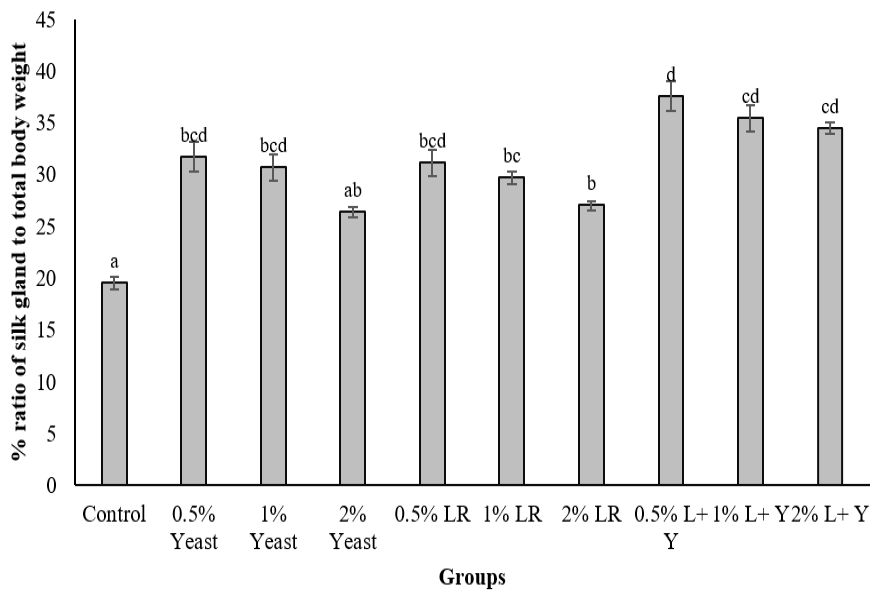
All experimental groups showed a higher percentage ratio of silk gland to body weight (F9, 90= 23.882; p< 0.05) than the control group. Silkworms fed with probiotic-coated mulberry leaves of 0.5% L. rhamnosus +S. cerevisiae exhibited the highest percentage ratio of silk gland to body weight (37.58d±1.421), followed by the 1% L. rhamnosus +S. cerevisiae treatment group (35.44cd±1.249) (Figure 1).
Evaluation of economic parameters
Significant differences (F9, 190= 8.985; P< 0.001) were observed between the cocoon length of the treatment groups and the control group. Similar trends were observed for other economic parameters, including cocoon width, length, and weight. Furthermore, the silkworms fed with
Table 2: Larval weight (g) of silkworm in control and treatment groups.
Groups
Increase in weight (g)
Day 1
Day 2
Day 3
Day 4
Day 5
Day 6
Control
0.166a±0.005
0.286a±0.004
0.379a±0.008
0.526a±0.007
0.669a±0.014
0.787a±0.018
Yeast 0.5%
0.190bc±0.003
0.303a±0.004
0.466cde±0.006
0.674dcde±0.007
0.869bcd±0.007
0.992cd±0.007
Yeast 1%
0.190abc±0.003
0.302a±0.004
0.463bcde±0.005
0.641bcd±0.008
0.854bc±0.007
0.965bcd±0.008
Yeast 2%
0.182ab±0.005
0.290a±0.005
0.442bcd±0.006
0.626b±0.010
0.830b±0.008
0.959bcd±0.008
LR 0.5%
0.185ab±0.004
0.327a±0.004
0.445bcd±0.007
0.631bc±0.009
0.865bcd±0.008
0.973bcd±0.008
LR 1%
0.176ab±0.004
0.298a±0.002
0.439bc±0.008
0.622b±0.009
0.849bc±0.008
0.949bc±0.008
LR 2%
0.179ab±0.005
0.290a±0.008
0.425b±0.007
0.614b±0.008
0.841bc±0.008
0.929b±0.009
L+Y 0.5%
0.200bc±0.004
0.307a±0.002
0.491ef±0.005
0.689de±0.007
0.884cd±0.010
1.063ef±0.014
L+Y 1%
0.210c±0.003
0.309a±0.003
0.510f±0.006
0.717e±0.004
0.914d±0.006
1.108f±0.06
L+Y 2%
0.197bc±0.003
0.304a±0.002
0.482def±0.005
0.657bcd±0.005
0.873bcd±0.005
1.020de±0.007
F(9,390) PANOVA
10.845 P<0.001
2.973 P>0.05
31.325; P<0.001
47.531 P<0.001
56.680 P<0.001
73.508P<0.001
Note: Means ± SE with different superscripts in the same columns are statistically significant (P < 0.05).
Table 3: Comparison of economic traits of silkworm in control and experimental groups.
Groups
Cocoon weight (g)
Cocoon length (mm)
Cocoon width (mm)
% Shell ratio
% Fibroin ratio
% Sericin ratio
Control
0.40a±0.010
27.57a±0.344
15.76a±0.176
41.51a±1.409
69a±0.490
31f±0.490
Yeast 0.5%
0.63bc±0.021
29.76abc±0.355
16.81ab±0.162
47.27ab±1.298
75cd±0.632
25bcd±0.632
Yeast 1%
0.60b±0.023
29.59abc±0.337
16.49ab±0.239
47.07ab±1.399
75cd±0.283
25bc±0.283
Yeast 2%
0.55bc±0.010
29.45abc±0.369
16.42ab±0.179
45.27bc±1.832
72abc±0.490
28def±0.490
LR 0.5%
0.57bcd±0.013
29.46abc±0.379
16.45ab±0.231
46.49abc±1.892
73bc±0.400
27cde±0.400
LR 1%
0.54bcd±0.022
29.44abc±0.293
16.14ab±0.242
43.58bc±2.498
72abc±0.632
28def±0.632
LR 2%
0.52b±0.022
28.35ab±0.237
15.99a±0.109
41.89bc±1.890
71ab±0.400
29ef±0.400
L+Y 0.5%
0.71d±0.019
31.20c±0.367
17.54b±0.278
50.61c±0.724
82e±0.400
18a±0.400
L+Y 1%
0.67cd±0.020
30.88c±0.333
16.98ab±0.237
49.16bc±1.770
81e±0.522
19a±0.522
L+Y 2%
0.65bcd±0.022
30.18bc±0.345
16.87ab±0.310
47.95bc±1.793
77d±0.632
23b±0.632
ANOVA
F9, 190= 7.812; P<0.001
F9, 190= 8.985; P<0.001
F9, 190= 19.790; p<0.001
F9, 190=10.311; P<0.001
F9, 40= 58.265; P<0.001
F9, 40= 52.139; P<0.001
Note: Means ± SE with different superscripts in the same columns are statistically significant (P < 0.05).
0.5% L. rhamnosus +S. cerevisiae registered the maximum cocoon weight (0.71±0.019), length (31.20±0.367), and width (17.54±0.278) among all study groups. The shell ratio of the treatment groups was significantly higher (F9, 190=10.311; P< 0.001) compared to the control group. The shell ratio of the 0.5% L. rhamnosus +S. cerevisiae treatment group (50.61±0.724) was the highest compared to other groups (Table 3).
The percentage of sericin content was significantly higher in the control group (F9, 40= 52.139; P< 0.001) compared to the treatment groups. The control group exhibited the highest sericin percentage (31±0.490), while the groups of silkworm cocoons fed with 0.5% and 1% L. rhamnosus +S. cerevisiae treated mulberry leaves showed the lowest percentage of sericin content (18±0.400 and 19±0.522, respectively) (Table 3). The percentage of fibroin in the control and experimental groups showed the opposite trend to the percentage of sericin. The fibroin content in the treatment groups was significantly higher (F9, 40= 58.265; P< 0.001) compared to the control group. The 0.5% L. rhamnosus +S. cerevisiae treatment group revealed the highest percentage of fibroin content (82±0.400), followed by the 1% L. rhamnosus +S. cerevisiae treatment group (81±0.522) (Table 3).
Enzymatic activity
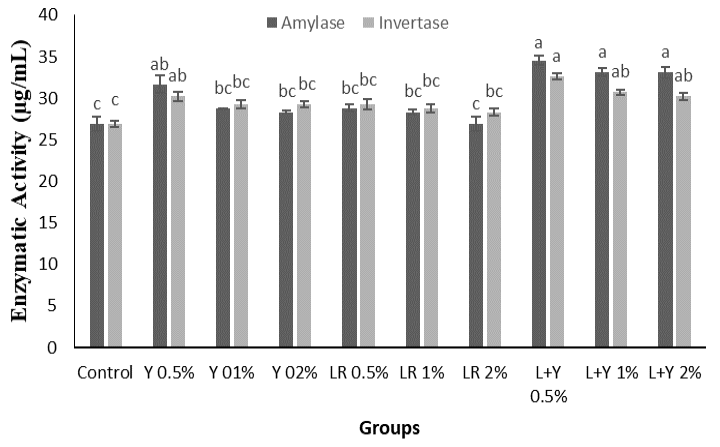
The enzymatic activities of both amylase and invertase in the probiotic treatment groups were significantly higher (p<0.001) than in the control group. It was highest in the silkworms fed with 0.5% L. rhamnosus +S. cerevisiae probiotic-fortified mulberry leaves (Figure 2).
Discussion
The mulberry leaves diet significantly affects the growth, development, and subsequent cocoon production of silkworm (B. mori L.) . The present study aimed to access the digestive enzymatic activity, as well as the commercial and biological traits of silkworms fed on probiotic-fortified mulberry leaves. Previous studies have reported similar effects of mulberry leaf fortification with various substances, such as whey proteins , egg albumin , sericin , amino acids , multivitamins , and royal jelly , on the enrichment of biological and commercial traits of silkworms. The obtained result showed that enzymatic activity (amylase and invertase) was enhanced when the silkworms were fed on fortified mulberry leaves. Moreover, significant improvements were observed in the economic and biological parameters of silkworms fed with probiotic-fortified mulberry leaves.
The larval weight of 5th instar silkworms increased when treated with different concentrations of probiotics (S. cerevisiae and L. rhamnosus). Similar results were observed when silkworms were fed with probiotics including Saccharomyces cerevisiae , Spirulina platensis , Lactobacillus acidophilus, Lactobacillus sporogens , L. rhamnosus, Saccharomyces boulardii, Bifidobacterium longum , and Bifidobacterium bifidum . The highest increase in weight was recorded when silkworms were fed with 0.5% S. cerevisiae + L. rhamnosus (L+Y) fortified mulberry leaves. The reason behind this increased growth and body weight of silkworm is that the probiotics are well recognized growth promoters and immune modulators. Moreover, their growth promoting ability has been tested against various economically important animals .
The enzymatic activity (amylase and invertase) of silkworms fed with probiotic-fortified mulberry leaves varied significantly compared to the control group. Among the different concentrations used, 0.5% of the L+Y treatment had the most significant impact on the enzymatic activity of both amylase and invertase. Esaivani et al. (2014) also reported a similar increase in enzymatic activity when fed with S. cerevisiae. Pachiappan et al. (2021) have reported similar results with Lactobacillus rhamnosus. Furthermore, the probiotics supplements produce digestive enzymes and upregulate the enzymatic activities .
The application of probiotics supplements (S. cerevisiae, L. rhamnosus, or a combination) on silkworms positively impacted their enzymatic profile, leading to improved commercial characteristics of the cocoon. The results showed that probiotics supplementation enhanced economic parameters, including cocoon weight, width and length, shell ratio, and sericin fibroin content). Silkworms, fed with 0.5% L+Y had the best economic parameters among all experimental and control groups. Ashoka et al. (2019) reported enhanced economic parameters with S. cerevisiae, and Pachiappan et al. (2021) reported similar results with L. rhamnosus.
The increased economic parameters of silkworms are attributed to the increased growth rates and activities of digestive enzymes (amylase and invertase), which are directly related to the gut microbiota influenced by the digestive process of the silkworm. Among commercially available probiotics, S. cerevisiae is the most widely accessible and cost-effective . A single 30 g packet of commercial yeast is sufficient to feed 1000 silkworms. While S. cerevisiae and L. rhamnosus are readily available, other probiotics are often found in combinations and may not be easily available in rural areas where sericulture is prevalent.
Conclusions and Recommendations
Here it is concluded that the probiotic-fortified mulberry leaves can significantly enhance the biological and commercial traits of silkworms. The combination of S. cerevisiae and L. rhamnosus (at a concentration of 0.5%) appears to be particularly effective in improving growth, development, and economic parameters. These findings highlight the potential benefits of using probiotics in the sericulture industry.
Declarations
Acknowledgment
The authors want to acknowledge the Office of Research Innovation and Commercialization (ORIC), Government College University, Lahore for providing the necessary funding to complete this project.
Funding
The research study was funded by the Office of Research Innovation and Commercialization (ORIC), Government College University, Lahore (No. 82/ORIC/23).
Ethical statement
The study was conducted after Ethical Approval from Bioethical Committee Government College University Lahore, Pakistan.
Declaration of generative AI and AI-assisted technologies in the writing process
No generative AI and AI-assisted technologies were used in the writing process.
Conflict of interest
The authors have declared no conflict of interest.
Figures
Figure 1:.
Percentage ratio of silk gland weight to total body weight of silkworm larvae in experimental and control groups.
Note: The bars with different superscripts are statistically significant (P< 0.05).
Figure 2:.
Enzymatic activity of amylase and invertase in control and experimental groups.
Note: The bars of the same enzyme with different superscripts show significant differences (P< 0.05).
References
Abdel-Rahman, Y.A., 2018. Effect of the whey protein on economic traits for mulberry silkworm, Bombyx mori L. J. Pl. Prot. Pathol., 9: 273-276. https://doi.org/10.21608/jppp.2018.41406[CrossRef]
Agustarini, R., Andadari, L., and Dewi, R., 2020. Conservation and breeding of natural silkworm (Bombyx mori L.) in Indonesia. IOP Conf. Ser. Earth Environ. Sci., 533: 012004. https://doi.org/10.1088/1755-1315/533/1/012004[CrossRef]
Albrektsen, S., Kortet, R., Skov, P.V., Ytteborg, E., Gitlesen, S., Kleinegris, D. and Overland, M., 2022. Future feed resources in sustainable salmonid production: A review. Rev. Aquacult., 14: 1790-1812. https://doi.org/10.1111/raq.12673[CrossRef]
Angelakis, E., 2017. Weight gain by gut microbiota manipulation in productive animals. Microb. Pathog., 106: 162-170. https://doi.org/10.1016/j.micpath.2016.11.002[CrossRef]
Ashoka, J., Hadimani, D.K., Sreenivas, A.G. and Beladhadi, R.V., 2019. Economics of probiotic feed supplementation to the mulberry silkworm. J. Pharmacogn. Phytochem., 8: 749-753.
Assan, D., Kuebutornye, F.K.A., Hlordzi, V., Chen, H., Mraz, J., Mustapha, U.F. and Abarike, E.D., 2022. Effects of probiotics on digestive enzymes of fish (finfish and shellfish); status and prospects: A mini review. Comp. Biochem. Physiol. B Biochem. Mol. Biol., 257: 110653. https://doi.org/10.1016/j.cbpb.2021.110653[CrossRef]
Cristofori, F., Dargenio, V.N., Dargenio, C., Miniello, V.L., Barone, M. and Francavilla, R., 2021. Anti-inflammatory and immunomodulatory effects of probiotics in gut inflammation: A door to the body. Front. Immunol., 12: 578386. https://doi.org/10.3389/fimmu.2021.578386[CrossRef]
de Barcelos Silva, A., Gomes, M.M., da Costa, C.A., da Rosa Righi, R., Barbosa, J.L.V., Pessin, G., De Doncker, G. and Federizzi, G., 2020. Intelligent personal assistants: A systematic literature review. Expert Syst. Appl., 147: 113193. https://doi.org/10.1016/j.eswa.2020.113193[CrossRef]
El-Saadony, M.T., Alagawany, M., Patra, A.K., Kar, I., Tiwari, R., Dawood, M.A., Dhama, K. and Abdel-Latif, H.M., 2021. The functionality of probiotics in aquaculture: An overview. Fish Shellfish Immunol., 117: 36-52. https://doi.org/10.1016/j.fsi.2021.07.007[CrossRef]
Esaivani, C., Vasanthi, K., Bharathi, R. and Chairman, K., 2014. Impact of probiotic Saccharomyces cerevisiae on the enzymatic profile and the economic parameters of silkworm Bombyx mori L. Adv. Biol. BioMed., 1: 1-8.
Gomaa, H.A., 2010. Biological activity and enhancement of silk yield produced by Bombyx mori L. larvae fed on mulberry leaves fortified with royal jelly. J. Pl. Protect. Pathol., 1: 837-844. https://doi.org/10.21608/jppp.2010.86948[CrossRef]
Guimarães, M.C., da Silva Guimarães, A.I.C., Natori, M.M., Alarcon, M.F.F., Dias, D.D.C., Ishikawa, C.M., Tapia-Paniagua, S., Moriñigo, M.Á., Moyano, F.J. and Tachibana, L., 2021. Oral administration of Bacillus subtilis and Lactobacillus plantarum modulates the gut microbiota and increases the amylase activity of Nile tilapia (Oreochromis niloticus). Aquacult. Int., 29: 91-104. https://doi.org/10.1007/s10499-020-00612-2[CrossRef]
Gunasekhar, V. and Somayaji, A., 2020. Effect of endophytic bacteria Burkholderia cepacia on growth, cocoon characters and enzyme activity of silkworm, Bombyx mori L. South Asian J. Res. Microbiol., 5: 1-8. https://doi.org/10.9734/sajrm/2019/v5i430134[CrossRef]
Gupta, S.K. and Dubey, R.K., 2021. Environmental factors and rearing techniques affecting the rearing of silkworm and cocoon production of Bombyx mori Linn. Acta Entomol. Zool., 2: 62-67. https://doi.org/10.33545/27080013.2021.v2.i2a.46[CrossRef]
Islam, T., Khan, I.L., Ganie, N.A., Sahaf, K.A., Jan, N. and Gora, M.M., 2020. Impact of egg albumen (egg white) fortified mulberry leaf on rearing and some cocoon parameters of silkworm, Bombyx mori L. (CSR6 × CSR26) × (CSR2 × CSR27) double hybrid. Int. J. Chem. Stud., 8: 267-271. https://doi.org/10.22271/chemi.2020.v8.i4e.10034[CrossRef]
Kadam, V., Shewale, V., Khairmode, P., Netam, V., and Tare, V., 2021. Seasonal impact on amylase and invertase activity in silkworm Bombyx mori (l) reared on v1 and m5 mulberry variety. Uttar Pradesh J. Zool., 42: 404-409.
Khedr, M.M.A., El-Shafiey, S.N. and Mead, H.M., 2013. Influence of fortification of mulberry leaves with natural and synthetic multivitamins on growth and development of Bombyx mori L. J. Pl. Protect. Pathol., 4: 111-123. https://doi.org/10.21608/jppp.2013.87265[CrossRef]
Lee, H., Park, S.J., Lee, M.E., Choi, K.M., Choi, H.Y., Hasegawa, Y., Kim, M. and Kim, K.B., 2020. Fabrication of nano-fibers using fibroin regenerated by recycling waste silk selvage. Polym. Bull., 77: 3853-3862. https://doi.org/10.1007/s00289-020-03113-7[CrossRef]
Masthan, K., Rajkumar, T. and Murthy C.V.N., 2017. Studies on fortification of mulberry leaves with probiotics for improvement of silk quality. Int. J. Biotechnol. Biochem., 13: 73-80.
Moens, F., Duysburgh, C., van den Abbeele, P., Morera, M. and Marzorati, M., 2019. Lactobacillus rhamnosus GG and Saccharomyces cerevisiae boulardii exert synergistic antipathogenic activity in vitro against enterotoxigenic Escherichia coli. Benef. Microbes., 10: 923-935. https://doi.org/10.3920/BM2019.0064[CrossRef]
Muzamil, A., Tahir, H.M., Ali, A., Bhatti, M.F., Munir, F., Ijaz, F., Adnan, M., Khan, H.A. and Qayyum, K.A., 2023. Effect of amino acid fortified mulberry leaves on economic and biological traits of Bombyx mori L. Heliyon, 9: e21053. https://doi.org/10.1016/j.heliyon.2023.e21053[CrossRef]
Nada, S., Amra, H., Deabes, M. and Omara, E., 2010. Saccharomyces cerevisiae and probiotic bacteria potentially inhibit aflatoxins production in vitro and in vivo studies. Int. J. Toxicol., 8: 32. https://doi.org/10.5580/9ec[CrossRef]
Nasri, N., Silalahi, J., Kaban, V.E. and Satria, D., 2023. A Review on the benefits of probiotics as fermented food against several diseases. J. Funct. Fd. Nutraceutical., 5: 41-52. https://doi.org/10.33555/jffn.v5i1.110[CrossRef]
Pachiappan, P., Swathiga, G., Alagesan, T., Umapathy, G. and Chozhan, K., 2021. Impact of probiotics on enzymatic activity and economic traits of double hybrid silkworm, Bombyx mori L. Pharm. Innov., 10: 1022-1026.
Pandiarajan, J., Balaji, S., Revathy, K., and Palanikumar, S., 2018. Fabrication and validation of silver nanoparticles from cocoon extract of silkworm Bombyx mori. L. Biocatal. Agric. Biotechnol., 16: 692-705. https://doi.org/10.1016/j.bcab.2018.05.017[CrossRef]
Qadir, J., Gupta, R.K., Bali, K., Sharma, M. and Gupta, S.K., 2022. Impact of sericin fortified mulberry leaves on the cocoon traits of silkworm Bombyx mori L. Pharm. Innov. J., 11: 1519-1522.
Radjabi, R., 2010. Effect of mulberry leaves enrichment with amino acid supplementary nutrients on silkworm, Bombyx mori L. at north of Iran. Acad. J. Entomol., 3: 45-51.
Rahim, F.U., Hyder, M.F. and Asma, M., 2021. Silkworm rearing practices in rural Pakistan. Sci. Pap. Ser. Manage. Econ. Eng. Agric. Rural Dev., 21: 667-673.
Riaz, M., Bukhari, R. and Sudan, K., 2020. Growth rate pattern and economic traits of silkworm, (Bombyx mori L) under the influence of inorganic and organic supplementation diet. Int. J. Fauna Biol. Stud., 8: 5-7. https://doi.org/10.22271/23940522.2021.v8.i1a.783[CrossRef]
Saha, J., Mondal, M.I., Sheikh, M.K. and Habib, M., 2019. Extraction, structural and functional properties of silk sericin biopolymer from Bombyx mori silk cocoon waste. J. Text. Sci. Eng., 9: 1-5. https://doi.org/10.4172/2165-8064.1000390[CrossRef]
Sajgotra, M., Gupta, V. and Namgyal, D., 2018. Effect of mulberry varieties on commercial characters of the bivoltine silkworm, Bombyx mori L. J. Pharmacogn. Phytochem., 7: 1087-1091.
Saranya, M., Krishnamoorthy, S. and Murugesh, K., 2019. Fortification of mulberry leaves with indigenous probiotic bacteria on larval growth and economic traits of silkworm (Bombyx mori L.). J. Ent. Zool. Stud., 7: 780-784.
Sarkar, T., Raghunath, M.K., Sivaprasad, V. and Babulal. 2023. Transgenic mulberry (Morus spp.) for stress tolerance: Current status and challenges. Mulberry Genome. Springer, Cham. pp. 243-259. https://doi.org/10.1007/978-3-031-28478-6_10[CrossRef]
Shakl, S. and Essa, Y., 2022. The effect of onion powder (Allium sp.) as an antibiotic on the larval haemolymph of silkworm and its effect on the economic parameters of cocoons as a food supplementary. Egypt. Acad. J. Biol. Sci. A Ent., 15: 27-36. https://doi.org/10.21608/eajbsa.2022.251819[CrossRef]
Silveira, M.C.F., Oliveira, E.M., Carvajal, E. and Bon, E.P., 2000. Nitrogen regulation of Saccharomyces cerevisiae invertase: Role of the URE2 gene. In: Twenty-first symposium on biotechnology for fuels and chemicals: Proceedings of the twenty-first symposium on biotechnology for fuels and chemicals held May 2–6, 1999, in Fort Collins, Colorado. Humana Press. pp. 247-254. https://doi.org/10.1007/978-1-4612-1392-5_18[CrossRef]
Soliman, A.M., 2021. The impact of fortification of mulberry leaves with the yeast Saccharomyces cerevisiae and the blue green algae Spirulina platensis on some quantitative parameters of silkworm Bombyx mori (L.). J. Pl. Protect. Pathol., 12: 55-59. https://doi.org/10.21608/jppp.2021.58388.1011[CrossRef]
Sudan, K. and Bukhari, R., 2021. Comparative study of nutritional, climatic and economical factors on growth and development of silkworm (Bombyx mori L.). Uttar Pradesh J. Zool., 11: 44-52.
Suharja, A.A., Henriksson, A. and Liu, S.Q., 2014. Impact of Saccharomyces cerevisiae on viability of probiotic Lactobacillus rhamnosus in fermented milk under ambient conditions. J. Fd. Process. Preserv., 38: 326-337. https://doi.org/10.1111/j.1745-4549.2012.00780.x[CrossRef]
Taha, R.H., Soliman, S.A. and Kamel, H.M., 2017. Micro-organisms supplementation to mulberry silkworm, Bombyx mori L. Egypt. Acad. J. Biol. Sci. A Ent., 10: 57-64. https://doi.org/10.21608/eajbsa.2017.12673[CrossRef]
Tahir, H.M., Saleem, F., Ali, S., Ain, Q.U., Fazal, A., Summer, M. and Murtaza, G., 2020. Synthesis of sericin-conjugated silver nanoparticles and their potential antimicrobial activity. J. Basic Microbiol., 60: 458-467. https://doi.org/10.1002/jobm.201900567[CrossRef]
Thakur, J., Gupta, R.K. and Bali, K., 2022. Innovations for reviving sericulture in Jammu and Kashmir. Pharma Innov. J., 11: 1126-1131.
Ude, A.U., Eshkoor, R.A., Zulkifili, R., Ariffin, A.K., Dzuraidah, A.W. and Azhari, C.H., 2019. Bombyx mori silk fibre and its composite: A review of contemporary developments. Mater. Des., 57: 298-305. https://doi.org/10.1016/j.matdes.2013.12.052[CrossRef]
Vishaka, G.V., Rathore, M.S., Chandrashekharaiah, M., Nadaf, H.A. and Sinha, R.B., 2020. The silkworm (Bombyx mori L.): A model for the production of beauvericin, a bioactive fungal metabolite. New Future Dev. Microbial Biotechnol. Bioeng., 11: 99-104. https://doi.org/10.1016/B978-0-12-821008-6.00010-4[CrossRef]
Zamani, P., Ghanipoor, M., Mirhosseini, S.Z., Abdoli, R. and Seidavi, A., 2019. Comparison of different selection strategies for mulberry silkworm, Bombyx mori. Int. J. Trop. Insect Sci., 39: 139-145. https://doi.org/10.1007/s42690-019-00015-8[CrossRef]
Zin, N.S.N.M., Azmi, N.A.S., Anuar, N.S., Shafie, S.A., Maznan, M.A.F., Goh, Y.M. and Samsulrizal, N., 2022. A 96 well plate based method for the estimation of alpha-amylase activity using miniaturises 3,5-dinitrosalicylic acid (DNSA) colorimetric method. Mal. appl. Biol., 51: 95-102. https://doi.org/10.55230/mabjournal.v51i4.16[CrossRef]
Zulfiqar, S., Hussain, M., Aftab, K., Malik, M.F., Khursheed, R., Liaqat, S. and Kanwal, M., 2022. Comparative performance of three silkworm races fed on local mulberry against biological and commercial parameters. Pakistan J. Zool., 54: 2865-2869. https://doi.org/10.17582/journal.pjz/20190414180419[Full text][CrossRef]