The present study determined the impacts of garlic and/or ginger oils on performance, physiological responses & gene expression of Nile tilapia throughout four weeks of supplementation.
Results from fish performance proved that ginger oil (Zingiber officinale) supplementation on fish diets by 0.5% enhanced overall body weight, weight gain and specific growth rate (SGR) with a lower feed conversion ratio (FCR). Ginger oil are identified as tastiness enhancer, which might be reflected on growth of fish, as described for Nile tilapia (da Silva Cardoso et al., 2021). This improvement of fish performance may be related to the active ingredients of ginger such as essential oils, steroids, flavonoids, phenolics, saponins, tannins, glycosides, and alkaloids which increase the efficiency of feed consumption and subsequent enhanced growth (Jahanjoo et al., 2018). Similarly, ginger contains a terpene compound characterized by its odor and taste, and this compound enhanced growth by increasing FI and FCR (Jolad et al., 2004). Furthermore, ginger stimulates the digestive enzymes secretion as enzymes of pancreas and bile from the liver, resulting in faster food digestion and aiding in the intestinal bacteria stability (Platel and Srinivasan, 2004).
Our findings were in accordance with da Silva Cardoso et al. (2021), who described that 0.57 ml of ginger oil addition on diet of Nile tilapia fish improved growth and FCR. Moreover, Naliato et al. (2021) demonstrated that dietary ginger powder (2.5, 5, 7.5, 10 and 15 g kg-1 diet) supplementation throughout 30 days improved Oreochromis niloticus growth performance metrics such as final BW, WG, SGR, and FCR. The same results reported in juvenile Black Rockfish (Sebastes schlegelii) (Oh et al., 2022), C. gariepinus juvenile (Iheanacho et al., 2017) fed on different concentrations of ginger powder (0.25%, 0.5%, 0.75%, 1% of diet; 250, 750, and 1000 mg/35 liters of water, respectively). The ginger supplementation at rate of 5 and 10 g kg-1 diet was furthermost suitable for Asian sea bass growth and livability (Talpur et al., 2013).
Although the appetizing, growth-stimulating effects of ginger on fish types, it was assessed that ginger essential oils addition on Nile tilapia feeds at rates of 0.5 %, 1.0 % for 55 days had no progress in fish growth parameters (Brum et al., 2017). Monteiro et al. (2021) reported similar findings in juvenile tambaqui fish supplemented with ginger oil for 60 days. The holding of various percentages of ginger dust in the zebrafish feed for 60 days (Ahmadifar et al., 2019) and Nile tilapia at levels of 0.5% and 1.0% (Şahan et al., 2016) significantly not affect the parameters of growth of these fish. Alternatively, offering a fish diet containing 1.5% ginger powder to tilapia niloticus for 60 days significantly not affect fish weight but decreased WG and SGR with increasing the FCR (Mahmoud et al., 2019).
The findings of the present study concluded that garlic oil addition to fish diets by 0.5% improved the overall body weight. This effect may be regarded as that the garlic oil contains principal compounds such as methyl and allyl-sulphides of allicin that increase appetite, and digestion (Fazllolahzadeh et al., 2011), as well as improve protein synthesis and have a direct bactericidal effect (Citarasu, 2010), which may lead to fish growth stimulation. additionally, when the garlic oil level was elevated (1%) or the combination of ginger oil (0.5%) and garlic oil (0.5%) was used, all the growth parameters (BW, WG, SGR) were decreased with higher FCR. These results might be connected to the destructive impact of high garlic or allicin concentration on fish health and fish growth performance. Also, this might be owing to that the amount of alkyl sulfide which comes to gut, counteracting with normal metabolism and lowering cell division, leading to bad growth and even death (Shakya and Labh, 2014). Additionally, the mode of action of oil combinations must be deciphered before their recommendation as feed additives (Salinas and Magadan, 2017) to avoid the adverse effects.
Nile tilapia (Oreochromis niloticus) grew the best when nourished a food holding 150 mg/kg garlic oil (Metwally, 2009) Adding garlic powder by 3% had an encouraging impact on the performance of growth in starlet sturgeon fingerlings (Lee et al., 2014). Moreover, Saleh et al. (2015) revealed that enhancement in BW, WG, and SGR with lowering FCR of sea bass (Dicentrarcus labrax) nourished a food containing 10, 20, and 30 g/Kg for 8 weeks. Nevertheless, Mahmoud et al. (2019) concluded that garlic powder supplementation in the Nile tilapia fish diet (1.5%) had an adverse effect on WG and SGR with increasing the FCR. The same results were reported by Xiang and Liu (2002), who concluded that the fish performance was lowered with elevation of allicin level in the diet of red bellied pacu (Colossoma barchypomum) fish.
Blood biochemical parameters are important aquaculture measurements that serve as a reflection of fish health and performance (Fazio, 2019). The administration of different levels of garlic oil and/or ginger oil in tilapia niloticus feeds markedly (P<0.05) raised the results of T4 hormone in all treatments when compared with control one (T1), while these additives significantly (P>0.05) not affect T3 hormone values between treated groups and control one.
There were relatively few previous studies about the effect of garlic oil and/or ginger oil administration on thyroid hormones of fish in the database to compare with our study. In humans, Mahmoodi et al. (2011) found that the consumption of uncooked garlic for six weeks has a non-significant (P>0.05) effect on thyroid hormone concentrations in hyperglycemic and/or hyperlipidemic individuals. In male albino rats, the supplementation of ginger extract via mouth at a dosage of 750 mg kg-1 for six weeks showed a marked (P<0.05) elevation in serum T3 and T4 concentrations in the ginger extract-treated group as compared with the chlorpyrifos-treated group (El-Kerdasy et al., 2021). The addition of garlic oil and/or ginger oil to tilapia niloticus feeds at different levels markedly (P<0.05) diminishes the total cholesterol and LDL-cholesterol in all treatments in comparison with the control one (T1), while those additives markedly (P<0.05) increase HDL-cholesterol in all treatments in comparison to the control one.
The decrease of total lipid in the serum of Nile tilapia nourished on feeds containing garlic in dissimilar forms may be attributed to the sulfur containing compound of garlic, which improves fish health and may increase the oxidation of plasma and cell lipids (Metwally, 2009).
The current findings are in agreement with those of Zare et al. (2021), who reported that the serum cholesterol was markedly lowered in the garlic-fed groups. Also, the supplementation of garlic powder at a level of 5, 10, 15, and 20 g kg-1 diet lowered the triglycerides and cholesterol levels in Asian sea bass (Talpur and Ikhwanuddin, 2012) besides in rainbow trout at 20, 30, and 50 g kg-1 (Mohebbi et al., 2012). But, the addition of garlic dust at 10 g kg-1 diet elevated the triglycerides and cholesterol levels in sobaity sea bream (Jennings et al., 2016). The chief bioactive complex in garlic is allicin, which is accountable for lowering the blood triglycerides and cholesterol (Liu and Yeh, 2002) and hinders cholesterol production (Yamamoto and Oue, 2006).
The current results agreed with Chung et al. (2021), who revealed that the plasma cholesterol level was negatively correlated with elevating levels of the essential oil of ginger in the tilapia niloticus feed. But those findings were dissimilar with that of Oh et al. (2022), who reported that the plasma cholesterol levels of juvenile Black Rockfish (S. schlegelii) weren’t affected markedly by dietary ginger juice extraction residue supplementation. This decrease was related to the existence of gingerol and shagol compounds in ginger, which inhibit peroxidation of lipid (Ekuagbere et al., 2018).
The kidney functions could be evaluated by measuring serum creatinine and urea levels (Azu et al., 2010). The current trial revealed that administration of 1% garlic oil (T3) and 1% ginger oil (T5) and both of them (T6) to the diet of Nile tilapia significantly (P<0.05) reduces the plasma urea and uric acid concentration in comparison with T1 (control group), T2, and T4. Also, these additives significantly (P>0.05) not affect plasma creatinine concentration in all groups in comparison to control one. The decrease in serum urea level confirms that phytobiotics such as garlic or ginger oil may improve digestion, absorption, and consumption of dietary protein, resulting in improved protein utilization with no adverse effect on liver and kidney functions (Oni et al., 2018).
Those findings were similar to that of Oni et al. (2018), who concluded that serum urea concentration was reduced (P < 0.05) significantly as phytomix (mixture of garlic, ginger, and chaya leaf) supplementation level increased in the diet of pullet chicks. The present results disagreed with Abdelwahab et al. (2020), who concluded that the concentrations of blood urea nitrogen, uric acid, and creatinine in Asian sea bass nourished garlic and/or ascorbic acid were significantly not affected as compared to the control one.
Minerals are inert elements, existing in whole somatic fluids and tissues, and their occurrence is important for the support of certain physicochemical procedures that are essential for life. The plasma levels of calcium and phosphorus showed a statistically non-significant (P>0.05) difference in the garlic oil and/or ginger oil treated-groups in comparison with T1 (control group). Those results were in agreement with Sheriff et al. (2017), who concluded that the ginger supplementation had a non-significant effect on serum calcium levels in the ginger-treated group as compared to control one. Our findings are unrelated to those of Tende et al. (2014), who reported that the ginger extract-treated groups had a significant decrease in serum calcium and sodium concentrations in comparison to the control group.
Immunostimulant administration is one of the utmost vital procedures of disease regulation in aquaculture by improving the resistance mechanisms of fish (Labh, 2020).
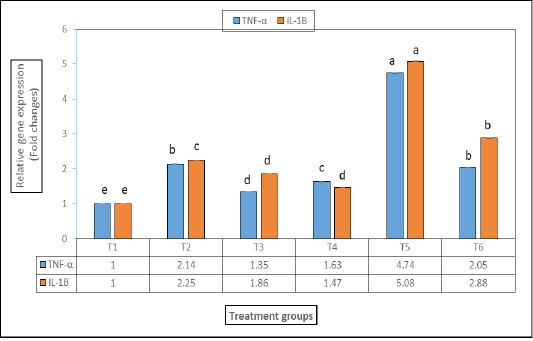
Modulation of the innate immune response is carried out mainly through the proinflammatory cytokines secreted by immune cells, especially TNF-α and IL-1β thus, gene expression patterns of this cytokine could be used to judge changes in an immune response. Modest level of proinflammatory cytokines transcription is advantageous to increase fish resistance against pathogen infection and maintain immunological balance. The findings of the current trial indicated that Nile tilapia fed on garlic oil and/or ginger oil significantly up regulated expression of immune related genes TNF-α and IL-1β. Previous studies have proven that fish supplementation with ginger had varied impacts on cytokine expression depended on the circumstance. Fazelan et al. (2020) suggested that supplementation with 10 g ginger/kg mitigated oxidative stress, immunosuppression and improved the defense to disease in common carp reared under high stocking density through up regulating gene expression levels of TNF-α, IL-1β and IL-8. Ahmadifar et al. (2019) found that feeding ginger at 1–3% had no significant effects on TNF-α, IL-1β or IL8 gene expression. Our findings are also agreed with Tanekhy and Fall (2015) who reported a marked upregulation in the expression level of TNF- α in intestine and lymphoid organ of Marsupenaeus japonicus before and after in stimulation with allicin garlic extract. Foysal et al. (2019) detected a slight upregulation of IL‐1β gene expression in the intestine of Nile tilapia after feed supplementation with garlic. Transcriptomic analysis by microarrays of fish nourished on garlic, carvacrol, and thymol essential oils containing feeds revealed an increase of genes linked to vesicular transport and exocytosis, biogenesis, oxidation reduction, leukocyte-mediated immunity, and overall metabolism processes (Firmino et al., 2020). Alternatively, Abdel-Tawwab et al. (2021) found a significant up-regulation in the levels of mRNA expression of IL-1β and IL-4 genes alongside with down regulation of TNF-α and HSP70 transcripts in response to garlic and chitosan powder treatment against Zearalenone induced toxicity in European seabass.