Hence increase in weight gain both in pashmina goats (14.79-27.11%) and kids (26.38-41.18%) due to ASUMMB supplementation can be related to balanced/.
Nutrient supplementation by feeding ASUMMB improves production performance of pashmina goats including growth, production, reproduction and health status.
It also increases birth weight, growth and pashmina production of growing kids besides improving health status.
Hence improvement in production potential of these animals can improve livelihood of poor pashmina farmers.
Selected from the article's own text.
Abstract
Mohd. Iqbal Yatoo1*, Maheshwar Singh Kanwar2, Mir Shabir Ahmad1
Abstract | This study was conducted to demonstrate the effect of area specific urea molasses mineral block (ASUMMB) on growth and production of pashmina goats and their kids. A total of 30 pashmina goats of age ranging from 1.5-2 years were divided into three groups (Group I, II and III), each group having 10 animals. Group I and Group II were supplemented with ASUMMB (150 g/day) and concentrate mixture (150 g/day) respectively, for 120 days (10 days of every month) each year. Group III was considered as control without any supplementation. They were evaluated for body weight gain and health status on quarterly basis, pashmina yield and quality, conception rate and birth weight of kids, on yearly basis. At 2 months age, kids of these animals were divided into three groups (Group I, II and III), each group containing 6 animals (n=6) and Group I was supplemented with ASUMMB (75 g/day), Group II with concentrate mixture (75 g/day) and Group III with no supplementation. They were evaluated for body weight gain and health status on quarterly basis, pashmina yield and quality on yearly basis. Body weight gain on quarterly basis, pashmina yield and staple/fiber length on yearly basis was higher (p<0.05) in both ASUMMB supplemented pashmina goats and kids than the non-supplemented group. ASUMMB supplementation increased conception rate of pashmina goats, birth weight (p<0.05) of kids and improved health status of both (+++). These findings are attributed to nutrient supplementation by ASUMMB, which provides all the essential nutrients required for growth, production, reproduction and health of pashmina goats, and thus improving production performance.
Introduction
Small ruminants diseases and nutrient deficiency are most eminent causes of production losses in goats . Nutrient deficiency results in poor growth, reduced pashmina yield, increased susceptibility to diseases and failure to conceive . Per animal production of 250-300 g of pashmina is far below than the inherited potential of 400 g ; . Production potential can be augmented by nutrient supplementation especially devised on area specific needs of animals and local feasibility ; . However, in Changthang such studies were lacking until recently we analyzed nutrient status of common fodders in Changthang and pashmina goats . Based on this nutrient status and local availability of fodders we devised area specific urea molasses mineral block (ASUMMB) . ASUMMB contains all essential nutrients including minerals and vitamins and provides maintenance requirements to pashmina goats and kids . Moreover, ASUMMB can serve as an alternate feeding supplement for goats , hence, minimizing fodder requirements as fodder scarcity is one of the main limiting factors for production performance of pashmina goats . However, effect of ASUMMB supplementation on production performance of pashmina goats is yet to be elucidated. The current study was designed to assess the impact of ASUMMB on the production performance and overall health conditions of the pashmina goats.
Materials and methods
Study Area
Present study was conducted in Trans Himalayan Changthang region of Ladakh (J&K). The geo-climatic features of the area have been described previously .
Area Specific Urea Molasses Mineral Block (ASUMMB)
ASUMMB was prepared at KVK Nyoma, Leh by using dried and crushed mixture of local fodders/grasses (composite fodder), urea, molasses, mineral and vitamin supplements along with cereal bran including rice bran and wheat bran. These ingredients were mixed in a proportion based on nutrient status of ingredients so as to meet requirements of pashmina goats . The percentage of ingredients used for ASUMMB was molasses (38), wheat bran (15.3), rice bran (15.3), composite fodder (14.4), urea (5), cement (10), salt (1), and vitamin and mineral mixture (1).
Animal Selection and Management
Animals were selected from farmers herd maintained under similar managemental conditions. A total of 30 (N=30) pashmina goats, all of the age of 1.5-2 years and in their first kidding, were divided into three groups (Group I, II and III), each group having 10 (n=10) animals. Group I and Group II was supplemented with ASUMMB (150 g/day) and concentrate mixture (150 g/day) respectively, for 120 days (10 days of every month and regularly in the morning) each year. Group III was control with no supplementation. They were evaluated for body weight gain and health status on quarterly basis, pashmina yield and quality, conception rate and birth weight of kids, on yearly basis. At 2 months age, kids of these animals were divided into three groups (Group I, II and III), each group containing 6 animals (n=6). Group I was supplemented with ASUMMB (75 g/day) and Group II with concentrate mixture (75 g/day), both for 120 days in a year (10 days of every month and regularly in the morning). Group III was control with no supplementation. They were evaluated for body weight gain and health status on quarterly basis, pashmina yield and quality on yearly basis. Animals grazed in the same pasture for the same time during the entire period of study and had free access to drinking water.
Production Parameters
Body Weight: Animals were weighed before and after supplementation on quarterly basis each year by weighing balance (range 1-100 kg), after proper restraining of animal.
Pashmina Yield: Yield of pashmina was recorded at the time of shearing / combing on yearly basis by weighing with the help of weighing balance (range 1-500 g).
Staple/Fiber Length: After proper cleaning of combed/sheared pashmina, staple/fiber length was measured with the help of measuring scale (range 1-10 cm).
Health Status: Health status was evaluated by regular monitoring of animals and diagnosing diseases if any during the period of study.
Conception Rate: This was calculated by recording total no. of goats that conceived on first matting and gave birth to kid(s) after gestation period.
Birth Weight of Kids: Birth weight of pashmina kids was evaluated at the time of kidding using weighing balance (range 1-5 kg). Body weight and health status of pashmina goat kids was evaluated as described above.
Statistical Analysis
Data was analyzed by SPSS Software for repeated measure ANOVA followed by Tukey’s multiple comparison test. Statistical significance was assessed at p<0.05.
Results
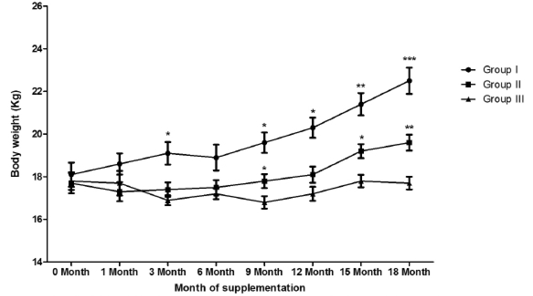
Higher (p<0.05) body weight gain was noted in Group I of pashmina goats on month 3, 9, 12, 15 and18 of ASUMMB supplementation than Group III and on month 3, 12, 15 and 18 than Group II. Group II and Group III showed non-significant (p≥0.05) difference except on month 9, 15 and 18 (Figure 1). Body weight gain was higher (p<0.05) in Group I from month 9, 12, 15 and 18 than the initial months 0, 3 and 6. Group II also showed significant (p<0.05) body weight gain from month 9, 15 and 18. Group III showed non-significant (p≥0.05) change in body weight during entire study period.
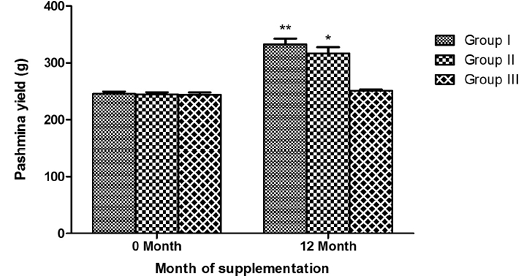
Higher (p<0.05) pashmina yield was noticed in ASUMMB supplemented goats of Group I on12th month than the non-supplemented goats of Group III however concentrate fed goats of Group II showed non-significant difference (p≥0.05) (Figure 2).
Staple/fiber length was significantly (p<0.05) longer in Group I than Group II and III which differed non-significantly (p≥0.05) (Figure 3).
ASUMMB supplemented goats of Group I showed better health status (+++) from beginning (Day 0) to end (18th month) of the study than non-supplemented Group III (+) which also showed poor health status than concentrate supplemented Group II (++) (Table 1).
Conception rate was higher in Group I (100%) than Group II (80%) and Group III (60%) as all the 10 animals conceived in Group I, and only 8 and 6 animals in Group II and Group III respectively.
Figure 3: Effect of ASUMMB supplementation on staple/fiber length of pashmina goats
Higher (p<0.05) birth weight was noted in kids of goats supplemented with ASUMMB than the non-supplemented goats and concentrate supplemented goats (Table 2). Body weight gain was higher (p<0.05) in ASUMMB supplemented kids of Group I than non-supplemented kids of Group III and concentrate supplemented kids of Group II (Table 2). Health status was better (+++) in ASUMB supplemented kids than the non-supplemented kids (-) and concentrate supplemented (+) kids (Table 2). Significantly (p<0.05) higher pashmina yield and longer staple/fiber length was noted in kids of Group I than kids of Group II and Group III (Table 3).
Discussion
Nutrient supplementation through balanced feeding improves production performance and prevents deficiency (NRC, 2001). Hence increase in weight gain both in pashmina goats (14.79-27.11%) and kids (26.38-41.18%) due to ASUMMB supplementation can be related to balanced/
Table 3: Effect of ASUMMB supplementation on production parameters of Pashmina goat kids (on 12th month)
Pashmina
yield (g)
Group I
293.3333±4.21637a
Group II
251.6667±3.33333b
Group III
208.3333±6.00925c
Staple / fiber length (cm)
Group I
5.1500±0.10878a
Group II
4.0667±0.10220b
Group III
3.5167±0.11377c
abcValues with different superscript differ significantly (p<0.05) between groups
complete feeding hence amelioration of deficiency and provision of all essential nutrients required for normal growth especially of muscles and bones in young ones. Adequate nutrients including proteins and minerals in ASUMMB may have improved muscle and bone growth hence increase in body weight (NRC, 2001). Forsberg et al. (2002) have also reported increase in body weight due to urea molasses mineral block supplementation in goats. ASUMMB provides urea, a non protein nitrogen (NPN) which is utilized for protein synthesis and minerals which are used for bone formation hence increase in body weight .
Increase in pashmina yield and staple/fiber length can be related to adequacy of nutrients for pashmina synthesis and development and appropriate fiber length attainment at maturity. Many nutrients especially proteins, copper, zinc have been found essential for animal fiber synthesis and development (NRC, 2001; . ASUMMB provides all essential nutrients . However, Mulholland and Coombe (1979) have found no improvement in wool production on urea molasses mineral block supplementation in sheep.
Improvement in conception rate and birth weight of kids is attributed to better physiological and health status of pashmina goats due to adequate nutrient supplementation by ASUMMB. Better nutrition of goats enhances reproductive health, conception rate and increases birth weight of kids ; ; .
Normal health status of both pashmina goats and kids reflects better immune status of these animals due to complete/balanced nutrition provided by ASUMMB supplementation. Proper nutrition enhances immunity of animal (NRC, 2001; . ASUMMB supplemented goats showed non occurrence of any disease from beginning (Day 0) to end (18th month) of the study. However, two animals in non-supplemented Group III suffered from mild respiratory ailment and one animal in Group II had lice infestation during winter season which recovered spontaneously.
Significant difference in production parameters between ASUMMB supplemented Group I and non-supplemented Group III in different months may be attributed to adequate provision of nutrients in Group I and deficiency of nutrients in Group III resulting in better weight gain, higher pashmina yield with longer staple/fiber length, higher conception rate and better health status. Significant difference between Group I and Group II on latter months may be due supplementation of nutrients by both ASUMMB and concentrate feeding in the initial months of supplementation and balanced/complete nutrient supplementation by only ASUMMB over longer period.
Supplementation of ASUMMB to pashmina goats also resulted in higher birth weight and better health status of kids. These ASUMMB supplemented kids showed higher growth and pashmina yield with longer staple/fiber length and better health status than the non-supplemented and concentrate supplemented kids. This is in corroboration with Pinos-Rodríguez et al. (2011).
Supplementation of ASUMMB provides all essential nutrients in adequate quantities required for growth, development, production, reproduction and health . This may have resulted in improvement in physiological and developmental processes including body growth, pashmina development, conception and immunity.
Conclusion
Nutrient supplementation by feeding ASUMMB improves production performance of pashmina goats including growth, production, reproduction and health status. It also increases birth weight, growth and pashmina production of growing kids besides improving health status. Production performance of pashmina goats directly reflects the economic status of Changpas. Hence improvement in production potential of these animals can improve livelihood of poor pashmina farmers. Thus ASUMMB can be used as an alternate and locally feasible feed supplement for boosting pashmina production.
Acknowledgement
Authors are thankful to Honorable Vice-Chancellor SKUAST-K for their support in this study. Hospitality of Changpas and assistance of supporting staff of KVK Nyoma (Changthang) is highly acknowledged.
Conflict of interest
Authors declare that they have no conflict of interest.
Author’s contribution
Mohd. Iqbal Yatoo drafted manuscript and analysed data, Mir Shabir edited manuscript and Maheshwar Singh Kanwar provided guidance.
References
Arthington JD (2006). Trace mineral nutrition and immune competence in cattle. Florida Ruminant Nutrition Symposium, Best Western Gateway Grand, Gainesville FL. Pp. 1-11.
Ben Salem H, Nefzaoui A (2003). Feed blocks as alternative supplements for sheep and goats. Small Rum. Res. 49: 275–288. http://dx.doi.org/10.1016/S0921-4488(03)00144-5[CrossRef]
Ceylan A, Serin I, Aksit H, Seyrek K (2008). Concentrations of some elements in dairy cows with reproductive disorders. Bull. Vet. Inst. Pulawy. 52: 109-112.
Forsberg NE, al-Maqbaly R, al-Halhali A, Ritchie A, Srikandakumar A (2002). Assessment of molasses-urea blocks for goat and sheep production in the Sultanate of Oman: intake and growth studies. Trop. Anim. Health Prod. 34: 231-239. http://dx.doi.org/10.1023/A:1015282625468[CrossRef]
Kincaid RL (1999). Assessment of trace mineral status of ruminants: A review. Proceedings of the American Society of Animal Science. Pp. 1-10
Kioumarsi H, Yahaya ZS, Rahman AW (2011). The effect of molasses/mineral feed blocks along with the use of medicated blocks on haematological and biochemical blood parameters in Boer Goats. Asian J. Anim. Vet. Adv. 6: 1264-1270. http://dx.doi.org/10.3923/ajava.2011.1264.1270[CrossRef]
Mulholland JG, Coombe JB (1979). Supplementation of sheep grazing wheat stubble with urea, molasses and minerals: Quality of diet, intake of supplements and animal response. Austr. J. Exp. Agri. 19: 23. http://dx.doi.org/10.1071/EA9790023[CrossRef]
NRC (2001). National Research Council. Nutrient requirements of sheep and goat. Natl. Acad. Sci. Washington DC.
Pinos-Rodríguez JM, López MG, García-López JC, Aguirre-Rivera JR, Mellado M. (2011). Effects of urea-prickly pear-molasses block supplementation on growth and milk production of crossbred goats on arid rangelands. J. Appl. Anim. Res. 39: 117-119. http://dx.doi.org/10.1080/09712119.2011.558679[CrossRef]
Wani SA, Wani MH, Wani GM, Yousuf S (2009). Economics of Pashmina based trans-humance production system in cold arid region of Jammu and Kashmir. Ind. J. Agri. Eco. 64: 229–45.
Yatoo MI, Kanwar MS (2016). ASUMMB technology for Changthang. Pamphlet. Pp. 1-2.
Yatoo MI, Devi S, Kumar P, Tiwari R, Sharma MC (2011). Soil plant animal micro mineral status and their inter relation in Kashmir valley. Ind. J. Anim. Sci. 81: 628-630.
Yatoo MI, Kanwar MS, Wani SA, Kumar D, Dimri U (2016). Alteration of metabolic biomarkers and oxidative stress indices in pashmina (Changthangi) goats under climate change. Ind. J. Anim. Sci. 86: 405–413.
Yatoo MI, Singh M, Kubrevi SS, Shabir M, Dar R, Angmo K (2014). Safeguarding a national asset: a review on problems faced by pashmina farmers in Changthang and their amelioration. Ind. J. Anim. Sci. 84: 1251-1255.