Body weight (kg) at birth, 30, 60, 90, 120, and 150 days were 2.34 + 0.03, 4.39 + 0.10, 6.61+ 0.14, 9.85 + 0.29, 11.8 + 0.24, and 13.7 + 0.24 kg, respectively(Table 1). Location influenced (P<0.05) body weights of kids at birth, 60, 90 and 150 days. Kids born in the SDS showed significantly (P<0.01) lower birth weight compared to other locations. Kids born at the MFS had significantly (P<0.05) higher weights at 60 and 90 days compared to the GDS while non–significant (P>0.05) compared to the SDS. At 90 and 150 days, kids born at the SDS and MFS demonstrated higher body weights in comparison to the GDS.
Table 1: Least square mean (LSM+SE) for body weights (kilograms) from birth to 150 days of age of Adilo kids by location (sheep dominant site, SDS; goat dominant site, GDS; and mixed flock site, MFS) and sex
means with different letters (a, b) within a trait in a column are different at indicated P value: NS non–significant (P >0.05);*P <0.05; **P <0.01
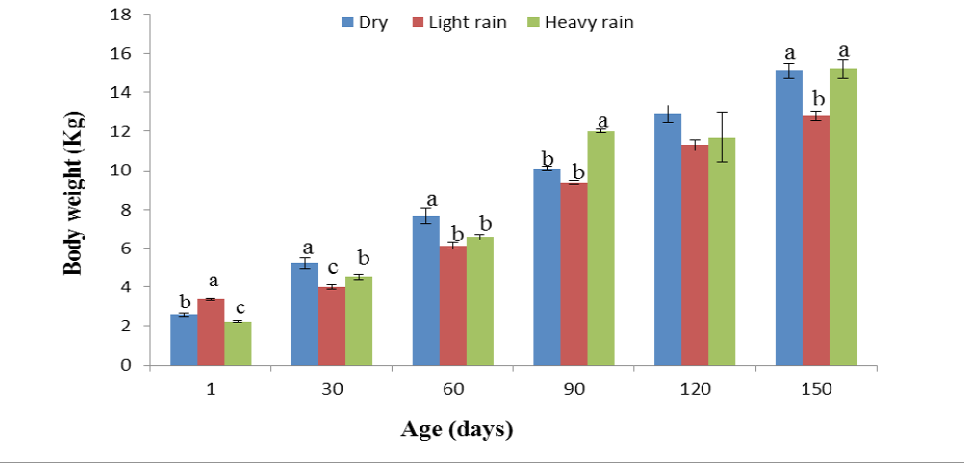
Figure 1: Body weights of kids
Body weights of kids from birth to 150 days of age as affected by the season of birth in Adilo district, south Ethiopia. Bars with different letters differ significantly at P value: non–significant, P>0.05 (at 120 days); P<0.001 (at birth); P<0.05(at 90 days); P<0.0001(at 30, 60 and 150 days)
Season is one of the important sources of variation on body weight of kids (Figure 1). The effect of season was significant on body weights at all ages except at 120 day. Kids born during the light rain season had significantly (P<0.001) higher birth weight than those born during the dry and heavy rain seasons. Likewise, kids born during the dry season had significantly higher birth weight compared to those born during the heavy rain season. The body weight of kids at 30 days during dry season was higher (P<0.0001) than heavy rain season. At 60 day, kids born during dry season were higher (P<0.0001) than the light and heavy rain seasons whilst at weaning (90 day), kids born during heavy rain season had higher (P<0.05) body weight compared to dry and light rain seasons. Kids born in the dry and heavy rain seasons showed significantly heavier (P<0.001) weights at 150 days compared to the light rain season. The effect of sex is significant at 30, 60, 90 and 120 days (Table 1); male kids had higher (P<0.05) body weights compared to the female counterparts.
Does in parity three and four had significantly (P<0.001) higher birth weight compared to parity one, two and five (Table 2). Likewise, parity five showed significantly higher (P<0.01) birth weight compared to parity one. Parity effect was significant (P<0.05) at 30 and 60 days, non–significant at 90 days weight, while the significance resumed at 120 and 150 days. Parity four showed significantly higher body weight at 30 day compared to parity two. Parity one had higher weight at 60 day compared to parity five and two. At 120 days of age, parity five demonstrated higher (P<0.05) body weights compared to parity two. Similarly at 150 days of age, parity five showed significantly heavier weight compared to parity three and the lower parities. Parity by sex was significant at 90 and 120 days (data not presented). Female kids born from the fifth parity were lower (P<0.05) than females in lower parities and male in all combinations.
Type of birth is also an important source of variation on weight at birth as well as at weaning (Table 2).
Single born kids grew faster (P<0.05) and reached weaning age earlier than multiple births. Type of birth influenced body weights of kids significantly from 30 to 90 days of age, and thereafter its effect disappeared. Single born kids were heavier (P<0.05) birth weight compared to multiple counterparts and they maintained their superiority at 30, 60 and 90 days of age.
Table 2: Least square mean (LSM+SE) for body weights (kilograms) from birth to 150 days of age of Adilo kids by parity and type of birth
Means with different letters (a, b) within a trait in a column are different at indicated P value: NS non–significant (P >0.05); *P <0.05; ***P<0.001
Table 3: Least square mean (LSM+SE) for average daily weight gain (grams) from birth until 30, 60, 90, 120 and 150 days of age of Adilo kids by location (sheep dominant site, SDS; goat dominant site, GDS; and mixed flock site, MFS) and season
Means with different letters (a, b) within a trait in a column are different at indicated P value: NS non–significant (P >0.05) *P <0.05; **P <0.01; ***P <0.001, ****P <0.0001

