
The research was conducted to investigate the immunomodulatory and growth promoting effects of basil (Ocimum basilicum) and ascorbic acid in heat stressed broiler chicken. A total of 360 (Hubbard) one-day old broilers were reared under heat stress (38 ± 1°C) and randomly divided into three groups i.e. A, B and C as control, basil seed at 5g/kg and ascorbic acid at 200 mg/kg supplementation, respectively. Improvement of intestinal villus seen in basil supplementary group (P>0.05), and significant increase in the absorption of crude protein (CP), crude fibre (CF), and metabolized energy (ME). However, the values of red blood cells and packed cell volume were non-significant whereas white blood cells, haemoglobin, and new castle disease antibody titer were significantly higher in basil supplementary group. The weight gain and feed conversion ratio significantly improved in basil treated group, while ascorbic acid and basil significantly decreased the water intake. Body temperature and mortality percentage were significantly decreased in ascorbic acid and basil supplementary group as compared to control. Dressing percentage significantly increased in both supplementary groups. It is concluded that supplementation of basil at 5g/kg feed, promotes the growth, improves the intestinal villus size, feed efficiency and immunity of heat stressed broiler chicken.
Research Article · Volume 51, Issue 3, 14 March 2019 · Open Access
Immunomodulatory and Growth Promoting Effects of Basil (Ocimum basilicum) and Ascorbic Acid in Heat Stressed Broiler Chickens
· · · · · · ·
Affiliations & Notes ⌄
- 1College of Animal Science and Veterinary Medicine, Shanxi Agricultural University, Taigu, China 2Department of Poultry Husbandry, Faculty of Animal Husbandry and Veterinary Sciences, Sindh Agriculture University, Tandojam, Sindh, Pakistan , * Corresponding author: wenxiatian@126.com
Article Info ⌄
- Journal:
- Pakistan Journal of Zoology
- Published:
- 14 March 2019

From the article
- The effect of basil seed and AA supplementation on feed intake, water intake, weight gain and feed conversion ratio in heat stressed broiler chicken, is presented in Table II.
- Dietary supplementation with basil seed and AA significantly (P0.05) improved the villus size of duodenum, jejunum, and ilium.
- Additionally, AA and basil decreased the body temperature, which may lower down the water intake as found in this study.
- Lower mortality was observed in basil supplementary group which may be the reason of higher immunity.
Selected from the article's own text.
Abstract
Introduction
The poultry industry is severely affected by a very deleterious effect of heat stress. It increases panting, body temperature, feed conversion ratio water consumption and reduce feed intake, body weight gain, carcass yield and makes it difficult to reach the sufficient poultry meat production in tropical regions . Corticosterone stored in adrenal cortex release into the blood circulation to help the metabolism . This hormone may cause cellular and humoral immunity failure because of the changings in the plasma concentrations of corticosteroids and adrenocorticotropic hormone (ACTH), resultantly lymphoid tissues get affected and the mass of spleen, thymus, and bursa reduced ultimately .
It needs to improve the thermos tolerance of the broiler chicken without affecting the productivity. Many authors have suggested different methods to reduce the negative effects of heat stress. Overnight feeding and feeding in cooler times of the day increase FI (Feed Intake), growth performance and survivability . Nutritional strategy in the heat stress conditions played vital role in mitigating the negative effects of heat stress, offered diet should fulfill the requirements of proteins, electrolytes, and energy for birds . Nutritional manipulation with inclusion of anti-stress compounds (enzymes, minerals, and vitamins) make a practical alternative in alleviating the effects of high ambient temperature. However, there is criticism over the usage of chemicals and synthetic feed additives due to the high cost, contraindications, and especially cumulative residual effects.
Ascorbic acid (AA) is an anti-oxidant which neutralize the free radicals, produce in stress condition . It improves the villus size, ultimately feed utilization increase . AA is a good quality antioxidant for poultry chicken in heat stress, it has been already studied well. Heat stress changes the endocrinal glands and declines the immune system and make it less powerful to fight with pathogens, in this condition AA decrease the activity of 21-hydroxilase and 11-b-hydroxilase (key enzymes in corticosterone biosynthesis) and overwhelms the negative effects of heat stress on performance and immune system . Other than AA, herbal antioxidants are also used in poultry industry to overcome heat stress condition .
Herb Ocimum sanctum (family Lamiaceae) is well known medicinal plant. It is anthelmintic, antibacterial, anti-inflammatory, antipyretic, and antimicrobial in nature . O. sanctum supplementation is effective in improving broiler performance and haematological parameters in stressed condition . This study investigates the effect of another Ocimum species O. basilicum on the immunity and growth performance of heat stressed broiler chickens.
Materials and methods
Three hundred sixty (360) one-day-old (Hubbard) broilers were equally and randomly divided into 3 groups; each group divided into 4 replicates of 30 birds in each and the groups were, i.e. control group (control), basil seed group (basil) and ascorbic acid group (AA). The sex ratio in each group was balanced. Control group was fed on basal diet without any supplementation, basil group supplemented with basil seed powder (O. basilicum) at the level of 5g/kg in feed and AA group supplemented with AA at the level of 200mg/kg in feed. Feed and water were provided ad libitum. Feeding program consisted on starter diet of 1-21 days, and finisher diet of 22-42 days (Table I).
Table I.- Composition of basal diet for heat stressed broiler chickens and proximate analysis of basil seed (Ocimum basilicum).
| Ingredients | Starter feed (g/kg) | Finisher feed (g/kg) |
| Rice | 316 | 400 |
| Maize | 100 | 100 |
| Rice polish | 150 | 160 |
| Fish meal | 85 | 80 |
| Soya bean | 70 | 55 |
| Guar meal | 50 | 40 |
| Canola meal | 115 | 80 |
| Rape seed meal | 33 | 30 |
| Sunflower | 70 | 44 |
| Lime stone | 11 | 11 |
| Nutritive values of experimental diet | ||
| Crude protein | 21.2 | 19 |
| Metabolize energy | 2800 K/Cal | 2950 K/Cal |
The floor space of 1 ft2. was provided to each chick on deep litter housing system and artificial brooding started 24 h before the arrival of the chickens. All the birds were subjected to natural induced heat stress. Record of temperature were maintained on daily basis with mean maximum daily temperature of 38±1°C, relative humidity (RH) 70.57 ±1.30% (recorded twice daily at a fixed time by hygrometer). The wooden dust was used as litter at thickness of 3 inches. Turning of litter practiced twice daily.
Feed intake and water intake was recorded daily, whereas weight gain was recorded on weekly basis. Feed conversion ratio was recorded by dividing weight gain with feed intake while at the end of trial period, two birds were selected from each replicate and slaughtered for dressing percentage, relative weight of visceral and non-visceral organs.
Basil seeds (Ocimum basilicum), were dried first for three days, then kept in an oven at 60ºC to decrease the moisture level up to 5%. The seeds were then ground manually with the help of pestle and mortar. The ground powder was sieved to get fine powder. At the end, it was mixed and supplemented in the feed at the rate of 5g/kg in basil group. Ascorbic acid (vitamin C) was mixed in the diet of group AA at the rate of 200mg/kg.
Nutrients absorption
Two birds per replicate were transferred to metabolic cage on 36th day for faecal collection. The feces were collected for three days, from the day 39 to 41 and the samples were stored at 20oC. The feed consumption was also recorded during this period .
Intestinal histomorphology
Histomorphological examination was performed on small intestinal tract which was removed entirely. The sampling for histomorpholigicl examination was performed as two cm sample of small intestine were taken from the middle part of duodenum, jejunum, and ileum. Firstly, tissue samples preserved in 10% neutral buffered formaldehyde for the time of 72 h. Then, dehydration was performed; afterward the next steps of clearing, and embedding were performed. Histological study was performed on 5μm thick transverse section, which was cut in microtome; then, fixed on slide and stained with haematoxylin and eosin. The tissue sections were examined on a Nikon phase contrast microscope coupled with a Microcomputer integrated digital imaging analysis system (Nikon Eclipse 80i, Nikon Co., and Tokyo, Japan). Villus height was measured from tip (with a lamina propria) of the villus to the base (villus-crypt junction), and villus width was measured at its middle part. The crypt depth was measured from villus-crypt junction to the distal limit of the crypt (Fig. 1). Three sections from upper, middle, and lower part of duodenum, jejunum and ileum were measured. Eighteen villi were counted from nine different sections in each segment (duodenum, jejunum, and ileum) per bird, and their average was expressed as the mean villus height and villus width for each bird. Finally, the villus height and villus width from six birds were expressed as mean villus height and width for one treatment group .
HI-Newcastle disease antibody titre
All the birds were vaccinated on 24th day against new castle disease and the blood samples were collected after 12 days of vaccination from the wing vein of two birds/replicate and stored at 20oC for further analysis. HI test was performed on chicken serum samples for the presence of antibodies as described in the Organization for Animal Health Manual (OIE, 2013).
Haematology
The blood samples were collected from wing web on 40th day and kept in a sterilized tube contains 3% sodium citrate for determination of haemoglobin, white blood cells, packed cell volume, red blood cells. The collected samples for red blood cells, white blood cells counts were analysed by Haemocytometer and Haemoglobin by Sahli’s method while PCV in Centrifuge machine.
Body temperature
Three broilers from each replicate were randomly selected on 42nd day for rectal temperature which was recorded using a digital thermometer.
Statistical analysis
The raw data was first tabulated in Microsoft Excel and then analysed in one-way analysis of variance (ANOVA) with JMP Software (version 7.0.1, SAS Institute Inc., Cary, NC, USA) and significant differences were compared in Tukey’s HSD comparison test.
Results
The effect of basil seed and AA supplementation on feed intake, water intake, weight gain and feed conversion ratio in heat stressed broiler chicken, is presented in Table II. Dietary supplementation with basil seed and AA significantly (P<0.05) increased the feed intake, weight gain, feed efficiency and reduced the water intake (P<0.05).
Table II.- Effects of basil seed (Ocimum basilicum) and ascorbic acid supplementation on the growth performance of heat stressed broiler chicken.
| Control | Basil (5g/kg) | AA (200 mg/l) | P. Value | |
| Feed intake (g/broiler) | 3591.5± 36.00 | 3776.2± 80.00 | 3625.5± 94.00 | 0.0490 |
| Water intake (ml/broiler) | 12330.1± 32.4a | 11856.5± 59.8b | 11726.5± 54.00c | 0.0001 |
| Weight gain (g/broiler) | 1815.4± 26.4b | 2010.9± 51.4a | 1915.1±7 0.4ab | 0.0113 |
| FCR (feed/gain) | 1.97± 0.02a | 1.87± 0.01b | 1.89± 0.02b | 0.0028 |
a-cMeans within a column not sharing a common superscript differ at P < 0.05. AA, ascorbic acid; FCR, feed conversion ratio.
Table III.- Effects of basil seed (Ocimum basilicum) and ascorbic acid supplementation on relative weight of organs in heat stressed broiler chickens.
| Items | Control | Basil (5g/kg) | AA (200 mg/l) | P. Value |
| Fat pad | 1.96±0.03 | 1.84±0.05 | 1.85±0.09 | 0.1301 |
| Dressing | 56.32±0.37c | 60.34 ±0.74a | 58.57 ±0.40b | 0.0003 |
| Liver | 3.28±0.07 | 3.18±0.13 | 3.17±0.09 | 0.3984 |
| Spleen | 0.05 ±0.01 | 0.06±0.004 | 0.05±0.01 | 0.5905 |
| Bursa | 0.14 ±0.01 | 0.15±0.01 | 0.14±0.01 | 0.2666 |
| Heart | 0.51±0.02 | 0.54±0.011 | 0.50±0.047 | 0.3528 |
| Gizzard | 1.37±0.08 | 1.45±0.10 | 1.42±0.02 | 0.4742 |
| Intestine | 2.24±0.11 | 2.38±0.01 | 2.24±0.09 | 0.1353 |
a-cMeans within a column not sharing a common superscript differ at P < 0.05. AA, ascorbic acid.
The effect of basil seed and AA supplementation on relative weight of visceral and non-visceral organs in heat stressed broiler chicken, is presented in Table III. Relative weight of fat pad, liver, spleen, bursa, heart, gizzard, intestine observed non-significant (P>0.05) in the dietary supplementation of basil seed and AA.
The effect of basil seed and AA supplementation on height, width, and crypt to depth ratio of duodenum, jejunum and ilium in heat stressed broiler chicken, is presented in Table IV. Dietary supplementation with basil seed insignificantly (P>0.05) improved the villus size of duodenum, jejunum, and ilium. Result of AA supplementary group remained insignificant (P>0.05).
Table IV.- Effects of basil seed (Ocimum basilicum) and ascorbic acid supplementation on nutrients retention of heat stressed broiler chickens.
| Nutrients (%) | Control | Basil (5g/kg) | AA (200 mg/l) | P. Value |
| Crude protein | 73 ±1b | 77 ±1a | 75 ±1ab | 0.0080 |
| Ether extract | 70 ±1b | 69 ±1b | 73 ±1a | 0.0066 |
| Crude fibre | 29 ±0.5b | 33 ±1a | 31 ±0.5ab | 0.0041 |
| Metabolized energy | 70 ±1b | 77 ±1a | 75 ±1a | 0.0004 |
a-cMeans within a column not sharing a common superscript differ at P < 0.05. AA, ascorbic acid.
Table V.- Effects of basil seed (Ocimum basilicum) and ascorbic acid supplementation on intestinal histomorphology of heat stressed broiler chickens (µm).
| Histomorphology | Control | Basil (5g/kg) | AA (200 mg/l) | P-value |
| Duodenum height | 1383±76 | 1430±26 | 1423±25 | 0.492 |
| Duodenum width | 150±5 | 157±2 | 155±5 | 0.169 |
| Duodenum crypt depth | 5.00±1 | 6.33±0.5 | 6.00±1 | 0.235 |
| Jejunum height | 1233±20 | 1266 ±51 | 1240±20 | 0.489 |
| Jejunum width | 149±4 | 153±2 | 151±3.6 | 0.514 |
| Jejunum crypt depth | 5.00±1 | 5.73±0.6 | 5.66±1.15 | 0.609 |
| Ilium height | 1100±50 | 1163±54 | 1156±51.3 | 0.332 |
| Ilium width | 126±7 | 136 ±5 | 130±10 | 0.397 |
| Ilium crypt depth | 4.80±0.3 | 5.50±0.5 | 5.33±0.57 | 0.258 |
a-c Means within a column not sharing a common superscript differ at P < 0.05. AA, ascorbic acid.
The effect of basil seed and AA supplementation on nutrients retention in heat stressed broiler chicken, is presented in Table V. Dietary supplementation with basil seed significantly (P<0.05) increased the crude protein, crude fibre, and metabolized energy except ether extract (EE), which decreased (P<0.05). AA supplementation significantly (P<0.05) increased the ether extract and metabolized energy whereas crude protein and crude fibre remained insignificant (P>0.05).
The effect of basil seed and AA supplementation on haematology, HI-ND antibody titre and body temperature in heat stressed broiler chicken, is presented in Table VI. Dietary supplementation with basil seed significantly (P<0.05) increased the white blood cells and haemoglobin while red blood cells, packed cell volume and new castle disease humoral immunity titre improved insignificantly (P<0.05). AA supplementation significantly (P<0.05) improved the haemoglobin while non-significantly (P>0.05) improved the white blood cells and red blood cells. Basil supplementation significantly (P<0.05) improved the immunity of heat stressed broiler chicken against the new castle disease. Whereas, ascorbic supplementary group remained insignificant (P>0.05).
Table VI.- Effects of basil seed (Ocimum basilicum) and ascorbic acid supplementation on haematology, ND antibody titre and the body temperature of heat stressed broiler chickens.
| Items | Control | Basil (5g/kg) | AA (200 mg/l) | P. Value |
| WBC | 9747 ±221b | 10383 ±275a | 10250 ±217ab | 0.0387 |
| Hb | 9.2 ±0.72b | 10.9 ±0.10a | 10.7 ±0.43a | 0.0103 |
| RBC | 3.60 ±0.10 | 3.83 ±0.28 | 3.80 ±0.34 | 0.5454 |
| PCV | 22.23 ±1.36 | 24.00 ±1.00 | 23.33 ±0.57 | 0.1876 |
| ND titre | 4.00 ±1.00 | 6.00 ±1.00 | 4.66 ±0.57 | 0.0787 |
a-cMeans within a column not sharing a common superscript differ at P < 0.05. AA, ascorbic acid; WBC, white blood cells (x106/µL); Hb, hemoglobin (g/dl); RBC, red blood cell (x106/µL); PCV, packed cell volume (%); ND, Newcastle disease.
Dietary supplementation of basil seed and AA significantly (P<0.05) decreased the body temperature in heat stressed broiler chicken (Fig. 2A). Mortality percentage was observed higher for control group and lower for basil and AA supplementary group (Fig. 2B).
Discussion
Basil improved the feed consumption of broiler chickens in heat stress condition. Constituents of basil, like linalool, estragole and eugenol are antimicrobials, which cause sterilization of gastrointestinal tract, resultantly feed utilization improved .
Water intake was reduced in the basil and AA supplementation group. Basil substances, such as camphor, thymol, and methyl cinnamate, impacted the taste of water; resultantly water intake reduced . Additionally, AA and basil decreased the body temperature, which may lower down the water intake as found in this study.
Our results regarding weight gain are in line with the findings of Rehman et al. (2018) who found that broilers kept at high ambient temperature gain less body weight. Antipyretic, antioxidant, and antimicrobial activities ; improved the digestive tract ecology and reduced the number of pathogenic microbes in the intestine, which provided more energy for growth. This could be the reason for 9.72% weight gain in basil supplementary group. Metabolic functions of AA could be the reason of weight gain, which served as a classical enzyme cofactor, as a protective agent and as an ascorbyl radical interactions with transition metal ions . Furthermore, Combs explained that metabolic role and antioxidant function of AA reduced the free radicals which protect the cells of the body against the potentially deleterious reactions of highly reactive oxidizing species. Good feed efficiency results were obtained for basil treated birds, which might be because of the higher feed intake, weight gain and nutrients retention as found in this study. Previous researchers found good feed efficiency ratio when supplemented the diet with basil seed .
Dressing percentage improved in this study by the addition of basil in the feed. Similarly, highest dressing percentage was observed when supplemented, 10g/kg basil seed whereas, higher weight gain in 5g/kg basil seed supplementary group was observed, which may be the reason for improved dressing percentage. The mode of action of AA alleviate the release of corticosteroid hormones and reduced the disturbance of electrolyte imbalances; thus, reducing catabolism of body reserves and preventing a strong dehydration in the bird , which may improve the dressing percentage. Basil did not affect the relative weight of liver, spleen, bursa, heart, gizzard and intestine. However, relative weight of heart, gizzard and the liver were not affected by the basil seed supplementation . Post-mortem findings of non-supplementary group revealed that liver was enlarged in size, which might be due to the heat stress condition, while the lowest mortality percentage and lower liver weightage was seen in AA.
Heat stress is responsible for the water holding capacity of animal cells when K+ ions accumulation is increased, it decreased the metabolic activities and reduced the digestibility of different components ; . CP, CF, and ME increased and EE decreased in the basil supplementary group, the antimicrobial and antioxidant activities of basil improved the gut health, bacterial population, improve nutrients absorption and utilization . Most of the herbal feed additives inhibit metabolism of lipid via interfering cholesterol micelles solubilisation in the gastrointestinal tract which decreased cholesterol absorption and increased faecal bile acid and cholesterol excretion . Furthermore, a study on sea bream (Sparus aurata) reported the basil seed increased the protein retention while coinciding with depression in lipid content. They further explained that digestive enzyme activities and serum total protein increased when supplemented with basil. AA supplementation increased the crude protein, ether extract, crude fibre, and metabolized energy .
All kinds of stressors existing around broiler chickens can be mimicked by corticosterone . Similarly, control group could not increase the villus size of height, width and crypt depth for duodenum, jejunum, and ilium parts. Birds exposed to heat stress intake less feed; hence, the height of villus decreases. Addition of basil in feeding, non-significantly improved the height, width, and crypt depth of intestinal villus, in stressed environment. However, no literature is yet available about basil effect over intestinal histomorphology, while some herbs proved effective on intestinal activity and for the villus of broiler chicken.
Heat stress lead birds to decreased total red blood cells per unit volume of blood, which in turn decreased haemoglobin concentration and packed cell volume. It is due to the positive relation between red blood cell, haemoglobin concentration and packed cell volume ; . The reduction in red blood cells per unit volume of blood, may be due to haemodilution. Similarly, numbers of red blood cells are dependent on both the numbers of new red blood cells produced and the average life span RBC’s. Hence, heat stress may shorten the red blood cells life span, resulting decrease in total numbers of red blood cells. White blood cells significantly decreased in heat stress condition . Leukocytes changed in response to environmental stress are stable and enduring . WBCs, and Hb increased when supplemented 5g/kg basil seed. Hb, WBCs, RBCs non-significantly increased when supplemented 10g/kg basil . The improvement might be because of the presence of phenolic compound like tannins, saponin, flavonoids, steroid, terpenoids, eugenol, caryophyllene, cardiac glyceride.
Basil supplementary group had better antibody titre of new castle disease. The reason could be the microflora which favours better nutrient utilization resultantly which stimulated the immune system . Lower mortality was observed in basil supplementary group which may be the reason of higher immunity. Broilers exposed to high ambient temperature, increased the corticosterone, secreted into the blood circulation . AA may protect the bursa of fabricius from the effect of glucocorticoid which is released under heat stress conditions and helps in immunity and blood cells.
Rectal temperature was high in heat stressed non-supplementary group. Similarly, body temperature is directly proportional to the environmental temperature. Herbs like Basil (O. basilicum) and synthetic AA help the broilers in maintaining homeostatic process as found in this research . Body temperature increased on 35th day in heat stress condition . Basil supplementary group reduced the mortality percentage which might be due to the antioxidant properties of basil and higher antibody titer, as seen in this study.
Conclusion
In conclusion, supplementation of basil seed powder (Ocimum basilicum) at the level of 5 g/kg and AA at the level of 200 mg/kg in the diet of heat stress broilers, increase weight gain, dressing percentage, improve the feed efficiency, villus size, better the new castle disease titre, nutrients retention (CP, CF, EE, ME), haematology (WBC’s, Hb). However, decreased the water intake and body temperature.
Acknowledgements
This work was supported by the Study on National Key R & D Program of China (2016YFD0500800), the National Natural Science Foundation of China (31072179) and Key Technologies R and D Program of Shanxi Province (20130311027-3).
Statement of conflict of interest
The authors declare that there is no conflict of interests regarding the publication of this article.
Figures
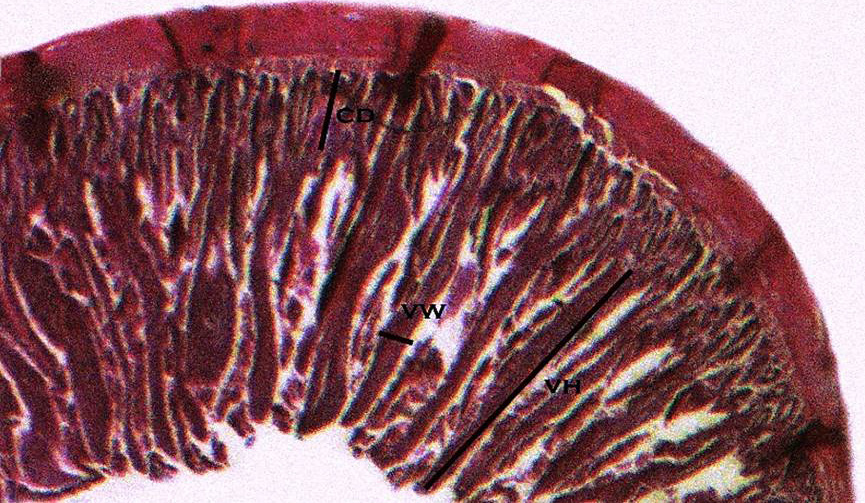
Measurements of intestinal villus. CD, crypt to depth; VW, villus width; VH, villus height
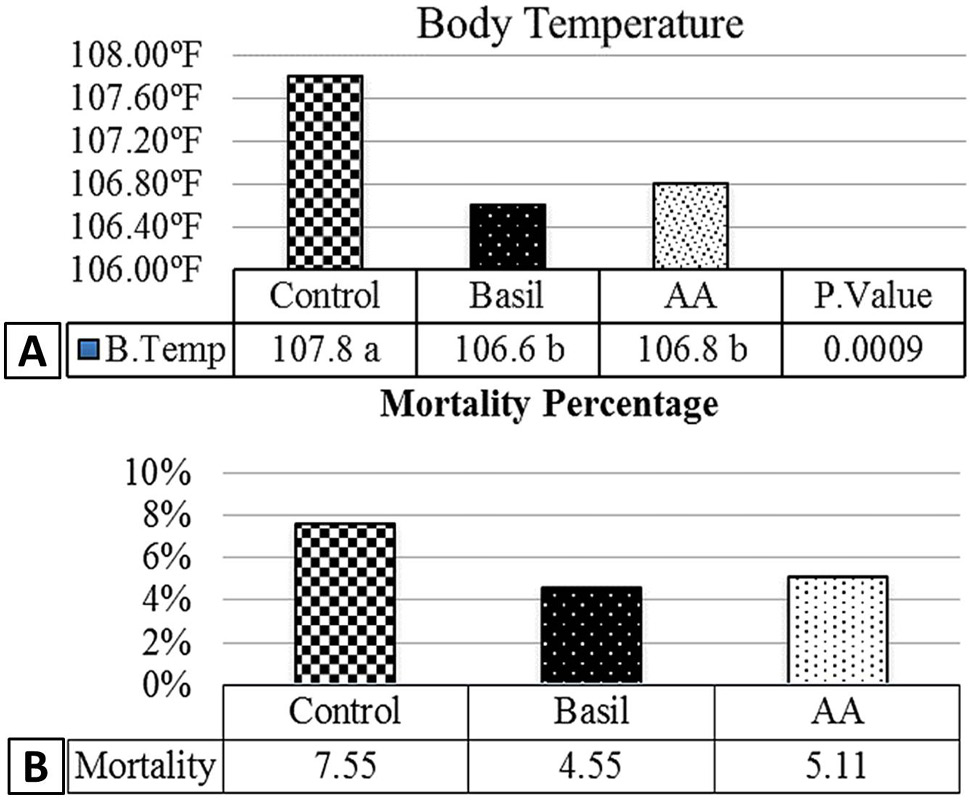
Effects of basil seed (Ocimum basilicum) and ascorbic acid supplementation on body temperature (A) and mortality percentage (B) of heat stressed broiler chickens. B. Temp, body temperature; AA, ascorbic acid.
References
- Ahmadiani, J.M., Semnanian, B. and Kamalinejad, M., 2001. Anti-inflammatory and antipyretic effects of Trigonella foenumgraecum leaves extract in the rat. J. Ethnopharmacol., 75: 283-286. https://doi.org/10.1016/S0378-8741(01)00187-8[CrossRef]
- Ahmed, H.A., Sadek, K.M. and Taha, A.E., 2015. Impact of two herbal seeds supplementation on growth performance and some biochemical blood and tissue parameters of broiler chickens. Int. J. biol. Biomol. Agric. Fd. Biotechnol. Engin., 3: 255-260.
- Altan, O., Altan, A, Oguz, I, Pabuccuoglu, A., and Konyalioglu, S., 2000. Effects of heat stress on growth, some blood variables and lipid oxidation in broilers exposed to high temperature at an early age. Br. Poult. Sci., 41: 489-493. https://doi.org/10.1080/713654965[CrossRef]
- Ashraf, Y., Shalaby, S.M., Nemetallah, B.R., Saleh, N.E., Sakr, E.M. amd Toutou, M.M., 2015. Possibility of using basil (Ocimum basilicum) supplementation in gilthead sea bream. Egypt. J. aquat. Res., 41: 203-210.
- Attia, Y., Hassan, R. and Qota, E., 2009. Recovery from adverse effects of heat stress on slow-growing chicks in the tropics 1: Effect of ascorbic acid and different levels of betaine. Trop. Anim. Hlth. Prod., 41: 807-818. https://doi.org/10.1007/s11250-008-9256-9[CrossRef]
- Borges, S., da Silva, A.F., Majorka, A., Hooge, D. and Cummings, K., 2004. Physiological responses of broiler chickens to heat stress and dietary electrolyte balance (sodium plus potassium minus chloride, milli equivalents per kilogram). Poult. Sci., 83: 1551-1558. https://doi.org/10.1093/ps/83.9.1551[CrossRef]
- Bonnet, S., Geraert, P., Lessire, M., Carre, B. and Guillaumin, S., 1997. Effect of high ambient temperature on feed digestibility in broilers. Poult. Sci., 76: 857-863. https://doi.org/10.1093/ps/76.6.857[CrossRef]
- Cafantaris, B., 1995. Vitamin C: Functions and applications in poultry and pigs. Feed Comp., 15: 15-20.
- Combs, G.F., 1992. The vitamins: Fundamental aspects in nutrition and health. Academic Press, San Diego, CA, USA, pp. 411-419.
- Daghir, N. (ed.), 1995. Broiler feeding and management in hot climates. In: Poultry production in hot climates. CABI Publishers, pp. 185-218. https://doi.org/10.1079/9781845932589.0227[CrossRef]
- Daghir, N., 2009. Nutritional strategies to reduce heat stress in broilers and broiler breeders. Lohmann Inform., 44: 6-15.
- Gharib, H., El-Menawey, M., Attalla, A. and Stino, F., 2005. Response of commercial layers to housing at different cage densities and heat stress conditions. 1-Physiological indicators and immune response. Egypt. J. Anim. Prod., 42: 47-70.
- Husseiny, O., Shalash, S. and Azouz, H., 2002. Response of broiler performance to diets containing hot pepper and/or fenugreek at different metabolizable energy levels. Egypt. Poult. Sci. J., 22: 387-406.
- Hayashi, K., Yoshizaki, R., Ohtsuka, A., Toroda, T. and Tuduki, T., 2004. Effect of ascorbic acid on performance and antibody production in broilers vaccinated against IBD under a hot environment. Proc. 22nd World’s Poult. Congr., pp. 550.
- Jahejo, A.R., Leghari, I., Sethar, A., Rao, M., Nisa, M. and Sethar, G., 2016. Effect of heat stress and ascorbic acid on gut morphology of broiler chicken. Sindh Univ. Res. J., 48: 829-832.
- Lee, S.J., Umano, K., Shibamoto, T. and Lee, K.G., 2005. Identification of volatile components in basil (Ocimum basilicum L.) and thyme leaves (Thymus vulgaris L.) and their antioxidant properties. Fd. Chem., 91: 131-137. https://doi.org/10.1016/j.foodchem.2004.05.056[CrossRef]
- Nilipour, A., 2000. Modern broilers require optimum ventilation. World Poult., 16: 30-31.
- Nweze, B. and Ekwe, O., 2012. Growth performance, gut and haemo-microbial study of finishing broilers fed African sweet basil (Ocimum gratissimum) leaf extract. Ozean J. appl. Sci., 5: 185-191.
- OIE, 2013. Peste des petits ruminants, Chapter 2.7. World Assembly of Delegates of the OIE, pp. 1-14.
- Onwurah, F., Ojewola, G. and Akomas, S., 2011. Effect of basil (Ocimum basilicum L.) on coccidial infection in broiler chicks. Acad. Res. Int. J., 1: 438-442.
- Osman, M., Yakout, H., Motawe, H. and El-Arab, W.E., 2010. Productive, physiological, immunological, and economical effects of supplementing natural feed additives to broiler diets. Egypt. Poult. Sci. J., 30: 25-53.
- Post, J., Rebel, J. and Ter-Huurne, A., 2003. Physiological effects of elevated plasma corticosterone concentrations in broiler chickens. An alternative means by which to assess the physiological effects of stress. Poult. Sci., 82: 1313-1318. https://doi.org/10.1093/ps/82.8.1313[CrossRef]
- Pardue, S.L. and Paul-Thaxton, J., 1986. Ascorbic acid in poultry: A review. World’s Poult. Sci. J., 42: 107-123. https://doi.org/10.1079/WPS19860009[CrossRef]
- Rajput, N., Muhammad, N., Yan, R., Zhong, X. and Wang, T., 2013. Effect of dietary supplementation of curcumin on growth performance, intestinal morphology, and nutrients utilization of broiler chicks. Poult. Sci., 50: 44-52. https://doi.org/10.2141/jpsa.0120065[CrossRef]
- Rehman, Z., Chand, N., Khan, RU., Khan, S. and Qureshi, MS., 2018. An assessment of the growth and profitability potential of meat-type broiler strains under high ambient temperature. Pakistan J. Zool., 50: 429-32.
- Ramnath, V., Rekha, P. and Sujatha, K., 2008. Amelioration of heat stress induced disturbances of antioxidant defense system in chicken by Brahma Rasayana. Evidence-Based Complem. Altern. Med., 5: 77-84.
- Ravid, U., Putievsky, E., Katzir, I. and Lewinsohn, E., 1997. Enantiomeric composition of linalol in the essential oils of Ocimum species and in commercial basil oils. Flav. Fragr. J., 12: 293-296. https://doi.org/10.1002/(SICI)1099-1026(199707)12:4<293::AID-FFJ648>3.0.CO;2-3[CrossRef]
- Richard, J., 1998. Physiological management and environmental triggers of the ascites syndrome. Poult. Int. Asia-Pac. Ed., 37: 28-33.
- Riyazi, S., Ebrahimnezhad, Y., Hosseini, S., Meimandipour, A. and Ghorbani, A., 2015. Comparison of the effects of basil (Ocimum basilicum) essential oil, avilamycin and protexin on broiler performance, blood biochemistry and carcass characteristics. Arch. Anim. Breed., 58: 425-432. https://doi.org/10.5194/aab-58-425-2015[CrossRef]
- Sturkie, P. (ed.), 1986. Heart: Contraction, conduction, and electrocardiography. In: Avian physiology. Springer, New York, NY, pp. 167-190. https://doi.org/10.1007/978-1-4612-4862-0[CrossRef]
- Smith, M., 2003. Effects of different levels of zinc on the performance and immunocompetence of broilers under heat stress. Poult. Sci., 82: 1580-1588. https://doi.org/10.1093/ps/82.10.1580[CrossRef]
- Swathi, B., Gupta, P. and Nagalakshmi, D., 2012. Effect of tulsi (Ocimum sanctum) and turmeric (Curcuma longa) on broiler performance and blood constituents during heat stress in broilers. Int. J. Pharm. Bio Sci., 3: 446-453.
- Wenk, C., 2003. Herbs and botanicals as feed additives in monogastric animals. Asian Australas. J. Anim. Sci., 16: 282-289. https://doi.org/10.5713/ajas.2003.282[CrossRef]
- Wolfenson, D., Bachrach, D., Maman, M., Graber, Y. and Rozenboim, I., 2001. Evaporative cooling of ventral regions of the skin in heat-stressed laying hens. Poult. Sci., 80: 958-964. https://doi.org/10.1093/ps/80.7.958[CrossRef]
Cited by 4 articles
In journals published by ResearchersLinks.
- Evaluation of the Productive and Physiological Effects of Grape Pomace, Its Nano-Form, and Its Seed Oil in Broiler Chickens Exposed to Cyclic Heat StressJournal of Animal Health and Production · 2026
- Effects of the Aqueous Extract of Solanum aethiopicum Shum Fruit on the Growth Performance, Hematological and Biochemical Parameters of Broilers Exposed to High Heat IndexAdvances in Animal and Veterinary Sciences · 2025
- Effect of Different Herbs on the Histomorphology and Performance of Coccidiosis Challenged Broiler ChickensSarhad Journal of Agriculture · 2021
- Effects of Immune Modulators on the Immune Status of Broiler ChickensPakistan Journal of Zoology · 2020
Services
Article usage statistics
Loading…