
The study was conducted in the University of Agriculture, Peshawar Pakistan during the year 2014-15. Mite specimens were collected from the honeybee colonies from different regions of Khyber Pakhtunkhwa i.e. Peshawar, Mardan, Kohat and Chitral to discovered Varroa mite species. Identification was done by using key developed byDe-Guzman and Fernandez and Coineau, (2007), i.e. body size (length and width), location of seta, shape, size (i.e. bristle hair, stiff) on dorsal shield, chaetotaxy and structure of the sternal, , metapodal, anal, and epigynal shields, periterme, morphology of setae on the legs and palps and its arrangement and number were observed. Results of the present study showed that the studied specimens were Varroa destructor, however, no Varrova jacobsoni were recorded during chaetotaxy and morphological studied. The study also confirms that V. jacobsoni population is not present in Khyber Pakhtunkhwa region of Pakistan.
Research Article · Volume 34, Issue 2, 30 May 2018 · Open Access
Identification of Varroa Mite Species of Honeybee, Apis mellifera in Khyber Pukhtunkhawa Peshawar, Pakistan
· · ·
Affiliations & Notes ⌄
- 1Department of Entomology,The University of Agriculture, Peshawar, Khyber Pukhtunkhawa Peshawar, Pakistan
- 2Department of Plant Protection, The University of Agriculture, Peshawar, Khyber Pukhtunkhawa Peshawar, Pakistan. mahwishentomologist@gmail.com
Article Info ⌄
- Journal:
- Sarhad Journal of Agriculture
- Published:
- 30 May 2018
From the article
- Results showed that the body length and width of mites collected from Peshawar and Chitral were little different from specimens as Mardan and Kohat (Table 1).
- Specimens from Peshawar, Mardan, Kohat and Chitral were short in size and shape of seta have stiff hairs on dorsal shield (Figure 1) under higher magnification microscope.
- Number of setae on epigynal shield was about 30, while setae on palp on Peshawar, Mardan, and Kohat mites were 16± 1, whereas, in Chitral mites the setae were ±18.
- Whereas, number of marginal setae in specimens collected from different regions of Khyber Pakhtunkhwa showed 21±2, while the marginal setae were 19 ± 0.4 in V. jacobsoni.
Selected from the article's own text.
Abstract
Introduction
Varroa destructor (Anderson and Trueman), is amongst the world’s most serious and dangerous pest of European honey bees, A. mellifera Linnaeus (Hymenoptera: Apidae). However, according to (Anderson and Trueman, 2000) stated that Varroa mite (V. destructor) was most responsible for demage in bee colonies whereas, V. jacobsoni resulted less harmful to honeybees . It is believed that A.cerana is rarely affected and have maximum level of natural defense against varroa mites. When A. mellifera colonies were introduced Asian people begin accepted how dangerous these mites could be. As evidence suggested that these mites may taken 50 to 100 years when Varroa’s host shift to another host and did not occur instantly, .
The genus Varroa includes in excess of 18 genetically different strains of mites . It is consider that Varroa destructor and Varroa jacobsoni (Acari: Varroidae) are closely related and both parasitizing the Asian honey bee (Apis cerana) ; . Hence in 1904 Oudemans described that V. jacobsoni, is not the same species which also attacks Apis mellifera. Anderson and Trueman (2000) corrected previous confusion and mislabeling the literature prior to 2000, recognizing V. destructor as a separate species.
Accurate estimates of the effect of Varroa on the apiculture industry are hard to find, but it is safe to assume that the mites have killed thousands of colonies of honeybees worldwide, resulting in economic loss of billions of dollars. Varroa have caused lower honey production, which ultimately lowering the profit margin in beekeeping. Varroa also affected the feral (wild) population of bees in many areas. Since, feral colonies when become unmanageable for Varroa and left unprotected. This ultimately results in loss of feral colonies quickly as Varroa continued to spread .
After creation of Pakistan, mostly researchers mentioned these mites as V.jacobsoni but little or no research work has been conducted on this aspect. Therefore, present study of Chaetotaxy of Varroa mite were carried out in different regions of Khyber Pakhtunkhwa by using different keys for identification purpose through detailed and keenly observations. In Khyber Pakhtunkhwa (Peshawar, Mardan, Kohat and Chitral) the infested colonies of A.mellifera were attacked by V.destructor species not V. jacobsoni.
Materials and Methods
The experiment (Varroa Population growth) was conducted in Nursery, Department of Horticulture and microscopic study was carried out in the Department of Pathology, The University of Agriculture, Peshawar, Pakistan. The specimens were collected from different areas of Khyber Pakhtunkhwa (Peshawar, Mardan, Kohat and Chitral) for taxonomic studies of varroa mites on A.mellifera during year 2014-15. De-Guzman, keys were used for identification of the mite samples.
Morphological characters
The fore mentioned morphological characters were used for the identification of collected samples. Length and width (body size), location of seta, shape, size (i.e. bristle hair, stiff) on dorsal shield, chaetotaxy and structure of the sternal, anal, metapodal, and epigynal shields, periterme, morphology of setae on the fore leg and palps, its arrangement and number.
Results and Discussion
Results showed that the body length and width of mites collected from Peshawar and Chitral were little different from specimens as Mardan and Kohat (Table 1). Body size i.e. length and width ratio of different specimens from different regions of Khyber
Table1: Chaetotaxy Characters.
| Morphological Character | Peshawar | Mardan | Kohat | Chitral |
| Body size Length and width ratio | 1.6 µm | 1.5 µm | 1.5 µm | 1.6 µm |
| Size, shape and location of seta (i.e. stiff hair, bristle) of dorsal shield | Stiff hairs ± 22 | Stiff hairs ±21 | Stiff hairs ±22 | Stiff hairs ±22 |
| Peritreme location | Peritreme not extending beyond the lateral margin of the dorsal shield. | Peritreme not extending beyond the lateral margin of the dorsal shield. | Peritreme not extending beyond the lateral margin of the dorsal shield. | Peritreme not extending beyond the lateral margin of the dorsal shield. |
| Number of Seta on Metapodal shield | 50-60 | 50-60 | 50-60 | 50-60 |
| Number of pore on sternal shield | ±16 | ± 18 | ± 18 | ± 18 |
| Number of seta on Epigyneal shield | More than 30 | More than 30 | More than 30 | More than 30 |
| Number of seta on Palp | ±16 | ±16 | ±16 | ±18 |
| Number of seta on fore leg | ± 29 | ± 28 | ± 29 | ± 28 |
Pakhtunkhwa showed 1.5- 1.6 µm while this ratio was1.2-1.3:1 in V. jacobsoni. Specimens from Peshawar, Mardan, Kohat and Chitral were short in size and shape of seta have stiff hairs on dorsal shield (Figure 1) under higher magnification microscope. periterme location was not extending beyond the lateral margin of the dorsal side (Figure 3). Number of setae on epigynal shield was about 30, while setae on palp on Peshawar, Mardan, and Kohat mites were 16± 1, whereas, in Chitral mites the setae were ±18. On foreleg the number of setae on Peshawar, Mardan, Kohat and Chitral were 28± 2 (Table 1). These findings were similar to those of Fernandez and Coineau (2007). Whereas, number of marginal setae in specimens collected from different regions of Khyber Pakhtunkhwa showed 21±2, while the marginal setae were 19 ± 0.4 in V. jacobsoni. In Species from Peshawar, Mardan, Kohat and Chitral the number of setae on metapodal shield was 50 ± 10 (Figure 2). While in V.jacobsoni, it was 22 ± 0.5. Pores on sternal shield were about 16±2 in Khyber Pakhtunkhwa species. However, in V. jacobsoni these were 11± 0.4. The findings were in line with the results of De-Guzman, who conducted molecular studies on species identification of Varroa in which he treated only two species i.e. V. jacobsoni and V. rinderi. At the same time, he also provided morphological characters of these two species. On comparison he observed that there was complete difference in different shield (epigyneal setae, number of setae on palp (Figure 4), number of seta on fore leg).
Conclusions and Recommendations
Mite specimens were collected from A. mellifera colonies from different locations of Khyber Pakhtunkhwa. The collected specimens were identified by observing different morphological and Chaetotaxy characters. The study revealed that V. destructor is recorded from all the studied areas whereas no specimen of V. jacobsoni was recorded in the present collection. From the present study findings it can be concluded that V. destructor is the main pest of A. mellifera colonies in different regions of Khyber Pakhtunkhwa. Further studies should be conducted in other regions of Khyber Pakhtunkhwa for exact identification of these destructive pests to minimize the losses.
Author’s Contribution
Mahwish Rehman: Conceived the idea, conducted the research and wrote the article.
Sajjad Ahmad: Supervised the study and provide technical guidance.
Maqsood Shah: Helped in improving the manuscript.
Inamullah Khan: Proof-read the article and removed the technical and grammaticall errors in the manuscript.
Figures
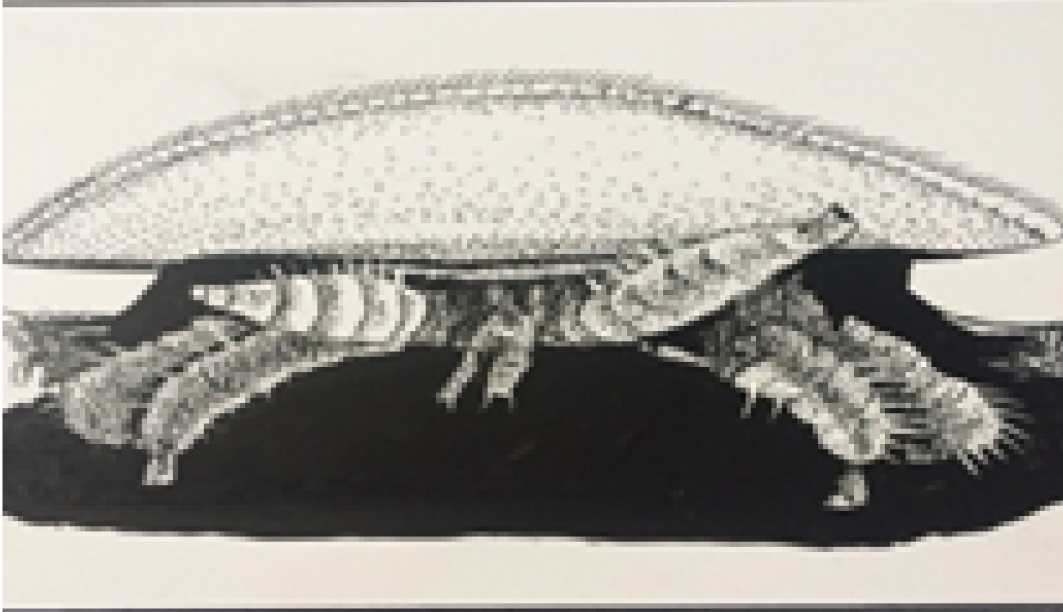
Dorsal View of V. destructor.
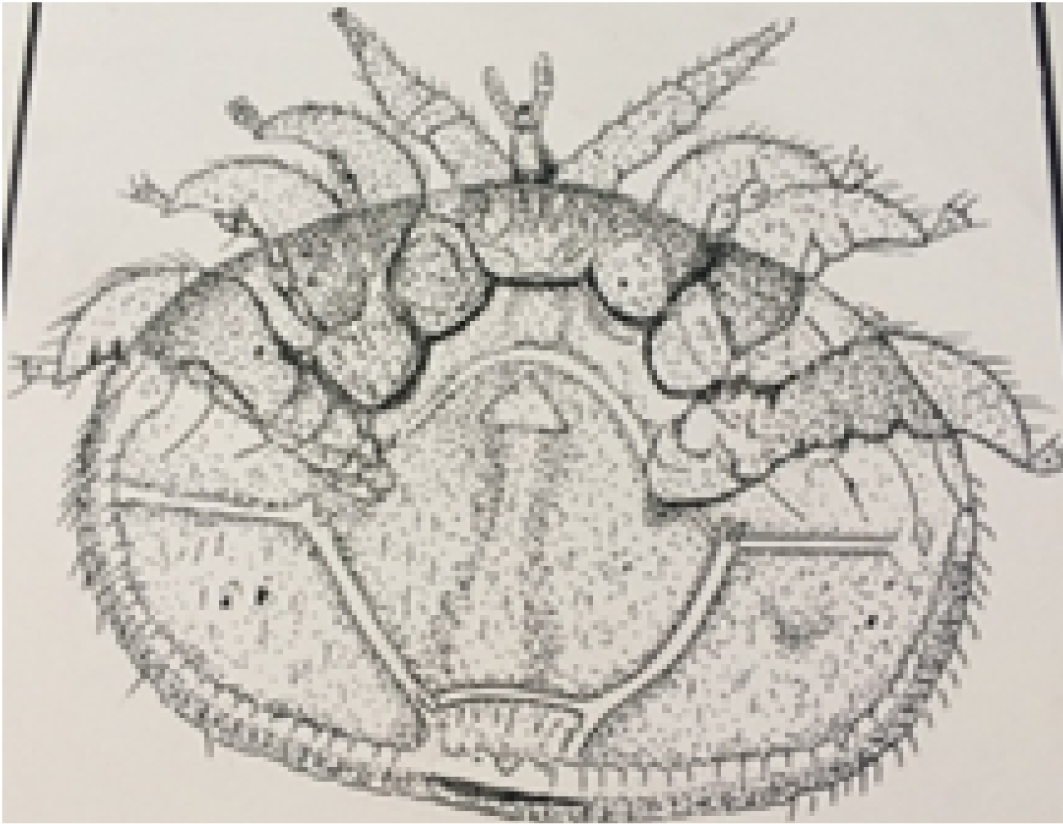
entral view of V. destructor.
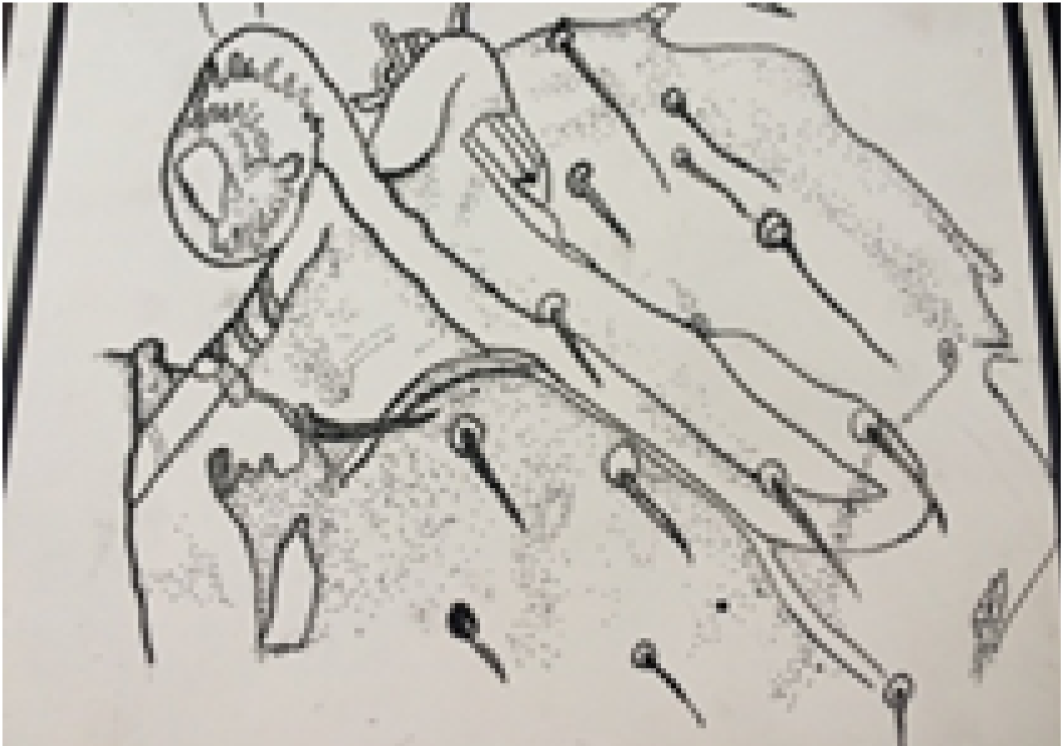
Peritreme.
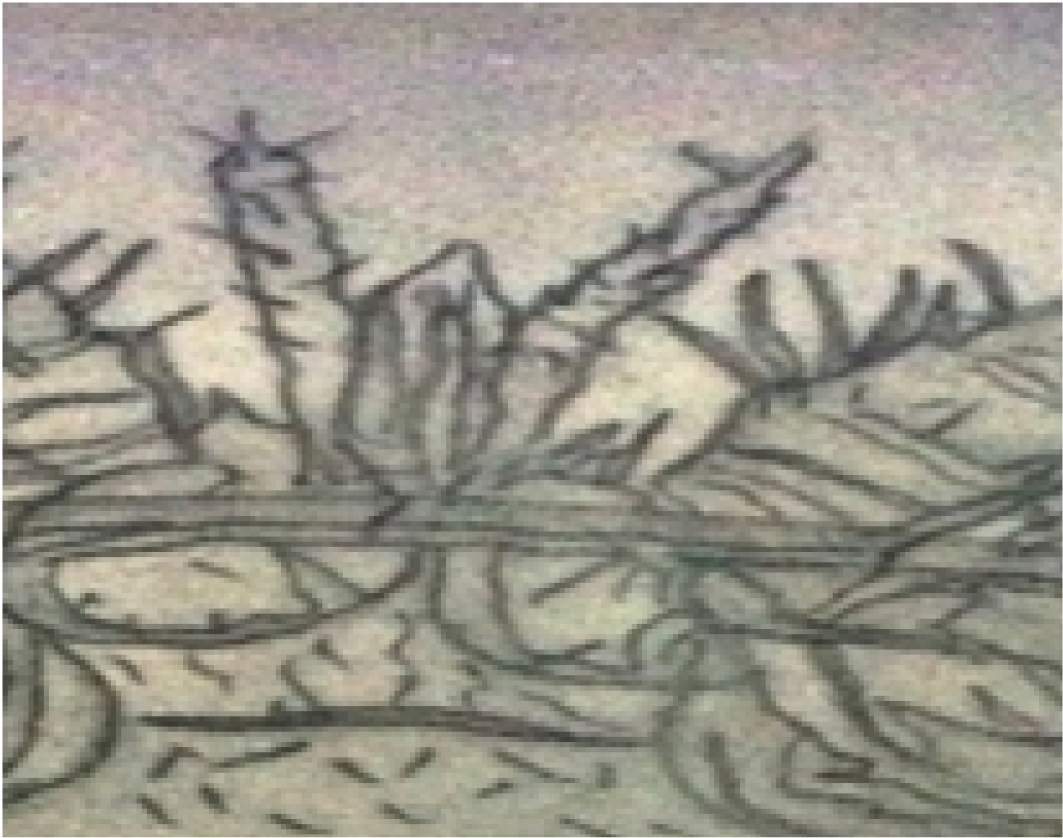
Palp and hypostome
References
- Anderson.D.L. and J.W.H. Trueman. 2000. Varroa jacobsoni (Acari: Varroidae) is more than one species. Exp.Appl.Acarol.24:165-189. https://doi.org/10.1023/A:1006456720416[CrossRef]
- Cobey, S. 2001. The Varroa species complex identifying Varroa destructor and new strategies of control. Am. Bee J. 141(3):194-196.
- De-Guzman, L.I., T.E. Rinderer and J.A. Stelzer. 1999. Occurrence of two genotypes of Varroajacobsoni Oud. in North America. Apido.30:31–36. https://doi.org/10.1051/apido:19990104[CrossRef]
- Delaplane, K.S. 2001. Varroa destructor revolution in the Making. Bee World. 82(4):157-159. https://doi.org/10.1080/0005772X.2001.11099522[CrossRef]
- Fernandez, N. and Y. Coineau. 2007. Varroa, the serial bee killer mite. Atlantica; Biarritz, France. pp.264.
- James, D.E. and C.M.Z. Nalen. 2014. Varroa Mite, Varroa destructor Anderson and Trueman (Arachnida: Acari:Varroidae).Extension assistant; Department of Entomology and Nematology, UF/IFAS Extension, Gainesville. FL 32611.
- Webster, T. C. and K.S. Delaplane. 2001.Mites of the HoneyBee. Dadant and Sons, Inc., Hamilton, Illinois. pp. 280
- Zhang, Z.Q. 2000. Notes on Varroa destructor (Acari: Varroidae) parasitic on honeybees in New Zealand. Syst. Appl. Acarol. Spec. Publ. 5:9-14. https://doi.org/10.11158/saasp.5.1.2[CrossRef]
Services
Article usage statistics
Loading…