
Periostracum Cicadae is the cast-off shell of the cicada Cryptotympana pustulata Fabricius, it is a widely used animal based traditional folk medicine, it is found to have many effects including antipyretic, antiallergic and antioxidant activities. In this study, ten N-acetyldopamine dimers, named Cicadamide C1–C10 (compounds 1–10), were isolated from Periostracum Cicadae. One-dimensional NMR, two-dimensional NMR, mass spectrometry, CD spectroscopy, and chemical evidence were performed to further determine their structures. In the results, ten N-acetyldopamine dimers were isolated and their structures were elucidated. This study provides a basic reference for further biological effects study on Periostracum Cicadae.
Research Article · Volume 56, Issue 1, 4 December 2023 · Open Access
Identification of Ten New N-acetyldopamine Dimers from Periostracum Cicadae
· ·
Affiliations & Notes ⌄
- 1Key Laboratory of Forest Resources and Utilization in Xinjiang of National Forestry and Grassland Administration, Xinjiang Academy of Forestry, Urumqi 830052, China. 2Key Laboratory of Fruit tree Species Breeding and Cultivation in Xinjiang, Urumqi 830052, China. 3Key Laboratory of Xinjiang Phytomedicine Resource and Utilization, Ministry of Education, College of Pharmacy, Shihezi University, Shihezi 832002, China. 4College of Pharmacy, Harbin Medical University, Harbin 150081, China. * Correspo
Article Info ⌄
- Journal:
- Pakistan Journal of Zoology
- Published:
- 4 December 2023

From the article
- In this study, the previously unknown phthalides with biologically activity from Periostracum Cicadae were identified.
- The structures of new identified compounds were established using spectroscopic methods.
- In the result, 10 new compounds (1–10) were isolated, the structural elucidation of compounds 1–10 were described.
- This study aims to provide a reference for the further functional research and the development and utilization of Periostracum Cicadae.
Selected from the article's own text.
Abstract
Introduction
Periostracum Cicadae is a well-known animal based traditional folk medicine. It is the cast-off shell of Cryptotympana pustulata Fabricius, commonly known as the black cicada, which is mainly distributed in Shandong, Henan, Hubei, and Sichuan Provinces of China. In traditional Chinese medicinal practice, Periostracum Cicadae, is considered to be cold-natured and have a sweet flavor, and is used for its therapeutic effect against vitiligo , anti-type IV allergic activity , an inhibitory effect on diabetic retinopathy , and anticonvulsant activity .
The clinical efficacy of Periostracum Cicadae is a consequence of its chemical constituents. Its crude extract has been reported to exhibit a variety of biological activities when it was administered by various routes. Hsieh et al. (1991) demonstrated that the water extract of Periostracum Cicadae had anticonvulsitant, sedative and hypothermic effects through pharmacological research. Shin et al. (1999) summarized the effects of oriental medicines including one from Cryptotympana on the systemic anaphylactic reactions induced by compound 48/80, and demonstrated that Cryptotympana atrata could significantly inhibit the rate of mast cells degranulation and systemic anaphylactic reaction, indicating that it may be beneficial to treat nonspecific anaphylaxis. Yang et al. (2013) explored the method of analyzing trace elements from Periostracum Cicadae. Liu et al. (2004) researched the effects of Periostracum Cicadae water extract on hemorheology in hyperlipidemic rats. The results showed that Periostracum Cicadae could significantly improve its hemorheology, which was reflected in the significant reduction of whole blood and plasma viscosity, thrombosis in vitro, erythrocyte aggregation index, serum triglyceride and total cholesterol levels. Wang et al. (2010) used different extraction methods and solvents to preliminarily isolate and study the antibacterial activity of the active ingredients of Periostracum Cicadae. It was found that the extracts obtained by different extraction methods had obvious antibacterial effects, but the differences between them were not significant, which showed that the active ingredients of Periostracum Cicadae had strong antibacterial activities.
Previous reports on its biological components have revealed that it is rich in dopamine ; ; . Oxenkrug and Requintina (2005) studied the effect of N-acetyldopamine on lipopolysaccharide (LPS) induced lipid peroxidation in the form of malondialdehyde (MDA) by measuring the thiobarbituric acid (TBA) reactive substances in rat brain homogenates in vitro, and found that N-acetyldopamine inhibited the formation of MDA in a concentration dependent manner and its effect was stronger than that of melatonin. Xu et al. (2006) isolated two N-acetyldopamine dimers from the methanolic extracts of Periostracum Cicadae and showed that they both exhibited antioxidant and anti-inflammatory activities in LPS induced RAW264.7 cells. Lu et al. (2015) identified three new N-acetyldopamine dimers from Dung Beetle Catharsius molossus, a similar traditional Chinese Medicine from insects.
In this study, we further investigated the phytochemistry of Periostracum Cicadae, with the aim of identifying the previously unknown phthalides with biologically activity from this folk medicine, the structures of new identified compounds were established using spectroscopic methods. In the result, 10 new compounds (1–10) were isolated from Periostracum Cicadae (Fig. 1). Herein, we describe the isolation and structural elucidation of compounds 1–10.
Materials and Methods
Materials
The dried Periostracum Cicadae in this study was purchased from a traditional medicine market in Urumuqi, Xinjiang, China. It was identified by Prof. Jincai Lu from School of Traditional Chinese Materia Medica, Shenyang Pharmaceutical University. The sample of Periostracum Cicadae was further deposited at Research Department of Natural Medicine of Shenyang Pharmaceutical University, with a voucher specimen (No. 20081001). The others relevant chemical reagents were analytical pure.
General experimental procedures
HR-ESI-MS was performed on a waters LCT Premier KE399 mass spectrometer (Waters Corp., Milford, MA, USA). A model MOS-450 Chiral Detector (Bio-Logic SAS, Caix, France) was used for CD analysis. The one and two-dimensional NMR spectra were recorded in CD3OD on a Bruker AV-600 spectrometer (1H, 600 MHz; 13C, 150 MHz) (Bruker Corp., Billerica, MA, USA) using tetramethylsilane (TMS) as the internal standard. Preparative HPLC was carried out using a waters 2998 photodiode array detector at 220 nm with a waters 2695 separation module (Waters Corp., Billerica, MA, USA) and a Shim-pack CLC-ODS reversed-phase column (No. 61514407B; Shimadzu Corp., Kyoto, Japan). Silica gel for chromatography was obtained from Oceanview Chemical Group Co. Ltd. (Qingdao, China).
Extraction and isolation
The powder of dried Periostracum Cicadae (5 kg) was extracted with EtOH (50 L) for 3 times under reflux conditions, each time for 3 h. The combined EtOH extracts (76 g) were concentrated in vacuo. A part of the EtOH fraction (70 g) was subjected to silica gel column chromatography (250 g) with a gradient of CHCl3/MeOH to afford 14 fractions (100:0–0:100) that were designated A–O.
Fraction F (CHCl3/MeOH, 100:5 vol/vol; 3.4834 g) was further subjected to ODS column elution with MeOH/H2O (40:60 vol/vol), after which a fraction (107.6 mg) of the eluted material was purified by preparative RP-HPLC (MeOH/H2O, 30:70 vol/vol) to obtain compound 2 (13.1 mg). Fraction G (CHCl3/MeOH, 100:8 vol/vol; 5.9045 g) was further purified by ODS column elution with MeOH/H2O (50:50 vol/vol) to yield 3 fractions. Fraction D1 (1.7607 g) was purified by preparative RP-HPLC (MeOH/H2O, 40:60 vol/vol) to obtain compounds 1 (40 mg), 3 (40.6 mg), 4 (11.0 mg), and 5 (159.3 mg). Fraction D3 (0.4297 g) was purified by preparative RP-HPLC (MeOH/H2O, 42:58) to obtain compounds 9 (13.0 mg) and 10 (15.0 mg). Fraction H (CHCl3/MeOH, 100:10, 3.047 g) was further purified by ODS column elution with MeOH/H2O (40:60 vol/vol) to yield a fraction (0.2313 g) that was purified by preparative RP-HPLC (MeOH/H2O, 37:73 vol/vol) to obtain compounds 6 (25.0 mg),7 (35.5 mg), and 8 (13.1 mg). The detailed compound characterization and related information of 1-10 were listed in Supplementary Table S1.
Results and Discussion
Ten isolated compounds
Structure elucidation of the compounds
Compound 1 was obtained as a white powder. The molecular formula of 1 was established as C30H31N3O9 on the basis of its HR-ESI-MS data (m/z 578.2160 [M+H]+; calcd. 578.2139 for C30H32N3O9). The UV spectrum of 1 exhibited λmax at 280.6 nm (MeOH).
The 1H-NMR (600 MHz, CD3OD) spectrum of 1 (Table I) showed 3 signals of ABX-type spin systems in the aromatic region (δ 6.77–7.05); 3 singlet peaks at δ 1.90 (s, 3H, H-3-2), δ 1.94(s, 3H, H-3′-2), and δ 1.92(s, 3H, H-2′′′-2); signals ascribable to 2 methylenes at δ 2.73(t, 2H, J = 7.2 Hz, H-1′′′) and δ 3.38(t, 2H, J = 7.2 Hz , H-2′′′); and 4 methine protons at δ 4.76(d, 1H, J=7.2 Hz, H-2), δ 4.80(d, 1H, J=7.2 Hz, H-2′), δ 5.77(d, 1H, J=7.2 Hz, H-3), and δ 5.72(d, 1H, J=7.2 Hz, H-3′). The 13C-NMR (150 MHz, CD3OD) spectrum (Table I) of 1 exhibited 30 signals and an acetamide structure of the carbonyl carbon signals at δ 173.3(C-3-1), δ 173.3(C-3′-1), and δ 173.3(C-2′′′-1), in addition to 18 signals in the aromatic region and signals ascribable to 3 methyl groups.
Analysis of HMBC (and HMQC, but not every compound needed to do HMQC) spectrum was performed to allot the H-atoms to their bonded C-atoms (Fig. 1 and Table I). The information concerning the location of these units was obtained from the HMBC experiment (Fig. 2). The HMBC correlations (Fig. 2 and Table I) indicated long-range couplings between the methine protonsignal at δ 5.77(H-3) and both the carbon signal at δ 144.4(C-4a) and the N-acetylamino carbon signal at δ 173.3 (C-3-1), as well as between the proton signal at δ 4.76(H-2) and both the carbon signal at δ 144.2(C-8a) and the 3, 4-substituted benzene carbon signal at 128.5(C-1′′), suggesting the presence of unit A (Fig. 2). The methine proton signal at δ 5.72(H-3′) was correlated with the carbons at δ 142.1(C-4′a) and δ 173.3(C-2′′′-1), and the methylene proton signal at δ 3.39(H-2′′′) was correlated with the 1, 4-benzodioxane moiety carbon signal at δ 134.3(C-7′), δ 2.73(H-1′′′), and δ 173.3(C-2′′′-1). According to these results, the N-acetylamino and N-acetylamino-2-ethyl groups were located at the 3′ and 7′ positions of the 1,4-benzodioxane moiety, indicating the presence of unit B (Fig. 2). Finally, the HMBC correlations from 4.80(H-2′) to δ 130.9(C-7), showed a linkage among units A and B.
Table I. 1H-NMR, 13C-NMR, and HMBC spectral data of compound 1.
| Position | δ(H)(J in Hz) | δ(C) | |
| 2 | 4.76 (d, J=7.2 Hz, 1H) | 78.2 | C-8a, 1′′, 2′′, 6′′, 3 |
| 3 | 5.77 (d, J=7.2 Hz, 1H) | 77.8 | C-4a, 1′′, 2, 3-1 |
| 5 | 6. 93 (dd, J=4.2, 8.4 Hz, 1H) | 118.0 | C-6, 7, 4a |
| 6 | 6.98 (dd,J=1.8, 8.4 Hz, 1H) | 122.3 | C-8, 4a, 2′ |
| 7 | 130.9 | ||
| 8 | 7.05 (dd,J=1.8, 8.4 Hz, 1H) | 117.4 | C-6, 7, 8a, 2′ |
| 4a | 144.4 | ||
| 8a | 144.2 | ||
| 2′ | 4.80 (d, J=7.2Hz, 1H) | 78.3 | C-6, 7, 8, 8′a, 3′ |
| 3′ | 5.72 (d, J=7.2Hz, 1H) | 77.9 | C-4′a, 7′, 2′, 3′-1 |
| 5′ | 6.85 (dd, J=2.4, 8.4 Hz, 1H) | 118.1 | C-6′, 7′, 4′a, 8′a |
| 6′ | 6.77 (dd, J=8.4 Hz, 1H) | 123.3 | C-5′, 8′, 4′a, 1′′′ |
| 7′ | 134.3 | ||
| 8′ | 6.84 (dd, J=2.4, 8.4 Hz, 1H) | 118.1 | C-7′, 4′a, 8′a, 1′′′ |
| 4′a | 142.1 | ||
| 8′a | 144.1 | ||
| 1′′ | 128.5 | ||
| 2′′ | 6.87 (d, J=7.8 Hz, 1H) | 115.6 | C- 3′′, 4′′, 6′′, 2 |
| 3′′ | 146.5 | ||
| 4′′ | 147.2 | ||
| 5′′ | 6.79 (d, J=8.4 Hz, 1H) | 116.2 | C-1′′, 3′′, 4′′ |
| 6′′ | 6.78(d, J=8.4 Hz, 1H) | 120.6 | C- 2′′, 4′′, 2 |
| 1′′′ | 2.73(t, J=7.2Hz, 2H) | 35.7 | C- 6′, 7′, 8′, 2′′′ |
| 2′′′ | 3.39(t, J=7.2Hz, 2H) | 42.1 | C-7, 1′′′, 2′′-1 |
| 2′′′-1 | 173.3 | ||
| 2′′′-2 | 1.92 (s, 3H) | 22.6 | C- 2′′-1 |
| 3-1 | 173.3 | ||
| 3-2 | 1.91 (s, 3H) | 22.6 | C- 3 -1 |
| 3′-1 | 173.3 | ||
| 3′-2 | 1.91 (s, 3H) | 22.5 | C- 3′ -1 |
The trans-configuration of the 1,4-benzodioxane moiety of 1 was confirmed by the coupling constants (J = 7.2 Hz) between protons H-2 and H-3. In the CD spectrum of 1 (Fig. 3), a negative Cotton effect at 235 nm and 280 nm (1Lb) was observed (Wu, 2009). Therefore, based on existing reports ; , the absolute stereochemistry of 1 was determined to be (2S,3R,2′R,3′S). Thus, 1 was identified as (2S,3R,2′R,3′S)- 2-(3′,4′-dihydroxyphenyl)-3-acetylamino-7-(3-acetylamino-7-(N-acetyl-2-aminoethyl)-1,4-benzodioxan-2-yl)-1,4-benzodioxane (Fig. 2) and named Cicadamide C1 (1).
Table II. 1H-NMR, 13C-NMR, and HMBC spectral data of compound 2.
| δ(H)(J in Hz) | δ(C) | HMBC | |
| 2 | 4.71 (d, J=7.2 Hz, 1H) | 78.2 | C-1′′, 2′′, 6′′, 3, 8a |
| 3 | 5.75 (d, J=7.2 Hz, 1H) | 78.4 | C-1′′, 2, 3-1, 4a |
| 5 | 7.05 (br.s. 1H) | 117.3 | C-6, 7, 4a, 2′ |
| 6 | 6.99 (d,J=7.8 Hz, 1H) | 122.4 | C-5, 4a, 2′ |
| 7 | 130.9 | ||
| 8 | 6.93 (d,J=7.8 Hz, 1H) | 118.0 | C-5, 6, 8a |
| 4a | 144.5 | ||
| 8a | 144.3 | ||
| 2′ | 4.79 (d, J=7.2Hz, 1H) | 78.2 | C-6, 7, 8, 3′, 8′a |
| 3′ | 5.73 (d, J=7.2Hz, 1H) | 77.9 | C-6, 2′, 3′-1, 4′a |
| 5′ | 6.83 (dd, J=7.2,13.8 Hz, 1H) | 118.1 | C-6′, 4′a, |
| 6′ | 6.78 (dd, J=7.2,13.8 Hz, 1H) | 123.4 | C-5′, 8′, 4′a, 1′′′ |
| 7′ | 134.3 | ||
| 8′ | 6.85 (dd, J=7.2,13.8 Hz, 1H) | 118.1 | C-7′, 6′, 8′a, 1′′′ |
| 4′a | 142.1 | ||
| 8′a | 144.1 | ||
| 1′′ | 128.5 | ||
| 2′′ | 6.86 (d, J=7.2 Hz, 1H) | 115.5 | C- 1′′, 4′′, 6′′, 2 |
| 3′′ | 146.5 | ||
| 4′′ | 147.2 | ||
| 5′′ | 6.79 (d, J=7.2 Hz, 1H) | 116.2 | C-1′′, 3′′ |
| 6′′ | 6.77 (d, J=7.2 Hz, 1H) | 120.6 | C- 2′′, 4′′, 2 |
| 1′′′ | 2.73 (t, J=7.2Hz, 2H) | 35.7 | C-6′, 7′, 8′, 2′′ |
| 2′′′ | 3.38 (t, J=7.2Hz, 2H) | 42.1 | C-7′, 1′′′, 2′′-1 |
| 2′′′-1 | 173.3 | ||
| 2′′′-2 | 1.92 (s, 3H) | 22.6 | C- 2′′-1 |
| 3-1 | 173.3 | ||
| 3-2 | 1.91 (s, 3H) | 22.6 | C- 3 -1 |
| 3′-1 | 173.3 | ||
| 3′-2 | 1.91 (s, 3H) | 22.5 | C- 3′ -1 |
Compound 2 was obtained as a white powder. The molecular formula of 2 was determined to be C30H31N3O9 on the basis of its HR-ESI-MS data (m/z 578.2141 [M+H]+; calcd. 578.2139 for C30H32N3O9). The 1H-NMR and 13C-NMR spectra (Table II) of 2 were similar to those of 1. The HMBC data suggested that the planar structure of 2 was identical to that of 1. Therefore, 2 may be a diastereomer of 1 at chiral centers C-2 and C-3. The CD spectrum of 2 showed a negative Cotton effect at 235 nm and a positive Cotton effect at 280 nm (1Lb). The absolute stereochemistry of 2 was determined to be (2R,3S,2′R,3′S) by the 2-phenyl-1,4-benzodioxane CD rule ; and comparison with 1. Thus, compound 2 was identified as (2R,3S,2′R,3′S)-2-(3′,4′-dihydroxyphenyl)-3-acetylamino-7-(3-acetylamino-7-(N-acetyl-2-aminoethyl)-1,4-benzodioxan-2-yl)-1,4-benzodioxane (Fig. 2) and named Cicadamide C2 (2).
Compound 3 was obtained as a white powder. The molecular formula of 3 was determined to be C30H31N3O9 on the basis of its HR-ESI-MS data (m/z 578.2111 [M+H]+; calcd. 578.2139 for C30H32N3O9). The 1H-NMR and 13C-NMR spectral data of 3 indicated that its structure was closely related to that of 1, and suggested that 3 was a positional isomer of 1 (Table III). The HMBC analysis of 3 revealed that 1 and 3 differed only in the position of the N-acetylamino-2-ethyl group (Fig. 2). The HMBC correlations from the methylene proton signal at δ 3.37(H-2′′′) correlated with the 1,4-benzodioxane moiety carbon signal at δ 134.4(C-6′), which was located at the 6′-position in 3 and at the 7′-position in 1. In the CD spectrum of 3, negative Cotton effects at 235 nm and 280 nm (1Lb) were observed. The absolute stereochemistry of 3 was determined to be (2S,3R,2′S,3′R) by the 2-phenyl-1,4-benzodioxane CD rule ; , and comparison with 1. Thus, compound 3 was identified as (2S,3R,2′S,3′R)-2-(3′,4′-dihydroxyphenyl)-3-acetylamino-7-(3-acetylamino-6-(N-acetyl-2-aminoethyl)-1,4-benzodioxan-2-yl)-1,4-benzodioxane (Fig. 2) and named Cicadamide C3 (3).
Compound 4 was obtained as a white powder. The molecular formula of 4 was determined to be C30H31N3O9 on the basis of its HR-ESI-MS data (m/z 578.2114 [M+H]+; calcd. 578.2139 for C30H32N3O9). The 1H-NMR and 13C-NMR spectral data of 4 (Table IV) indicated that its structure was closely related to that of 3. The HMBC data suggested that the planar structure of 4 was identical to that of 3. Therefore, 4 may be a diastereomer of 3 at chiral centers C-2 and C-3, C-2′, and C-3′. In the CD spectrum of 4, positive Cotton effects at 235 nm and 280 nm (1Lb) were observed ; . The absolute stereochemistry of 4 was determined to be (2R,3S,2′R,3′S) by the 2-phenyl-1,4-benzodioxane CD rule ; and comparison with 2. Thus, compound 4 was identified as (2R,3S,2′R,3′S)-2-(3′,4′-dihydroxyphenyl)-3-acetylamino-7-(3-acetylamino-6-(N-acetyl-2-aminoethyl)-1,4-benzodioxan-2-yl)-1,4-benzodioxane (Fig. 2) and named Cicadamide C4 (4).
Table III. 1H-NMR, 13C-NMR, and HMBC spectral data of compound 3.
| Position | δ(H)(J in Hz) | δ(C) | HMBC |
| 2 | 4.76 (d, J=7.2 Hz, 1H) | 78.3 | C- 1′′, 2′′, 6′′, 4a |
| 3 | 5.73 (d, J=7.2 Hz, 1H) | 77.7 | C- 8a, 3-1, 2 |
| 5 | 6. 92 (s, 1H) | 118.1 | C- 4a, 6, 7 |
| 6 | 6. 97 (dd, J=3.0, 7.8 Hz, 1H) | 122.2 | C- 4a, 8, 2′ |
| 7 | 130.9 | ||
| 8 | 7.03(br.s, 1H) | 117.4 | C-4a, 8a, 6, 7, 2′ |
| 4a | 144.2 | ||
| 8a | 143.2 | ||
| 2′ | 4.79 (d, J=7.2Hz, 1H) | 78.2 | C- 6, 7, 8, 8′a |
| 3′ | 5.73 (d, J=7.2Hz, 1H) | 78.2 | C- 4′a, 3′-1, 2′ |
| 5′ | 6.78 (d, J=7.2 Hz, 1H) | 118.2 | C- 4′a, 8′a, 7′ |
| 6′ | 134.4 | ||
| 7′ | 6.75 (dd, J=1.8, 8.4 Hz, 1H) | 123.2 | C- 8′a, 5′, 1′′′ |
| 8′ | 6.91 (d, J=7.2 Hz, 1H) | 117.9 | C-4′a, 8′a, 6′, 7′ |
| 4′a | 144.3 | ||
| 8′a | 142.7 | ||
| 1′′ | 128.5 | ||
| 2′′ | 6.79(br.s, 1H) | 116.1 | C- 1′′, 3′′, 6′′ |
| 3′′ | 146.4 | ||
| 4′′ | 147.2 | ||
| 5′′ | 6.88 (d, J=4.2 Hz, 1H) | 115.6 | C- 4′′, 6′′ |
| 6′′ | 6.77 (br.s, 1H) | 120.6 | C- 1′′, 4′′, 2 |
| 1′′′ | 2.71(t, J=7.2Hz, 2H) | 35.7 | C- 6′, 7′, 2′′′, 5′ |
| 2′′′ | 3.37(t, J=7.2Hz, 2H) | 42.1 | C- 6′, 2′′′-1, 1′′′ |
| 2′′′-1 | 173.2 | ||
| 2′′′-2 | 1.92 (s, 3H) | 22.6 | C- 2′′′-1 |
| 3-1 | 173.2 | ||
| 3-2 | 1.91 (s, 3H) | 22.5 | C- 3-1 |
| 3′-1 | 173.3 | ||
| 3′-2 | 1.90 (s, 3H) | 22.6 | C- 3′-1 |
Compound 5 was obtained as a white powder. The molecular formula of 5 was determined to be C30H31N3O10 on the basis of its HR-ESI-MS data (m/z 578.2144 [M+H]+; calcd. 578.2139 for C30H32N3O10). The 1H-NMR and 13C-NMR spectral data of 5 (Table V) indicated that its structure was closely related to that of 3, and suggested that 5 was a positional isomer of 3. The HMBC analysis of 5 (Fig. 2) revealed that 3 and 5 differed only in the position of the A group. The HMBC correlations from δ 4.86(H-2′) to δ 129.7(C-6) demonstrated the linkage among units A and B, which was located at the 6-position in 5 and at the 7-position in 3. Thus, compound 5 was identified as 2-(3′,4′-dihydroxyphenyl)-3-acetylamino-6-(3-acetylamino-6-(N-acetyl-2-aminoethyl)-1,4-benzodioxan-2-yl)-1,4-benzodioxane (Fig. 2) and named Cicadamide C5 (5).
Compound 6 was obtained as a white powder. The molecular formula of 6 was determined to be C30H31N3O9 on the basis of its HR-ESI-MS data (m/z 594.2054 [M+H]+; calcd. 594.2088 for C30H32N3O9). The 1H-NMR and 13C-NMR spectra data of 6 (Table VI) were similar to those of 5, with the exception of the absence of the hydroxyl group located at δ 48.1(C-2′′′) in compound 5. The HMBC experiment suggested that the planar structure of 6 was identical to that of 5. The methine protons at δ3.37(C-1′′′) and δ 3.43 (C-1′′′) were correlated with δ 73.0(C-6) and δ 173.6(C-2′′′-1), and δ 4.65 (H-2′′′) was correlated with δ 48.1(C-2′′′) and δ 137.9(C-6′), indicating an N-acetylamino-2-glyoxyl group. In the CD spectrum of 6, positive Cotton effects at 235 nm and 280 nm (1Lb) were observed. The absolute stereochemistry of 6 was determined to be (2R,3S,2′R,3′S) by the 2-phenyl-1,4-benzodioxane CD rule ; and comparison with 3. Thus, compound 6 was identified as (2R,3S,2′R,3′S)-2-(3′,4′-dihydroxyphenyl)-3-acetylamino-6-(3-acetylamino-6-(N-acetyl-2-amino-1-hydroxylethyl)-1,4-benzodioxan-2-yl)-1,4-benzodioxane (Fig. 2) and named Cicadamide C6 (6).
Compound 7 was obtained as a white powder. The molecular formula of 7 was determined to be C30H31N3O10 on the basis of its HR-ESI-MS data (m/z 594.2082 [M+H]+; calcd. 594.2088 for C30H32N3O10). The 1H-NMR and 13C-NMR spectral data of 7 (Table VII) indicated that its structure was closely related to that of 6, and suggested that 7 was a positional isomer of 6. The HMBC analysis of 7 (Fig. 2) revealed that 6 and 7 differed only in the position of the N-acetylamino-2-ethyl group. The HMBC data showed that the methylene proton signal at δ3.37(C-2′′′) and δ 3.45(C-2′′′) was correlated with the 1,4-benzodioxane moiety carbon signal at δ 137.7(C-7′), which was located at the 7′-position in 7 and at the 6′-position in 6. The CD spectrum of 7 showed a negative Cotton effect at 235 nm and a positive Cotton effect at 280 nm (1Lb). The absolute stereochemistry of 7 was determined to be (2R,3S,2′R,3′S) by the 2-phenyl-1,4-benzodioxane CD rule ; and comparison with 1. Thus, compound 7 was identified as (2R,3S,2′R,3′S)-2-(3′,4′-dihydroxyphenyl)-3-acetylamino-6-(3-acetylamino-7-(N-acetyl-2-amino-1-hydroxylethyl)-1,4-benzodioxan-2-yl)-1,4-benzodioxane (Fig. 2) and named Cicadamide C7 (7).
Table IV. 1H-NMR, 13C-NMR, and HMBC spectral data of compound 4.
| Position | δ(H)(J in Hz) | δ(C) | HMBC |
| 2 | 4.77 (d, J=7.2 Hz, 1H) | 78.1 | C-8a, 1′′, 2′′, 6′′,3 |
| 3 | 5.76 (d, J=7.2 Hz, 1H) | 77.7 | C-4a, 2,3-1 |
| 5 | 6. 90 (d, J=8.4 Hz, 1H) | 118.0 | C-7, 8a |
| 6 | 6.97 (dd,J=1.8, 8.4 Hz, 1H) | 122.3 | C-5, 8, 4a |
| 7 | 130.9 | ||
| 8 | 7.04 (br.s, 1H) | 117.3 | C-6, 7, 4a, 8a |
| 4a | 144.1 | ||
| 8a | 144.3 | ||
| 2′ | 4.79 (d, J=7.2Hz, 1H) | 78.3 | C-8′a, 6, 7, 8, 3′ |
| 3′ | 5.75 (d, J=7.2Hz, 1H) | 78.1 | C-4′a, 3′-1, 2′ |
| 5′ | 6.76(br.s, 1H) | 118.2 | C-4′a, 8′a, 7′, 1′′′ |
| 6′ | 134.3 | ||
| 7′ | 6.72 (dd, J=1.8, 8.4 Hz, 1H) | 123.1 | C-5′, 8′a, 1′′′ |
| 8′ | 6.87 (d, J=8.4 Hz, 1H) | 117.9 | C-8′a, 6′, 7′ |
| 4′a | 143.3 | ||
| 8′a | 142.7 | ||
| 1′′ | 128.5 | ||
| 2′′ | 6.88 (d, J=7.8 Hz, 1H) | 115.5 | C- 4′′, 6′′ |
| 3′′ | 146.4 | ||
| 4′′ | 147.1 | ||
| 5′′ | 6.80 (d, J=8.4 Hz, 1H) | 116.2 | C-6′′, 4′′, 3′′ |
| 6′′ | 6.76(br.s, 1H) | 120.6 | C-2′′, 4′′ |
| 1′′′ | 2.71(t, J=7.2Hz, 2H) | 35.7 | C-5′, 6′, 7′, 2′′′ |
| 2′′′ | 3.37(t, J=7.2Hz, 2H) | 42.1 | C-6′, 1′′′, 2′′′-1 |
| 2′′′-1 | 173.2 | ||
| 2′′′-2 | 1.92 (s, 3H) | 22.7 | |
| 3-1 | 173.2 | ||
| 3-2 | 1.90 (s, 3H) | 22.6 | |
| 3′-1 | 173.2 | ||
| 3′-2 | 1.86 (s, 3H) | 22.6 |
Compound 8 was obtained as a white powder. The molecular formula of 8 was determined to be C30H31N3O10 on the basis of its HR-ESI-MS data (m/z 594.2012 [M+H]+; calcd. 594.2088 for C30H32N3O10). The 1H-NMR and 13C-NMR spectral data of 8 (Table VII) indicated that its structure was closely related to that of 7, and suggested that 8 was a positional isomer of 7. The HMBC analysis of 8 (Fig. 2) revealed that 7 and 8 differed only in the position of the A group. The HMBC correlations from δ 4.82(H-2′) to δ 130.9(C-7) demonstrated the linkage among units A and B, which was located at the 6-position in 7 and at the 7-position in 8. The CD spectrum of 8 showed a positive Cotton effect at 235 nm and a negative Cotton effect at 280 nm (1Lb). The absolute stereochemistry of 8 was determined to be (2R,3S,2′R,3′S) by the 2-phenyl-1,4-benzodioxane CD rule ; and comparison with 1. Thus, compound 8 was identified as (2R,3S,2′R,3′S)-2-(3′,4′-dihydroxyphenyl)-3-acetylamino-7-(3-acetylamino-7-(N-acetyl-2-amino-1-hydroxylethyl)-1,4-benzodioxan-2-yl)-1,4-benzodioxane and named Cicadamide C8 (8).
Table V. 1H-NMR, 13C-NMR, and HMBC spectral data of compound 5.
| Position | δ(H)(J in Hz) | δ(C) | HMBC |
| 2 | 4.79 (d, J=7.2 Hz, 1H) | 76.7 | C-8a, 1′′, 2′′, 6′′, 3 |
| 3 | 5.66 (d, J=7.2 Hz, 1H) | 75.7 | C-2,3-1 |
| 5 | 6. 99 (d, J=7.2 Hz, 1H) | 116.2 | C-8a, 4a, 7 |
| 6 | 129.7 | ||
| 7 | 6. 90 (d, J=9.0 Hz, 1H) | 120.7 | C-6, 2′ |
| 8 | 6. 97 (d, J=3.6 Hz, 1H) | 116.8 | C-4a, 8a, 6 |
| 4a | 142.0 | ||
| 8a | 143.0 | ||
| 2′ | 4.86 (d, J=7.2Hz, 1H) | 76.5 | C-8′a, 5, 6, 7, 3′ |
| 3′ | 5.68 (d, J=7.2Hz, 1H) | 76.3 | C-2′, 3′-1 |
| 5′ | 6.77(br.s, 1H) | 116.8 | C-8′a, 4′a, 7′ |
| 6′ | 133.3 | ||
| 7′ | 6.71 (d, J=8.4 Hz, 1H) | 121.7 | C-5′, 8′ |
| 8′ | 6.89 ((d, J=2.4, 8.4 Hz, 1H)) | 116.1 | C-4′a, 8′a, 6′ |
| 4′a | 141.9 | ||
| 8′a | 141.0 | ||
| 1′′ | 126.6 | ||
| 2′′ | 6.81(br.s, 1H) | 114.9 | C-4′′, 6′′ |
| 3′′ | 145.2 | ||
| 4′′ | 145.9 | ||
| 5′′ | 6.74 (d, J=7.8 Hz, 1H) | 115.4 | C-1′′, 3′′ |
| 6′′ | 6.72 (d, J=7.8 Hz, 1H) | 119.1 | C-2′′, 4′′ |
| 1′′′ | 2.62(t, J=7.2Hz, 2H) | 34.4 | C-2′′′, 5′, 6′, 7′ |
| 2′′′ | 3.24(t, J=7.2Hz, 2H) | 40.3 | C-1′′′, 2′′′-1, 6′ |
| 2′′′-1 | 169.2 | ||
| 2′′′-2 | 2.07 (s, 3H) | 22.7 | C-2′′′-1 |
| 3-1 | 169.2 | ||
| 3-2 | 1.92 (s, 3H) | 22.7 | C-3-1 |
| 3′-1 | 169.7 | ||
| 3′-2 | 1.91 (s, 3H) | 22.7 | C-3′-1 |
Table VI. 1H-NMR, 13C-NMR, and HMBC spectral data of compound 6.
| Position | δ(H)(J in Hz) | δ(C) | HMBC |
| 2 | 4.73 (d, J=7.2 Hz, 1H) | 78.3 | C-2′′, 1′′, 6′′, 3 |
| 3 | 5.69 (d, J=7.2 Hz, 1H) | 77.8 | C-2, 3-1, 4a |
| 5 | 6.96(br.s, 1H) | 117.4 | C-2′ |
| 6 | 131.1 | ||
| 7 | 6. 94 (d, J=8.4 Hz, 1H) | 122.4 | C-8a |
| 8 | 6. 91 (d, J=8.4 Hz, 1H) | 117.8 | C-6, 7, 4a, 8a |
| 4a | 143.7 | ||
| 8a | 145.0 | ||
| 2′ | 4.79 (d, J=7.2Hz, 1H) | 78.3 | C-7, 6, 5 |
| 3′ | 5.72 (d, J=7.2Hz, 1H) | 78.2 | C-2′, 3′-1, 4′a |
| 5′ | 6.90 (d, J=8.4 Hz, 1H) | 115.9 | C-4′a, 8′a, 1′′′ |
| 6′ | 137.9 | ||
| 7′ | 6.74 (d, J=8.4 Hz, 1H) | 120.7 | C-5′, 8′ |
| 8′ | 6.91 (d, J=8.4 Hz, 1H) | 118.1 | C-7′, 6′, 4′a |
| 4′a | 143.4 | ||
| 8′a | 143.7 | ||
| 1′′ | 128.5 | ||
| 2′′ | 6.83(br.s, 1H) | 115.6 | C-1′′, 3′′, 2 |
| 3′′ | 146.5 | ||
| 4′′ | 147.2 | ||
| 5′′ | 6.79 (d, J=8.4 Hz, 1H) | 116.2 | C-2′′, 4′′ |
| 6′′ | 6.88 (d, J=8.4 Hz, 1H) | 120.7 | C-5′′, 6′′, 3′′ |
| 3-1 | 173.2 | ||
| 3-2 | 1.87 (s, 3H) | 22.5 | |
| 3′-1 | 173.2 | ||
| 3′-2 | 1.89 (s, 3H) | 22.5 | |
| 1′′′ | 4.65 (dd, J=7.2, 4.5 Hz, 1H) | 73.0 | C-5′, 6′, 7′, 2′′′ |
| 2′′′ | 3.37 (dd, J=3.9, 13.5 Hz, 1H) 3.43 (dd, J=3.9, 13.5 Hz, 1H) | 48.1 | C-6′, 1′′′, 2′′′-2 |
| 2′′′-1 | 173.6 | ||
| 2′′′-2 | 1.97 (s, 3H) | 22.6 |
Compound 9 was obtained as a white powder. The molecular formula of 9 was determined to be C30H29N3O9 on the basis of its HR-ESI-MS data (m/z 576.1982 [M+H]+; calcd. 576.1982 for C30H30N3O9). Comparison of the NMR data of 9 (Table IX) with those of 8 showed that the compounds were very similar, with the exception of the presence of 2 olefinic protons at δ6.15(C-1′′′) and δ 7.35(H-2′′′) in 9 in place of the hydroxyl group present in 8. The absolute stereochemistry of 9 was determined by its CD spectrum ; , which showed a positive Cotton effect at 235 nm and a negative Cotton effect at 280 nm (1Lb). Thus, compound 9 was identified as (2S,3R,2′R,3′S)-2-(3′,4′-dihydroxyphenyl)-3-acetylamino-7-(3-acetylamino-7-(N-acetyl-2-aminoethylene)-1,4-benzodioxan-2-yl)-1,4-benzodioxane and named Cicadamide C9 (9).
Table VII. 1H-NMR, 13C-NMR, and HMBC spectral data of compound 7.
| Position | δ(H)(J in Hz) | δ(C) | HMBC |
| 2 | 4.76 (t, J=7.2 Hz, 1H) | 78.3 | C-1′′, 2′′, 6′′, 3, 8a |
| 3 | 5.74 (d, J=7.2 Hz, 1H) | 77.8 | C-2, 4a 3-1, |
| 5 | 6. 99 (br.s, 1H) | 117.4 | C-4a, 8a, 7 |
| 6 | 131.0 | ||
| 7 | 6.97(br.s, 1H) | 122.0 | C-5, 6, 8, 2′ |
| 8 | 6.97(br.s, 1H) | 118.1 | C-8a, 7, 6 |
| 4a | 145.0 | ||
| 8a | 143.6 | ||
| 2′ | 4.81 (t, J=7.2Hz, 1H) | 78.3 | C-5, 6, 7, 3′, 8′a |
| 3′ | 5.75 (d, J=7.2Hz, 1H) | 78.2 | C-2′, 3′-1, 4′a |
| 5′ | 6.90 (d, J=8.4 Hz, 1H) | 117.9 | C-8′a, 4′a, 6′, 7′ |
| 6′ | 6.94 (d, J=8.4 Hz, 1H) | 120.8 | C-4′a, 8′a, 1′′′ |
| 7′ | 137.7 | ||
| 8′ | 7.02(br.s, 1H) | 115.8 | C-4′a, 8′a, 5′, 6′ |
| 4′a | 143.0 | ||
| 8′a | 144.0 | ||
| 1′′ | 128.5 | ||
| 2′′ | 6.88(br.s, 1H) | 115.6 | C-2, 3′′, 4′′, 6′′ |
| 3′′ | 146.5 | ||
| 4′′ | 147.2 | ||
| 5′′ | 6.79 (d, J=7.8 Hz, 1H) | 116.1 | C-1′′, 3′′, 4′′, 6′′ |
| 6′′ | 6.77 (d, J=7.8 Hz, 1H) | 120.6 | C-2, 2′′, 4′′ |
| 3-1 | 173.2 | ||
| 3-2 | 1.90 (s, 3H) | 22.5 | C-3-1 |
| 3′-1 | 173.3 | ||
| 3′-2 | 1.91 (s, 3H) | 22.6 | C-3′-1 |
| 1′′′ | 4.69(dd, J=4.8, 7.2Hz, 1H) | 73.0 | C-6′, 7′, 8′ |
| 2′′′ | 3.37(dd, J=4.8, 7.2Hz, 1H) 3.45(dd, J=4.8, 7.2Hz, 1H) | 48.1 | C-1′′′, 7, 2′′′-1 |
| 2′′′-1 | 173.6 | ||
| 2′′′-2 | 1.96 (s, 3H) | 22.6 | C-2′′′-1 |
Table VIII. 1H-NMR, 13C-NMR, and HMBC spectral data of compound 8.
| Position | δ(H)(J in Hz) | δ(C) | HMBC |
| 2 | 4.75 (d, J=7.2 Hz, 1H) | 78.3 | C-8a, 1′′, 2′′, 6′′, 3 |
| 3 | 5.77 (d, J=7.2 Hz, 1H) | 77.9 | C-4a, 2 |
| 5 | 6.94 (d, J=8.4 Hz, 1H) | 118.1 | C-4a, 8a, 7 |
| 6 | 6.99 (dd, J=1.8, 8.4 Hz, 1H) | 122.2 | C-4a, 8 |
| 7 | 130.9 | ||
| 8 | 7.05 (d, J=7.8 Hz, 1H) | 117.3 | C-8a, 6 |
| 4a | 144.2 | ||
| 8a | 144.4 | ||
| 2′ | 4.82 (d, J=7.2Hz, 1H) | 78.3 | C-8′a, 6, 7, 8, 3′ |
| 3′ | 5.74 (d, J=7.2Hz, 1H) | 78.2 | C-4′a, 2′ |
| 5′ | 6.89 (dd, J=2.4, 8.4 Hz, 1H) | 117.9 | C-4′a, 8′a, 7′ |
| 6′ | 6.92 (d, J=8.4 Hz, 1H) | 120.9 | C-4′a, 1′′′ |
| 7′ | 137.8 | ||
| 8′ | 7.04(d, J=7.8 Hz, 1H) | 115.8 | C-8′a, 6′ |
| 4′a | 143.0 | ||
| 8′a | 144.1 | ||
| 1′′ | 128.5 | ||
| 2′′ | 6.86(d, J=7.2 Hz, 1H) | 115.6 | C-3′′, 4′′, 6′′, 2 |
| 3′′ | 146.5 | ||
| 4′′ | 147.2 | ||
| 5′′ | 6.94 (d, J=8.4 Hz, 1H) | 118.1 | C-1′′, 3′′, 4′′ |
| 6′′ | 6.77 (d, J=8.4 Hz, 1H) | 120.6 | C-1′′, 4′′ |
| 3-1 | 173.3 | ||
| 3-2 | 1.90 (s, 3H) | 22.5 | C-3-1 |
| 3′-1 | 173.3 | ||
| 3′-2 | 1.91 (s, 3H) | 22.6 | C-3′-1 |
| 1′′′ | 4.68 (dd, J=5.4, 7.2Hz, 1H) | 73.0 | C-6′, 7′, 8′ |
| 2′′′ | 3.42(dd, J=4.2, 13.8Hz, 1H) 3.45(dd, J=4.2, 13.8Hz, 1H) | 48.1 | C-1′′′, 2′′′-1, 7′ |
| 2′′′-1 | 173.6 | ||
| 2′′′-2 | 1.94 (s, 3H) | 22.6 | C-2′′′-1 |
Compound 10 was obtained as a white powder. The molecular formula of 10 was determined to be C30H29N3O9 on the basis of its HR-ESI-MS data (m/z 576.1982 [M+H]+; calcd. 576.1982 for C30H30N3O9). The 1H-NMR and 13C-NMR spectra of 10 (Table X) were similar to those of 9. The HMBC experiment suggested that the planar structure of 10 was identical to that of 9. Therefore, 10 may be a diastereomer of 9 at chiral centers C-2′ and C-3′. In the CD spectrum of 10, negative Cotton effects at 235 nm and 280 nm (1Lb) were observed. The absolute stereochemistry of 10 was determined to be (2R,3S,2′R,3′S) by the 2-phenyl-1,4-benzodioxane CD rule ; and comparison with 9. Thus, compound 10 was identified as (2R,3S,2′R,3′S)-2-(3′,4′-dihydroxyphenyl)-3-acetylamino-7-(3-acetylamino-7-(N-acetyl-2-aminoethylene)-1,4-benzodioxan-2-yl)-1,4-benzodioxane (Fig. 2) and named Cicadamide C10 (10). Overall, the 10 compounds were obtained and elucidated.
Table IX. 1H-NMR, 13C-NMR, and HMBC spectral data of compound 9.
| Position | δ(H)(J in Hz) | δ(C) | HMBC |
| 2 | 4.78 (d, J=7.2 Hz, 1H) | 78.4 | C-8a, 1′′, 6′′ 2′′, 3 |
| 3 | 5.76 (d, J=7.2 Hz, 1H) | 78.2 | C-4a, 2, 3-1 |
| 5 | 6. 96 (d, J=7.2 Hz, 1H) | 118.2 | C-4a, 8, 7 |
| 6 | 6.99 (d,J=7.2 Hz, 1H) | 122.4 | C-4a, 2′ |
| 7 | 130.9 | ||
| 8 | 7.06 (br.s, 1H) | 117.3 | C-8a, 6, 2′ |
| 2′ | 4.81 (d, J=7.2Hz, 1H) | 78.3 | C-8′a, 6, 7, 8, 3′ |
| 3′ | 5.75 (d, J=7.2Hz, 1H) | 78.0 | C-4′a, 2′, 3′-1 |
| 5′ | 6.93 (d, J=8.4 Hz, 1H) | 118.0 | C-4′a, 6′, 7′ |
| 6′ | 6.90 (d, J=8.4 Hz, 1H) | 120.2 | C-7′, 8′, 4′a, 1′′′ |
| 7′ | 132.2 | ||
| 8′ | 6.88 (d, J=8.4 Hz, 1H) | 114.8 | C-8′a, 4′a, 6′, 1′′′ |
| 4a | 144.3 | ||
| 8a | 144.4 | ||
| 4′a | 143.7 | ||
| 8′a | 143.2 | ||
| 1′′ | 128.5 | ||
| 2′′ | 6. 86 (br.s, 1H) | 115.5 | C-4′′, 6′′, 2 |
| 3′′ | 146.3 | ||
| 4′′ | 147.2 | ||
| 5′′ | 6.78 (d, J=8.4 Hz, 1H) | 116.1 | C-3′′, 6′′ |
| 6′′ | 6.76(d, J=8.4 Hz, 1H) | 120.5 | C-1′′, 2′′, 4′′ |
| 1′′′ | 6.15(dd, J=4.2 15.0Hz,1H) | 113.9 | C-2′′′, 8′, 6′ |
| 2′′′ | 7.35(dd, J=3.4, 15.0Hz, 1H) | 122.9 | C-2′′′-1, 1′′′, 7′ |
| 2′′′-1 | 170.6 | ||
| 2′′′-2 | 2.07 (s, 3H) | 22.6 | C-2′′′-1 |
| 3-1 | 173.3 | ||
| 3-2 | 1.92 (s, 3H) | 22.6 | C-3 -1 |
| 3′-1 | 173.3 | ||
| 3′-2 | 1.91 (s, 3H) | 22.2 | C-3′ -1 |
Table X. 1H-NMR, 13C-NMR, and HMBC spectral data of compound 10.
| Position | δ(H)(J in Hz) | δ(C) | HMBC |
| 2 | 4.73 (d, J=7.2 Hz, 1H) | 78.3 | C-8a, 2′′, 6′′ |
| 3 | 5.72 (d, J=7.2 Hz, 1H) | 78.3 | C-4a, 2, 3-1 |
| 5 | 6. 94 (d, J=7.2 Hz, 1H) | 118.2 | C-4a, 7 |
| 6 | 6.94 (d,J=7.2 Hz, 1H) | 123.0 | C-4a, 8, 2′ |
| 7 | 132.1 | ||
| 8 | 6.96 (br.s, 1H) | 118.1 | C-8a, 6, 2′ |
| 2′ | 4.79 (d, J=7.2Hz, 1H) | 78.3 | C-8′a, 6, 7, 8 |
| 3′ | 5.73 (d, J=7.2Hz, 1H) | 78.3 | C-4′a, 2′, 3′-1 |
| 5′ | 6.85 (d, J=8.4 Hz, 1H) | 118.1 | C-4′a, 8′a, 7′ |
| 6′ | 6.85 (d, J=8.4 Hz, 1H) | 120.2 | C-7′, 8′, 4′a, 1′′′ |
| 7′ | 132.1 | ||
| 8′ | 6.83 (d, J=8.4 Hz, 1H) | 114.9 | C-8′a, 6′, 1′′′ |
| 4a | 145.0 | ||
| 8a | 145.0 | ||
| 4′a | 143.7 | ||
| 8′a | 143.1 | ||
| 1′′ | 128.5 | ||
| 2′′ | 6.83 (d, J=8.4 Hz, 1H) | 115.6 | C-1′′, 3′′, 6′′ |
| 3′′ | 146.5 | ||
| 4′′ | 146.5 | ||
| 5′′ | 6.78 (d, J=8.4 Hz, 1H) | 116.2 | C-1′′, 3′′, 6′′ |
| 6′′ | 6.75 (d, J=8.4 Hz, 1H) | 120.6 | C-2′′, 4′′, 5′′, |
| 1′′′ | 6.11 (d, J=14.4Hz, 1H) | 113.9 | C-2′′′, 7′, 6′, 8′ |
| 2′′′ | 7.33 (d, J=14.4Hz, 1H) | 123.0 | C-2′′′-1, 1′′′, 7′ |
| 2′′′-1 | 170.6 | ||
| 2′′′-2 | 2.03 (s, 3H) | 22.6 | C-2′′′-1 |
| 3-1 | 173.2 | ||
| 3-2 | 1.89 (s, 3H) | 22.6 | C-3 -1 |
| 3′-1 | 173.2 | ||
| 3′-2 | 1.87 (s, 3H) | 22.6 | C-3′ -1 |
Conclusion
In this study, the previously unknown phthalides with biologically activity from Periostracum Cicadae were identified. The structures of new identified compounds were established using spectroscopic methods. In the result, 10 new compounds (1–10) were isolated, the structural elucidation of compounds 1–10 were described. This study aims to provide a reference for the further functional research and the development and utilization of Periostracum Cicadae.
Funding
This work was supported by the National Natural Science Foundation of China (No. 81860725).
Supplementary material
There is supplementary material associated with this article. Access the material online at: https://dx.doi.org/10.17582/journal.pjz/20210513050500
Statement of conflict of interest
The authors have declared no conflict of interest.
Figures
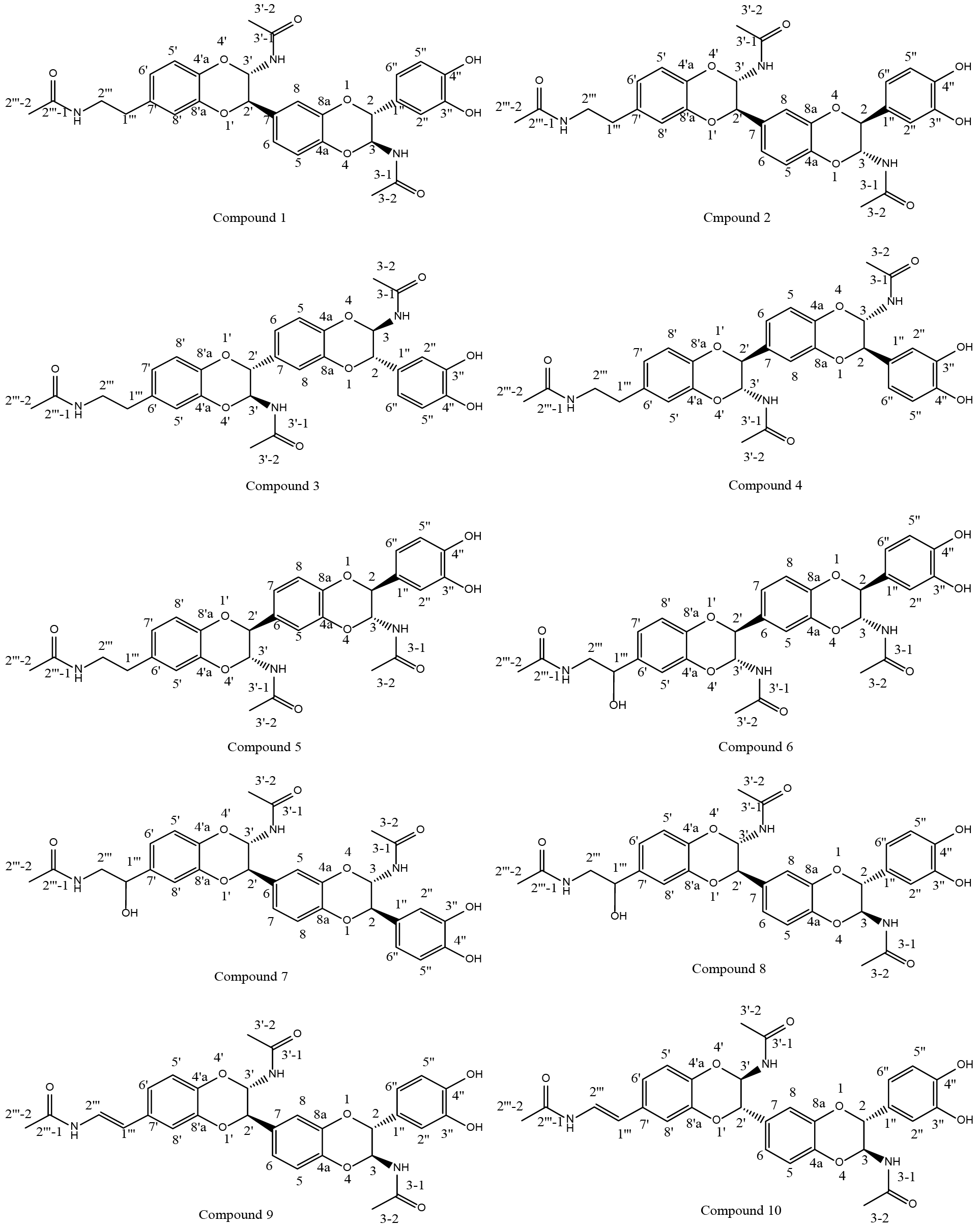
Structures of compounds 1–10.
Note: The structural diagrams of these compounds were drawn based on the analysis of 13C-NMR, 1H-NMR, HMBC and HMQC data, but not every compound needs to do HMQC.
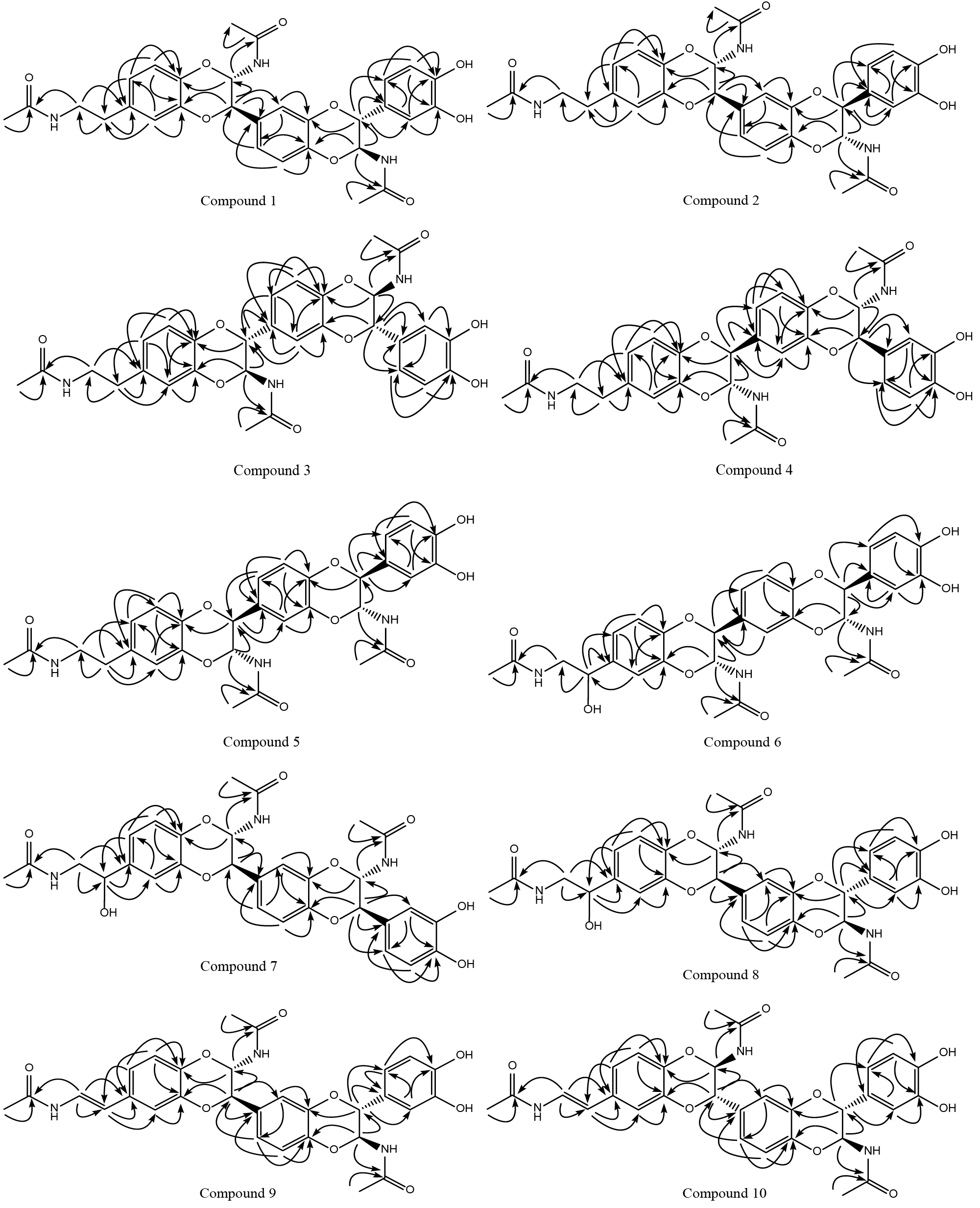
Key HMBC correlations of compounds 1–10.
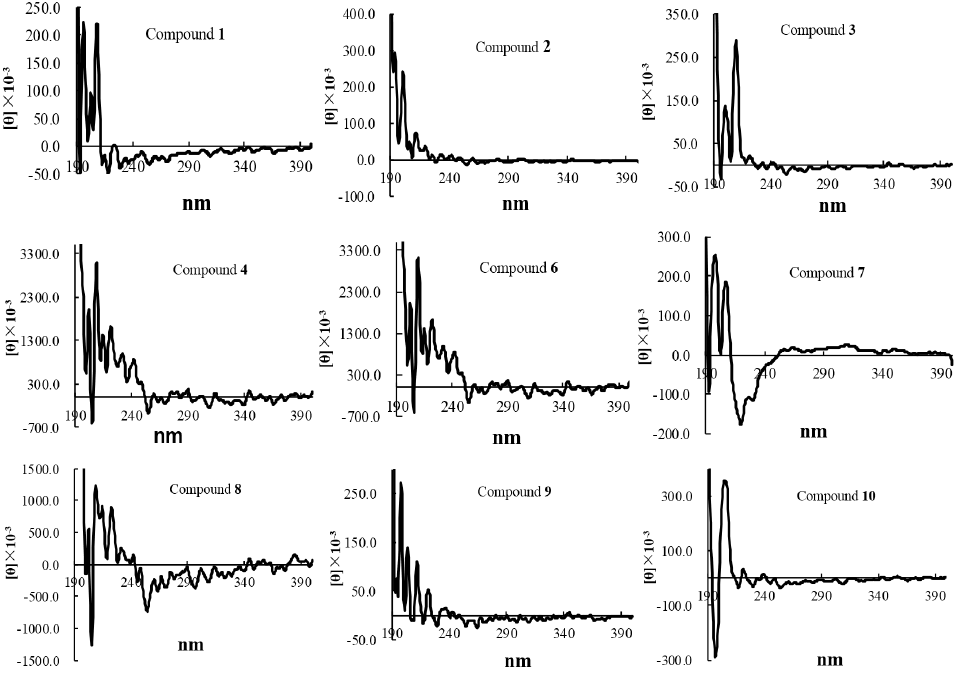
CD spectral data of compounds 1–10.
Note: After spectrum analysis based on 13C-NMR, 1H-NMR and HMQC data, compound 5 and compound 3 were found to be isomers, so the CT scan images of compound 5 is not given here.
References
- An, L., 2008. Anticonvulsant activity of periostracum cicadae. China Med. Herald, 5: 35-36.
- Hsieh, M.T., Peng, W.H., Yeh, F.T., Tsai, H.Y. and Chang, Y.S., 1991. Studies on the anticonvulsive, sedative and hypothermic effects of Periostracum Cicadae extracts. J. Ethnopharmacol., 35: 83-90. https://doi.org/10.1016/0378-8741(91)90136-2[CrossRef]
- Liu, S.T., Li, J.M., Wang, L.Z., Wang, Q., Liang, Y.J., Zhu, F.H., Li, J., Qi, R.X., Yu, J. and Lin, L.W., 2004. The effects of Periostracum cicadae on hemorheology in rats. Acta Chin. Med. Pharmacol., 32: 56-57.
- Liu, H., Yan, Y.M., Liao, L., Wang, S.X., Zhang, Y. and Cheng, Y.X., 2019. Cicadamides A and B, N-acetyldopamine dimers from the insect Periostracum cicadae. Nat. Prod. Commun., 14: 1-6. https://doi.org/10.1177/1934578X19850019[CrossRef]
- Lu, J., Sun, Q., Tu, Z.C., Lv, Q., Shui, P.X. and Cheng, Y.X., 2015. Identification of N-acetyldopamine dimers from the dung beetle Catharsius molossus and their COX-1 and COX-2 inhibitory activities. Molecules, 20: 15589-15596. https://doi.org/10.3390/molecules200915589[CrossRef]
- Lin, X.R., Tu, C.X., Meng, X.M., Yang, C.M., Gao, M.Y. and Gu, L., 2001. Studies on treating eczema by Chinese herbal medicine with anti-type IV allergic activity. Chin. J. Integr. Trad. Western Med., 7: 7-11. https://doi.org/10.1007/BF02935097[CrossRef]
- Noda, N., Kubota, S., Miyata, Y., and Miyahara, K., 2000. Optically active N-acetyldopamine dimer of the crude drug “Zentai,” the cast-off shell of the cicada, Cryptotympana sp. Chem. Pharm. Bull., 48: 1749-1752. https://doi.org/10.1248/cpb.48.1749[CrossRef]
- Oxenkrug, G.F., and Requintina, P.J., 2005. N-acetyldopamine inhibits rat brain lipid peroxidation induced by lipopolysaccharide. Annls N. Y. Acad. Sci., 1053: 394-399. https://doi.org/10.1196/annals.1344.034[CrossRef]
- Shin, T.Y., Park, J.H. and Kim, H.M., 1999. Effect of Cryptotympana atrata extract on compound 48/80-induced anaphylactic reactions. J. Ethnopharmacol., 66: 319-325. https://doi.org/10.1016/S0378-8741(98)00223-2[CrossRef]
- Wu, L.J., 2009. Practical spectral analysis of organic compound. People’s Medical Publishing, Beijing. pp. 67.
- Wang, J., Tian, Q., Tao, G., Gao, Q., Lv, T. and Wang, D., 2010. Analyses on ingredients and antibacterial activity of periostracum cicadae. Chin. Bull. Ent., 47: 1109-1112.
- Xing, G.X., 2010. Treatment of 98 cases of diabetic retinopathy by combined acupuncture and herbs. J. Acupunct. Tuina Sci., 8: 295-296. https://doi.org/10.1007/s11726-010-0430-z[CrossRef]
- Xu, M.Z., Lee, W.S., Han, J.M., Oh, H.W., Park, S.P., Tian, G.R., Jeong, T.S. and Park, H.Y., 2006. Antioxidant and anti-inflammatory activities of N-acetyldopamine dimers from Periostracum Cicadae. Bioorg. Med. Chem. 14: 7826-7834. https://doi.org/10.1016/j.bmc.2006.07.063[CrossRef]
- Yang, L., Li, G.Y., Li, Q.R. and Wang, J.H., 2012. Two new N-acetyldopamine tetrapolymers from Periostracum Cicadae. J. Asian Nat. Prod. Res., 19: 1-6.
- Yang, L., Li, Y.L., Ma, X.Q. and Yan, Q.H., 2013. Comparison of dry ashing, wet ashing and microwave digestion for determination of trace elements in periostracum serpentis and periostracum cicadae by ICP-AES. J. Chil. chem. Soc., 58: 1876-1879. https://doi.org/10.4067/S0717-97072013000300018[CrossRef]
- Yang, L., Li, G.Y., Wang, H.Y., Zhang, K., Zhu, Y., Zhao, W.B., Wang, H. and Wang, J.H., 2016. Five new N-acetyldopamine dimers from Periostracum Cicadae. Phytochem. Lett., 16: 97-102. https://doi.org/10.1016/j.phytol.2016.02.010[CrossRef]
- Zhang, S.Q. and Che, J., 2004. Treatment of 30 cases of vitiligo by cupping method plus external application of Chinese herbs. J. Acupunct. Tuina Sci., 2: 42-43. https://doi.org/10.1007/BF02861410[CrossRef]
Supplementary material
Services
Article usage statistics
Loading…