Research Article · Volume 11, Issue 1, 29 December 2022 · Open Access
Identification of FecXG and FecB Mutations and its Association with Litter Size in Kacang and Boerka Goat
· ·
Affiliations & Notes ⌄
1Laboratory of animal genetics and breeding, Faculty of Animal Science, University of Mataram, Indonesia
2Laboratory of Biotechnology Faculty of Animal Science, University of Mataram. *Correspondence | Maskur, Laboratory of animal genetics and breeding, Faculty of Animal Science, University of Mataram, Indonesia
According to these results, we can state that BMP15 and BMPR1B genes were polymorphic and significantly affected the litter size in Kacang and Boerka goats.
However, our study has limitations on the effective population size of each genotype group in the test goats, which will impact the association analysis results.
Therefore, further investigations on large and balanced populations are required to confirm the association of BMP15 and BMPR1B genes with increased prolificacy in Kacang and Boerka goats.
Selected from the article's own text.
Abstract
The Kacang goat is one of Indonesia’s prolific native goat breeds, while the Boerka goat is a crossbreed between Kacang and Boer goats. It is widely known that the ovulation rate and litter size in sheep breeds are significantly impacted by the BMP15 (FecXG) and BMPR-1B (FecB) gene alterations. Based on this knowledge, the study’s objective was to determine the presence of BMP15 and BMPR-1B gene polymorphisms and how they affected the prolific traits of Kacang and Boerka goats. This study indicates that the FecXG and FecB mutations were associated with litter size in Kacang and Boerka goat breeds. The FecXG has two genotypes in both Kacang and Boerka goats, namely homozygote wild type ++ and heterozygote mutant carrier G+ with a litter size of 1.56 and 1.65 (Kacang); 1.61 and 1.75 (Boerka), respectively. Meanwhile, FecB mutations produce three genotypes: homozygote wild type ++, heterozygote mutant carrier B+ and homozygote mutant BB with a litter size of 1.00, 1.37, and 1.65 (Kacang); and 1.00, 1.18, and 1.74 (Boerka), respectively.
In Indonesia, the increase in the goat population is generally related to empowering the economy of rural households, supporting food security, and improving the nutritional quality of families. Goats have great potential to increase rural and urban prosperity due to their ability to adapt well to tropical climates, have better productivity, and can utilize low-quality fiber ; so that it can be effortlessly maintained in a dry land farm.
The Kacang goat is one of the native Indonesian goats that have high fertility, with a litter size of 1.56–1.98 kids per birth, 52.2% for twins, and 2.6% for triplets . While the Boerka goat is a hybrid goat resulting from a cross between Kacang and Boer goat. As a hybrid breed, Boerka goats have the potential to be developed as meat-producing goats because of their better growth and meat quality. Boerka goats have a birth weight of 2.6-2.8 kg with a weaning weight of 10-12 kg, while the birth weight of Kacang goats was 1.6-1.8 kg with a weaning weight of 6-8 kg. Boerka goats also have prolific characteristics, with a litter size of 1.45–1.54 kids per birth .
Prolific traits are reproductive traits that have high economic value in goats, where high litter size can accelerate goat population growth. The tendency to produce twins or triplets in goats and sheep is the same, and this trait is passed on to their offspring. The genetic mechanism of increasing litter size due to the FecB and FecX mutations has been widely reported. However, prolificacy regulation at the gene level is different in sheep and goats. Mutations in the BMP15 gene make granulosa cells more sensitive to FSH, accelerating the formation of follicular and early ovulation of tiny follicles, thereby increasing ovulation in ewes . Granulosa cells and oocytes express the BMP receptor (BMPR) and then bind to BMP15. The ovulation rate is enhanced by one copy due to an additive effect of the BMPR-1B gene mutation ;.
As in sheep, the genetics of prolificacy has also been studied extensively in goats. Several studies have shown that the BMP15 gene is also the primary gene that regulates prolificacy in goats, such as in Funiu white , Jining Gray , Beetal and Teddy , and Markhoz goats . Polymorphism in the BMPR-1B gene was also reported to be associated with prolific traits in Black Bengal , Beetal, and Teddy goats . On the contrary, Hua et al. (2008) showed none of the FecB and FecX polymorphism in prolific goat breeds, including Haimen, Huanghuai, Boer, Nubi and Matou.
Based on the abovementioned, the mechanism and regulation pathways of fecundity genes in prolific goats are not clear, so additional study is still required in various breeds and a large sample size of a goat. In goats, litter size is a reproductive trait with low heritability and is regulated by more than one gene. Therefore, it is crucial to provide scientific information for designing a set of DNA markers that can be useful for marker-assisted selection (MAS) in Kacang and Boerka goats.
MATERIAL AND METHOD
Experimental animals and DNA isolation
The experiments were carried out with a total sample was 211 female goats, consisting of 111 Boerka and 100 Kacang goats. All samples were collected at PT. Sadhana Arif Nusa, East Lombok, West Nusa Tenggara, Indonesia. For association analysis, the number of kids for every birth and the average litter size for each ewe of the first three parities were recorded. Blood samples were collected from each animal using a K2EDTA Venoject tube and preserved at -25°C. The Genomic DNA extraction was performed according to the Genomic DNA Mini Kit Geneid procedure.
PCR amplification and Genotyping
Primer 3.0 software was used to design two pairs of PCR primers based on the Ovis aries genbank database (GenBank access code: NC_022322) and the published nucleotide sequence of the caprine gene. The forward and reverse primers for exon 2 of BMP15 and exon 6 of BMPR1B genes are presented in Table 1.
DNA amplification was carried out in the Nexus Mastercycler PCR machine with a reaction volume of a 15 µl consisted 1 µl DNA, 0.5 µl Primers, 6.25 µl MyTaq HS Red Mix, 2x and 7.25 µl Water (dH2O). Amplification conditions were as follows: pre-denaturation conditions for 5 minutes at 95 oC, followed by 35 cycles of denaturation step at 95 oC for 10 s, annealing at 60 oC for 20 s, and elongation at 72 oC for 30 s; with the final elongation stage at 72 oC for 5 minutes in one cycle. About 5 µl of each PCR product were digested separately with Hinf1 10 U for BMP15 and AvaII 10 U for BMPR-1B at 37 °C overnight. The digested product was separated by 2.5% agarose gel electrophoresis and visualized in an AlphaImager (Alpha Innotech Corporation, USA).
Data analysis
Popgene version 1.31 software was used to investigate the genotype and allele frequencies, heterozygosity, polymorphism information content, and Hardy-Weinberg equilibrium. SNP position determination was corrected to Ensembl’s DNA sequence using the MEGA-X program (ENSCHIG00000024611). The association of genotypes with the litter size of Kacang and Boerka goats was examined using the General Linear Model procedure with SAS 9.1.3 software (SAS Institute, Cary, NC, USA). The linear model applied was:
Yiklm = µ + Ci + Bk + (BC)ik+ Sl + Eiklm
Where, Yiklm is the trait observation of the iklmth animals; µ is the overall mean; Ci is the genotype effect of the ith; Bk is the breed effect of the kth; (BC)ik is the interaction between the ith and the kth; S1 is the sire effect of the lth, and Eiklm is the random error.
RESULT AND DISCUSSION
Polymorphism of BMP15 gene in Kacang and Boerka Goat
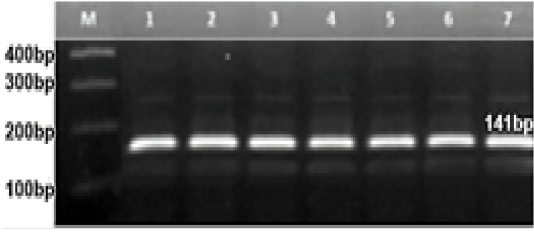
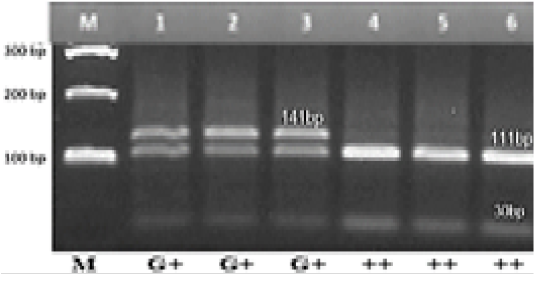
Amplifying the BMP15 gene in Kacang and Boerka goats produced DNA fragments (PCR products) with a length of 141 bp (Figure 1). The BMP15 gene mutation was identified by the RFLP method using the Hinf1 restriction enzyme with the G|ANTC cleavage site (Figure 2). The wild type of the exon 2 BMP15 gene sequence has a cleavage site for the Hinf1 enzyme that produces alleles with sizes of 111 bp and 30 bp (+ allele), respectively. The C/T transition mutation caused a change in the cleavage site of the HinfI enzyme at position 718 (c.718C>T) of the BMP-15 gene, which resulted in a mutant allele (G allele) with a size of 141 bp.
Table 1: Gene sequences and primers
Gene
Primer Sequence 5’- 3'
Amplicons
Restriction enzymes
Annealing temp. (oC)
BMP15
F: CACTGTCTTCTTGTTACTGTATTTCAATGAC
R: GATGCAATACTGCCTGCTTG
141 bp
HinfI
60
BMPR1B
F: GTCGCTATGGGGAAGTTTGGATG
R: CAAGATGTTTTCATGCCTCATCAACACGGTC
140 bp
AvaII
59
F: forward, R: reverse
Table 2: Genotype and Allele Frequency of BMP15 gene on Kacang and Boerka Goats
SNP Position
Goat Population
N
Genotype Frequency
Allele Frequency
GG
G+
++
G
+
c.718C>T
Kacang
100
0.000
0.330
0.670
0.165
0.835
Boerka
111
0.000
0.396
0.604
0.198
0.802
N: Number of goats; HWE: Hardy-Weinberg equilibrium
Identification of allele and genotype of the BMP15 gene using the method of RFLP-Hinf1 resulted in wild type + and mutant type G allele with homozygote wild type ++ and heterozygote mutant carrier G+ genotypes, while the homozygote mutant GG genotype was not identified on Kacang and Boerka goats (Figure 2). The allelic and genotypic frequency distributions indicate a very contrasting difference (P<0.01). In the two goat breeds, the genotype ++ was significantly higher than the G+, and the + allele was significantly higher than the G allele (Table 2). The presence of polymorphic sites for exon 2 of the BMP15 gene has been published in various breeds of goats, such as Jining Grey ; Guizhou White ; Taihang black and Funiu white ; Beetal and Teddy goats .
In this study, the homozygous mutant GG was not found in the Kacang and Boerka goat populations. Similarly, homozygous mutant GG also was not found in several goat breeds, such as Teddy goats , Markhoz goats , Taihang black , and Jining gray ; and some breeds of sheep, including the Small Tailed Han , Belclare , Barki and Rahmani , six Egyptian sheep breeds , and Lombok Fat Tail . The Possible reasons need to be explained that no GG ewes were observed in the present study. A tendency towards accumulating and losing certain genotypes could be due to intensive selection. GG ewes may exist in the Kacang and Boerka breeds, but this research used experimental ewes with a litter record, so all infertile ewes were excluded. Another possible reason that GG ewes may not exist in the Kacang and Boerka breeds is that there are no reports of infertility among Kacang and Boerka goats, as in Belclare sheep.
Polymorphism of BMPR-1B gene in Kacang and Boerka Goat
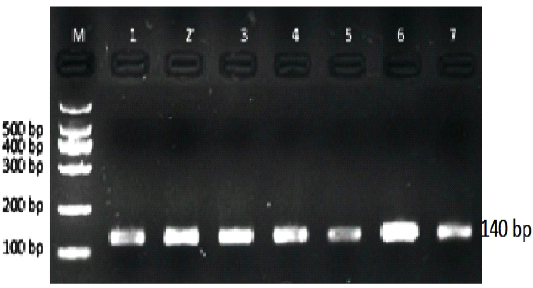
Amplifying the BMPR-1B gene in Kacang and Boerka goats produced DNA sequences with a length of 140 bp (Figure 3). The wild type sequence of exon 6 of the BMPR-1B gene has no cleavage site for the AvaII restriction enzyme, so the wild type allele is 140 bp (+). Mutations at this locus are transition mutations that convert adenine into guanine at the base position 746 coding regions of the BMPR-1B gene (c.746A>G). These mutations cause the formation of a cleavage site for the AvaII restriction enzyme (G|GACC), so the digestion produces mutant alleles measuring 110 and 30 bp (B) in length.
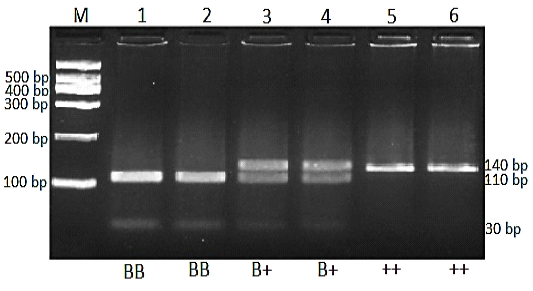
Identification of allele and genotype using the method of RFLP-AvaII resulted in two alleles, namely mutant B (110 bp and 30 bp) and wild + allele (140 bp), with three genotypes ++ (homozygote wild type), B+ (heterozygote mutant carrier), and BB (homozygote mutant) (Figure 4). The allelic and genotypic frequency distributions indicate a highly contrasting difference (P<0.01). The frequency of the wild + allele was significantly higher than the mutant B allele, and the genotypic ++ was significantly higher than B+ and BB in the two goats breed (Table 3). However, the previous research in several sheep breeds indicates the abundance of mutant alleles compared to wild alleles, such as in prolific Garole ; Indonesian fat-tailed ; Small-Tail Han ; ; and Bayanbulak sheep .
Similar to this study, the FecB mutation has been previously found in several goat breeds, including Black Bengal , Markhoz , Beetal and Teddy goats . In contrast, it has not been found in some other goat breeds, including the Rayini goats of Iran , the prolific Raighar , the Indian Berari and Surti goat ; , and some Egypt sheep breeds ; ;. The possible reasons for the differences between the results obtained from different breeds may be due to: (1) the accumulation of certain genotypes and alleles as a result of intensive selection, (2) the possibility of inbreeding, and (3) the possibility of previous genes introgression as a breeding strategy.
Genetic Diversity Within the Goat Breeds
The genetic diversity of a population is represented by the number of alleles, expected heterozygosity (He), observed heterozygosity (Ho), and Polymorphic Information Content (PIC) values as the fundamental data for individual and population discrimination . Data in Table 4 indicate a genotypic imbalance in the two goat populations where the observed heterozygosity was significantly different from the Hardy-Weinberg expectation agreement. In this study, the low level of Ho and He values revealed low genetic diversity in the two goat populations. The occurrence of heterozygosity deficits in the population is caused by selection pressure at certain loci and inbreeding.
The PIC value of the FecXG (c.718C>T) in both Kacang and Boerka goat breeds was 0.211 and 0.221, while FecB (c.746A>G) was 0.170 and 131, respectively. Bolstein et al. (1980), the PIC level classified as highly (PIC > 0.50), reasonably (0.50 > PIC > 0.25), and slightly (PIC < 0.25) informative. Thus, in recent research, the PIC value in both BMP15 and BMPR1B was classified as slightly informative (PIC < 0.25).
Association of The FecXG and FecB mutations with Litter Size in the Goat Breeds
The mutations of FecXG (c.718C>T) and FecB (c.746A>G) were investigated as potential gene candidates for prolificacy in Indonesian Kacang and Boerka goats. The mutations and their influence on litter size and ovulation rates were initially found in sheeps and subsequently identified in other species, such as goats. On the other hand, no FecB and FecXG mutations and/or their association with litter size were detected in earlier studies in various breeds of sheep and goats.
The influence of The FecXG (c.718C>T) mutation on goat litter size is apparent from the data of this study (Table 5). We found two genotypes in both goat breeds, namely homozygote wild type ++ and heterozygote carrier G+, in which the G+ had a higher number of kids than the ++ genotype. These findings are similar to the previous study done on Jining Grey goats, in which the heterozygote carrier AB had 1.13 more offspring than the homozygote AA (p < 0.01) . Conversely, some other re
Table 3: Genotype and Allele Frequency of BMPR-1B gene on Kacang and Boerka Goats
SNP Position
Goat Population
N
Genotype Frequency
Allele Frequency
BB
B+
++
B
+
c.746A>G
Kacang
100
0.040
0.130
0.830
0.105
0.895
Boerka
111
0.027
0.099
0.874
0.077
0.923
N: Number of goats; HWE: Hardy-Weinberg equilibrium
Table 4: Genetic diversity measures in Kacang and Boerka goat populations across BMP15 (c.718C>T) and BMPR1B (c.746A>G) gene loci.
Goat population
N
SNP Position
Ho
He
se
PIC
X2(HWE)
Kacang
100
c.718C>T
0.278
0.239
0.024
0.211
3.905
c.746A>G
0.130
0.188
0.038
0.170
9.507
means
0.204
0.214
0.031
0.191
6.706
Boerka
111
c.718C>T
0.298
0.253
0.024
0.221
6.782
c.746A>G
0.099
0.141
0.035
0.131
9.942
means
0.199
0.197
0.030
0.176
8.362
N: sample size; Ho: observe heterozygosity; He: expected heterozygosity; PIC: polymorphic information content; and HWE: Hardy-Weinberg Equilibrium.
Table 5: Association of BMP15 (c.718C>T) and BMPR-1B (c.746A>G) gene polymorphism with litter size in the goat breeds
Goat population
Locus
Genotype
Number of individuals
Litter Size (LS)
Kacang
c.718C>T
G+
++
33
67
1.65±0.339a
1.56±0.291b
c.746A>G
BB
B+
++
4
13
83
1.00±0.000a
1.37±0.220b
1.65±0.280c
Boerka
c.718C>T
G+
++
44
67
1.75±0.396a
1.61±0.406b
c.746A>G
BB
B+
++
3
11
97
1.00±0.000a
1.18±0.252b
1.74±0.369c
searchers observed that the homozygote mutant goats had the most offspring, followed by the heterozygote carrier and homozygote wild-types, such as Beetal and Teddy goats , Anglo-Nubian , Funiu white and Taihang black .
In some sheep breeds, such as the Small Tailed Han ; , the Chios , the Rahmani, and the Rahmani x Barki Cross , previous studies also demonstrated that the heterozygote carrier genotype for BMP-15 had a larger litter size than the homozygote wild-type. In contrast, several other studies found that the homozygote wild type had a higher litter size than the heterozygote carrier. Meanwhile, homozygote carrier sheeps for this mutation were infertile. Mc Natty et al. (2005) state that FecXG mutation causes premature stop codon at amino acid residue 239 (CAG -->TAG, Q239Ter), resulting in immature protein, which may result in loss of BMP15 function. The relationship between BMP15 mutations and ovulation rates is based on the concept that the rate of ovulation will increase if the expression of the BMP15 gene is lower, but if the level of BMP15 is too low, it will cause total dysfunction .
The important role of BMP15 in modulating litter size and the rate of ovulation in sheeps and goats was supported by several previous studies. The BMP15 gene expression was significantly (P<0.05) higher in the prolific goat than in non-prolific goats’ ovaries ;; . However, Crawford et al. (2011) found that the BMP15 gene expression in the oocytes of prolific was lower than in wild Booroola Romney sheeps. This finding suggests that BMP15 plays a distinct role in goats and sheep, and that it may regulate female fertility and ovulation rate in a species-specific manner .
In the current research, we observed a negative relationship between FecB mutation (A746G or Q249R) and Litter Size (LS) in prolific Kacang and Boerka goats (Table 5). The Litter Size of the wild-type ++ goats was greater than carrier B+ and mutant BB goats. Polley et al. (2009) found a positive effect of FecB mutation on Black Bengal goats in which the genotypes of homozygote wild type, heterozygote carrier and homozygote mutant had litter sizes of 2.7, 3.04, and 3.11, respectively. However, some previous studies showed the FecB mutation had low polymorphism and no association with litter size in Anhui White, Wendeng Dairy, Jining Grey, Boer, Liaoning Cashmere, Barbari, Malabari, Osmanabadi, and Ganjam goats ;. The different genetic impacts of these mutations are possibly caused by the intense selection pressure on the population resulting in the accumulation of certain genotypes. This in turn would have an impact on the effective population size in the goat genotype group and would alter the results of the significant association analysis. Another possible reason is that the BMPR-1B gene expression may vary between breeds and environmental conditions or due to the interactions between breeds and the environment .
In sheep breeds, some researchers have confirmed that the FecB mutation has an effect on ovulation rate and/or litter sizes, such as Dorset, Mongolian, Small-Tail Han, Hu and Bayanbulak sheep (China: ; ; ; ; Garole, Nilagiri, Nellore and Deccani sheep (India: ; ; ; Mehraban and Kalehkoohi (Iran: ; ; . The important role of FecB mutations in the regulation of sheep reproduction has been confirmed in several previous studies. The FecB mutation reduces the BMPR-IB inhibitory effect on granulosa cell steroidogenesis so that they are more sensitive to FSH; thus, the cell division becomes more active, leading to the maturation and ovulation of multiple ovarian follicles . The basic concept of the prolific nature is that an increased ovulation rate leads to a more significant number of ovulated oocytes and if fertilization occurs and the parent is able to maintain a viable embryo, it will be followed by the birth of more than one kid .
CONCLUSION
According to these results, we can state that BMP15 and BMPR1B genes were polymorphic and significantly affected the litter size in Kacang and Boerka goats. The results of this study will hopefully provide a basis for the development of marker-assisted selection (MAS) for goat breeding programs in the future. However, our study has limitations on the effective population size of each genotype group in the test goats, which will impact the association analysis results. Therefore, further investigations on large and balanced populations are required to confirm the association of BMP15 and BMPR1B genes with increased prolificacy in Kacang and Boerka goats.
Acknowledgment
The University of Mataram Research Grant funded this research with contract number: 2832/UN18.L1/PP2020. The greatest appreciation to the Rector of the University of Mataram for the support of this research.
Novelty Statement
The authors declare that the article is original and sourced from unpublished research data. The Faculty of Animal Science University of Mataram’s ethics committee granted all the research materials and procedures with registration number: 10/UN18.F2/EC/2021.
Author’s Contributions
Maskur was responsible for designing, analyzing, interpreting data, and preparing the manuscript; Muhammad Muhsinin was responsible for phenotypic and genotypic analysis, and preparation of the manuscript; and Sulaiman Ngongu Depamede was responsible for the experiment, laboratory analysis, and article preparation.
Figures
Figure 1. Figure 1.
Amplicons of BMP15 gene (lines 1-7) and marker 100 bp (M).
Figure 2.
PCR-RFLP product of BMP15|HinfI gene (lines 1- 6) and marker 100 bp (M)
Figure 3.
Amplicons of BMPR1B gene (lines 1-7) and marker 100 bp (M).
Figure 4.
PCR-RFLP product of BMPR1B|AvaII gene (lines 1- 6) and marker 100 bp (M)
References
Abdel-Rahman SM, Mustafa YA, Abd Errasool HA, El-Hanafy AA, El-Maghraby AM (2013). Polymorphism in BMP-15 gene and its association with litter size in Anglo-Nubian goat. Biotechnol. Anim. Husband. 29(4): 675683. https://doi.org/10.2298/BAH1304675A[CrossRef]
Abdoli R, Zamani P, Deljou A, Rezvan H (2013). Associations of BMPR-1B and GDF9 genes polymorphisms and secondary protein structure changes with reproduction traits in Mehraban ewes. J.Gene., 524: 296–303. https://doi.org/10.1016/2013.03.133[CrossRef]
Abulyazid I, Abdalla M, Sharada H, Saleh H, Hassanin W (2011). Prolificacy detection in Egyptian sheep using RFLP-specific PCR. Egypt Acad J. Biolog. Sci., 1: 1–4. https://doi.org/10.21608/eajbsc.2011.16139[CrossRef]
Ahlawat S, Sharma R, Maitra A, Tantia MS (2015). Current status of molecular genetics research of goat fecundity. [Review]. Small Rumin. Res., 125: 3442. https://doi.org/10.1016/j.smallrumres.2015.01.027[CrossRef]
Ahlawat S, Sharma R, Maitra A, Tantia MS, Roy M, Mandakmalen S (2014). New genetic polymorphisms in Indian goat BMPR1B gene. Indian J. Anim. Sci. 84: 37–42 https://doi.org/10.1016/j.smallrumres.2015.01.027.[CrossRef]
Al-Musawi SL, Walton KL, Heath D, Simpson CM, Harrison CA (2013). Species differences in the expression and activity of bone morphogenetic protein-15. Endocrinology., 154: 888–899. [CrossRef] [PubMed] https://doi.org/10.1210/en.2012-2015[CrossRef]
Bolstein D, White RL, Skolnik M, Davis RW (1980). Construction of a genetic linkage map in man using restriction fragment length polymorphisms. Am. J. Hum. Genet., 32: 314-331.
Chaudhari A, Ramanujam R, Ragothaman V (2019). Effect of Booroola fecundity (FeCB) gene on litter size and scope for use in restoration of Nilagiri sheep from threatened status. Rev. Agrária Acadêmica., 2: 11-6. https://doi.org/10.32406/v2n62019/11-16/agrariacad[CrossRef]
Chu MX, Jiao CL, He YQ, Wang JY, Liu ZH, Chen GH (2007). Association between PCR-SSCP of bone morphogenetic protein 15 gene and prolificacy in Jining Grey goats. Anim Biotechnol.18(4): 263-74. https://doi:10.1080/10495390701331114[CrossRef]
Chu MX, Liu ZH, Jiao CL, He YQ, Fang L, Ye S, Chen GH, Wang JY (2007). Mutations in BMPR-IB and BMP-15 genes are associated with litter size in small tailed han sheep (Ovis aries). J. Anim. Sci.;85(3): 598–603. https://doi.org/10.2527/jas.2006-324[CrossRef]
Chu MX, Zhao XH, Zhang YJ, Jin M, Wang JY, Di R, Cao GL, Feng T, Fang L, Ma YH, Li K (2010). Polymorphisms of BMPR-IB gene and their relationship with litter size in goats. Mol. Biol. Rep., 37: 4033-4039. https://doi.org/10.1007/s11033-010-0062-x[CrossRef]
Crawford JL, Heath DA, Reader KL, Quirke LD, Hudson NL, Juengel JL, McNatty KP (2011). Oocytes in sheep homozygous for a mutation in bone morphogenetic protein receptor 1B express lower mRNA levels of bone morphogenetic protein 15 but not growth differentiation factor 9. Reproduction., 142: 53–61. https://doi.org/10.1530/REP-10-0485[CrossRef]
Dangar NS, Pandya GM, Ramani UV, Padheriya YD, Sangma T, Patel SS, Devkatte S (2019). Association Study of Fecundity Gene BMPR1B with Prolificacy in Surti Goats under Farm and Field Condition. Ind. J. Vet. Sci. Biotech., 14(4): 17-20 https://doi.org/10.21887/ijvsbt.14.4.5.[CrossRef]
El-Seedy AS, Hashem NM, El-Azrak KM, Nour EA, Ramadan TA, Taha TA, Salem MH (2017). Genetic screening of FecB, FecX(G) and FecX(I) mutations and their linkage with litter size in Barki and Rahmani sheep breeds. Reprod. Domest. Anim., 52: 1133–1137. https://doi.org/10.1111/rda.13002[CrossRef]
Fabre S, Pierre A, Mulsant P, Bodin L, DiPasquale E, Persani L, Monget P, Monniaux D (2006). Regulation of ovulation rate in mammals: contribution of sheep genetic models. Reprod. Biol. Endocrinol. 4: 20. https://doi.org/10.1186/1477-7827-4-20[CrossRef]
Fogerty (2008). Environmental modulation of FecB expression. Use of the FecB (Booroola) gene in sheep-breeding programs. Proc. of the Helen Newton Turner Memorial International Workshop held in Pune. Maharashtra. India, 1: 66-75.
Gazooei YM, Niazi A, and Zamiri MJ (2013). Single nucleotide polymorphism analysis of the bone morphogenetic protein receptor IB and growth and differentiation factor 9 genes in Rayini goats (Capra hircus). J. Livest. Sci. Technologies, 1: 45-50.
Ghoreishi H, Sadegh Fathi-Yosefabad, Jalal Shayegh, and Abolfazl Barzegari (2019). Identification of mutations in BMP15 and GDF9 genes associated with prolificacy of Markhoz goats. Arch. Anim. Breed., 62, 565–570, 2019 https://doi.org/10.5194/aab-62-565-2019[CrossRef]
Guo X, Wang X, Di R, Liu Q, Hu W, He X, Yu J, Zhang X, Zhang J, Broniowska K (2018). Metabolic effects of FecB gene on follicular fluid and ovarian vein serum in sheep (Ovis aries). Int. J. Mol. Sci., 19(2): 539. https://doi.org/10.3390/ijms19020539[CrossRef]
Hua GH, Chen SL, Ai JT, Yang LG (2008). None of the polymorphism of ovine fecundity major genes FecB and FecX was tested in goat. Anim. Reprod. Sci., 108: 279–286 https://doi.org/10.1016/j.anireprosci.2007.08.013.[CrossRef]
Islam M, Basheer A, Javed K, Anjum AA, Zahoor I (2019). PCR-RFLP-based identification of polymorphisms in BMPR1B, GDF9 and BMP15 genes associated with litter size in Beetal and Teddy goats. S. Afr. J. Anim. Sci., 49 (4): 697-708. https://doi.org/10.4314/sajas.v49i4.11[CrossRef]
Jia J, Qian C, Gui L, Jin J, Li Y, Ru Q, Hou S (2019). Association of polymorphisms in bone morphogenetic protein receptor-1B gene exon-9 with litter size in Dorset, Mongolian, and Small Tail Han ewes. Asian-Aust. J. Anim. Sci., 32: 949-955 https://doi.org/10.5713/ajas.18.0541[CrossRef]
Kumar R, Taraphder S, Sahoo A, Senpati P, Paul R, Roy M, Sarkar U, Raja D, Samanta I, Baidya S (2016). Polymorphism and nucleotide sequencing of BMP-15 gene in an organised herd of Garole sheep (Ovis aries). Indian J. Anim. Sci., 55(1): 77-86.
Liandris E, Kominakis A, Andreadou M, Kapeoldassi K, Chadio S, Tsiligianni T, Gazouli M, Ikonomopoulos I (2012). Associations between single nucleotide polymorphisms of GDF9 and BMP15 genes and litter size in two dairy sheep breeds of Greece. Small Rumin. Res., 107: 16- 21. https://doi.org/10.1016/j.smallrumres.2012.04.004[CrossRef]
Mahdavi M, Nanekarani S, Hosseini SD (2014). Mutation in BMPR-IB gene is associated with litter size in Iranian Kalehkoohi sheep. Anim. Reprod. Sci., 147: 93-98. https://doi.org/10.1016/j.anireprosci.2014.04.003[CrossRef]
Mahmilia F and Elieser S (2008). Korelasi lama bunting dengan bobot lahir, litter size dan daya hidup kambing Boerka-1. Pros. Sem. Nas. Tekn. Pet. & Vet. Puslitbangnak Deptan, Bogor, Hal. 391-394.
Maskur M, Tapaul R, Kasip L (2016). Genetic polymorphism of bone morphogenetic protein receptor 1B (BMPR-1B) gene and its association with litter size in Indonesian fat-Tailed sheep. African J. Biotech., 15(25): 1315-1319. https://doi.org/10.5897/AJB2015.15093[CrossRef]
Mc Natty KP, Juengel JL, Reader KL, Lun S, Myllymaa S, Lawrence SB (2005). Bone morphogenetic protein 15 and growth di_erentiation factor 9 cooperate to regulate granulosa cell function in ruminants. Reproduction. 129: 481–487. [CrossRef] [PubMed] https://doi.org/10.1530/rep.1.00517[CrossRef]
Moore RK and Shimasaki S (2005). Molecular biology and physiological role of the oocyte factor, BMP-15. Mol. Cell.Endocrinol. 234: 67-73. https://doi.org/10.1016/j.mce.2004.10.012[CrossRef]
Mullen MPHJ, Howard DJ, Powell R (2013). Investigation of prolific sheep from UK and Ireland for evidence on origin of the mutations in BMP15 (FecXG, FecXB) and GDF9 (FecGH) in Belclare and Cambridge sheep. PLoS ONE. 8. https://doi.org/10.1371/journal.pone.0053172[CrossRef]
Palai TK, Bisoi PC, Maity A, Behera PC, Sahoo G, Polley S, De S (2013). Prolificacy in Raighar goats is independent of FecB gene. Veterinary World, 6: 479-481. https://doi.org/10.5455/vetworld.2013.479-481[CrossRef]
Pamungkas FA, Batubara A, Doloksaribu M, Sihite E (2009). Petunjuk Teknis Potensi Beberapa Plasma Nutfah Kambing Indonesia. Puslitbangnak, Deli Serdang, Sumatera Utara.
Pan ZY, Di R, Tang QQ, Jin HH, Chu MX, Huang DW, He JN, Liu QY, Hu WP, Wang XY (2015). Tissue-specific mRNA expression profiles of GDF9, BMP15, and BMPR1B genes in prolific and non-prolific goat breeds. Czech J. Anim. Sci., 60: 452–458. [CrossRef] https://doi.org/10.17221/8525-CJAS[CrossRef]
Polley S, De S, Batabyal S, Kaushik R, Yadav P, Arora JS, Chattopadhyay S, Pan S, Brahma B, Datta TK, Goswami SL (2009). Polymorphism of fecundity genes (BMPR1B, BMP15 and GDF9) in the Indian prolific Black Bengal goat. Small Ruminant Res 85:122–129. [CrossRef] https://doi.org/10.1007/s11250-009-9518-1[CrossRef]
Polley S, De S, Brahma B, Mukherjee A, Vinesh PV, Batabyal S, Arora JS, Pan S, Samanta AK, Datta TK, Goswami SL (2010). Polymorphism of BMPR1B, BMP15 and GDF9 fecundity genes in prolific Garole sheep. Trop. Anim. Health Prod. 42: 985-993. https://doi.org/10.1007/s11250-009-9518-1[CrossRef]
Pramod RK, Sharma SK, Singhi A, Pan S, Mitra A (2013). Differential ovarian morphometry and follicular expression of BMP15, GDF9 and BMPR1B influence the prolificacy in goat. Reprod. Domes. Anim., 48, 803-809. https://doi.org/10.1111/rda.12165[CrossRef]
Praveena K, Ramana DBV, Pankaj PK (2017). Booroola Gene (FecB) Polymorphism and its liaison with litter size in indigenous sheep breeds of Telangana, India. J Anim Res., 7:227-31. https://doi.org/10.5958/2277-940X.2017.00034.1[CrossRef]
Ran XQ, Lin JB, Du ZY, Qing C, Wang Jf (2009). Diversity of Bmp15 and Gdf9 genes in White Goat of Guizhou province and evolution of the en-coded proteins. Zoological Research, 30: 593-602. https://doi.org/10.3724/SP.J.1141.2009.06593[CrossRef]
Saleh A, Hammoud M, Dabour N, Hafez E, Sharaby M (2020). BMPR-1B, BMP-15 and GDF-9 genes structure and their relationship with litter size in six sheep breeds reared in Egypt. BMC Res. Notes 13, 215. [CrossRef] [PubMed] https://doi.org/10.1186/s13104-020-05047-9[CrossRef]
Seo D, Bhuiyan MSA, Sultana H, Heo JM, Lee JH (2016). Genetic divesity analysis of South and East Asian duck populations using highly polymorphic microsatellite markers. Asian Aust. J. Anim. Sci., 29: 471-478. https://doi. org/10.5713/ajas.15.0915
Sharma L, Kuralkar SV, Sajid Ali S, Bankar PS, Prajakta K (2016). Polymorphism Study of BMPR-1B and BMP-15 Genes in Berari Goats. Ind.J.of Small Rum. 22(2): 230-233 https://doi.org/10.5958/0973-9718.2016.00062.3[CrossRef]
Shokrollahi B and Morammazi S (2018). Polymorphism of GDF9 and BMPR1B genes and their association with litter size in Markhoz goats. Reprod. Domest. Anim., 53: 971–978. [CrossRef] https://doi.org/10.1111/rda.13196[CrossRef]
Talebi R, Ahmadi A, Afraz F, Sarry J, Woloszyn F, Fabre S (2018). Detection of single nucleotide polymorphisms at prolificacy major genes in the Mehraban sheep and association with litter size. Ann. Anim. Sci., 18(5): 685-698. https://doi.org/10.2478/aoas-2018-0014[CrossRef]
Wang W, La Y, Zhou X, Zhang X, Li F, Liu B (2018). The genetic polymorphisms of TGFβ superfamily genes are associated with litter size in a Chinese indigenous sheep breed (Hu sheep). Anim. Reprod. Sci., 189: 19-29. https://doi.org/10.1016/j.anireprosci.2017.12.003[CrossRef]
Wang Y, Li Y, Zhang N, Wang Z, Bai J (2011). Polymorphism of Exon 2 of BMP15 Gene and Its Relationship with Litter Size of Two Chinese Goats. Asian-Aust. J. Anim. Sci., 24(7):905-911 https://doi.org/10.5713/ajas.2011.10432[CrossRef]
Wen YL, Guo XF, Ma L, Zhang XS, Zhang JL, Zhao SG, Chu MX (2021). The expression and mutation of BMPR1B and its association with litter size in small-tail Han sheep (Ovis aries), Arch. Anim. Breed., 64: 211–221, https://doi.org/10.5194/aab-64-211-2021[CrossRef]
Wilson T, Wu XY, Juengel JL, Ross IK, Lumsden JM, Lord EA, Dodds KG, Walling GA, McEwan JC, O’Connell AR, McNatty KP, Montgomery GW (2001). Highly prolific Booroola sheep have a mutation in the intracellular kinase domain of bone morphogenetic protein IB receptor (ALK-6) that is expressed in both oocytes and granulosa cells. Biol. Repr., 64:1225–1235. https://doi.org/10.1095/biolreprod64.4.1225[CrossRef]
Yang CX, Zi XD, Wang Y, Yang DQ, Ma L, Lu JY, Niu HR, Xiao XL (2012), Cloning and mRNA expression levels of GDF9, BMP15, and BMPR1B genes in prolific and non-prolific goat breeds. Mol. Reprod. Dev., 79(1): 2. https://doi.org/10.1002/mrd.21386[CrossRef]
Zhang CS, Geng LY, Du LX, Liu ZZ, Fu ZX, Feng MS, Gong YF (2011). Polymorphic Study of FecXG, FecGH and FecB mutations in four domestic sheep breeds in the lower yellow river valley of China. J. Anim. Vet. Adv., 10(17): 2198- 2201 https://doi.org/10.3923/javaa.2011.2198.2201.[CrossRef]
Zuo B, Hongguang Q, Ziyu W, Xu W, Noor N, Aierdin B, Shijia Y, Xiaolong H, Changhai G, Zhiqin G, Feng W (2013). A Study on BMPR-IB Genes of Bayanbulak Sheep. Asian-Aust. J. Anim. Sci., 26(1): 36-42. https://doi.org/10.5713/ajas.2012.12238[CrossRef]