
Newcastle disease virus (NDV) is a highly contagious virus of domesticated (i.e. chickens, peacock, pet birds) and wild birds, which is excreted in the fecal material of infected birds. The house fly, Musca domestica L. can gain entry into the poultry flocks and will feed on poultry droppings and potentially serves as a mechanical vector for Newcastle disease. During the current study, houseflies were captured and examined for the presence of NDV. A total of 80 samples were collected from eight different poultry farms located around Faisalabad city with ten samples from each farm viz. Khurrianwala road, Shahkot road, Faisalabad road, Satyana road, Jhumra road, Nankana sahib road, Lahore road and Jaranwala road. Homogenate from house flies was first harvested in 11 day old embryonated chicken eggs to propagate the NDV, which was then titrated using haemagglutination inhibition assay for quantification of NDV. Polyclonal antibodies were produced in experimental rabbits followed by titration. These antibodies were then used to detect the presence of NDV. Sixteen samples were found positive (20%), 62 negative (77.5 %) and two unreactive (2.5 %) for NDV. All of the poultry farms around Faisalabad showed positive NDV (ranging from 1 to 4 samples). We conclud that house flies can play a role in the mechanical transmission of ND virus. Moreover, it is also suggested that positive poultry farms are likely to cause NDV infection to other farms in the vicinity due to the house fly flight range.
Short Communication · Volume 54, Issue 4, 25 April 2022 · Open Access
House Fly, Musca domestica (Diptera: Muscidae) Acts as a Mechanical Vector for Newcastle Disease of Poultry in Faisalabad, Pakistan
· · · · · · · · · ·
Affiliations & Notes ⌄
- 1Entomology Lab, Department of Zoology, Government College University, Faisalabad 2Department of Zoology, Government College University, Faisalabad 3Department of Microbiology, Government College University, Faisalabad 4Department of Biochemistry, Government College Women University, Faisalabad * Corresponding author: kashif.zahoor@gcuf.edu.pk
Article Info ⌄
- Journal:
- Pakistan Journal of Zoology
- Published:
- 25 April 2022

From the article
- House fly samples were collected from ten poultry farms located at the boundary of Faisalabad, viz. Jhumra Road, Khurrianwala Road, Jaranwala Road, Satyana Road, Nankana Sahib Road, Shahkot Road, Faisalabad Road and Lahore Road.
- Large quantites of waste material and garbage were observed near these poultry farms.
- All tested poultry farms in Faisalabad showed positive samples for Newcastle disease.
- It is concluded that house flies can play a major role in the mechanical transmission of ND in Faisalabad.
Selected from the article's own text.
Abstract
Materials and methods
The present study was conducted during 2017 in the Entomology Lab, Department of Zoology, Government College University, Faisalabad. A total of 80 samples, each contained 20 flies, were collected from poultry farms on eight different roads by selecting 10 farms on each road. Flies were transported to the laboratory within 30-45 minutes after collection . The washed samples were disinfected with sodium hypochlorite (0.05%) for 30 seconds and rinsed twice with sterile PBS for 1 minute. The homogenate of flies was prepared to perform haemagglutination inhibition assay by adding 1000 IU of penicillin, 10,000µg/mL of streptomycin to, inhibit bacterial growth, and 200 IU/mL of ketoconazolas as an antifungal agent. The homogenate was kept for 1-2 hours at room temperature (22°C) and then, the prepared samples were frozen at -20°C . The samples were thawed to room temperature and centrifuged for 10 min at 1000 rpm. After this, 0.2mL of supernatant was inoculated into 9-11 daysold embryonated chicken eggs. Inoculated eggs were placed in an incubator at 37°C and 70% humidity and were checked daily. After 4 days, all inoculated eggs were transferred to temperature cabinets maintained at 4°C. For virus detection, allantoic fluid was harvested and tested for the presence of NDV by heamagglutinating inhibition test (HI). Non-heamagglutinating fluids were also tested twice to confirm negative detection for NDV. For the production of polyclonal antibodies against NDV, to detect the virus, two adult rabbits free from any clinical disease were selected . The rabbits were injected subcutaneously with commercially available LaSota strain (Sindh Poultry Vaccine Center, Karachi) at day 1, 3, 5, 7 and 14 with 0.1, 0.3, 0.5, 0.8 and 1.0ml, respectively. The blood was collected after 14 days after last injection and was processed for extraction of serum. Blood was also collected from the wing vein of 45 day old broilers. After the collection of blood, the next step was procurement of RBCs from the blood. After centrifuging, RBCs were further washed with an adequate amount of normal saline two to three times and were used to prepare 1-2% dilutions. For the heamagglutinating inhibition test (HI) used to detect NDV, 50µL of normal saline was added in all wells from1-12 wells of first row for one sample. The procedure was repeated in other rows for other samples, and 50µL of sample collected from flies was added separately in each row. Two-fold serial dilutions were prepared in each row. 50µL of polyclonal antibodies were added in each row from well No. 1-11 and the plate was incubated for 20-25 minutes at 37˚C followed by the addition of 1-2% of washed RBCs in all of the wells 1-12. The formation of buttons in the wells of microtiter plates indicated the presence of ND virus in the sample .
Results and discussion
House fly samples were collected from ten poultry farms located at the boundary of Faisalabad, viz. Jhumra Road, Khurrianwala Road, Jaranwala Road, Satyana Road, Nankana Sahib Road, Shahkot Road, Faisalabad Road and Lahore Road. Results showed that among poultry farms located at different roads, four (40%) from Shahkot Road were found positive for NDV followed by Khurrianwala Road (3) and two for each of Faisalabad Road, Satyana Road and Lahore Road. Only one poultry farm was found positive for each of Jhumra Road, Nankana Sahib Road, and Jaranwala Road (Fig. 1). Overall 40% of samples were positive for Shahkot Road followed by Satyana road (30% NDV), Khurrianwala Road (26%) and 17% near to reactive), Faisalabad Road (23% positive), Lahore Road (21% positive), Nankana Sahib Road (09% positive, and 11% near to reactive), Jaranwala Road (09% positive) and Jhumra Road (5% positive ). All eight poultry farms showed positive samples. Overall, from 80 samples from poultry farms, sixteen samples were found positive (20%), 62 negatives (77.5 %) and two near to reactive (2.5 %) for NDV. The present study shows that house flies can play a major role as mechanical vector for ND in Faisalabad.
In Pakistan, more than eighty billion rupees are invested in the poultry sector and infectious diseases are the major problem in the poultry industry, causing serious economic losses in term of high mortality and morbidity, stress, reduced egg production, and hatchability . The house fly, Musca domestica, is considered a major pest of livestock and poultry around the globe . It transmits a variety of microbes, e.g., protozoans, bacteria, viruses, etc. through mouthparts, faeces, regurgitation, and simple body surface contamination .
Chaka et al. (2012) conducted serological studies to evaluate the prevalence of ND and IBD in active clinical cases and apparently healthy chickens during disease outbreaks. They reported a prevalence of 21.5% and 34.5%. Similar results were found during this study (20% positive). In addition, Tadesse et al. (2005) also reported a prevalence of 28.57%, 29.69% and 38.33%. This study shows that NDV can serve as the major infectious disease, which reduces the number and productivity of traditionally managed chickens. Subsequently, serological study reveals the presence of circulating antibodies of ND in chicken samples from backyards and small scale poultry producer farms in Agarfa and Sinana districts of Bale zone. An overall seroprevelance of 27.86% was obtained using HAI from two districts . Moreover, in a previous study, eight Pakistani isolates were characterized .
Large quantites of waste material and garbage were observed near these poultry farms. It has already been reported that house flies carry pathogens from waste material and garbage to the poultry farms . Large quantities of horse, cow, buffalo, goat manures and dog faeces were observed near poultry farms selected during this study. These manure and fecal material can serve breeding sites and are considered problematic because houseflies are attracted to animal dung and manure. Houseflies carry pathogens from the manure to the poultry farms and thus, can spread Newcastle disease. Rapid expansion of house flies in poultry farms can cause stress to hens and transmit diseases leading to economic problems such as small size of eggs, contamination of meat, and a drop in egg production . High temperature, humidity, poor sanitation, waste material, unhygienic conditions are also considered as main reasons for expansion of flies. Houseflies can fly up to 3-4 miles. It is possible that poultry waste, even human filth and/or meat pieces thrown nearby farms could be transported to other places by various dispersal agents (e.g., dogs, crows, eagles, crows, etc ; . This material may carry NDV positive fly eggs and hence, could be responsible for disease spread. Hence, management of house flies should be performed by eradication of any kind of waste and garbage near poultry farms in order to avoid Newcastle disease.
Conclusions
All tested poultry farms in Faisalabad showed positive samples for Newcastle disease. Overall, from 80 samples, sixteen were found positive (20%), 62 negative (77.5 %) and two near to reactive (2.5 %) for NDV. It is concluded that house flies can play a major role in the mechanical transmission of ND in Faisalabad.
Acknowledgements
The facilities provided by Department of Zoology and Microbiology, GCUF are highly acknowledged and allowed us to conduct this research work.
Statement of conflict of interest
The authors have declared no conflict of interests.
Figures
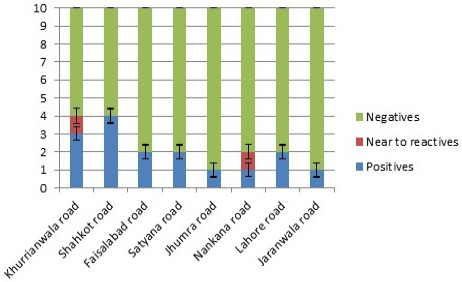
Graphical representation of sampling sites with their corresponding positive, negative and near to reactive samples for NDV from Faisalabad.
References
- Abbas, T., Muneer, M.A., Ahmed, M.D., Khan, M.A. and Younus, M.K.I., 2006. Pak. Vet. J., 26: 55-58.
- Alam, J., Muhammad, F., Siddiqui, M.U., Khan, S.A., Rehmani, S. and Ahmad, A., 2012. Pakistan J. Zool., 44: 1301-1305.
- Alexander, D.J., 2011. Avian Pathol., 40: 547-558. https://doi.org/10.1080/03079457.2011.618823[CrossRef]
- Alexander, D.J. and Sonne, D., 2003. Avian paramyxo viruses 2–9. In: Diseases of poultry, 11th ed. Iowa State University Press, Ames, pp. 88-92.
- Baldacchino, F., Muenworn, V., Desquesnes, M., Desoli, F., Charoenviriyaphap, T. and Duvallet, G., 2013. Parasite, 20: 26. https://doi.org/10.1051/parasite/2013026[CrossRef]
- Calibeo-Hayes, D., Denning, S.S., Stringham, S.M., Guy, J.S., Smith, L.G. and Watson, D.W., 2003. Avian Dis., 47: 149-153. https://doi.org/10.1637/0005-2086(2003)047[0149:MTOTCB]2.0.CO;2[CrossRef]
- Chaka, H., Goutard, F., Bisschop, S.P. and Thompson, P.N., 2012. Poult. Sci., 91: 862-869. https://doi.org/10.3382/ps.2011-01906[CrossRef]
- Geresu, M.A., Elemo, K.K. and Kassa, G.M., 2016. J. Vet. Med. Anim. Hlth., 8: 99-106.
- Haque, M.H., Hossain, M.T., Islam, M.T., Zinnah, M.A., Khan, M.S.R. and Islam, M.A., 2010. Bangladesh J. vet. Med., 8: 87-92. https://doi.org/10.3329/bjvm.v8i2.9618[CrossRef]
- Khan, H.A.A., Shad, S.A. and Akram, W., 2013. Parasit. Res., 112: 2049-2054. https://doi.org/10.1007/s00436-013-3365-8[CrossRef]
- Khan, M.Y., Arshad, M., Mahmood, S.M. and Hussein, I., 2001. Int. J. Agric. Biol., 13: 491-497.
- Khan, H.A.A., Shad, S.A. and Akram, W., 2012. Parasit. Res., 111: 1165-1171. https://doi.org/10.1007/s00436-012-2947-1[CrossRef]
- Kristensen, M. and Jespersen, J.B., 2003. J. econ. Ent., 96: 1300-1306. https://doi.org/10.1093/jee/96.4.1300[CrossRef]
- Malik, A., Singh, N. and Satya, S., 2007. J. environ. Sci. Hlth. Part B., 42: 453-469. https://doi.org/10.1080/03601230701316481[CrossRef]
- Mullen, G.L. and Durden, L.A., 2002. Medical and veterinary entomology. Academic Press.
- Munir, M., Cortey, M., Abbas, M., Afzal, F., Shabbir, M.Z., Khan, M.T. and Zohari, S., 2012. Infect. Gen. Evol., 12: 1010-1019. https://doi.org/10.1016/j.meegid.2012.02.015[CrossRef]
- Narayanan, M.S., Parthiban, M., Sathiya, P. and Kumanan, K., 2010. Vet. Arhiv., 80: 51-60.
- Rahual, P., 2013. Int. J. Sci. Res. Publ., 3: 1-3.
- Tadesse, S., Ashenafi, H. and Aschalew, Z., 2005. Int. J. appl. Res. vet. Med., 3: 25-29.
- Watson, D.W., Niño, E.L., Rochon, K., Denning, S., Smith, L. and Guy, J.S., 2007. J. med. Ent., 44: 666-671. https://doi.org/10.1093/jmedent/44.4.666[CrossRef]
Services
Article usage statistics
Loading…