
Multiple sclerosis (MS) is a complex disorder, characterized by demyelination and loss of axonal parts of neurons in the central nervous system involving multiple genetic and environmental factors. Although, the demyelinated lesions develop throughout the brain, but more frequently are extensive in white matter. Currently, three different approaches are being utilized to treat MS, where synthetic drugs are the most frequently used but they do not cure the disease. Secondly, the stem cell therapy but this too has limited success in treating MS in humans. The thirds technique involving administering hormones has been found to be most effective method but this too have some significant side effects. Alternatively, natural products can potentially serve as an affordable and effective substitute for the treatment of MS with minimum or no side effects. Blackseeds (Nigella sativa) and honey possessing potent neuroprotective, antioxidant, and anti-inflammatory properties with no reported side effects can be a prospective candidate for an alternate remedial treatment of MS in animal model as well as in humans. In this study we established a new animal model (quail), to assess the synergistic efficacy of honey and black seed against demyelination within brain. A total of 35 male quails were used, among 10 were non treated and 25 were treated with 200 mg/kg/day cuprizone (CPZ) demyelination for six months to induce demyelination. After that they were divided into seven groups of five animal each where 3 CPZ treated groups received either honey, black seed oil or mixture of both for 6 weeks after demyelination. Behavioral tests were performed at the end of treatment. Afterwards, oligodendrocyte population was estimated in cerebellar white matter after histology. It was found that all three treatments efficiently induce remyelination. Interestingly, the mixture of honey and black seed was significantly more efficient than honey and black seed alone. Our data support the need of clinical trials for administration of N. sativa and honey in MS patients.
Research Article · Volume 56, Issue 3, 4 April 2024 · Open Access
Honey and Black Seed Synergistically Promote Regeneration of Oligodendrocytes in Cuprizone Intoxicated Quail Brain
· · · · · · ·
Affiliations & Notes ⌄
- 1Department of Biosciences, COMSATS University, Islamabad, 45550, Pakistan 2Department of Physiology, Government College University, Faisalabad, Pakistan 3Department of Zoology, Rawalpindi Women University, Rawalpindi, Pakistan 4Department of Zoology, Pir Mehr Ali Shah Arid Agriculture University, Rawalpindi, Pakistan * Corresponding author: asghar.shabbir@comsats.edu.pk
Article Info ⌄
- Journal:
- Pakistan Journal of Zoology
- Published:
- 4 April 2024

From the article
- After behavioral and histological analysis, the mixture of honey and black seed showed significantly higher beam walk and flight tests scores and oligodendrocyte population.
- A comparison of the efficacy of honey, black seed oil and the mixture has demonstrated that; honey, black seed and the mixture have accelerated the spontaneous regeneration of oligodendrocytes at 3%, 6%, and 27%, respectively as compared to CPZ treated animals at the end of experiment.
- This study is the first attempt to assess the therapeutic effects of honey, black seed, and the mixture in CPZ induced demyelinated quail model.
- After six months of CPZ induced chronic demyelination and six weeks of honey and black seed oil treatment, we found that honey and black seed oil are capable to induce and accelerate the remyelination and the mixture of two is more efficient than both separately.
Selected from the article's own text.
Abstract
INTRODUCTION
Within the central nervous system, oligodendrocytes are specialized glial cells of that form myelin sheath around axons facilitating the saltatory conduction, ultimately enhance nerve transmission efficiency . Alterations in the structure or function of these cells lead to numerous disabilities, more frequently multiple sclerosis (MS). It is a heterogeneous disease with unknown autoantigens which are responsible for induction of disease. MS develops due to an imbalance between demyelination and remyelination resulting into permanent demyelination of axons leading to cerebral atrophy at earlier stages and breakdown of blood brain barrier at later stages of the disease ; . It is well established that MS is a disease induced by both genetic and environmental factors and often more prevalent in females as compared to males . Recent therapeutic approaches for MS involves prolonged use of medications merely to reduce the symptoms and slowdown progression of the disease . Hormonal therapy and stem cell therapies like embryonic stem cell, and mesenchymal stem cells, on the other hand, have been tested in animal models with considerable success but have limitations for humans use ; . In general, the existing drugs merely focus on the prevention of the symptoms while their long-term usage has further adverse side effects in addition to high costs . To reduce side effects, and increase cost effectiveness of existing drugs, herbal medicines can be a potential candidate for effective treatment against MS . Honey is a natural compound mainly comprised of carbohydrates, water and a small quantity of nitrogen, organic acids, minerals and vitamins which enhance its biological potential for therapeutic usage . Honey exhibits antimicrobial, antioxidant, anti-inflammatory, anticancer, antihyperlipidemic, and cardioprotective properties due to bioactive compounds such as polyphenols with reported protective roles in cardiovascular diseases (CVD), diabetes, cancer, gastrointestinal tract diseases and neurodegenerative diseases .
Nigella sativa L. (Ranunculaceae) (black seed) is an annual flowering plant found in Southern Europe, Southwest Asia and North Africa . A number of studies suggest that N. Sativa is beneficial for the treatment of diseases associated with cardiovascular, nervous system, skin, infectious, reproductive system, respiratory system, skeletal system, and gastrointestinal system . Being herbal medicine containing biologically active compounds, such as thymoquinone, nigellone and melatin, black seeds are being tested in clinical trials against neurological disorders ; . It is also reported to have a role in cell survival, cell cycle and anti-apoptotic activity as well as it potentially ameliorates brain function related to cognition, depression, epilepsy, and memory due to high proportions of polyunsaturated fatty acids in black seeds composition. These compounds are essential for protecting nervous system against any neuronal injury or disorders . The reported therapeutic potential, easy availability, cost effective processing and no side effects of using black seeds render it an ideal candidate for treatment of MS using an animal model. In this study we have evaluated the therapeutic potential of honey, black seed and their combinations in regeneration of oligodendrocytes in cuprizone induced quail brain. The results will be helpful in validating the therapeutic potential of mixture of honey and black seed, and designing a new drug against MS with no side effect.
MATERIALS AND METHODS
Site of study and ethical approval
This study was conducted in the Department of Biosciences of COMSATS University, Islamabad. All the ethical and biosafety approvals were sought and granted by departmental ethical review committee.
Animal model
Due to unavailability of the relevant animal model for MS, this study was done in a new animal model, quail (Coturnix japonica). Quails have been proving an important tool in disease research . Since 1940, Quails have been utilized in genetics research and have become an important model in developmental biology, behavior and biomedical studies . They have also been used as an animal model for albinism . The quail are relatively smaller in size and are easier to rare than chicken or even mouse .
Adult males (14 weeks old) were obtained from Hamza Chicks Islamabad, Pakistan. Animals were housed under standard laboratory conditions at the Institute and fed with standard chicken diet and continuous supply of fresh drinking water. Demyelination was induced with CPZ at a dose of 200 mg/kg/day for 6 months by mixing the (CPZ, Sigma) powder in feed pellets. Weekly body weights of each animal were recorded basis throughout the treatment period along with clinical observation.
Treatment
From the laboratory reared animals, seven groups for bioassay were designated with five animals in each group (Table I). Animals in group 3 to 7 were exposed to a daily dose of CPZ while animals in group 1 and 2 were kept untreated. At the end of 6 months, animals in group 1 and 3 were slaughtered to assess the extent of demyelination. Animals in group 5 and 6 were given a daily dose of honey and black seed through oral gavage at 100 mg/kg/day respectively for a period of 6 weeks after induction of demyelination. Both honey and black seeds were administered in mixture, in equal quantity, to the animals of group 7 at a dose of 200 mg/kg/day for 6 weeks. Animals of group 4 did not receive any treatment. Animals in all the groups were perfused in 4% paraformaldehyde at the end of 6 weeks to isolate brains.
Tissue processing for histological analysis
Histological assessment was done as described by Akram et al. (2018). Tissues were fixed in a mixture of ethanol (60 ml), formaldehyde (30 ml), and glacial acetic acid (10 ml) for 24–48 h, and then proceeded for embedding in paraffin. Sections of 8-10 μm thickness were cut on a microtome (Shandon, Finesse 325, Thermo Fisher Scientifific, Luton, England) and stained with Harris hematoxylin (Sigma Aldrich, 638A) and eosin (Sigma-Aldrich, E4009). Sections were examined at different magnifications with light microscope (Olympus CH40 Olympus Optical Co. Ltd 2-43-2 Tokyo Japan Model BX41TF SN 5L20405) and focusing on the white matter of cerebellum. Images were captured using a microscope mounted camera (Model DP12-2 SN 5094926 B4 Tokyo Japan) and the number of cells were counted by processing the images with Image J software.
Table I. Animals groups and treatment.
| Animal groups | Treatment | Exposure |
| G1 | Positive control | No. for 6 months |
| G2 | Positive control | No. for 7.5 months |
| G3 | Cuprizone | 6 months |
| G4 | Cuprizone | 6 months + 6 weeks no treatment |
| G5 | Cuprizone+Honey | 6 months + 6 weeks |
| G6 | Cuprizone+Black seed | 6 months + 6 weeks |
| G7 | Cuprizone+Honey and black seed | 6 months + 6 weeks |
Behavioral bioassays
Prior to slaughtering of the animals, following behavioral studies were performed.
Beam walking assay
The beam walking test was performed in accordance with several studies ; ; ; . Albeit with modification. We overcome the animal size, as rectangular beam, by adjusting the diameter or rounded shape to support the movement of these quails. The set up consisted of one rectangular wooden beam of 2 cm width and 100 cm length. The beam was graduated from score 1-20. The ends of the beam were placed on two wooden blocks, 15 cm long, 15 cm wide and 30 cm high. These dimensions of the blocks allowed beam to stay at an elevation of 30 cm from the ground. The quail were trained on the beam twice a day for three days before test.
Experiment was performed with control and treated quail at the end of treatment i.e., CPZ and honey, black seed and the mixture. These quails were compelled to walk from one end of the graduated beam to the other. We recorded the graduated score of the beam where quail feet slipped. Maximum score 20 was given to the quail which crossed beam without any slip. Three observations were made for each quail get average scores ± SE.
Flight assessment
Quails were stimulated to fly from a fixed height (150 cm). The length of their flight was measured and the quality of rhythmic fanning of wings and take off/ landing were recorded. The data was presented as the average length of flight ± SE.
Statistical analysis
Weekly body weight, beams score, flight length and number of cells (counted) in central part of cerebellum of all the treated and untreated control groups were recorded. The obtained data were expressed as mean ± SEM and analyzed using ANOVA after conforming the assumption of data homogeneity. Where the significant differences were observed, the pair wise post-hoc comparisons were performed using Tukey’s test at α =0.05. The data analyses were conducted using Statistical Package for the Social Sciences for Windows (SPSS 22.0, IBM SPSS Inc.) and GraphPad Prism 8.
RESULTS
Body weight
Although not significantly different, a slight increase in weekly body weight of the animals was recorded when they were treated with black seed alone or together with honey (Fig. 1).
Clinical observation after 6 months of CPZ treatment showed some motor impairment of the negative control group that was confirmed by histology. Behavioral studies were not conducted for positive and negative control groups after six months of CPZ treatment.
Behavioral studies
Beam walk test
The beam walk score showed significant difference between the control and CPZ treated animal. Similarly, all the treated groups i.e., honey, black seeds, and mixture treated groups showed significantly lower score than positive control but significantly higher than CPZ treated animal. Interestingly, there was no significance difference between animal groups treated with honey, black seed, and the mixture (Fig. 2).
Table II. Oligodendrocyte number in demyelinated and remyelinated animals.
| Animal groups | No of cell in central cerebellar white matter | Percentage (%) |
| Positive control 6 months | 115 | 100 |
| Positive control 7.5 months | 122 | 100 |
| Cuprizone 6 months | 53 | 46.08 |
| Cuprizone 7.5 months | 76 | 62.29 |
| Honey | 80 | 65.50 |
| Black seed | 84 | 89.3 |
| Honey and black seed | 109 | 89.30 |
Flight test
Like beam walking test, flight length score showed significant difference between the control and all other groups. Animals in honey, black seed and mixture groups showed flight lengths longer than CPZ treated quails but significantly lower than control. Interestingly, no significant difference was observed between honey, black seed, and mixture group (Fig. 3). These results clearly indicate that the quality of rhythmic fanning of wings and take off/landing was improved moderately in treated groups i.e., honey, black seed and the mixture compared to CPZ treated group.
Histopathological assessment
After six months of CPZ treatment, thickness of cerebellar white matter decreases as compared to positive control group (Fig. 4C, D, respectively). The central white matter of cerebellar and cerebrum showed more apoptotic glial cells, rare alive oligodendrocytes and shrinkage of axons in the groups treated with CPZ for six months compared to control group (Fig. 4E, F) cerebellar white matter, and (Fig. 4G, H) cerebral white matter). Effective remyelination can be seen is CPZ treated animal when left untreated for 6 weeks (Fig. 4J). Honey, black seed and the mixture treated groups showed variable rate of oligodendrocyte regeneration (Fig. 4K, L, M).
Cells counting
The population of oligodendrocytes reduces to 45% after six months of CPZ treatment (n=5) (Fig. 5, Table II). A spontanous regeneration can be observed after the removal of CPZ treatment and oligodendrocyte number rises to 62% at the end of experiment i.e., 7.5 months (n=5). Animals treated with either honey (n=5) (65%) or black seed (n=5) (68%) also displayed increase in oligodendrocyte number but difference was non significant as compared to cuprizone only treated (n=5) animals at the end of experiment.
Interestingly, animal group treated with honey and black seed mixture (n=5) showed significantly higher number of oligodendrocytes (89%) as compared to all other groups except control group. This is clear indication that honey and black seed mixture effeciently promotes oligodendrocyte regeneration in quail white cellellar matter.
DISCUSSION
Multiple sclerosis is a complex inflammatory autoimmune and neurodegenerative disorder that leads to the loss of myelin sheath and parts of axons in the central nervous system (CNS). The history of CPZ model begin more than 50 years ago (Peterson-Bollier, 1955). The direct or indirect supplementation of normal animal chow with CPZ lead to oligodendroglia cell death and consequent demyelination . Though many models have been used for MS studies, CPZ is considered as one of the most widely used model to study demyelination and remyelination ; . It also helps to study intercellular interaction between glial cells .
In humans, the ventral zone of the spinal cord is the site of origin of oligodendrocytes that express myelin genes and platelet derived growth factor-α (PDGFRα). In birds and rodents, oligodendrocytes of the dorsal spinal cord initially originate from the ventral half of the spinal cord and then migrate towards the dorsal side. This indicates the common origin of oligodendrocytes in both vertebrate classes . Other investigations have reported similar origin between birds and human oligodendrocytes . Till date no study has been conducted to use quail as an in vivo model of MS.
After one week of CPZ induced demyelination, oligodendrocyte mitochondria get affected which leads to oligodendrocytes apoptosis and consequently downregulation of many myelin associated protein ; . It is well established that 0.2% CPZ induces extensive and reproductible demyelination without detrimental systemic effects in adult 8-10 weeks old mice. However, the effect differs among mouse strains . Either 400 mg/kg/day or 200 mg/kg/day is recommended for obtaining extensive and consistent demyelination after 5 weeks of administration in rodents. Six months were required to obtain similar results in quail model. This may be due to double number of neurons in birds than mammals . Although this bring novel insight on the duration to induced demyelination in birds, further study is required to find out the best CPZ doze. Demyelination is more prominent in the oligodendrocyte rich areas of the central nervous system such corpus callosum and cerebellar white matter . As quail brain lacks a clearly defined corpus callosum so we focused on quail’s cerebellar white matter to assess the potential of honey and black seed in the regeneration of oligodendrocytes post CPZ administration.
Recent approaches tend to improve or even stop disease progression in patients, with primary progressive MS (PPMS) and secondary progressive MS (SPMS), by stimulating the neuroprotective activity or inhibiting the inflammation or promoting the spread of innate immune reaction and inducing the remyelination by promoting OPCs proliferation and differentiation . In relapsing remitting MS, commercially available drugs are useful to regulate the activity of immune cells and episodes of the disease. Due to continuous loss of neuronal function in progressive stages of disease, stimulation of the endogenous remyelination could be a great progress in MS therapies .
Medicinal plants are thought to have beneficial effects in cancers, diabetes and neurodegenerative diseases (Dehghan et al., 2016). An increased number of studies have emphasized on the herbal compounds to improve myelin repair (remyelination) and suppress the inflammation and symptoms .
Body weight is an important parameter to assess the health or disease condition of an animal. However, in the present study we did not find significant body weight loss in animals. The motor impairment was also less prominent among the CPZ treated animals though we notice some dizziness and seizures. Approximately 5% of body weight loss was observed after six months of CPZ treatment in quails as compared to a loss of 10% in mice model fed with 0.2% CPZ for five weeks . Either dose of CPZ was not sufficient to induce severe demyelination or the number of oligodendrocytes is higher in the quail brain because songbirds contain roughly the double number of neurons as compared to same brain size of mammals . Although incomplete, the spontaneous remyelination was remarkable in the animals fed with CPZ for six months and exempted of any treatment for six weeks. The body weight was slightly increased at seven and half month compared to six months weight. The difference observed in the beam walk test and flight length test between the CPZ treated group and honey and black seed treated group further strengthened the existing and incomplete endogenous remyelination. Moreover, the no. of counted oligodendrocytes in positives control and negatives control groups clearly demonstrate spontaneous and incomplete remyelination. The incomplete endogenous remyelination always occurs in progressive form of MS which underlines the significance of medication to continuously stimulate the innate remyelination.
Honey is a natural compound that can be obtained from the plant nectar (Rodríguez et al., 2019). Its mains properties differ based on the botanical and geographical origin, climate, and processing. It is mainly composed of carbohydrates, water with minor quantities of other ingredients like nitrogen, organic acids, minerals and vitamins which influence its biological potency .
Behaviorally, the observed difference between honey treated group and CPZ treated group at the end of experiment prove that honey enhances the endogenous remyelination. Comparing the numbers of oligodendrocytes in the honey treated group and CPZ treated, we observed that honey induces remyelination after arrest of CPZ treatment at the end of six months. Albeit the first study assessing the effect of honey in MS animal model, our data confirmed the anti-inflammatory and antioxidant potency of honey linked to one of his mains compounds, named polyphenols ; . In MS treatment, the strategies are, stopped the inflammation, increased the antioxidant enzymes and promoted the remyelination .
N. sativa L. usually known as black seed or black cumin is being used for more than thousand years, due to its pharmacological properties . Thymoquinone is the most abundant constituent of the volatile oil of black seed, and is thought to be responsible for the most properties of the herb . Thymoquinone, is also well known for the removal of free radical and superoxide ions . This role conserve the activity of various antioxidant enzymes, such as catalase, glutathione peroxidase and glutathione-S-transferase .
Black seed has the potential to attenuate oxidative stress by activating the antioxidant defense system (Nrf2 signaling), inhibit inflammation by activating anti-inflammatory signaling (NF-κB and TLR signaling), induce immunity by modulating innate and adaptive immune components, prevent apoptosis by upregulating pro-survival signals and downregulating pro-apoptotic signals (PI3K/Akt, JNK, and mTOR signaling) .
These properties are further confirmed by our data where a significant difference of beam walk and flight test scores was observed between animal treated with black seed and the CPZ treated animals. The counted number of oligodendrocytes in black seed treated group compared to CPZ treated group also demonstrated the capability of black seed to accelerate remyelination after the damage caused by CPZ. Our results are in agreement with ; who reported enhanced remyelination in the CNS after N. sativa treatment in experimental autoimmune encephalomyelitis (EAE) model of MS. It was further described to reduce inflammation processes. The neuroprotective and antioxidant potentials of black seed have also been elucidated in lead induced neurotoxicity during development and early life in mouse models and in rotenone induced Parkinson’s animal model .
After behavioral and histological analysis, the mixture of honey and black seed showed significantly higher beam walk and flight tests scores and oligodendrocyte population. Although the mixture is more efficient than the other treatment groups, it does not completely rectify the damage induced in the animal by CPZ. That may be due to short duration of the honey and black seed treatment. After discontinuation of CPZ treatment, the mixture of honey and black seed reduces inflammation and promote the recruitment and regeneration of OPCs. The loss of myelin can be restored during remyelination, which can prevent axonal degeneration and restore motor function.
The complementary effect of mixture of honey and black seed, revealed a new therapeutic dimension of the disease. A comparison of the efficacy of honey, black seed oil and the mixture has demonstrated that; honey, black seed and the mixture have accelerated the spontaneous regeneration of oligodendrocytes at 3%, 6%, and 27%, respectively as compared to CPZ treated animals at the end of experiment.
Overall, honey, black seed and the mixture have induced 20%, 23% and 43% regeneration of oligodendrocytes respectively in comparison with CPZ treated group at the end of six-month group. Black seed displayed 4% higher regeneration than honey while and the mixture effect was 20% and 24.6% superior than black seed and honey, respectively.
Honey is known world-wide as a medicine, energy source and well recognized for biological, physiological and pharmacological activities (Amin et al., 2018). In the universal honey phenolic acids, flavonoids, and antioxidants are found with synergic action . Glucose, fructose, flavonoid, polyphenols and organic acids are thought to play a major role in quality and health benefits of honey . Phenolic compounds have well established antioxidant, antimicrobial, antiviral, anti-inflammatory, antifungal, wound healing, and cardio protective properties (Viuda et al., 2008). Medically honey has been found to have antioxidant, anti-inflammatory, anti-bacterial, antiviral, anti-ulcer, antihyperlipidemic, antidiabetic and anticancer properties . The presence of phenols and flavonoids in honey is believed to be responsible for the exhibition of anti-oxidative and anti-inflammatory activities . Black seed also contains many anti-inflammatory and antioxidant components like polyphenols, quercetin, kaempferol and thymoquinone which are efficient in relieving the oxidative stress by activating the antioxidant defense system and inhibiting the inflammation by activating anti-inflammatory signaling .
Similar anti-inflammatory, and antioxidant potential of honey and black seed is essential for the therapeutic application in MS animal model. Collectively they promote efficient remyelination and recovery of saltatory action potential conduction to restore motor impairment.
Our data confirmed the therapeutic potential of honey and black seed in the MS animal model. However, more studies are required to qualitatively assess the effects of each of these medicinal products and their active ingredients.
CONCLUSION
This study is the first attempt to assess the therapeutic effects of honey, black seed, and the mixture in CPZ induced demyelinated quail model. After six months of CPZ induced chronic demyelination and six weeks of honey and black seed oil treatment, we found that honey and black seed oil are capable to induce and accelerate the remyelination and the mixture of two is more efficient than both separately. Our findings stress the need of future experiments to identify and characterize active ingredients to design effective drugs with low cost and no adverse side effects.
ACKNOWLEDGEMENT
The authors acknowledged the COMSATS University Islamabad for providing an enabling environment during the study.
Funding
This research did not receive any specific grant from funding agencies in the public, commercial, or not-for-profit sectors.
IRB approval
The study project was approved by the Ethics Review Board and Institutional Biosafety Committee of Department of Biosciences, COMSATS University, Islamabad, 45550, Pakistan after due deliberations.
Ethics approval and consent to participate
Not applicable.
Consent for publication
Not applicable.
Availability of data and materials
All the generated and analyzed data of this study are included in this article and its supplementary material files.
Statement of conflict of interest
The authors have declared no conflict of interest.
Figures
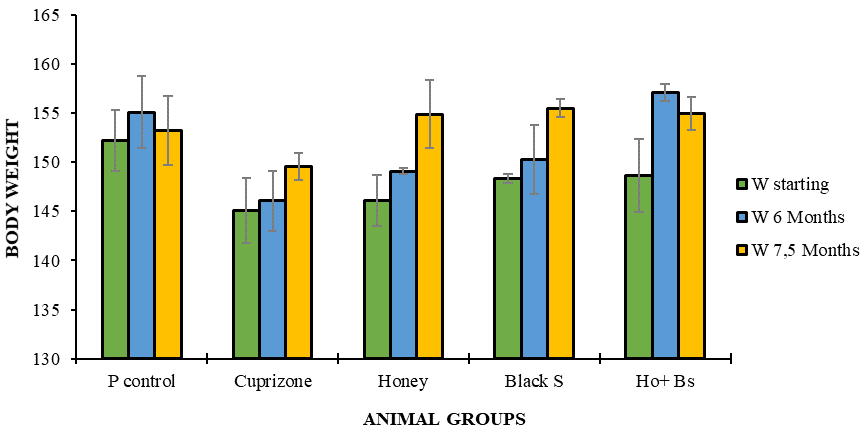
Body weights of animals at the starting, after six months and after seven and half months. There is no significant difference of body weight among the groups. Values are presented as mean t SEM. P value was set at 0.05.
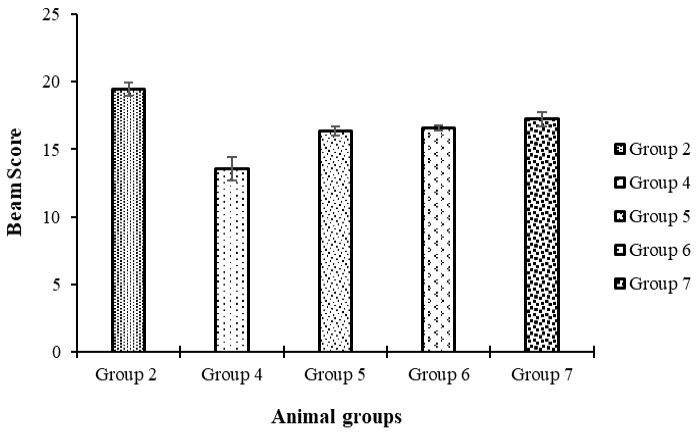
Beam walking score for five animal groups. Control group had significantly higher score as compared to all other groups. Honey, black seed and mixed groups showed significantly higher scores than CPZ treated animals. Scores are presented as mean ± SEM. Boxes with the same alphabet are not significantly different (P ≤ 0.05).
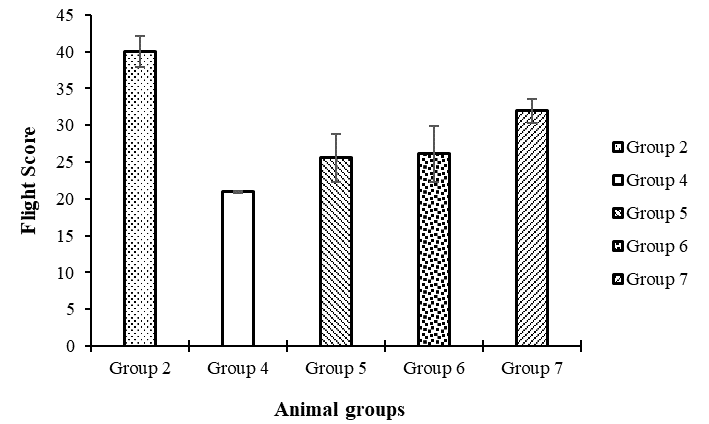
Flight length test results. Control group showed highest score followed by natural products treated groups and CPZ intoxicated group. Control group shows significantly higher length of flights than any other group. Treated groups have flight lengths less than control but significantly higher than animal treated with CPZ only. Data was presented as mean ± SEM. Bar with same alphabet means no significant difference (P ≤ 0.05).
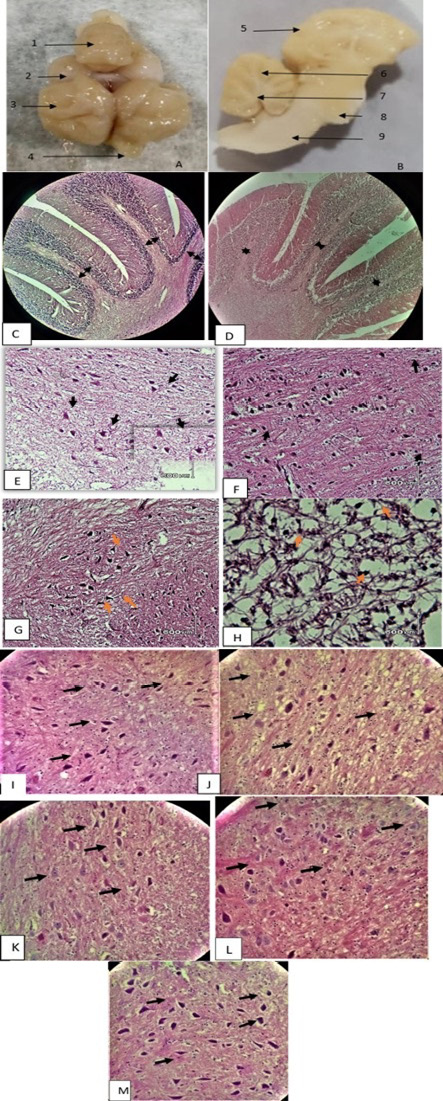
Cerebellar and cerebral white matter (H & E x 20 and x 40). (A) positive control entire brain (1: cerebellum; 2: optic lobe; 3: cerebral hemisphere; 4: olfactory lobe). (B) positive control sagittal brain section (5: cerebral cortex; 6: cerebellar cortex; 7: deep cerebellar white matter; 8: pons; 9: medullar oblongata. (C) positive control after six months shows normal thickness of cerebellar white matter folds. (D) six months CPZ treated animals show loss of cerebellar thickness in white matter folds. (E) control group kept for six months without CPZ shows deep cerebellar white matter and normal oligodendrocyte population. (F) animals with CPZ treatment for six months show rare oligodendrocytes. (G) cerebral white matter of control animal after six months shows normal glial cells. (H) cerebral white matter of six months CPZ treated animal shows apoptotic oligodendrocytes (arrow) and shrinkage of axons. (I) normal oligodendrocyte population can be seen in control animal after seven and half months without any treatment. (J) spontaneous oligodendrocyte regeneration can be seen in animal with no treatment for six weeks after six months of CPZ treatment. (K) honey treated group showing regeneration of oligodendrocytes. (L) black seed treated group showing increase in glial cells population. (M) Mixture (honey and black seed) treated group shows significantly increased oligodendrocyte population.
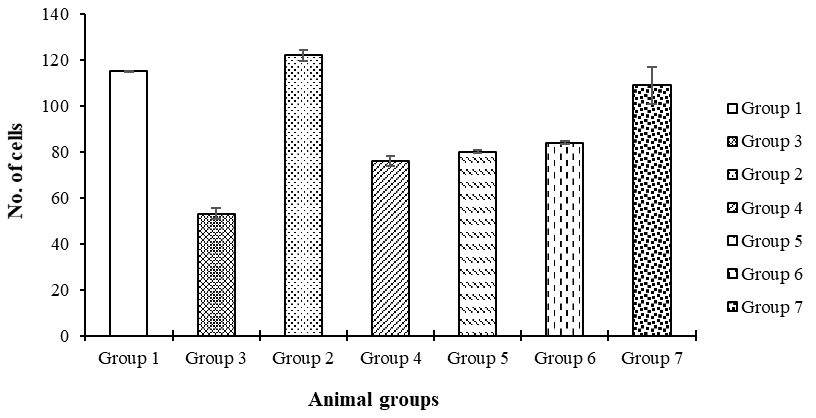
The number of oligodendrocytes in cerebellar white matter of quail is depicted in the graph. There is a severe depletion of oligodendrocytes after six months of CPZ treatment. Oligodendrocyte no. increases after the arrest of treatment. A non-significant difference in the number of oligodendrocytes can be observed in CPZ, honey and black seed group. Animals in mixture group have significantly higher number of oligodendrocytes than the honey, black seed and CPZ group. Oligodendrocyte number has been presented as mean ± SEM. Bar with same alphabet means no significant difference (P ≤ 0.05).
References
- Ahmad, A., Husain, A., Mujeeb, M., Khan, S.A., Najmi, A.K., Siddique, N.A., Damanhouri, Z.A., and Anwar, F., 2013. A review on therapeutic potential of Nigella sativa: A miracle herb. Asian Pac. J. Trop. Biomed., 3: 337-352. https://doi.org/10.1016/S2221-1691(13)60075-1[CrossRef]
- Ahmed, S.S.A., Sulaiman, A.A., Baig, I.M., Liaqat, S., Fatima, S., Jabeen, S., Shamim, N., and Othman, N.H., 2018. Honey as a potential natural antioxidant medicine: An insight into its molecular mechanisms of action. J. Oxid. Med. Cell. Long., 20. https://doi.org/10.1155/2018/8367846[CrossRef]
- Akhtar, M., Imam, S.S., Afroz, M., Ahmad, A.K., Najmi, M., Mujeeb and Aquil, M., 2014. Neuroprotective study of Nigella sativa-loaded oral provesicular lipid formulation: In vitro and ex vivo study. Drug Deliv., 21: 487-494. https://doi.org/10.3109/10717544.2014.886640[CrossRef]
- Akram, Z., Jalali, S., Kalsoom, O., Batool, S., and Shami, S.A., 2018. A study on the effects of arsenic toxicity on oviduct histomorphology in the female rat. J. Histol., 41: 149-159. https://doi.org/10.1080/01478885.2018.1484330[CrossRef]
- Alfaqih, K., 2020. Atypical ocular manifestations of multiple sclerosis and side effects of drugs: A review. EC Microbiology, 16: 1-7.
- Amin, F.A.Z., Sabri, S., Mohammad, S.M., Ismail, M., Chan, K.W., Ismail, N., Norhaizan, M.E., and Zawawi, N., 2018. Therapeutic properties of stingless bee honey in comparison with european bee honey. Adv. Pharmacol. pharmaceut. Sci., 2018. https://doi.org/10.1155/2018/6179596[CrossRef]
- Baer, J.R., Lansford and Cheng, K., 2015. Japanese quail as a laboratory animal model. Lab. Anim. Med., 2015: 1087-1108. https://doi.org/10.1016/B978-0-12-409527-4.00022-5[CrossRef]
- Bogdanov, S.T., Jurendic, R., Sieber and Gallman, P., 2008. Honey for nutrition and health: A review. J. Am. Coll. Nutr., 27: 677-689. https://doi.org/10.1080/07315724.2008.10719745[CrossRef]
- Butt, U.J.S.A., Shah, T., Ahmed and Zahid, S., 2018. Protective effects of Nigella sativa L. seed extract on lead induced neurotoxicity during development and early life in mouse models. Toxicol. Res., 7: 32-40. https://doi.org/10.1039/C7TX00201G[CrossRef]
- Carter, R.J., Morton, J., and Dunnett, S.B., 2001. Motor coordination and balance in rodents. Curr. Protocol. Neurosci., 15: 8.12.11-18.12.14. https://doi.org/10.1002/0471142301.ns0812s15[CrossRef]
- Chen, X., Wu, J.S., Lvovskaya, E., Herndon, C., Supnet and Bezprozvanny, I., 2011. Dantrolene is neuroprotective in Huntington’s disease transgenic mouse model. Mol. Neurodegen., 6: 1-12. https://molecularneurodegeneration.biomedcentral.com/ articles/10.1186/1750-1326-6-81
- Cianciosi, D., Forbes, T.Y., Afrin, S., Gasparrini, M., Reboredo-Rodriguez, P.P., Manna, J., Zhang, L., Bravo. L.S., Martínez, F., and Agudo, P.T., 2018. Phenolic compounds in honey and their associated health benefits: A review. Molecules, 23: 2322. https://doi.org/10.3390/molecules23092322[CrossRef]
- Coles, A.J., Compston, D., Selmaj, K.W., Lake, S.L., Moran, S., Margolin, D.H., Norris, K., and Tandon, P., 2008. Alemtuzumab vs. interferon beta-1a in early multiple sclerosis. New Eng. J. Med., 359: 1786-1801. https://doi.org/10.1056/NEJMoa0802670[CrossRef]
- Dehghan-Shahreza, F.S.S., Beladi-Mousavi and Rafieian-Kopaei, M., 2016. Medicinal plants and diabetic kidney disease; an updated review on the recent findings. Immunopathol. Persa., 2: e04.
- Dendrou, C.A., Fugger, L. and Friese, M.A., 2015. Immunopathology of multiple sclerosis. Nat. Rev. Immunol., 15: 545-558. https://www.nature.com/articles/nri3871, https://doi.org/10.1038/nri3871[CrossRef]
- Ebrahimi, S.S., Oryan, S., Izadpanah, E., and Hassanzadeh, K., 2017. Thymoquinone exerts neuroprotective effect in animal model of Parkinson’s disease. Toxicol. Lett., 276: 108-114. https://doi.org/10.1016/j.toxlet.2017.05.018[CrossRef]
- Fahmy, H.M., Noor, N.A., Mohammed, F.F., Elsayed, A.A., and Radwan, N.M., 2014. Nigella sativa as an anti-inflammatory and promising remyelinating agent in the cortex and hippocampus of experimental autoimmune encephalomyelitis-induced rats. J. Basic appl. Zool., 67: 182-195. https://doi.org/10.1016/j.jobaz.2014.08.005[CrossRef]
- Ghaiad, H.R., Nooh, M.M., El-Sawalhi, M.M., and Shaheen, A.A., 2017. Resveratrol promotes remyelination in cuprizone model of multiple sclerosis: Biochemical and histological study. Mol. Neurobiol., 54: 3219-3229. https://doi.org/10.1007/s12035-016-9891-5[CrossRef]
- Gudi, V., Gingele, S., Skripuletz, T., and Stangel, M., 2014. Glial response during cuprizone-induced de-and remyelination in the CNS: Lessons learned. Front. cell. Neurobiol., 8: 73. https://doi.org/10.3389/fncel.2014.00073[CrossRef]
- Gudi, V., Škuljec, J., Yildiz, Ö., Frichert, K., Skripuletz, T., Moharregh-Khiabani, D.E., Voß, K., Wissel, S., Wolter and Stangel, M., 2011. Spatial and temporal profiles of growth factor expression during CNS demyelination reveal the dynamics of repair priming. PLoS One, 6: e22623. https://doi.org/10.1371/journal.pone.0022623[CrossRef]
- Hala, G.M., El-Najjar, N., and Schneider-stock, R., 2006. The medicinal potential of black seed (Nigella sativa) and its components. Adv. Phytol., 2: 133-153. https://doi.org/10.1016/S1572-557X(05)02008-8[CrossRef]
- Hannan, M.A., Rahman, M.A., Sohag, M.J., Uddin, R., Dash, M.H., Sikder, M.S., Rahman, B., Timalsina, Y.A., Munni and Sarker, P.P., 2021. Black cumin (Nigella sativa L.): A comprehensive review on phytochemistry, health benefits, molecular pharmacology, and safety. Nutrients, 13: 1784. https://doi.org/10.3390/nu13061784[CrossRef]
- Hohlfeld, R., 2021. Mesenchymal stem cells for multiple sclerosis: Hype or hope? Lancet Neurol., 20: 881-882. https://doi.org/10.1016/S1474-4422(21)00324-0[CrossRef]
- Hollenbach, J.A., and Oksenberg, J.R.., 2015. The immunogenetics of multiple sclerosis: A comprehensive review. J. Autoimmun., 64: 13-25. https://doi.org/10.1016/j.jaut.2015.06.010[CrossRef]
- Homma, K., 1968. Studies on perfect and imperfect albinism in the Japanese quail (Coturnix corturnix japonica). Japan J. Zootec. Sci., 39: 348-352. https://doi.org/10.2508/chikusan.39.348[CrossRef]
- Hossen, M.S., Ali, M.Y., Jahurul, M., Abdel-Daim, M.M., Gan, S.H., and Khalil, M.I., 2017. Beneficial roles of honey polyphenols against some human degenerative diseases: A review. Pharmacol. Rep., 69: 1194-1205. https://doi.org/10.1016/j.pharep.2017.07.002[CrossRef]
- Huss, D., Poynter, G. and Lansford, R., 2008. Japanese quail (Coturnix japonica) as a laboratory animal model. Lab. Anim., 37: 513-519. https://doi.org/10.1038/laban1108-513[CrossRef]
- Hussain, R., Ghoumari, A.M., Bielecki, B., Steibel, J., Boehm, N., Liere, P., Macklin, W.B., Kumar, N.R., Habert and Mhaouty-Kodja, S., 2013. The neural androgen receptor: A therapeutic target for myelin repair in chronic demyelination. Brain, 136: 132-146. https://doi.org/10.1093/brain/aws284[CrossRef]
- Irvine, K., and Blakemore, W., 2006. Age increases axon loss associated with primary demyelination in cuprizone-induced demyelination in C57BL/6 mice. J. Neuroimmunol., 175: 69-76. https://doi.org/10.1016/j.jneuroim.2006.03.002[CrossRef]
- Jakimovski, D.S., Gandhi, I., Paunkoski, N., Bergsland, J., Hagemeier, D., Ramasamy, D., Hojnacki, C., Kolb, R., Benedict and Weinstock-Guttman, B., 2019. Hypertension and heart disease are associated with development of brain atrophy in multiple sclerosis: A 5-year longitudinal study. Eur. J. Neurol., 26: 87-e88. https://doi.org/10.1111/ene.13769[CrossRef]
- Juszczak, L., Gałkowska, D., Ostrowska, M., and Socha, R., 2016. Antioxidant activity of honey supplemented with bee products. Nat. Prod. Res., 30: 1436-1439. https://doi.org/10.1080/14786419.2015.1057582[CrossRef]
- Komoly, S., 2005. Experimental demyelination caused by primary oligodendrocyte dystrophy. Regional distribution of the lesions in the nervous system of mice [corrected]. Ideggyogy Sy., 58: 40-43. https://europepmc.org/article/med/15884397
- Kremer, D., Akkermann, R., Küry, P., and Dutta, R., 2019. Current advancements in promoting remyelination in multiple sclerosis. Mult. Sci. J., 25: 7-14. https://doi.org/10.1177/1352458518800827[CrossRef]
- Lindner, M., Fokuhl, J., Linsmeier, F., Trebst, C., and Stangel, M., 2009. Chronic toxic demyelination in the central nervous system leads to axonal damage despite remyelination. Neurol. Lett., 453: 120-125. https://doi.org/10.1016/j.neulet.2009.02.004[CrossRef]
- Liu, J., Tang, T.S., Tu, H., Nelson, O., Herndon, E., Huynh, D.P., Pulst, S.M., and Bezprozvanny, I., 2009. Deranged calcium signaling and neurodegeneration in spinocerebellar ataxia type 2. J. Neurol., 29: 9148-9162. https://doi.org/10.1523/JNEUROSCI.0660-09.2009[CrossRef]
- Luong, T.N., Carlisle, H.J., Southwell, A., and Patterson, P.H., 2011. Assessment of motor balance and coordination in mice using the balance beam. Neuroscience, 49: e2376. https://doi.org/10.3791/2376[CrossRef]
- Machado, D.M.A.A., Almeida-Muradian, L.B., Sancho, M.T., and Pascual-Maté, A., 2018. Composition and properties of Apis mellifera honey: A review. J. Apic. Res., 57: 5-37. https://doi.org/10.1080/00218839.2017.1338444[CrossRef]
- Miller, R.J., and Bell, G.I., 1996. AK/STAT eats the fat. Trends Neurosci., 19: 159-161. https://doi.org/10.1016/S0166-2236(96)30006-4[CrossRef]
- Minvielle, F., 2009. What are quail good for in a chicken-focused world? World Poult. Sci. J., 65: 601-608. https://doi.org/10.1017/S0043933909000415[CrossRef]
- Mitew, S., Hay, C.M., Peckham, H., Xiao, J., Koenning, M., and Emery, B., 2014. Mechanisms regulating the development of oligodendrocytes and central nervous system myelin. Neuroscience, 276: 29-47. https://doi.org/10.1016/j.neuroscience.2013.11.029[CrossRef]
- Mojaverrostami, S., Bojnordi, M.N., Ghasemi-Kasman, M.M., Ebrahimzadeh, A. and Hamidabadi, H.G., 2018. A review of herbal therapy in multiple sclerosis. Adv. Pharm. Bull., 8: 575. https://doi.org/10.15171/apb.2018.066[CrossRef]
- Noor, N.A., Fahmy, H.M., Mohammed, F.F., Elsayed, A.A. and Radwan, N.M., 2015. Nigella sativa amliorates inflammation and demyelination in the experimental autoimmune encephalomyelitis-induced Wistar rats. Int. J. clin. exp. Pathol., 8: 6269. https://doi.org/10.1016/j.bcp.2011.09.029[CrossRef]
- Olkowicz, S., Kocourek, M., Lučan, R.K., Porteš, M., Fitch, W.T., Herculano-Houzel, S. and Němec, P., 2016. Birds have primate-like numbers of neurons in the forebrain. Proc. natl. Acad. Sci., 113: 7255-7260. https://doi.org/10.1073/pnas.1517131113[CrossRef]
- Peterson, R.E., and Bollier, M.E., 1955. Spectrophotometric determination of serum copper with biscyclohexanoneoxalyl dihydrazone. Analyt. Chem., 27: 1195-1197. https://doi.org/10.1021/ac60103a054[CrossRef]
- Piao, Y., and Liang, X., 2012. Chinese medicine in diabetic peripheral neuropathy: Experimental research on nerve repair and regeneration. Evid. Based Complement. Altern. Med., 2012. https://doi.org/10.1155/2012/191632[CrossRef]
- Remington, L.T., Babcock, A.A., Zehntner, S.P. and Owens, T., 2007. Microglial recruitment, activation, and proliferation in response to primary demyelination. Am. J. Pathol., 170: 1713-1724. https://doi.org/10.2353/ajpath.2007.060783[CrossRef]
- Rivera, F.J., Hinrichsen, B., and Silva, M.E., 2019. Pericytes in multiple sclerosis. Adv. exp. Med. Biol., 1147: 167-187. https://doi.org/10.1007/978-3-030-16908-4_8[CrossRef]
- Rodríguez-Flores, M.S., Escuredo, O., Míguez, M., and Seijo, M.C., 2019. Differentiation of oak honeydew and chestnut honeys from the same geographical origin using chemometric methods. Fd. Chem., 297: 124979. https://doi.org/10.1016/j.foodchem.2019.124979[CrossRef]
- Shimakura, K., 1940. Notes on the genetics of the Japanese quail. I. The simple, Mendelian, autosomal, recessive character brown-splashed white, of its plumage. Idengahu Zasshi Japan J. Genet., 16: 106-112. https://doi.org/10.1266/jjg.16.106[CrossRef]
- Silvestroff, L.S., Bartucci, J., Pasquini and Franco, P., 2012. Cuprizone-induced demyelination in the rat cerebral cortex and thyroid hormone effects on cortical remyelination. Exp. Neurol., 235: 357-367. https://doi.org/10.1016/j.expneurol.2012.02.018[CrossRef]
- Steelman, A.J., Thompson, J.P. and Li, J., 2012. Demyelination and remyelination in anatomically distinct regions of the corpus callosum following cuprizone intoxication. Neurol. Res.,72: 32-42. https://doi.org/10.1016/j.neures.2011.10.002[CrossRef]
- Tavakkoli, A., Ahmadi, A., Razavi, B.M., and Hosseinzadeh, H., 2017. Black seed (Nigella sativa) and its constituent thymoquinone as an antidote or a protective agent against natural or chemical toxicities. Iran. J. Pharm. Res., 16(Suppl): 2-23. https://www.ncbi.nlm.nih.gov/pmc/articles/PMC5963642/.
- Vazhacharickal, P.J., 2021. A review on health benefits and biological action of honey, propolis and royal jelly. J. med. Plants Stud., 9: 1-13. http://www.plantsjournal.com.
- Viuda-Martos, M., Ruiz-Navajas, Y.J., Fernández-López and Pérez-Álvarez, J., 2008. Functional properties of honey, propolis, and royal jelly. J. Fd. Sci., 73: R117-R124. https://doi.org/10.1111/j.1750-3841.2008.00966.x[CrossRef]
- Woo, C.C., Kumar, A.P.G., Sethi and Tan, K.H.B., 2012. Thymoquinone: Potential cure for inflammatory disorders and cancer. Biochem. Pharm., 83: 443-451. https://doi.org/10.1016/j.bcp.2011.09.029[CrossRef]
- Zhan, J., Mann, T.S., Joost, N., Behrangi, M., Frank and Kipp, M., 2020. The cuprizone model: Dos and do nots. Cells, 9: 843. https://doi.org/10.3390/cells9040843[CrossRef]
- Zhen, W., Liu, A., Lu, J., Zhang, W., Tattersall, D., and Wang, J., 2017. An alternative cuprizone-induced demyelination and remyelination mouse model. ASN Neuro., 9: 1759091417725174. https://doi.org/10.1177/1759091417725174[CrossRef]
Services
Article usage statistics
Loading…