Tiambo Christian Keambou1*, Sylvere Mboumba2, Blaise Arnaud Hako Touko3, Celestine Bembide4, Toussaint Mezui Mezui2, Annie Marie Yvonne Tedongmo5, Yacouba Manjeli5
1University of Buea, P.O. Box 63, Buea, Cameroon; 2University of Science and Technology of Masuku, PO Box 901 Franceville/Gabon; 3Catholic University Institute of Buea (CUIB), P.O Box 563 Buea, Cameroon; 4Central African Institute of Agronomic Research (ICRA), PO Box 1762, Bangui, Central African Republic; 5University of Dschang, P.O. Box 222, Dschang, Cameroon.
*Correspondence | Tiambo Christian Keambou, University of Buea, Buea, Cameroon; Email: keambou.tiambo@ubuea.cm
Abstract
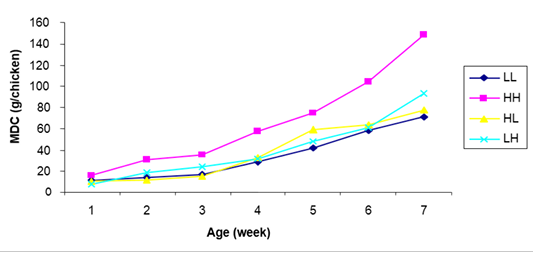
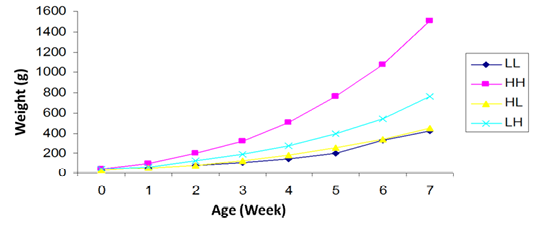
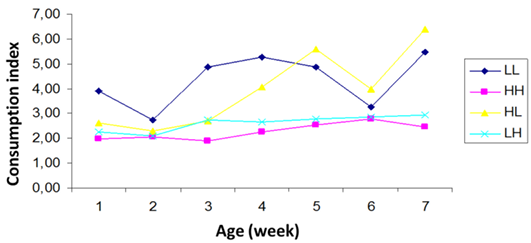
With the aim of improving the productivity of local chicken, reciprocal crossbreeding experiments were carried out to compare the performances of Hubbard rooster x local chicken (HL) and local rooster x Hubbard female (LH) to those of pure Hubbard (HH) and local (LL) breeds simultaneously reared in the same conditions in the Western Highlands of Cameroon. The main result showed that the effect of genetic type has significantly influenced the studied parameters. The analysis of egg characteristics revealed that the HH and LH crossbreds produced eggs of statistically comparable weight (P>0.05) of 70.28 ± 0.62g and 69.51 ± 0.58g, respectively. These eggs proved to be heavier and of significantly higher measurements (P<0.05) than those of the LL and HL crossbreds, which in turn presented best shape indices of respectively, 73.95 ± 1.20 and 72.79 ± 0.65. The study of growth, conformation and carcass revealed that HH chicks significantly consumed more feed (P>0.05) than the three others genetic type throughout the study period and had the best performances (P>0.05) from the first to the seventh week for all considered parameters. The final weight of HH was 1504.69 ± 88.07g, followed by LH (762.78 ± 122.68 g), then HL (451.17 ± 62.13 g) and finally LL (422.31 ± 20.94 g). On the other hand, LH chicks had better mean daily weight gain (31.34 ± 16.78) and feed conversion (2.86 ± 0.06) than LL (4.19 ± 0.57) and HL (12, 08 ± 5.29). But whatever the period, HH chicks made the best feed conversion (2.04 ± 0.07 and 2.58 ± 0.17 for the starting and growing period), carcass yield and heart weight (72.28 ±1.13 % and 12.2 ± 2.33 g). On the contrary, there was no significant difference for the liver and crop weight (12.20 ± 3.65 g; 13.56 ± 2.65 g and 10.07 ± 3.16 g; 12.00 ± 1.77 g) respectively for HL and LL.
Keywords | Aviculture, Cameroon, Crossbreeding, Productivity
Editor | Kuldeep Dhama, Indian Veterinary Research Institute, Uttar Pradesh, India.
Received | April 09, 2015; Revised | May 25, 2015; Accepted | May 31, 2015; Published | August 03, 2015
Citation | Keambou TC, Mboumba S, Touko BAH, Bembide C, Mezui TM, Tedongmo AMY, Manjeli Y (2015). Growth performances, carcass and egg characteristics of the local chicken and its first generation reciprocal crossbreds with an exotic strain in Cameroon . Adv. Anim. Vet. Sci. 3(10): 507-513.
ISSN (Online) | 2307-8316; ISSN (Print) | 2309-3331
Copyright © 2015 Keambou et al. This is an open access article distributed under the Creative Commons Attribution License, which permits unrestricted use, distribution, and reproduction in any medium, provided the original work is properly cited.