In this study, sweet potato and cassava meal had a lower metabolizable energy than that stated by Heuzé et al. (2015). Meanwhile, the crude protein was found to be the same as mentioned by these authors. Comparatively to the same research outcomes, this study revealed that crude fibre, lipids and ash content of the sweet potato meal were higher, Cassava meal had lower ash content than expected, but had higher protein content, ash and lipids content than what stated earlier by Heuzé et al. (2015). The differences found in the tubers used as compared to literature results may have numerous origins that could be intrinsic or extrinsic to the genetic makeup of the tubers. In fact Schoeninger et al. (2000) mentioned that irrespective of season and presence of above-ground foliage, the age of the tuber may be an important factor as older tubers have a higher fraction of inedible material.
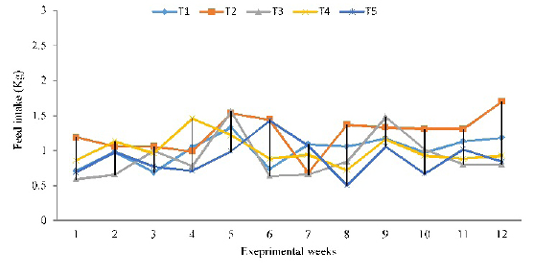
Feed intake was found to increase across the treatments with increased level of substitution for maize with cassava-sweet potato meal. This is opposed to Salami and Odunsi (2003), Anaeto and Adighibe (2011) and Kana et al. (2013) who reported a decrease feed intake with increased level of inclusion of similar test diet. However, it should be mentioned that an important aspect suggested to have favoured increase feed intake was the fact that the feed was pelleted, meanwhile with studies by Salami and Odunsi (2003), Anaeto and Adighibe (2011) and Kana et al. (2013), mash feed was used. Indeed, Munt et al. (1995) and Preston et al. (2000) mentioned the advantages of pelleted feed on feed intake and growth performances in chicken.
Metabolizable energy intake was found to increase in the substituted diets with the control diet having the lowest intake. This is contrary to the observation by Aina and Fanimo (1997) in which inclusion of cassava meal in the diet of layer birds significantly reduced metabolizable. Crude protein intake was also found to increase with cassava-sweet potato meal substituted diets, while the control diet had the least crude protein intake. This disagrees with Aina and Fanimo (1997) where no significant difference in crude protein intake of layer birds fed sweet potato and cassava meal was observed. Lipid intake for this experimental trial was found to increase with cassava-sweet potato substitution. The increase in apparent digestibility of organic nutrients of pelleted feed is in accordance with Zelenka et al. (2003) who observed higher apparent digestibility with pelleted feed as oppose to mash feed (with crude fat being highly significant).
In general, T5 recorded the highest digestibility closely followed by T3, then T2, T4 and T1 with the least of them all. An increase in digestibility across the experimental treatments was observed, indicating that digestibility increased with increase substitution of maize by cassava-sweet potato meal. This is supported by Heuzé et al. (2015) who stated that cassava and sweet potato meal are much more dusty and soluble than maize, hence cassava and sweet potato meal diets are digested faster than maize diets (confirm in this study by T5 achieving the highest digestibility). Therefore, to achieve better digestibility in Cameroon Kabir chickens production, T5 (100% substitution) and T3 (50% substitution) are recommended according to this experimental trial.
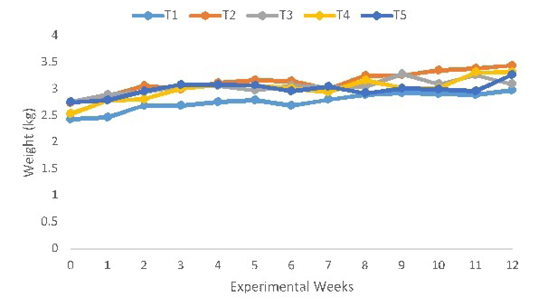
The growth study of all the experimental treatments showed no statistical difference in growth amongst the treatments. This confirms the fact that Cameroon Kabir chickens used were at their plateau stage of growth. This is in accordance with what was reported by INRA (1989) who confirmed the fact that most of the nutrients assimilated at this stage are principally oriented for body maintenance and less for growth.
Weight base FCR indicates that T3 had a better FCR followed by T5, T1, T2 and T4. Meanwhile, egg base FCR showed better FCR for all cassava-sweet potato substituted diets with the control diet having the poorest egg base FCR. This suggest that cassava-sweet potato meal substituted diets had better reproductive performances than the maize base diet (control diet).This differ from what was reported by Farooq et al. (2002) in which egg base FCR was found to vary between 1.92-2.13 less than what was observed in this study.
The formulated test diet increased in cost per kg from 214.7 Fcfa for the control diet (T1) to 408.6 Fcfa for 100% substitution of maize with cassava-sweet potato meal (T5). This is in contrast to what was observed by Aderemi et al. (2006), Anaeto and Adighibe (2011), Kana et al. (2013) and Salami and Odunsi (2003) who all observed a decrease in the cost of formulated feed per kg as the percentage substitution of maize increased. This increase in cost shows that substituting maize with cassava-sweet potato meal for Kabir chicken production was not economical during the experimental period in Buea.
The RBC count ranges from 1.9-4.7(×106 mm) with the hens having lower counts and rosters higher counts, which agrees with the study carried out by Bahman et al. (2011). The RBC count were all within accepted ranges for T1 and T3. T2 count levels where low, meanwhile the RBC count for T4 hens were abnormally high. Whereas, the blood count for T5 rosters were abnormally the same as those of hens.
Haemoglobin levels for the treatments were found to follow the same trend of variation as do the RBC count, T1 and T3 varying within acceptable ranges as discussed by Bahman et al. (2011) and Keambou et al. (2014).
HCT (Haematocrit level) for T4 hens were abnormally high above normal range display by T1, T3, and T5 hens whereas T2 and T5 rosters values were abnormally low. MCV (Mean Cell Volume in fl), MCH (Mean Corpuscular Haemoglobin in pg), and MCHC (mean corpuscular hemoglobin concentration) for T1 and T3 were within normal range. T2 was abnormally low together with T5 rosters. T4 values for both sexes were averagely the same and within range for hens. All the normal ranges were found to be in conformity with Adeyemo and Sani (2013) who witness increase in these blood parameters using hydrolyzed cassava peel meal diet.
From the carcass analyses results, hens from the various treatments had a higher % weight of kidney, gizzard, liver, spleen, proventriculus and abdominal fat than their corresponding rosters in the same treatment had a corresponding higher % weight of heart and lungs with respect to carcass. This is conformity to their respective physiological requirements. From the data obtained and analyzed, there were no abnormalities found within the treatments in relation to their carcass characteristics.