
Ulcerative colitis (UC) is a kind of chronic inflammatory bowel disease, closely related to colon cancer. Ginsenoside Rh2 (GRh2) is a rare protopanaxadiol type triterpene saponins in ginseng, which has anti-inflammatory/cancer/diabetic impacts. To investigate the molecular mechanism in which GRh2 reduced inflammation of UC via upregulating microRNA (miR)-30a-5p, we detected miR-30a-5p in the tissues and serum of patients with active UC and in NCM460 cells after dextran sulfate sodium (DSS) treatment. Inflammation factors, nuclear factor-κB (NF-κB) and p65, were detected in NCM460 cells introduced with disparate concentrations of GRh2 after DSS treatment or transfection. We found that GRh2 increased expressionlevels of miR-30a-5p to inhibit inflammation and promote to advancement of NCM460 cell. In conclusion, enhancive miR-30a-5p further elevated GRh2’s repression UC’s progression. GRh2 drives miR-30a-5p to repress inflammation, NF-κB pathway and cell advancement, thereby mitigating UC.
Research Article · Volume 56, 19 March 2025 · Open Access
Ginsenoside Rh2 Reduces Inflammation of Ulcerative Colitis via Elevating microRNA-30a-5p
· · · · · · · · ·
Affiliations & Notes ⌄
- 1Affiliated Hospital of Zunyi Medical University, Zunyi City, Guizhou Province, 563000, China * Corresponding author: zhangsuy66@hotmail.com
Article Info ⌄
- Journal:
- Pakistan Journal of Zoology
- Published:
- 19 March 2025

From the article
- In this study, we found that GRh2 alleviates DSS stimulated UC by elevating elevating miR-30a-5p.
- Enhanced Mir-30a-5p drives UC cell progression, which is inhibited by inhibition of Mir-30a-5p.
- In conclusion, GRh2 promotes the progression of UC cells and controls the progression of UC in a dose-dependent manner.
- Enhancement of miR-30a-5p inhibits the progression of UC by inhibiting inflammation and activation of the NF-κB pathway.
Selected from the article's own text.
Abstract
INTRODUCTION
Ulcerative colitis (UC) is a kind of chronic inflammatory bowel disease . The incidence is increasing year by year, and patients with disease degree are prone to recurrence, which is also supposed to result in colon cancer . Therefore, the harm of UC to the human body cannot be ignored. Nowadays, the best clinical treatment of UC is drug therapy. Current drugs for the treatment of UC include mesalazine , 5-aminosalicylic acid , steroids and immunosuppressive agents. However, long-term application of the drugs could result in diversified side impacts like drug resistance, liver and kidney toxicity, and allergic reactions, while traditional Chinese medicine has obvious advantages like memorable efficacy, reduced recurrence rate, and fewer side impacts in treating UC. New Chinese medicine treatment of UC has an extremely extensive prospect.
Ginsenoside Rh2 (GRh2) is a rare protopanaxadiol type triterpene saponins in ginseng . Many reports have confirmed GRh2 has anti-inflammatory/cancer/diabetic effects . For instance, GRh2 reduces allergic airway inflammation by controlling activation of nuclear factor-κB (NF-κB) in a mouse model of asthma . A study reveals the molecular mechanism of GRh2 in UC. GRh2 alleviates UC by regulating the STAT3/miR-214 pathway . However, mechanism of GRh2 in treatment of UC requires to be further clarified.
MicroRNA (miRNA) is a class of tiny endogenous single-stranded non-coding RNA molecules with the function of regulating gene expression, participating in various immune-linked illnesses (Van der Goten et al., 2021). There is increasing evidences manifesting miRNAs can affect the disease activity in UC patients , and are dysregulated in the inflammatory environment of the intestinal mucosa of UC patients . MiR-20b, miR-98, miR-125b-1 and let-7e are specifically elevated in UC patients, and can be used as new biomarkers of UC . MiR-141 plays an important role in intestinal inflammation in patients with active UC by inhibiting CXCL5 . Plentiful studies have manifested miR-30a-5p is reduced in illnesses , and is considered a regulator of inflammation . MiR-30a-5p silencing targeting SOCS1 promotes macrophages M2 polarization and improves cardiac injury behind viral myocarditis (VMC) . However, the role of miR-30a-5p in UC remains unclear.
In this study, human normal colonic epithelial cells NCM460 were studied in vitro to verify the effect of GRh2 on UC. The results originally identified the molecular mechanism in which GRh2 alleviating the inflammation of UC by upregulating miR-30a-5p, and provided a theoretical basis for development GRh2 as a new target for UC treatment.
MATERIALS AND METHODS
Human tissue samples
24 active UC patients and 20 healthy individuals undergoing colonic mucosal biopsy within colonoscopy at Affiliated Hospital of Zunyi Medical University was enrolled from 2016 to 2017. After blood collection, serum was extracted by centrifuge and stored in a PAXgene™ tube covering RNA stabilization solution (Fisher Scientific, Waltham, MA) . Colon tissues of 11 patients undergoing surgical resection and corresponding healthy controls were collected, and biopsy tissues were obtained by mucosal dissection . Biopsy tissues were obtained by mucosal dissection RNAlater (Ambion, Austin, TX, USA) with quick-freezing in liquid nitrogen, and then the serum was stored with the biopsy tissue in a refrigerator at -80°C (Van der Goten et al., 2014). Pathological analysis via a pathologist was further confirmed as active UC. All patients in the study signed informed consent forms. This study was approved by the Ethics Committee of the Ethics Committee of Affiliated Hospital of Zunyi Medical University, and performance of all operations were carried out according to the guidelines permitted by the ethics Committee.
Cell culture
Normal colonic epithelial cell NCM460 (ATCC, Manassas, VA, USA) were in Dulbecco’s Modified Eagle Medium (DMEM) appended with 10% fetal bovine serum, 100 U/mL penicillin and 100 μg/mL streptomycin, which was changed every other day. 80% confluent cells were selected for subsequent experiments .
NCM460 cells were treated with 2% dextran sulfate sodium (DSS) (MP Biomedicals, Santa Ana, USA) at 37°C for 4 d for establishment of an in vitro UC model .
Cell transfection
NCM460 cells were seeded in a 24-well plate (5 × 10⁴ cells/ well) and cultured in antibiotic-free DMEM. When cell confluence reaches 80%, miR-30a-5p mimic/inhibitor and their negative controls (NC-mimic/inhibitor) were transfected into NCM460 cells, according to the method of Lipofectamine 3000 (Invitrogen, Carlsbad, CA, USA) manufacturing. The transfection efficiency was detected by reverse transcription quantitative polymerase chain reaction (RT-qPCR). All oligonucleotides were derived from Ribobio (Guangzhou, China) .
Cell counting kit (CCK)-8 detection of cell viability
The viability of NCM460 cells treated or transfected with different concentrations of GRh2 (0, 10, 20, 50 μM, purity ≥ 98%, Merck KGaA, Darmstadt, Germany) was determined by CCK-8 method. NCM460 cells were seeded into 96-well plates (8000 cells/well) for culture. Addition of 10 µL CCK-8 reagent (Guangzhou Tianti Biotechnology Co., Ltd., Guangzhou, China), and incubation were implemented . Then a BioTek PowerWave spectrophotometer (Thermo Fisher, USA) was employed for detection of the absorbance at 450 nm. The inhibition rate was calculated as (the control - the experimental/the control) OD × 100% .
Flow cytometry
Apoptosis of NCM460 cells was determined by detection and analysis . According to the manufacturer’s protocol, cells were isolated with trypsin and stained with Annexin V-luciferin isothiocyanate/Propyl iodide (Beyotime Institute of Biotechnology). The results were analyzed applying FACSCalibur flow cytometer (BD Biosciences) and FlowJo software (version 7.6.1; Tree Star, Inc.) .
RT-qPCR
Total RNA was extracted from NCM460 cell and tissue samples using TRIzol reagent (Invitrogen) according to the instructions, with miRNA Reverse Transcription Kit (Promega, USA) or PrimeScript RT-PCR Kit (Takara, Japan) for reverse transcription of miRNA and mRNA into cDNA. StepOne real-time PCR system (Applied Biosystems, USA) was used for RT-QPCR detection . Glyceraldehyde-3-phosphate dehydrogenase (GAPDH) was applied as a loading control for mRNA, with U6 for miRNA. The primers were from GeneCopoeia (California, USA). PCR primer sequences applied in the research were shown in Table I.
Enzyme-linked immunosorbent assay (ELISA)
GRh2 with different concentrations or transfected into serum-free DMEM cell culture medium was incubated. The supernatant was sucked by a straw, the impurities were removed by centrifugation at 300 g, and the supernatant was taken for subsequent experiments . Concentrations of tumor necrosis factor -α (TNF-α), interleukin (IL)-1β and IL-6 in cell culture supernatant were determined using ELISA kits (eBioscience, Thermo Fisher Scientific, USA) according to manufacturer’s instructions. Absorbance at 450 nm was measured with a microplate meter (Biotek Instruments, Inc., Winooski, VT, USA) .
Table I. Primer sequence design.
| Name | Primer sequence (5'-3') |
| miR-30a-5p | F: ACACTCCAGCTGGGTGTAAACATCCTCGAC; R: CAGTGCGTGTCGTGGAGT |
| U6 | F: CGCGCTTCGGCAGCACATAIACT; R: ACGCTTCACGAATTTGCGTGTC |
| IL-6 | F: CCGGAGAGGAGACTTCAG; R: CAGAATTGCCATTGCACAAC |
| TNF-a | F: GGTCTGGGCCATAGAACTGA; R: CAGCCTCTTCTATTCCTGC |
| IL-lp | F: TTGTTGATGTGCTGCTGTGA; R: TGTGAAATGCCACCTTTTGA |
| GAPDH | F: AGGAGCGAGACCCCACTAACA; R: AGGGGGGCTAAGCAGTTGGT |
Western blot
Total protein of NCM460 cells was extracted by radioimmunoprecipitation analysis of a mixture of lysate buffer (Beyotime Biotechnology, China) and protease and phosphatase inhibitors (MedChemExpress, China). Quantitative analysis was carried out by Bicinchoninic Acid protein analysis kit (Thermo Scientific, USA). Proteins were separated by 10% sodium dodecyl sulfate polyacrylamide gel electrophoresis, and electrical imprinting was carried out on polyvinylidene fluoride membrane. Then the membrane was blocked with 5% skim milk powder . Then, incubation of the membrane was with the following primary antibodies: anti-GDPHA (1: 2000; Abbkine, Inc., USA), anti-NF-κB p65 and anti-NF-κB p-p65 (both 1: 1000) (Cell Singnaling Technology, USA). After washing with Phosphate Buffered Saline Tween-20 buffer solution, membranes were incubated with diluted horseradish peroxidase-conjugated secondary antibody (1: 500, 00, Santa Cruz Biotechnology, USA) . After washing with Tris-buffered saline with Tween 20, the protein bands were observed using the enhanced chemiluminescence kit (Beyotime) according to the manufacturer’s instructions .
Statistical analysis
All data are presented as mean±standard error. Prizm GraphPad V6 software (GraphPad, San Diego, CA, USA) was used for statistical analysis. A t test was used to compare differences between the two groups, and one-way ANOVA and Bonferroni multivariate comparison test were used to compare differences between three groups and more than three groups. P < 0.05 was considered a significant difference .
RESULTS
GRh2 inhibits inflammation and the NF-κB pathway
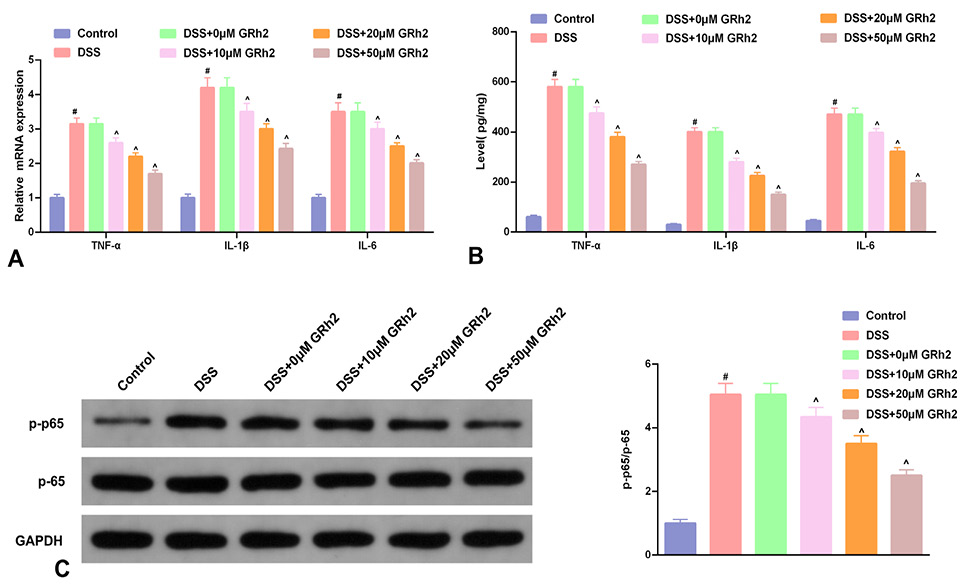
In order to explore the mechanism of GRh2 action in UC cells, NCM460 cells were treated with 2% DSS to construct UC model in vitro, and then treated with different concentrations of GRh2 (0, 10, 20, 50 μM). In chronic intestinal inflammation, multiple immune and non-immune and intestinal epithelial cells (NCM460) produce a variety of pro-inflammatory/anti-inflammatory factors, such as TNF-α, IL-1β and IL-6, which can affect apoptosis of NCM460 cells . TNF-α, IL-1β and IL-6 were determined in the supernatant of GRh2 and NCM460 cells with different concentrations (Fig. 1A, B). Results demonstrated that GRh2 inhibited TNF-α, IL-1β and IL-6 in a dose-dependent manner. NF-κB stimulates a suite of genes implicated in the inflammatory cascade’s development, as well as the activation of sorts of pro-inflammatory and inflammatory mediators, including TNF-α, lymphocytes and cytokines, resulting in long-term inflammation and apoptosis . Therefore, NF-κB was detected to clarify that GRh2 memorably repressed NF-κB p-p65 (Fig. 1C). Results manifested GRh2 inhibited the inflammation response and the NF-κB pathway in UC cells.
GRh2 drives UC cell advancement
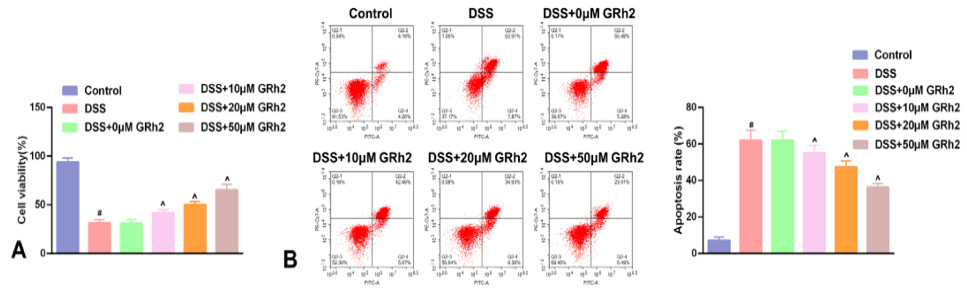
Next, we explored expression of GRh2 in UC tissues. Cell progression was detected (Fig. 2A-B), indicating that GRh2 had a concentration-dependent effect on NCM460 cell progression after DSS treatment. These results confirmed that GRh2 can effectively promote UC cell process in a concentration-dependent manner. Among the above treatments, 50 μM GRh2 had the most obvious effect on UC cells. 50 μM GRh2 was selected for subsequent experiments.
Mir-30a-5p has a significant inhibitory effect on active UC patients
To understand the difference of miR-30a-5p between active UC patients and healthy controls, miR-30a-5p was detected in serum of 24 active UC patients and 20 healthy controls, as well as in colon tissues of 11 active UC patients and 11 healthy controls. The results showed that miR-30a-5p was significantly decreased in active UC patients compared with healthy controls (P < 0.05) (Fig. 3A, B). Relative miR-30a-5p was detected in normal or DSS-introduced NCM460 cells to ensure that Mir-30a-5P was significantly inhibited in DSS-treated cells compared with normal (P < 0.05) (Fig. 3C).
Characterization of MiR-30a-5p in UC cells
To investigate the characteristics of miR-30a-5p in UC cells, miR-30a-5p mimics/inhibitors and NC-mimic and NC-inhibitor were transfected into NCM460 cells without introduction of GRh2, respectively. miR-30a-5p was detected in the transfected NCM460 cells (Fig. 4A), revealing that vs. the NC-mimic/inhibitor, miR-30a-5p in the cells introduced with miR-30a-5p mimic/inhibitor was clearly enhanced or declined (P < 0.05). Detection of inflammatory-linked factors was in NCM460 cells behind transfection manifested enhancive miR-30a-5p inhibited the inflammation (P < 0.05) (Fig. 4B, C). It came out in the transfected NCM460 cells, augmented miR-30a-5p restrained NF-κB p-p65 (P < 0.05) (Fig. 4D), while NF-κB p65 did not change memorably. The transfected NCM460 cell progression was then measured to ensure that inhibition of Mir-30A-5P significantly inhibited NCM460 cell progression (P < 0.05), while upregulating one enhanced that (P < 0.05) (Fig. 4E, F).
GRh2 inhibits UC progression via elevating miR-30a-5p
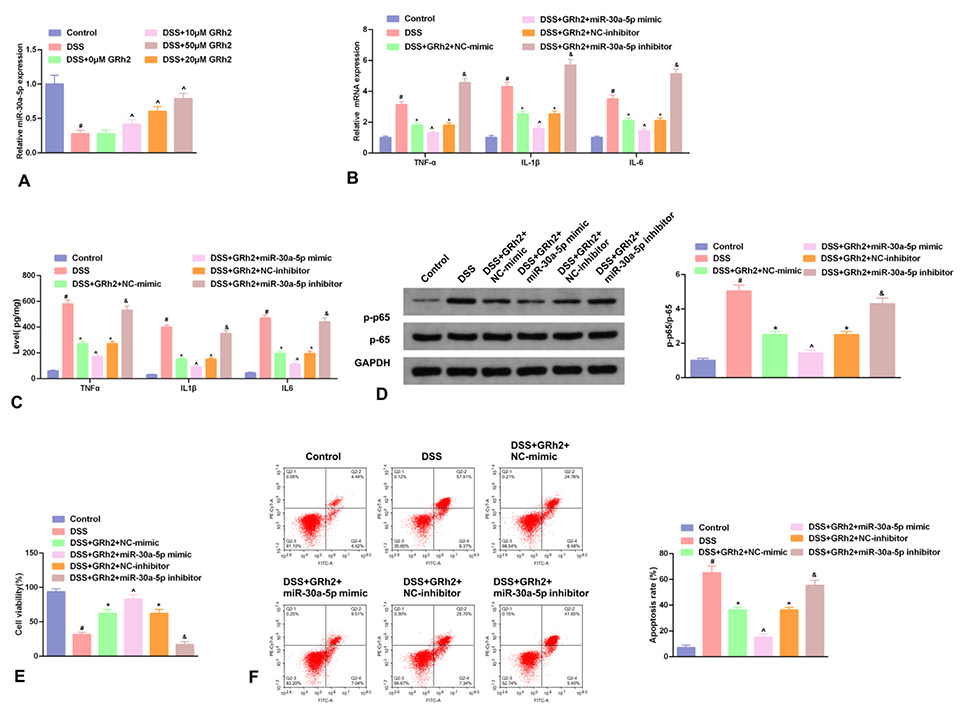
To explore the effect of GRh2 on Mir-30a-5p in NCM460 cells, we detected miR-30a-5p in NCM460 cells treated with different concentrations of GRh2. The results showed that GRh2 drove miR-30a-5p (P < 0.05) (Fig. 5A). To further investigate the molecular mechanism of GRh2 controlling UC progression by increasing miR-30a-5p, we transfected miR-30a-5p mimic/inhibitor and NCs into NCM460 cells introduced by GRh2 (50 μM). NCM460 cells were then detected to progress behind GRh2 import and transfection. The results showed that the enhancement of miR-30a-5p further enhanced the effect of GRh2 by inhibiting inflammatory response, phosphorylation of NF-κB p65, and enhancing UC cell progression, while mir-30a-5p inhibitors attenuated GRh2 inhibition of UC progression by enhancing miR-30a-5p (Fig. 5B-F). In conclusion, GRh2 alleviates UC by upregulating miR-30a-5p.
DISCUSSION
UC is a long-term intestinal inflammatory illness. Its pathogenesis refers to diversified genes and pathways . Nowadays, little is known about its pathogenesis. There is a popular belief that the illness is stimulated via environmental, immune, genetic and intestinal flora disorders and other reasons . Chinese medicine has been employed for treating UC for a long time in China. Recently, numerous pharmaceutical companies have started to pay attention to the research and development of natural products owing to considerations like drug resistance, cost and safety. It has become an important direction for the treatment of UC to discover the main active ingredients from Chinese traditional medicine .
Studies have confirmed that GRh2 is an intermediate metabolite of ginseng , which has anti-inflammatory/cancer/diabetic/obesity functions . For instance, Rh2 enhances immune cell activity but inhibits tumor cell growth . Rh2 inhibition is used to treat the cellular progression of cancer and can also be used to alleviate the side effects of chemotherapy or radiotherapy . Rh2 also plays a role in the treatment of UC. In previous studies, GRh2 alleviates DSS-stimulated colitis by enhancing TGF-β signaling . In this study, we found that GRh2 alleviates DSS stimulated UC by elevating elevating miR-30a-5p. In addition, other studies have shown that the ingredients contained in other Chinese medicines also have a considerable impact on the treatment of UC. For example, pomegranate polyphenols reduce intestinal inflammation of UC in vivo and in vitro via Mir-145/p70S6K1/HIF1α axis . Anemoside B4, a compound with anti-inflammatory activity, prevents acute UC by inhibiting the TLR4/NF-κB/MAPK pathway . Resveratrol enhances T-regulatory cells by inhibiting Mir-31 to prevent colitis stimulated by 2, 4, 6-nitrobenzene sulfonate solution .
To reveal the mechanism of GRh2 action in UC, NCM460 cells were treated with 2% DSS to establish an inflammatory model, and then treated with different concentrations of GRh2 (0, 10, 20, 50 μM). The results showed that GRh2 inhibited inflammation in a concentration-dependent manner, which is consistent with previous studies . GRh2 also has anticancer effects in UC - related colorectal cancers. However, there are only 2 reports on the function of GRh2 in UC, and no studies have been conducted to clarify the therapeutic effect of GRh2 in human UC patients. Therefore, the molecular mechanism of GRh2 in UC needs to be further studied, and a large number of studies are needed to verify and ensure its safety.
A large amount of evidence suggests that miRNA is involved in the pathogenesis of UC. For instance, miR-155 is involved in the pathogenesis of UC by targeting FOXO3a . MiR-141 participates in UC’ pathogenesis via targeting CXCL5 . Meanwhile, miRNA can control the biological behavior of UC. For instance, miR-155 targets Est-1 and stimulates UC via the Th17 pathway mediated by IL-23/17/6 . Inhibition of miR-330-3p alleviates DSS stimulated UC and apoptosis by enhancing er stress component XBP . This study initially found that miR-30a-5p was inhibited in tissues and serum of patients with active UC and in DSS-introduced NCM460 cells. Enhanced Mir-30a-5p drives UC cell progression, which is inhibited by inhibition of Mir-30a-5p. Differences in miR-30a-5p also affect inflammatory responses, NF-κB and p65 phosphorylation. Considering previous reports, in UC, elevated Mir-31 and -155 control the IL-13 pathway by targeting IL-13 receptor α-1 . Some reports have identified miR-30A-5p as a downstream target. Several reports have clarified miR-30a-5p mitigated lipopolysaccharid-stimulated inflammatory damage in human A549 cells and mice by targeting RUNX2 . MiR-30a-5p contributes to colorectal cancer tumor growth by targeting the LIN28B/IRS1 axis . We hypothesized that miR-30a-5p may control the pathway and inhibit apoptosis of UC cells by targeting TNF-α, IL-1β and IL-6 receptors. This speculation needs to be confirmed by further experiments.
CONCLUSION
In conclusion, GRh2 promotes the progression of UC cells and controls the progression of UC in a dose-dependent manner. Enhancement of miR-30a-5p inhibits the progression of UC by inhibiting inflammation and activation of the NF-κB pathway. GRh2 alleviates UC by elevating miR-30a-5p. The results of this study once again confirmed the characteristics of GRh2 in UC, and provided a theoretical basis for GRh2 to be used as a new UC treatment drug in the future.
Statement of conflict of interest
The authors have declared no conflict of interest.
Figures
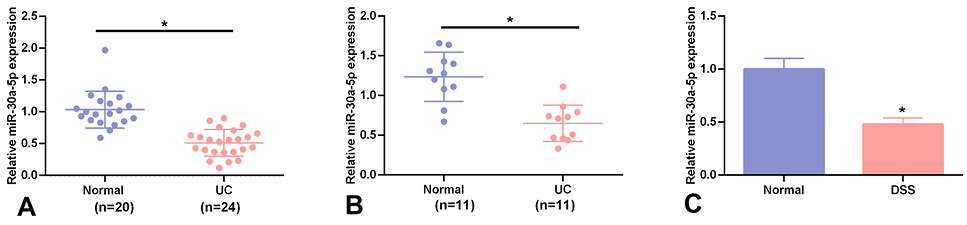
MiR-30a-5p is refrained in serum and tissues of active UC patients and NCM460 cells behind DSS treatment. A, RT-qPCR detection of the relative miR-30a-5p in the serum of active UC patients and healthy controls. Vs. healthy controls, miR-30a-5p was apparently reduced in the serum of active UC patients. B-C, RT-qPCR detection of the relative miR-30a-5p in colonic mucosal biopsies from active UC patients and healthy controls, and in normal or DSS-introduced NCM460 cells. * P < 0.05.
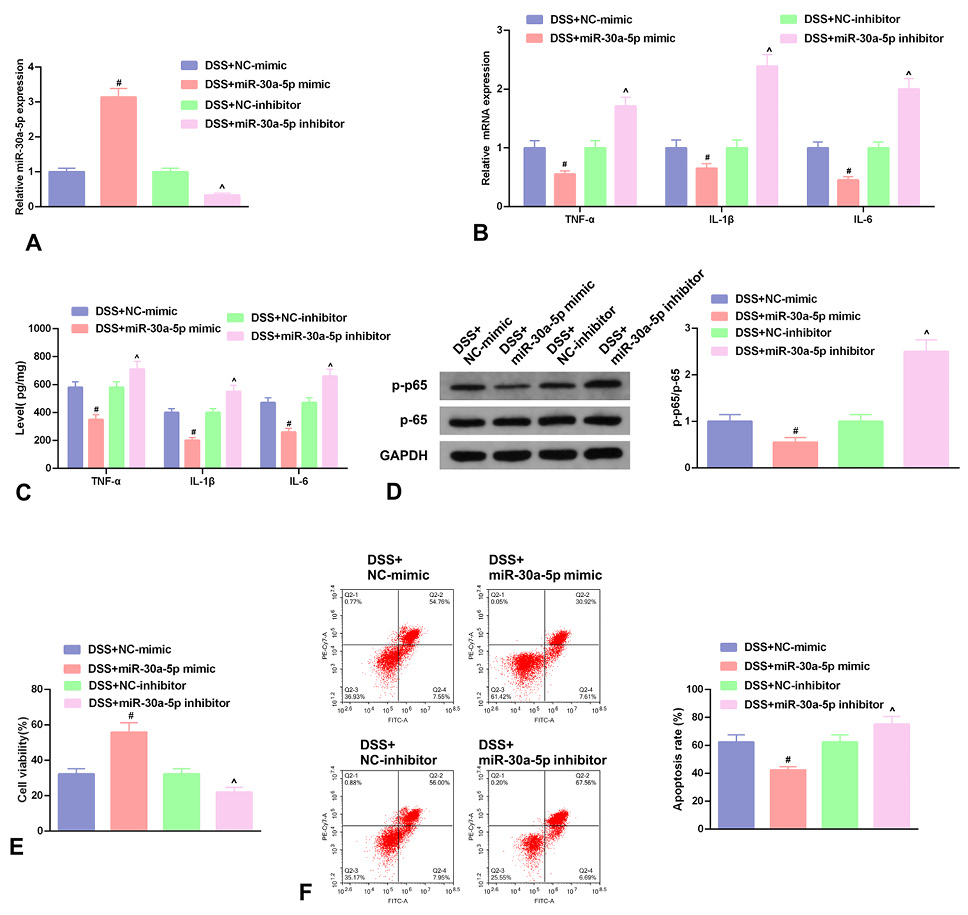
Enhancive miR-30a-5p restrains inflammation and NF-κB pathway, and strengthens NCM460 cell advancement. A, the relative miR-30a-5p in NCM460 cells introduced with miR-30a-5p mimic/inhibitor and NC-mimic/inhibitor. B, TNF-α, IL-1β and IL-6. A-B, RT-qPCR detection. C, ELISA detection the concentrations of TNF-α, IL-1β and IL-6 in cell culture medium. D, WB detection of the ratio of NF-κB p-p65 to NF-κB p65 protein. E, CCK-8 method detection of the cell viability. F, Flow cytometry detection of apoptosis. B-F, in introduced NCM460 cells. E-F, Elevated miR-30a-5p elevated cell viability but repressed cell apoptosis. # P < 0.05, vs. the NC mimic in the miR-30a-5p mimic; ^ P < 0.05, vs. the NC-inhibitor in the miR-30a-5p inhibitor.
References
- Alrafas, H., Busbee, P., Nagarkatti, M. and Nagarkatti, P., 2020. Resveratrol downregulates miR-31 to promote t regulatory cells during prevention of TNBS-induced colitis. Mol. Nutr. Fd. Res., 64: e1900633. https://doi.org/10.1002/mnfr.201900633[CrossRef]
- Cai, M., Chen, S. and Hu, W., 2017. MicroRNA-141 is involved in ulcerative colitis pathogenesis via aiming at CXCL5. J. Interferon Cytokine Res. Off. J. Int. Soc. Interferon Cytokine Res., 37: 415-420. https://doi.org/10.1089/jir.2017.0019[CrossRef]
- Chen, Q., Fang, X., Yao, N., Wu, F., Xu, B. and Chen, Z., 2020. Suppression of miR-330-3p alleviates DSS-induced ulcerative colitis and apoptosis by upregulating the endoplasmic reticulum stress components XBP1. Hereditas, 157: 18. https://doi.org/10.1186/s41065-020-00135-z[CrossRef]
- Chen, X., Xu, T., Lv, X., Zhang, J. and Liu, S., 2021. Ginsenoside Rh2 alleviates ulcerative colitis by regulating the STAT3/miR-214 signaling pathway. J. Ethnopharmacol., 274: 113997. https://doi.org/10.1016/j.jep.2021.113997[CrossRef]
- Coskun, M., Bjerrum, J., Seidelin, J., Troelsen, J., Olsen, J. and Nielsen, O., 2013. miR-20b, miR-98, miR-125b-1*, and let-7e* as new potential diagnostic biomarkers in ulcerative colitis. World J. Gastroenterol., 19: 4289-4299. https://doi.org/10.3748/wjg.v19.i27.4289[CrossRef]
- Deng, X., Shang, L., Du, M., Yuan, L., Xiong, L. and Xie, X., 2020. Mechanism underlying the significant role of the miR-4262/SIRT1 axis in children with inflammatory bowel disease. Exp. Ther. Med., 20: 2227-2235. https://doi.org/10.3892/etm.2020.8918[CrossRef]
- Ding, A. and Wen, X., 2018. Dandelion root extract protects NCM460 colonic cells and relieves experimental mouse colitis. J. Natl. Med., 72: 857-866. https://doi.org/10.1007/s11418-018-1217-7[CrossRef]
- Dubois-Camacho, K., Diaz-Jimenez, D., De la Fuente, M., Quera, R., Simian, D., Martínez, M., Landskron, G., Olivares-Morales, M., Cidlowski, J., Xu, X., Gao, G., Xie, J., Chnaiderman, J., Soto-Rifo, R., González, M.J., Calixto, A. and Hermoso, M.A., 2019. Inhibition of miR-378a-3p by inflammation enhances IL-33 levels: A novel mechanism of alarmin modulation in ulcerative colitis. Front. Immunol., 10: 2449. https://doi.org/10.3389/fimmu.2019.02449[CrossRef]
- Fukuda, T., Naganuma, M., Takabayashi, K., Hagihara, Y., Tanemoto, S., Nomura, E., Yoshimatsu, Y., Sugimoto, S., Nanki, K., Mizuno, S., Mikami, Y., Fukuhara, K., Sujino, T., Mutaguchi, M., Inoue, N., Ogata, H., Iwao, Y., Abe, T. and Kanai, T., 2020. Mucosal concentrations of N-acetyl-5-aminosalicylic acid related to endoscopic activity in ulcerative colitis patients with mesalamine. J. Gastroenterol. Hepatol., 35: 1878-1885. https://doi.org/10.1111/jgh.15059[CrossRef]
- Goudarzi, R., Partoazar, A., Mumtaz, F., Yousefi-Manesh, H., Abdollahi, A., Dehpour, A. and Rashidian, A., 2020. Arthrocen, an avocado-soy unsaponifiable agent, improves acetic acid-induced colitis in rat by inhibition of NF-kB signaling pathway. J. Fd. Biochem., 44: e13244. https://doi.org/10.1111/jfbc.13244[CrossRef]
- Guo, J., Zhang, R., Zhao, Y. and Wang, J., 2021. MiRNA-29c-3p Promotes intestinal inflammation via targeting leukemia inhibitory factor in ulcerative colitis. J. Inflamm. Res., 14: 2031-2043. https://doi.org/10.2147/JIR.S302832[CrossRef]
- He, R., Li, Y., Han, C., Lin, R., Qian, W. and Hou, X., 2019. L-Fucose ameliorates DSS-induced acute colitis via inhibiting macrophage M1 polarization and inhibiting NLRP3 inflammasome and NF-kB activation. Int. Immunopharmacol., 73: 379-388. https://doi.org/10.1016/j.intimp.2019.05.013[CrossRef]
- Hou, J., Hu, X., Chen, B., Chen, X., Zhao, L., Chen, Z., Liu, F. and Liu, Z., 2017. miR-155 targets Est-1 and induces ulcerative colitis via the IL-23/17/6-mediated Th17 pathway. Pathol. Res. Pract., 213: 1289-1295. https://doi.org/10.1016/j.prp.2017.08.001[CrossRef]
- Hu, Y., Xue, J., Min, J., Qin, L., Zhang, J. and Dai, L., 2020. Biocatalytic synthesis of ginsenoside Rh2 using Arabidopsis thaliana glucosyltransferase-catalyzed coupled reactions. J. Biotechnol., 309: 107-112. https://doi.org/10.1016/j.jbiotec.2020.01.003[CrossRef]
- Ji, W., Zhang, X., Sun, X., Wang, X., Chang, B. and Zhang, M., 2014. miRNA-155 modulates the malignant biological characteristics of NK/T-cell lymphoma cells by targeting FOXO3a gene. J. Huazhong Univ. Sci. Technol. med. Sci., 34: 882-888. https://doi.org/10.1007/s11596-014-1368-z[CrossRef]
- Jung, H., Kim, J., Lee, K., Tizaoui, K., Terrazzino, S., Cargnin, S., Smith, L., Koyanagi, A., Jacob, L., Li, H., Hong, S.H., Yon, D.K., Lee, S.W., Kim, M.S., Wasuwanich, P., Karnsakul, W., Shin, J.I. and Kronbichler, A., 2021. Roles of microRNAs in inflammatory bowel disease. Int. J. Biol. Sci., 17: 2112-2123. https://doi.org/10.7150/ijbs.59904[CrossRef]
- Kim, H., Banerjee, N., Sirven, M., Minamoto, Y., Markel, M., Suchodolski, J., Talcott, S. and Mertens-Talcott, S., 2017. Pomegranate polyphenolics reduce inflammation and ulceration in intestinal colitis-involvement of the miR-145/p70S6K1/HIF1α axis in vivo and in vitro. J. Nutr. Biochem., 43: 107-115. https://doi.org/10.1016/j.jnutbio.2017.02.005[CrossRef]
- Kraskiewicz, H., Paprocka, M., Bielawska-Pohl, A., Krawczenko, A., Panek, K., Kaczyńska, J., Szyposzyńska, A., Psurski, M., Kuropka, P. and Klimczak, A., 2020. Can supernatant from immortalized adipose tissue MSC replace cell therapy? An in vitro study in chronic wounds model. Stem Cell Res. Ther., 11: 29. https://doi.org/10.1186/s13287-020-1558-5[CrossRef]
- Lee, H., Lee, S., Jeong, D. and Kim, S., 2018. Ginsenoside Rh2 epigenetically regulates cell-mediated immune pathway to inhibit proliferation of MCF-7 breast cancer cells. J. Ginseng Res., 42: 455-462. https://doi.org/10.1016/j.jgr.2017.05.003[CrossRef]
- Li, J., Wang, Y., Wang, K., Wang, Z., Jia, D., Yang, B. and Xiong, C., 2017. Downregulation of miR-214-3p May contribute to pathogenesis of ulcerative colitis via targeting STAT6. BioMed. Res. Int., 2017: 8524972. https://doi.org/10.1155/2017/8524972[CrossRef]
- Li, L., Piao, H., Zheng, M., Lin, Z., Choi, Y. and Yan, G., 2015. Ginsenoside Rh2 attenuates allergic airway inflammation by modulating nuclear factor-κB activation in a murine model of asthma. Mol. Med. Rep., 12: 6946-6954. https://doi.org/10.3892/mmr.2015.4272[CrossRef]
- Li, P., Yao, Y., Ma, Y. and Chen, Y., 2021. MiR-30a-5p ameliorates LPS-induced inflammatory injury in human A549 cells and mice via targeting RUNX2. Innate Immun., 27: 41-49. https://doi.org/10.1177/1753425920971347[CrossRef]
- Li, W., Sun, Y., Dai, L., Chen, H., Yi, B., Niu, J., Wang, L., Zhang, F., Luo, J., Wang, K., Guo, R., Li, L., Zou, Q., Ma, Z.S. and Miao, Y., 2021. Ecological and network analyses identify four microbial species with potential significance for the diagnosis/treatment of ulcerative colitis (UC). BMC Microbiol., 21: 138. https://doi.org/10.1186/s12866-021-02201-6[CrossRef]
- Li, X., Chu, S., Lin, M., Gao, Y., Liu, Y., Yang, S., Zhou, X., Zhang, Y., Hu, Y., Wang, H. and Chen, N., 2020. Anticancer property of ginsenoside Rh2 from ginseng. Eur. J. med. Chem., 203: 112627. https://doi.org/10.1016/j.ejmech.2020.112627[CrossRef]
- Liu, G., Liu, Y., Jiang, G. and Ren, W., 2018. The reversal effect of Ginsenoside Rh2 on drug resistance in human colorectal carcinoma cells and its mechanism. Hum. Cell, 31: 189-198. https://doi.org/10.1007/s13577-017-0189-3[CrossRef]
- Liu, S., Zhang, S., Lv, X., Lu, J., Ren, C., Zeng, Z., Zheng, L., Zhou, X., Fu, H., Zhou, D. and Chen, Y., 2019. Limonin ameliorates ulcerative colitis by regulating STAT3/miR-214 signaling pathway. Int. Immunopharmacol., 75: 105768. https://doi.org/10.1016/j.intimp.2019.105768[CrossRef]
- Luo, Y., Yu, M., Yan, Y., Zhou, Y., Qin, S., Huang, Y., Qin, J. and Zhong, M., 2020. Rab27A promotes cellular apoptosis and ROS production by regulating the miRNA-124-3p/STAT3/RelA signalling pathway in ulcerative colitis. J. cell. mol. Med., 24: 11330-11342. https://doi.org/10.1111/jcmm.15726[CrossRef]
- Ma, H., Zhou, M., Duan, W., Chen, L., Wang, L. and Liu, P., 2020. Anemoside B4 prevents acute ulcerative colitis through inhibiting of TLR4/NF-κB/MAPK signaling pathway. Int. Immunopharmacol., 87: 106794. https://doi.org/10.1016/j.intimp.2020.106794[CrossRef]
- Malham, M., James, J., Jakobsen, C., Hoegdall, E., Holmstroem, K., Wewer, V., Nielsen, B. and Riis, L., 2021. Mucosal microRNAs relate to age and severity of disease in ulcerative colitis. Aging, 13: 6359-6374. https://doi.org/10.18632/aging.202715[CrossRef]
- Nighot, P., Young, K., Nighot, M., Rawat, M., Sung, E., Maharshak, N., Plevy, S., Ma, T. and Blikslager, A., 2013. Chloride channel ClC-2 is a key factor in the development of DSS-induced murine colitis. Inflamm. Bowel Dis., 19: 2867-2877. https://doi.org/10.1097/MIB.0b013e3182a82ae9[CrossRef]
- Pekow, J., Meckel, K., Dougherty, U., Huang, Y., Chen, X., Almoghrabi, A., Mustafi, R., Ayaloglu-Butun, F., Deng, Z., Haider, H., Hart J., Rubin D., Kwon J. and Bissonnette M., 2017. miR-193a-3p is a key tumor suppressor in ulcerative colitis-associated colon cancer and promotes carcinogenesis through upregulation of IL17RD. Clin. Cancer Res. Off. J. Am. Assoc. Cancer Res., 23: 5281-5291. https://doi.org/10.1158/1078-0432.CCR-17-0171[CrossRef]
- Peng, L., Gao, X., Nie, L., Xie, J., Dai, T., Shi, C., Tao, L., Wang, Y., Tian, Y. and Sheng, J., 2020. Astragalin attenuates dextran sulfate sodium (DSS)-induced acute experimental colitis by alleviating gut microbiota dysbiosis and inhibiting NF-κB activation in mice. Front. Immunol., 11: 2058. https://doi.org/10.3389/fimmu.2020.02058[CrossRef]
- Qiu, S., Li, P., Zhao, H. and Li, X., 2020. Maresin 1 alleviates dextran sulfate sodium-induced ulcerative colitis by regulating NRF2 and TLR4/NF-kB signaling pathway. Int. Immunopharmacol., 78: 106018. https://doi.org/10.1016/j.intimp.2019.106018[CrossRef]
- Rezayat, S., Dehpour, A., Motamed, S., Yazdanparast, M., Chamanara, M., Sahebgharani, M. and Rashidian, A., 2018. Foeniculum vulgare essential oil ameliorates acetic acid-induced colitis in rats through the inhibition of NF-kB pathway. Inflammopharmacology, 26: 851-859. https://doi.org/10.1007/s10787-017-0409-1[CrossRef]
- Tambuwala, M., Khan, M., Thompson, P. and McCarron, P., 2019. Albumin nano-encapsulation of caffeic acid phenethyl ester and piceatannol potentiated its ability to modulate HIF and NF-kB pathways and improves therapeutic outcome in experimental colitis. Drug Delivery Transl. Res., 9: 14-24. https://doi.org/10.1007/s13346-018-00597-9[CrossRef]
- Tang, M., Zhou, J., You, L., Cui, Z. and Zhang, H., 2019. LIN28B/IRS1 axis is targeted by miR-30a-5p and promotes tumor growth in colorectal cancer. J. cell. Biochem., 12. Online ahead of print. https://doi.org/10.1002/jcb.29529[CrossRef]
- Tian, Y., Cui, L., Lin, C., Wang, Y., Liu, Z. and Miao, X., 2020. LncRNA CDKN2B-AS1 relieved inflammation of ulcerative colitis via sponging miR-16 and miR-195. Int. Immunopharmacol., 88: 106970. https://doi.org/10.1016/j.intimp.2020.106970[CrossRef]
- Van der Goten, J., Vanhove, W., Lemaire, K., Van Lommel, L., Machiels, K., Wollants, W., De Preter, V., De Hertogh, G., Ferrante, M., Van Assche, G., Rutgeerts, P., Schuit, F. and Vermeire, S., 2014. Integrated miRNA and mRNA expression profiling in inflamed colon of patients with ulcerative colitis. PLoS One, 9: e116117. https://doi.org/10.1371/journal.pone.0116117[CrossRef]
- Wang, D., Kim, Y., Baek, N., Mathiyalagan, R., Wang, C., Jin, Y., Xu, X. and Yang, D., 2021. Lactobacillus rhamnosus glycosyl transformation of ginsenoside Rh2 into two novel ginsenosides using recombinant glycosyltransferase from and its applications. J. Ginseng Res., 45: 48-57. https://doi.org/10.1016/j.jgr.2019.11.004[CrossRef]
- Wang, S., Shen, L. and Luo, H., 2021. Identification and validation of key miRNAs and a microRNA-mRNA regulatory network associated with ulcerative colitis. DNA Cell Biol., 40: 147-156. https://doi.org/10.1089/dna.2020.6151[CrossRef]
- Watanabe, M., Nishino, H., Sameshima, Y., Ota, A., Nakamura, S. and Hibi, T., 2013. Randomised clinical trial: evaluation of the efficacy of mesalazine (mesalamine) suppositories in patients with ulcerative colitis and active rectal inflammation, a placebo-controlled study. Aliment. Pharmacol. Ther., 38: 264-273. https://doi.org/10.1111/apt.12362[CrossRef]
- Wu, F., Guo, N., Tian, H., Marohn, M., Gearhart, S., Bayless, T., Brant, S. and Kwon, J., 2011. Peripheral blood microRNAs distinguish active ulcerative colitis and Crohn’s disease. Inflamm. Bowel Dis., 17: 241-250. https://doi.org/10.1002/ibd.21450[CrossRef]
- Wu, Q., Zhu, Y., Guo, C. and Zheng, X., 2014. Ginsenoside Rh2 alleviates dextran sulfate sodium-induced colitis via augmenting TGFβ signaling. Mol. Boil. Rep., 41: 5485-5490. https://doi.org/10.1007/s11033-014-3422-0[CrossRef]
- Xiang, H., Tao, X., Xia, S., Qu, J., Song, H., Liu, J. and Shang, D., 2017. viaEmodin alleviates sodium taurocholate-induced pancreatic acinar cell injury microRNA-30a-5p-mediated inhibition of high-temperature requirement a/transforming growth factor beta 1 inflammatory signaling. Front. Immunol., 8: 1488. https://doi.org/10.3389/fimmu.2017.01488[CrossRef]
- Yan, Y., Shao, M., Qi, Q., Xu, Y., Yang, X., Zhu, F., He, S., He, P., Feng, C., Wu, Y., Li H., Tang W., and Zuo J., 2018. Artemisinin analogue SM934 ameliorates DSS-induced mouse ulcerative colitis via suppressing neutrophils and macrophages. Acta Pharmacol. Sin., 39: 1633-1644. https://doi.org/10.1038/aps.2017.185[CrossRef]
- Ye, H., Wu, Q., Zhu, Y., Guo, C. and Zheng, X., 2014. Ginsenoside Rh2 alleviates dextran sulfate sodium-induced colitis via augmenting TGFβ signaling. Mol. Biol. Rep., 41: 5485–5490. https://doi.org/10.1007/s11033-014-3422-0[CrossRef]
- Zeng, L., Tan, J., Xue, M., Liu, L., Wang, M., Liang, L., Deng, J., Chen, W. and Chen, Y., 2020. An engineering probiotic producing defensin-5 ameliorating dextran sodium sulfate-induced mice colitis via Inhibiting NF-kB pathway. J. Transl. Med., 18: 107. https://doi.org/10.1186/s12967-020-02272-5[CrossRef]
- Zhang, B. and Coon, C., 1997. The relationship of calcium intake, source, size, solubility in vitro and in vivo, and gizzard limestone retention in laying hens. Poult. Sci., 76: 1702-1706. https://doi.org/10.1093/ps/76.12.1702[CrossRef]
- Zhang, L., Virgous, C. and Si, H., 2020. How does ginsenoside Rh2 mitigate adipogenesis in cultured cells and obese mice? Molecules (Basel, Switzerland), 25: https://doi.org/10.3390/molecules25102412[CrossRef]
- Zhang, R., Wang, Z., Yu, Q., Shen, J., He, W., Zhou, D., Yu, Q., Fan, J., Gao, S. and Duan, L., 2019. Atractylenolide II reverses the influence of lncRNA XIST/miR-30a-5p/ROR1 axis on chemo-resistance of colorectal cancer cells. J. cell. mol. Med., 23: 3151-3165. https://doi.org/10.1111/jcmm.14148[CrossRef]
- Zhang, T., Zhou, Y., You, B., You, Y., Yan, Y., Zhang, J., Pei, Y., Zhang, W. and Chen, J., 2021. miR-30a-5p inhibits epithelial-to-mesenchymal transition by targeting CDK6 in nasal polyps. Am. J. Rhinol. Allergy, 35: 152-163. https://doi.org/10.1177/1945892420939814[CrossRef]
- Zhang, Y., Cai, S., Ding, X., Lu, C., Wu, R., Wu, H., Shang, Y. and Pang, M., 2021. MicroRNA-30a-5p silencing polarizes macrophages toward M2 phenotype to alleviate cardiac injury following viral myocarditis by targeting SOCS1. Am. J. Physiol. Heart Circ. Physiol., 320: H1348-H1360. https://doi.org/10.1152/ajpheart.00431.2020[CrossRef]
- Zhou, J., Liu, J., Gao, Y., Shen, L., Li, S. and Chen, S., 2021. miRNA-based potential biomarkers and new molecular insights in ulcerative colitis. Front. Pharmacol., 12: 707776. https://doi.org/10.3389/fphar.2021.707776[CrossRef]
Services
Article usage statistics
Loading…