
Oral squamous cell carcinoma is the sixth most common cancer worldwide. Though there are significant improvements in diagnosis and treatment, the outcome is still very low. Thus, the development of novel therapeutic approaches is needed. In this study, we aimed to identify the inhibitory effect of celecoxib (CXB), cisplatin (Cis) and the combination of CXB and Cis and to explore the potential molecular mechanisms involved in oral cancer cells (OC-3 and SCC-9). MTT assay was used to check the cell viability, cell migration and invasion was performed to evaluate the metastasis and western blot to check the protein expression. The results showed that the combination of CXB and Cis synergistically inhibited cell proliferation, migration and invasion of OC-3 cells. The notch signalling pathway plays an oncogenic role in tongue squamous cell carcinoma. We observed that treatment with CXB and Cis decreased NOTCH1, JAG1, Pre 2, and ADAM9 expression and increased Numb protein expression. Our study demonstrated that Notch signalling is dysregulated in human OSCC and plays a role in cell proliferation.
Research Article · Volume 56, 19 March 2025 · Open Access
Celecoxib and Cisplatin Synergistically Inhibit Oral Cancer Cell Proliferation Via Modulating the NOTCH 1 Signalling Pathway
· · · · · · · ·
Affiliations & Notes ⌄
- 1Department of Medical Laboratory Technology, Faculty of Applied Medical Sciences, University of Tabuk, Tabuk 71491, Saudi Arabia. 2 Department of Medical Microbiology, Faculty of Medicine, University of Tabuk, Tabuk 71491, Saudi Arabia. 3Department of Bioinformatics and Medical Engineering, Asia University, Taichung, Taiwan. 4Department of Medical Research, China Medical University Hospital, China Medical University, Taichung 404, Taiwan. 5Department of Medical Laboratory Science and Biotechnolo
Article Info ⌄
- Journal:
- Pakistan Journal of Zoology
- Published:
- 19 March 2025

From the article
- In the present study, we provide clear evidence that the combined tumour treatment with Cis and CXB significantly decreased oral squamous cell carcinoma cell proliferation, migration and invasion in vitro, compared with the single treatment.
- In the present study, OC-3 cells showed increased NOTCH1, Jagged1 (JAG1), Presenilin 1,2, Nicastrin, and RBPSUH expression.
- Based on NOTCH1 expression we chose to use OC-3 cell line to reveal the potential association between NOTCH1 signalling and oral cancer cell proliferation.
- In this study we observed that CXB and combination treatment was not able to inhibit JAG1 expression, however Cis treatment alone decreased Jag1 expression compared to control cells.
Selected from the article's own text.
Abstract
INTRODUCTION
Oral squamous cell carcinoma (OSCC) is the sixth most common cancer worldwide, and accounts for 90% of all oral cancer types found in the mouth, tongue, and lips ; . The risk factors of OSCC include smoking, alcohol consumption, betel nut chewing and human papillomavirus (HPV) infection . Despite recent improvements in chemotherapy and surgery, the survival rate is still low as a result of the emergence of treatment resistance and recurrence . Cisplatin, cis-diamminedichloroplatinum (II) Pt (NH3)2Cl2 is widely used anticancer drug, used in the treatment of various cancer types, including OSCC . The development of platinum-resistant OSCC is an important factor that leads to treatment failure.
CXB, a cyclooxygenase 2 (COX-2) inhibitor is an effective non-steroidal anti-inflammatory drug (NSAIDs). Targeted inhibition of COX-2 may be an effective strategy for treating several cancer types like prostate, colon, lung and liver cancer ; . CXB is also said to reverse the epithelial-to-mesenchymal transition (EMT), reduce cell motility, and restrict proliferation in oral cancer cells . Furthermore, COX-2 expression was significantly downregulated after treatment with CXB alone or in combination with Cis compared with Cis alone in oral cancer cells . Previous studies have suggested that a combination of the Cis with CXB exerts a synergistic anti-proliferative effect . Numerous studies have shown that combining CXB with additional medications may have synergistic anti-cancer benefits in a variety of cancer types ; ; ; .
Notch controls how cancer stem cells (CSCs) develop and helps cells acquire EMT phenotype, both of which are crucially linked to treatment resistance , 2010). The Notch signalling pathway may play dual roles such as tumour suppressor/ oncogene in different cancers , role of Notch signalling in OSCC remains controversial. It has been shown that OSCC expressed jagged canonical Notch ligand 1 (JAG1), a canonical notch ligand . Notch signalling inhibition has been shown to inhibit cancer cell proliferation/cell cycle progression, reduce cancer cell viability, and increase cell apoptosis in various cancer types . An earlier study hypothesized that COX-2 could accelerate the progression of gastric cancer by activating the neurogenic locus notch homolog protein 1 (NOTCH1) signal pathway . Nevertheless, the combinatory effect of CXB and Cis on Notch activity in oral cancer cells has not yet been studied. Our study demonstrated that Notch signalling is dysregulated in human OSCC and plays a significant role in cell proliferation and migration.
MATERIALS AND METHODS
Chemicals and antibodies
Celecoxib (Pfizer) was purchased from a local pharmacy and dissolved in DMSO (Sigma Chemical Co). Cisplatin was purchased from local pharmacy and dissolved in normal saline (2 mg/ml) as a stock solution in 4 °C. CXB and Cis were added at various concentrations to cells in 10% fetal bovine serum (FBS)-containing DMEM. Antibodies NOTCH1 (#3268), Jag1 (#2620), Jag2 (#2210), Presenilin-1 (#5643) and 2 (#9979), Nicastrin (#3632) and Numb (#2756), A disintegrin and a metalloprotease 9 (ADAM9) (#4151), and RBPSUH (#5442) were purchased from cell signalling technology (Danvers, MA). β-actin (MABT825), GAPDH (AB2302) was purchased from Millipore (Billerica, MA). Secondary antibodies were obtained from Santa Cruz Biotechnology, Inc (Santa Cruz, CA, USA).
OSCC cell lines
SCC-9 and OC-3 cell lines were purchased from Food Industry Research and Development Institute, Hsinchu, Taiwan. SCC-9 cells were cultured in Dulbecco’s modified Eagle’s medium (DMEM-F12) supplemented with 40 ng/ml hydrocortisone containing 10% fetal bovine serum. OC-3 cells were cultured in a 1:2 mixture of DMEM and Keratinocyte Serum Free Medium (KSFM) with 10% FBS (Gibco, Grand Island, NY, USA). All culture medium were supplemented with 1% penicillin and streptomycin and incubated in a 5% CO2, 37°C humidified incubator.
Cell viability assay
OC-3 cells were seeded into 96-well plates and incubated overnight at 37oC, which was followed by treatments CXB (100µM), Cis (20 µM) and in combination for 24 h. Cell growth was measured using 0.5 mg/ml 3-(4,5-dimethylthiazol-2-yl)-2,5-diphenyltetrazolium bromide (Sigma) colorimetric method. The blue MTT formazan precipitate was then dissolved in 200 μl of DMSO and absorbance was measured on a multiwell plate reader.
Migration and invasion assay
Cell migration and invasion was performed at a 24- well Transwell chamber with a pore size of 8 μm (Corning, Bedford, MA, USA). SCC-9 cells were mixed with cultured medium containing 0.5% FBS and seeded into the upper chambers of the insert coated with or without 100 μl Matrigel (dilution at 1: 2; Corning, Bedford, MA, USA). The inserts were placed in 24-well plates containing complete medium with CXB (100µM), Cis (20 µM) and in combination for 24 h in lower wells, respectively.
Western blot analysis
Cells were collected after treatment, twice washed with cold PBS, and then lysed in lysis buffer. NativePAGETM 4-16% Bis-Tris gels from Thermofisher Scientific were used to produce whole cell lysates and fractionate them for SDS-PAGE. After that, proteins were transported to an Immobilon-P polyvinylidene difluoride membrane (Millipore, Bedford, MA, USA). After blocking the membrane with 5% nonfat milk in TBST, the membrane was incubated with the antibody at 4 °C overnight. The membrane was incubated with a secondary antibody for one hour at room temperature following three TBST washings. Western blot chemiluminescence reagent (Amersham Biosciences Corp., Piscataway, NJ) was used to monitor bands, and Image Quant LAS 4000 (GE Healthcare) was used to see chemiluminescent signals.
Statistical analysis
The student t-test and one-way ANOVA were used to assess the experimental data from the in vitro experiments. P value <0.05 was considered statistically significant. All statistical analyses were performed using Prism 6.0 (GraphPad, San Diego, CA, USA).
RESULTS
Celecoxib and Cisplatin synergistically reduced SCC-9 cell proliferation on oral cancer cells
The effects of CXB combined with Cis on the viability of OC-3 cells were detected by MTT assay. After treated with 2.5–25 μM Cis (Fig. 1A) for 24 h, cell viability decreased significantly (p < 0.001) in a dose dependent manner. The IC50 of treatment with Cis alone was 25 μM and CXB concentration was chosen from previous studies . As shown in Figure 1B, combination treatment with both drugs greatly decreased cell growth compared to CXB and Cis treatment alone (Fig. 1A). Our findings suggest that CXB combined with Cis had a synergistic anti-proliferation effect on OC-3 cells.
Celecoxib combined with Cisplatin inhibits migration and invasion of OC-3 cells
We then tested the ability of CXB, Cis, or CXB+ Cis treated OC-3 cells to proliferate for 24 h. Compared to control cells, cells treated to CXB or Cis alone or in combination displayed a decreased potential for migration. In contrast to CXB or Cis treated cells, the combination group significantly inhibited the migration of OC-3 cells (Fig. 2A). The impact of CXB and Cis on the propensity of OC-3 cells to invade was then examined. In comparison to the control group, cell invasion was reduced in the treatment groups (Fig. 2B). The combo group showed much less OC-3 cell invasion than the CXB or Cis groups. The outcomes shown that CXB and Cis can prevent OC-3 cells from migrating and invading.
We then evaluated the expression difference of epithelial-mesenchymal transition (EMT) markers between control and treatment group. We found no significant changes in E-cadherin, Vimentin and Claudin expression (Fig. 2C).
Effect of CXB combined with Cis on NOTCH1 signalling related molecules in OC-3 cells
We then determined whether NOTCH1 signalling-related molecules are expressed in OSCC cell lines- OC-3, SCC-9, and the cell lysates were analysed using western blotting. These results demonstrate that NOTCH1, Jag1, Pre-1 and 2; Nic, Numb, RBPSUH and ADAM9 proteins were upregulated and Jag2 protein were downregulated in OC-3 cells (Fig. 3A). Based on Notch1 expression, we chose OC-3 cells to study the molecular mechanism. Our data indicated that combination group decreased NOTCH1, Pre- 2, and ADAM9 expression and the expression of Numb was increased (Fig. 3B).
DISCUSSION
Accumulating evidence suggests that the anticancer activity of known chemotherapeutic drugs can be enhanced by using CXB . The proliferation of non-small cell lung cancer (NSCLC) cells was dramatically suppressed in vitro, and the growth of the tumour in vivo when low dosages of sorafenib (SOR) and CXB were combined . In our previous study combination of CLA (1 nM) and CXB (50 µM) significantly inhibited cell viability, and migration and invasion of oral cancer cells . Jeon and Suh (2013) demonstrated that a combination of CXB and luteolin greatly inhibited breast cancer cell growth than either CXB or luteolin treatment. In the present study, we provide clear evidence that the combined tumour treatment with Cis and CXB significantly decreased oral squamous cell carcinoma cell proliferation, migration and invasion in vitro, compared with the single treatment.
To observe molecular target, this study targeted NOTCH1 as a key protein that are responsible for pathogenesis of several different types of cancer . Previous research emphasized that NOTCH1 acts as an oncogene in tongue cancer and induced tongue cancer cell proliferation and migration and inhibit cell apoptosis . Our recent finding showed that NOTCH1 plays an oncogenic role in oral squamous cell carcinoma (Data not published). Therefore, we first screened for NOTCH1 related molecular markers- Jag1, 2, Pres-1 and 2, Nic, Numb, RBPSUH and ADAM9 in OC-3 and SCC-9 cell lines. In the present study, OC-3 cells showed increased NOTCH1, Jagged1 (JAG1), Presenilin 1,2, Nicastrin, and RBPSUH expression. However, NOTCH1 was weakly expressed and Jagged 2 (JAG2), Numb was detected in SCC-9 cells. Based on NOTCH1 expression we chose to use OC-3 cell line to reveal the potential association between NOTCH1 signalling and oral cancer cell proliferation.
Notch receptors are activated by Notch ligands, Jag1 is a NOTCH1 ligand that triggers Notch signalling through cell-cell interactions . The Notch receptor is cleaved by gamma secretase in the third cleavage (S3). A presenilin-dependent -secretase protease complex, consisting of presenilin 1 (PSEN1) or PSEN2, nicastrin, presenilin enhancer 2 (PEN2), and anterior pharynxdefective1 (APH1), regulates S3. Notch intracellular domain (NICD) would be released from the membrane to the cytoplasm following gamma secretase proteolysis of the Notch receptor ; ; . Previous studies indicated that ADAM9 mediates cancer progression via regulating EMT . However, our results indicating that Cis decreased NOTCH1, Pre2 and ADAM9 expression by increasing Numb expression. Numb over expression in human esophageal squamous cell carcinoma led to a decrease in cell proliferation, migration, and invasion . In this study we observed that CXB and combination treatment was not able to inhibit JAG1 expression, however Cis treatment alone decreased Jag1 expression compared to control cells. Without binding to NOTCH receptors, the JAG1 intracellular domain can stimulate tumour growth and epithelial-mesenchymal transition .
The current study only found that CXB and Cis combination therapy improved antitumour activity in the OC-3 cell line more than CXB or Cis treatment alone; this discovery was not confirmed in other oral cancer cell lines and requires further investigation.
Funding
This work was supported by the University of Tabuk (0211-1443-S).
Data availability statement
The data that support the findings of this study are available from the corresponding author, Z.M.M, upon reasonable request.
Statement of conflicts of interest
The authors have declared no conflict of interest.
Figures
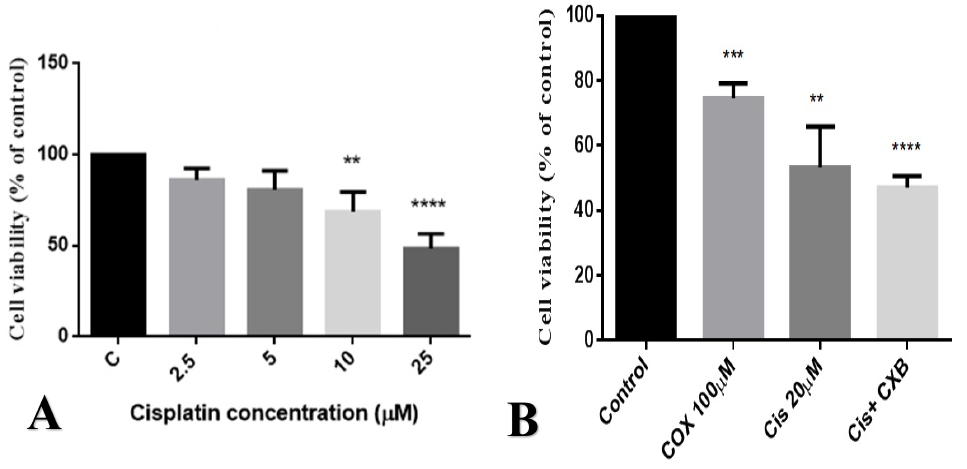
Effect of celecoxib and cisplatin on the viability of OC-3 cells. Inhibitory rate of Scc-9 cell viability was determined by the MTT assay when OC-3 cells were treated with; (A) cisplatin, (B) celecoxib (100µM), cisplatin (25 μM) or in combination for 24 h. Data are expressed as the means ± SD. * p < 0.05, ** p < 0.01, *** p < 0.001 vs. the control group.
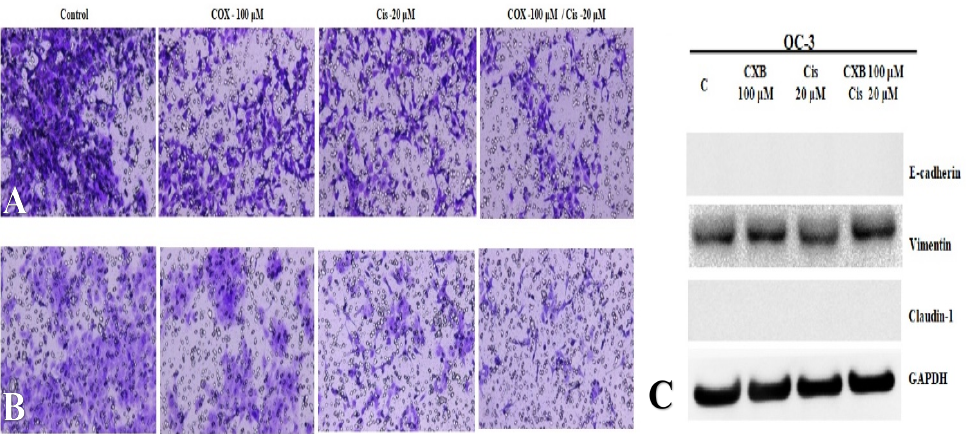
Effects of CXB combined with Cis on the migration and invasion of OC-3 cells. Transwell chamber migration and invasion experiments (×100). (A) Transwell chambers images of cell migration; (B) transwell chambers images of cell invasion. (B) EMT proteins- E-cadherin, Vimentin and Claudlin-1 expression was analysed by Western blotting. GAPDH was used as loading control.
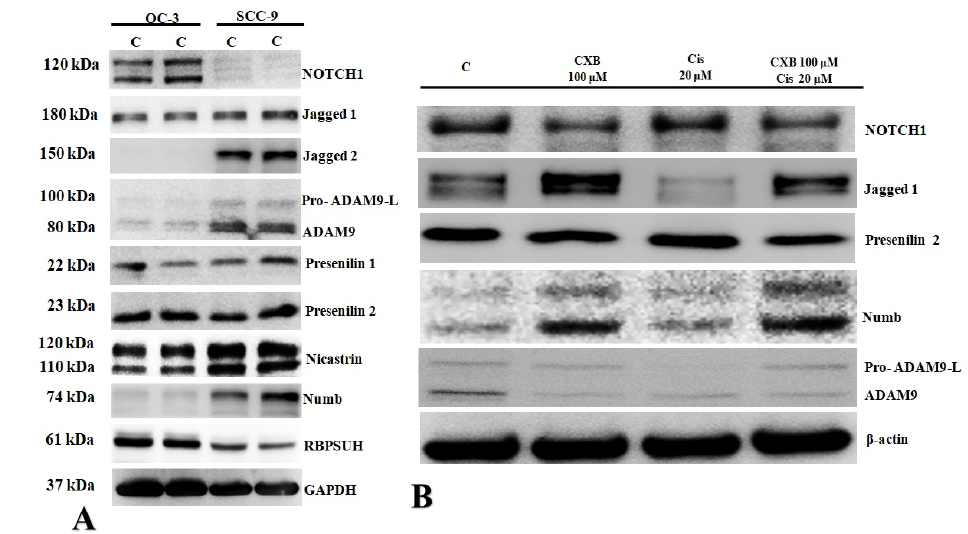
Analysis of NOTCH1 pathway in OSCC cells. (A) OC-3 and SCC-9 cells were used to screen for NOTCH1 signaling pathway by western blotting. (B) OC-3 cells were treated with Celecoxib, Cisplatin and combination and further analyzed for NOTCH1, Presenilin1, 2, Nicastrin, Numb, RBPSUH by western blotting. GAPDH and β-actin was used as internal control.
References
- Arai, M.A., Akamine, R., Tsuchiya, A., Yoneyama, T., Koyano, T., Kowithayakorn, T. and Ishibashi, M., 2018. The notch inhibitor cowanin accelerates nicastrin degradation. Sci. Rep., 8: 5376. Available from https://www.ncbi.nlm.nih.gov/pubmed/29599482, https://doi.org/10.1038/s41598-018-23698-4[CrossRef]
- Chiang, S.L., Velmurugan, B.K., Chung, C.M., Lin, S.H., Wang, Z.H., Hua, C.H., Tsai, M.H., Kuo, T.M., Yeh, K.T., Chang, P.Y., Yang, Y.H. and Ko, Y.C., 2017. Preventive effect of celecoxib use against cancer progression and occurrence of oral squamous cell carcinoma. Sci. Rep., 7: 6235. https://doi.org/10.1038/s41598-017-06673-3[CrossRef]
- Fortini, M.E., 2002. Gamma-secretase-mediated proteolysis in cell-surface-receptor signalling. Nat. Rev. Mol. Cell Biol., 3: 673-684. Available from https://www.ncbi.nlm.nih.gov/pubmed/12209127, https://doi.org/10.1038/nrm910[CrossRef]
- Gan, R.H., Wei, H., Xie, J., Zheng, D.P., Luo, E.L., Huang, X.Y., Xie, J., Zhao, Y., Ding, L.C., Su, B.H., Lin, L.S., Zheng, D.L. and Lu, Y.G., 2018. Notch1 regulates tongue cancer cells proliferation, apoptosis and invasion. Cell Cycle, 17: 216-224. Available from https://www.ncbi.nlm.nih.gov/pubmed/29117785. https://doi.org/10.1080/15384101.2017.1395534[CrossRef]
- Gan, R.H., Lin, L.S., Xie, J., Huang, L., Ding, L.C., Su, B.H., Peng, X.E., Zheng, D.L. and Lu, Y.G., 2019. Fli-06 intercepts notch signaling and suppresses the proliferation and self-renewal of tongue cancer cells. Oncol. Targets Ther., 12: 7663-7674. https://doi.org/10.2147/OTT.S221231[CrossRef]
- Gowda, R., Sharma, A. and Robertson, G.P., 2017. Synergistic inhibitory effects of celecoxib and plumbagin on melanoma tumor growth. Cancer Lett., 385: 243-250. Available from https://www.ncbi.nlm.nih.gov/pubmed/27769779. https://doi.org/10.1016/j.canlet.2016.10.016[CrossRef]
- Grosch, S., Tegeder, I., Niederberger, E., Brautigam, L. and Geisslinger, G., 2001. Cox-2 independent induction of cell cycle arrest and apoptosis in colon cancer cells by the selective cox-2 inhibitor celecoxib. FASEB J., 15: 2742-2744. Available from http://www.ncbi.nlm.nih.gov/pubmed/11606477. https://doi.org/10.1096/fj.01-0299fje[CrossRef]
- Hashibe, M., Brennan, P., Chuang, S.C., Boccia, S., Castellsague, X., Chen, C., Curado, M.P., Dal Maso, L., Daudt, A.W., Fabianova, E., Fernandez, L., Wünsch-Filho, V., Franceschi, S., Hayes, R.B., Herrero, R., Kelsey, K., Koifman, S., La Vecchia, C., Lazarus, P., Levi, F., Lence, J.J., Mates, D., Matos, E., Menezes, A., McClean, M.D., Muscat, J., Eluf-Neto, J., Olshan, A.F., Purdue, M., Rudnai, P., Schwartz, S.M., Smith, E., Sturgis, E.M., Szeszenia-Dabrowska, N., Talamini, R., Wei, Q., Winn, D.M., Shangina, O., Pilarska, A., Zhang, Z.-F., Ferro, G., Berthiller, J. and Boffetta, P., 2009. Interaction between tobacco and alcohol use and the risk of head and neck cancer: Pooled analysis in the international head and neck cancer epidemiology consortium. Cancer Epidemiol. Biomark. Prevent., 18: 541-550. https://doi.org/10.1158/1055-9965.EPI-08-0347[CrossRef]
- Hijioka, H., Setoguchi, T., Miyawaki, A., Gao, H., Ishida, T., Komiya, S. and Nakamura, N., 2010. Upregulation of notch pathway molecules in oral squamous cell carcinoma. Int. J. Oncol., 36: 817-822. Available from https://www.ncbi.nlm.nih.gov/pubmed/20198324. https://doi.org/10.3892/ijo_00000558[CrossRef]
- Hong, J., Liu, Z., Zhu, H., Zhang, X., Liang, Y., Yao, S., Wang, F., Xie, X., Zhang, B., Tan, T., Fu, L., Nie, J. and Cheng, C., 2014. The tumor suppressive role of numb isoform 1 in esophageal squamous cell carcinoma. Oncotarget, 5: 5602-5614. Available from https://www.ncbi.nlm.nih.gov/pubmed/24980814. https://doi.org/10.18632/oncotarget.2136[CrossRef]
- Hsu, Y.Y., Bai, C.H., Wang, C.C., Chen, W.L., Wu, W.T. and Lai, C.H., 2019. Health disparities of employees in taiwan with major cancer diagnosis from 2004 to 2015: A nation- and population-based analysis. Int. J. environ. Res. Publ. Hlth., 16. Available from https://www.ncbi.nlm.nih.gov/pubmed/31167441. https://doi.org/10.3390/ijerph16111982[CrossRef]
- Irie, T., Tsujii, M., Tsuji, S., Yoshio, T., Ishii, S., Shinzaki, S., Egawa, S., Kakiuchi, Y., Nishida, T., Yasumaru, M., Iijima, H., Murata, H., Takehara, T., Kawano, S. and Hayashi, N., 2007. Synergistic antitumor effects of celecoxib with 5-fluorouracil depend on ifn-gamma. Int. J. Cancer, 121: 878-883. Available from https://www.ncbi.nlm.nih.gov/pubmed/17450522. https://doi.org/10.1002/ijc.22720[CrossRef]
- Jeon, Y.W. and Suh, Y.J., 2013. Synergistic apoptotic effect of celecoxib and luteolin on breast cancer cells. Oncol. Rep., 29: 819-825. Available from https://www.ncbi.nlm.nih.gov/pubmed/23229294. https://doi.org/10.3892/or.2012.2158[CrossRef]
- Kopan, R. and Ilagan, M.X., 2009. The canonical notch signaling pathway: Unfolding the activation mechanism. Cell, 137: 216-233. Available from https://www.ncbi.nlm.nih.gov/pubmed/19379690. https://doi.org/10.1016/j.cell.2009.03.045[CrossRef]
- Li, W.Z., Wang, X.Y., Li, Z.G., Zhang, J.H. and Ding, Y.Q., 2010. Celecoxib enhances the inhibitory effect of cisplatin on tca8113 cells in human tongue squamous cell carcinoma in vivo and in vitro. J. Oral Pathol. Med., 39: 579-584. https://doi.org/10.1111/j.1600-0714.2009.00885.x[CrossRef]
- Liu, B., Yan, S., Qu, L. and Zhu, J., 2017. Celecoxib enhances anticancer effect of cisplatin and induces anoikis in osteosarcoma via pi3k/akt pathway. Cancer Cell Int., 17: 1. https://doi.org/10.1186/s12935-016-0378-2[CrossRef]
- Markopoulos, A.K., 2012. Current aspects on oral squamous cell carcinoma. Open Dent. J., 6: 126-130. Available from https://www.ncbi.nlm.nih.gov/pubmed/22930665. https://doi.org/10.2174/1874210601206010126[CrossRef]
- Pelullo, M., Nardozza, F., Zema, S., Quaranta, R., Nicoletti, C., Besharat, Z.M., Felli, M.P., Cerbelli, B., d’Amati, G., Palermo, R., Capalbo, C., Talora, C., Di Marcotullio, L., Giannini, G., Checquolo, S., Screpanti I. and Bellavia, D., 2019. Kras/adam17-dependent jag1-icd reverse signaling sustains colorectal cancer progression and chemoresistance. Cancer Res., 79: 5575-5586. Available from https://www.ncbi.nlm.nih.gov/pubmed/31506332. https://doi.org/10.1158/0008-5472.CAN-19-0145[CrossRef]
- Purow, B., 2012. Notch inhibition as a promising new approach to cancer therapy. Adv. exp. Med. Biol., 727: 305-319. https://doi.org/10.1007/978-1-4614-0899-4_23[CrossRef]
- Qian, M., Qian, D., Jing, H., Li, Y., Ma, C. and Zhou, Y., 2014. Combined cetuximab and celecoxib treatment exhibits a synergistic anticancer effect on human oral squamous cell carcinoma in vitro and in vivo. Oncol. Rep., 32: 1681-1688. https://doi.org/10.3892/or.2014.3334[CrossRef]
- Sarkar, S., Zemp, F.J., Senger, D., Robbins, S.M. and Yong, V.W., 2015. Adam-9 is a novel mediator of tenascin-c-stimulated invasiveness of brain tumor-initiating cells. Neuro-oncology, 17: 1095-1105. https://doi.org/10.1093/neuonc/nou362[CrossRef]
- Srivastava, S., Dewangan, J., Mishra, S., Divakar, A., Chaturvedi, S., Wahajuddin, M., Kumar, S. and Rath, S.K., 2021. Piperine and celecoxib synergistically inhibit colon cancer cell proliferation via modulating wnt/β-catenin signaling pathway. Phytomed. Int. J. Phytother. Phytopharmacol., 84: 153484. https://doi.org/10.1016/j.phymed.2021.153484[CrossRef]
- Suresh, G.M., Koppad, R., Prakash, B.V., Sabitha, K.S. and Dhara, P.S., 2019. Prognostic indicators of oral squamous cell carcinoma. Annls Maxill. Surg., 9: 364-370. https://doi.org/10.4103/ams.ams_253_18[CrossRef]
- Velmurugan, B.K., Hua, C.H., Tsai, M.H., Lee, C.P., Chung, C.M. and Ko, Y.C., 2020. Combination of celecoxib and calyculin-a inhibits epithelial-mesenchymal transition in human oral cancer cells. Biotech. Histochem., 95: 341-348. https://doi.org/10.1080/10520295.2019.1700429[CrossRef]
- Wang, Z., Li, Y., Kong, D., Ahmad, A., Banerjee, S. and Sarkar, F.H., 2010. Cross-talk between mirna and notch signaling pathways in tumor development and progression. Cancer Lett., 292: 141-148. https://doi.org/10.1016/j.canlet.2009.11.012[CrossRef]
- Wang, Z., Li, Y., Banerjee, S. and Sarkar, F.H., 2009. Emerging role of notch in stem cells and cancer. Cancer Lett., 279: 8-12. Available from https://www.ncbi.nlm.nih.gov/pubmed/19022563. https://doi.org/10.1016/j.canlet.2008.09.030[CrossRef]
- Xiu, M.X., Liu, Y.M. and Kuang, B.H., 2020. The oncogenic role of jagged1/notch signaling in cancer. Biomed. Pharmacother., 129: 110416. Available from https://www.ncbi.nlm.nih.gov/pubmed/32593969. https://doi.org/10.1016/j.biopha.2020.110416[CrossRef]
- Xu, X.C., 2002. Cox-2 inhibitors in cancer treatment and prevention, a recent development. Anti-Cancer Drugs, 13. Available from https://journals.lww.com/anti-cancerdrugs/fulltext/2002/02000/cox_2_inhibitors_in_cancer_treatment_and.3.aspx. https://doi.org/10.1097/00001813-200202000-00003[CrossRef]
- Yeh, T.S., Wu, C.W., Hsu, K.W., Liao, W.J., Yang, M.C., Li, A.F., Wang, A.M., Kuo, M.L. and Chi, C.W., 2009. The activated notch1 signal pathway is associated with gastric cancer progression through cyclooxygenase-2. Cancer Res., 69: 5039-5048. https://doi.org/10.1158/0008-5472.CAN-08-4021[CrossRef]
- You, W.K., Schuetz, T.J. and Lee, S.H., 2023. Targeting the dll/notch signaling pathway in cancer: Challenges and advances in clinical development. Mol. Cancer Ther., 22: 3-11. Available from https://www.ncbi.nlm.nih.gov/pubmed/36223541. https://doi.org/10.1158/1535-7163.MCT-22-0243[CrossRef]
- Zhang, H., Li, Z. and Wang, K., 2014. Combining sorafenib with celecoxib synergistically inhibits tumor growth of non-small cell lung cancer cells in vitro and in vivo. Oncol. Rep., 31: 1954-1960. Available from https://www.ncbi.nlm.nih.gov/pubmed/24549815. https://doi.org/10.3892/or.2014.3026[CrossRef]
Services
Article usage statistics
Loading…