
This study is aimed to identify genetic variants in BDNF gene and their association with Obsessive Compulsive Disorder (OCD) among Pakistani Punjabi population. We recruited a total of 100 patients diagnosed with OCD following Diagnostic Statistical Manual-IV (DSM-IV) criteria and controls (n=120) were selected from the same ancestry during August 2011 to January 2014fromSir Ganga Ram Hospital and Panjab Institute of Mental Health, Lahore. The demographic values for age, employment and marital status did not differ significantly among case and control groups. Exonic regions of BDNF gene were sequenced. In-silico analysis was performed to detect the possible disease causing effect of genetic variants with OCD. Sequencing of BDNF gene showed one change G>A at position c.196 (rs6265) resulting in a nonsynonymous change from valine to methionine. We found only one homozygous and heterozygous carrier for this polymorphism. Healthy siblings of the carrier individuals and control group were screened and found as negative for this polymorphism. In-silico analysis through mutation taster, exon splicing enhancer and polyphin2 software predicted this polymorphism as a site broken and possibly damaging. These findings suggest that BDNF polymorphism Val66Met has some possible role in OCD development in Punjabi patients.
Short Communication · Volume 49, Issue 4, 30 July 2017 · Open Access
Genetic Contribution of BDNF Gene in Obsessive Compulsive Disorder in Pakistani Punjabi Population
· · · · · · · ·
Affiliations & Notes ⌄
- 1Institute of Biochemistry and Biotechnology,, University of Veterinary and Animal Sciences, Lahore, Pakistan 2Faculty of Science and Technology, Virtual University of Pakistan, Lahore, Pakistan 3Department of Psychiatry, Sir Ganga Ram Hospital, Lahore, Pakistan 4Punjab Institute of Mental Health, Lahore, Pakistan , * Corresponding author: masroor.ellahi@vu.edu.pk
Article Info ⌄
- Journal:
- Pakistan Journal of Zoology
- Published:
- 30 July 2017

From the article
- We observed one variation G>A, resulting in an amino acid change from valine to methionine at 66 amino acid position.
- Two patients were found homozygous for Val>Met and heterozygous for Val>Met at c.196 position in BDNF gene.
- Our finding suggests that polymorphism Val66Met (rs6265) have some possible role of OCD development in Punjabi ethnic group.
Selected from the article's own text.
Abstract
Table I.- Primers for coding region of BDNF gene.
| Gene | Forward Primer | Reverse Primer | Temp |
| BDNF-1 | TGCAGCTGGAGT TTATCACC | GCCGAACTTTCTGGTCCTC | F=57.80, R=59.72 |
| BDNF-2 | GCAAACATCCGA GGACAA | TGCCGTTACCCACTCACT | F=55.02, R=57.30 |
| BDNF-3 | CTCCTCTTCTCTT TCTGCTG | TCCACTATCTTCCCCTTTTA | F=57.80, R=53.70 |
| BDNF-4 | CCCTGTATCAAA AGGCCAAC | CGGCAACAAACCACAACAT | F=57.80, R=55.41 |
F, forward; R, reverse, Temp, melting temperature.
OCD is a fourth most common deliberate psychiatric disorder. Its worldwide prevalence is 1-3% of children and adults and equally affects both males and females . OCD is a mental disorder, according to the Diagnostic Manual of Mental Disorders (DSM-IV) criteria, this disease is characterized by intermittent and interfering obsessive thoughts and cyclic compulsive behaviors which reduce anxiety that is associated with obsessions. Previous studies on twin and family’s genetic showed that OCD is a chronic disorder and established irrespective of sex, race, marital status, intelligence, socioeconomic status, nationality or religions ; . Patients with OCD experience intrusive and repetitive thoughts known as obsession and the un-controllable urge to repeatedly acts or rituals compulsions to reduce the anxiety produced by obsessional thoughts (American Psychiatric Association, 1994). Several studies revealed that OCD is associated mainly with dysregulation and less concentration of 5-HT neurotransmission, which may play a possible role in the pathogenesis of OCD ; .
Materials and methods
Genomic DNA was extracted from the blood using a standard procedure (Sambrook and Russel, 2001). Primers were designed through Primer3 software to amplify the complete BDNF coding region (Table I). The complete coding region of BDNF gene was directly sequenced using ABI 3130xl automated sequencer (Applied Biosystem Inc, Foster City, CA). The sequenced data was aligned and analyzed using Blast Local search Alignment tool. Chi square (X2) test was used for categorical variables and student’s t-test was used for continuous variables. In-silico prediction analysis was performed using mutation taster, Polyphin2 and Exon splicing enhancer software.
Results and discussion
In this study, we investigated the genetic variation of OCD individuals in the Punjab ethnic group in Pakistan. we aimed at exploring the existence of possible genetic interaction between BDNF gene and clinical variables in samples of OCD patients (Fig 1). The demographic distribution of the both groups is illustrated in Table II. In both groups the distribution of male and female was similar. We observed one variation G>A, resulting in an amino acid change from valine to methionine at 66 amino acid position. Two patients were found homozygous for Val>Met and heterozygous for Val>Met at c.196 position in BDNF gene.
Table II.- Demographic characteristics of the subjects with OCD and without OCD included in the study.
| OCD | Control | p-value | |
| Age | 26.08 ± 7.6 | 29.6 ± 7.3 | 0.081 |
| Gender | |||
| Male | 55 (55%) | 70 (58%) | 1.00 |
| Female | 45 (45%) | 50 (41%) | 1.00 |
| Education in years | 8.3±4.8 | 10.6±2.9 | 0.0002 |
| Employment | |||
| Employed | 43 (43%) | 81 (67.5%) | 1.00 |
| Unemployed | 57 (57%) | 39 (32.5%) | 1.00 |
| Marital status | |||
| Unmarried | 45 (45%) | 76 (63.3%) | 1.00 |
| Married | 55 (55%) | 44 (36.6%) | 1.00 |
| Family history of OCD | |||
| No | 68 (68%) | 120 (100%) | |
| Yes | 32(32%) | 0 (0%) | |
| Age at onset | 24.2±6.2 | - | |
| Duration of illness | 8.2±5.8 | - | |
| Mean Y-BOCS score | |||
| Y-BOCS Obs score | 12.8±2.6 | - | |
| Y-BOCS Comp score | 12.2±3.6 | - | |
| Total | 25±6.2 | - | |
SD, standard deviation; Y-BOCS, Yale-Brown obsessive compulsive scale; Obs, obsessions; Comp, compulsions; OCD, obsessive compulsive disorder. P-value was calculated through the Chi-square test. Values are Mean±SD.
In-silico analysis of this genetic variation was performed using mutation taster (http://www.mutationtaster.org/) and Exon Splicing Enhancer software (http://www.umd.be/HSF3/4DACTION/AW_QuickMutant). Resulting data predicted it as disease causing with a site broken effect. We collected blood samples of other healthy family members of the patients observed with Val>Met polymorphism, but found as negative for this variation.
Several studies supported the hypothesis that BDNF gene Val66Met genotype has been found to be associated with the clinical features of OCD in various ethnic groups in the world ; , 2013). Our results support most of previous and recent studies. BDNF Val66Met polymorphism has been extensively studied, the first study that associates Val66Met was conducted in 2003 , that study reported that the Met66 allele revealed a protective effect on OCD . Other previous studies reported Val66Met was a risk allele , 2013). BDNF polymorphism Val66Met has been studied in several other mental disorders such as schizophrenia, bipolar disorder, depression, drug abuse and anorexia nervosa, most of them did not associate between the Val66Met and the disease ; ; ; ; . Some found the association between OCD and Val66Met, showed inconsistent results ; ; ; .
It has been found that there are significant ethnic differences in BDNF Val66Met polymorphism . Caucasian carriers with Val/Val genotype have higher anxiety scores than carriers of heterozygous Val/Met genotype or homozygous Met/Met genotype . Comparison of genotype frequency Val/Val, Val/Met and Met/Met reported as significant ethnic differences in Val66Met variation in the BDNF gene with a similar distribution of Val/Met alleles among Korean individuals and the most frequent genotype in Caucasian population was Val/Val . Homozygous Val/Val (G/G) genotype is also considered as an increased risk for sporadic Alzheimer’s disease (AD) and homozygous A (Met) allele with the increased risk of poorer episodic memory ; . Also evidence that the Val66 allele might increase the risk of depression as it was specially transmitted to bipolar volunteers in families ; . However, a study conducted on Japanese population, found no association of bipolar disorder and BDNF polymorphism .
As BDNF gene plays a significant role in regulating neuronal proliferation and function and participating in the synaptic plasticity (Huang and Reichardt, 2001b), many previous and recent studies found and support that its peripheral levels were down regulated in various mental disorders such as OCD , anorexia nervosa , depression and schizophrenia . It might be suggested that the lower peripheral blood level is a common feature and might be a marker reflecting impairment of synaptic plasticity and neuronal function in various mental disorders.
Conclusion
Our finding suggests that polymorphism Val66Met (rs6265) have some possible role of OCD development in Punjabi ethnic group. Genetic association of this polymorphism can be validated by screening at large scale.
Acknowledgment
Higher education commission of Pakistan is highly acknowledged for providing funding.
Statement of conflict of interest
Authors have declared no conflict of interest.
Figures
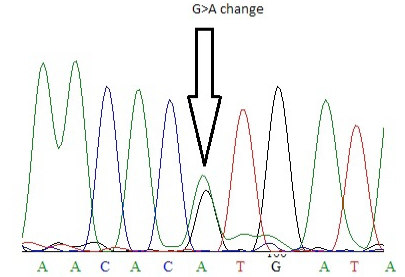
The sequencing result of BDNF gene of OCD affected person showing the heterozygosity change from G>A.
References
- Alonso, P., Gratacòs, M., Menchón, J.M., Saiz-Ruiz, J., Segalàs, C., Baca-García, E., Labad, J., Fernández-Piqueras, J., Real, E., Vaquero, C., Pérez, M., Dolengevich, H., González, J.R., Bayés, M., de Cid, R., Vallejo, J. and Estivill, X., 2007. Biol. Psychiat., 63: 619-628. https://doi.org/10.1016/j.biopsych.2007.06.020[CrossRef]
- American Psychiatric Association. 2000. 4th edition, text revision (DSM-IV-TR). Washington, DC.
- Brandys, M.K., Kas, M.J.H., van Elburg, A.A., Ophoff, R., Slof-Op’t Landt, M.C.T., Middeldorp, C.M., Boomsma, D.I., van Furth, E.F., Slagboom, P.E. and Adan, R.A.H., 2013. World J. Biol. Psychiat., 14: 441-451. https://doi.org/10.3109/15622975.2011.605470[CrossRef]
- Chen, S.L., Lee, S.Y., Chang, Y.H., Chen, S.H., Chu, C.H., Wang, T.Y., Chen, P.S., Lee, I.H., Yang, Y.K., Hong, J.S. and Lu, R.B., 2014. Prog. Neuro-psychoph., 51: 99-104. https://doi.org/10.1016/j.pnpbp.2014.01.012[CrossRef]
- Egan, M.F., Kojima, M., Callicott, J.H., Goldberg, T.E., Kolachana, B.S., Bertolino, A., Zaitsev, E., Gold, B., Goldman, D., Dean, M., Lu, B. and Weinberger, D.R., 2003. Cell, 112: 257-269. https://doi.org/10.1016/S0092-8674(03)00035-7[CrossRef]
- Friedman, W.J. and Greene, L.A.,1999. Exp. Cell Res., 253: 131-142. https://doi.org/10.1006/excr.1999.4705[CrossRef]
- González-Castro, T.B., Nicolini, H., Lanzagorta, N., López-Narváez, L., Genis, A., Pool García, S. and Tovilla-Zárate, C.A., 2015. Bipol. Disord., 17: 27-38. https://doi.org/10.1111/bdi.12306_17[CrossRef]
- Gyekis, J.P., Yu, W., Dong, S., Wang, H., Qian, J., Kota, P. and Yang, J., 2013. Am. J. Med. Genet. Part B: Neuropsychiat. Genet., 162: 61-70. https://doi.org/10.1002/ajmg.b.32122[CrossRef]
- Hall, D., Dhilla, A., Charalambous, A., Gogos, J.A. and Karayiorgou, M., 2003. Am. J. Hum. Genet., 73: 370-376. https://doi.org/10.1086/377003[CrossRef]
- Hemmings, S.M.J., Kinnear, C.J., Van Der Merwe, L., Lochner, C., Corfield, V.A., Moolman-Smook, J.C. and Stein, D.J., 2008. World J. Biol. Psychiat., 9: 126-134. https://doi.org/10.1080/15622970701245003[CrossRef]
- Hemmings, S.M.J., Lochner, C., van der Merwe, L., Cath, D.C., Seedat, S. and Stein, D.J., 2013. J. Psychiat. Res., 47: 1857-1863. https://doi.org/10.1016/j.jpsychires.2013.08.012[CrossRef]
- Hettema, J.M., Neale, M.C. and Kendler, K.S., 2001. Am. J. Psychiat., 158: 1568-1578. https://doi.org/10.1176/appi.ajp.158.10.1568[CrossRef]
- Huang, E.J. and Reichardt, L.F., 2001a. Neurotrophins: Annu. Rev. Neurosci., 24: 677-736. https://doi.org/10.1146/annurev.neuro.24.1.677[CrossRef]
- Huang, E.J. and Reichardt, L.F., 2001b. Annu. Rev. Neurosci., 24: 677. https://doi.org/10.1146/annurev.neuro.24.1.677[CrossRef]
- Kanazawa, T., Glatt, B., Kia-Keating, H., Yoneda and Tsuang, M.T., 2007. Psychiat. Genet., 17: 165-170. https://doi.org/10.1097/YPG.0b013e32801da2e2[CrossRef]
- Lang, U.E., Hellweg, R., Kalus, P., Bajbouj, M., Lenzen, K.P., Sander, T., Kunz, D. and Gallinat, J., 2005. Psychopharmacology, 180: 95-99. https://doi.org/10.1007/s00213-004-2137-7[CrossRef]
- Lee, R., Kermani, P., Teng, K.K. and Hempstead, B.L., 2001. Science, 294: 1945-1948. https://doi.org/10.1126/science.1065057[CrossRef]
- Nakata, K., Ujike, H., Sakai, A., Uchida, N., Nomura, A., Imamura, T., Katsu, T., Tanaka, Y., Hamamura, T. and Kuroda, S., 2003. Neurosci. Lett., 337: 17-20. https://doi.org/10.1016/S0304-3940(02)01292-2[CrossRef]
- Neves-Pereira, M., Mundo, E., Muglia, P., King, N., Macciardi, F. and Kennedy, J.L., 2002. Am. J. Hum. Genet., 71: 651-655. https://doi.org/10.1086/342288[CrossRef]
- Pivac, N., Kim, B., Nedić, G., Joo, Y.H., Kozarić-Kovačić, D., Hong, J.P. and Muck-Seler, D., 2009. Croat. med. J., 50: 43-48. https://doi.org/10.3325/cmj.2009.50.43[CrossRef]
- Saito, S., Watanabe, K., Hashimoto, E. and Saito, T., 2009. Prog. Neuro-psychoph., 33: 312-316. https://doi.org/10.1016/j.pnpbp.2008.12.009[CrossRef]
- Sampaio, A.S., Lins, R.M.P., Daltro-Oliveira, R., Quarantini, L.D.C., de Rosário, M.C., Miguel, E.C. and Hounie, A.G., 2013. Archiv. clin. Psychiat., 40: 177-190. https://doi.org/10.1590/S0101-60832013000500003[CrossRef]
- Sarvet, B., 2013. Pediatr. Rev., 34: 19-27. https://doi.org/10.1542/pir.34-1-19[CrossRef]
- Sen, S., Duman, R. and Sanacora, G., 2008. Biol. Psychiat., 64: 527-532. https://doi.org/10.1016/j.biopsych.2008.05.005[CrossRef]
- Sklar, P., Gabriel, S.B., McInnis, M.G., Bennett, P., Lim, Y., Tsan, G., Schaffner, S., Kirov, G., Jones, I., Owen, M., Craddock, N., DePaulo, J.R. and Lander, E.S., 2002. Mol. Psychiat., 7: 579-593. https://doi.org/10.1038/sj.mp.4001058[CrossRef]
- Ventriglia, M., Bocchio Chiavetto, L., Benussi, L., Binetti, G., Zanetti, O., Riva, M.A. and Gennarelli, M., 2002. Mol. Psychiat., 7: 136-137. https://doi.org/10.1038/sj.mp.4000952[CrossRef]
- Verhagen, M., van der Meij, A., van Deurzen, P.A.M., Janzing J.G.E., Arias-Vasquez, A., Buitelaar, J.K. and Franke, B., 2008. Mol. Psychiat., 15: 260-271. https://doi.org/10.1038/mp.2008.109[CrossRef]
- Wang, Y., Zhang, H., Li, Y., Wang, Z., Fan, Q., Yu, S., Lin, Z. and Xiao, Z., 2015. J. Affect. Disord., 186: 7-12. https://doi.org/10.1016/j.jad.2015.07.023[CrossRef]
- Wendland, J.R., Kruse, M.R., Cromer, K.C. and Murphy, D.L., 2007. Neuropsychopharmacology, 32: 2543-2551. https://doi.org/10.1038/sj.npp.1301394[CrossRef]
- Westenberg, H.G.M., Fineberg, N.A. and Denys, D., 2007. CNS Spectrums, 12: 14-27. https://doi.org/10.1017/S109285290001590X[CrossRef]
- Zai, G., Arnold, P., Strauss, J., King, N., Burroughs, E., Richter, M.A. and Kennedy, J.L. 2005. Psychiat. Genet., 15: 235. https://doi.org/10.1097/00041444-200512000-00002[CrossRef]
- Zohar, J., Chopra, M., Sasson, Y., Amiaz, R. and Amital, D., 2000. World J. Biol. Psychiat., 1: 92-100. https://doi.org/10.3109/15622970009150571[CrossRef]
Services
Article usage statistics
Loading…