
This study reports the first pathotypic and genetic characterizations of the pigeon paramyxovirus type I (PPMV-1) from pigeon in Egypt during 2014. Pathotyping, based on the mean death time (86 hours) in eggs and the intracerebral pathogenicity index (1.2), and the amino acid motif, (112KRQKR116), at the cleavage site of the fusion (F) protein indicated the emergence of PPMV-1 in Egypt. Phylogenetic analysis of the F and haemagglutinin-neuraminidase (HN) genes indicated that the isolate clustered with the PPMV-1 strains recently reported from Israel within subgenotype VIb. Our findings report the emergence of PPMV-1 in Egyptian pigeons and the potential role these wild birds can play in the transmission and evolution dynamics of PPMV-1.
Short Communication · Volume 3, Issue 2, 17 May 2016 · Open Access
Genetic Characterization of Pigeon Paramyxovirus Type 1 in Egypt
· · · ·
Affiliations & Notes ⌄
- 1Department of Virology, Faculty of Veterinary Medicine, Cairo University, Egypt
- 2Department of Virology, Faculty of Veterinary Medicine, University of Sadat City, Egypt
- 3Central Laboratory for Evaluation of Veterinary Biologics, Egypt
- 4The Pirbright Institute, Ash Road, Pirbright, Woking, GU24 0NF, United Kingdom
Article Info ⌄
- Journal:
- Hosts and Viruses
- Published:
- 17 May 2016
From the article
- Abstract | This study reports the first pathotypic and genetic characterizations of the pigeon paramyxovirus type I (PPMV-1) from pigeon in Egypt during 2014.
- Pathotyping, based on the mean death time (86 hours) in eggs and the intracerebral pathogenicity index (1.2), and the amino acid motif, (112KRQKR116), at the cleavage site of the fusion (F) protein indicated the emergence of PPMV-1 in Egypt.
- Phylogenetic analysis of the F and haemagglutinin-neuraminidase (HN) genes indicated that the isolate clustered with the PPMV-1 strains recently reported from Israel within subgenotype VIb.
- Phylogeny indicated that the isolate, Pigeon/Egypt/VRLCU/2014, clustered with the APMV-1 strains within genotype VI of class II (Figure 2).
Selected from the article's own text.
Abstract
Acknowledgments
This work was financed by the Ministry of Higher Education (Cultural Affairs & Missions Sector), Egypt.
Conflict of Interests
The authors declare that they have no conflict of interest.
Authors’ Contribution
M.A. Rohaim., R.F. El Naggar and N. Leblanc drafted and revised the manuscript. A.M. Helal and H.A. Hussein attended to the case and performed clinical sampling and follow-up. All authors contributed to the writing of the manuscript and approved it for submission.
Figures
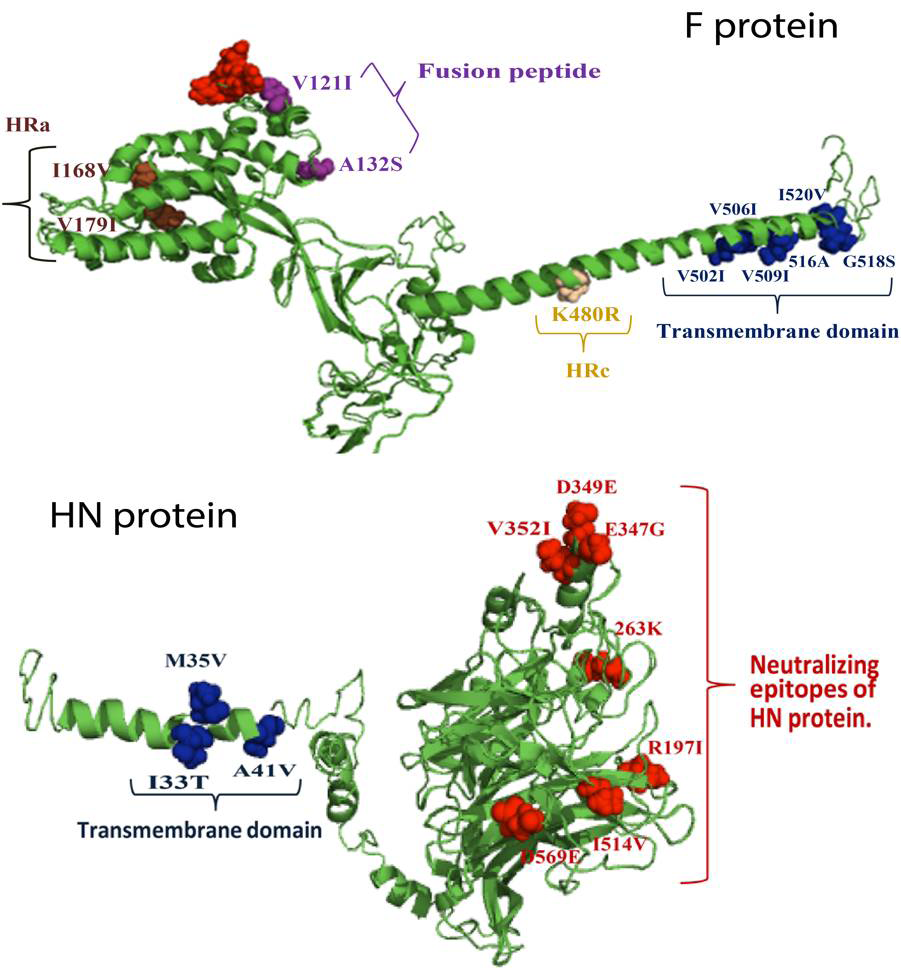
Predicted 3D structures for F and HN proteins of PPMV-1 Pigeon/Egypt/VRLCU/2014 showing amino acids residues at cleavage site, fusion peptide, HR and transmembrane domain of F protein, and neutralizing epitopes and transmembrane domain of HN protein
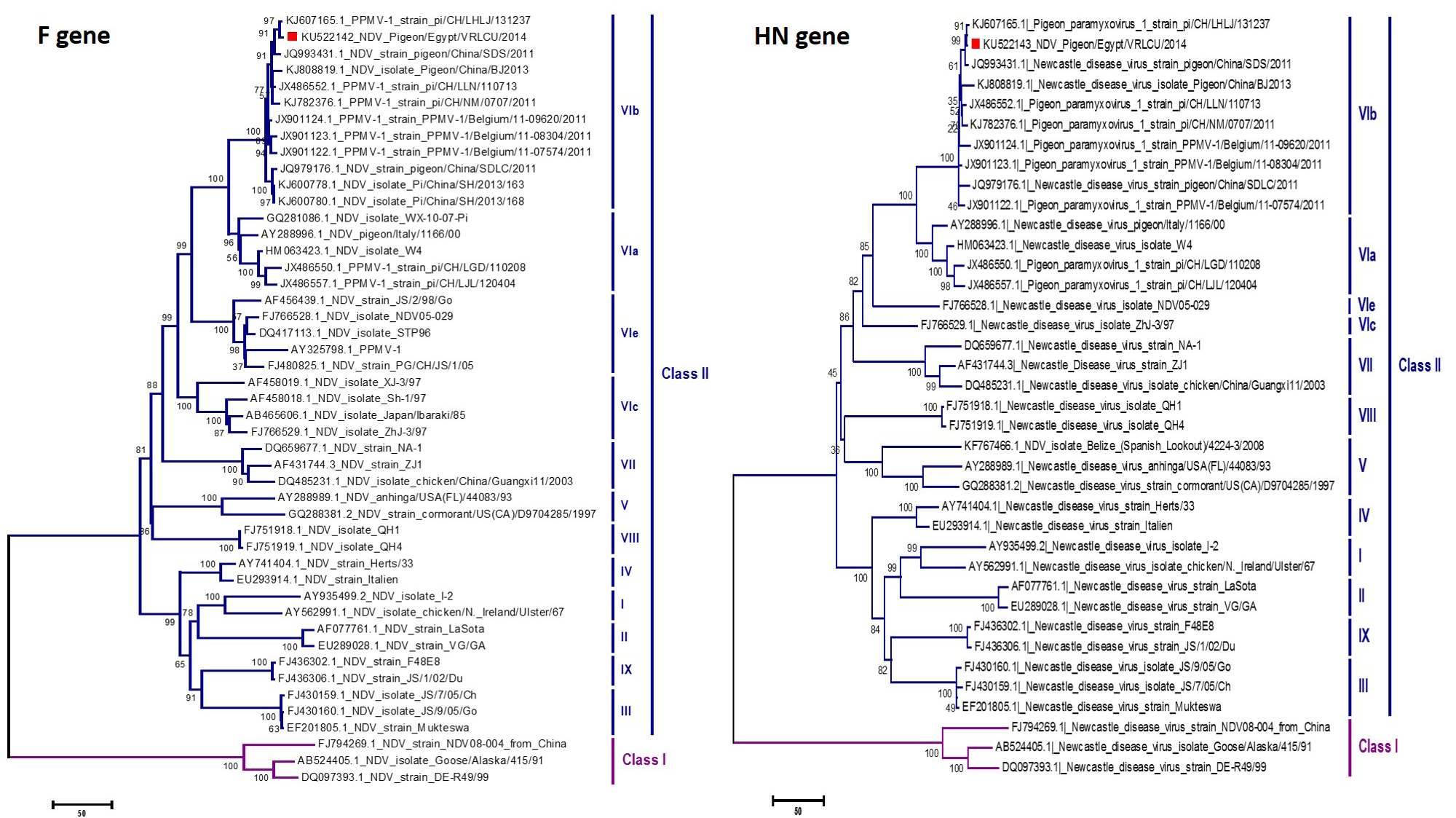
Phylogenetic tree
References
- Aldous EW, Mynn JK, Banks J, Alexander DJ (2003). A molecular epidemiological study of Avian paramyxovirus type 1 (Newcastle disease virus) isolates by phylogenetic analysis of a partial nucleotide sequence of the fusion protein gene. Avian Pathology. 32(3), 239- 257. http://dx.doi.org/10.1080/0307945031000097831[CrossRef]
- Alexander DJ, Senne DA (2008). Newcastle Disease and Other Avian Paramyxo viruses’. In: A Laboratory Manual for the Isolation, Identification and Characterization of Avian Pathogens. Dufour-Zavala L, Senne DA, Glisson JR (Eds.), 5th Edn. Omni Press, Inc., Madison, Wisconsin, USA. Pp: 135-141.
- Bulbule NR, Madale DS, Meshram CD, et al. (2015). Virulence of Newcastle disease virus and diagnostic challenges. Advances in Animal and Veterinary Sciences. 3(5s): 14-21. http://dx.doi.org/10.14737/journal.aavs/2015/3.5s.14.21[Full text][CrossRef]
- Diel DG, da Silva LH, Liu H, et al. (2012). Genetic diversity of avian paramyxovirus type 1: proposal for a unified nomenclature and classification system of Newcastle disease virus genotypes. Infect. Genet. Evol. 2012; 12, 1770–1779. http://dx.doi.org/10.1016/j.meegid.2012.07.012[CrossRef]
- Dortmans JCFM, Rottier PJM, Koch G, et al. (2011). Passaging of a Newcastle disease virus pigeon variant in chicken results in selection of viruses with mutations in the polymerase complex enhancing virus replication and virulence. Journal of General Virology. 92, 336–345. http://dx.doi.org/10.1099/vir.0.026344-0[CrossRef]
- Guo H, Liu X, Han Z, et al. (2013). Phylogenetic analysis and comparison of eight strains of pigeon paramyxovirus type 1 (PPMV-1) isolated in China between 2010 and 2012. Archives of Virology. 158: 1121–1131. http://dx.doi.org/10.1007/s00705-012-1572-8[CrossRef]
- Hall TA, (1999). BioEdit: a user-friendly biological sequence alignment editor and analysis program for Windows 95/98/NT. Nucleic Acids Symposium Series. 41: 95–98.
- Hu S, Wang T, Liu Y, et al. (2010). Identification of a variable epitope on the Newcastle disease virus hemagglutinin-neuraminidase protein. Veterinary Microbiology. 140: 92–97. http://dx.doi.org/10.1016/j.vetmic.2009.07.029[CrossRef]
- Kaleta EF, Alexander DJ, Russell PH, (1985). The first isolation of the avian PMV-1 virus responsible for the current panzootic in pigeons? Avian Pathology. 14: 553–557. http://dx.doi.org/10.1080/03079458508436258[CrossRef]
- Martin DP, Lemey P, Lott M, et al. (2010). RDP3: a flexible and fast computer program for analyzing recombination. Bioinformatics. 26: 2462–2463. http://dx.doi.org/10.1103/PhysRevD.82.064006[CrossRef]
- Munir M, Linde AM, Zohari S, et al. (2010). Complete genome analysis of an avian paramyxovirus type 1 strain isolated in 1994 from an asymptomatic black-headed gull (Larus ridibundus) in southern Sweden. Avian Diseases. 54(2): 923–930. http://dx.doi.org/10.1637/9086-092409-RESNOTE.1[CrossRef]
- Romer-Oberdorfer A, Veits J, Werner O, et al. (2006). Enhancement of pathogenicity of Newcastle disease virus by alteration of specific amino acid residues in the surface glycoproteins F and HN. Avian Diseases. 50: 259–263. http://dx.doi.org/10.1637/7471-111505R.1[CrossRef]
- Snoeck CJ, Owoade AA, Couacy-Hymann E, et al. (2013). High genetic diversity of Newcastle disease virus in poultry in West and Central Africa: cocirculation of genotype XIV and newly defined genotypes XVII and XVIII. Journal of Clinical Microbiology. 51:2250 –2260. http://dx.doi.org/10.1128/JCM.00684-13[CrossRef]
- Tamura K, Peterson D, Peterson N, et al. (2011). MEGA5: Molecular evolutionary genetics analysis using maximum likelihood, evolutionary distance, and maximum parsimony methods. Molecular Biology and Evolution. 28(10): 2731–2739. http://dx.doi.org/10.1093/molbev/msr121[CrossRef]
- Toro H, Hoerr FJ, Farmer K, et al. (2005). Pigeon paramyxovirus: association with common avian pathogens in chickens and serologic survey in wild birds’, Avian Diseases. 49, 92– 98. http://dx.doi.org/10.1637/7268-083104r1[CrossRef]
- World Organization for Animals Health (OIE), (2012). Newcastle Disease. Manual of Diagnostic Tests and Vaccines for Terrestrial Animals: Mammals, Birds and Bees. Seventh ed. Vol 1, part 2. Biological Standards Commission, World Organization for Animal Health, Paris, France. Pp. 555–574 (chapter 2.3.14).
- Zhang Y, Skolnick J, (2004). Automated structure prediction of weakly homologous proteins on a genomic scale. Proceedings of the National Academy of Sciences USA. 101: 7594–7599. http://dx.doi.org/10.1073/pnas.0305695101[CrossRef]
- Zhang Y, (2008). I-TASSER server for protein 3D structure prediction. BMC Bioinformatics. 9: 40. http://dx.doi.org/10.1186/1471-2105-9-40[CrossRef]
Services
Article usage statistics
Loading…