Since 1990, LPAI H9N2 has been constantly circulated in poultry farms from the Far East to the Middle East (Fusaro et al., 2011), and associated with great zoonotic consequences (Butt et al., 2003).
In December 2010, active monitoring studies have been conducted to isolate AIV or influenza A virus H9N2from broiler chickens in Egypt (Monne et al., 2013), and LPAIV H9N2 has been identified for the first time in Egypt in November 2011 from bobwhite quails. The isolated strains were closely related to the G1 strain which isolated from neighboring countries, thus increases the possibility of epidemiological pervasion (El-Zoghby et al., 2012). In 2016, we conducted another active survey in the poultry farms of Luxor governorate, in the southern of Egypt. About five hundred samples (cloacal and tracheal swabs) were collected from fifty farms of three local centers (Esna, Armant, and Luxor) within the governorate. All farms were suffering from mild respiratory signs with moderate to high mortality. The current screening revealed that ten farms (20%) were positive for LPAI H9N2 by real-time
RT-PCR, which was lower than Abdel Hamid et al. (2016) who reported 32% (32 /100) incidence of AIV (H9N2). Kayali et al. (2014) performed an active surveillance for AIV from 2010-2012 and reported 18.7% positive cases for AIV (H9N2) and 21.7% co-infected cases of AIV H9N2 and H5N1, which was somewhat in the same line as our result. Other studies were conducted in Egypt, showed that the incidence of AIV (H9N2) among broilers was ranged from 10% to approximately 55% (Shalaby et al., 2014; Dabbour, 2015).
Genetic evolution of the avian influenza viruses depending mainly on the alterations and mutations of different sites on HA genes, which are important for pathogenicity determinant and host range.
Proteolytic cleavage site, the receptor-binding site (RBS), and the presence or absence of glycosylation sites near the RBS in the HA gene are identified as fundamental keys for the molecular determinants of pathogenicity and viral transmission (Baigent and McCauley, 2003). Based on proteolytic cleavage site, the amino acid sequences of the 3 isolates have “PARSSRGLF” motif, thus can be identified as LPAIV (Steinhauer, 1999).
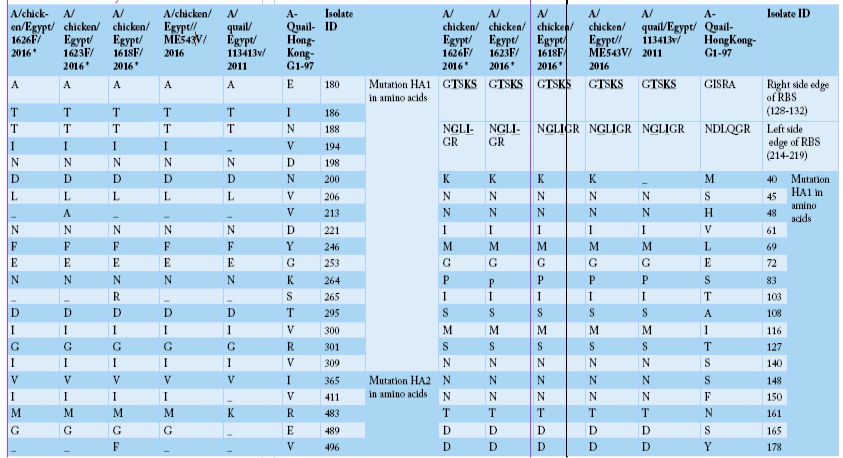
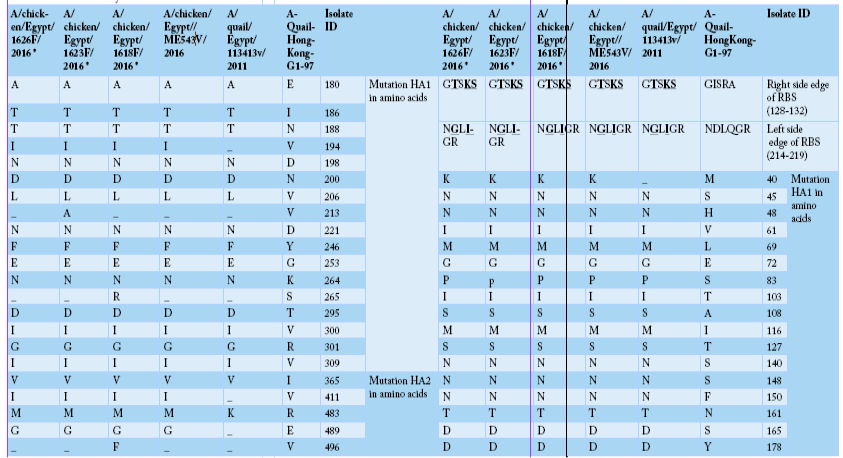
RBS of the HA gene influences the generation of human viruses from avian precursors and also it is essential for host cellular receptor specificity. Analysis of the RBS in the current study showed that all 3 isolates had variations in both right side edge and left side edge. In case of the right side the changes were determined at three positions such as “129” where Isoleucine has been shifted to Threonine, at “131” in which Arginine was changed to Lysine, and at “132” Alanine was substituted by Serine. Also, the left edge of the RBS showed mutations at positions “ 215” Aspartate was altered to Glycine, and “217” Glutamine was replaced by Isoleucine. Furthermore, analysis of the RBS showed that all 3 isolates had H173, and L216 which had been previously identified as human markers, these results came parallel with those of Neumann and Kawaoka, (2006). Thus, explain the zoonotic transmission of AIV (H9N2). According to Wan et al. (2008), AIV (H9N2) has acquired a typical receptor binding resembling that of human strains. These findings might increase the probability of assortment in both human and pig respiratory tracts. It was noticed that the combination of H173, E180, and L216 was typical of the early human isolates H3N2 (Sorrell et al., 2009). However, the presence of human-like receptor was determined at positions T179 and G218 which was identified before in the avian virus of G9 lineage (A/Ch/HK/G9/97). The presence of H173, T179, and L216 residues in HA1 is supposed to sustain the binding to mammalian α2,6-sialic acid-linked receptors and the replication in the human respiratory epithelial cells (Sorrell et al., 2009; Wan et al., 2008).
Glycosylation sites of the HA gene are significant for detection of the virus virulence, shielding antigenic epitopes, as well as host cell receptors (Wanzeck et al., 2011). Two potential glycosylation sites were lost from the current isolates. Previous studies showed a relationship between the addition of glycosylation sites to the HA and the loss of H5N1 virulence, as well as the reduction in the specificity of H2 receptor binding (Kaverin et al., 2000). Additionally, others indicated that change in the glycosylation pattern may result in adaptation of AIV (H9N2) in poultry host (Baigent and McCauley, 2003).
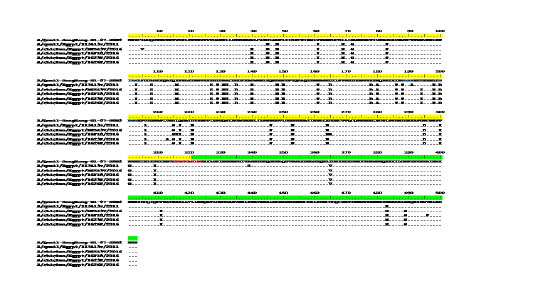
The identity percent of the current study exhibited that all three isolates were closely related to each other at a range from 99% to 100%, as well as their relatedness to the Egyptian and Middle East strains. Furthermore, one isolate “A/chicken/Egypt/1626F/2016” possessed 92% identity to the Asian strain. While, other 2 isolates “A/ chicken /Egypt / 1618F/ 2016” and “A/ chicken/ Egypt/ 1623F/ 2016” had 91% identity. Similarly, “A/chicken/Egypt/1626F/2016” showed 99% identity to the Egyptian strain of 2011. While both isolates “A/ chicken/ Egypt/ 1618F/ 2016” and “A/chicken/Egypt/1623F/2016” showed 98%. All of these findings were quite similar to that have been identified by Abd ElHamid et al., (2018) who showed that AIV H9N2 isolates had 92.3-97.1% identity with the Egyptian strain A/Quail/Egypt/113413v/2011.
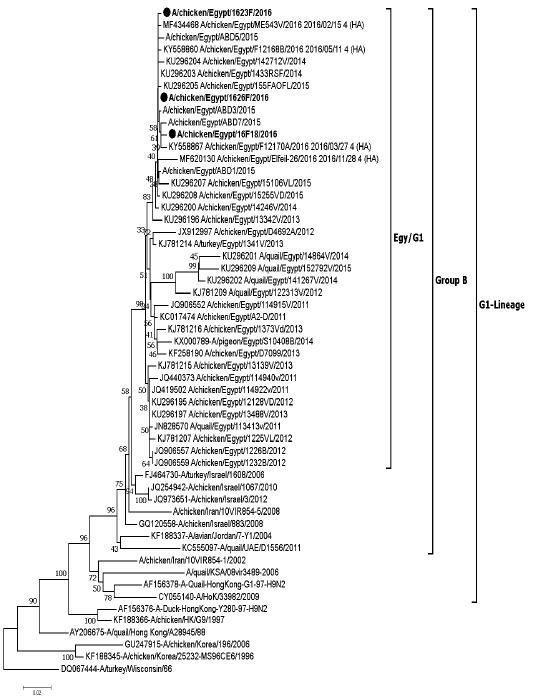
The phylogenetic evolution of the current isolates demonstrated a very close relatedness to “G1/97”, which was firstly recorded in china during 1997, then disseminated through the Eurasian countries such as, Iran, Pakistan, and Italy with a permanent evolution. Afterward they distributed to North Africa and Middle East including, Tunisia, Egypt, Saudi Arabia, UAE and Israel (Alexander, 2000, EL Zoghby et al., 2012; Perk et al., 2006; Tombari et al., 2011). Egyptian H9 viruses were classified previously into 2 sublineages of group B according to Fusaro et al. (2011) and Kandeil et al. (2014). These findings were in the same as Banks et al. (2000), who identified the close relation of all Egyptian strains to those isolated from the Middle East as G1 lineage with close relation to the Israeli strains.