Mortality of Tribolium castaneum increased significantly with increasing concentration of Eruca sativa essential oil and longer exposure duration (p < 0.05).
These results demonstrate that prolonged exposure enhanced the fumigant toxicity of E. sativa essential oil against adult T. castaneum.
Mortality increased progressively with concentration at all exposure periods, confirming the fumigant activity of the oil.
The observed increase in mortality with prolonged exposure time indicates that fumigant efficacy of E. sativa essential oil is time dependent.
Selected from the article's own text.
Abstract
This study evaluated the fumigant toxicity of Eruca sativa essential oil against adult Tribolium castaneum under laboratory conditions. Beetles were exposed to four concentrations (25, 50, 75, and 100 µL/L air), and mortality was recorded after 24, 48, and 72 h. Mortality increased significantly with both concentration and exposure time, reaching a maximum of 89% at 72 h at the highest concentration. Probit analysis revealed a progressive decline in LC₅₀ values with increased exposure duration, indicating enhanced toxicity over time. These results demonstrate that E. sativa essential oil exhibits notable fumigant activity against T. castaneum under controlled laboratory conditions.
Stored grain losses caused by insect pests represent a persistent threat to global food security, particularly in developing countries where post-harvest losses may reach 10–30% due to inadequate storage infrastructure and ineffective pest management practices ; . Among stored-product insects, Tribolium castaneum (Herbst), commonly known as the red flour beetle, is one of the most destructive and widely distributed pests. It infests a broad range of stored commodities, including wheat, maize, rice, and processed grain products, causing significant quantitative losses through feeding as well as qualitative deterioration resulting from contamination with frass, cast skins, and offensive odors ; .
Control of stored-product pests has traditionally depended on synthetic fumigants such as phosphine and methyl bromide, along with residual insecticides. Although these methods provide rapid and effective control, their prolonged and widespread use has resulted in serious limitations, including the development of insecticide resistance, risks to human health, and adverse environmental consequences ; ; ; . Moreover, increasing regulatory restrictions and growing consumer demand for pesticide-free food products have intensified the search for safer and more sustainable pest management alternatives ; Singhano et al., 2020).
In this context, botanical essential oils have gained considerable attention as eco-friendly alternatives to conventional fumigants. These natural products contain diverse bioactive compounds that exhibit insecticidal, repellent, antifeedant, and growth-regulating properties, often acting on multiple physiological and behavioral targets in insects and thereby reducing the likelihood of resistance development ; ; . Among botanicals, Eruca sativa (Mill.), a member of the family Brassicaceae, is of particular interest due to its high content of glucosinolates and their enzymatic hydrolysis products, especially isothiocyanates. These sulfur-containing compounds are known for their strong biological activity and have been reported to exert toxic effects against a range of insect pests ; ; .
Previous studies have demonstrated the fumigant efficacy of essential oils derived from plants such as Eucalyptus spp., Withania somnifera, and Thymus vulgaris against several stored-product insects ; ; . Even so, despite the documented insecticidal potential of E. sativa essential oil against certain insect species, including Blattella germanica , information regarding its fumigant toxicity against T. castaneum remains limited. In particular, systematic evaluations of dose- and time-dependent mortality responses and lethal concentration estimates for this species are scarce.
Thus, the present study aimed to evaluate the fumigant toxicity of Eruca sativa essential oil against adult Tribolium castaneum under controlled laboratory conditions, assess mortality responses at different concentrations and exposure durations, and determine LC₅₀ values. This work seeks to contribute novel data on the potential of E. sativa as a botanical fumigant for the management of stored-product pests.
Materials and Methods
Insect culture
Adult Tribolium castaneum (Herbst) were obtained from a laboratory-maintained colony at the Department of Zoology insect rearing facility. The insects were reared on finely milled wheat flour supplemented with 5% brewer’s yeast to provide essential nutrients for growth and reproduction . Cultures were maintained in glass jars covered with muslin cloth secured with rubber bands to allow adequate ventilation and prevent insect escape. All rearing and experimental insects were kept in a controlled environment chamber at 27 ± 2 °C, 65 ± 5% relative humidity (RH), and a 12:12 h light:dark photoperiod to ensure uniform physiological conditions . Only healthy, unsexed adults aged 7–14 days were used in bioassays to minimize variability in susceptibility .
Essential oil extraction
Seeds of Eruca sativa were procured from a local agricultural supplier and visually inspected to ensure the absence of mold, debris, and insect damage. The seeds were thoroughly cleaned, air-dried, and ground into a coarse powder prior to extraction. Essential oil was extracted by hydro-distillation using a Clevenger-type apparatus for 3 h following the method described by Rezaei et al. (2019). The obtained oil was separated from the aqueous phase, dried over anhydrous sodium sulfate to remove residual moisture, and stored in airtight amber glass vials at 4 °C until use to minimize oxidation and loss of volatile constituents . The chemical composition of the essential oil was not analyzed in the present study, information regarding its constituents is inferred from previously published literature.
Fumigation bioassay
Fumigant toxicity assays were conducted following methods adapted from Sharma et al. (2016) and Ebadollahi and Setzer (2020). Circular filter papers (Whatman No. 1, 9 cm diameter) were treated with measured volumes of E. sativa essential oil to obtain final concentrations of 25, 50, 75, and 100 µL/L air. Treated filter papers were allowed to air-dry for approximately 2 min at room temperature to facilitate uniform volatilization and then attached to the underside of the lids of airtight glass containers (1 L volume).
Twenty unsexed adult T. castaneum were introduced into each container, and the lids were immediately sealed to prevent the escape of volatile compounds. Each concentration was replicated three times (n= 60 insects per concentration). Control treatments consisted of filter papers treated with solvent only and maintained under identical experimental conditions.
Mortality assessment
Insect mortality was assessed after 24, 48, and 72 h of exposure. Beetles were considered dead if they showed no movement when gently prodded with a fine camel hair brush . Mortality assessments were conducted in a blinded manner to reduce observer bias.
Data analysis
Observed mortality data were corrected for control mortality using Abbott’s formula . Corrected mortality percentages were subjected to probit analysis (Finney, 1971) using SPSS version 25.0 (IBM Corp., Armonk, NY, USA) to estimate median lethal concentrations (LC₅₀) and corresponding 95% confidence intervals. Prior to statistical analysis, mortality data were arcsine square root transformed to stabilize variances. One-way analysis of variance (ANOVA) was performed separately for each exposure period (24, 48, and 72 h) to evaluate the effect of concentration on mortality, followed by Tukey’s HSD test for mean separation at a significance level of p < 0.05 .
Results
Mortality of Tribolium castaneum increased significantly with increasing concentration of Eruca sativa essential oil and longer exposure duration (p < 0.05). A clear dose- and time-dependent response was observed across all treatments. Mortality levels were consistently higher at 48 and 72 h compared to 24 h for each concentration tested.
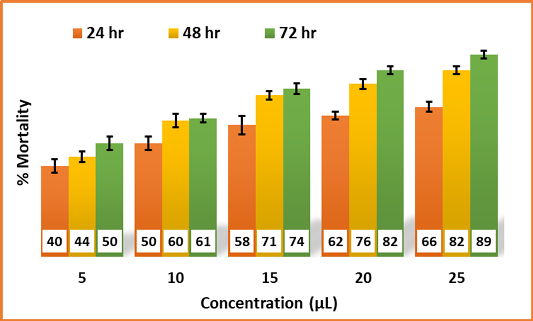
As shown in Table 1, at the lowest concentration, mortality increased from 40% after 24 h to 50% after 72 h, whereas at the highest concentration tested, mortality increased from 66% at 24 h to a maximum of 89% after 72 h. These results demonstrate that prolonged exposure enhanced the fumigant toxicity of E. sativa essential oil against adult T. castaneum.
Table 1: Percentage mortality of Tribolium castaneum after 24, 48, and 72 h of exposure to different concentrations of Eruca sativa essential oil.
Concentration
24 h (%)
48 h (%)
72 h (%)
5
40
44
50
10
50
60
61
15
58
71
74
20
62
76
82
25
66
82
89
Figure 2 illustrates the percentage mortality of T. castaneum at different concentrations of E. sativa essential oil after 24, 48, and 72 h of exposure. Mortality increased progressively with concentration at all exposure periods, confirming the fumigant activity of the oil. Error bars represent standard deviation among replicates.
Probit analysis indicated a gradual decline in LC₅₀ values with increasing exposure time, reflecting enhanced toxicity following prolonged fumigation. The effects of concentration on mortality were statistically significant at each exposure period based on one-way ANOVA (p < 0.05), indicating a strong relationship between dose and insect mortality.
Discussion
The fumigant toxicity of Eruca sativa essential oil observed in the present study suggests that this plant possesses bioactive constituents capable of adversely affecting adult Tribolium castaneum under laboratory conditions. Although the chemical composition of the essential oil was not analyzed in this study, previous reports indicate that E. sativa seeds are rich in glucosinolates and their hydrolysis products, particularly sulfur-containing compounds such as isothiocyanates, which are known for their insecticidal properties ; . The insecticidal effects attributed to isothiocyanates in earlier studies include disruption of respiratory metabolism and interference with key enzymatic processes; however, such mechanisms are inferred here based solely on published literature rather than direct experimental evidence .
The observed increase in mortality with prolonged exposure time indicates that fumigant efficacy of E. sativa essential oil is time dependent. This pattern is consistent with previous studies reporting enhanced toxicity of essential oils following longer exposure periods, likely due to increased penetration and accumulation of volatile compounds within insect tissues ; . Similar time-dependent effects have been documented for other botanical fumigants against T. castaneum, including essential oils of Origanum majorana and Thymus species ; . The progressive decline in LC₅₀ values over time observed in this study further supports the influence of exposure duration on fumigant toxicity.
Botanical essential oils offer several advantages over conventional synthetic fumigants, including rapid biodegradation and reduced persistence in the environment, which may lower risks to non-target organisms and minimize residual contamination of stored products . These characteristics are particularly relevant given the widespread development of resistance to phosphine and increasing regulatory restrictions on chemical fumigants ; . However, the high volatility and sensitivity of essential oils to environmental factors such as temperature, humidity, and light may limit their consistency and residual effectiveness under practical storage conditions .
To overcome these limitations, recent research has emphasized the importance of formulation strategies aimed at improving the stability and controlled release of botanical oils. Approaches such as nanoencapsulation and incorporation into biopolymer matrices have been shown to enhance the persistence and efficacy of essential oils in stored-product pest management systems . In addition, combining botanical fumigants with other compatible control agents, including diatomaceous earths or entomopathogenic fungi, may offer synergistic effects and improve overall pest suppression, as demonstrated in previous integrated management studies .
Although the results obtained under laboratory conditions indicate promising fumigant activity of E. sativa essential oil against T. castaneum, further investigations under semi-field and field storage conditions are necessary. Such studies should evaluate formulation stability, cost-effectiveness, effects on grain quality, and potential impacts on non-target organisms. Addressing these factors will be essential for determining the practical applicability of E. sativa essential oil as a component of integrated pest management programs for stored grain protection.
Conclusion
This study demonstrates that Eruca sativa essential oil exhibits significant fumigant toxicity against adult Tribolium castaneum under laboratory conditions, with mortality increasing in a concentration- and time-dependent manner. The findings suggest potential for further development of this oil as a botanical fumigant; however, additional studies under semi-field and field storage conditions are required to validate efficacy, stability, and practical applicability.
Acknowledgement
The authors are grateful to the Department of Zoology at the University of Lahore for providing the research facilities and insect cultures used in this study.
Novelty Statement
This study provides the first systematic evaluation of the time-dependent and dose-dependent fumigant toxicity of Eruca sativa essential oil specifically against T. castaneum.
Author’s Contribution
SM: Formal Analysis and Manuscript write up; KR: Methodology and Data Collection; TAC: Conceptualization and Supervision.
Generative AI and AI assisted technology statement
The authors declare that no generative AI and AI assisted technology was used in the creation of this manuscript.
Conflict of interest
The authors have declared no conflict of interest.
Figures
Figure 1:.
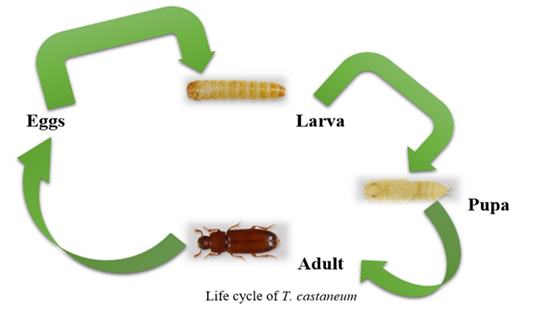
Insect life cycle.
Figure 2:.
Illustrates the percentage mortality of T. castaneum at different concentrations of E. sativa essential oil after 24, 48, and 72 h of exposure. Mortality increased progressively with concentration at all exposure periods, confirming the fumigant activity of the oil. Error bars represent standard deviation among replicates.
References
Abass AB, Fischler M, Schneider K, Daudi S, Gaspar A, Rüst J, Kabula E, Ndunguru G, Madulu D, Msola D (2018). On-farm comparison of different postharvest storage technologies in a maize farming system of Tanzania Central Corridor. J. Stored Prod. Res., 77: 55–65. https://doi.org/10.1016/j.jspr.2018.03.002[CrossRef]
Abbott WS (1925). A method of computing the effectiveness of an insecticide. J. Econ. Entomol., 18(2): 265–267. https://doi.org/10.1093/jee/18.2.265[CrossRef]
Attia MA, Wahba TF, Shaarawy N, Moustafa FI, Guedes RNC, Dewer Y (2020). Stored grain pest prevalence and insecticide resistance in Egyptian populations of the red flour beetle Tribolium castaneum (Herbst) and the rice weevil Sitophilus oryzae (L.). J. Stored Prod. Res., 87: 101611. https://doi.org/10.1016/j.jspr.2020.101611[CrossRef]
Baoua IB, Bakoye O, Amadou L, Murdock LL, Baributsa D (2018). Performance of PICS bags under extreme conditions in the Sahel zone of Niger. J. Stored Prod. Res., 76: 96–101. https://doi.org/10.1016/j.jspr.2018.01.007[CrossRef]
Bateni H, Karimi K (2016). Biorefining of Eruca sativa plant for efficient biofuel production. RSC Adv., 6(41): 34492–34500 https://doi.org/10.1039/C5RA27062F.[CrossRef]
Bell L, Spadafora ND, Müller CT, Wagstaff C, Rogers HJ (2016). Use of TD-GC–TOF-MS to assess volatile composition during post-harvest storage in seven accessions of rocket salad (Eruca sativa). Food Chem., 194: 626–636. https://doi.org/10.1016/j.foodchem.2015.08.043[CrossRef]
Ebadollahi A, Setzer WN (2020). Analysis of the essential oils of Eucalyptus camaldulensis Dehnh. and E. viminalis Labill. as a contribution to fortify their insecticidal application. Natl. Prod. Commun., 15(9): 1934578X20946248. https://doi.org/10.1177/1934578X20946248[CrossRef]
Gaur SK, Kumar K (2020). Toxicity and insect growth regulatory effects of root extract from the medicinal plant, Withania somnifera (Linnaeus) against red flour beetle, Tribolium castaneum (Coleoptera: Tenebrionidae). Arch. Phytopathol. Plant Prot., 53(17–18): 856–875. https://doi.org/10.1080/03235408.2020.1802566[CrossRef]
Gugliandolo A, Giacoppo S, Ficicchia M, Aliquò A, Bramanti P, Mazzon E (2018). Eruca sativa seed extract: A novel natural product able to counteract neuroinflammation. Mol. Med. Rep., 17(5): 6235–6244. https://doi.org/10.3892/mmr.2018.8695[CrossRef]
Gupta S, Arora R, Arora S, Sohal SK (2017). Evaluation of insecticidal potential of 4-Methylthiobutyl isothiocyanate on the growth and development of polyphagous pest, Spodoptera litura (Fab.)(Lepidoptera: Noctuidae). Evaluation, 2(2).
Hikal WM, Baeshen RS, Said-Al-Ahl HA (2017). Botanical insecticide as simple extractives for pest control. Cogent Biol., 3(1): 1404274. https://doi.org/10.1080/23312025.2017.1404274[CrossRef]
Islam W (2017). Eco-friendly approaches for the management of red flour beetle: Tribolium castaneum (Herbst). Sci. Lett., 5: 105–114.
Isman MB (2015). A renaissance for botanical insecticides? Pest Manage. Sci., 71(12): 1587–1590. https://doi.org/10.1002/ps.4088[CrossRef]
Khan HAA (2020). Susceptibility to indoxacarb and synergism by enzyme inhibitors in laboratory and field strains of five major stored product insects in Pakistan. Chemosphere, 257: 127167. https://doi.org/10.1016/j.chemosphere.2020.127167[CrossRef]
Rajkumar V, Gunasekaran C, Paul CA, Dharmaraj J (2020). Development of encapsulated peppermint essential oil in chitosan nanoparticles: Characterization and biological efficacy against stored-grain pest control. Pestic. Biochem. Physiol., 170: 104679. https://doi.org/10.1016/j.pestbp.2020.104679[CrossRef]
Rezaei M, Khaghani R, Moharramipour S (2019). Insecticidal activity of Artemisia sieberi, Eucalyptus camaldulensis, Thymus persicus and Eruca sativa oils against German cockroach, Blattella germanica (L.). J. Asia-Pac. Entomol., 22(4): 1090–1097. https://doi.org/10.1016/j.aspen.2019.08.013[CrossRef]
Sakka GV, Kavallieratos NG, Kanellopoulos NV (2020). Efficacy of different phosphine formulations against several stored-product insect species: Laboratory and field trials. J. Stored Prod. Res., 87: 101614. https://doi.org/10.1016/j.jspr.2020.101614[CrossRef]
Sharma N, Dubey N, Sharma K (2016). Screening of insecticidal activity of Origanum majorana oil against Tribolium castaneum. Biosci. Biotechnol. Res. Asia, 6(1): 203–208.
Singano CD, Ngwira TM, Mvumi BM, Phiri TR (2020). Evaluation of the efficacy of some botanical extracts against the red flour beetle, Tribolium castaneum (Herbst) (Coleoptera: Tenebrionidae). J. Exp. Agric. Int., 42(9): 101–111. https://doi.org/10.9734/jeai/2020/v42i930591[CrossRef]
Umair GM, Sana R, Arbab T, Muhammad A, Islam S, Bushra M (2020). Toxic and repellent potentials of different plant oils and new chemistry insecticides against Tribolium castaneum. GSC Biol. Pharma. Sci., 11(2): 61–70. https://doi.org/10.30574/gscbps.2020.11.2.0081[CrossRef]
Wakil W, Kavallieratos NG, Usman M, Gulzar S, Khan SA (2020). Detection of phosphine resistance in Tribolium castaneum (Herbst) (Coleoptera: Tenebrionidae) populations from Pakistan. J. Stored Prod. Res., 88: 101635. https://doi.org/10.1016/j.jspr.2020.101635[CrossRef]
Wang D, Hou X, Cheng J (2020). Resistance of Tribolium castaneum (Coleoptera: Tenebrionidae) to phosphine in China. J. Econ. Entomol., 113(1): 452–458. https://doi.org/10.1093/jee/toz253[CrossRef]