
New Boselaphus (Mammalia, Bovidae) material is excavated from Pabbi Hills of Sardhok, northern Pakistan. Recently excavated bovid material in the Pleistocene locality of Sardhok (Punjab, Pakistan) includes dentition that provides a better knowledge of the taxon morphology, and this material expands our anatomical knowledge of this taxon. Boselaphus namadicus is spanning from about 3.4 to 0.6 Ma in the Siwalik Group. The Pleistocene species, Boselaphus cf. namadicus, was adapted to open and dry habitats of the Siwaliks.
Short Communication · Volume 49, Issue 6, 13 December 2017 · Open Access
Fossils of Boselaphus (Bovini: Bovidae: Ruminantia) from Sardhok Pleistocene of Pakistan
· · · · ·
Affiliations & Notes ⌄
- 1Dr. Abu Bakr Fossil Display and Research Centre, Department of Zoology, University of the Punjab, Quid-e-Azam Campus, Lahore 54590, Pakistan 2Department of Zoology, GC Women University, Faisalabad, Pakistan , * Corresponding author: khalidkasuri@gmail.com
Article Info ⌄
- Journal:
- Pakistan Journal of Zoology
- Published:
- 13 December 2017

From the article
- The small size species include Elachistoceras and Eotragus; the medium size species include Miotragocerus, Tetracerus and Tragoportax; the large size species include Selenoportax, Pachyportax and Boselaphus.
- Later, Lydekker (1878) noticed the similarities of the sample with the living species of Boselaphus tragocamelus and renamed it Boselaphus namadicus.
- Boselaphus namadicus is recorded from the Sardhok Pleistocene of the Siwalik Group.
- The large mammalian faunal element indicates the important role of open landscapes throughout the Early Pleistocene of the region.
Selected from the article's own text.
Abstract
Type specimen
NHMUK 36851, cranium and horn-cores; from the Pleistocene of the Narbada valley, India, described and figured by Rutimeyer (1878, p. 89, Pl. 6, figs 7-8) under the name of Portax namadicus.
Diagnosis
A Boselaphus larger size than B. tragocamelus; with horn-cores slightly closer to the orbits, with their inner keel situated farther inward and more to the front than in B. tragocamelus; temporal fossa relatively slightly shorter; occipital less convex transversely over the foramen magnum and less hollowed on either side of the median vertical line; occipital condyles much wider and projecting farther in rear of the occipital crest; foramen magnum much larger; paraoccipital process less compressed laterally” .
Stratigraphic range: Upper Siwaliks.
Geographic distribution: South Asia .
New material: Lower dentition: PUPC 11/127, left dp4-m1; PUPC 69/207, left dp4; PUPC 67/297, right m1; PUPC 12/61, left m1; PUPC 67/296, right m2; PUPC 66/18, left m2; PUPC 68/48, left m2.
Locality: Sardhok (SD9, SD19, SD24, SD25, SD26), Gujrat district, Punjab province, Pakistan.
Description
The lower deciduous premolar is trilobed tooth (Fig. 1-1). The lobes are well crescentic and the 1st lobe is shorter than the 2nd and 3rd lobes that are almost equal in size. The enamel is thin and rugose. The cingulum is present antero-labially. The two tubercles are present labially in the valleys between the first and second lobes as well as in the second and third lobes. The stylids are bulky and divergent comparatively (Fig. 1-1, 1-2). The antero-posterior length of the deciduous molar is considerably greater than the transverse diameter (Table I). The height of the lobes increases antero-posteriorly0. The ribs are highly projected. The rib of the third lobe is slightly tilted forward near the apex. The fossettid of the first lobe is simpler and wider than those of the second and the third lobes. The labial side of the third lobe is broad at the base, becoming abruptly narrow and pointed at the apex.
The lower molars are hypsodont and narrow crowned (Fig. 1-3 to 7). The stylids are well divergent. The molars represent pronounced crown neck. The enamel is finely rugose. The ectostylid is well developed lying towards the hypoconid with oval cross section (Fig. 1-3 to 7). The metaconid is spindle shaped with an inflated median part, which produces the moderately strong anterior median rib of the metaconid. The anterior transverse flange is very prominent in the molars. The hypoconid is more constricted than those of the protoconid.
Comparison
The molars show rugose enamel, strong ectostylids, prominent median ribs, constricted labial lobes, and strong and divergent stylids. The general contour of the studied specimens excludes the specimens from the tribe Bovini (Proamphibos, Amphibos, Bos, Leptobos etc.) and favor their inclusion to the tribe Boselaphini. The morphology of these specimens is typical of boselaphines, in general the divergent stylids and pronounced crown neck of the teeth make their inclusion in boselaphines , 1939; Khan et al., 2008a, b, 2009, 2010). The specimens are large enough (Table I) to include them in the large Siwalik boselaphines of the Siwalik Pleistocene.
The dimensions and morphology of the studied material (Table I, Fig. 1) reveal all the features of the Pleistocene boselaphine species Boselaphus namadicus, a species recorded from the Upper Siwaliks of the subcontinent. The material is assigned to Boselaphus cf. namadicus owing to insufficient data.
Table I.- The measurements of the studied cheek teeth (mm) of Boselaphus cf. namadicus.
| Specimen No. | Nature | Length | Width | W/L ratio |
| PUPC 11/127 | dp4 | 29.0 | 12.0 | 0.41 |
| m1 | 26.2 | 13.8 | 0.52 | |
| PUPC 69/207 | ldp4 | 31.7 | 11.4 | 0.35 |
| PUPC 67/297 | rm1 | 26.1 | 10.7 | 0.40 |
| PUPC 12/61 | lm1 | 31.4 | 13.7 | 0.43 |
| PUPC 67/296 | rm2 | 28.4 | 12.0 | 0.42 |
| PUPC 66/18 | lm2 | 32.0 | 14.7 | 0.45 |
| PUPC 68/48 | lm2 | 28.5 | 14.9 | 0.52 |
Discussion
The boselaphines are generally found abundantly in the Siwalik Group (Lydekker, 1878; ; ; , 1937, 1939; ; . Nevertheless, boselaphines are one of the dominant bovids found in the Late Miocene of Africa and Eurasia with a variety of morphs ranging small-medium to large size , 1971, 1994; ; . The small size species include Elachistoceras and Eotragus; the medium size species include Miotragocerus, Tetracerus and Tragoportax; the large size species include Selenoportax, Pachyportax and Boselaphus.
First record of Boselaphus namadicus from the Siwaliks was reported by Rutimeyer (1878) under the name of the genus Portax. Later, Lydekker (1878) noticed the similarities of the sample with the living species of Boselaphus tragocamelus and renamed it Boselaphus namadicus. The tribe Boselaphini has wide distribution in the subcontinent Siwalik. But the group is now restricted to south Asia representing only two living species Nilegauy (Boselaphus tragocamelus) and Tetracere (Tetracerus quadricornis). Boselaphus namadicus is considered to be immediate ancestor of modern boselaphine Boselaphus tragocamelus or may close alley to the living species.
Conclusions
Boselaphus namadicus is recorded from the Sardhok Pleistocene of the Siwalik Group. The large mammalian faunal element indicates the important role of open landscapes throughout the Early Pleistocene of the region. The presence of wooded biotopes along a major river is indicated by the frequent occurrences of these large mammals. The predominance of large sized mammals in this sequence indicates the important role of open, steppe-like environment at that time.
Supplementary material
There is supplementary material associated with this article. Access the material online at: http://dx.doi.org/10.17582/journal.pjz/2017.49.6.sc3
Statement of conflict of interest
Authors have declared no conflict of interest.
Figures
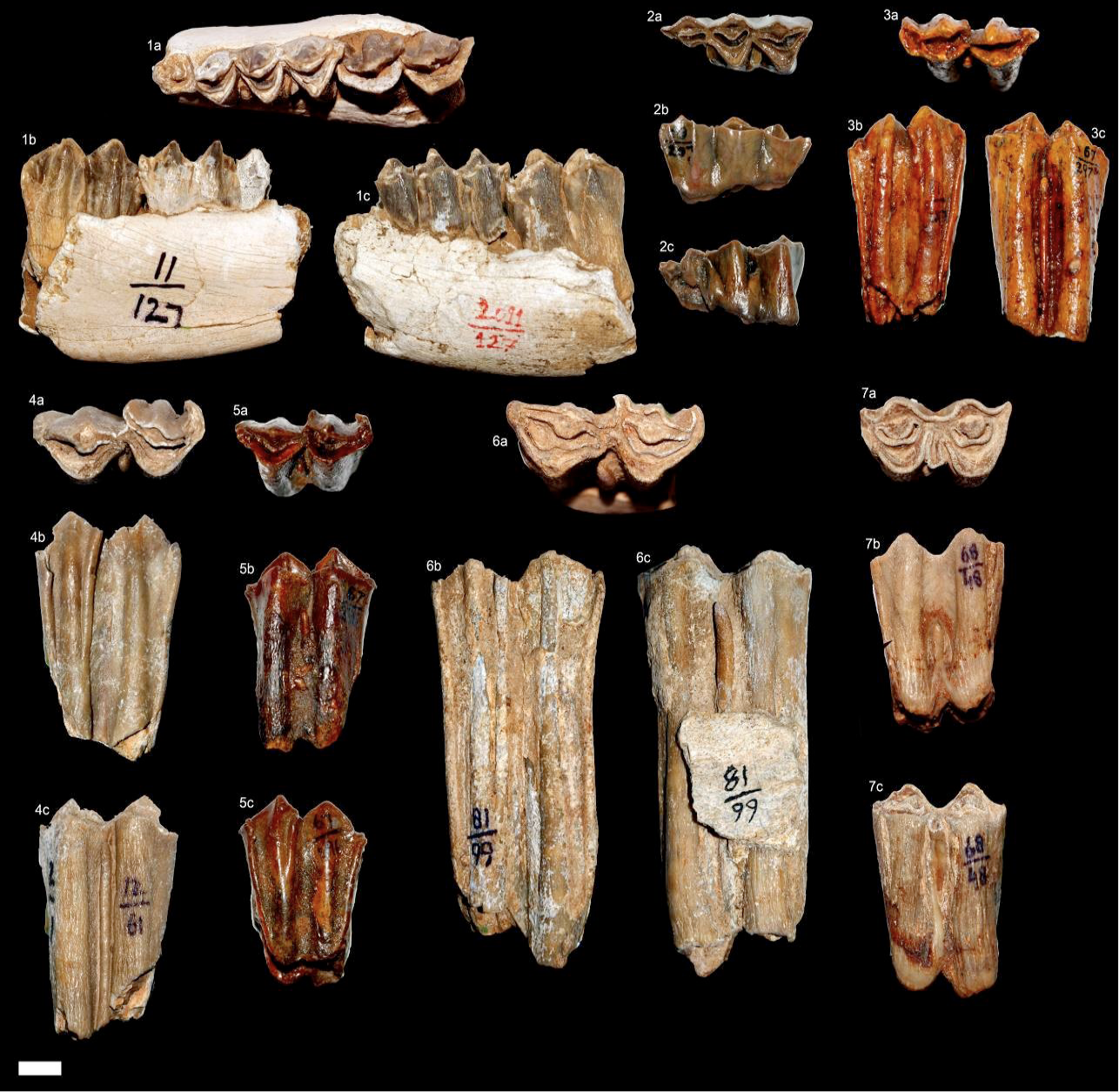
Boselaphus cf. namadicus: 1, PUPC 11/127, left mandible fragment with dp4-m1; 2, PUPC 69/207, ldp4; 3, PUPC 67/297, rm1; 4, PUPC 12/61, lm1; 5, PUPC 67/296, rm2; 6, PUPC 66/18, lm2; 7, PUPC 68/48, lm2. Views: a, occlusal; b, lingual; c, labial. Scale bar 10 mm.
References
- Akhtar, M., 1992. Taxonomy and Distribution of the Siwalik Bovids. Ph. D. Diss., University of the Punjab, Lahore, Pakistan.
- Colbert, E.H., 1935. Am. Mus. Novit. 799: 1-24.
- Colbert, E.H., 1943. Trans. Am. phil. Soc., N. S., 32: 395-429.
- Dennell, R., Coard, R. and Turner, A., 2006. Palaeogeogr. Palaeoclimat. Palaeoecol., 234: 168-185. https://doi.org/10.1016/j.palaeo.2005.10.008[CrossRef]
- Dennell, R., Coard, R. and Turner, A., 2008. Quat. Int., 192: 78-88. https://doi.org/10.1016/j.quaint.2007.06.023[CrossRef]
- Gentry, A.W., 1970. In: Fossil vertebrates of Africa (eds. L.S.B. Leakey and R.J.G. Savage), Academic Press, London, 2: 243-323
- Gentry, A.W., 1971. Bull. Br. Mus. (N.H.), G.S., 20: 229-296.
- Gentry, A.W., 1994. Hist. Biol., 7: 115-158. https://doi.org/10.1080/10292389409380449[CrossRef]
- Khan, M.A. and Farooq, U., 2006. Int. J. zool. Res., 2: 100-109.
- Khan, M.A., Ahmad, Z. and Akhtar, M., 2008a. Biologia (Pakistan), 54: 65-72.
- Khan, M.A., Iqbal, M., Ghaffar, A., Khan, A.M. and Akhtar, M., 2008b. Pakistan J. Zool., 40: 303-307.
- Khan, M.A., Iliopoulos, G. and Akhtar, M., 2009. Geobios, 42: 739-753. https://doi.org/10.1016/j.geobios.2009.04.003[CrossRef]
- Khan, M.A., Kostopoulos, D.S., Akhtar, M. and Nazir, M., 2010. Neu. Jahrb. Geol. Paläont., 258: 121-128.
- Khan, M.A., Iqbal, J., Ali, S. and Akhtar, M., 2014. Pakistan J. Zool., 46: 463-470.
- Lydekker, R., 1878. Pal. Ind., 10: 88-181.
- Maglio, V.J., 1973. Trans. Am. philos. Soc., 63: 1-149. https://doi.org/10.2307/1006291[CrossRef]
- Matthew, W.D., 1929. Bull. Am. Mus. Nat. Hist., 56: 437-560.
- Nanda, A.C., 2008. Quat. Int., 192: 6-13. https://doi.org/10.1016/j.quaint.2007.06.022[CrossRef]
- Pilgrim, G.E., 1926. Proc. Pan-Pacific Sci. Congr. Australia, pp. 896-931.
- Pilgrim, G.E., 1937. Bull. Am. Mus. N. H., 72: 729-874.
- Pilgrim, G.E., 1939. Pal. Ind. N. S., 26: 1-356.
- Rutimeyer, L., 1878. Abhandl. Schweiz. Paläontol. Gesell., 4: 1-208.
- Sarwar, M., 1977. Bull. Deptt. Zool. Univ. Punjab Lahore, 10: 1-172.
- Tewari, R., Pant, P.C., Singh, I.B., Sharma, S., Sharma, M., Srivastava, P., Singhvi, A.K., Mishra, P.K. and Tobschall, H.J., 2002. Man Environ., 27: 1-14.
- Valdiya, K.S., 1993. Curr. Sci., 64: 873–885.
- Vrba, E.S. and Schaller, G., 2000. In: Antelopes, deer and relatives (eds. E.S. Vrba and G. Schaller), Yale University Press, New Haven, pp. 203-222.
Supplementary material
Services
Article usage statistics
Loading…