
Albinism is a deficiency in melanin production due to genetic anomalies, which appear as the lack of coloration of part or in the whole body of an organism. These conditions are rare in wild animal populations. Here, we report the world’s first record of a completely albinotic (OCA type 1) wild lesser jerboa Jaculus jaculus. During the survey on mammals in southwest Saudi Arabia on 15 May 2022, we captured one specimen of an adult albino male individual of lesser jerboa, in the region of southern Tathlith governorate in Asir province southwest of Saudi Arabia, in a sandy area with light vegetation cover surrounded by rocky hills and mountains.
Short Communication · Volume 57, Issue 2, 8 April 2025 · Open Access
First Record of a Completely Albinotic (OCA Type 1) Wild Lesser Jerboa, Jaculus jaculus in the World from Saudi Arabia
·
Affiliations & Notes ⌄
- 1Department of Biology, College of Science, University of Bisha, Bisha, Saudi Arabia 2Departments of Zoology, Faculty of Science, Al-Azhar University, Cairo * Corresponding author: Fouad_fouad@azhar.edu.eg
Article Info ⌄
- Journal:
- Pakistan Journal of Zoology
- Published:
- 8 April 2025

From the article
- The present study describes the first record of the total albinism of the lesser jerboa Jaculus jaculus with a completely white body pelage coloration without any pigmentation at any part of its body with pink eyes suffering from poor vision.
- However, the albino lesser jerboa specimen is nearly identical in its external morphological characters because it lies within the normal range of the variation reported for those of typically colored individuals known for this species (Table II).
- Here, we report the first record of a completely albinotic (OCA type 1) wild lesser Jerboa Jaculus jaculus in the world from southwest Saudi Arabia.
Selected from the article's own text.
Abstract
Materials and methods
An albino male specimen of lesser jerboa Jaculus jaculus, in addition to typically colored individuals, was captured alive on 15 May 2022 in the same habitats of the surveyed area southern of Tathlith governorate in Asir province southwest Saudi Arabia, site coordinates are 19°20`08.6”N, 43°40`04.5”E, at elevation 1.22 km a.s.l. (Fig. 1). The characteristics of the habitats has been detailed in the Table I.
The external morphological characters of the lesser jerboa specimens were measured to millimeters (mm). Fifth external morphological measurements were taken for each individual of the lesser jerboa Jaculus jaculus using a 0.1mm caliper, according to . After some filed data sheet was completed, the lesser jerboa Jaculus jaculus samples were released in their natural wild habitats.
Table I. Characteristics of habitat under study.
| Information | Study area |
| Elevation | 1216.79 m |
| Average annual temperature ºC | 27ºC |
| Average annual humidity % | 38.52% |
| Vegetation | Sparsely vegetated desert area with low cover shrubs |
Results and discussion
Our knowledge of albinism animals is infrequent because this condition is rare to be met in wild animals, is non-contagious and is a genetically inherited condition that affects animals worldwide regardless of species or environmental conditions. Naturally, it results from a significant deficit in the production of melanin pigment and is characterized by the complete or partial absence of pigmentation in the skin, hair and eyes.
In this paper, we describe the first record of total albinism (OCA type 1) wild lesser jerboa Jaculus jaculus in the world from southwest Saudi Arabia and compare their morphological characters with those of typically colored. To date, there has not been any record of this abnormality (albinism) in the genus Jaculus and the family Dipodidae in the Arabian region. The only report of albinism condition in the family Dipodidae was recorded in Zapus princeps in the USA .
The albino male sample of lesser jerboa Jaculus jaculus was collected in the surveyed area southern of Tathlith Governorate in Asir Province South West of Saudi Arabia, site coordinates is 19°20`08.6”N, 43°40`04.5”E, at elevation 1.22 km a.s.l., during the survey on mammals in a sandy area surrounded by rocky hills and mountains. This area exhibits a hot and humid climate with rare annual rainfall and limited water resources in a hyper-arid region. Also, it’s covered with light vegetation of some shrubs and grass growing on the little amount of available annual water resources and it’s fragmented in sandy zones between rocky hills and mountains of Asir province, southwest Saudi Arabia (Fig. 1).
One of the most important things we noticed about this albino sample of lesser jerboa is that it did not show the same reaction as its counterparts from the normal samples of typically colored jerboa, as it appeared in a quiet state and did not react violently to light or to holding it, and this was the first thing that drew our attention to this sample. Before checking its color, it becomes clear that its entire body is covered with thick white fur and suffers from severe visual deficiency. The present study describes the first record of the total albinism of the lesser jerboa Jaculus jaculus with a completely white body pelage coloration without any pigmentation at any part of its body with pink eyes suffering from poor vision. It is considered a completely albinotic case (OCA type 1) that was noted while handling the albino sample (Fig. 2).
The normal individuals of the lesser jerboa pelage coloration agree with what is known for the species. It usually exhibits grayish sandy, with the faint gray basis of hair showing through in patches and some very fine dark speckling above the posterior back with a lighter underside, ear tip pigmented and black eyes. Also, these rodents have long tufted tails with black sub-terminal bands and white tips ; .
During the same period at the same site, we also recorded normal jerboa with typically colored individuals. After the external morphological characters were measured to compare with the albino sample, all samples were released in their natural wild habitats. However, the albino lesser jerboa specimen is nearly identical in its external morphological characters because it lies within the normal range of the variation reported for those of typically colored individuals known for this species (Table II).
Table II. External characters of lesser jerboa Jaculus jaculus samples were collected from Saudi Arabia.
| Character | Albinism sample | Normal samples | After Harrison and Bates, 1991 |
| TBL | 260 | 261±8.5(255-267)2 | 276±15.2(234-317)97 |
| TL | 158 | 158.5±0.7(158-159)2 | 170±11.8(128-203)97 |
| HF | 60 | 59.5±0.7(59-60)2 | 57±2,5(51-64)88 |
| FA | 30 | 30±0.0(30-30)2 | 26.6±1.3(24-30)33 |
| EL | 18 | 18.5±0.7(18-19)2 | 21.9±1.8(17-26)96 |
TBL, total body length including tail length; TL, tail length, HF, hind foot length; FA, forearm length and EL, ear length taken from notch to tip.
This unique case represents the first record of a completely albinotic (OCA type 1) in wild rodents dwelling in the desert habitats of the Arabian Peninsula. The condition of total albinism and lack of coloration in the lesser jerboa has not been recorded before in the genus Jaculus in the world and the family Dipodidae in the Arabian region. The recordings occurred during the study on 15 May 2022. The adult albino male with a completely white body and pink eyes with poor vision observed and documented by several videos were taken during the night (Fig. 2). Due to the rigor situations in which this rare specimen had been caught, we had to photograph it, take some morphological measurements and released it into its natural wild habitats for fear of causing harm or death to it.
Albinism is a rare condition still undetected in most wild mammal species, at least in rodent individuals. However, the albinism events recorded might result from a hereditary condition in which the melanin pigment is either absent or nonfunctional . The lack of coloration in albinos, in natural conditions, has tended to have reduced survival rates than any other individuals with normal coloration or make them less appealing for reproduction ; ; ; ; ; also, higher sensitivity to disease and poor vision may reduce the viability of albinos .
Conclusions
Albinism condition is rare to be met in wild animals. Here, we report the first record of a completely albinotic (OCA type 1) wild lesser Jerboa Jaculus jaculus in the world from southwest Saudi Arabia.
Acknowledgment
We are grateful to the membersof the fieldwork team who participated in the collection of this unique sample, and are Ashaq Husain Alqahtani, Sultan Ayed Alqahtani, Ashaq Ayed Alqahtani, Saad Mohamed Alqahtani and Abdullah Ayed Alqahtani.
Ethical statement
This work was carried out according to the ethical framework of wildlife protection laws in Saudi Arabia. Collecting samples of the wild lesser jerboa Jaculus jaculus for taking morphological measurements, photographing them, and re-releasing them to their nature isn’t considered contrary to any of the laws of wildlife protection in the Kingdom of Saudi Arabia. It does not contradict the relevant international laws in this regard. Also, this species is widespread and not threatened, according to previous studies published internationally. In addition, the area is not protected and does not require permission to work within it.
Statement of conflict of interest
The authors have declared no conflict of interest.
Figures
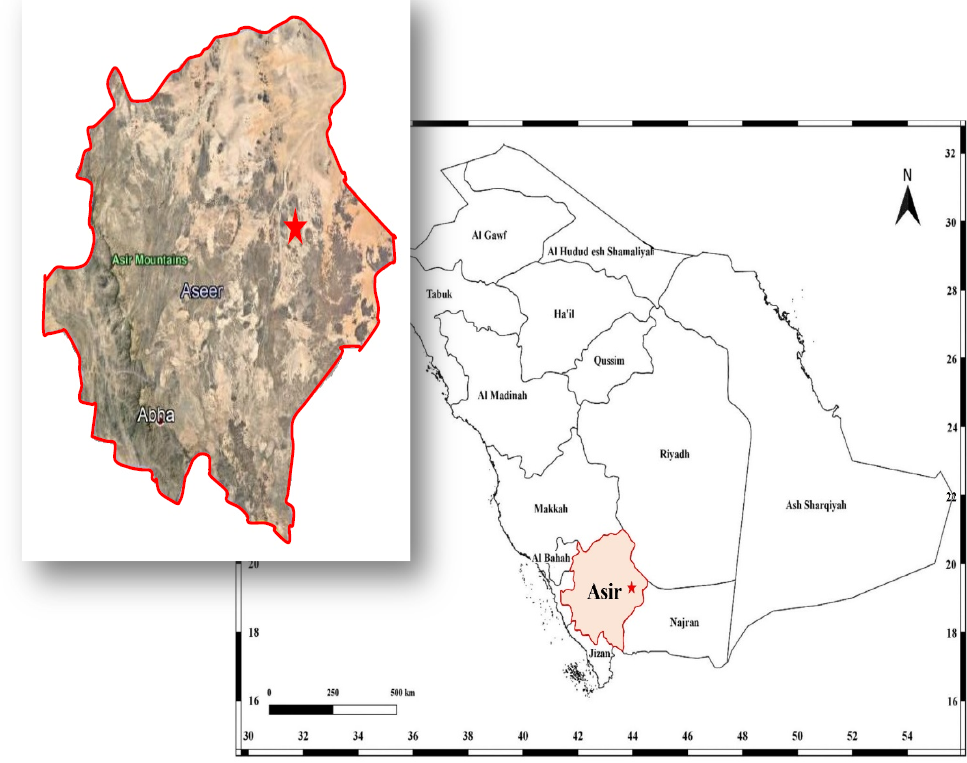
A map showing the geographical locality from which the albino specimen of Jaculus jaculus was collected from Saudi Arabia.
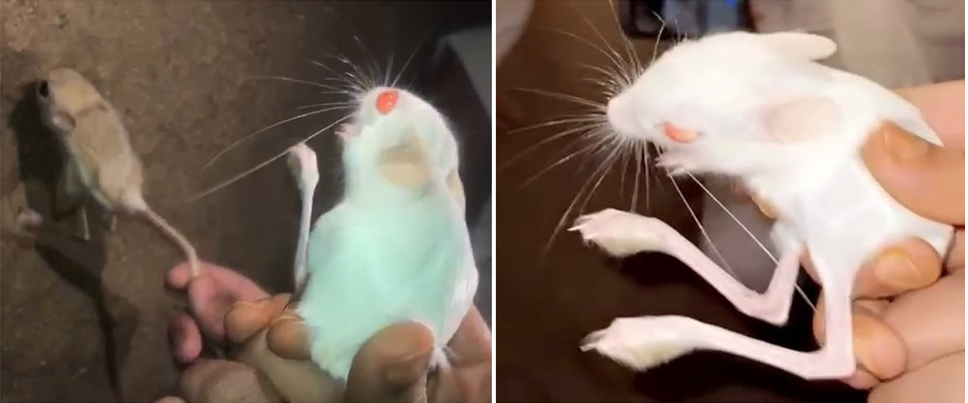
Extracted photographs showing the first record of the albino specimen of lesser jerboa Jaculus jaculus from Saudi Arabia.
References
- Abreu, M.S.L., Machado, R., Barbieri, F., Freitas, N.S. and Oliveira, L.R., 2013. Braz. J. Biol., 73: 185-194. https://doi.org/10.1590/S1519-69842013000100020[CrossRef]
- Acevedo, J. and Aguayo, M., 2008. Rev. Biol. Mar. Oceanograf., 43: 413–417. https://doi.org/10.4067/S0718-19572008000200017[CrossRef]
- Al-Sadoon, M.K., Paray, B.A. and Al-Otaibi, H.S., 2016. Saudi J. biol. Sci., 23: 642–648. https://doi.org/10.1016/j.sjbs.2016.04.005[CrossRef]
- Buttiker, W. and Harrison, D.L., 1982. Fauna Saudi Arabia, 4: 488-502.
- Durant, S.M., Pettorelli, N., Bashir, S., Woodroffe, R., Wacher, T., De Ornellas, P., Ransom, C., Abáigar, T., Abdelgadir, M., El Alqamy, H. and Beddiaf, M., 2012. Science, 336: 1379–1380. https://doi.org/10.1126/science.336.6087.1379[CrossRef]
- Espinal, M., Mora, J.M., Ruedas, L.A., López, L.I. and Marineros, L., 2016. Mastozool. Neotrop., 23: 63–69.
- Fertl, D. and Rosel, P., 2009. Albinism. In: Encyclopedia of marine mammals (eds. W.F. Perrin, B. Würsig and J.G.M. Thewissen). Academic Press. San Diego, USA, pp. 24–26. https://doi.org/10.1016/B978-0-12-373553-9.00006-7[CrossRef]
- Freund, K.B., Sarraf, D., Mieler, W.F. and Yannuzzi, L.A., 2016. The Retinal Atlas E-Book. Elsevier Health Sciences. pp. 13-231.
- García-Casimiro, E. and Santos-Moreno, A., 2020. Neotrop. Biol. Conserv., 15: 195–200. https://doi.org/10.3897/neotropical.15.e50951[CrossRef]
- Harrison, D.L., 1964. The mammals of Arabia 1. Introduction, Insectivora, Chiroptera, Primates, Benn, London. pp. 192.
- Harrison, D.L., 1968. The mammals of Arabia 2. Carnivora, Hyracoidea, Artiodactyla, pp. 193–381.
- Harrison, D.L., 1972. The mammals of Arabia 3. Lagomorpha and Rodentia. Benn, London. pp. 382–670.
- Harrison, D.L., 1981. Mammals of the Arabian Gulf. The Natural History of the Arabian Gulf. Allen and Unwin London. pp. 92.
- Harrison, D.L. and Bates, P.J.J., 1991. The mammals of Arabia. Harrison Zool, Mus. Pub., pp. 354.
- Hart, E., Belk, M., Jordan, E. and Gonzalez, M., 2004. Species, 749: 1-7. https://doi.org/10.1644/749[CrossRef]
- Hofreiter, M. and Schöneberg, T., 2010. Cell. Mol. Life Sci., 67: 2591–2603. https://doi.org/10.1007/s00018-010-0333-7[CrossRef]
- Ito, S. and Wakamatsu, K., 2008. Photochem. Photobiol., 84: 582–592. https://doi.org/10.1111/j.1751-1097.2007.00238.x[CrossRef]
- Lutz, C.G., 2001. Practical genetics for aquaculture. Blackwell Science, Oxford. pp. 256. https://doi.org/10.1002/9780470999837[CrossRef]
- Miller, J.D., 2005. Missouri Conserv. Mag., 66: 4–7.
- Osborn, D.J. and Helmy, I., 1980. The contemporary land mammals of Egypt (including Sinai). Field Museum of Natural History Chicago ILL. https://doi.org/10.5962/bhl.title.2801[CrossRef]
- Paray, B.A. and Al-Sadoon, M.K., 2018. Saudi J. biol. Sci., 25: 604-608. https://doi.org/10.1016/j.sjbs.2018.02.012[CrossRef]
- Reum, J.C.P., Paulsen, C.E., Pietsch, T.W. and Parker-Stetter, S.L., 2008. Northw. Nat., 89: 60-62. https://doi.org/10.1898/1051-1733(2008)89[60:FROAAC]2.0.CO;2[CrossRef]
- Romero, V., Racines-Márquez, C.E. and Brito, J., 2018. Mammalia, 82: 509-515. https://doi.org/10.1515/mammalia-2017-0111[CrossRef]
- Sandoval-Castillo, J.E., Mariano-Melendez, C., Villavicencio-Garayzar, C., 2006. Cybium, 30: 191-192.
- Silva-Caballero, A., Montiel-Reyes, F., Sánchez-Garibay, E. and Ortega, J., 2014. Therya, 5: 839–843. https://doi.org/10.12933/therya-14-193[CrossRef]
Services
Article usage statistics
Loading…