
Rapid urbanisation has led to the reduction and loss of natural habitats, resulting in increased direct contact between wildlife and humans which often led to behavioural adjustments in wildlife. In this context, herein, the flight initiation distance (FID) of the Eurasian tree sparrow (Passer montanus) to observers wearing different colored clothing (white, black, red, and green) approaching in four sites (rural areas: Fuping and Chifeng; urban areas: Wuhu and Baoding) was compared. We found that habitat type (rural area versus urban area) did not affect the FID of Eurasian tree sparrows. The color of the observer’s clothes significantly affected the sparrow’s behavioral response, they exhibited a longer FID in the presence of observers wearing red. There was no interaction between habitat type and clothing color on FID of Eurasian tree sparrows. This study showed that even in tree sparrows, which have long coexisted with humans in their habitat, subtle alterations in human activity can induce changes in the flight initiation distance (FID) of Eurasian tree sparrows. This also suggests that Eurasian tree sparrows can adapt their behaviour to the disturbance caused by the color of human clothing.
Research Article · Volume 57, Issue 5, 20 August 2025 · Open Access
Fear No Colors? Eurasian Tree Sparrows are More Wary of People Dressed in Red
· · · ·
Affiliations & Notes ⌄
- 1Forestry Survey and Planning Institute of Ningxia Hui Autonomous Region 2College of Biological Sciences and Engineering, North Minzu University, Yinchuan 750021, China Bin Li and Zhipeng Xu contributed equally to this work. * Corresponding author: liujp@nun.edu.cn, xxffyan@126.com
Article Info ⌄
- Journal:
- Pakistan Journal of Zoology
- Published:
- 20 August 2025

From the article
- The results of this study showed no significant differences in the FIDs of sparrows in the different habitat category (rural: FID, 5.96±2.26m, urban: FID, 6.54±3.04m; F=0.273, df =1, 893, P =0.601).
- This study showed that habitat type did not affect the FIDs of Eurasian tree sparrows.
- The results of the present study showed that the FID of sparrows was significantly longer when observers approached sparrows in red clothing compared to other colors, and the same trend was presented in rural as well as urban areas.
- Because the tree sparrows’ FIDs were significantly shorter when approached in black and white, compared to when approached in red.
Selected from the article's own text.
Abstract
Introduction
Rapid growth in the global urban population means that rural land is increasingly being converted into cities in order to satisfy human needs ; . As a result, more natural habitats are being fragmented or even destroyed, and direct human contact with wildlife is becoming more frequent, posing a challenge to the survival of many species ; Tätte et al., 2018). The negative impacts of urbanization have been observed in various species, including insects , reptiles (Gonçalves et al., 2018), birds , and mammals . In this new environment of rapid urbanisation, it is important to better understand the ways in which animals coexist with humans (Frid and Dill, 2002; Shochat et al., 2006; . Animals usually adjust their behaviour in response to environmental changes and disturbance from humans, and behavioural plasticity is one of the key factors that allows animals to cope with environmental changes and coexist with humans ; ; ; .
Predation is a direct contributor to animal mortality, and humans are often viewed as predators by animals ; . Animals can adopt different defence mechanisms when faced with a predation threat hiding through camouflage, escape, and resistance, with escape being the most common anti-predatory behaviour ; ; Ibáñez-Álamo et al., 2019). Flight initiation distance (FID) is the distance between the animal and predator when the fleeing prey is being approached by a potential predator or between the animal and source of disturbance ; Bateman and Fleming, 2011; , and it is often used to assess the anti-predatory behaviour of animals. FID is the animal’s measure of the cost versus benefit of escape ; ; . Numerous factors, such as the level of urbanization, flock size, urban habitat characteristics, and local hunting activities, exert significant influence on FIDs in avian species ; ; ; ; Samia et al., 2017; ; . Some studies have shown that in urban areas that are frequently disturbed by humans, animals flee from humans at shorter distances ; ; Vincze et al., 2016). Furthermore, due to reduce the reduced risk of predation in urban environments, urban birds may also exhibit more relaxed anti-predatory behaviour with shorter FIDs than rural species ; . However, even the same type of human activity can have different effects on FIDs in birds. Therefore, it is still important to study the effects of a particular factor on bird FIDs in different regions in order to gain a comprehensive understanding of how birds rapidly adapt to the dynamic urban environment. For example, some studies have shown that the wearing of face masks by human during the COVID-19 pandemic does indeed affect the anti-predation behavioral responses of birds, as evidenced by certain birds exhibiting reduced FIDs in close proximity to mask-wearing individuals ; ; . However, a study conducted by Mikula et al. (2021) across four European countries failed to observe any significant influence of mask usage on avian escape and alert behaviors.
Related studies have shown that the color of human clothing can also have an effect on the FID in birds ; ; ; ; . The species confidence hypothesis suggests that birds are attracted to colors identical or similar to their own plumage, and repelled by colors that are dissimilar (Burley, 1986). This hypothesis has now been documented in some relevant studies ; ; ; however, these studies have been unable to fully explain their results, such as one study that found no significant difference in FID whether humans wore or did not wear red clothing in close proximity to various red and non-red bird species during summer . The concealment color hypothesis suggests that animals would have been more alert to the surrounding threats, or at least during the non-breeding season. When observers wear brightly colored clothing, they become highly conspicuous to avian species. The birds promptly take flight upon confirming the presence of a potential threat when they detect observers wearing brightly colored clothing .
Studies have indicated that the black throat patch of Eurasian tree sparrows (Passer montanus; thereafter sparrows) serves not only as a means to distinguish between males and females , but also as a sex-specific signal conveying individual personality traits and reflecting the status information of this species ; Fülöp et al., 2021). However, it remains unclear whether sparrows are attracted to the same color of human clothing as their sex-specific signal throat patches during the non-breeding season. We also wondered whether the color of human clothing affects the anti-predatory behavioral responses of sparrows that have long settled in human settlements. As such, the present study investigated the FID of the sparrow to humans wearing different colored clothing (white, black, red, and green) in four study sites. We hypothesized whether tree sparrows would be attracted to black clothing resembling their black badge feathers in their throats, and if so, the sparrows would have the shortest FID when the observer was wearing the black clothing.
Materials and Methods
Study site
Baoding is located in the northern part of the North China Plain and central Hebei Province (38°10′–40°00′ N, 113°40′–116°20′ E) with a total area of 22,000 km2, and has a warm temperate continental monsoon climate. The Baoding population was 11,437,200 by the end of 2020 (http://www.baoding.gov.cn). In Baoding, field data were mainly collected in suburban parks with few human activities.
Wuhu is located in south-eastern Anhui Province at the lower reaches of the Yangtze River (30°19′–31°34′ N,117° 40′–118°44′ E) and belongs to the subtropical humid monsoon climate zone (Supplementary Figs. 1, 2). Wuhu has a resident population of 3.731 million by the end of 2022 and covers an area of 6009.02 km2 (https://www.wuhu.gov.cn). In Wuhu, field data were mainly collected from parks and residential areas.
Chifeng is located in south-eastern Inner Mongolia (41°17′–45°24′ N, 116°21′–120°58′ E), with a total area of 90,000 km2 and a total population of only 4,036,000, and belongs to the mid-temperate semi-arid continental monsoon climate zone (http://www.chifeng.gov.cn). In Chifeng, data were mainly collected in agricultural areas and township roads.
Fuping County is located in central Shaanxi Province (34°42′–35°06′ N, 108°57′–109°26′ E) with a total area of 1,241 km2, the Fuping population was 642,500 by the end of 2020, and has a warm temperate monsoon continental climate (http://www.fuping.gov.cn). Fuping originated mainly from township roads and surrounding residential areas.
FID data collection
FIDs were measured for sparrows in Baoding, Hebei Province (urban); Wuhu, Anhui Province (urban); Chifeng, Inner Mongolia (rural); and Fuping, Shaanxi Province (rural) from November 2021 to February 2022. Clothing worn during the survey consisted of four colors white, black, red, and green and one color was worn randomly each day for the sparrow FID analysis (Supplementary Fig. 3). The FID was recorded as described by Blumstein (2006) and Weston et al. (2012). When a bird was observed through binoculars, the first task was to determine the species. Then the observer walked towards the focus birds at constant walking pace in a straight line. The FID was then recorded as the straight-line distance from the observer to the sparrow individual when it began its flight (obtained by calculating the number of steps from the observer to the point of flight of the sparrows and multiplying by the length of each step). FIDs were recorded for all sparrows meeting the following criteria: (1) Individual sparrow foraging or engaging in comfort behaviour on the ground. When an observer encountered a highly alert individual sparrow, they would retreat at least 10 m away, and would not focus on the individual for at least 1 min. If the individual flew away during this period, the record was abandoned. If it was no longer alert, the test would continue. Otherwise, the observer repeated the process by retreating at least 10 m back, until the individual sparrow was no longer alert. (2) Measurements were discarded when there were mixed flocks of other species and sparrows. This ensured that the FID of the observed individuals was not influenced by birds of other species. (3) The observer ensured that there was no other human interference within 30 m of the individual being observed . (4) When the target is a group of individuals of the same species, the distance at which more than 60% of the individuals flying away is the FID of the group. Appropriate re-sampling of the same individual would not affect the results of the study (. Nevertheless, an observer would continue walking in only one direction at least 15 min between consecutive measures when wearing a certain colored clothing, without sampling from the same position twice. This prevented repeat trials of the same individual when the observer was wearing the same-colored clothing.
Statistical analyses
The IBM SPSS 26.0 for Windows (IBM Inc., Armonk, NY, USA) was used for statistical analysis. A generalised linear mixed model was used to determine the effect of clothing color on FIDs. To compare FIDs between different habitat category (urban and rural) and clothing color, the FID was used as the response variable, and the clothing color, habitat category, interaction term (color*habitat category) and flock size were used as predictors with each site within the habitat category as random effect. All tests were two-tailed, with a significant level determined as P < 0.05. The data are presented as the mean ± standard deviation (SD).
Results
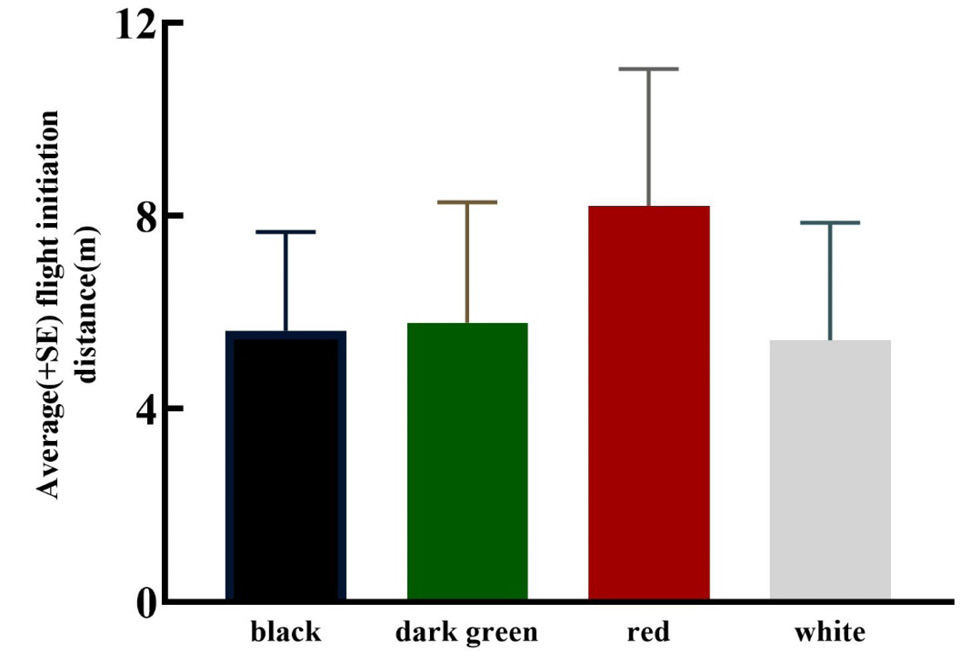
The results of this study showed no significant differences in the FIDs of sparrows in the different habitat category (rural: FID, 5.96±2.26m, urban: FID, 6.54±3.04m; F=0.273, df =1, 893, P =0.601). The color of the observer’s clothing had a significant effect on the sparrows FID, which was significantly longer when the observer approached wearing red compared to when they approached wearing green, white, or black (FIDs: red, 8.20 ± 2.84 m; green, 5.79 ± 2.49m; white, 5.42 ± 2.43 m; black, 5.62 ± 2.04 m; F=65.277, df =3, 893, P < 0.0001; Fig. 1). There was a significant interaction between the clothing color and habitat category (F=2.958, df =3, 893, P =0.032). Flock size also had a significant effect on the sparrows FID (F=29.068, df =1, 893, P < 0.0001).
Discussion
This study showed that habitat type did not affect the FIDs of Eurasian tree sparrows. The color of human clothing also had an effect on the FIDs of sparrows in winter, with the sparrow species showing significantly longer FIDs to observers wearing red clothing.
Many studies have shown that the FIDs of birds in urban areas are shorter than those in rural areas ; ; Battle et al., 2016; . The reasons for FID differences between urban and rural birds may be related to habitat type, differences in predation risk, and different levels of human disturbance, among others ; ; ; . The present study showed that the FID of rural sparrows was not significantly longer than that of urban sparrows. This was not consistent with the findings of previous related studies (e.g., ; ; ; ; . The reasons for this lack of difference may be as follows: First, although population size, availability of food, type and number of predators, and level of human disturbance may vary from one study site to another. Sparrows may respond to variations in the environment by habituating and flexibly adjusting their own anti-predatory behaviour , which has led to no significant differences in the FID of sparrows across different habitats. Second, the number of sites in this study may be relatively small, with only 2 sites in both urban and rural areas, so the FID of sparrows did not show gradient changes between urban and rural areas. In some studies, more geographic areas were studied and habitat types were more diverse, so they were able to find urban-rural differences in bird FID ; ; . Battle et al. (2016) could find urban-rural differences in FIDs of two songbirds, which may be attributed to the small sample size. Third, during the survey season, there may not be significant differences in the actual intensity of human disturbance at the four experimental sites. From the perspective of human population density, Baoding city is 519 people/km2, Wuhu city is 620 people/km2, and Fuping country population is 517 people/km2, overall, the human population density of the three cities is not much different. In addition, Fuping has a large number of tourist attractions, and the large increase in the number of tourists also increases the intensity of human interference with the local wildlife.
The results of the present study showed that the FID of sparrows was significantly longer when observers approached sparrows in red clothing compared to other colors, and the same trend was presented in rural as well as urban areas. The feather color of sparrows is mainly black, white and dark brown, they may be more comfortable than red. Because the tree sparrows’ FIDs were significantly shorter when approached in black and white, compared to when approached in red. Therefore, the findings of our study provide strong support for the species confidence hypothesis . Our findings are similar to those of other bird species studied by Gutzwiller and Marcum (1997), Gould et al. (2004), and Zhou and Liang (2020). We’ve all found that it’s easier to approach birds when the observer is wearing the same feather color as the bird. Our findings are inconsistent with those of Cooper and Perez-Mellado (2011) and Raveh et al. (2012). Cooper and Perez-Mellado (2011) found that the color of an investigator’s shirt did not affect FIDs by the Balearic Lizard (Podarcis lilfordi). Raveh et al. (2012) found that the alert distance and FIDs of chamois (Rupicapra rupicapra) were not affected by the color of raincoat. However, Cooper and Perez-Mellado (2011) as well as Raveh et al. (2012) did not specifically aim to test the species confidence hypothesis. They used the colors red, yellow, and blue, as well as red, orange, and olive, all of which are not found in the study species, lizards and chamois. In addition, these colors are highly visible in the natural environment. Therefore, there is no significant difference between lizards and sheep in FIDs for different color observers.
Although studies have indicated that the black throat patch of tree sparrows serves as a sex-specific signal reflecting the status information of this species ; Fülöp et al., 2022). We did not find that the tree sparrows’ FIDs were shorter when approached in black, compared to when approached in white and in green. This suggests that tree sparrows are unlikely to be attracted to black clothing resembling the black badge feathers in their throats during non-breeding seasons. Our findings are inconsistent with those of Putman et al. (2017) and Fondren et al. (2020).
They all found that animals are more tolerant of humans wearing their sexually selected signaling color. But their experiments were conducted during the animals’ breeding season, when sexual selection signals are more attractive, whereas ours were conducted during the non-breeding season. This may lead to differences between our results and theirs.
This study showed that the FID was significantly longer when the observer approached sparrows in red clothing compared to when they wore one of the other three colors, the results of the present study were also consistent with the concealment color hypothesis. The concealment color hypothesis predicts that animals will be alert to surrounding threats, at least during the non-breeding season, and that observers are more likely to be spotted by birds when wearing brightly colored clothing, resulting in birds fleeing sooner than if the observers were wearing dull colored clothing . Our experiment was conducted in winter, when most of the leaves have fallen and the grass has withered, leaving only a few evergreen trees. Therefore, the color of the grass surface is mainly yellow, while the color of the trees in the environment is mainly dark green. In this background environment, at least in the eyes of the human being, red is the most prominent compared to the other three. As a result, the sparrow exhibited a significantly longer FIDs when approached by the observer wearing red compared to the other three colors.
In summary, the findings of this study suggest that human clothing color can lead to changes in escape responses even in a commonly seen companion species of sparrows. Red clothing had the most significant effect on the escape behaviour of sparrows, causing them to escape at greater distances than when observers wore a different color. The results of this study suggest that during field studies, researchers should consider the effect of clothing color on the birds’ escape response. In addition, as ecotourism is becoming increasingly popular, gaining an better understanding of the reaction of different animals to the color of human clothing may assist in the development of appropriate tourism management strategies, which should be further confirmed by future work and verified in more bird species.
Declarations
Acknowledgment
We would like to thank the anonymous reviewers’ constructive comments on an early version of this manuscript.
Funding
This work was supported by Fundamental Research Funds for Central Universities, North Minzu University (2021KYQD05) and Key R & D projects in Ningxia (talent introduction project; 2021BEB04015) to JL.
Ethical approval and IRB approval
The experiments comply with the current laws of China, where they were performed. Fieldwork was carried out without special permit for this study. Experimental procedures were in agreement with the Animal Research Ethics Committee of North Minzu University (No. NMU- 2021-001).
Data availability
Data that support the findings of this study are available from the corresponding author on reasonable request.
Supplementary material
There is supplementary material associated with this article. Access the material online at: https://dx.doi.org/10.17582/journal.pjz/20231212044025
Statement of conflict of interests
The authors have declared no conflict of interest.
Figures
References
- Batabyal, A., Balakrishna, S. and Thaker, M., 2017. A multivariate approach to understanding shifts in escape strategies of urban lizards. Behav. Ecol. Sociobiol., 71: 83. https://doi.org/10.1007/s00265-017-2307-3[CrossRef]
- Batemen, P.W. and Fleming, P.A., 2011. Who are you looking at? Hadeda Ibises use direction of gaze, head orientation and approach speed in their risk assessment of a potential predator. J. Zool., 285: 316-323. https://doi.org/10.1111/j.1469-7998.2011.00846.x[CrossRef]
- Battle, K.E., Foltz, S.L. and Moore, I.T., 2016. Predictors of flight behavior in rural and urban songbirds. Wilson J. Ornithol., 128: 510-519. https://doi.org/10.1676/1559-4491-128.3.510[CrossRef]
- Blumstein, D.T., 2006. Developing an evolutionary ecology of fear: How life history and natural history traits affect disturbance tolerance in birds. Anim. Behav., 71: 389-399. https://doi.org/10.1016/j.anbehav.2005.05.010[CrossRef]
- Blumstein, D.T., 2016. Habituation and sensitization: New thoughts about old ideas. Anim. Behav., 120: 255-262. https://doi.org/10.1016/j.anbehav.2016.05.012[CrossRef]
- Burley, N., 1986. Comparison of the band-colour preferences of two species of estrildid finches. Anim. Behav., 34: 1732-1741. https://doi.org/10.1016/S0003-3472(86)80260-3[CrossRef]
- Cavalli, M., Baladrón, A.V., Isacch, J.P., Biondi, L.M. and Bó, M.S., 2016. Differential risk perception of rural and urban burrowing owls exposed to humans and dogs. Behav. Process., 124: 60-65. https://doi.org/10.1016/j.beproc.2015.12.006[CrossRef]
- Chaves, Ó.M., Júnior, J.S., Buss, G., Hirano, Z.M., Jardim, M.M.A., Amaral, E.L. S., Godoy, J.C., Peruchi, A.R., Michel, T. and Bicca-Marques, J.C. 2022. Wildlife is imperiled in peri-urban landscapes: Threats to arboreal mammals. Sci. Total Environ., 821: 152883. https://doi.org/10.1016/j.scitotenv.2021.152883[CrossRef]
- Cooper, W. and Pérez-Mellado, V., 2011. Escape by the Balearic lizard (Podarcis lilfordi) is affected by elevation of an approaching predator, but not by some other potential predation risk factors. Acta Herpetol., 6: 247-259.
- Cooper, W.E. and Blumstein, D.T., 2015. Escaping from predators: An integrative view of escape decisions. Cambridge University Press, Cambridge. https://doi.org/10.1017/CBO9781107447189[CrossRef]
- Cooper, W.E., Samia, D.S.M. and Blumstein, D.T., 2015. Fear, spontaneity, and artifact in economic escape theory: A review and prospectus. Adv. Study Behav., 47: 147-197. https://doi.org/10.1016/bs.asb.2015.02.002[CrossRef]
- Díaz, M., Møller, A.P., Flensted-Jensen, E., Grim, T., Ibáñez-Álamo, J.D., Jokimäki, J., Markó, G. and Tryjanowski, P., 2013. The geography of fear: A latitudinal gradient in anti-predator escape distances of birds across Europe. PLoS One, 8: e6463. https://doi.org/10.1371/journal.pone.0064634[CrossRef]
- Fabrero, G.V.N., Manceras, L.J.S., Agduma, A.R. and Tanalgo, K.C., 2023. Uncovering the effects of COVID-19 mask wearing on bird flight initiation distance in urbanized areas in the Southern Philippines. Animals, 13: 1289. https://doi.org/10.3390/ani13081289[CrossRef]
- Fondren, A., Swierk, L. and Putman, B.J., 2020. Clothing color mediates lizard responses to humans in a tropical forest. Biotropica, 52: 172-181. https://doi.org/10.1111/btp.12744[CrossRef]
- Frid, A. and Dill, L., 2002. Human-caused disturbance stimuli as a form of predation risk. Conserv. Ecol., 6: 11. https://www.jstor.org/stable/26271862, https://doi.org/10.5751/ES-00404-060111[CrossRef]
- Fülöp, A., Németh, Z., Kocsis, B., Deák-Molnár, B., Bozsoky, T., Csöppü, G. and Barta, Z., 2022. Fighting ability, personality and melanin signalling in free-living Eurasian tree sparrows (Passer montanus). PeerJ, 10: e13660. https://doi.org/10.7717/peerj.13660[CrossRef]
- Gonçalves, L.O., Alvares, D.J., Teixeira, F.Z., Schuck, G., Coelho, I.P., Esperandio, I.B., Anza, J., Beduschi, J., Bastazini, V.A.G., and Kindel, A.A., 2018. Reptile road-kills in southern Brazil: composition, hot moments and hotspots. Sci. Total Environ., 615: 1438-1445. https://doi.org/10.1016/j.scitotenv.2017.09.053[CrossRef]
- Gould, M.L., Green, L., Altenau, B. and Blumstein, D.T., 2004. A study of the species-confidence hypothesis with spinycheeked honeyeaters (Acanthagenys rufogularis). Emu, 104: 267-271. https://doi.org/10.1071/MU03033[CrossRef]
- Gutzwiller, K.J. and Marcum, H.A., 1997. Bird reactions to observer clothing color: Implications for distance-sampling techniques. J. Wildl. Manage., 61: 935-947. https://doi.org/10.2307/3802203[CrossRef]
- Haddad, N.M., Brudvig, L.A., Clobert, J., Davies, K.F., Gonzalez, A., Holt, R.D. and Cook, W.M., 2015. Habitat fragmentation and its lasting impact on Earth’s ecosystems. Sci. Adv., 1: e1500052. https://doi.org/10.1126/sciadv.1500052[CrossRef]
- Hall, M.J., Burns, A.L., Martin, J.M. and Hochuli, D.F., 2020. Flight initiation distance changes across landscapes and habitats in a successful urban coloniser. Urban Ecosyst., 23: 785-791. https://doi.org/10.1007/s11252-020-00969-5[CrossRef]
- Huey, R.B., Hertz, P.E. and Sinervo, B., 2003. Behavioural drive versus behavioural inertia in evolution: A null model approach. Am. Nat., 161: 357-366. https://doi.org/10.1086/346135[CrossRef]
- Ibáñez-Álamo, J.D., Magrath, R.D., Oteyza, J.C., Chalfoun, A.D., Haff, T.M., Schmidt, K.A., Thomson, R.L. and Martin, T.E., 2015. Nest predation research: Recent findings and future perspectives. J. Ornithol., 156: 247-262. https://doi.org/10.1007/s10336-015-1207-4[CrossRef]
- Jiang, X., Liang, W. and Zhang, Y., 2023. Black-headed gulls are more wary of people dressed in red: A test of the concealment color hypothesis. J. Ethol., 41: 201–206. https://doi.org/10.1007/s10164-023-00786-1[CrossRef]
- Jiang, X., Liu, J., Zhang, C. and Liang, W., 2020. Face masks matter: Eurasian tree sparrows show reduced fear response to people wearing face masks during the COVID-19 pandemic. Glob. Ecol. Conserv., 24: e01277. https://doi.org/10.1016/j.gecco.2020.e01277[CrossRef]
- Kunca, T. and Yosef, R., 2016. Differential nest-defense to perceived danger in urban and rural areas by female Eurasian sparrowhawk (Accipiter nisus). PeerJ, 4: e2070. https://doi.org/10.7717/peerj.2070[CrossRef]
- Lee, J.H., Nam, W.H., Lee, D.Y. and Sung, H.C., 2022. Intersexual differences in the monomorphic Eurasian Tree Sparrow (Passer montanus saturatus). Wilson J. Ornithol., 134: 464-472. https://doi.org/10.1676/22-00007[CrossRef]
- Lima, S.L. and Dill, L.M., 1990. Behavioral decisions made under the risk of predation: A review and prospectus. Can. J. Zool., 68: 619-640. https://doi.org/10.1139/z90-092[CrossRef]
- McGiffin, A., Lill, A., Beckman, J. and Johnstone, C.P., 2013. Tolerance of human approaches by common mynas along an urban-rural gradient. Emu, 113: 154-160. https://doi.org/10.1071/MU12107[CrossRef]
- Mikula, P., Jokimäki, J., Kaisanlahti-Jokimäki, M.L., Markó, G., Morelli, F., Møller, A.P., Szakony, S., Yosef, Reuven., Albrecht, Tomáša. and Tryjanowski, P., 2021. Face mask-wear did not affect large-scale patterns in escape and alertness of urban and rural birds during the COVID-19 pandemic. Sci. Total Environ., 793: 148672. https://doi.org/10.1016/j.scitotenv.2021.148672[CrossRef]
- Møller, A.P. and Liang, W., 2013. Tropical birds take small risks. Behav. Ecol., 24: 267-272. https://doi.org/10.1093/beheco/ars163[CrossRef]
- Møller, A.P., 2012. Urban areas as refuges from predators and flight distance of prey. Behav. Ecol., 23: 1030-1035. https://doi.org/10.1093/beheco/ars067[CrossRef]
- Møller, A.P., 2014. Life history, predation and flight initiation distance in a migratory bird. J. Evol. Biol., 27: 1105-1113. https://doi.org/10.1111/jeb.12399[CrossRef]
- Mónus, F., Liker, A., Pénzes, Z. and Barta, Z., 2017. Status signalling in male but not in female Eurasian tree sparrows passer montanus. Ibis, 159: 180-192. https://doi.org/10.1111/ibi.12425[CrossRef]
- Morelli, F., Benedetti, Y., Díaz, M., Grim, T., Ibáñez-Álamo, J.D., Jokimäki, J., Kaisanlahti-Jokimäki, M.L., Tätte, K., Markó, G., Jiang, Y., Tryjanowski, P. and Møller, A.P., 2019. Contagious fear: escape behavior increases with flock size in European gregarious birds. Ecol. Evol., 9: 6096-6104. https://doi.org/10.1002/ece3.5193[CrossRef]
- Ouyang, J.Q., Isaksson, C., Schmidt, C., Hutton, P., Bonier, F. and Dominoni, D., 2018. A new framework for urban ecology: An integration of proximate and ultimate responses to anthropogenic change. Integr. comp. Biol., 58: 915-928. https://doi.org/10.1093/icb/icy110[CrossRef]
- Putman, B.J., Drury, J.P., Blumstein, D.T. and Pauly, G.B., 2017. Fear no colors? Observer clothing color influences lizard escape behavior. PLoS One, 12: e0182146. https://doi.org/10.1371/journal.pone.0182146[CrossRef]
- Raveh, S., Van Dongen, W.F.D., Grimm, C. and Ingold, P., 2012. Cone opsins and response of female chamois (Rupicapra rupicapra) to differently coloured raincoats. Eur. J. Wildl. Res., 58: 811-819. https://doi.org/10.1007/s10344-012-0629-z[CrossRef]
- Riffell, S.K. and Riffell, B.D., 2002. Can observer clothing color affect estimates of richness and abundance? An experiment with point counts. J. Field Ornithol., 73: 351-359. https://doi.org/10.1648/0273-8570-73.4.351[CrossRef]
- Rodriguez-Prieto, I., Fernández-Juricic, E., Martín, J. and Regis, Y., 2009. Antipredator behavior in blackbirds: Habituation complements risk allocation. Behav. Ecol., 20: 371-377. https://doi.org/10.1093/beheco/arn151[CrossRef]
- Runyan, A.M. and Blumstein, D.T., 2004. Do individual differences influence flight initiation distance? J. Wildl. Manage., 68: 1124-1129. https://doi.org/10.2193/0022-541X(2004)068[1124:DIDIFI]2.0.CO;2[CrossRef]
- Salomão, R.P., Alvarado, F., Baena-Díaz, F., Favila, M.E., Iannuzzi, L., Liberal, C.N., Santos B.A., Vaz-de-Mello F.Z. and González-Tokman, D., 2019. Urbanization effects on dung beetle assemblages in a tropical city. Ecol. Indic., 103: 665–675. https://doi.org/10.1016/j.ecolind.2019.04.045[CrossRef]
- Samia, D.S.M., Blumstein, D.T., Diaz, M., Grim, T., Ibáñez-Álamo, J.D., Jokimäki, J., Tätte, K., Marko, G., Tryjanowski, P. and Møller, A.P., 2017. Rural-urban differences in escape behavior of European birds across a latitudinal gradient. Front. Ecol. Evol., 5: 66. https://doi.org/10.3389/fevo.2017.00066[CrossRef]
- Shochat, E., Warren, P.S., Faeth, S.H., McIntyre, N.E. and Hope, D., 2006. From patterns to emerging processes in mechanistic urban ecology. Trends Ecol. Evol., 21: 186-191. https://doi.org/10.1016/j.tree.2005.11.019[CrossRef]
- Simkin, R.D., Seto, K.C., McDonald, R.I. and Jetz, W., 2022. Biodiversity impacts and conservation implications of urban land expansion projected to 2050. Proc. natl. Acad. Sci. U.S.A., 119: e2117297119. https://doi.org/10.1073/pnas.2117297119[CrossRef]
- Sol, D., Lapiedra, O. and González-Lagos, C., 2013. Behavioural adjustments for a life in the city. Anim. Behav., 85: 1101-1112. https://doi.org/10.1016/j.anbehav.2013.01.023[CrossRef]
- Tätte, K., Møller, A.P. and Mänd, R., 2018. Towards an integrated view of escape decisions in birds: relation between flight initiation distance and distance fled. Anim. Behav., 136: 75-86. https://doi.org/10.1016/j.anbehav.2017.12.008[CrossRef]
- Tryjanowski, P., Kosicki, J., Hromada, M. and Mikula, P., 2020. The emergence of tolerance of human disturbance in Neotropical birds. J. trop. Ecol., 36: 1-5. https://doi.org/10.1017/S0266467419000282[CrossRef]
- Uchida, K., Suzuki, K. K., Shimamoto, T., Yanagawa, H. and Koizumi, I., 2019. Decreased vigilance or habituation to humans? Mechanisms on increased boldness in urban animals. Behav. Ecol., 30: 1583-1590. https://doi.org/10.1093/beheco/arz117[CrossRef]
- van Dongen, W.F., Robinson, R.W., Weston, M.A., Mulder, R.A. and Guay, P.J., 2015. Variation at the DRD4 locus is associated with wariness and local site selection in urban black swans. BMC Evol. Biol., 15: 253. https://doi.org/10.1186/s12862-015-0533-8[CrossRef]
- van Vliet, J., 2019. Direct and indirect loss of natural area from urban expansion. Nat. Sustain., 2: 755-763. https://doi.org/10.1038/s41893-019-0340-0[CrossRef]
- Vincze, E., Papp, S., Preiszner, B., Seress, G., Bókony, V. and Liker, A., 2016. Habituation to human disturbance is faster in urban than rural house sparrows. Behav. Ecol., 27: 1304-1313. https://doi.org/10.1093/beheco/arw047[CrossRef]
- Weston, M.A., Mcleod, E.M., Blumstein, D.T. and Guay, P.J., 2012. A review of flight-initiation distances and their application to managing disturbance to Australian birds. Emu, 112: 269-286. https://doi.org/10.1071/MU12026[CrossRef]
- Yang, S., Liu, J., Sadam, A., Nahid, M.I., Khan, R.U. and Liang, W., 2024. Face masks in action: Birds show reduced fear responses to people wearing face masks during the COVID-19 pandemic in three Asian countries. Heliyon, 10: e24970. https://doi.org/10.1016/j.heliyon.2024.e24970[CrossRef]
- Ydenberg, R.C. and Dill, L.M., 1986. The economics of fleeing from predators. In: Advances in the study of behaviour. Acad. Press, 16: 229-249. https://doi.org/10.1016/S0065-3454(08)60192-8[CrossRef]
- Zhou, B. and Liang, W., 2020. Avian escape responses to observers wearing clothing of different colors: A comparison of urban and rural populations. Glob. Ecol. Conserv., 22: e00921. https://doi.org/10.1016/j.gecco.2020.e00921[CrossRef]
Supplementary material
Services
Article usage statistics
Loading…