
Use of osmoprotectants is a possible strategy for plants to survive under adverse environmental conditions. The current study emphasizes the ameliorative role of trehalose, in mitigating the detrimental effects of salt stress, in cotton plants. Three concentrations of trehalose (0, 5 and 50 mM) were applied to plant foliage, subjected to varying levels (0, 11 and 17 dSm-1) of salinity. Salt stress disturbed the sodium and potassium concentrations in leaves and roots of plants. Different morphological traits of plants including number of leaves, leaf fresh weight, shoot fresh weight, root fresh weight, plant height, leaf dry weight and root dry weight were severely hampered by salt stress. The absence of necrosis in cotton leaves under salt treatments indicated that growth was primarily restricted by the osmotic component of salt stress. Activities of antioxidant enzymes (superoxide dismutase, peroxidase and catalase) in plant leaves were increased in response to salt stress. Treatment of stressed plants with trehalose considerably improved the growth attributes and reduced the activities of antioxidant enzymes, indicating its ameliorative role in salt stress alleviation. However, no improvement was noted in K+ and Na+ dynamics by trehalose application. In conclusion, trehalose plays a key role in survival of plants under elevated saline conditions.
Research Article · Volume 33, Issue 2, 1 May 2020 · Open Access
Exogenous Trehalose Improves Cotton Growth by Modulating Antioxidant Defense Under Salinity-Induced Osmotic Stress
· · · · ·
Affiliations & Notes ⌄
- 1Department of Agronomy, Bahauddin Zakariya University Multan 60800, Pakistan
- 2Department of Plant Breeding and Genetics, Bahauddin Zakariya University Multan 60800, Pakistan
- 3Department of Agronomy, The Islamia University of Bahawalpur, 63100, Pakistan. bukhariasad@yahoo.com, asadbukhari@bzu.edu.pk
Article Info ⌄
- Journal:
- Pakistan Journal of Agricultural Research
- Published:
- 1 May 2020
Abstract
Introduction
Soil salinity is a globally well-known agricultural problem, affecting crop production in many parts of the world particularly arid, semi-arid and coastal regions. Almost 19.5% of the global irrigated arable land is salt affected , which is increasing with the passage of time. Most of the cultivated crops are sensitive to high salt concentration . However, as compared with other crops, cotton is moderately tolerant to salt stress . Soil salinity adversely affects cotton growth, particularly during emergence and seedling establishment ; . In addition to delayed germination and poor seedlings establishment, salinity also hinders vegetative, as well as the reproductive development of cotton plants . Akhtar et al. (2010) have reported a significant decline in germination, leaf area, chlorophyll content, number of bolls per plant, boll weight and shoot dry weight under NaCl stress. Shoots are more sensitive to salts as compared to roots, resulting in lower shoot/root ratios in salt-stressed cotton plants . When subjected to prolonged salt stress, mature cotton plants show a reduction in fruit bearing branches , delayed fruit initiations, decrease in fruit node number, higher fruit shedding and late maturity . In response to high salt concentration, plants exhibit a decrease in shoot growth in two distinct phases i.e. osmotic stress (rapid response) and ionic stress (slow response) . The osmotic phase shows a rapid reaction to salt stress due to an increase in osmotic pressure.
Increased salt accumulation in the rhizosphere is a major factor reducing the soil water potential and consequently decreasing the uptake of moisture by plants. In monocots, osmotic stress primarily decreases growth by affecting leaf expansion and stomatal conductance while in dicot plants it restricts the number of branches or individual leaf size . Ionic phase shows a slow reaction to salinity as ions accumulate to toxic concentrations in shoots and older leaves. Ionic stress affects plant growth much later as compared to osmotic stress, especially under low to moderate salinity levels . Toxicity occurs when certain ions are taken up with the water and accumulate in the leaves to an extent that causes tissue damage. Ion toxicity mostly results from Na and Cl accumulation and oxidative stress as a result of prolonged exposure to salinity.
Conventional breeding, genetic engineering or inter-specific introgressions are the possible tools to develop salt tolerant cotton genotypes . Although genetically modified cotton plants perform better under salinity stress, but the tolerance level is still far behind the requirements of commercial production due to their limited salinity tolerance or poor agronomic performance. To combat osmotic stress, many plants produce and accumulate compatible organic solutes such as glycine betaine, proline, trehalose and ectoine . In addition to the development of tolerant genotypes, use of organic solutes could be an effective way to mitigate the detrimental effects of salt stress.
Trehalose is a non-reducing disaccharide required in the acquisition of stress tolerance . Trehalose plays an important physiological role as a protectant against various abiotic stresses in different organisms including bacteria, yeast and invertebrates . Exogenous application of trehalose at low concentrations (1-30 mM) to different plant species has been shown to induce stress related genes and components of trehalose signaling . In plants, trehalose has been successfully used in greenhouse and laboratory experiments to enhance tolerance against abiotic stresses . In a recent study, trehalose has been reported to improve the performance of wheat plants by mitigating the severity of salt-induced oxidative stress . Like other compatible organic solute, it plays a significant role in ameliorating various abiotic stresses in plants . In response to abiotic stresses, trehalose accumulates in several plant species and may act as a stabilizer, energy source and protector for biological membrane structures and proteins . Substantial number of evidences recommends trehalose-6-phosphate (T6P) as a potential player and a requisite sugar signal in plants that integrate metabolism with growth and development dynamics ; . Exogenously applied trehalose plays a significant role as osmo-protectant in plants . Trehalose played a beneficial role by decreasing the rate of ion leakage and lipid peroxidation in root cells of maize plants under salinity stress . Trehalose application induced salt tolerance in rice plants by maintaining potassium concentration and reducing the sodium accumulation in roots . Trehalose accumulation in tobacco, through genetic engineering, also improved tolerance to salinity . It acts as osmo-protectant and maintains the cellular osmotic balance by efficiently stabilizing different biological systems such as dehydrated enzymes, proteins and lipid membranes. Trehalose also plays an important role in the scavenging of reactive oxygen species (ROS) directly or indirectly . Trehalose shows protective effect by preserving the ion pump that particularly expels out the excess amount of Na+ from the chloroplast. Trehalose protects lipid bi-layer integrity and functions of enzymes during salt stress .
It is hypothesized that trehalose may improve the physiological and biochemical attributes of cotton plants under saline conditions. The functions of endogenous trehalose and its intermediaries in plant stress response have been recently explored. However, its practical application to field crops is largely less known.
Materials and Methods
The present study was conducted in the greenhouse of the Department of Agronomy, Bahauddin Zakariya University, Multan, Pakistan. Delinted seeds of Bt cotton (Gossypium hirsutum L., var., NIAB 777) were kindly supplied by Punjab Seed Certification Department, Zonal office Multan. Clay pots were filled with 10 kg of equal mixture of silt and local soil. The experimental soil has 7.8 pH, 2.89 EC (dS m-1), 0.59% organic matter, 0.03% total nitrogen, 8.47 mg kg-1 soil Olsen phosphorus, and 130 mg kg-1 soil ammonium-extractable available potassium. Nutrients were mixed in the prepared soil before sowing at the rate of 2.8 g urea, 2.6 g MOP, 4.6 g SSP, 2.8 g MgSO4, 3.0 g CaSO4 and 1.0 g FeSO4 per pot. Micronutrients were supplied in the form of a nutrient solution. Ten delinted seeds were sown in each pot. Seedlings were later thinned out to maintain 2 plants per pot. The study was conducted under completely randomized design (3 × 3 factorial) with three salinity levels and three trehalose levels and was replicated four times. For salt treatment, the pots were allocated to three groups i.e. control (no salt), 11 dSm-1 (medium salinity) and 17 dSm-1(high salinity), 36 days after sowing (DAS). Prior to the experiment, maintenance of desired EC in the experimental soil was optimized. In order to avoid sudden osmotic shock to young plants and to keep plants in osmotic phase of salt stress , salt (NaCl) was applied in the form of solution and in equal increments at 2 days interval. For maintenance of 11 dSm-1 salt treatment, NaCl solution (100 mM) was applied to the pots at 2 days interval in four equal increments i.e. 50, 52, 54 and 56 DAS. For 17 dSm-1 treatment, the NaCl was provided in six equal increments at 2 days interval i.e. 50, 52, 54, 56, 58 and 60 DAS. The final NaCl concentrations for 11 and 17 dSm-1 were 1.75 and 2.62 g per kg soil, respectively. All pots were supplied with 2 liter of irrigation water at 4 days interval till harvest. For trehalose (0, 5 and 50 mM) treatments, the plants were sprayed twice i.e. 64 and 70 DAS. Trehalose was applied with a hand sprayer on both sides of the leaves until the leaves were completely wet. Trehalose concentration was chosen on the basis of previously published research .
The plants were harvested at 76 DAS and the data were recorded for plant height, number of leaves per plant, leaf fresh and dry weight, shoot fresh weight, root fresh and dry weight and number of buds per plant. Leaf, shoot and root fresh weight were measured immediately after harvesting. The samples were then kept at 70 oC for 72 hours to measure dry weight.
Sodium (Na+) and potassium (K+) concentration in root and shoot of plants were analyzed by digestion process. Briefly, tissue samples were dried at 105oC for 72 h and 0.5 g finely ground samples were dry-ashed in muffle furnace at 550oC and digested into nitric acid-perchloric acid (HNO3-HClO4) at 2:1 ratio, following Rashid (1986). The concentration of elements was measured by means of flame photometry. Na+ uptake at the root surface and Na+ translocation from root to shoot were calculated as described below.
Na+ uptake at the root surface = total plant Na+ content / total root dry weight
Na+ translocation from root to shoot = shoot Na+ content / root Na+ content
Fresh samples (0.3 g) were collected, in liquid nitrogen, from uppermost fully expanded leaves for antioxidant enzyme activity assay. The specimens were homogenized in 50 mM phosphate buffer solution (PBS, Na2HPO.12H2O + NaH2PO4.2H2O) having pH 7.8, 50 mM concentration, followed by centrifugation for 15 minutes at 10,000×g. The supernatant was collected in new tubes to determine the activity of superoxide dismutase (SOD), Peroxidase (POD) and Catalase (CAT). SOD activity was measured by detecting the inhibition of NBT (nitroblue tetrazolium) reduction. The reaction mixture (3 mL) contained 130 mM methionine, 75 µM NBT, 100 µM EDTA, enzyme extract and 20 µM riboflavin. The mixture was incubated under fluorescent lamps for 20 min before measuring the absorbance at 560 nm . For POD determination, the reaction mixture (3 mL) was composed of 50 mM potassium phosphate buffer (pH 7.8), 1.5% guaiacol, 300 mM H2O2 and enzymes extract. The absorbance was taken at 470 nm . CAT activity was measured as described by Aebi (1984). The absorbance of the reaction mixture (50 mM PBS at pH 7.8, enzyme extract and 300 mM H2O2) was detected at 240 nm as a result of H2O2 disappearance.
Data were subjected to Fischer’s analysis of variance (two-way ANOVA) using Statistix 8.1. Multiple comparisons to separate treatment means were performed using the least significant difference (LSD) test with P ≤ 5%.
Results and Discussion
Agronomic attributes
Both salinity levels (11 and 17 dSm-1) clearly reduced plant height as compared to control conditions, with no considerable difference between 2 stress treatments. Exogenous application of trehalose at all levels had no significant effect on the height of cotton plants under control and stressed conditions (Figure 1A). The results revealed a substantial decline in shoot fresh weight of salt-stressed plants as compared to those grown under normal conditions. The toxic effect of salinity was more pronounced at higher stress level. Trehalose spray on control plants showed no significant effect while it improved the SFW of stressed plants. Both levels (5mM and 50mM) of trehalose significantly enhanced SFW under 11dSm-1 salt level. However, at 17dSm-1 lower dose of trehalose was more effective in stress amelioration (Figure 1B). The results showed that both salt treatments (11 and 17 dSm-1) significantly reduced the leaf fresh weights as compared with the control. But no statistical difference was noted between 2 salt treatments. Foliar application of trehalose did not affect leaf fresh weights of control plants. Nonetheless, trehalose significantly improved the leaf fresh weights of salt-stressed plants at both stress levels. The application of 50 mM trehalose significantly increased the LFW as compared to 0 mM concentration medium salt treatment (11 dSm-1). While at higher salt stress (17 dSm-1), both 5 and 50 mM trehalose significantly enhanced the LFW as compared to 0 mM trehalose (Figure 1C). An obvious decline in LDW of cotton plants was observed under both salinity levels. However, the effect was more prominent at higher salinity treatment, as compared with the control plants. No significant effect of trehalose, at either concentration, was observed towards stress amelioration for this parameter (Figure 1D). Both salt treatments (11 and 17 dSm-1) markedly reduced the RFW as compared to control plants, with a more pronounced effect at higher stress levels. A clear decline in RFW of unstressed plants was observed when treated with 50 mM trehalose. Under saline condition both doses of trehalose application exhibited a significant enhancement in RFW at higher stress levels. However, the difference between 2 trehalose levels was statistically non-significant (Figure 1E). Under saline conditions root dry weight of plants was significantly reduced by both salt treatments (11 and 17 dSm-1) as compared to control plants. But the difference between 2 stress levels was not noticeable. A clear decline in RDW of control plants was observed by 50 mM trehalose applications. Both levels of trehalose (5 and 50 mM) equally mitigated the deleterious effects of salinity and improved the RDW of plants at both stress levels (Figure 1F). The application of both salt treatments significantly reduced the number of leaves per plant. However, the difference between 11 and 17 dSm-1 salt level was statistically at par. Exogenous application of trehalose at all stress levels had no significant effect on number of leaves of cotton in both the control and salt-treated plants (Figure 1G). Both salt treatments (11 and 17 dSm-1) reduced the number of buds per plant, but the effect was clearer at higher stress level in comparison with the plants grown under normal conditions. The application of trehalose did not induce a significant change in number of buds per plant under control or stressed environment (Figure 1H).
Sodium and potassium concentration
The results regarding the Na+ and K+ dynamics in cotton plants are presented in Table 1. The lower dose (11dSm-1) of NaCl in the root medium considerably increased the Na+ concentration, both in leaf and root tissues of cotton, as compared with the control treatments. Root Na+ concentration was further increased when the plants were treated with 17 dSm-1 salt concentrations. However, at higher salinity level (17 dSm-1) no further increase in leaf Na+ concentration was noted. Results revealed that the root K+ concentration was markedly reduced at both stress levels. But in leaves, the obvious decrease in K+ concentration was observed only at higher salinity treatment, in comparison with the control. The application of trehalose had no effect on K+ and Na+ dynamics in roots as well as leaves of cotton plants under control and stressed conditions. Both salt treatments substantially reduced K:Na ratios in both the roots and leaves, however trehalose application had no significant effect on K:Na ratios under either salt treatment (Figure 2A, B). Similarly, salt treatments significantly increased Na uptake at the root surface and Na translocation from root to shoot, while trehalose application did not influence both variables under either salt treatment (Figure 2C, D).
Antioxidant enzyme activities
Conspicuous alterations were observed in the activity of SOD, POD and CAT under the influence of salinity stress and trehalose treatment (Figure 3). A considerable rise was noted in SOD activity with increasing salt concentration, as compared with control plants. However, a lower dose of trehalose (5 mM) clearly ameliorated the salt-induced increase in SOD activity at both salinity levels, in comparison with the NaCl treatment alone. But, a higher dose of trehalose (50 mM) was found to be effective only at elevated salinity level. But the difference between ameliorative effects of 2 trehalose levels was not noticeable. POD activity was also increased under salt stress, but the magnitude of impact was almost similar at both NaCl treatments. The lower dose of trehalose
Table 1: Effect of trehalose foliar application on Na+ and K+ concentrations of cotton roots and leaves under different salt stress conditions.
| Salt treatment | Trehalose (mM) | Root K (mg g-1 DM) | Root Na (mg g-1 DM) | Leaf K (mg g-1 DM) | Leaf Na (mg g-1 DM) |
| Control | 0 | 8.75±0.2 a | 1.65±0.2 c | 20.25±1.3 a | 0.88±0.1 b |
| 5 | 9.50±0.2 a | 2.10±0.3 c | 21.38±1.8 a | 0.76±0.1 b | |
| 50 | 8.50±0.8 a | 1.78±0.2 c | 20.38±0.4 a | 0.67±0.1 b | |
| 11 dSm-1 | 0 | 6.63±0.3 b | 8.18±0.4 b | 18.38±1.3 a | 6.78±0.8a |
| 5 | 6.40±0.3bc | 6.25±0.6 b | 18.38±0.5 a | 7.06±0.8a | |
| 50 | 6.65±0.6 b | 7.50±0.7 b | 18.25±0.4a | 7.12±0.6a | |
| 17 dSm-1 | 0 | 4.83±0.4 c | 11.08±0.8 a | 11.63±0.9 b | 8.92±0.5 a |
| 5 | 5.70±0.4bc | 11.50±0.7 a | 11.98±0.7 b | 8.56±0.9a | |
| 50 | 5.43±0.6bc | 12.53±1.3 a | 12.75±1.4 b | 8.80±0.8 a |
Data points are means ± SE of four replicates. Different letters indicate significant difference among the treatments (P≤0.05).
significantly reduced the POD activity at elevated salinity levels as compared to the higher one. POD activity was highly increased by 50 mM trehalose treatment at low salinity level, as compared with 0 and 5 mM concentration. Like SOD and POD, a similar increasing trend was observed in CAT activity with increasing salt stress. Both trehalose treatments had no clear effect on CAT activity at lower stress levels. But at higher salinity treatment, CAT activity was noticeably declined by both trehalose concentrations. Nonetheless, the difference between two trehalose treatments was statistically negligible.
The present study investigated the impact of foliar applied trehalose on growth, Na+ accumulation in tissues and antioxidant activities of cotton plants subjected to 11 and 17 dSm-1 salinity levels. Results showed that both salt treatments significantly reduced cotton growth attributes. Despite substantial reduction in growth, no symptoms of necrosis were observed on leaves of plants subjected to salt treatments. This indicates that the growth was primarily inhibited by osmotic phase of salinity stress. It is considered that growth reduction by ion-toxicity occurs when plants show symptoms of necrosis on leaf blade and margins . Salt accumulation in apoplast and changes in cell wall extensibility might be the possible explanations for growth retardation in the current investigation. Cells are osmotically adjusted for elongating cells to develop and maintain turgidity. The distinction between the osmotic and ion-specific effects depends upon the formation of new leaves and the severity of injury on older leaves. Shoot growth mainly depends upon the production and expansion of leaf cells. Osmotic stress rapidly decreases the rate of expansion of young leaves . Reduction in biomass production as a result of salinity-induced osmotic stress is a consequence of decreased photosynthetic efficiency due to reduced leaf growth and smaller size of photosynthetic organs ; ; . Under salt-induced osmotic stress, the inhibition of growth is primarily due to a reduction in cell wall expansibility .
Cotton is recognized as a moderately salt tolerant crop with a threshold level of 7.7 dSm-1 . In many crops that salt tolerance during ionic phase of salinity is associated with partial exclusion of Na+ from the shoots , Na+ uptake dynamics, Na+ compartmentation within the cell or/and in the plant , Na+ tolerance in tissues and K+ retention in plant leaves . However, plant species generally don’t vary in tolerance to osmotic phase of salinity . In the present study, the trehalose application significantly improved cotton growth under salt treatments. However, trehalose did not influence the salt-induced increase in uptake, translocation as well as leaf and root concentrations of Na. Tolerance to osmotic stress and Na-specific damages can be differentiated with the absence or presence of necrotic spots on leaves, respectively . Sodium-specific damage overrides the osmotic damage only when Na concentration in the tissues exceeds the critical limit. These results indicated that trehalose application primarily ameliorated the osmotic stress-induced inhibition of growth. In the present study, foliar application of trehalose increased the biomass production in cotton under saline condition because of its role as osmo-protector in detrimental environmental conditions . Similarly, growth attributes of wheat were improved by foliar application of wheat under salinity stress . Foliar application of trehalose also significantly alleviated the injurious effects of salt stress on maize plants by increasing the biomass production . The growth of Sinorhizobium saheli was improved with foliar application of trehalose under PEG-induced osmotic stress .
The outcome of the current study also indicated a noticeable increase in the activities of SOD, POD and CAT, in the leaves of salt stressed cotton plants, as compared with non-stressed treatments. A similar result was reported by Abdallah et al. (2016). The rise in the activity of antioxidant enzymes could be attributed to the elevated synthesis of reactive oxygen species (ROS), in response to salt stress, as a measure to protect the plants from oxidative damage. SOD serves as the first line of defense against oxidative damage. Under NaCl treatment, the activity of SOD was enhanced to transform O-2 to H2O2, which was ultimately detoxified by increased activity of CAT and POD to produce water and oxygen (Abdallah et al. (2016)). The decrease in the activity of SOD, POD and CAT by trehalose application on stressed plants, as compared with NaCl treatment alone, explains its direct involvement in scavenging ROS . The activation of antioxidant defense system by trehalose could be due to stabilization of dehydrated proteins, lipid membranes and enzymes . The enzyme activation could also be the results of trehalose role in gene detoxification . These facts indicate that trehalose was involved in the feedback of abiotic stress variations. Exogenous application of osmo-regulators is a possible mean of developing tolerance in plants against stressful environmental conditions .
Conclusions and Recommendations
Foliar application of trehalose significantly alleviated the osmotic damage and improved the various growth parameters like the number of leaves, leaf fresh weight, shoot fresh weight, root fresh weight, plant height, leaf dry weight and root dry weight. Trehalose also mitigated the salinity stress by modulating the activities of antioxidant enzyme (SOD, POD and CAT). However, the underlying mechanisms involved in trehalose-mediated biochemical changes need to be investigated in future studies.
Acknowledgments
Bahauddin Zakariya University Multan
Author’s Contributions
Ahmad Naeem Shahzad and Shakeel Ahmad conceived the idea, Samee Ullah and Muhammad Latif: performed the experiment, Muhammad Kamran Qureshi analyzed the data, Ahmad Naeem Shahzad wrote the manuscript, Syed Asad Hussain Bukhari wrote and revised the manuscript.
Conflict of interest
The authors declare that there is no conflict of interests regarding the publication of this article.
Figures
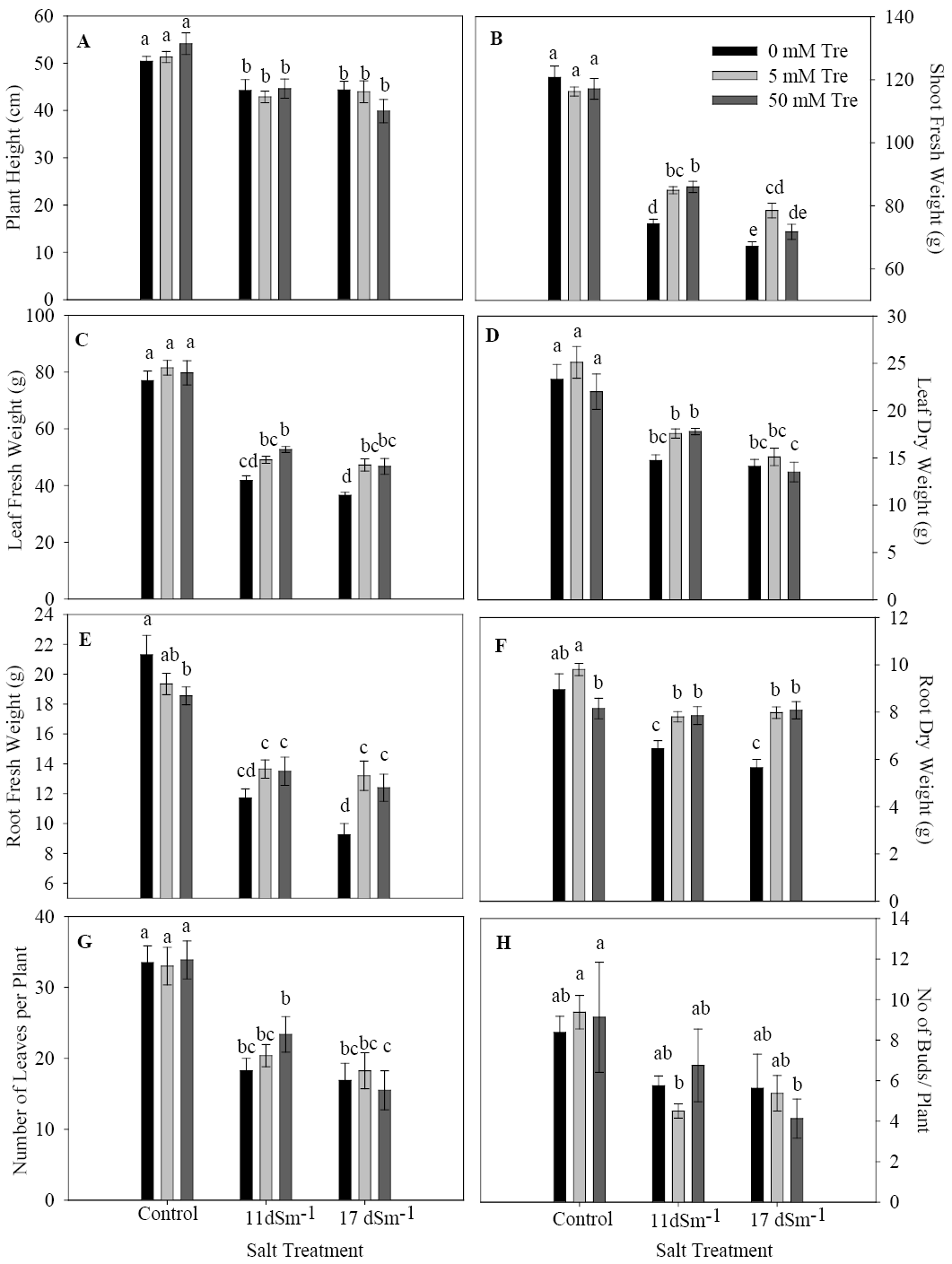
Effect of trehalose foliar application on plant height (A), shoot fresh weight (B), leaf fresh weight (C), leaf dry weight (D), root fresh weight (E), root dry weight (F) number of leaves per plant (G), and number of buds per plant (H) under different salt stress conditions. Means are representatives of 4 replicates with bars indicating the standard error. Different letters indicate significant difference among the treatments (P≤0.05).
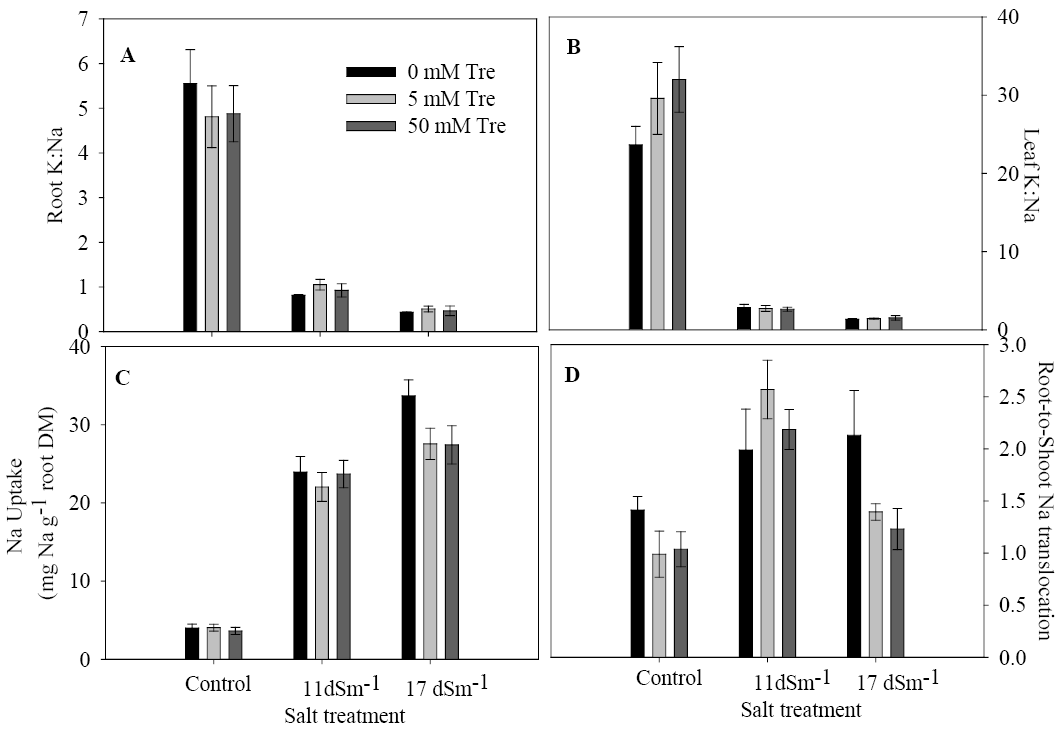
Effect of trehalose foliar application on the root K:Na ratio (A), leaf K:Na ratio (B), Na uptake (C), and root-to-shoot Na translocation under different salt stress conditions. Vertical bars are means ± SE of four replicates.
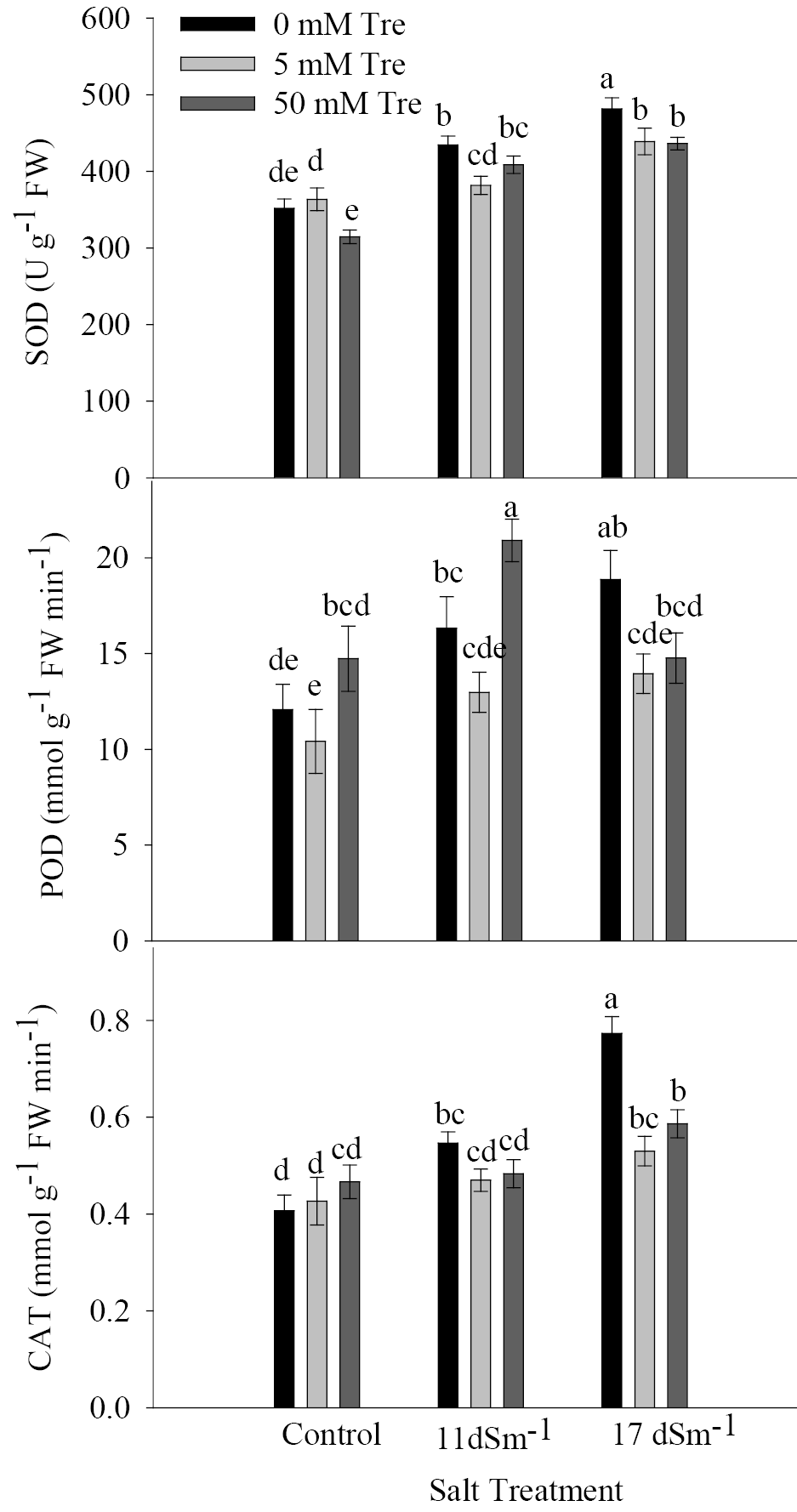
Effect of trehalose foliar application on the activity of antioxidant enzymes (SOD, POD and CAT) under different salt stress conditions. Vertical bars are means±SE of four replicates. Significant differences (P≤0.05) between treatments are indicated by different letters.
References
- Abdallah, M.M.S., Z.A. Abdelgawad and H.M.S. El-Bassiouny. 2016. Alleviation of the adverse effects of salinity stress using trehalose in two rice varieties. South Afr. J. Bot. 103: 275-282. https://doi.org/10.1016/j.sajb.2015.09.019[CrossRef]
- Abdelraheem A., N. Esmaeili, M.O’Connell and J. Zhang. 2019. Progress and perspective on drought and salt stress tolerance in cotton. Ind. Crops Prod. 130: 118-129. https://doi.org/10.1016/j.indcrop.2018.12.070[CrossRef]
- Aebi, H., 1984. Catalase in vitro. Methods Enzymol., 105: 121-126. https://doi.org/10.1016/S0076-6879(84)05016-3[CrossRef]
- Akhtar, J., Z.A. Saqib, M. Sarfraz, I. Saleem and M.A. Haq. 2010. Evaluating salt tolerant cotton genotypes at different levels of NaCl stress in solution and soil culture. Pak. J. Bot. 42: 2857-2866.
- Ashraf, M., 2002. Salt tolerance of cotton: Some new advances. Crit. Rev. Plant Sci., 21: 1-30. https://doi.org/10.1080/0735-260291044160[CrossRef]
- Bae H, E. Herman, B. Bailey, H.J. Bae and R. Sicher. 2005. Exogenous trehalose alters Arabidopsis transcripts involved in cell wall modification, abiotic stress, nitrogen metabolism and plant defense. Physiol. Plant 125: 114–126. https://doi.org/10.1111/j.1399-3054.2005.00537.x[CrossRef]
- Brugnoli, E. and O. Björkman. 1992. Growth of cotton under continuous salinity stress: Influence on allocation pattern, stomatal and non-stomatal components of photosynthesis and dissipation of excess light energy. Planta. 187: 335-347. https://doi.org/10.1007/BF00195657[CrossRef]
- Byrt, S., R. Munns, R.A. Burton, M. Gilliham and S. Wege. 2018. Root cell wall solutions for crop plants in saline soils. Plant Sci., 269: 47-55. https://doi.org/10.1016/j.plantsci.2017.12.012[CrossRef]
- Caldana, C., Y. Li, A. Leisse, Y. Zhang, L. Bartholomaeus, A.R. Fernie, L. Willmitzer and P. Giavalisco. 2013. Systemic analysis of inducible target of rapamycin mutants reveal a general metabolic switch controlling growth in Arabidopsis thaliana. Plant J. 73:897-909. https://doi.org/10.1111/tpj.12080[CrossRef]
- Chaves, M.M., J. Flexas and C. Pinheiro. 2009. Photosynthesis under drought and salt stress: regulation mechanisms from whole plant to cell. Ann. Bot. 103: 551-560. https://doi.org/10.1093/aob/mcn125[CrossRef]
- Chen, W., C. Feng, W. Guo, D. Shi and C. Yang. 2011. Comparative effects of osmotic-, salt- and alkali stress on growth, photosynthesis, and osmotic adjustment of cotton plants. Photosynthetica. 49: 417. https://doi.org/10.1007/s11099-011-0050-y[CrossRef]
- Cramer, G.R. and D.C. Bowman. 1991. Kinetics of maize leaf elongation. J. Exp. Bot. 42: 1417-1426. https://doi.org/10.1093/jxb/42.11.1417[CrossRef]
- Delorge I., M. Janiak, S. Carpentier and P. Van-Dijck. 2014. Fine tuning of trehalose biosynthesis and hydrolysis as novel tools for the generation of abiotic stress tolerant plants. Front. Plant Sci. 5: 147. https://doi.org/10.3389/fpls.2014.00147[CrossRef]
- Dhindsa, R.S., P.L. Plumb-Dhindsa and D.M. Reid. 1982. Leaf senescence and lipid peroxidation: effects of some phytohormones, and scavengers of free radicals and singlet oxygen. Physiol. Plant. 56: 453-457. https://doi.org/10.1111/j.1399-3054.1982.tb04539.x[CrossRef]
- Dinakar, C., A. Vishwakarma, A.S. Raghavendra and K. Padmasree. 2016. Alternative Oxidase Pathway Optimizes Photosynthesis During Osmotic and Temperature Stress by Regulating Cellular ROS, Malate Valve and Antioxidative Systems. Front. Plant Sci. 7: 68. https://doi.org/10.3389/fpls.2016.00068[CrossRef]
- Djilianov, D., T. Georgieva, D. Moyankova, A. Atanassov, K. Shinozaki, S.C.M. Smeeken, D.P.S. Verma and N. Murata. 2005. Improved abiotic stress tolerance in plant by accumulation of osmoprotectants gene transfer approach. Biotechnol. Biotechnol Eq. 19: 63-71. https://doi.org/10.1080/13102818.2005.10817287[CrossRef]
- Farooq, M., A. Wahid, D.J. Lee, S.A. Cheema and T. Aziz. 2010. Comparative time course action of the foliar applied glycine betaine, salicylic acid, nitrous oxide, brassinosteroids and spermine in improving drought resistance of rice. J. Agron. Crop. Sci. 196: 336-345. https://doi.org/10.1111/j.1439-037X.2010.00422.x[CrossRef]
- Fernandez, O., L. Béthencourt, A. Quero, R.S. Sangwan and C. Clément. 2010. Trehalose andplant stress responses: friend or foe? Trends Plant Sci. 15: 409–417. https://doi.org/10.1016/j.tplants.2010.04.004[CrossRef]
- Garcia, A.B., J. Engler, S. Iyer, T. Gerats, M. Van Montagu and A.B. Caplan. 1997. Effects of Osmoprotectants upon NaCl Stress in Rice. Plant Physiol. 115: 159-169. https://doi.org/10.1104/pp.115.1.159[CrossRef]
- Garg, A.K., J.K. Kim, T.G. Owens, A.P. Ranwala, Y.D. Choi, L.V. Kochian and R.J. Wu. 2002. Trehalose accumulation in rice plants confers high tolerance levels to different abiotic stresses. Appl. Biol. Sci. 99: 15898-15903. https://doi.org/10.1073/pnas.252637799[CrossRef]
- Gouffi, K., N. Pica, V. Pichereau and C. Blanco. 1999. Disac-charides as a new class of non-accumulated osmoprotectants for Sinorhizobium meliloti. Appl. Environ. Microbiol. 65: 1491-1500. https://doi.org/10.1128/AEM.65.4.1491-1500.1999[CrossRef]
- Hare, P.D., W.A. Cress and J. vanStaden. 1998. Dissecting the roles of osmolyte accumulation during stress. Plant Cell Environ. 21: 535-553. https://doi.org/10.1046/j.1365-3040.1998.00309.x[CrossRef]
- Hasanuzzaman, M., K. Nahar and M. Fujita. 2013. Ecophysiology and responses of plants under salt stress. In: Ahmad P., M.M. Azooz and M.N.V. Prasad (eds), Ecophysiology and Responses of Plants under Salt Stress. Springer, New York, pp. 25-87. https://doi.org/10.1007/978-1-4614-4747-4_2[CrossRef]
- Iordachescu, M. and R. Imai. 2008. Trehalose biosynthesis in response to abiotic stresses. J. Integ. Plant Biol. 50: 1223-1229. https://doi.org/10.1111/j.1744-7909.2008.00736.x[CrossRef]
- Jones, R.G.W., 1981. Salt tolerance. In: Johnson, C.B. (ed) Physiological Processes Limiting Plant Productivity. Butterworth- Heinemann, London. pp. 271-292. https://doi.org/10.1016/B978-0-408-10649-8.50019-8[CrossRef]
- Kumar, K.B. and P.A. Khan. 1982. Peroxidase and polyphenol oxidase in excised ragi (Eleusine coracana cv PR 202) leaves during senescence. Ind. J. Exp. Biol. 20: 412-416.
- Leslie, S.B., E. Israeli, B. Lighthart, J.H. Crowe and L.M. Crowe. 1995. Trehalose and sucrose protect both membranes and proteins in intact bacteria during drying. Appl. Environ. Microbiol. 61: 3592-3597. https://doi.org/10.1128/AEM.61.10.3592-3597.1995[CrossRef]
- Li, Z.G., Luo, L.J., Zhu, L.P. 2014. Involvement of trehalose in hydrogen sulfide donor sodium hydrosulfide-induced the acquisition of heat tolerance in maize (Zea mays L.) seedlings. Bot. Stud. 55:20.
- Liu, S., Y. Dong, L. Xu and J. Kong. 2014. Effects of foliar applications of nitric oxide and salicylic acid on salt-induced changes in photosynthesis and antioxidative metabolism of cotton seedlings. Plant Growth Regul. 73: 67-78. https://doi.org/10.1007/s10725-013-9868-6[CrossRef]
- Longenecker, D.E., 1974. The influence of high sodium in soils upon fruiting and shedding, boll characteristics, fiber properties, and yields of two cotton species. Soil Sci., 115: 294-302. https://doi.org/10.1097/00010694-197304000-00005[CrossRef]
- Luo, Y., F. Li, G.P. Wang, X.H. Yang and W. Wang. 2010. Exogenously-supplied trehalose protects thylakoid membranes of winter wheat from heat-induced damage. Biol. Plant. 54: 495-501. https://doi.org/10.1007/s10535-010-0087-y[CrossRef]
- Maas, E.V., 1986. Salt tolerance of plants. Appl. Agric. Res. 1: 12-26.
- Mostofa, M.G., M.A. Hossain, M. Fujita and L.S.P. Tran. 2015. Physiological and biochemical mechanisms associated with trehalose-induced copper-stress tolerance in rice. Sci. Rep. 5: 11433. https://doi.org/10.1038/srep11433[CrossRef]
- Munns, R., 2002. Comparative physiology of salt and water stress. Plant Cell Environ. 25: 239-250. https://doi.org/10.1046/j.0016-8025.2001.00808.x[CrossRef]
- Munns, R., J.B. Passioura, J. Guo, O. Chazen and G.R. Cramer. 2000. Water relations and leaf expansion: Importance of time scale. J. Exp. Bot. 51: 1495-1504. https://doi.org/10.1093/jexbot/51.350.1495[CrossRef]
- Munns, R., D. Schachtman and A. Condon. 1995. The Significance of a Two-Phase Growth Response to Salinity in Wheat and Barley. Func. Plant Biol. 22: 561-569. https://doi.org/10.1071/PP9950561[CrossRef]
- Munns, R. and M. Tester. 2008. Mechanism of salinity tolerance. Annu. Rev. Plant Biol. 59: 651-681. https://doi.org/10.1146/annurev.arplant.59.032607.092911[CrossRef]
- Qadir, M. and M. Shams. 1997. Some Agronomic and Physiological Aspects of Salt Tolerance in Cotton (Gossypium hirsutum L.). J. Agron. Crop Sci. 179: 101-106. https://doi.org/10.1111/j.1439-037X.1997.tb00504.x[CrossRef]
- Quintal, E.B., A.V. Buend, A.K. González, M.C. Pech, D.O. Camacho, I.E. Machado, I. Pottosin and M.M. Estévez. 2014. Mechanisms of salt tolerance in habanero pepper plants (Capsicum chinense Jacq.) Proline accumulation, ions dynamics and sodium root-shoot partition and compartmentation. Front. Plant Sci. 5: 605. https://doi.org/10.3389/fpls.2014.00605[CrossRef]
- Rashid, A., 1986. Mapping zinc fertility of soils using indicator plants and soils-analyses. PhD thesis, University of Hawaii, HI, USA.
- Romero, C., J.M. Belles, J.L. Vaya, R. Serrano and F.A. Culianez-Macia. 1997. Expression of the yeast trehalose-6-phosphatesynthase in transgenic tobacco plants: pleiotropic phenotypes include drought tolerance. Planta. 201: 293-297. https://doi.org/10.1007/s004250050069[CrossRef]
- Sadak, M.S., 2019. Physiological role of trehalose on enhancing salinity tolerance of wheat plant. Bull. Nat. Res. Centre. 43: 53. https://doi.org/10.1186/s42269-019-0098-6[CrossRef]
- Shahzad, A.N., B. Pitann, H. Ali, M.F. Qayyum, A. Fatima and H.F. Bakhat. 2015. Maize genotypes differing in salt resistance vary in jasmonicacid accumulation during the first phase of salt stress. J. Agron. Crop Sci. 201: 443-451. https://doi.org/10.1111/jac.12134[CrossRef]
- Silva, E.N., J.A.G. Silveira, C.R.P. Fernandes, A.T.B. Dutra and R.M. Aragão. 2009. Ion uptake and growth of physic nut under different salinity levels. Rev. Ciência Agron. 40: 240-246.
- Soltanpour, P.N. and R.H. Follett. 1995. Crop tolerance to soil salinity. Colorado State University Cooperative Extension Fact Sheet No. 0.505
- Tester, M. and R. Davenport. 2003. Na+ tolerance and Na+ transport in higher plants. Ann. Bot. 91: 503-527. https://doi.org/10.1093/aob/mcg058[CrossRef]
- Wu, H.H., M. Zhu, L. Shabala, M.X. Zhou and S. Shabala. 2015. K+ Retention in leaf mesophyll, an overlooked component of salinity tolerance mechanism: a case study for barley. J. Integr. Plant Biol. l57: 171-185. https://doi.org/10.1111/jipb.12238[CrossRef]
- Yuan H.X., Y. Xiong and K.L. Guan. 2013. Nutrient sensing, metabolism, and cell growth control. Mol. Cell. 49: 379-387. https://doi.org/10.1016/j.molcel.2013.01.019[CrossRef]
- Zeid, I.M., 2009. Trehalose as osmoprotectant for maize under salinity-induced stress. Res. J. Agric. Biol. Sci., 5: 613-622.
Services
Article usage statistics
Loading…