
In México, the inclusion of the commercially important native species Castarrica mojarra (Mayaheros urophthalmus) in aquaculture requires a diet that is sustainable, ecologically sound, bioavailable and bio-digestible, as well as being economical and nutritionally suitable, in order to optimise their development. This diet should include the partial or total substitution of fish protein (FP), with domestic cricket protein being a feasible option. We evaluated the effect on juvenile M. urophthalmus of including different levels of house cricket protein (HCP) in their diet as a substitute for FP. Three hundred juveniles, with an average length of 1.1±0.2 cm and an average weight of 0.81±0.12 g, were distributed into five treatments (T1: 0%; T2: 5%; T3: 10%; T4: 15% and T5: 20%), all in triplicate. The fish were fed 5% of their biomass five times a day. Biometric parameters such as size, weight and survival were recorded biweekly and used to calculate the average weight gained (AWG), the specific growth rate (SGR), the protein consumption (PC), the protein efficiency ratio (PER) and the fed consumption (FC). All biometric parameters were statistically compared. In our study, AWG and SGR were lower at T5, and PC, PER and FC decreased as the proportion of cricket protein in the diet increased, with no effect on survival. FCR showed no significant differences. HCP is an excellent source of protein, which can replace up to 75% of fishmeal in castaricas diet T4.
Research Article · Volume 58, Issue 6, 28 September 2026 · Open Access
Evaluation of Effect of House Cricket (Acheta domesticus) Protein on the Growth of Castarrica (Mayaheros urophthalmus)
· · · · · · · · ·
Affiliations & Notes ⌄
- 1División Académica de Ciencias Agropecuarias (DACA), Universidad Juárez Autónoma de Tabasco (UJAT). Km. 25. Carretera Villahermosa-Teapa. C.P. 86040. Tabasco, México 2Laboratorio de Biología Molecular, DAMJ-UJAT, Carretera Estatal Libre Villahermosa-Comalcalco Km. 27+000 s/n Ranchería Ribera Alta, Jalpa de Méndez C.P. 86205, México 3Laboratorio de Fisiología en Recursos Acuáticos, DACBIOL-Universidad Juárez Autónoma de Tabasco, Carretera Villahermosa Cárdenas Km 0.5, Villahermosa 86139, C.P. 861
Article Info ⌄
- Journal:
- Pakistan Journal of Zoology
- Published:
- 28 September 2026

From the article
- We observed that AWG was affected at a 20% inclusion level of HCP, and that a 100% substitution of FP had a negative effect on growth (Table III).
- However, inclusion levels of 5–15% HCP (Fig. 1A) showed growth levels similar to those obtained with the control diet.
- The best growth results for the castarrica mojarra (Mayaheros urophthalmus) were obtained with diets containing 15% HCP (T4), indicating that HCP is a viable FP alternative in feed formulation for this species.
- It should be noted that, although total FP replacement by HCP affected growth, SGR and FCR were higher than the control treatment, suggesting that total FP replacement could be achieved by eliminating chitin and/or including limiting amino acids (methionine, arginine and/or lysine).
Selected from the article's own text.
Abstract
INTRODUCTION
In México, the high demand for aquaculture species is reflected in the limited variety available. Therefore, the inclusion of native species that are commercially important is necessary. Small endemic species, such as the castarica mojarra (Mayaheros urophthalmus), are a source of high-quality protein and essential fatty acids and contain a wide variety of micronutrients. In fact, they contain more micronutrients than larger fish, such as carp and nile tilapia (Oreochromis niloticus). Therefore, these species can help to increase productivity, maintain biodiversity, and promote a healthy ecological balance. This makes them key to sustainable aquaculture and food security ; . This fish has greater commercial value at regional and national levels than nile tilapia. However, there is still no specific diet for this carnivorous species, which requires a nutritionally specific diet to allow it to grow and develop optimally. Feed for aquaculture species is currently based on fish meal from anchoveta (Engraulis ringens), which has an impact on their natural habitats. Therefore, there is a need for alternative sustainable, ecological, bioavailable and bio-digestible sources of animal, vegetable and insect protein that are also economical and nutritionally suitable, since feed represents 60–70% of production costs . The quality and bioavailability of nutrients also influence growth and development. Costa and Soares (2015) found insects of the orders Diptera, Trichoptera, Odonata, Hemiptera and Coleoptera in the stomachs and intestines of some fish species. These insects contain a high concentration of protein (45–68%), are highly bioavailable and may help to modulate the gastrointestinal microbiota and physiological state of fish .
The house cricket (Acheta domesticus) contains up to 69% protein and is considered an alternative source to fish protein (FP) due to its similar nutritional content ; De la Cruz-Alvarado et al., 2025). It favours the growth, development and health of fish . Annex II of Regulation 2017/893 of 24 May 2017 allows the use of insects in the diets of farm and aquaculture animals in the European Union. However, some researchers recommend including no more than 30% insect meal in fish diets ; . However, in the carnivorous tropical gar (Atractosteus tropicus), up to 75% of fishmeal could be replaced with cricket meal (De la Cruz-Alvarado et al., 2025). Therefore, it is expected that a greater proportion than 30% can be replaced in the diets of M. urophthalmus due to their carnivorous nature and feeding habits during this life stage, which include some aquatic insects. This study aimed to evaluate the growth and survival of M. urophthalmus juveniles when FP was replaced with house cricket protein (HCP).
Materials And Methods
Obtaining and maintaining organisms
The M. urophthalmus juveniles were donated to the Laboratory of Nutrigenomics and Toxicology of Tropical Fishes of the Universidad Popular de La Chontalpa (UPCH) in Cárdenas, Tabasco, México, by the Instituto Tecnológico de Centla from Tabasco, México. The juveniles had an average weight of 0.81±0.12 g and an average length of 1.1±0.2 cm. The bioassay was conducted in 15 semicircular 80-litre tanks at a density of 20 organisms per tank (300 organisms in total) with a semi-closed recirculation system and two daily water changes. The temperature was maintained at 28±1 °C, and the oxygen concentration was kept constant at 7.2±0.4 mg/L. These parameters were measured using a Hualix-brand YSI 55 oximeter (DO) at 08:00 and 16:00. Oxygen was supplied to the system via a 2 HP Pioneer-brand blower, and the pH was kept constant at 7.02±0.1, as measured using a HI98108-brand pHep+® pH meter. Cleaning and physicochemical parameters were recorded twice daily (at 08:00 and 16:00, respectively). The fish were acclimatized to a commercial diet for 10 days. Subsequently, co-feeding was performed, gradually substituting the commercial diet until it was entirely replaced by the diet corresponding to its treatment. The treatments were performed in triplicate. For this bioassay, five diets with different levels of HCP substitution were used (T1: 0%; T2: 5%; T3: 10%; T4: 15%; T5: 20%), respectively (Table I).
Diet formulation and elaboration with selected ingredients
The isoproteic diets prepared are shown in Table I. They were formulated using the MIXWIN Plus 2.0 programme and elaborated in the Laboratory of Physiology of Aquatic Resources (LAFIRA) of the Academic Division of Biological Sciences at the Universidad Juárez Autónoma de Tabasco (UJAT).
The diets were prepared by mixing the macronutrients for 15 min. and then adding and mixing in the micronutrients for a further 15 min. The liquid ingredients were then incorporated and blended for a further 15 min. Finally, water (~400 ml kg-1 per diet) was added and stirred for an additional 15 min. The pellets were prepared using a 5 mm screen in a meat mill (Torrey, M-22RI, Monterrey, N.L., México), and then all the pellets were dried at 60 °C for 12 h in a forced-air furnace. The pellets were crushed manually and sieved to obtain an adequate size for juveniles. Finally, the experimental diets were stored at -20 °C for later use.
The fish were fed five daily rations at 08:00, 10:00, 12:00, 14:00 and 16:00 for 45 days. Biometrics were performed every 15 days to adjust the food ration, in which weight and length were recorded. The fish were fed at a rate of 5% of their biomass. The experimental diets were analyzed for their proximate composition, including moisture, ash, lipid and protein content, according to AOAC (2000).
Table I. Experimental diet formulations with different inclusion levels of house cricket (A. domesticus) protein.
|
Ingredients (g 100 g-1 diet) |
T1 (0% HCP) |
T2 (5% HCP) |
T3 (10% HCP) |
T4 (15% HCP) |
T5 (20% HCP) |
|
Soft wheat grain |
43.44 |
42.56 |
42.74 |
41.86 |
41.6 |
|
Fish meal (herring) |
26.01 |
20 |
12.83 |
5.72 |
0 |
|
Soybean meal (44%) |
20 |
18.9 |
18 |
18 |
17.03 |
|
Cricket flour |
0 |
8 |
16 |
24 |
31 |
|
Fish oil |
3.05 |
4 |
4 |
4 |
3.86 |
|
Soy lecithin |
3 |
2.05 |
1.93 |
1.92 |
2 |
|
Gelatin |
2 |
2 |
2 |
2 |
2 |
|
Vitamin premix |
1 |
1 |
1 |
1 |
1 |
|
Dehydrated fish solubles |
1 |
1 |
1 |
1 |
1 |
|
Vitamin C |
0.5 |
0.5 |
0.5 |
0.5 |
0.5 |
|
Chemical composition (g/100g dry matter) |
|||||
|
MEt energy(m) |
1355.36 |
1654.59 |
1987.15 |
2286.38 |
2564.29 |
|
Protein |
35 |
35 |
35 |
35 |
35 |
|
Total fat |
10 |
10 |
10 |
10 |
10 |
|
Fiber |
2.89 |
3.54 |
4.1 |
4.75 |
5.27 |
|
Ashes |
5.07 |
4.31 |
3.68 |
2.92 |
2.31 |
HCP, house cricket protein
Determination of growth parameters
The biometric parameters determinated were, absolute weight gain (AWG), specific growth rate (SGR), daily growth coefficient (DGC), protein consumption (PC), feed conversion ratio (FCR), protein efficiency ratio (PER), daily weight gain (DWG), condition factor (K), feed efficiency (FE) and survival (P). All parameters were determinated after the experiment using the biometric data and the following equations:


Where: Wi and Wf are the initial and final weight of the fish respectively, and T is the number of days in the feeding period.








Statistical analysis
An analysis of variance (ANOVA) was performed on the biometric data obtained during and at the end of the experiment. Additionally, Duncan’s tests were employed for the treatment of means, with a significance level of P < 0.05. The statistical analyses were performed using Statistica v.7.0 (Statsoft, Tulsa, OK, USA) software, and SigmaPlot 12.0 was used to create the graphs.
RESULTS
In our study, there were no statistical differences in AWG between the T1, T2, T3 and T1 treatments. However, T5 showed significant differences compared to the other treatments (Fig. 1A). For SGR, the values were higher in the T2, T3 and T4 treatments, which were statistically significant compared to the T1 or control treatment and the T5 treatment, which showed the lowest values. Even the T5 treatment showed higher values than the T1 treatment, with significant differences between them (Fig. 1B). Regarding the FCR factor, there was no statistical difference between the values; however, an increase in these values was observed in T4 and T5, respectively, with P values of <0.05 (Fig. 1C).
Analysis of the data for PC and PER did not reveal any significant differences between the treatments. However, a tendency for these values to decrease as the HCP concentration increased was observed, indicating an inverse proportional correlation for values of P < 0.05 (Fig. 2A, B).
Decreased feed intake was observed as the cricket protein concentration increased and the fish protein concentration in the diet decreased. The highest FC values
Table II. Nutritional profile of experimental diets.
|
Treatment |
Protein |
Approx. sample weight (g) |
N (%) |
C (%) |
Humidity (%) |
Ashes (%) |
Total lipids (%) |
Cal/g |
|
T1 |
0 % |
1,074 |
6.57 |
45.31 |
11.460 |
6.598 |
3.771 |
4573.192 |
|
T2 |
5 % |
1,049 |
6.82 |
46.05 |
9.703 |
6.613 |
6.048 |
4678.849 |
|
T3 |
10 % |
1.032 |
6.81 |
45.71 |
11.796 |
6.556 |
4.217 |
4868.103 |
|
T4 |
15 % |
0.949 |
6.75 |
46.89 |
10.079 |
4.862 |
7.702 |
4419.706 |
|
T5 |
20 % |
1.118 |
7.10 |
46.42 |
10.129 |
5.420 |
5.986 |
5125.193 |
For details of treatments, see Table I.
N, nitrogen (%); C, carbon (%)
were obtained in treatments T1 and T2, which showed no significant differences from each other. However, these were slightly different to T3 and T4, which showed no significant differences between them but were slightly different to T5. The latter treatment presented the lowest values and showed significant differences with respect to T1 and T2 (Fig. 2C). Although survival was unaffected by any of the treatments, growth decreased when FP was completely replaced. FE showed no significant differences but a statistically significant reduction was observed between treatments with increased HCP for values of P < 0.05 (Table III).
Proximal analysis of diets
Including new protein sources in fish diets has been challenging due to the varying characteristics, nutritional and/or anti-nutritional factors of each source, which can affect fish growth positively or negatively. For our study, the diets were sent to the Aquaculture Nutrition Laboratory at the Universidad Nacional Autónoma de México, Campus Sisal in Mérida, Yucatán, where the nutritional profiles were determined and are shown in Table II. According to the biometries performed, the most widely accepted treatment was T4. The initial weight, length and final weight data (Table III) are essential for evaluating growth.
Table III. Growth parameters of M. urophthalmus.
|
Treatment |
T1 (0%) |
T2 (5%) |
T3 (10%) |
T4 (15%) |
T5 (20%) |
|
Wi (g) |
0.81±0.01a |
0.81±0.01a |
0.81±0.01a |
0.81±0.02a |
0.81±0.01a |
|
Wf (g) |
2.4±0.14b |
2.2±0.07b |
2.1±0.09b |
2.1±0.16b |
1.8±0.09a |
|
LF (cm) |
4.7±0.15c |
4.7±0.08bc |
4.6±0.09bc |
4.3±0.09a |
4.5±0.12ab |
|
DWG (mg) |
35.7±3.22b |
31.56±1.71b |
29.56±2.0b |
28.26±3.78b |
21.41±2.14a |
|
DGC |
0.02±0.002b |
0.02±0.001b |
0.01±0.001ab |
0.01±0.002ab |
0.01±0.001a |
|
K |
2.28±0.08ab |
2.19±0.07b |
2.22±0.05b |
2.55±0.06c |
1.93±0.07a |
|
FE (g) |
0.34±0.02a |
0.32±0.01a |
0.31±0.02a |
0.31±0.03a |
0.30±0.08a |
See Table I for details of T1, T2,T3, T4 and T5.
Wi, initial weight; Wf, final weight; LF, Final length; DWG, daily weight gain; DGC, daily growth coefficient; K, condition factor; FE, feed efficiency
DISCUSSION
As the aquaculture sector grows, the demand for FP increases , thereby raising the cost of fish feed. Insect meal therefore represents an alternative nutritional source for fish . Adequate levels of insect meal in diets have been observed to increase immunostimulatory effects due to their chitin or antimicrobial peptide content, thereby improving intestinal health and immunity ; .
In our study, a 5% inclusion level of HCP represented a 25% substitution of fish meal (FM). We observed that AWG was affected at a 20% inclusion level of HCP, and that a 100% substitution of FP had a negative effect on growth (Table III). However, inclusion levels of 5–15% HCP (Fig. 1A) showed growth levels similar to those obtained with the control diet. Perera and Bhujel (2022) reported that replacing 100% of FP with meal from either domestic (A. domesticus) or field (G. bimaculatus) crickets did not affect the growth of guppy fish (Poecilia reticulata). Subsequently, Perera et al. (2023) indicated that weight gain was affected in juvenile O. niloticus when 100% of the FP was replaced by A. domesticus or field cricket (G. bimaculatus) meal. Similarly, Lee et al. (2017) observed that palatability and growth decreased as the proportion of A. domesticus meal in the diet of juvenile hybrid red tilapia (Oreochromis sp.) increased, with the lowest levels of palatability and growth being observed at 60% inclusion. A similar negative effect was observed in diets with total replacement of FM by black soldier fly (Hermetia illucens) meal in common carp (Cyprinus carpio), which showed gut damage when FM replacement was at 75% .
The low growth at high inclusion concentrations of HCP may be due to insect protein often being deficient in certain amino acids (see Table IV), such as lysine and methionine (De la Cruz-Alvarado et al., 2025). These amino acids are crucial for processes such as growth regulation, cell signalling and communication, energy production, and protein synthesis, as well as for regulating the osmotic and immune systems ; Rodriguez and Perez, 2022; Velazquez et al., 2022). The high utilization values obtained in M. urophthalmus (T4) may be due to its omnivorous nature and tendency towards carnivory, as well as its utilization of the most abundant resources in
Table IV. Comparison of amino acid profiles of FP and HCP used in the experimental diets (mg/100g, dry weight basis).
|
Amino acids |
House criket meal |
Fish meal |
|
Glycine (Gly) |
1240.61 |
3.92 |
|
Alanine (Ala) |
1642.28 |
3.07 |
|
Serina (Ser) |
429.79 |
2.18 |
|
Proline (Pro) |
528.87 |
2.84 |
|
Valine (Val) |
<1.18 |
2.38 |
|
Threonine (Thr) |
358.44 |
2.31 |
|
Cysteine (Cys) |
< 1.22 |
1.00 |
|
Isoleucine (Ile) |
< 1.32 |
1.90 |
|
Leucine (Leu) |
< 1.32 |
4.1 |
|
Asparagine (Asn) |
< 1.33 |
1.5 |
|
Aspartic acid (Asp) |
162.62 |
4.7 |
|
Lysine (Lys) |
112.83 |
4.38 |
|
Glutamine (Gln) |
266.45 |
5.22 |
|
Glutamic acid (Glu) |
500.46 |
5.57 |
|
Methionine (Met) |
< 1.50 |
1.65 |
|
Histidine (His) |
21.97 |
0.62 |
|
Phenylalanine (Phe) |
< 1.66 |
3.87 |
|
Arginine (Arg) |
< 1.75 |
3.56 |
|
Tyrosine (Tyr) |
< 1.82 |
1.7 |
|
Tryptophan (Trp) |
< 2.05 |
1.17 |
its environment. These resources include insects during their initial growth stage. This exposure of the digestive tract and/or enzymes to chitin may indicate the presence of chitinases, as has been observed in cobia (Rachycentron canadum) and flamingo snapper (Lutjanus guttatus) . Similarly, Gutowska et al. (2004) found higher chitinase activity in the stomachs of thirteen marine species found at different depths. They found chitin in the digestive tracts of crustaceans. Thus, chitinases in the stomach indirectly digest the exoskeleton of prey, facilitating the work of other digestive enzymes. Meanwhile, chitinase in the intestine hydrolyses chitin dimers into absorbable monomers of β-N-acetylglucosamine. Therefore, these species may contain digestive enzymes that allow them to utilize the chitin in their diet more effectively.
These results are corroborated by the SGR values obtained, where treatments T2, T3 and T4 were higher than those presented by the control diet (Fig. 1B). In contrast, a decrease in growth was observed in treatment T5, similar to that reported by Perera et al. (2023) for O. niloticus juveniles when fish meal was completely replaced with A. domesticus meal. Meanwhile, Ng et al. (2001) found that African catfish (Clarias gariepinus) exhibited the same behaviour when 100% of fish meal was replaced with silkworm (Tenebrio molitor) meal, whereas an 80% replacement yielded acceptable growth data. Conversely, De la Cruz-Alvarado et al. (2025) found that replacing 100% of FP with HCP negatively affected the growth of A. tropicus.
Some studies indicate that cricket meal contains antioxidants that improve the health and growth of fish, as observed in C. carpio and rainbow trout (Oncorhynchus mykiss) . However, when inclusion levels are very high, oxidative stress increases and affects fish growth ; . Gasco et al. (2016) and Guerreiro et al. (2022) suggest that the dietary inclusion level should not exceed 30%. However, the optimal substitution level varies depending on the species of fish being studied. In our bioassay, the survival of the organisms was unaffected by the treatments, and there were no statistical differences regarding FCR, although a slight increase was observed in T4 and T5 (Fig. 1C). Perera et al. (2023) indicate that, in O. niloticus juveniles, the FCR was similar when fed 100% G. bimaculatus meal replacement for FP, but higher when fed 100% A. domesticus meal replacement for FM. The decreasing trend of PC and PER observed in our results as HCP concentration increased (Fig. 2A, B) is related to dietary acceptance by fish.
We currently know that insect meals typically contain high levels of insoluble chitin from their exoskeletons. This carbohydrate is poorly digestible by certain fish species due to proteins bound to the chitin that prevent its absorption. This decreases the palatability and digestibility of the diet, as well as the gene expression of proteolytic enzymes (De la Cruz-Alvarado et al., 2025). This was corroborated by the FC results (Fig. 2C), which showed a decrease in feed acceptance as the dietary HCP increased. T5 was the least accepted diet, which may be related to palatability, as Tilami et al. (2020) attribute low growth to sensory factors in the diet, such as an unpleasant taste, bitterness, acidity, or odour. This causes low feed intake, as well as the presence of oxidised fat and chitin. Taufek et al. (2016) attribute it to an imbalance or deficiency of amino acids.
In low amounts, chitin helps to regulate oxidative stress in fish and enhances immunomodulatory effects. It also promotes the growth of beneficial bacteria in the gut by activating chitin receptors on the cell surface. These receptors release cytokines and chemokines, which activate the innate immune system ; . Chitin and its derivatives also modulate lipid digestion and absorption in enterocytes, thereby influencing the generation of fatty acids in the liver ; . Likewise, high levels of chitin decrease dietary palatability and inhibit superoxide formation while elevating nitric oxide levels and causing oxidative stress . This occurs by binding to selenocysteine in the selenium-dependent glutathione peroxidase (SeGPX) catalytic centre, thereby inactivating it and causing damage to the liver, health and growth ; . De la Cruz-Alvarado et al. (2025) attributed low growth in A. tropicus to the presence of chitin in A. domesticus meal, which could have reduced feed intake and nutrient availability.
It should be noted that freshwater fish require higher amounts of short-chain fatty acids (FA), such as linolenic and linoleic acids, and that fish meals are deficient in these FAs and contain higher amounts of long-chain FAs, such as DHA and EPA . Insect meal can address these deficiencies by significantly increasing the content of linoleic FA and total n-6 FA in fish fillets ; . FAs are important for energy production and cell signalling. Therefore, the nutritional requirements of fish, especially carnivores, are high in terms of the quality and quantity of protein in their diet . It is important to determine the optimal level of dietary inclusion as well as the effect of an ingredient on the healthy development of fish .
According to Gasco et al. (2016), the low levels of fatty acids contained in insect meal negatively affect growth, since the saturated and monounsaturated fatty acids present in insects in greater quantities are less sensitive to oxidation than the unsaturated ones . Likewise, free fatty acids represent the main source of aerobic fuel for the energetic metabolism of fish muscle . They are also part of cellular and subcellular structures, serve as a biological vehicle in the absorption of fat-soluble vitamins A, E and K, and are essential for maintaining the integrity of cell membranes. They are also precursors of the hormone prostaglandin (Tacon, 1989). Therefore, a deficiency in these fatty acids directly affects the concentration of linoleic acid , as well as the growth and health of fish.
Our study demonstrated that HCP can be used as a dietary supplement. However, further research is needed on amino acid and essential fatty acid supplementation to optimise growth in M. uruphthalmus and fully replace FP.
CONCLUSION
The best growth results for the castarrica mojarra (Mayaheros urophthalmus) were obtained with diets containing 15% HCP (T4), indicating that HCP is a viable FP alternative in feed formulation for this species. It should be noted that, although total FP replacement by HCP affected growth, SGR and FCR were higher than the control treatment, suggesting that total FP replacement could be achieved by eliminating chitin and/or including limiting amino acids (methionine, arginine and/or lysine). However, studies involving the supplementation of amino acids, essential fatty acids, oxidative stress, animal welfare and gene expression with longer exposure times are required to optimise growth in M. uropthalmus.
Declarations
Acknowledgement
The authors wish to express their deep gratitude to the Universidad Popular de La Chontalpa (UPCH) and the Laboratory of Physiology of Aquatic Resources (LAFIRA)-DACBiol-UJAT for the facilities provided for the development of this work.
Funding
The study received no external funding.
IRB approval
The study was approved by the institutional evaluation committee of Laboratorio de Biología Molecular, DAMJ-UJAT, Carretera Estatal Libre Villahermosa-Comalcalco Km. 27+000 s/n Ranchería Ribera Alta, Jalpa de Méndez C.P. 86205, México.
Ethical statement
For this study, all institutional, national and international regulations that guarantee the well-being and health of the organisms used in the experimentation were followed.
Generative AI and AI assisted technology statement
The authors declare that no generative AI and AI assisted technology was used in the creation of this manuscript.
Statement of conflict of interest
The authors have declared no conflict of interest.
Figures
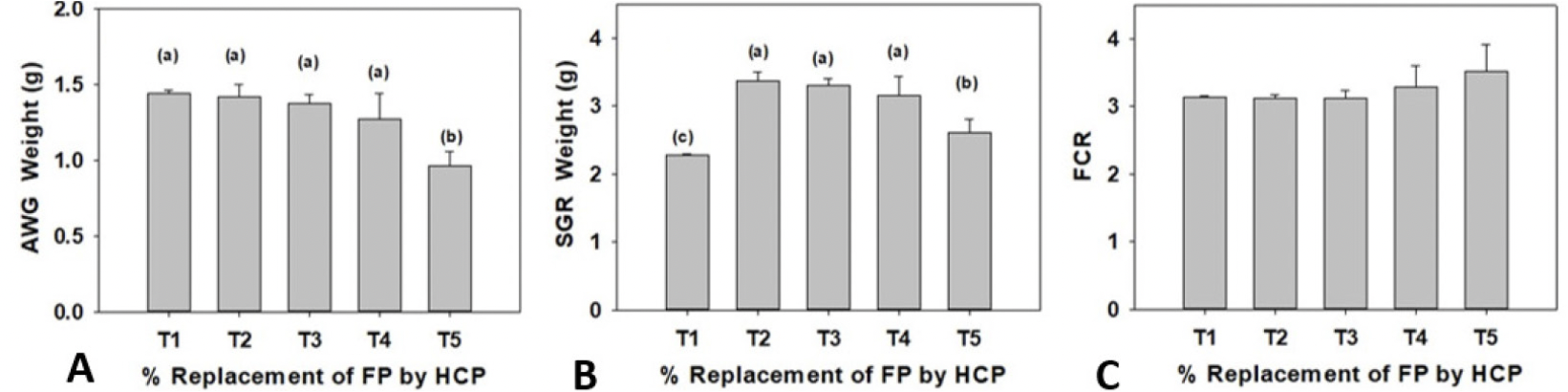
Absolute weight gain (A), specific growth rate (B) and feed conversion (C) rate of M. urophthalmus fed different levels of fish protein substitution for A. domesticus cricket protein. Values in the graph represent means ± SD. Means with different superscripts are significantly different for P < 0.05. For details of treatments, see Table I.
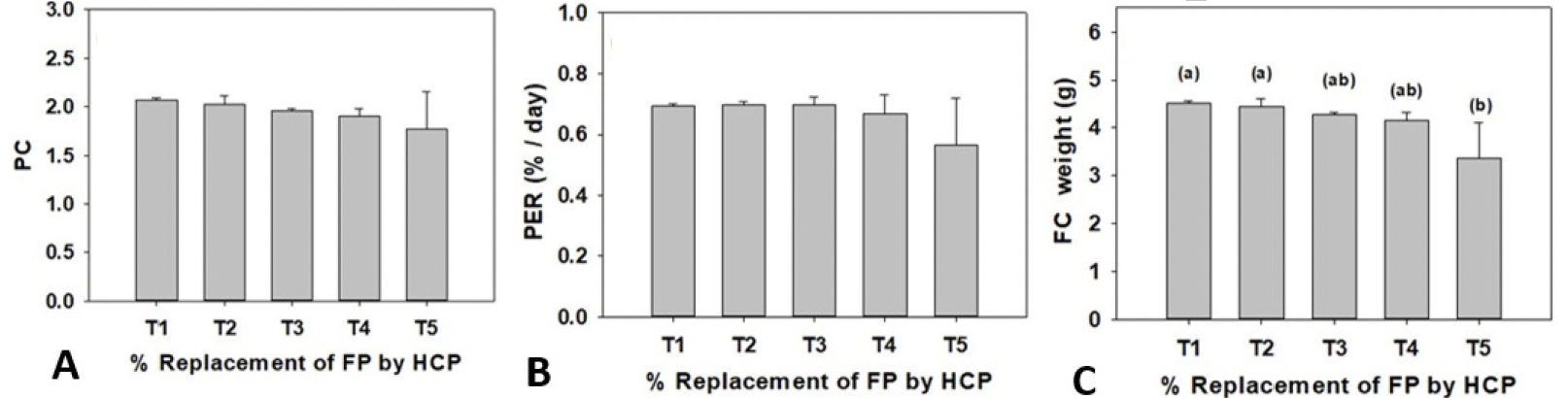
Consumed crude protein (A), protein efficiency rate (B) and feed consumed (C) of M. urophthalmus fed different levels of fish protein substitution for A. domesticus cricket protein. Values in the graph represent means ± SD. Means with different superscripts are significantly different for P < 0.05. For details of treatments, see Table I.
References
- AOAC, 2000. Official methods of analysis of AOAC International (17.ª ed.). AOAC International.
- Carvajal, K., 2022. Efecto de la sustitución de harina de pescado por harina de insecto (Hermetia illucens y Acheta domesticus) en el desempeño biológico, digestibilidad, actividad enzimática y perfil de ácidos grasos de juveniles de Totoaba macdonaldi. Tesis de Maestría en Ciencias. Centro de Investigación Científica y de Educación Superior de Ensenada, Baja California. México.
- Castellano, A., 2020. Osmorregulación en peces (agua dulce y salada). Animales y biología. https://animalesbiologia.com/peces/actualidad/osmorregulacion-peces. Recuperado el 10 enero 2025.
- Castro-González, M.I., Maafs-Rodríguez, A.G. and Galindo-Gómez, C., 2013. Perfil de ácidos grasos de diversas especies de pescados consumidos en México. Rev. Biol. Trop., 61: 1981-1998. Recuperado el 20 de octubre de 2025, de https://www.scielo.sa.cr/scielo.php?script=sci_arttextandpid=S0034-77442013000500032, https://doi.org/10.15517/rbt.v61i4.12875[CrossRef]
- Costa, I.D. and Soares, M.O., 2015. The seasonal diet of Aequidens tetramerus (Cichlidae) in a small forest stream in the Machado River basin, Rondönia, Brazil. Acta Amaz., 45: 365–372. https://doi.org/10.1590/1809-4392201500223[CrossRef]
- D’Antonio, V., Serafini, M. and Battista, N., 2021. Dietary modulation of oxidative stress from edible insects: A mini-review. Front. Nutr., 8: 642551. https://doi.org/10.3389/fnut.2021.642551[CrossRef]
- De la Cruz-Alvarado, F.J., Concha Frías, B., López-Cerino, M.G., Álvarez-González, C.A., Gaxiola-Cortés, G., Arias-Moscoso, J.L., Bautista-Ortega, J., Hernández-García, S. and Palma-Cancino, D.J., 2025. Modulation of gene expression in the digestive tract of the tropical gar (Atractosteus tropicus) in response to cricket meal (Acheta domesticus). Fishes, 10: 469. https://doi.org/10.3390/fishes10090469[CrossRef]
- Elia, A.C., Capucchio, M.T., Caldaroni, B., Magara, G., Dörr, A.J.M., Biasato, I. and Gasco, L., 2018. Influence of Hermetia illucens meal dietary inclusion on the histological traits, gut mucin composition and the oxidative stress biomarkers in rainbow trout (Oncorhynchus mykiss). Aquaculture, 496: 50-57. https://doi.org/10.1016/j.aquaculture.2018.07.009[CrossRef]
- Gasco, L., Henryc, M., Piccolo, G., Marono, S., Gai, F., Renna, M., Lussiana, C., Antonopoulou, E., Mola, P. and Chatzifotis, S., 2016. Tenebrio molitor meal in diets for European sea bass (Dicentrarchus labrax L.) juveniles: Growth performance, whole body composition and in vivo apparent digestibility. Anim. Feed Sci. Technol., 220: 34–45. https://doi.org/10.1016/j.anifeedsci.2016.07.003[CrossRef]
- Giordano, E. and Visioli, F., 2014. Long-chain omega 3 fatty acids: molecular bases of potential antioxidant actions. Prostaglandins Leukot. Essent. Fat. Acids, 90: 1-4. https://doi.org/10.1016/j.plefa.2013.11.002[CrossRef]
- Guerreiro, I., Castro, C., Serra, C. R., Coutinho, F., Couto, A., Peres, H. and Enes, P., 2022. Oxidative stress response of meagre to dietary black soldier fly meal. Animals, 12: 3232. https://doi.org/10.3390/ani12233232[CrossRef]
- Gutowska, M.A., Drazen, J.C. and Robison, B.H., 2004. Digestive chitinolytic activity in marine fishes of Monterey Bay, California. Comp. Biochem. Physiol. A Mol. Integr. Physiol., 139: 351-358. https://doi.org/10.1016/j.cbpb.2004.09.020[CrossRef]
- Henry, M. A., Gai, F., Enes, P., Peréz-Jiménez, A. and Gasco, L., 2018. Effect of partial dietary replacement of fishmeal by yellow mealworm (Tenebrio molitor) larvae meal on the innate immune response and intestinal antioxidant enzymes of rainbow trout (Oncorhynchus mykiss). Fish Shellfish Immunol., 83: 308-313. https://doi.org/10.1016/j.fsi.2018.09.040[CrossRef]
- Koide, S.S., 1998. Chitin-chitosan: properties, benefits and risks. Nutr. Res., 18: 1091-1101. https://doi.org/10.1016/S0271-5317(98)00091-8[CrossRef]
- Lee, S.W., Tey, H.Ch., Wendy, W. and Zahari, M.W., 2017. The effect of house cricket (Acheta domesticus) meal on growth performance of red hybrid tilapia (Oreochromis sp.). Int. J. Aquacult. Sci., 8: 78-82.
- Li, S., Ji, H., Zhang, B., Zhou, J. and Yu, H., 2017. Defatted black soldier fly (Hermetia illucens) larvae meal in diets for juvenile Jian carp (Cyprinus carpio var. Jian): Growth performance, antioxidant enzyme activities, digestive enzyme activities, intestine and hepatopancreas histological structure. Aquaculture, 477: 62-70. https://doi.org/10.1016/j.aquaculture.2017.04.015[CrossRef]
- Lu, C.H. and Ku, C.C., 2013. Effects of shrimp waste meal on growth performance and chitinase activity in juvenile cobia (Rachycentron canadum). Aquaccult. Res., 44: 1190-1195. https://doi.org/10.1111/j.1365-2109.2012.03097.x[CrossRef]
- Meinam M., Singh Y. J., Bharati H. and Meinam T., 2023. Importance of fish biodiversity conservation and management. Int. J. Sci. Res. Arch., 9: 387–391. https://doi.org/10.30574/ijsra.2023.9.2.0513[CrossRef]
- Mikołajczak, Z., Rawski, M., Mazurkiewicz, J., Kierończyk, B. and Józefiak, D., 2020. The effect of hydrolyzed insect meals in sea trout fingerling (Salmo trutta m. trutta) diets on growth performance, microbiota and biochemical blood parameters. Animals, 10: 1031. https://doi.org/10.3390/ani10061031[CrossRef]
- Ng, W.K., Liew, F.L., Ang, L.P. and Wong, K.W., 2001. Potential of mealworm (Tenebrio molitor) as an alternative protein source in practical diets for African catfish, Clarias gariepinus. Aquacult. Res., 32: 273-280. https://doi.org/10.1046/j.1355-557x.2001.00024.x[CrossRef]
- Osuna-Salazar, A., 2015. Evaluación del crecimiento, actividad quitinolítica y coloración del pargo flamenco (Lutjanus guttatus) alimentado con harina de cabezas de camarón. Tesis de Maestría. Centro de Investigación en Alimentación y Desarrollo, A.C. (CIAD), Mazatlán, México.
- Pacini, N., Elia, A.C., Abete, M.C., Dörr, A.J.M., Brizio, P., Gasco, L. and Prearo, M., 2013. Antioxidant response versus selenium accumulation in the liver and kidney of the Siberian sturgeon (Acipenser baeri). Chemosphere, 93: 2405-2412. https://doi.org/10.1016/j.chemosphere.2013.08.042[CrossRef]
- Perera, G.S.C. and Bhujel, R.C., 2022. Replacement of fishmeal by house cricket (Acheta domesticus) and field cricket (Gryllus bimaculatus) meals: Effect for growth, pigmentation, and breeding performances of guppy (Poecilia reticulata). Aquacult. Rep. 25: 101260. https://doi.org/10.1016/j.aqrep.2022.101260[CrossRef]
- Perera, G.S.C., Perera, A.D., Piyavorasakul, C., Pumpuang, S., 2023. Fishmeal replacement by house cricket (Acheta domesticus) and field cricket (Gryllus bimaculatus) meals in Nile Tilapia (Oreochromis niloticus) fingerling feed. Aqua Stud., 23(S1): 52-61. https://doi.org/10.4194/AQUAST1187[CrossRef]
- Rodríguez, C. and Perez, J., 2022. Ácidos grasos omega-3. El porqué de una obsesión.. En Alfonso-Carrillo, J. (Ed.), Mujeres de la Ciencia, pp. 117-166. XVII Semana Científica Telesforo Bravo. Editorial Instituto de Estudios Hispánicos de Canarias. Puerto de la Cruz. 200 pp. ISBN 978-84- 09-44138-9. Archipiélago de las Islas Canarias, España.
- Silva, A., 2005. Cultivo de Peces Marinos. Facultad de Ciencias del Mar, Departamento de Acuicultura, Universidad Católica del Norte, 266 p. ISBN 956-287-211-4. Coquimbo, Chile.
- Tacón, A., 1989. Nutrición y alimentación de peces y camarones cultivados manual de capacitación. https://www.fao.org/3/ab492s/ab492s01.htm (accessed 20 Jan 2025).
- Taufek, N.M., Muin, H., Raji, A.A., Razak, S.A., Yusof, H.M. and Alias, Z., 2016. Apparent digestibility coefficients and amino acid availability of cricket meal, Gryllus bimaculatus, and fishmeal in african catfish, Clarias gariepinus, diet. J. World Aquacult. Soc., 47: 798-805. https://doi.org/10.1111/jwas.12302[CrossRef]
- Tilami, S., Turek,J., Červený, D., Lepič, P., Kozák, P., Burkina, V., Sakalli, S., Tomčala, A. Sampels, S. and Mráz, J., 2020. Insect meal as a partial replacement for fish meal in a formulated diet for perch Perca fluviatilis. Turk. J. Fish Aquat. Sci., 20: 867-878. https://doi.org/10.4194/1303-2712-v20_12_03[CrossRef]
- Velázquez, J., Herrejón, G., De-León, J. and Trejo, J., 2022. Revisión: Alimentación no tradicional para mejorar el rendimiento del crecimiento de peces en condición sub y supra-óptima de temperatura. Perspect. Cienc. Tecnol., 5: 30-43. https://revistas.uaq.mx/index.php/perspectivas/article/view/672/620
- WorldFish H.Q., 2024. Tiny treasures, big impact. The vital role of small indigenous fish in nutrition and livelihoods. A Photographic Sojourn of the Project “Taking Nutrition-Sensitive Carp-SIS Polyculture Technology to Scale”. New Delhi, India.
- Xia, W., Liu, P., Zhang, J. and Chen, J., 2011. Biological activities of chitosan and chitooligosaccharides. Fd. Hydrocoll., 25: 170-179. https://doi.org/10.1016/j.foodhyd.2010.03.003[CrossRef]
- Xiao, X., Jin, P., Zheng, L., Cai, M., Yu, Z., Yu, J. and Zhang, J., 2018. Effects of black soldier fly (Hermetia illucens) larvae meal protein as a fishmeal replacement on the growth and immune index of yellow catfish (Pelteobagrus fulvidraco). Aquacult. Res., 49: 1569-1577. https://doi.org/10.1111/are.13611[CrossRef]
Services
Article usage statistics
Loading…