
Glutathione (GSH) is a powerful antioxidant thiol compound that is critical for the detoxification of xenobiotics in plants. The genetic manipulation of GSH biosynthesis-related genes is considered a prime strategy to achieve higher in planta GSH contents. In this study, stably transformed Brassica napus lines harboring the feedback-insensitive isoform of Serine acetyltransferase (SAT), a rate-limiting enzyme for cysteine (Cys), and GSH biosynthesis, were subjected to H2O2, metolachlor, and atrazine-induced oxidative stress. The overexpression of the NtSAT4 gene from Nicotiana tobacco under 35S promoters in various compartments of the cell, which includes cytosol, plastids, and mitochondria in transgenic lines, resulted in enhanced tolerance in terms of lesser wilting and pigment discoloration to induced stress compared to non-transformed plants. In terms of approximate percentage damage, under 14% H2O2stress,30-60% of the leaf area turned necrotic in the single overexpression lines compared to 95% damage in the wild-type plants. Whereas, the least amount of damage (10-20%) was observed in the double overexpression lines. When subjected to 24 µM metolachlor, the wild-type leaf discs were fully necrotic, whereas the single overexpression lines exhibited 20-60%, and the double overexpression lines showed only 15-20% necrosis. The data suggested that overexpression of NtSAT4 is a promising strategy for improved stress tolerance against these xenobiotics in B. napus.
Research Article · Volume 39, Issue 3, 17 October 2023 · Open Access
Evaluating the Performance of Genetically Engineered Serine acetyltransferase 4 (NtSAT4) Overexpression Brassica napus L. Lines under Xenobiotics Exposure
·
Affiliations & Notes ⌄
- 1Institute of Biotechnology and Genetic Engineering, The University of Agriculture, Peshawar, Khyber Pakhtunkhwa, Pakistan. *Correspondence | Muhammad Sayyar Khan, Institute of Biotechnology and Genetic Engineering, The University of Agriculture, Peshawar, Khyber Pakhtunkhwa, Pakistan
- 2Email: sayyar@aup.edu.pk
Article Info ⌄
- Journal:
- Sarhad Journal of Agriculture
- Published:
- 17 October 2023
Abstract
Introduction
Glutathione (GSH) is critical in protecting plants against several stresses, including heavy metals and xenobiotics. Their accumulation in plants triggers the abiotic defence response resulting in the production of GSH, which in turn sequesters/chelates these harmful substances to protect them ; ; ; . Conjugation of xenobiotics of different structures with GSH is a common detoxification pathway in higher plants. These GSH conjugates are catalyzed by GSH S transferases (GSTs) ; . This conjugation generally occurs in the cytosol and is subsequently deposited in the vacuoles of plants and fungi to avoid toxicological effects ; . Previous research has demonstrated that GSH availability is correlated with xenobiotic (herbicide) resistance ; ; ; . Its availability is a critical factor in determining cell sensitivity and under standing herbicide selectivity . Since conjugation of xenobiotics with GSH or its oligomers phytochelatins results in the fast depletion of cytosolic GSH pools, thereby, any such perturbation that causes the depletion of GSH can severely weaken a plant’s defense against xenobiotics. Therefore, the genetic manipulation of GSH biosynthesis in plants is a very promising approach to enhancing the plant’s tolerance potential against abiotic stresses ; ; ; . For this reason, the assimilatory sulfate reduction pathway has been genetically manipulated by overexpressing different rate-limiting genes to elevate in planta GSH in different plant species ; ; .
Cys availability is rate-limiting in GSH production; overexpression of a rate-limiting gene in the Cys synthesis pathway ATPS1 (ATP sulfurylase) has resulted in elevated GSH contents . The GSH overproducer transgenic lines also showed improved tolerance to atrazine . Serine acetyltransferase (SAT), which catalyzes the acetylation of L-serine, is one of the rate-limiting enzymes in the production of Cys. However, Cys synthesis is tightly regulated, and SAT activity is feedback inhibited by Cys itself. A Cysteine insensitive isoform of SAT from Nicotiana tabacum (NtSAT4) has been explored to be completely insensitive to Cys up-to 0.6 mM . The expression of this isoform in bacteria has resulted in elevated Cys and GSH contents.
The usage of Brassica napus L. for phytoextraction has gained importance in cleaning polluted lands ; . It is a powerful phyto accumulator of heavy metals for environmental cleanup . We have recently demonstrated that overexpression of Brassica napus L. with the feedback insensitive SAT (NtSAT4) in different subcellular compartments has resulted in up to 3.5-fold higher free Cys and 5.3-fold higher GSH contents. Overproduction of GSH in these lines led to improved tolerance against oxidative stress with hydrogen peroxide (H2O2) and the heavy metal cadmium (Cd) in overexpression lines . These lines also translocated significantly greater amounts of iron (Fe) from roots to shoots. Since GSH-dependent GST-mediated detoxification is important in the bio transformations of several xenobiotics in plants to minimize their potential phytotoxicity ; , we tested the performance of these NtSAT4 GSH overproducer lines under selected herbicides stress in this study.
Materials and Methods
Plant material
The seeds of the single and double overexpression NtSAT4 transgenic B. napuslines recently produced at the Institute of Biotechnology and Genetic Engineering, The University of Agriculture Peshawar, were the starting material for this study. The seeds of the cultivar Oscar were used as a starting material for this project.
Plant growth conditions
The seeds of wild-type (Oscar) and single and double overexpression NtSAT4 transgenic lines plants were surface sterilized as mentioned before by , then treated at cold temperatures (2 days at 4 ºC) to break dormancy. The seeds were then germinated on Murashige and Skoog (MS) media (half-strength) on Petri plates for five days. The plantlets were then shifted to the soil in pots and allowed to acclimatize in the greenhouse. DNA was extracted from the seedlings, and they were analyzed through PCR. The PCR-positive plants were allowed to grow and later used in the experiment.
Exposure of leaf discs to H2O2 and other xenobiotics
About 8-10 leaf discs from young leaves of single overexpressor NtSAT4 transgenic lines (P, M, and C), double overexpressors, and wild-type plants were subjected to 14% H2O2 for 24 hours and one set of leaf discs was kept as control and only subjected to distilled water. The plants were also subjected to xenobiotics such as herbicides, metolachlor, and atrazine. Leaf discs were exposed to 24 µM metolachlor stress for 24 hrs. While in the case of atrazine stress, whole NtSAT4 transformed and wild-type plantlets were subjected to 12 µM and 24 µM for 48 and 24 hours, respectively, in quarter-strength MS media. The control set of plants was kept in quarter-strength MS media. The performance of the NtSAT4 single and double overexpressor lines and wild-type plants was arbitrated by comparing the degree of chlorosis or wilting. Leaf damage in response to the above-mentioned stresses was also documented by taking into account the percentage of the total leaf area damaged in response to a particular stress in transgenic lines.
Results and Discussion
Performance of the NtSAT4 overexpression lines under H2O2 stress
In biological sciences, the leaf disc methodology is an established approach to documenting the response of plants to reactive oxygen species exposure ; . To essay the response of single and double overexpressor NtSAT4 lines and wild-type plants, the leaf discs taken from these lines grown under glasshouse conditions were exposed to14% H2O2. The leaf discs were kept at room temperature under light conditions for 24 hours. It was noted that the NtSAT4 (single and double) overexpressor lines exhibited lesser loss of pigments (chlorosis) as compared to the wild-type leaf discs after oxidative stress (Figure 1). The C264 and M193 showed lesser chlorosis as compared to the P230 amongst the single overexpressor lines and hence showed better performance. The double overexpressor NtSAT4 lines (M193×P230 and M193×C264) also performed better as compared to the wild-type leaf discs. Furthermore, amongst the transgenic lines, the double overexpressor lines exhibited distinctly reduced chlorosis as compared to NtSAT4 single overexpressor lines. Numerical data in the form of approximate percentage damage showed 95% of the leaf area turned necrotic in the wild-type when exposed to 14% H2O2; the single overexpressor lines showed 30-60% damage, whereas the least amount of damage was exhibited by double overexpressor lines (10-20%). The overall result of this experiment concluded that all the NtSAT4 transgenic lines showed lesser chlorosisas compared to the wild-type plants and hence showed moretolerance toH2O2 oxidative stress. Additionally, the double overexpressor NtSAT4 lines performed slightly superior to the single overexpression lines.
Performance of the overexpression lines under herbicide metolachlor stress
In another leaf disc assay, the leaf discs from NtSAT4 transgenic and wild-type greenhouse-grown plants were exposed to herbicide metolachlor. The leaf discs were subjected to 24 µM metolachlor and kept at room temperature under light conditions for 24 hours. The transgenic (single and double overexpression) lines indicated lesser chlorosis as compared to the non-transgenic leaf discs (Figure 2). In terms of percentage damage, the wild-type leaf discs showed 100% necrosis, whereas the single overexpressor lines exhibited 20-60%, and NtSAT4 double overexpressor lines revealed 15-20% necrosis.
Performance of the NtSAT4 overexpression lines under herbicide atrazine stress
To determine the effect of another xenobiotic on transgenic plants as compared to non-transgenic plants, four-week-old plantlets kept in growth chambers in hydroponic media were subjected to aherbicide known as atrazine. The transgenic (single and double overexpressor) lines and wild-type plants were distributed in three sets, one set was kept as control and subjected to 1⁄4 strength MS media without the herbicide, next set was exposed to 24 µl atrazine for 24 hours and the last set was exposed to 12 µl of atrazine for 48 hours. The single overexpression lines M193 and P230, and the double NtSAT4overexpression lines containing M193×C264 and M193×P230 exhibited higher tolerance compared to the wild-type plants in terms of lesser wilting (Figure 3). Among the NtSAT4 transgenic lines, M193 (single overexpressor line) and M×C (double overexpressor line) showed lesser wilting to both concentrations of atrazine stress.
Response of single and double overexpressionNtSAT4 lines to xenobiotics-induced oxidative stress
Heavy metals and herbicides such as metolachlor and atrazine have very harmful effects on plants and, ultimately, human health. Recently, it has been shown that genetically engineered plants can exhibit more tolerance to these xenobiotics as compared to their respective wild-type plants. These transgenic lines also showed an ability to remove these contaminants from the environment. After uptake from their surroundings via roots and shoots, these herbicides and heavy metals are converted to non-toxic forms through different biochemical pathways. These toxic metabolites chelate with GSH, amino acids, and sugars and are subsequently sequestered in the cell vacuoles ; ; ; .
These toxic environmental stimulants result in the production of reactive oxygen species (ROS), such as hydroxyl radicals, H2O2, and superoxide radicals, which are extremely damaging to the cell components and biochemical pathways ; ; . The hydrogen peroxide produced triggers the plant’s defense mechanisms, and hence these toxic oxides are sequestered in the vacuole ; ; . The leaf disc assessment in biological sciences is a widely accepted approach in documenting plants responses to reactive oxygen species exposure ; . To document the antioxidant response of NtSAT4 single and double overexpression lines, their leaf discs were subjected to different xenobiotics. The leaf discs from single and double overexpression lines and wild-type plants were subjected to 14% H2O2 stress for 24 hours at room temperature under 16 hours of light conditions. The leaf discs of all the single overexpression lines exhibited lesser chlorosis as compared to leaf discs from wild-type plants. The double overexpressor lines M193×P230 and M193×C264 also performed significantly better as compared to the wild-type plants. Moreover, both the double overexpressor lines showed distinctly lesser pigment discoloration as compared to their single overexpressor counterparts as well. This better tolerance to ROS may be attributable to the higher potential for GSH production in the double overexpression transgenic lines. GSH is an important antioxidant and protects the cells from the damaging effects of ROS produced during different stresses by sequestrating them from the system ; ; Navari-Izzo et al., 1997).
To determine the response of NtSAT4 single and double overexpressor lines to organic contaminants such as herbicides, they were subjected to metolachlor and atrazine. The leaf discs were exposed to 24 µM metolachlor for 24 hours under light conditions at room temperature. The transgenic lines, both single and double overexpressors, exhibited lesser bleaching of pigments as compared to wild-type leaf samples. One-month-old NtSAT4 transgenic lines and wild-type plants were also subjected to another herbicide known as atrazine. Two concentrations of atrazine 12 µM for 48 hours and 24 µM for 24 hours were applied to the plants in hydroponic media. Both the single overexpressor lines (M193 and P230) and double overexpressor lines demonstrated significantly lesser wilting compared to the wild-type plants. GSH acts as a substrate of PCs biosynthesis, and PCs are involved in defense mechanisms of detoxification of toxic compounds ; . N. tabacum StGCL-GS overexpressors lines showed improved tolerance to herbicide paraquat-induced oxidative stress compared to the wild-type leaf discs . Transgenic plants exhibited better tolerance to herbicides when expressed with P450 genes ; ; Ohkawa et al., 1998). Transformed Oryza sativa overexpressing CYP1A1, CYP2B, or CYP2C19 genes detoxify different herbicides . Whereas the pIKBACH transgenic plants detoxify many herbicides as these transgenics overexpress all three P450s , 2006). The leaf disc experiments indicated that NtSAT4 single and double overexpressing B. napus lines can potentially be used for phytoremediation of xenobiotics, including hydrogen peroxide, heavy metals, and herbicides from the environment.
Conclusions and Recommendations
The overexpression of NtSAT4 in single and double-overexpressing B. napus lineshas resulted in enhanced stress tolerance against H2O2, metolachlor, and atrazine-induced oxidative stresses. In terms of H2O2-inducedoxidative stresses, the double overexpression lines performed better compared to the single overexpression lines. The transgenic lines may be tested against a combination of heavy metals and oxidative stresses under different growth conditions.
Acknowledgments
The authors are thankful to the Higher Education Commission (HEC)-Pakistan for funding via Grant No. 20-2015/NRPU/R&D.
Novelty Statement
Unlike the previous approach for enhancing in planta GSH contents, we have addressed the issue of feedback inhibition by overexpressing the feedback-insensitive isoforms of SAT from tobacco, i.e., NtSAT4, to overproduce in planta GSH. Moreover, since Cys biosynthesis takes place in three subcellular compartments, therefore in this research, the expression of NtSAT4 was targeted to the mitochondria, plastids, and cytosol of the cell.
Authors contribution
Fariha Qahar: Conducted the research and wrote the first draft of the manuscript.
Muhammad Sayyar Khan: Designed the project and experiments.
Conflict of interest
The authors have declared no conflict of interest.
Figures
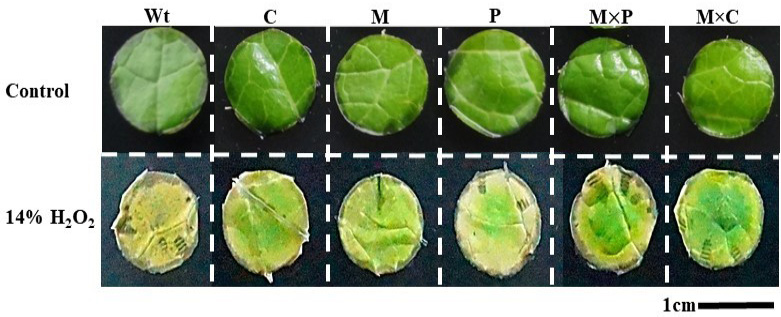
Effect of 14% Hâ‚‚Oâ‚‚ on the leaf discs of NtSAT4 single and double overexpression lines. Leaf discs from three compartment-specific single overexpressor lines cytosolic (C), mitochondrial (M), and plastidic (P) and double overexpressor lines mitochondrial×plastidic (M×P) and mitochondrial×cytosolic (M×C) lines and wild-type plants treated with 14% Hâ‚‚Oâ‚‚ for 24 hours. Scale bar = 1 cm.
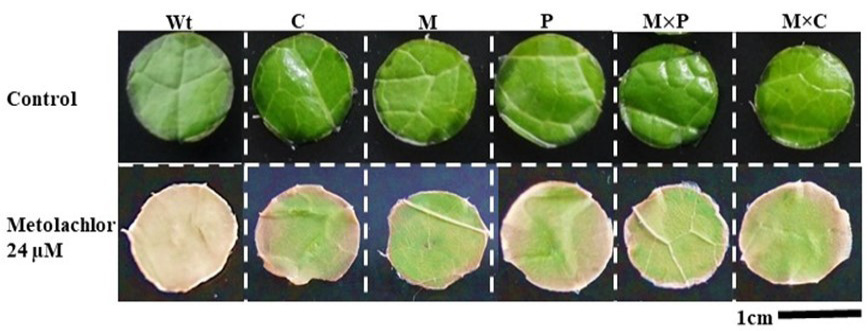
Effect of metolachlor on the leaf discs of NtSAT4 single and double overexpression lines. Leaf discs of single overexpressor lines cytosolic (C), mitochondrial (M), and plastidic (P) and double overexpressor lines mitochondrial × plastidic (M×P) and mitochondrial × cytosolic (M×C) lines and wild-type plants exposed to 24µl metolachlor. Leaf discs were kept under continuous light for 24 hours at room temperature. Scale bar = 1 cm.
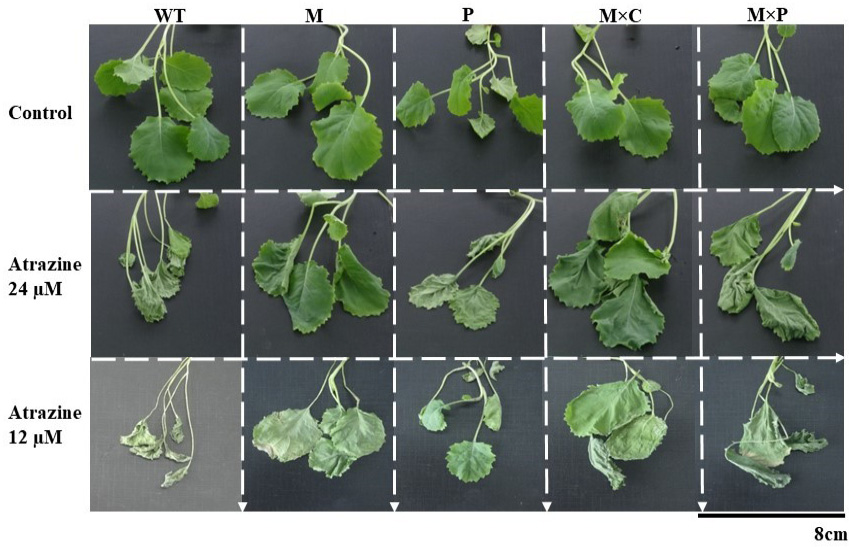
Effect of the herbicide atrazine on NtSAT4 single and double overexpressor lines and wild-type. One-month-old non-transformed (Wt), NtSAT4 single overexpressor lines mitochondrial (M) and plastidic (P) and double overexpressor lines mitochondrial × cytosolic (M×C) and mitochondrial × plastidic (M×P) plantlets grown on 1/4-strength MS hydroponic media. Plants were treated with control (1/4-strength MS), 12 µl atrazine for 48 hrs, and 24 µl for 24 hours. These were kept under control conditions in the growth room under continuous light. Scale bar = 8cm.
References
- Angelova, V., R. Ivanova, J. Todorov and K. Ivanov. 2017. Potential of rapeseed (Brassica napus L.) for phytoremediation of soils contaminated with heavy metals. J. Environ. Prot. Ecol., 18(2): 468-478.
- Asare, M.O., J. Száková and P. Tlustoš. 2023. The fate of secondary metabolites in plants growing on Cd-, As-, and Pb-contaminated soils. A comprehensive review. Environ. Sci. Pollut. Res., 30(5): 11378-11398. https://doi.org/10.1007/s11356-022-24776-x[CrossRef]
- Bartha, B., C. Huber and P. Schröder. 2014. Uptake and metabolism of diclofenac in Typha latifolia–how plants cope with human pharmaceutical pollution. Plant Sci., 227: 12-20. https://doi.org/10.1016/j.plantsci.2014.06.001[CrossRef]
- Bártíková, H., L. Skálová, L. Stuchlíková, I. Vokřál, T. Vaněk and R. Podlipná. 2015. Xenobiotic-metabolizing enzymes in plants and their role in uptake and biotransformation of veterinary drugs in the environment. Drug Metab. Rev., 47(3): 374-387.
- Cao, Y.Y., C.D. Qi, S. Li, Z. Wang, X. Wang, J. Wang, S. Ren, X. Li, N. Zhang and Y.D. Guo. 2019. Melatonin alleviates copper toxicity via improving copper sequestration and ROS scavenging in cucumber. Plant Cell Physiol., 60(3): 562-574. https://doi.org/10.1093/pcp/pcy226[CrossRef]
- Chandrakar, V., B. Yadu, R. Xalxo, M. Kumar and S. Keshavkant. 2020. Mechanisms of plant adaptation and tolerance to metal/metalloid toxicity. Plant ecophysiology and adaptation under climate change: Mechanisms and perspectives II: Mechanisms of adaptation and stress amelioration. pp. 107-135. https://doi.org/10.1007/978-981-15-2172-0_6[CrossRef]
- Dasari, S., M. Ganjayi, L. Oruganti, H. Balaji and B. Meriga. 2017. Glutathione S-transferases detoxify endogenous and exogenous toxic agents. Mini review. J. Dairy, Vet. Anim. Res., 5(5): 00154. https://doi.org/10.15406/jdvar.2017.05.00154[CrossRef]
- Dixon, D.P., A. Lapthorn and R. Edwards. 2002. Plant glutathione transferases. Genome Biol., 3(3): 1-10. https://doi.org/10.1186/gb-2002-3-3-reviews3004[CrossRef]
- Flocco, C.G., S.D. Lindblom, A. Elizabeth and P. Smits. 2004. Overexpression of enzymes involved in glutathione synthesis enhances tolerance to organic pollutants in Brassica juncea. Int. J. Phytoremed., 6(4): 289-304. https://doi.org/10.1080/16226510490888811[CrossRef]
- Foyer, C.H. and G. Noctor. 2005. Redox homeostasis and antioxidant signaling: A metabolic interface between stress perception and physiological responses. Plant Cell, 17(7): 1866-1875. https://doi.org/10.1105/tpc.105.033589[CrossRef]
- Foyer, C.H., H. Lopez-Delgado, J.F. Dat and I.M. Scott. 1997. Hydrogen peroxide-and glutathione-associated mechanisms of acclamatory stress tolerance and signaling. Physiol. Plant. 100(2): 241-254. https://doi.org/10.1111/j.1399-3054.1997.tb04780.x[CrossRef]
- Gill, S.S. and N. Tuteja. 2010. Reactive oxygen species and antioxidant machinery in abiotic stress tolerance in crop plants. Plant Physiol. Biochem., 48(12): 909-930. https://doi.org/10.1016/j.plaphy.2010.08.016[CrossRef]
- Gorinova, N., M. Nedkovska and A. Atanassov. 2005. Cytochrome p450 monooxygenases as a tool for metabolizing of herbicides in plants. Biotechnol. Biotechnol. Equip., 19(3): 105-115. https://doi.org/10.1080/13102818.2005.10817290[CrossRef]
- Hasanuzzaman, M. and M. Fujita. 2011. Selenium pretreatment upregulates the antioxidant defense and methylglyoxal detoxification system and confers enhanced tolerance to drought stress in rapeseed seedlings. Biol. Trace Element. Res., 143: 1758-1776. https://doi.org/10.1007/s12011-011-8998-9[CrossRef]
- Juan, C.A., J.M. Pérez de la Lastra, F.J. Plou and E. Pérez-Lebeña. 2021. The chemistry of reactive oxygen species (ROS) revisited: Outlining their role in biological macromolecules (DNA, lipids and proteins) and induced pathologies. Int. J. Mol. Sci., 22(9): 4642. https://doi.org/10.3390/ijms22094642[CrossRef]
- Kawahigashi, H., S. Hirose, E. Hayashi, H. Ohkawa and Y. Ohkawa. 2002. Phytotoxicity and metabolism of ethofumesate in transgenic rice plants expressing the human CYP2B6 gene. Pestic. Biochem. Physiol. 74(3): 139-147. https://doi.org/10.1016/S0048-3575(02)00153-0[CrossRef]
- Kawahigashi, H., S. Hirose, H. Ohkawa and Y. Ohkawa. 2003. Transgenic rice plants expressing human CYP1A1 exude herbicide metabolites from their roots. Plant Sci., 165(2): 373-381. https://doi.org/10.1016/S0168-9452(03)00197-3[CrossRef]
- Kawahigashi, H., S. Hirose, H. Ohkawa and Y. Ohkawa. 2006. Phytoremediation of the herbicides atrazine and metolachlor by transgenic rice plants expressing human CYP1A1, CYP2B6, and CYP2C19. J. Agric. Food Chem., 54(8): 2985-2991. https://doi.org/10.1021/jf052610u[CrossRef]
- Khan, A.D., M.S. Khan, S.A.K. Bangash, K. Naeem, A. Jalal and M. Tayyab. 2021. Cadmium and arsenic provoke mostly distinct but partly overlapping responses in Brassica juncea. Crop Pasture Sci., https://doi.org/10.1071/CP21157[CrossRef]
- Liedschulte, V., A. Wachter, A. Zhigang and T. Rausch. 2010. Exploiting plants for glutathione (GSH) production: uncoupling GSH synthesis from cellular controls results in unprecedented GSH accumulation. Plant Biotechnol. J., 8(7): 807-820. https://doi.org/10.1111/j.1467-7652.2010.00510.x[CrossRef]
- Linacre, N.A., S.N. Whiting, A.J. Baker, J. Scott Angle and P.K. Ades. 2003. Transgenics and phytoremediation: the need for an integrated risk assessment, management, and communication strategy. Int. J. Phytoremed., 5(2): 181-185. https://doi.org/10.1080/713610179[CrossRef]
- Marrs, K.A., 1996. The functions and regulation of glutathione s-transferases in plants. Ann. Rev. Plant Biol., 47(1): 127-158. https://doi.org/10.1146/annurev.arplant.47.1.127[CrossRef]
- Mullineaux, P.M. and T. Rausch. 2005. Glutathione, photosynthesis and the redox regulation of stress-responsive gene expression. Photosynth. Res., 86(3): 459-474. https://doi.org/10.1007/s11120-005-8811-8[CrossRef]
- Nakka, S., A.S. Godar, C.R. Thompson, D.E. Peterson and M. Jugulam. 2017. Rapid detoxification via glutathione S‐transferase (GST) conjugation confers a high level of atrazine resistance in Palmer amaranth (Amaranthus palmeri). Pest Manage. Sci., 73(11): 2236-2243. https://doi.org/10.1002/ps.4615[CrossRef]
- Navari‐Izzo, F., S. Meneguzzo, B. Loggini, C. Vazzana and C. Sgherri. 1997. The role of the glutathione system during dehydration of Boea hygroscopica. Physiol. Plant., 99(1): 23-30. https://doi.org/10.1034/j.1399-3054.1997.990104.x[CrossRef]
- Ohkawa, H., H. Imaishi, N. Shiota, T. Yamada, H. Inui and Y. Ohkawa. 1998. Molecular mechanisms of herbicide resistance with special emphasis on cytochrome P450 monooxygenases. Plant Biotechnol., 15: 173-176. https://doi.org/10.5511/plantbiotechnology.15.173[CrossRef]
- O’Kane, D., V. Gill, P. Boyd and R. Burdon. 1996. Chilling, oxidative stress and antioxidant responses in Arabidopsis thaliana callus. Planta, 198(3): 371-377. https://doi.org/10.1007/BF00620053[CrossRef]
- Ozougwu, J.C., 2016. The role of reactive oxygen species and antioxidants in oxidative stress. Int. J. Res., 1(8).
- Pilon-Smits, E. and M. Pilon. 2002. Phytoremediation of metals using transgenic plants. Crit. Rev. Plant Sci., 21(5): 439-456. https://doi.org/10.1080/0735-260291044313[CrossRef]
- Pilon-Smits, E.A., S. Hwang, C.M. Lytle, Y. Zhu, J.C. Tai, R.C. Bravo, Y. Chen, T. Leustek and N. Terry. 1999. Overexpression of ATP sulfurylase in Indian mustard leads to increased selenate uptake, reduction, and tolerance. Plant Physiol., 119(1): 123-132. https://doi.org/10.1104/pp.119.1.123[CrossRef]
- Rajab, H., M.S. Khan, M. Wirtz, M. Malagoli, F. Qahar and R. Hell. 2020. Sulfur metabolic engineering enhances cadmium stress tolerance and root to shoot iron translocation in Brassica napus L. Plant Physiol. Biochem., 152: 32-43. https://doi.org/10.1016/j.plaphy.2020.04.017[CrossRef]
- Rajab, H., M.S. Khan, S.H. Shah and S.M.A. Shah. 2019. Genetic transformation of tobacco serine acetyltransferase 4 (NtSAT4) gene in Brassica napus L. Sarhad J. Agric., 35(4): 1224-1233. https://doi.org/10.17582/journal.sja/2019/35.4.1224.1233[Full text][CrossRef]
- Rogers, S.O. and A.J. Bendich. 1989. Extraction of DNA from plant tissues. Plant Mol. Biol. Manual, pp. 73-83. https://doi.org/10.1007/978-94-009-0951-9_6[CrossRef]
- Sachdev, S., S.A. Ansari, M.I. Ansari, M. Fujita and M. Hasanuzzaman. 2021. Abiotic stress and reactive oxygen species: Generation, signaling, and defense mechanisms. Antioxidants, 10(2): 277. https://doi.org/10.3390/antiox10020277[CrossRef]
- Smirnoff, N. and D. Arnaud. 2019. Hydrogen peroxide metabolism and functions in plants. New Phytol., 221(3): 1197-1214. https://doi.org/10.1111/nph.15488[CrossRef]
- Syed, S., M.S. Khan, A. Jalal and Z. Iqbal. 2023. Inoculation of Serratia sp. under cadmium stress significantly affected Brassica juncea growth attributes and glutathione levels. Pak. J. Agric. Sci., 60(1).
- Syguda, A., A. Gielnik, A. Borkowski, M. Woźniak-Karczewska, A. Parus, A. Piechalak, A. Olejnik, R. Marecik, L. Lawniczak and L. Chrzanowski. 2018. Esterquat herbicidal ionic liquids (HILs) with two different herbicides: Evaluation of activity and phytotoxicity. New J. Chem., 42(12): 9819-9827. https://doi.org/10.1039/C8NJ01239C[CrossRef]
- Tong, Y.P., R. Kneer and Y.G. Zhu. 2004. Vacuolar compartmentalization: A second-generation approach to engineering plants for phytoremediation. Trends Plant Sci., 9(1): 7-9. https://doi.org/10.1016/j.tplants.2003.11.009[CrossRef]
- Van Ginneken, L., E. Meers, R. Guisson, A. Ruttens, K. Elst, F.M. Tack, J. Vangronsveld, L. Diels and W. Dejonghe. 2007. Phytoremediation for heavy metal‐contaminated soils combined with bioenergy production. J. Environ. Eng. Lands. Manage., 15(4): 227-236. https://doi.org/10.3846/16486897.2007.9636935[CrossRef]
- Verbruggen, N., C. Hermans and H. Schat. 2009. Molecular mechanisms of metal hyperaccumulation in plants. New Phytol., 181(4): 759-776. https://doi.org/10.1111/j.1469-8137.2008.02748.x[CrossRef]
- Vontas, J.G., G.J. Small and J. Hemingway. 2001. Glutathione S-transferases as antioxidant defense agents confer pyrethroid resistance in Nilaparvata lugens. Biochem. J., 357(1): 65-72. https://doi.org/10.1042/bj3570065[CrossRef]
- Wirtz, M. and R. Hell. 2003. Production of cysteine for bacterial and plant biotechnology: application of cysteine feedback-insensitive isoforms of serine acetyltransferase. Amino Acids, 24(1): 195-203. https://doi.org/10.1007/s00726-002-0313-9[CrossRef]
- Xia, Z., Z. Xu, Y. Wei and M. Wang. 2018. Overexpression of the maize sulfite oxidase increases sulfate and GSH levels and enhances drought tolerance in transgenic tobacco. Front. Plant Sci., 9: 298. https://doi.org/10.3389/fpls.2018.00298[CrossRef]
- Xiang, X., Y. Wu, J. Planta, J. Messing and T. Leustek. 2018. Overexpression of serine acetyltransferase in maize leaves increases seed-specific methionine-rich zeins. Plant Biotechnol. J., 16(5): 1057-1067. https://doi.org/10.1111/pbi.12851[CrossRef]
- Ye, F., Y. Zhai, K.-L. Guo, Y.-X. Liu, N. Li, S. Gao, L.-X. Zhao and Y. Fu. 2019. Safeners improve maize tolerance under herbicide toxicity stress by increasing the activity of enzymes in vivo. J. Agric. Food Chem., 67(42): 11568-11576. https://doi.org/10.1021/acs.jafc.9b03587[CrossRef]
- Zhang, F., X. Xiao, G. Yan, J. Hu, X. Cheng, L. Li, H. Li and X. Wu. 2018. Association mapping of cadmium-tolerant QTLs in Brassica napus L. and insight into their contributions to phytoremediation. Environ. Exp. Bot., 155: 420-428. https://doi.org/10.1016/j.envexpbot.2018.07.014[CrossRef]
- Zheng, T., X. Yu, Y. Sun, Q. Zhang, X. Zhang, M. Tang, C. Lin and Z. Shen. 2022. Expression of a cytochrome P450 gene from bermuda grass Cynodon dactylon in soybean confers tolerance to multiple herbicides. Plants, 11(7): 949. https://doi.org/10.3390/plants11070949[CrossRef]
- Zhu, Y.L., E.A. Pilon-Smits, L. Jouanin and N. Terry. 1999. Overexpression of glutathione synthetase in Indian mustard enhances cadmium accumulation and tolerance. Plant Physiolo., 119(1): 73-80. https://doi.org/10.1104/pp.119.1.73[CrossRef]
Services
Article usage statistics
Loading…