Research Article · Volume 10, Issue 3, 16 September 2022 · Open Access
Enhancement of Nutritive Value of Cassava Stumps by Aspergillus niger ATCC 16404 in Solid State
· · · · · · · ·
Affiliations & Notes ⌄
1Department. of Animal Science, Landmark University, Km 4 Ipetu – Omu Aran Road, P. M. B. 1001, Omu Aran, Kwara State, Nigeria
2Department of Animal Production and Health, School of Agriculture and Agricultural Technology, Federal University of Technology Akure, P. M. B. 704, Akure, Ondo State, Nigeria
3Department of Biological Sciences, College of Sciences, Afe Babalola University, Ado - Ekiti, Ekiti State, Nigeria. *Correspondence | Razaq Adekunle Animashahun, Department. of Animal Science, Landmark University, Km 4 Ipetu – Omu Aran Road, P. M. B. 1001, Omu Aran, Kwara State, Nigeria
There was a significant enhancement of crude protein in the fermented cassava stumps (FCS) from 2.52 % in unfermented to 7.45% (Table 1) representing 196% increment (Figure 1).
Generally, the mineral compositions of the cassava stump showed consistent increase with period of fermentation.
When compared with the unfermented cassava stump, fermentation was observed to significantly enhance the mineral contents of the cassava stump (Figure 2).
With the high percentage enhancement of the nutritive values observed in the current study, it can be concluded that solid-state fermentation using Aspergillus niger ATCC 16404 may be a good technique for the enrichment of cassava by-products.
Selected from the article's own text.
Abstract
This study investigated the nutritional and anti-nutritional components of non-fermented and microbe fermented cassava stumps using Aspergillus niger (ATCC 16404) strain in a solid substrate. The dried and milled cassava stumps were aseptically inoculated with Aspergillus niger (ATCC 16404) strain in a solid-state at substrates to water ratio 1.0:1.0 w/v and then incubated for 192 hours at room temperature. Samples were taken at 48 h interval for the proximate, minerals and anti-nutrients composition determination of the fermented cassava stumps. The experimental design employed was completely Randomized Design. The results showed that the fermentation media and the fermentation period significantly (P < 0.05) affected the nutritional and anti-nutritional components of the cassava stumps, as there was better enhancement of the by-product at higher fermentation period. The highest crude protein (CP), ether extract (EE), ash, and lowest crude fiber (CF) in fermented cassava stumps were obtained at 192 hours of fermentation with the following values CP 7.45%, EE 9.81% and ash 7.01%. A similar trend was also observed for mineral enhancement and anti-nutrient degradation. Conclusively, this study showed that solid-state fermentation using Aspergillus niger (ATCC 16404) strain can effectively enhance the nutritive value of cassava stumps which can help increase the feed resources for non-ruminant animals.
The major constraint to livestock production is the availability and cost of feed resources; hence the search for alternative, cheap, non-conventional and underutilized feed ingredients such as agro-industrial by-products and wastes is important. Agro-industrial by-products are in abundance in Nigeria and the industries producing these by-products have expenses for their proper disposals. Some of these wastes left unutilized cause environmental pollution and constitute health hazards . Those that are utilized do not have their full potential harnessed due to high fibre content, low digestibility, presence of anti-nutritive factors and lack of knowledge of processing methods.
Nigeria with annual production of 53 million tonnes is the number one World producer of cassava . A root crop cultivated mainly in tropical and sub-tropical regions . Cassava processing produces large amounts of waste and is considered to contribute significantly to environmental pollution (Food and Agricultural Organization (FAO, 2001). A cassava-starch production unit process 100 tons of tubers per day has an output of 47 tons of fresh by-products, which may cause environmental problems when left in the surroundings of processing plants or carelessly disposed off . One of these by-products is the cassava stump (the highly fibrous trimmed ends of the cassava root), which is usually left in the open areas after cassava processing. The wet form of this by-product often constitutes environmental pollution, emitting foul odour; and when the dried one are burned it can deplete the ozone layer. The best use of this by-product is its use as firewood by the rural dwellers, and woody stems are ground-up and used as substrate for growing mushrooms (Food and Agricultural Organization (FAO, 2013).
The utilization of agro-industrial residues as substrates in solid-state fermentation (SSF) processes provides an alternative avenue and value addition to these otherwise underutilized or unused residues. Solid substrates generally provide a good dwelling environment to the microbial flora comprising bacteria, yeasts, and fungi. Amongst these, filamentous fungi have been reported to be the best studied for SSF due to their hyphal growth ; . Pasaribu et al. (1998) opined that substrate fermentation using Aspergillus niger could be used to improve high fibrotic, low protein and poorly digestible agricultural by-products.
Cassava stump can provide a vast amount of valuable feed resources if properly harnessed and processed into value-added products for animal use; thereby serving as alternatives to conventional feed resources and bringing down the cost of animal production. This could motivate farmers to venture more into livestock production and provides more job opportunity.
There are very scarce literature or scientific studies on cassava stumps, thus this study is an attempt to see how this cassava by-product can be nutritionally improved using Aspergillus niger.
MATERIALS AND METHODS
Chemical Analysis of the By-Products
The composite cassava stumps were obtained from the garri Processing Unit of Commercial Farm, Landmark University, Omu-Aran, Kwara State of Nigeria. The proximate analysis of the dried and milled cassava stumps was carried out in triplicate, using Association of Analytical Chemist method (AOAC, 2000). The detergent components of the fiber were analyzed by the method of Van Soest (1991) while the metabolizable energy (ME) was calculated from Pauzenga formula as reported by Clement et al. (2017) shown below:
ME (kcal/kg DM) = (37 x % CP) + (81.8 x % EE) + (35.5 x % NFE).
Determination of the Mineral Content of the Cassava By-Products
The mineral content determination was carried out by ashing about 2g of samples collected from each of the cassava by-products. The ashed sample was then dissolved in HNO3, and the samples filtered into clean small plastic bottles using number 42 Whatman filter paper. The filtrate was then diluted to 100ml with distilled water. Magnesium (Mg); potassium (K) and sodium (Na) were determined by flame photometry using the specific metal bulbs . Phosphorus (P) was determined by the Vanado-molybdate method using Corning Colorimeter 253 (AOAC, 2000) and calcium (Ca) was determined by titrating the filtrate with ethylene diamine tetra-acetic acid (EDTA) as described by Bisergaeva and Sirieva, (2020).
Determination of Anti-nutrients in the Cassava By-Products
The method of the Association of Analytical Chemist (AOAC, 2000) was used to determine the hydrocyanide (HCN) content of the cassava stumps; Phytic acid and Alkaloid were determined by the procedure of Ezeonu and Ejikeme (2016); while the Follin Denis titrating method as described by Li et al. (2015) was used to determine the tannin level.
Solid State Fermentation Process
Aspergillus niger, a filamentous fungus was used as the candidate micro-organism for this study. The type Aspergillus niger ATCC 16404 was obtained from the Microbiology Laboratory of the Department of Microbiology, Landmark University, Omu-Aran, Kwara State of Nigeria.
Fifty grams of the dried and milled cassava stumps were weighed into 12 sets of 250 ml conical flask, distilled water was added at 1.0:1.0 w: v (50g stumps + 50 ml H2O).
The flasks were then plugged with nonabsorbent cotton wool. All samples were autoclaved for 15 min at a pressure of 103.421 KPa and a temperature of 121oC; the samples were then allowed to cool. Each of the autoclaved samples was then inoculated with 2 ml of A. niger containing 1.07 x 10⁹ colony forming unit per ml in a laminar flow chamber. All the samples were thereafter kept on the bench under ambient temperature. At every 48 hours (48th, 96th, 144th and 192th hour), three conical flasks (i.e. triplicate) were
Table 1: Proximate composition of the fermented cassava stump (% DM)
Proximate Parameters (%)
Fermentation period (hours)
±SEM
UFS
48
96
144
192
Moisture
6.05d
13.10a
9.53b
8.01bc
7.51c
0.07
Crude protein
2.53cd
3.57c
3.84c
5.37b
7.45a
0.02
Ether extract
5.53c
7.75b
9.81a
9.80a
8.55ab
0.10
Crude fibre
12.53a
10.52b
9.52b
9.05bc
7.51c
0.12
Ash
3.01c
4.80b
7.01a
6.55a
6.25a
0.10
Nitrogen free extract
70.3 a
60.74b
59.29b
61.52b
62.43b
0.24
ME (kcal/kg)
3043b
2922c
3049b
3185a
3191a
0.28
NDF
33.42a
31.43b
29.01c
27.31d
23.32e
0.23
ADF
20.68a
20.33a
20.02a
18.48b
14.31c
0.69
a –e = Means on the same row with different superscripts are statistically significant (P < 0.05). UFS = Unfermented stump; NDF = Neutral detergent fibre; ADF = Acid detergent fibre; ME = Metabolizable energy; SEM = Standard error of mean.
Table 2: Mineral components (%) of fermented cassava stumps
Minerals
Fermentation period in Hours
±SEM
UFS
48
86
144
192
Calcium
0.14d
0.25c
0.45b
0.68a
0.72a
0.12
Phosphorus
0.11b
0.14b
0.26a
0.30a
0.35a
0.05
Magnesium
0.04c
0.08b
0.15a
0.20a
0.20a
0.05
Potassium
0.05
0.06
0.08
0.08
0.10
0.01
Sodium
0.0001
0.0001
0.0003
0.0004
0.0005
0.01
a –d = Means on the same row with different superscripts are statistically significant (P < 0.05). UFS = Unfermented cassava stump; SEM = Standard error of means.
Table 3: Anti-nutrient contents of fermented cassava stumps
Anti-nutrient
Fermentation period in Hours
±SEM
UFS
48
96
144
192
Alkaloid (%)
3.21a
2.87ab
2.04b
1.67b
0.34c
0.04
Phytate (mg/100g)
9.10a
8.50ab
8.00b
7.81bc
7.11c
0.20
HCN (mg/kg)
1.35a
1.06b
1.01b
0.69c
0.65c
0.03
Saponin (%)
2.26a
1.83b
1.66b
1.52b
1.19c
0.11
Tannin (%)
0.43a
0.37a
0.31ab
0.27b
0.16c
0.02
a –c = Means on the same row with different superscripts are statistically significant (P < 0.05). UFS = Unfermented cassava stump; SEM = Standard error of mean; HCN = Hydrocyanide
taken and the fermentation terminated by sun-drying for two days and stored in cellophane bags for subsequent analyses .
Chemical Analyses of the Fermented Products
Proximate analyses, minerals, and anti-nutritive contents were carried out as described above.
Statistical Analysis
The experimental design was completely Randomized Design (CRD). All generated data from the experiment were presented as the mean values of three replicates each. One-way Analysis of Variance (ANOVA) and Duncan Multiple Range Test were carried out using SAS 2000 package at the end of the analyses.
RESULTS
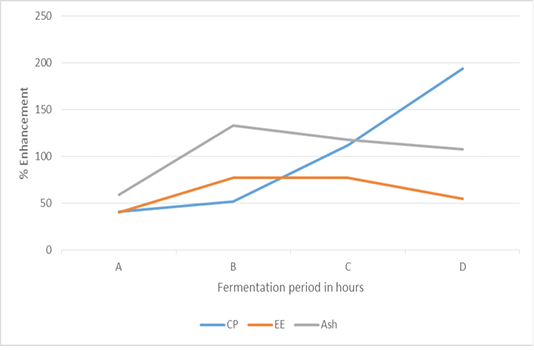
At the different fermentation conditions, ether extract showed consistent increase (from 5.53 to 9.81%) with time of fermentation up to 96 h, after which decrease was observed. Crude protein however, continue to increase until the end of fermentation process (192 h) (Table 1).
There was a significant enhancement of crude protein in the fermented cassava stumps (FCS) from 2.52 % in unfermented to 7.45% (Table 1) representing 196% increment (Figure 1).
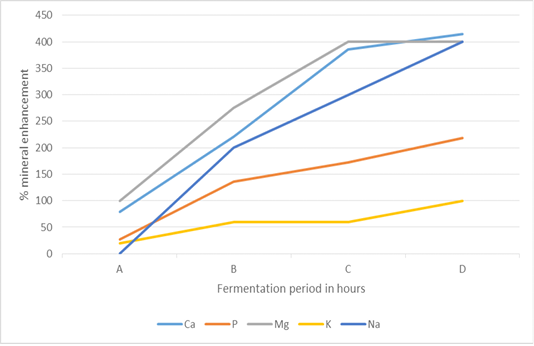
Generally, the mineral compositions of the cassava stump showed consistent increase with period of fermentation. This trend was irrespective of the minerals (Table 2). When compared with the unfermented cassava stump, fermentation was observed to significantly enhance the mineral contents of the cassava stump (Figure 2).
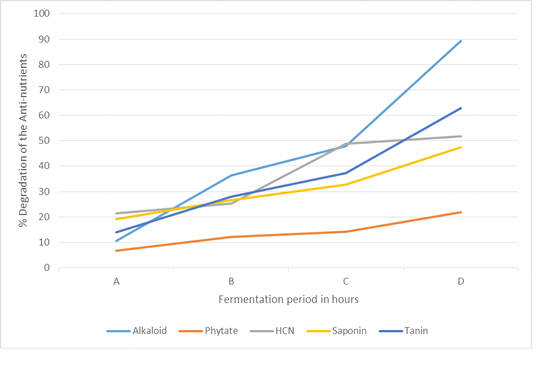
All the anti-nutrient contents detected showed consistent decreases with fermentation period. This trend was irrespective of the ant-nutrients type (Table 3). The SSF significantly reduced the alkaloid content of the FCS in this study (Table 3 and Figure 3). In addition, there were significant reductions in the HCN levels in the FCS (Figure 3).
DISCUSSION
The significant enhancement of crude protein (CP) in the fermented cassava stumps (FCS) observed in this study is in agreement with previous works (Aderemi and Nworgu, 2007; Aro et al., 2010; Adeleke et al., 2017). This observation is an indication that A. niger ATCC 16404 can be employed in the enhancement of cassava stump. The increase in the CP may be because of A. niger β-glucosidase that attribute in the production of proteases, which is responsible for the degradation of proteins and peptides (Ikpesu et al., 2016). It could also be due to the bioconversion of sugar into protein, and/or the proliferation and exponential growth of the A. niger, thereby yielding single cell proteins into the media (Akinyele and Agbo, 2007; Okpako et al., 2008, Ikpesu et al., 2016). This may also be a clue to the reduction in nitrogen free extract (NFE) as the fermentation progressed, as negative correlation has been reported between protein and carbohydrate levels during fermentation process (Okpako et al., 2008; Yafetto, 2018).
There was also an increase in EE up to 96 hours of fermentation, after which the values began to decline. This is consistent with the findings of Animashahun et al. (2013) and Shi et al. (2015), who found higher EE in Penicillium sp. and Aspergillus niger assisted solid state fermentation respectively. The enhancement of EE could probably due to biosynthesis of lipids during the fermentation process by the A. niger from the substrates. The synthesis of enzymes during SSF is well known, and the hydrolysis activity of these enzymes on antinutrients (e.g., lipases, proteases, amylases, and phytase) results in the liberation of single cell proteins, simple sugars, fatty acids, and minerals .
There was reduction in the crude fibre (CF), acid detergent fibre (ADF) and neutral detergent fibre (NDF) of the fermented cassava stump. The action of the A. niger and the elicited enzymes may be responsible for this CF and the fibre fractions degradation and this can enhance the digestibility of the cassava stump in the non-ruminant gastro intestinal tracts. This finding could also enhance knowledge of the application of fungi in protein enhancement and fibre fractions degradation of agro industrial wastes and subsequent incorporation into non-ruminants feed to increase the productivity thereby increasing the protein intake of human and improving the economic status of local farmers .
The reduction in the NFE of the FCS may be due to the utilization of the substrates as the energy source by the A. niger in the enrichment of protein levels during the fermentation process ; Animashahun et al., 2013). Hence, as the protein increased there was a corresponding reduction in the NFE.
The significant reduction in the alkaloid content of the FCS reported in this study was lower than what was reported in related studies ; . The FCS incorporation into feed may not therefore negatively affect voluntary feed intake by the animals. The significant reduction in phytate level could be due to the relative ability of A. niger to secrete phytase, an enzyme that hydrolyses phytate in the FCP ; . The results were also in agreement with previous works by Oboh et al. (2003) and Etsuyankpa et al. (2015) who reported reduction in the phytate level of cassava by- products after A. niger assisted fermentation. The values obtained in the study were grossly lower than those observed by Oluremi et al. (2007) and Aro et al. (2010). Therefore, there will probably be no fear of nutrient deficiency due to phytic acid in the feed.
The HCN levels in the FCS were far below the toxic level of 5mg/100g for livestock reported by Coursey (1973), and within the range of 4mg/100g recommended by World Health Organization as reported by Ekere and Ese (2014) and Ojiambo et al. (2017). The very low HCN may be due to the initial sun drying of the cassava stumps prior to fermentation, as sun drying is a well-known process of detoxifying cassava root, and also the variety or source of the cassava stumps ; .
The microbial SSF caused appreciable reduction in the level of saponin of the cassava stump; this is in consonant with the report of Etsuyankpa et al. (2015). The saponin level of the FCS was lower than the 3mg/100g adjudged to be hazardous to cattle . There was significant reduction in the level of tannin in FCS, which may be attributed to the degradation of the polyphenols in the solid substrates by the A. niger during the fermentation process . It is noteworthy that the levels of tannin in the FCS was well below 1-20% reported to cause depressed growth rate and poor feed utilization in non-ruminants . Tannin and saponin are known to adversely affect digestibility in animal (Richard, 2003), the low levels of this anti-nutrient in the FCS is an indication that digestibility may not be negatively affected if this cassava by-product is used in the feed of animals.
SSF by A. niger significantly enhanced all the minerals content of the FCS. This may be because of biodegradation of non-starch polysaccharides in the substrate . The Ca level obtained in this study was higher than 0.03mg/100g obtained by Oboh (2006) and reported by Aro (2008). However, the values in this study are lower than 3.4 – 3.85% daily requirement per head per day recommended for commercial laying hens by Miles and Harms (1982) and 4.25 –4.75% by Hyline (2014). It should be noted that these recommended values are to be supplied by all the feed ingredients in the feed and not the FCS alone. The optimum enhanced level of phosphorus in the FCS at the optimum enhanced levels was within the range of 0.35 and 0.48% (Hyline, 2014). The values in this study are higher than the values of 0.20, 0.20, 0.15, 0.20 and 0.20% in wheat, corn, barley, oat and peas respectively, but comparable to P values of 0.37, 0.48 and 0.50% in soybean meal, cottonseed meal and sunflower meal (Hyline, 2014). Incorporating FCS in the feed may therefore have no adverse effect on growth, performance, productivity and reproductive activities of chickens.
There was improvement in the levels of Mg and K in the FCS up to the end of fermentation (192 hours). The Mg level obtained for FCS was higher than 0.48mg/100g (4.8mg/kg) reported by Aro (2008). The use of this cassava by-product in poultry nutrition meet with the Mg requirement of 0.03 – 0.06 mg/100g for avian specie. The K values obtained for FCS are higher than 0.05mg/100g reported by Oboh (2006) and Aro (2008). The Na content of the FCS are grossly lower than the 0.04 mg/100g reported by Oboh (2006) and Aro (2008). The differences could be due to specie differences of the candidate organisms, and the ability of these organisms to liberate Na. Aro (2008)observed that the combination of A. fumigatus/lactic acid and S. cerevisiae/lactic acid yielded the highest Na in cassava starch residue and cassava peel respectively while Oboh (2006) employed S. cerevisiae and Lactobacillus sp. in cassava peels. These results also validated the report of Aro (2008) who observed that A. niger may have special need for Na.
Ramesh and Lonsane (1991) observed that the solid substrate might not provide all the nutrients needed by the candidate organisms for maximum activity. Some of the vital nutrients necessary for optimum growth and product formation during SSF may be at sub-optimal level and this may necessitate exogenous supply of various nutrients like carbon source to the medium to improve the growth of the organisms and product yield. The reduction in the values of EE and ash after the attainment of the maximum enhancement could be due to the depletion of the nutrient in the media or depletion of the sugar content in the fermentation substrate ; which possibly could have led to the death of some of the organisms.
CONCLUSION
Findings from this study revealed that solid-state fermentation is a very good and cheap method of enhancing the nutritive values of cassava stump and local farmers on the field can easily employ it with little or no assistance. With the high percentage enhancement of the nutritive values observed in the current study, it can be concluded that solid-state fermentation using Aspergillus niger ATCC 16404 may be a good technique for the enrichment of cassava by-products. These findings are also indications that Aspergillus niger (ATCC 16404) is a good microbial candidate for solid state fermentation in the enhancement of cassava stumps.
The cassava stump which hitherto has been of no value, when fermented can be incorporated into the feed of non-ruminant livestock as a source of energy thereby solving the problem of disposal and environmental pollution on one hand, as well as serving as cheap and viable feed resource for the livestock enterprise.
ACKNOWLEDGEMENT
The authors will like to appreciate the Management of Landmark University, Omu Aran, Kwara State, Nigeria for their material and instrumental supports.
CONFLICT OF INTEREST
The authors declare that there is no conflict of interest.
novelty statement
The novelty of this study is the conversion of woody seemly waste (stump) of cassava by product to valuable product that can be utilized by livestock.
authors contribution
Animashahun R. A.: Conceptualization, Investigation and writing. Onibi G. E.: Project administration and Supervision. Aro S. O.: Investigation and Supervision. Akpor O. B.: Resources and Investigation. Alabi O. O.: Project administration. Okeniyi F. A.: Review & editing. Falana M. B.: Formal analysis and Visualization Shoyombo. A. J. Data curation. Olawoye S. O: Software.
Figures
Figure 1. Figure 1.
Degree of enhancement of the crude protein, ether extract and ash in the fermented cassava stump CP = crude protein; EE = Ether extract; A = 48 hours, B = 96 hours; C = 144 hours; D = 192 hours
Figure 2.
Degree of cassava stump minerals’ enhancement by the solid state fermentation Ca = Calcium; P = Phosphorus; Mg = Magnesium; K = Potassium; Na = Sodium; A = 48 hours, B = 96 hours; C = 144 hours; D = 192 hours
Figure 3.
Degree of cassava stump anti-nutrients’ degradation by the solid state fermentation HCN = Hydrocyanide; A = 48 hours, B = 96 hours; C = 144 hours; D = 192 hours
References
Adeleke B. S., Akinyele B. J., Olaniyi O. O., Jeff-Agboola Y. A. (2017). Effect of Fermentation on Chemical Composition of Cassava Peels. Asian J. Plant Sci. Res., 7(1): 31-38.
Aderemi F.A., Nworgu F.C. (2007). Nutritional Status of Cassava Peels and Root Sieviate Biodegraded with Aspergillus niger. American-Eurasian J. Agric. Environ. Sci. 2: 308-311.
Akinyele B. J., Agbo O. (2007). Increasing the Nutritional Value of Plantain Wastes by Activities of Fungi Using the Solid-State Fermentation Technique: Res. J. Microbiol., 2: 117-124. https://doi.org/10.3923/jm.2007.117.124 http://scialert.net/abstract/?doi=jm.2007.117.124[CrossRef]
Animashahun R. A, Omoikhoje S. O., Edokpayi M. I., Adesina B. T. (2013). Nutrient Values of Cassava Residual Pulp as Affected by Solid State Fermentation with Penicillium spp. Int. J. Appl. Agric. Apic. Res.,9 (1&2): 42-47.
Association of Official Analytical Chemists. (2000). Official methods of analysis of the Association of Analytical Chemists International (13th ed.). Washington, USA: MD Publishing.
Aro S. O. (2008). Improvement in the Nutritive Quality of Cassava and its By-Products through Microbial Fermentation. A review of the extent of fermentation of cassava and its by-products. African J. Biotechnol., 7(25): 4789-4797.
Aro S. O., Aletor V. A., Tewe O. O., Agbede J. O. (2010). Nutritional Potentials of Cassava Tuber Wastes: A Case Study of a Cassava Starch Processing Factory in South-Western Nigeria. Livestock Research for Rural Development Livestock Research for Rural Development, 22, Article #213. Retrieved April 11, 2020, from http://www.lrrd.org/lrrd22/11/aro22213.htm
Aro S. O., Aletor V. A. (2012). Proximate Composition and Amino Acids Profile of Different Cassava Tuber Wastes collected from a Cassava Starch Producing Factory in Nigeria. Livest. Res. Rural Develop., 24, Article #40. Retrieved April 11, 2020, from http://www.lrrd.org/lrrd24/3/aro24040.htm
Bayitse R., Hou S., Laryea G., Bjerre, A. B. (2015). Protein Enrichment of Cassava Residue using Trichoderma pseudokomingi (26801). AMP Express Springer Open J., 5: 80-85. https://doi.org/10.1186/s13568-015-0166-8.[CrossRef]
Bisergaeva R. A., Sirieva Y. N. (2020) Determination of calcium and magnesium by atomic absorption spectroscopy and flame photometry. J. Phys.: Conf. Ser.1691 012055 J. Physics: Conference Series. 1691 (2020) 012055. https://doi.org/10.1088/1742-6596/1691/1/01205[CrossRef]
Chauynarong N., Elangovan A.V., Iji P.A. (2009). The Potential of Cassava Products in Diets for Poultry. World’s Poult. Sci. J., 65: 23-35. https://doi.org/10.1017/S0043933909000026[CrossRef]
Clement A, Dankasa K. L., Uchei I. J, Bala. S., Siaka D. S. (2017). Nutrient Digestibility and Growth Performance of Broiler Chickens Fed Processed Tropical Sickle Pod (Senna Obtusifolia (L.)) Seed Meal Based-Diets. J. Agric. Sci., 62(4): 371-384. Https://doi.org/10.2298/JAS1704371CUDC[CrossRef]
Coursey D. G. (1973). Cassava as food: toxicity and technology. In B. Nestel and R. MacIntyre (Eds.), Proceedings of the Inter-disciplinary Workshop, London, England (pp. 27–36). Ottawa, Canada: International Development Research Centre, IDRC-010e.
Fullan M. (1996). Leadership for change. In International handbook for educational leadership and administration. New York, NY: Kluwer Academic.
D’Mello J. P. F. (2000). Antinutritional factors and mycotoxins. In Farm Animal Metabolism and Nutrition. Wallingford, UK: CAB International.
Ekere N. R., Eze I. S. (2014). Evaluation of Cyanogenic Potentials of Local Cassava Species and Residual Cyanide Contents of Their Locally Processed Food Products in Southeast Nigeria. Human Ecolog. Risk Assessment: An Int. J., 20(3): 789-796. Https://doi.org/10.1080/10807039.2012.723185[CrossRef]
Enyenihi G. E., Udedibie A. B. I., Akpan M. I., Obasi O., Solomon I. P. (2009). Effects of 5 h Wetting of Sun-Dried Cassava Tuber Meal on the Hydrocyanide Content and Dietary Value of the Meal for Laying Hens. Asian J. Anim. Vet. Adv., 4: 326-331.
Etsuyankpa M. B., Gimbo C. E., Agbaji E. B., Omoniyi K. L. Ndamitso M. M., Mathew J. T. (2015). Assessment of the Effects of Microbial Fermentation of selected Anti-nutrients in the products of Four Local Cassava Varieties from Niger State, Nigeria. American J. Food Sci. Technol., 3(3): 89-96. Https://doi.org/10.12691/ajfst-3-3-6[CrossRef]
Ezekiel O. O., Aworh O. C. (2013). Solid State Fermentation of Cassava Peels with Trichoderma viride (ATCC 36316) for Protein Enrichment. Int. J. Nutrit. Food Engineer., 7 (3): 202-20.
Ezeonu C. S., Ejikeme C. M. (2016). Qualitative and Quantitative Determination of Phytochemical Contents of Indigenous Nigerian Softwoods. New Journal of Science Hindawi Publishing Corporation, 2016. 1-9. Available at http://dx.doi.org/10.1155/2016/5601327[CrossRef]
Farinas C. S, Vitcosque G. L., Fonseca R. F., Neto V. B., Couri S. (2011). Modeling the Effects of Solid-State Fermentation Operating Conditions on Endoglucanase Production using an Instrumented Bioreactor. Indust. Crops Prod., 34(1): 1186–1192.
Food and Agricultural Organization (2001). Strategic Environmental Assessment. An Assessment of the Impact of Cassava Production and Processing on the Environment and Biodiversity. Proceedings of the Validation Forum on the Global Cassava Development Strategy. 5. FAO, Rome. 26-28 April 2000
Food and Agricultural Organization (2013). Harvest, Post-harvest and Value Addition. Retrieved May 20, 2020 from http://www.fao.org/sustainable-agricultural-mechanization/guidelinesoperations/on-farm-postharvest-and-value-addition/en/
Gupta R. K., Gangoliya S. S., Singh N. K. (2015). Reduction of phytic acid and enhancement of bioavailable micronutrients in food grains. J. Food Sci. Technol. 52(2):676-684. Https://doi.org/10.1007/s13197-013-0978-y.[CrossRef]
Hy-line (2014). Hyline International. Hy-line Brown Commercial Layers Management Guide. Hy-Line International. pp 16-23. Retrieved May 20, 2020 from http://www.poultryhub.org/wp-content/uploads/2012/06/2009_Hy-Line_Brown.pdf
Ikpesu T. O., Ariyo A. B., Ogbomida E. T. (2016). Optimization of Protein and Reduction Cyanide content of Cassava peels by pre-treatment with Aspergillus niger ANL 301. J. Indust. Pollut. Cont., 32(2): 633-637.
Iyayi E. A. (2004). Changes in the Cellulose, Sugar and Crude protein contents of Agro-Industrial by-products Fermented with A. Niger, A. flavus and Penicillium sp. African J. Biotechnol., 3(3): 816-188.
Kumar R. (1991). Anti-nutritional Factors, the Potential Risks of Toxicity and Method to Alleviate them. In A. Speedy and P. L. Pugliese (Eds). Proceedings of FAO Expert Consultation held at the Malaysian Agricultural Research and Development Institute, Kualar Lumpur, Malaysia. Retrieved May 21, 2020 from http://www.fao.org.docrep/003/t0632e/T063210.htm
Lapa R. A.S., Lima J. L.F.C., Santos J. L.M. (1996). Determination of calcium, magnesium, sodium and potassium in wines by FIA using an automatic zone sampling system. Food Chem., 55(4): 397-402. https://doi.org/10.1016/0308-8146(95)001654.[CrossRef]
Li L., Long W., Wan X., Din Q., Zhang F, Wan D. (2015). Studies on Quantitative Determination of Total Alkaloids and Berberine in Five Origins of Crude Medicine “Sankezhen” J. Chromatograp. Sci., 53(2): 307–311. https://doi.org/10.1093/chromsci/bmu060[CrossRef]
Miles R.D., Harms R.H. (1982). Relationship between Egg Specific Gravity and Plasma Phosphorus from Hens Fed Different Dietary Calcium, Phosphorusand Sodium Levels. Poult. Sci., 61(1): 175-177.
Oboh G., Akindahunsi A. A. (2003). Biochemical Changes in Cassava Products (flour and garri) Subjected to Saccharomyces cerevisae Solid Media Fermentation. Food Chem. 82 (4): 599-602. Https://doi.org/10.1016/S0308-8146(03)00016-5[CrossRef]
Oboh G. (2006). Nutritive Value and Antioxidant and Antimicrobial Properties of Strchium Sparganophora Leaves. J. Med. Food, 9(2): 276-280.
Okpako C. E., Ntui V. O., Osuagwu A. N., Obasi F. I. (2008). Proximate Composition and Cyanide content of Cassava Peels Fermented with Aspergillus niger and Lactobacillusrhamnasus. J. Food, Agric. Environ., 6(2): 251-255.
Oluremi O. I. A., Mou P. M., Enkola A. Y. (2007). Effect of Fermentation of Sweet Orange (Citrus sinensis) Fruit Peel on its Maize Replacement Value in Broiler Diet. J. Anim. Vet. Adv., 6(8): 1017-1021.
Ojiambo O. C., Nawiri M. P., Masika E. (2017). Reduction of Cyanide Levels in Sweet Cassava Leaves Grown in Busia County, Kenya Based on Different Processing Methods. Food Res., 1 (3): 97 – 102.
Otekunrin O. A., Sawicka B. (2019). “Cassava, a 21st Century Staple Crop: How can Nigeria Harness Its Enormous Trade Potentials? Acta Scient. Agric., 3(8): 194-202. Https://doi.org/10.31080/ASAG.2019.03.0586[CrossRef]
Pasaribu T., Sinurat A. P., Purwadaria T., Hamid H. S. (1998). Peningkatannilaigizi lumpursawitmelalui proses fermentasi; Pengaruhjeniskapang, suhudan lama proses enzimatis (Improvement of Nutrition of Spring Lumps through Fermentation Process; Effects of Yam, Temperature and Length of the Enzymatic Process). Indonesian J. Anim. Vet. Sci. (JITV), 3(4): 237-242.
Price M. L., Hagerman A. E., Butler L. G. (1980). Tannin Content of Cowpeas, Chickpeas, Pigeon peas and Mung beans. J. Agric. Food Chem., 28 (2): 459- 461. Https://doi.org/10.1021/jf60228a047[CrossRef]
Raimbault M. (1998). General and Microbiological Aspects of Solid Substrate Fermentation. Electronic J. Biotechnol., 1(3): 1-15. Https://doi.org/10.2225/ Available atwww.ajbiotechnology.info>index.php>article>view
Ramesh M.V., Lonsane B. K. (1991). Ability of Solid-State Fermentation Technique to Significantly Minimize Catabolite Repression of α-Amylase Production by Bacillus lincheniformis M27. Appl. Microbiol. Biotechnol., 35: 591-593. Https://doi.org/10.1007/BF00169621[CrossRef]
Richards M. P. (2003). Genetic Regulation of Feed Intake and Energy Balance in Poultry. Poult. Sci., 82(6): 907-916.
Sharma R., Garg P., Kumar P., Bhatia S. K., Kulsh S. (2020). Microbial Fermentation and Its Role in Quality Improvement of Fermented Foods. Fermentation., 6: 106; https://doi.org/10.3390/fermentation6040106[CrossRef]
Shi C., He J., Yu J., Yu B., Huang Z., Mao X., Zheng P., Chen D. (2015). Solid state fermentation of rapeseed cake with Aspergillus niger for degrading glucosinolates and upgrading nutritional value. J. Anim. Sci. Biotechnol. 6:13. https://doi.org/10.1186/s40104-015-0015-2[CrossRef]
Van Soest P. J, Robertson J. B., Lewis B. A (1991). Method of Dietary Fibre, Neutral Detergent Fiber and Non-Starch Polysaccharides in Relation to Animal Nutrition. J. Dairy Sci., 74(10): 3583-3597.
Yafetto L (2018). Protein Enrichment of Cassava Pulp by Solid State Fermentation using Aspergillus niger. Studies in Fungi., 3(1): 7-18. Https://doi.org/10.5943/sif/3/1/2[CrossRef]