
The increasing reports of multidrug-resistant Acinetobacter baumannii associated infections especially in the healthcare settings are of global concern. The recent emergence of 16S rRNA methylases particularly armA is associated with a high-level resistance to the routinely used aminoglycosides in clinical settings. The current study aimed to screen the armA genes among the A. baumannii isolates collected from clinical specimens at the tertiary care hospitals of Lahore and Faisalabad,Pakistan. A total of 148 A. baumannii isolates were collected. The initial identification of bacterial isolates was performed by standard microbiological techniques, and API 20E and for final confirmation multiplex PCR was performed using genus and species-specific primers. The susceptibility to various antimicrobial agents including the aminoglycosides was determined by the Kirby-Bauer method and minimum inhibitory concentration (MIC) to aminoglycosides was evaluated by the broth microdilution method. Moreover, the armA genes were studied by PCR followed by Sanger sequencing. The isolates showed a high rate of resistance to cephalosporins, carbapenems, aminoglycosides, and fluoroquinolones whereas colistin and tigecycline were the most active antimicrobial agents against A. baumannii as none of the isolates was found resistant to these two drugs. Moreover, the armA was found in 25% (n=37) of A. baumannii isolates which showed a high level of resistance to aminoglycosides i.e., amikacin; ≥256µg/ml (Breakpoints; ≥64µg/ml) and gentamicin; ≥MIC 64µg/ml (Breakpoints; ≥16µg/ml). This study has described the presence of armA positive A. baumannii strains in Pakistan which poses serious clinical concern that can lead to therapeutic failures in near future.
Short Communication · Volume 53, Issue 6, 17 October 2021 · Open Access
Emergence of armA Mediated Aminoglycoside Resistance in Multidrug-Resistant Acinetobacter baumannii in Pakistani Hospitals
· · · · · · · · ·
Affiliations & Notes ⌄
- 1Department of Microbiology, Government College University, Faisalabad 2Department of Pathology, Allama Iqbal Medical College, Lahore 3School of Biological Sciences, University of the Punjab, Lahore, 4Department of Bioinformatics and Computational Biology, Virtual University of Pakistan, Lahore , * Corresponding author: mohsin.mic@gmail.com
Article Info ⌄
- Journal:
- Pakistan Journal of Zoology
- Published:
- 17 October 2021

From the article
- A total of 148 clinical isolates were characterized as A. baumannii by the multiplex PCR.
- The resistance to ciprofloxacin, trimethoprim-sulfamethoxazole, and doxycycline was observed in 92.6% (137/148), 79.1% (117/148), and 54.7% (81/148) A. baumannii isolates.
- Among the aminoglycosides, 88.5% (131/148) isolates were found resistant to amikacin and gentamicin while 83.1% (123/148) isolates were resistant to tobramycin.
- Among the 24/148 amikacin resistant strain with a MIC of 256µg/mL, 6 isolates (25%) were positive for the presence of armA gene, however, all the 31 (100%) strains with a MIC of ≥512µg/mL were found positive for the armA gene.
Selected from the article's own text.
Abstract
Materials and methods
A total of 148 A. baumannii strains were collected from the tertiary care hospitals of Faisalabad and Lahore, Pakistan between July 2018 and December 2018. The isolates were obtained from various clinical specimens including tracheal secretions, sputum, bronchial washings, blood, wound swab, and other specimens using recommended culture media. The initial identification was based on the phenotypic tests and API 20E (Biomerieux, France). Finally, the bacterial strains were grown on Mueller-Hinton agar/broth and were stored at −20°C.
For the species-level identification, the multiplex PCR was performed as reported previously . The A. baumannii was confirmed in case the amplicon has yielded two PCR products including a 425-bp fragment of the recA gene specific for the Acinetobacter species and a 208-bp PCR product of the intergenic spacer region (16S rRNA) specific for A. baumannii . The Acinetobacter species other than A. baumannii which have yielded only the 425-bp product was not included in the study.
The antibiotic susceptibility profiling of the A. baumannii strains was evaluated using disc diffusion assay. The antibiotic discs (Oxoid, UK) with the following antibiotics and concentrations were used: aminoglycosides: amikacin (30 µg), gentamicin (10 µg) and tobramycin (10 µg), carbapenems: imipenem (10 µg), meropenem (10 µg), fluoroquinolones: ciprofloxacin (5 µg), beta-lactam with beta-lactamase inhibitors; piperacillin-tazobactam (110 µg), ampicillin- sulbactam (20 µg), cephalosporins: cefotaxime (30 µg), ceftazidime (30 µg), ceftriaxone (30 µg), cefepime (30 µg), sulfonamides: sulfamethoxazole-trimethoprim (25 µg) and tetracyclines: doxycycline (30 µg). The standardized culture for each isolate was used for making a lawn on the surface of Mueller-Hinton agar in the Petri plates. The antibiotic discs were applied on the agar surface and incubated for 24 h at 37°C. The inhibition zones were interpreted as per the Clinical Laboratory Standards Institute (CLSI) recommendations.
For the evaluation of minimum inhibitory concentrations (MICs) of aminoglycosides (amikacin, gentamicin), polymyxins (colistin) and glycylcyclines (tigecycline) (Sangon Biotech, Shanghai, China), broth microdilution method was used as per CLSI and food and drug authority (FDA, USA) guidelines. Escherichia coli (ATCC) 25922 (Manassas, USA) was used as quality control strains.
For the amplification of 315-bp fragment of armA gene, the genomic DNA was extracted by FavorPrep kit (Favorgen Biotech Corp, Taiwan). The PCR was completed in a PCR tube (total volume: 30µl) containing 0.5µM of each primer; (Forward; ATTCTGCCTATCCTAATTGG, Reverse; ACCTATACTTTATCGTCGTC), 15µl Master mix (Thermo Fisher Scientific, USA) as described by Nie et al. (2014). The thermal cycling parameters during the PCR were as follows: an initial denaturation (5 min) at 95°C followed by 40 cycles each with a denaturation period for 45 sec (95°C), annealing step for 45 sec (55°C), and the extension step for 45 sec (72°C). For each amplification batch, a negative control containing the master mix reagent without the template DNA was included. The amplicons were electrophoresed for 40 min in 1.5% (w/v) agarose gels and observed under the ultraviolet (UV) light in the gel documentation system.
Results
A total of 148 clinical isolates were characterized as A. baumannii by the multiplex PCR. Among the isolates, the percentage resistance to the carbapenems (imipenem and meropenem) as well as to the 3rd and 4th generation cephalosporins (cefotaxime, ceftazidime, ceftriaxone, and cefepime) was 94% whereas 137 (92.6%) strains were resistant to the piperacillin-tazobactam and ampicillin-sulbactam. The resistance to ciprofloxacin, trimethoprim-sulfamethoxazole, and doxycycline was observed in 92.6% (137/148), 79.1% (117/148), and 54.7% (81/148) A. baumannii isolates. Among the aminoglycosides, 88.5% (131/148) isolates were found resistant to amikacin and gentamicin while 83.1% (123/148) isolates were resistant to tobramycin. None of the isolates were found resistant to the polymyxins (colistin) as per CLSI 2018 and glycylcyclines (tigecycline) as per FDA guidelines (Fig. 1).
Table I.- MIC distribution of aminoglycosides against A. baumannii isolates.
| Antimicrobial agents | Breakpoints (µg/mL) | A. baumannii isolates | No. of isolates with the following MIC (µg/mL) | ||||||||||
| ≤0.5 | 1 | 2 | 4 | 8 | 16 | 32 | 64 | 128 | 256 | ≥512 | |||
| Amikacin | Susceptible (≤16) | armA negative (n=111) | - | - | - | 9 | 1 | 7 | - | 11 | 65 | 18 | - |
| Intermediate (32) | armA positive (n=37) | - | - | - | - | - | - | - | - | - | 6 | 31 | |
| Resistant (≥64) | Overall (n=148) | 0 | 0 | 0 | 9 | 1 | 7 | 0 | 11 | 65 | 24 | 31 | |
| Gentamicin | Susceptible (≤4) | armA negative (n=111) | 1 | 8 | 4 | 4 | - | 10 | 19 | 35 | 30 | - | - |
| Intermediate (8) | armA positive (n=37) | - | - | - | - | - | - | - | 4 | 1 | 8 | 24 | |
| Resistant (≥16) | Overall (n=148) | 1 | 8 | 4 | 4 | - | 10 | 19 | 39 | 31 | 8 | 24 | |
To delineate the role of armA in mediating high-level aminoglycoside resistance, PCR was performed to detect the armA gene in all the susceptible and resistance isolates (Table I). Overall, the armA (16S rRNA methylase) gene was detected among 25% (37/148) isolates and all of these were having an increased MIC value for both amikacin and gentamicin (Table I).
A marked difference was observed in the distribution of the armA gene among the amikacin and gentamicin resistant A. baumannii as is evident from the MIC of these antimicrobial agents. The MIC distribution for amikacin ranged from 256 µg/mL to ≥ 512µg/mL, whereas for gentamicin ranged from 64µg/mL to ≥512µg/mL for the armA positive isolates that was sufficiently higher as compared to the isolates negative for armA gene which indicate the role of armA in mediating high-level resistance as exhibited by the MIC value for aminoglycosides.
Discussion
In this study, the drug resistance profile of A. baumannii was studied to better comprehend the incidence of drug-resistant A. baumannii in the tertiary care hospitals. The resistance to the aminoglycosides among the 148 isolates were 88.5% to amikacin and gentamicin while 83.1% to tobramycin which is similar to the previous study which has reported the percentage resistance to amikacin, gentamicin, and tobramycin as 87.6%, 93.6, and 74.6 among Acinetobacter species from clinical specimens . The comparable resistance rates to imipenem (93.9%) and meropenem (93.9%) were observed in the current study compared to the previous report which has reported the carbapenem resistance in 90% isolates . The minor disparities maybe because the previous study has not characterized the Acinetobacter up to the species level. Moreover, almost all the A. baumannii isolates had a multidrug-resistant phenotype in the present study with a wide majority of extensively drug-resistant strains.
The current study has shown that 88.5% of strains were found resistant to amikacin and gentamicin and 83.1% to tobramycin whereas the armA harboring strains were found to have high-level resistance to all the tested aminoglycosides, suggesting that the aminoglycoside can be used alone or in combination with carbapenems for the therapeutic management of A. baumannii infections caused only by the susceptible strains. Moreover, the results specified the emergence of 16S methylases i.e., armA which is known for its ability to confer high-level aminoglycoside resistance .
Although the present study has described the emergence of armA in A. baumannii isolates for the very first time in Pakistan, the occurrence of armA has been shown in several studies resulting in highly resistant A. baumannii phenotypes. The prevalence of armA in two different studies from China has shown that and 59.54% (103/173) and 45.76% (54/118) A. baumannii isolates were found to harbor the armA gene which is relatively much higher as compared to our study 27% (37/148) ; . In a study at Algerian hospitals, only 8.5% of isolates were found positive for the armA enzyme gene .
The literature has suggested that the cutoff value i.e., 256µg/mL for amikacin, offers excellent predictive value for the presence of 16S rRNA methylases . Among the 24/148 amikacin resistant strain with a MIC of 256µg/mL, 6 isolates (25%) were positive for the presence of armA gene, however, all the 31 (100%) strains with a MIC of ≥512µg/mL were found positive for the armA gene. Despite the many other 16S rRNA methylases including npmA, rmtA, rmtB, rmtC, rmtD, and rmtE have been reported from the Gram-negative bacterial pathogen, the A. baumannii is frequently found to harbor armA as reported in the majority of studies . The disparities of the acquisition of gene may be attributed to the fact that different lineages of A. baumannii isolates are common in different regions and that these enzymes which confer aminoglycoside resistance differ regarding their substrate range and none of these enzymes alone can confer resistance to all the available aminoglycosides. Moreover, the difference in the composition and combinations of the resistance genes may also depend on antibiotic usage . Furthermore, it has been described that these aminoglycoside resistance determinants are frequently linked to other resistance genes such as blaSHV, blaCTX- M, blaTEM, and oxacillinases ; .
The emergence of these 16S methylases i.e. armA and the consequent high-level resistance to the aminoglycoside may represent an alarming concern for combinational therapy using aminoglycoside along with beta-lactams agents particularly carbapenems for the effective management of infections caused by A. baumannii. Further, the present study proposes the likelihood that A. baumannii carrying the armA and other carbapenem-resistant genes offer a selective advantage which ultimately contributes towards the dissemination of these superbugs in clinical settings.
In conclusion, the study has verified the emergence of 16S rRNA methylase conferring high-level aminoglycoside resistance among indigenous A. baumannii strains which strongly recommends further epidemiological studies at a national and global scale and ongoing monitoring system for the surveillance of resistance genes among these MDR pathogens.
Statement of conflict of interest
The authors have declared no conflict of interests.
Figures
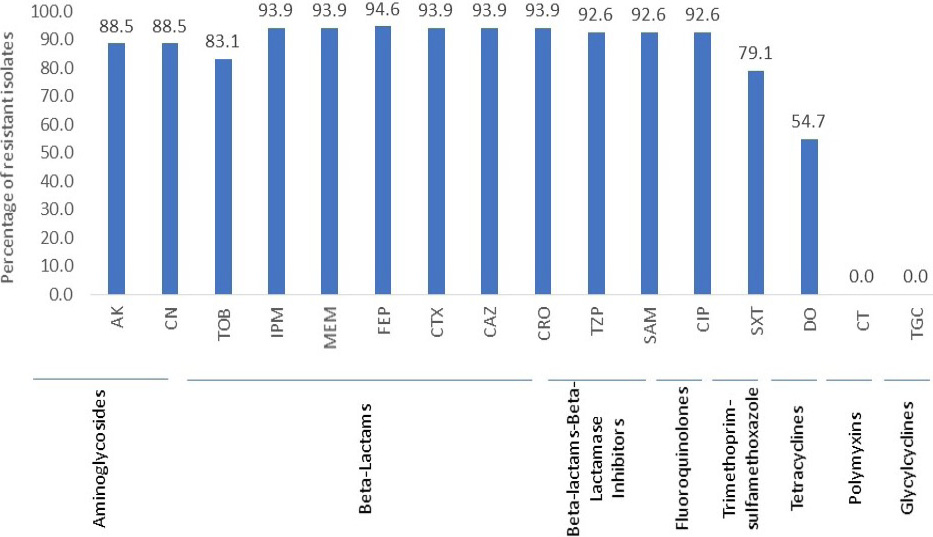
Percentage resistance to various antimicrobial agents among 148 A. baumannii isolates. AK, amikacin; CN, gentamicin; TOB, tobramycin; IPM, imipenem; MEM, meropenem; FEP, cefepime; CTX, cefotaxime; CAZ, ceftazidime; CRO, ceftriaxone; TZP, piperacillin-tazobactam; SAM, ampicillin-sulbactam; CIP, ciprofloxacin; SXT, sulfamethoxazole-trimethoprim; CT, colistin; TGC, tigecycline.
References
- Bakour, S., Touati, A., Bachiri, T., Sahli, F., Tiouit, D., Naim, M., Azouaou, M. and Rolain, J.M., 2014. J. Infect. Chemother., 20: 696-701. https://doi.org/10.1016/j.jiac.2014.07.010[CrossRef]
- Bogaerts, P., Galimand, M., Bauraing, C., Deplano, A., Vanhoof, R., De Mendonca, R., Rodriguez-Villalobos, H., Struelens, M. and Glupczynski, Y., 2007. J. Antimicrob. Chemother., 59: 459-464. https://doi.org/10.1093/jac/dkl527[CrossRef]
- Chen, T.L., Siu, L.K., Wu, R.C., Shaio, M.F., Huang, L.Y., Fung, C.P., Lee, C.M. and Cho, W.L., 2007. Clin. Microbiol. Infect., 13: 801-806. https://doi.org/10.1111/j.1469-0691.2007.01744.x[CrossRef]
- Galimand, M., Courvalin, P. and Lambert, T., 2003. Antimicrob. Agents Chemother., 47: 2565-2571. https://doi.org/10.1128/AAC.47.8.2565-2571.2003[CrossRef]
- Galimand, M., Sabtcheva, S., Courvalin, P. and Lambert, T., 2005. Antimicrob. Agents Chemother., 49: 2949-2953. https://doi.org/10.1128/AAC.49.7.2949-2953.2005[CrossRef]
- Karah, N., Haldorsen, B., Hermansen, N.O., Tveten, Y., Ragnhildstveit, E., Skutlaberg, D.H., Tofteland, S., Sundsfjord, A. and Samuelsen, O., 2011. J. med. Microbiol., 60: 515-521. https://doi.org/10.1099/jmm.0.028340-0[CrossRef]
- Khurshid, M., Rasool, M.H., Ashfaq, U.A., Aslam, B. and Waseem, M., 2017. Future Microbiol., 12: 1261-1269. https://doi.org/10.2217/fmb-2017-0080[CrossRef]
- Khurshid, M., Rasool, M.H., Ashfaq, U.A., Aslam, B., Waseem, M., Ali, M.A., Almatroudi, A., Rasheed, F., Saeed, M., Guo, Q. and Wang, M., 2020. Infect. Drug Resist., 13: 2855-2862. https://doi.org/10.2147/IDR.S260643[CrossRef]
- Krause, K.M., Serio, A.W., Kane, T.R. and Connolly, L.E., 2016. Cold Spring Harb Perspect. Med., 6: a027029. https://doi.org/10.1101/cshperspect.a027029[CrossRef]
- Lee, J.C., Koerten, H., van den Broek, P., Beekhuizen, H., Wolterbeek, R., van den Barselaar, M., van der Reijden, T., van der Meer, J., van de Gevel, J. and Dijkshoorn, L., 2006. Res. Microbiol., 157: 360-366. https://doi.org/10.1016/j.resmic.2005.09.011[CrossRef]
- Nie, L., Lv, Y., Yuan, M., Hu, X., Nie, T., Yang, X., Li, G., Pang, J., Zhang, J., Li, C., Wang, X. and You, X., 2014. Acta Pharm. Sin. B, 4: 295-300. https://doi.org/10.1016/j.apsb.2014.06.004[CrossRef]
- Sohail, M., Rashid, A., Aslam, B., Waseem, M., Shahid, M., Akram, M., Khurshid, M. and Rasool, M.H., 2016. Rev. Soc. Bras. Med. Trop., 49: 300-304. https://doi.org/10.1590/0037-8682-0111-2016[CrossRef]
- Sung, J.Y., Kwon, K.C., Cho, H.H. and Koo, S.H., 2011. Korean J. Lab. Med., 31: 265-270. https://doi.org/10.3343/kjlm.2011.31.4.265[CrossRef]
- Tada, T., Miyoshi-Akiyama, T., Kato, Y., Ohmagari, N., Takeshita, N., Hung, N.V., Phuong, D.M., Thu, T.A., Binh, N.G., Anh, N.Q., Nga, T.T., Truong, P.H., Xuan, P.T., Thule, T.A., Son, N.T. and Kirikae, T., 2013. BMC Infect. Dis., 13: 251. https://doi.org/10.1186/1471-2334-13-251[CrossRef]
- Wang, Y., Shen, M., Yang, J., Dai, M., Chang, Y., Zhang, C., Luan, G., Ling, B. and Jia, X., 2016. Exp. Ther. Med., 12: 3642-3652. https://doi.org/10.3892/etm.2016.3828[CrossRef]
Services
Article usage statistics
Loading…