
Food spoilage is a complex process in which food deteriorates to that extent at which it becomes unfit for human consumption. Food spoilage due to microorganisms is a serious issue which causes approximately 25% food loss globally Present study revealed the effects of storage temperature associated with bacterial spoilage of fish meat. A total 24 samples were procured during three different seasons from local retail shops (n=12) and supermarket (n=12) in order to observe the bacteria which are associated with meat spoilage. Total viable count of aerobic psychrophilic, mesophilic and thermophilic bacteria was performed through selective enrichment and culturing of samples to determine the diversity of bacteria. Staphylococcus aureus (42%), Enterococcus faecium (54%), Salmonella sp. (38%), Bacillus sp. (71%), and Moraxella sp. (63%)were isolated from the samples collected from two different managemental systems. Statistical analysis revealed that temperature and seasonal variations alongside storage conditions affect not only the shelf-life of fish meat but also increase the spoilage microbiota population, hence, altering the quality profile of meat. Therefore, we can conclude that storage temperature is a crucial factor in determining the quality of fish meat.
Short Communication · Volume 53, Issue 4, 8 June 2021 · Open Access
Effects of Storage Temperature on the Microbiological Quality of Fish Meat from Two Different Managemental Systems
· · · · · ·
Affiliations & Notes ⌄
- 1University Diagnostic Laboratory, University of Veterinary and Animal Sciences, Lahore 2Quality Operations Laboratory, University of Veterinary and Animal Sciences, Lahore 3Department of Microbiology, University of Veterinary and Animal Sciences, Lahore * Corresponding author: durrani042@gmail.com
- 22017-phd-1002@uvas.edu.pk
Article Info ⌄
- Journal:
- Pakistan Journal of Zoology
- Published:
- 8 June 2021

From the article
- Bacterial spoilage of fish meat was recorded in samples procured from two different managemental systems.
- The poorest quality was observed during summer season, where 65% of the fish were found unacceptable for consumption.
- Moreover, total bacterial counts were significantly high at P < 0.05 in fish samples procured during summer season.
- Hence, we can conclude that maintaining storage temperature is crucial feature in keeping the quality of fish meat.
Selected from the article's own text.
Abstract
Materials and methods
Samples (n=24) of freshwater carp Labeo rohita were procured from local market and supermarket of Lahore, Pakistan to study the effect of storage temperature and duration of storage on the microbiological profile affecting its shelf-life of fish meat. The temperature of the fish samples was recorded with the help of digital thermometer prior sampling to mimic the onsite storage temperature during transportation as well as storage up to 8 h. Samples were collected around 6 a.m. afterwards, transported as whole un-gutted fish in sterile (UV-irradiated) zip-lock bags to University Diagnostic Laboratory (Bacteriology section), University of Veterinary and Animal Sciences (UVAS), Lahore in ice packed insulated boxes.
Samples were collected from both managemental systems in spring, summer and winter season to observe the effects of seasonal variations on the viable bacterial load. Each sampling (spring (March-April)/summer (August-September)/winter (November-December)) was comprised of 4 whole un-gutted fish from each system. The temperature range varied in the local market from 18oC, 27oC and 9oC in spring, summer and winter seasons, respectively, at the time of sample collection. While the supermarket maintained its temperatures up to 1oC owing the availability of fishery chillers.
To remove any external debris, the exterior of the fish was rinsed with sterile distilled water. Evisceration was carried out with sterile equipment to avoid contamination samples. Afterwards samples were further processed for bacterial isolation. A 25g portion of interior flesh content was taken aseptically and processed for bacteriological analysis.
Samples were homogenized in 225ml of sterile physiological saline NaCl 0.85% (w/v) and were serially diluted. Samples were inoculated on general purpose media and selective media to perform culturing and isolation of selective bacteria. After inoculation, the bacterial colonies isolated from samples were subjected to bacteriological characterization procedures. The presumed colonies were first determined on selective media, while further identification was carried out using morphological and biochemical methods. All media used were from Oxoid Ltd, UK. The plates were incubated aerobically at 4oC for 7 days, 37oC and 45oC for 24 h for mesophiles and psychrophiles, respectively.
Following homogenization, the samples for aerobic psychrophilic (AP), aerobic mesophilic (AM) and thermophilic count were serially diluted and cultured using pour agar-overlay method on all-purpose medium (Nutrient Agar, Oxoid, UK). Readings from total viable count (TVC) was determined after every two h up to eight h to determine the effect of storage duration on viable load. After spreading, the plates were incubated at 4oC for 7 days, 37oC and 45oC for 24 h for mesophiles and psychrophiles, respectively.
Salmonella spp. was determined according to the method of Andrews and Hammack (2014). Detection of S. aureus was performed following the method of Cappuccino and Sherman (2007). Enterococcus faecium was determined according to method of Cappuccino and Sherman (2007). Moraxella spp. were subjected to culturing on blood and chocolate agar, given the aerobic incubation for 24 h at 30-37oC with conventional biochemical tests like catalase test, oxidase test, urease and hydrogen sulfide activity was also carried out. Sugar fermentation (glucose, sucrose, maltose and lactose) was also performed.
The significance of differences between means (P< 0.05) total viable count, seasonal variations and storage temperature were analyzed using one way analysis of variance (ANOVA).
Results and discussion
Microbiological quality of the samples was observed to be affected in all three seasons. The effects of temperature variations in different seasons on the total viable count were recorded up to 8 h of storage. Bacterial spoilage of fish meat was recorded in samples procured from two different managemental systems. Both systems were having different hygienic status, which in turns affects the bacterial load in the meat. Fish samples were analyzed for total viable count (TVC) for aerobic psychrophilic, mesophilic and thermophilic bacteria. The microbiological quality of samples varied between all three seasons regarding total counts of aerobic psychrophilic, mesophilic and thermophilic bacteria (Fig. 1). The poorest quality was observed during summer season, where 65% of the fish were found unacceptable for consumption. While for the spring and winter seasons it was recorded as 53% and 43%, respectively. Moreover, total bacterial counts were significantly high at P < 0.05 in fish samples procured during summer season.
Similar observations were reported by Popovic et al. (2010) showed that the microbiological quality of individual samples varied widely between different fish species and also between winter and summer seasons regarding total counts of aerobic mesophilic and psychrophilic bacteria. The poorest quality was for fish samples, where 66.6 per cent of fresh and frozen fish were found unacceptable by Croatian standards.
The Salmonella spp. isolates enriched in selenite cysteine broth showed brick red turbid appearance due to reduction of selenite. The colonies on Salmonella Shigella (S.S) agar displayed smooth translucent black colonies within due time of 48-72 h. Colonies on XLD were bright pink with black centers. IMViC test resulted positive for Indole, Methyl red and citrate utilization while negative for Voges Proskauer. Catalase was recorded positive while oxidase was negative for the isolates. Gram staining revealed typical gram negative pinkish red rods.
S. aureus was selectively enriched in BHI broth and raised medium to large slightly translucent or creamy colonies with clear zone of hemolysis was observed on 5% sheep blood agar. Golden brown pinhead and yellow colonies with fermentation of mannitol were seen on trypticase soy agar and mannitol salt agar, respectively. Purple stained grape like clusters were observed in microscopy after gram staining. The isolates were catalase and coagulase positive.
Samples processed for E. faecium were enriched in trypticase soy broth with 6.5% NaCl for purification of enterococci from streptococci. The isolates gave esculin hydrolysis in the presence of bile salts showed blackening on bile esculin azide agar which does not permit the growth of gram negative bacteria. The isolates were further tested for the arabinose fermentation on cephalexin aztreonam arabinose agar to distinguish between E. faecium and E. faecalis. Gram positive (purple-stained) diplococci were observed microscopically which turned out to be catalase negative and oxidase positive.
Active spoilers involved B. cereus which was enriched in BHI broth (1% maltose and 10IU polymyxin B/ml). Followed by streaking on MYP agar the plates were observed for typical colonies that appeared as dry, flat and white colonies surrounded by wide opaque zone. Conventional biochemical tests resulted in a positive catalase and citrate test while recorded negative for oxidase test and gelatin hydrolysis. Gram staining revealed typical gram positive rods stained purple.
Given the aerobic incubation for 24 h, Moraxella spp. revealed grey-white, waxy and crumbled appearance with no hemolysis on blood agar. Gram staining showed gram negative short rods and coccobacilli. Conventional biochemical tests which resulted in positive catalase and oxidase test. No hydrogen sulfide and urease production was recorded. Ability to ferment glucose, sucrose, maltose and lactose was not recorded.
In vitro assay during present work revealed that the samples were primarily contaminated by bacterial pathogens like Salmonella spp., S. aureus that are capable of causing gastrointestinal illnesses. Others included the not so classic food-borne organism E. faecium (but is associated with foodborne outbreaks) as well as active spoilers like Bacillus cereus and Moraxella spp. as at chilled temperatures. Incidence of isolated bacterial species in the samples was found to be Salmonella spp. (38%), S. aureus (42%), E. faecium (54%), Bacillus cereus (71%) and Moraxella spp. (63%). The results are in general agreement with those previously reported by Popovic et al. (2010) proposed that unacceptable Enterobacteriaceae levels were obtained in 40% of the freshwater fish summer samples (Fig. 2).
The conditions at local market for extended time of storage and selling of fishes are not ideal and may prompt to deterioration suggesting that fish should not be stored beyond six hours at ambient temperature. Therefore, hygienic conditions and use of clean water during processing of fish should be practiced. Post-harvest, freshly caught fish should to be appropriately stored at low temperatures to control growth of bacteria.
A similar study by Eze et al. (2011) suggested that aquaculture items can harbor pathogens, which are part of the natural microbiota of the surroundings and bioburden of the fish samples was determined by using agar plate method. S. aureus, E. coli and Lactobacillus plantarum, in particular, were the most commonly occurring pathogens linked to fish. The incidence of S. aureus in fish was credited to the contamination due to non-hygienic handling by workers. This recommends that fish with this pathogen post-harvest must have been infected through management.
Falcao et al. (2002) have suggested that the ice which is used to refrigerate seafood might be contaminated with pathogenic microorganisms and can be a source of infection for humans, as they retrieved the presence of high numbers of coliforms, heterotrophic indicator microorganisms and pathogenic strains from ice that was used for chilling fish and other seafood items. Therefore, some of the contamination detected in the current study could be due to the ice used for chilling purposes.
Conclusion
The current study focuses on aspects of fish spoilage due to bacteria in particular. Temperature variations during three different seasons and storage conditions not only affected the storage life but also the microbiota population that causes spoilage leading to the change in composition and the quality profile. Hence, we can conclude that maintaining storage temperature is crucial feature in keeping the quality of fish meat.
Statement of conflict of interest
The authors have declared no conflict of interests.
Figures
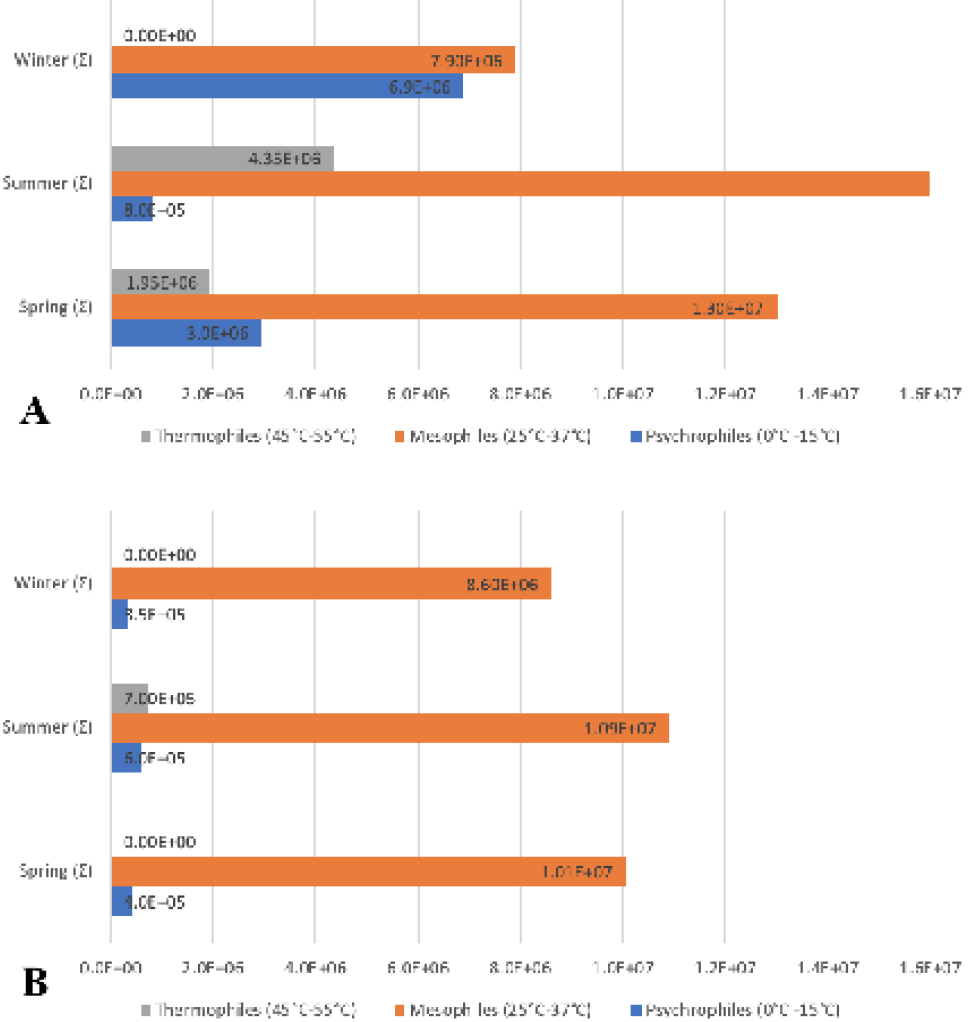
Bacterial pathogens in fish meat samples procured from local market (A) and super market (B).
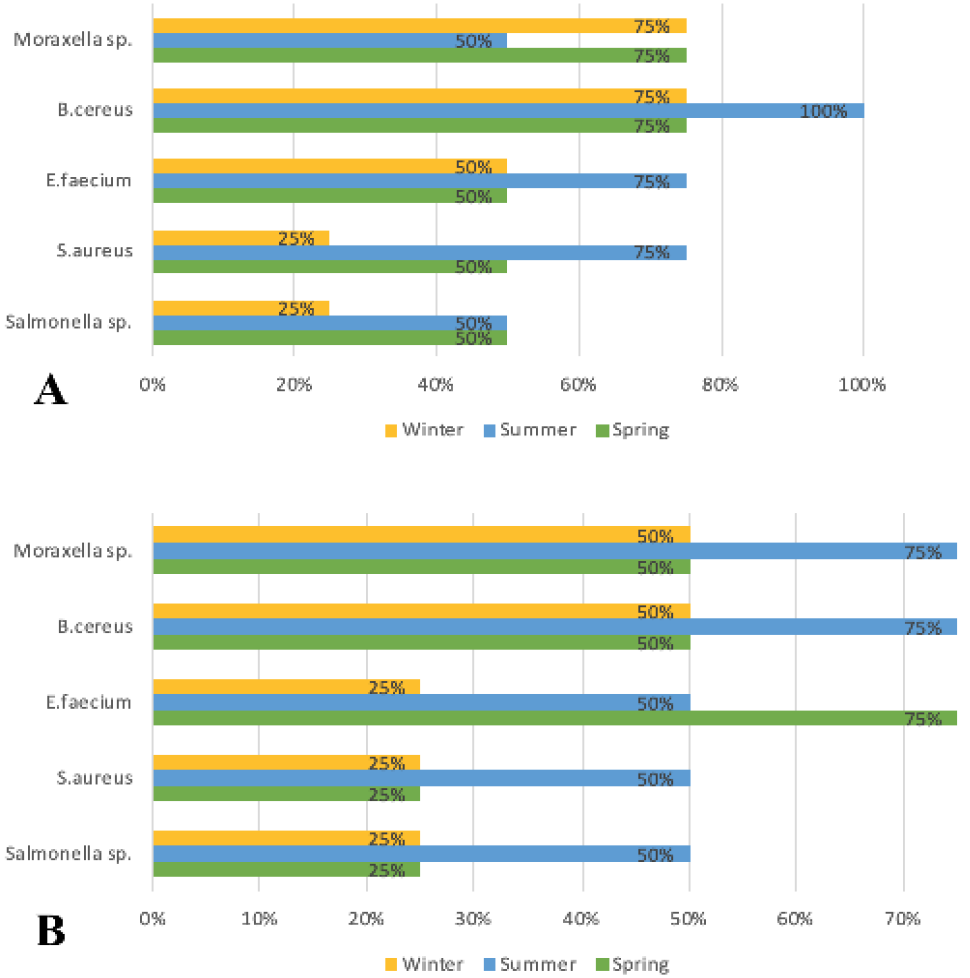
Bacterial pathogens recovered from local fish market samples (A); super market samples (B) (All Seasons).
References
- Andrews, W.H., Wang, H., Jacobson, A. and Hammack, T., 2014. Salmonella. US Food and Drug Administration, Bacteriological analytical manual (BAM), 2011.
- Bekaert, K., Devriese, B.L., Maes, S. and Robbens, J., 2015. Fd. Microbiol., 46: 132-138.
- Bello, O., Bello, T.K. and Bankole, S.A., 2013. J. Adv. Biol., 1: 13.
- Cappuccino, J.G. and Shermann, N., 2007. Microbiology lab manual. USA, Benjamin-Cummings Publishing Company.
- Claussen, I.C., 2011. Proc. Fd. Sci., 1: 1907-1909. https://doi.org/10.1016/j.profoo.2011.09.280[CrossRef]
- Dalgaard, P., Vancanneyt, M., Euras, V.N., Swings, J., Fruekilde, P. and Leisner, J., 2003. J. appl. Microbiol., 94: 80-89.
- Doulgeraki, A.I., Ercolini, D., Villani, F. and Nychas, G-J.E., 2012. J. Fd. Microbiol., 157: 130-141.
- Durmuş, M., Polat, A., ÖZ, M., Ozogul, Y. and Ucak, I., 2014. J. Fd. Nutr. Res., 53: 344-352.
- Eyo, A., 2014. Post-harvest losses in the fisheries of Kainji Lake.
- Eze, E., Echezona, B. and Uzodinma, E., 2011. Afr. J. agric. Res., 6: 1947-1951.
- Falcao, J.F., Dias, A.M.G., Correa, E.F. and Falcão, D.P., 2002. Fd. Microbiol., 19: 269–276. https://doi.org/10.1006/fmic.2002.0490[CrossRef]
- Fukui, Y., Yoshida, M., Shozen, K., Funatsu, Y., Takano, T., Oikawa, H., Yano, Y. and Satomi, M., 2012. J. Gen. appl. Microbiol., 58: 273-281. https://doi.org/10.2323/jgam.58.273[CrossRef]
- Ganguly, S. and Prasad, A., 2012. Rev. Fish Biol. Fish., 22: 11-16. https://doi.org/10.1007/s11160-011-9214-x[CrossRef]
- Gopalakrishnan, S., Sasidharan, V., Sunder, J., Mudavath, M. and Kumar, R., 2016. Adv. Anim. Vet. Sci., 4: 468-475. https://doi.org/10.14737/journal.aavs/2016/4.9.468.475[Full text][CrossRef]
- Gram, L. and Dalgaard, P., 2003. Int. J. Fd. Microbiol., 4: 65-72.
- Jan, A., Hasan, Z., Shah, H., Ullah, R., Ahmad, I. and Younas, M., 2014. Pakistan J. Zool., 46: 1371-1375.
- Mahboob, S., Ahmad, L., Sultana, S., Alghanim, K., Al-Misned, F. and Ahmad, Z., 2014. J. Biochem. mol. Toxicol., 28: 137-142. https://doi.org/10.1002/jbt.21545[CrossRef]
- Popovic, N.T., Benussi, S.A., Dzidara, P., Coz-Rakovac, R., Strunjak-Perovic, I., Kozacinski, L., Jadan, M. and Brlek-Gorski, D., 2010. Vet. Med., 55: 233-241.
- Yeni, F., Acar, S., Polat, Ö., Soyer, Y. and Alpas, H., 2014. Fd. Cont., 40: 359-367. https://doi.org/10.1016/j.foodcont.2013.12.020[CrossRef]
- Zhou, G., Xu, X. and Liu, Y., 2010. Meat Sci., 86: 119-128. https://doi.org/10.1016/j.meatsci.2010.04.033[CrossRef]
Services
Article usage statistics
Loading…