
To study the effect of Perilla frutescens (Perilla) seeds on the polyunsaturated fatty acid in egg yolk. Three groups, each of 40 healthy Gallus domesticuss 26 weeks old, were fed 6, 10 and 15% of perilla seeds in addition to daily basic ration.. The control group (CK) of 40 birds was fed basic daily ration. The polyunsaturated fatty acid (PUFA) content and the ratio of n-6/n-3 PUFA in yolk were determined by gas chromatography with 24 eggs randomly selected from each group on the 10th, 25th and 40th day after start of the treatment. The results showed that on 10th, 25th and 40th day, the contents of α-linolenic acid (ALA, C18:3n3) and docosahexaenoic acid (DHA, C22:6n3) were significantly increased in yolk of 6% and 15% seed group (P < 0.05). On 25th day, the contents of γ-linolenic acid (C18:3n6) in yolk of 10% and 15% seed groups were much lower than those of the CK (P < 0.05) and the contents of arachidonic acid (C20:4n6) in yolk of 6% and 10% were much lower than those of the CK (P < 0.05). The ratio of n-6/n-3 PUFA in yolk of all experimental groups were significantly lower than that of the CK (P < 0.05). This study provides theoretical basis for the scientific production of functional eggs rich in DHA and ALA.
Research Article · Volume 54, Issue 1, 20 November 2021 · Open Access
Effects of Dietary Addition of Perilla frutescens Seeds on the Content of Polyunsaturated Fatty Acids in Egg Yolk of Gallus domesticus
· · · · ·
Affiliations & Notes ⌄
- 1Tianjin Key Laboratory of Agricultural Animal Breeding and Healthy Husbandry, College of Animal Science and Veterinary Medicine, Tianjin Agricultural University, Tianjin 300384, China , * Corresponding author: yuxiaoxue1990@163.com
- 2anliuli2003@163.com
Article Info ⌄
- Journal:
- Pakistan Journal of Zoology
- Published:
- 20 November 2021

From the article
- The contents of docosahexaenoic acid (DHA, C22:6n3) in yolk of the P1, P2 and P3 were clearly higher than those of the CK on the 10th, 25th and 40th days (P < 0.05).
- The results showed that the content of ALA and DHA increased more and reached significant difference level (P < 0.05), and the contents of ALA and DHA in yolk of the test groups increase by multiple.
- In conclusion, the contents of DHA and ALA in yolk were significantly increased by adding certain levels of perilla seeds in daily ration, and the ratio of n-6/n-3 PUFA in yolk was significantly decreased.
Selected from the article's own text.
Abstract
Introduction
The main characteristics of polyunsaturated fatty acids (PUFA): straight chain, containing two or more double bonds, 18-22 carbon atoms. Generally, n-3PUFA series and n-6p PUFA series are divided according to the position of the carbon atom of the farthest double bond of carboxyl group ; . The n-3 PUFA series contain C18:3n3, C20:3n3, C20:5n3, and C22:6n3. The n-6 PUFA series include C18:2n6, C18:3n6, C20:3n6, and C20:4n6 .
Some studies show that when the intake of n-3PUFA and n-6PUFA is in a certain range, n-3PUFA can effectively prevent many kinds of diseases, such as cancer (breast cancer, prostate cancer and colorectal cancer), obesity, apoplexy, inflammation, diabetes, coronary heart disease, nervous system disease, etc., by reducing the malignant degree of tumor, increasing insulin signal transduction and enhancing immune response and many other ways ; ; ; . The n-6 PUFA has the function of preventing type II diabetes mellitus, atherosclerosis and myocardial infarction ; ; , etc. Perilla frutescens, also called Perilla, native from Southeast Asia, is a food and traditional medicine, its seeds can be used for producting edible oils. It has been shown that some plant seeds or fruits, such as perilla (Perilla frutescens) seeds, flax seeds, nuts, etc., are rich in C18:3n3 that is relatively cheap and has a wide range of sources. Enzymes of cis double chain inserted into the fatty acid n-6 or n-3 in poultry can convert C18:3n3 into long chain n-3PUFA b; ; ; .
Up till now, there have been few reports on the effect of adding perilla seeds in daily ration on polyunsaturated fatty acid deposition in eggs of local varieties. The purpose of this experiment is to study the effect of different perilla seeds in the diet on the content of polyunsaturated fatty acids in the yolk of Gallus domesticus, and to provide scientific theoretical basis for animal husbandry production of functional eggs rich in docosahexaenoic acid (DHA, C22:6n3) and γ-linolenic acid (ALA, C18:3n3).
Materials and methods
Animals and experimental design
The experiment was conducted from May to June 2018 at the breeding base of Tianjin Jinwa Agricultural Science and Technology Development (Tianjin) Co., Ltd. Randomized selection of 160 26-week-old, healthy Gallus domesticus were randomly divided into 4 groups, each containing 40 chickens, which were raised outdoors with feed and potable water ad libitum. The control group (CK) was fed basic daily ration (Table I), while the test group with additional 6%, 10% and 15% of perilla seeds (P1, P2 and P3). The details of main reagents and instruments used in this study are listed in Supplementary Table I.
Table I.- Composition of basic daily ration.
| Main raw material | Content (%) |
| Maize | 72.5 |
| Bean pulp | 20 |
| Emulsification equilibrium oil powders1 | 2.5 |
| Premix2 | 5.0 |
1Main raw materials: palm oil, soybean oil, soybean phospholipid oil and other vegetable oils; puffed corn; glucose; dextrin; 2Premix for each kilogram of daily ration including: vitamin A 30000 IU, vitamin B1 20 mg, vitamin B2 40 mg, vitamin B6 60 mg, vitamin D3 800 IU, vitamin E 20 mg, vitamin K3 400 mg, iron 0.7 g, copper 0.008 g, manganese 0.3 g, zinc 0.8 g, iodine 2 mg, selenium 2 mg, calcium 5.1%, choline chloride 7 g, sodium chloride 1.8%, methionine 2%, phosphorus 1.5%, and water 10%.
Sample collection and methodology
Before and after the 10th, 25th and 40th days, 24 eggs were randomly selected from each group and stored at 4°C for later use, 24 eggs were used to detect the fatty acids.
Sample pre-treatment was performed with reference to GB5009.168-2016 (National Health and Family Planning Commission of the People’s Republic of China, 2017). The gas phase conditions for measurement were shown in Supplementary Table II.
Data analysis
SPSS 20.0 was used and one-way ANOVE and Duncan’D analysis was applied to conduct multiple comparison of the mean values and the significance test. All the data were expressed by mean ± standard deviation with P < 0.05 for significant difference.
Results
Figure 1A shows that the content of linoleic acid (LA, 18:2n6c) in the yolk of P1, P2 and P3 were not significantly different from that of the CK (P > 0.05) on the 10th, 25th and 40th day. The LA content of in the yolk of the P1 and P3 were higher than that of the CK at the 10th and 40th days.
Figure 1B shows that the contents of α-linolenic acid (ALA, C18:3n3,) in yolk of the test groups that added 3 different levels of perilla seeds in daily ration were clearly higher than those of the CK (P < 0.05) on the 10th, 25th and 40th days.
The contents of γ-linolenic acid (GLA, C18:3n6,) in yolk of the test groups were lower than that of the CK on the 10th, 25th and 40th days (Fig. 1C). On the 25th day, GLA in P2 and P3 yolks decreased significantly (P < 0.05).
Figure 1D shows that the contents of dihomo-γ-linolenic acid (DHGLA, C20:3n6) in yolk of P1, P2 and P3 and the CK were not clearly different (P > 0.05) within the 3 test periods.
From Figure 1E it can be seen that, on the 25th day, the content of arachidonic acid (ARA, C20:4n6,) in P1 and P2 was significantly lower than that in CK (P < 0.05). On the 40th day, the content of ARA in P1, P2 and P3 were all lower than that of the CK (P > 0.05).
The contents of docosahexaenoic acid (DHA, C22:6n3) in yolk of the P1, P2 and P3 were clearly higher than those of the CK on the 10th, 25th and 40th days (P < 0.05). On the 25th day, the content of DHA in yolk of the P3 was the highest, reaching 0.688g/100g (Fig. 1F).
The ratio of n-6/n-3 PUFA in yolk of the P1, P2 and P3 were significantly lower than that of the CK during the whole test period (P < 0.05) (Fig. 1G).
Discussion
DHA has many effects such as anti-inflammation, anti-cancer, improving immune function, promoting the development of brain nerve and optic nerve ; ; ; . ALA is the precursor of long chain fatty acid, which can be transformed into DHA with metabolism in vivo, and has the functions of improving the eyesight and brain, reducing blood fat and delaying senility . With the perilla seeds rich in ALA and DHA added into the daily ration of laying hens, the content of ALA and DHA in eggs was significantly increased , and the production of eggs rich in n-3PUFA could be achieved with perilla seeds instead of flax seeds. Bruneel et al. (2013) showed that the content of DHA in yolk increased significantly with the addition of a certain amount of microalgae in daily ration, while the content of ALA did not change much. Neijat et al. (2016) added hemp seeds and hemp seed oil in daily ration of laying hens, and had found that the content of ALA in eggs increased linearly and the content of DHA increased quadratically. The results showed that the content of ALA and DHA increased more and reached significant difference level (P < 0.05), and the contents of ALA and DHA in yolk of the test groups increase by multiple. The results are implying that adding a certain amount of perilla seeds in the daily ration could produce functional eggs enriched with DHA and ALA.
Four kinds of n-6 PUFA, i.e. LA, GLA, DHGLA and ARA were detected in this test. With the addition of three different levels of perilla seeds in daily ration, the content of LA in yolk of test group was higher, the difference is not very large. The reason was that the LA rich in perilla seeds could be deposited in yolk due to the ingestion of Gallus domesticus; the content of GLA in yolk of the P1, P2 and P3 was all lower than that of the CK. On the 25th day, compared with CK, GLA in the yolk of the P2 and P3 was significantly lower (P < 0.05). The reason might be that both LA and ALA in vivo need to be catalyzed by delta-6 desaturase to produce GLA and C18:4n3 separately, and delta-6 desaturase is more easily combined with ALA. In the high concentration perilla seeds group, there was a large amount of ALA, therefore, there was less delta-6 desaturase combined with LA, leading to much lower yield of GLA in the P1, P2 and P3 than that in the CK . The main fatty acid of the n-6PUFA series in yolk is ALA. It has been found that LA in vivo can be metabolized into arachidonic acid and plays an key role in the inflammatory process for the reason that they can act as substrates of the inflammatory active substance of eicosanoids, leading to the production of inflammatory mediators that has certain adjustment effect of the inflammatory reaction ; . Studies have shown that not only DHA but also ARA are needed to ensure the regular growth of mice ; . In this experiment, the content of ARA was decreased in the test groups. The reason was that the sufficient perilla seeds added in the daily ration increased the content of C18:3n3 with more than 2.3%, which inhibited the synthesis of ARA so as to have reduced the content of ARA in the yolk .
The appropriate ratio of n-6/n-3 PUFA is 4~6:1, 4:1, and 5~10:1 (Chinese Nutrition Society, 2000; . Studies have shown that there is a general lack of n-3 PUFA in Chinese and Western daily rations, while n-6 PUFA is abundant, which results in n-6/n-3 PUFA higher than the recommended standard. In addition, there is a certain synergistic and limiting effect between n-3 PUFA and n-6 PUFA. Therefore, it is considered that the intake of n-6 PUFA or n-3 PUFA alone will cause some disadvantages. Reducing the n-6/n-3 PUFA is more beneficial to the reduction of the incidence of some chronic diseases, and the optimal n-6/n-3 PUFA for patients with different diseases is different ; ; . The result in this test shows that by adding 3 different levels of concentration of perilla in the daily ration, the ratio of n-6/n-3PUFA in yolk could all be clearly decreased to greatly improve the quality of yolk.
Conclusion
In conclusion, the contents of DHA and ALA in yolk were significantly increased by adding certain levels of perilla seeds in daily ration, and the ratio of n-6/n-3 PUFA in yolk was significantly decreased. This study provides theoretical basis for the scientific production of functional eggs rich in DHA and ALA.
Acknowledgements
The study was supported by Tianjin Enterprise Technology Commissioner Project (19JCTPJC59500); the Major Special Scientific and Technological Project and Engineering Project of Tianjin (18ZXBFNC00310) and the “131” Innovative Talent Team Building Project of Tianjin (20180318).
Supplementary material
There is supplementary material associated with this article. Access the material online at: https://dx.doi.org/10.17582/journal.pjz/20200603020604
Statement of conflict of interests
The authors declare no conflict of interest.
Figures
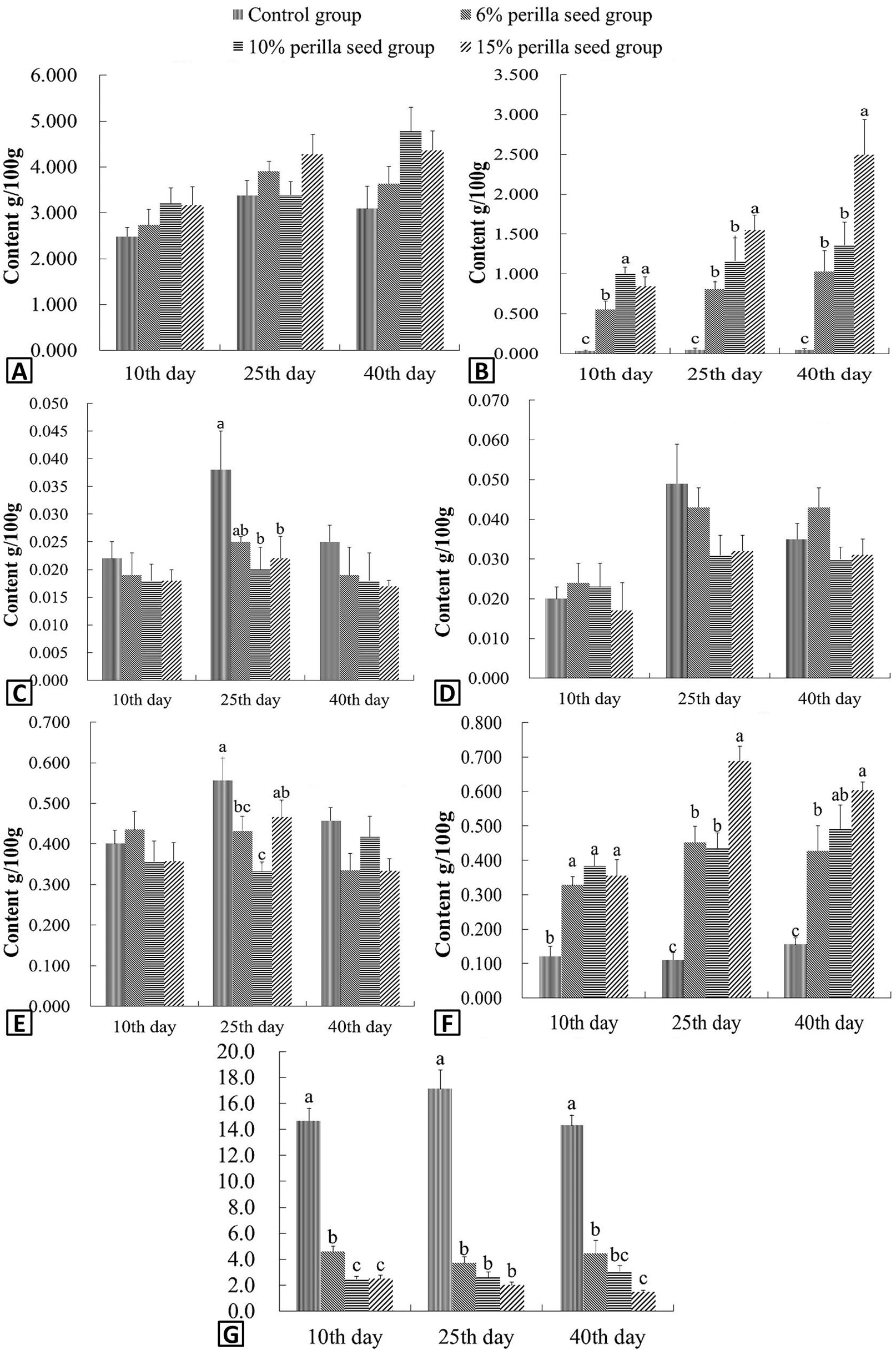
Effect of perilla seeds on the content of linolenic acid (A), α-linolenic acid (B), γ-linolenic acid (C), dihomo-γ-linolenic acid (D), arachidonic acid (E), docosahexaenoic acid (F) and the ratio of n-6/n-3 PUFA (G) in yolk.
References
- Bruneel, C., Lemahieu, C., Fraeye, I., Ryckebosch, E., Muylaertc, K., Buyse, J. and Foubert, I., 2013. Impact of microalgal feed supplementation on omega-3 fatty acid enrichment of hen eggs. J. Funct. Foods, 5: 897-904. https://doi.org/10.1016/j.jff.2013.01.039[CrossRef]
- Burdge, G. and Calder, C., 2005. Conversion of α-linolenic acid to longer-chain polyunsaturated fatty acids in human adults. Reprod. Nutr. Dev., 45: 581-597. https://doi.org/10.1051/rnd:2005047[CrossRef]
- Chinese Nutrition Society, 2000. Chinese dietary reference intakes. China Light Industry Press, China.
- Colombo, J., Jill Shaddy, D., Kerling, E.H., Gustafson, K.M. and Carlson, S.E., 2017. Docosahexaenoic acid (DHA) and arachidonic acid (ARA) balance in developmental outcomes. Prostagl. Leukotrienes Essent. Fat. Acids, 121: 52-56. https://doi.org/10.1016/j.plefa.2017.05.005[CrossRef]
- Devlin, A.M., Chau, C.M.Y., Dyer, R., Matheson, J., McCarthy, D., Yurko-Mauro K., Innis, S.M. and Grunau, R.E., 2017. Developmental outcomes at 24 months of age in toddlers supplemented with arachidonic acid and docosahexaenoic acid, results of a double blind randomized, controlled trial. Nutrients, 9: 975-992. https://doi.org/10.3390/nu9090975[CrossRef]
- Djoussé, L., Pankow, J.S., Eckfeldt, J.H., Folsom, A.R., Hopkins, P.N., Province, M.A., Hong, Y. and Ellison, R.C., 2001. Relation between dietary linolenic acid and coronary artery disease in the national heart, lung, and blood institute family heart study. Am. J. clin. Nutr., 74: 612-619. https://doi.org/10.1093/ajcn/74.5.612[CrossRef]
- Duan, S.H., Li, Z.Q., Fan, Z.Z., Qin, M.R., Yu, X.X. and Li, L.A., 2021a. Effects of dietary addition of linseed oil on the content of polyunsaturated fatty acids in egg yolk of Gallus domestiaus. J. Biobased Mater. Bioen., 15: 565-570. https://doi.org/10.1166/jbmb.2021.2089[CrossRef]
- Duan, S.H., Li, Z.Q., Fan, Z.Z., Qin, M.R., Yu, X.X. and Li, L.A., 2021b. Effect of dietary supplementation of perilla seeds on the monounsaturated fatty acid profile in Gallus domestiaus egg yolk. J. Biobased Mater. Bioen., 15: 231-237. https://doi.org/10.1166/jbmb.2021.2042[CrossRef]
- Grobas, S., Méndez, J., Lázaro, R., Blas, C.D. and Mateos, G.G., 2001. Influence of source and percentage of fat added to diet on performance and fatty acid composition of egg yolks of two strains of laying hens. Poult. Sci., 80: 1171–1179. https://doi.org/10.1093/ps/80.8.1171[CrossRef]
- Guo, P.B., Si, M.j., Wu, D., Xue, H.Y., Hu, W.H. and Wong, H.L., 2020. Incorporation of docosahexaenoic acid (DHA) enhances nanodelivery of antiretroviral across the blood-brain barrier for treatment of HIV reservoir in brain. J. Contr. Release, 328: 696-709. https://doi.org/10.1016/j.jconrel.2020.09.050[CrossRef]
- Harauma, A., Yasuda, H., Hatanaka, E., Nakamura, M.T., Salem, N. and Moriguchi, T., 2017. The essentiality of arachidonic acid in addition to docosahexaenoic acid for brain growth and function. Prostagl., Leukotr. Essent. Fatty Acids, 116: 9-18. https://doi.org/10.1016/j.plefa.2016.11.002[CrossRef]
- Hayashi, S., Satoh, Y., Ogasawara, Y. and Dairi, T., 2020. Recent advances in functional analysis of polyunsaturated fatty acid synthases. Curr. Opin. chem. Biol., 59: 30-36. https://doi.org/10.1016/j.cbpa.2020.04.015[CrossRef]
- Hayashi, Y., Yokomizo, Y., Yoko, F. and Lkuyo, L., 2020. The effect of polyunsaturated fatty acid deficiency on allergic response in ovalbumin-immunized mice. Prostagl., Leukotr. Essent. Fat. Acids, 164: 102231. https://doi.org/10.1016/j.plefa.2020.102231[CrossRef]
- Horrocks, L.A. and Yeo, Y.K., 1999. Health benefits of docosahexaenoic acid (DHA). Pharmacol. Res., 40: 211-225. https://doi.org/10.1006/phrs.1999.0495[CrossRef]
- Jessie, B., Nakamura, M.T. and Ma, D.W.L., 2018. Differentiating the biological effects of linoleic acid from arachidonic acid in health and disease. Prostagl., Leukotr. Essent. Fat.Acids, 135: 1–4. https://doi.org/10.1016/j.plefa.2018.05.004[CrossRef]
- Jin, G., Li, J., Qi, Y. and Yang, Y., 2018. Study on the source and physiological function of polyunsaturated fatty acids. Feed Rev., 312: 23-25.
- Liu, Z.S., Jiang, Y. and Chen, F., 2016. Roles of arachidonic acid, docosahexaenoic acid and eicosapentaenoic acid in infiammation. J. Fd. Safe. Qual., 7: 3890-3899.
- Long, S., Wang, H., Wu, S.G., Qi, G.H., Zhang, H.J. and Wang, J., 2017. Biological functions and mechanisms of docosahexaenoic acid and its application in poultry production. Chin. J. Anim. Nutri., 29: 1101-1109.
- National Health and Family Planning Commission of the People’s Republic of China, 2017. National food safety standard determination of fatty acids in food: GB5009.168-2016. China Standard Press, Beijing, pp. 3-4.
- Neijat, M., Suh, M., Neufeld, J. and House, J.D., 2016. Increasing levels of dietary hempseed products leads to differential responses in the fatty acid profiles of egg yolk, liver and plasma of laying hens. Lipids, 51: 615-633. https://doi.org/10.1007/s11745-016-4146-9[CrossRef]
- Pan, Y., 2016. Study the efficiency of the α-linolenic acid absorption and bioconversion into long chain polyunsaturated fatty acids in vivo and in vitro. PhD thesis, Jiangnan University, Wuxi, China.
- Salmerón, J., Hu, F.B., Manson, J.A.E., Stampfer, M.J., Colditz, G.A., Rimm, E.B. and Willett, W.C., 2001. Dietary fat intake and risk of type 2 diabetes in women. Am. J. clin. Nutr., 73: 1019-1026. https://doi.org/10.1093/ajcn/73.6.1019[CrossRef]
- Sampath, H. and Ntambi, J.M., 2004. Polyunsaturated fatty acid regulation of gene expression. Nutr. Rev., 62: 333-339. https://doi.org/10.1111/j.1753-4887.2004.tb00058.x[CrossRef]
- Simopoulos, A.P., 2008. The importance of the omega-6/omega-3 fatty acid ratio in cardiovascular disease and other chronic diseases. Exp. Biol. Med., 233: 674-688. https://doi.org/10.3181/0711-MR-311[CrossRef]
- Story, M.J., 2021. Zinc, ω-3 polyunsaturated fatty acids and vitamin D: An essential combination for prevention and treatment of cancers. Biochimie, 181: 100–122. https://doi.org/10.1016/j.biochi.2020.11.019[CrossRef]
- Sugano, M. and Hirahara, F., 2000. Polyunsaturated fatty acids in the food chain in Japan. Am. J. clin. Nutri., 71: 189-196. https://doi.org/10.1093/ajcn/71.1.189S[CrossRef]
- Szczuko, M., Kikut, J., Komorniak, N., Bilicki, J., Celewicz, Z. and Zietek, M., 2020. The role of arachidonic and linoleic acid derivatives in pathological pregnancies and the human reproduction process. Int. J. mol. Sci., 21: 9628-9647. https://doi.org/10.3390/ijms21249628[CrossRef]
- Wang, D.D., 2018. Dietary n-6 polyunsaturated fatty acids and cardiovascular disease: Epidemiologic evidence. Prostagl. Leukotr. Essent. Fat. Acids, 135: 5-9. https://doi.org/10.1016/j.plefa.2018.05.003[CrossRef]
- Wen, M., Zhao, Y.C., Shi, H.H., Wang, C.C., Zhang, T.T., Wang, Y.M. and Xue, C.H., 2021. Short-term supplementation of DHA as phospholipids rather than triglycerides improve cognitive deficits induced by maternal omega-3 PUFA deficiency during the late postnatal stage. Fd. Funct., 12: 564-572. https://doi.org/10.1039/D0FO02552F[CrossRef]
- Wu, Y.B., Li, L., Wen, Z.G., Yang, P.L. and Yan, H.J., 2018. Research progress on metabolism and physiological function of very-long-chain polyunsaturated fatty acids in animals. Chin. J. Anim. Sci., 54: 20-26.
- Yang, R., 2015. The effects of GABA DHA ALA on performance and egg quality of laying hens. PhD thesis, YanBian University, Yanji, China.
- Zhang, P.P., Tang, C.Q., Ding, Z.Q., Huang, H. and Sun, Y., 2017. Effects of simultaneous supplementation of laying hens with alpha-linolenic acid and eicosapentaenoic acid/docosahexaenoic acid resources on egg quality and n-3 fatty acid profile. Asian-Austral. J. Anim. Sci., 30: 973-978. https://doi.org/10.5713/ajas.15.0850[CrossRef]
Supplementary material
Services
Article usage statistics
Loading…