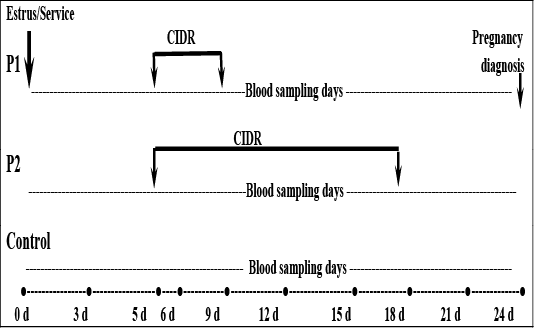
The current study aimed to improve pregnancy rate of repeat-breeder Egyptian buffaloes by using CIDR treatment at different intervals post-mating. In repeat breeder dairy-cows, various CIDR protocols could be used to improve pregnancy rate (Ghasemzaeh-Nava et al., 2007) and improve the fertility of repeat breeder Iraqi buffaloes (Azawi et al., 2012). To avoid long calving intervals, culling rate, and decrease of milk production due to subjecting buffaloes to ≥3 services/animal, animals in our study were administrated with supplemental P4 (CIDR) at two different intervals post-mating of P1 (day 5-9) and P2 (day 5-18) in repeat breeder buffalo cows and heifers. In our study, all experimental buffalo cows were without reproductive disorders (dystocia, retained placenta, endometritis) at the previous season, and buffalo heifers were healthy with proper LBW and cyclic, but all experimental animals failed to conceived after three conductive mating cases.
In our study, we improved overall PR of cows and heifers from 13.3% (2/15) in repeat breeder Egyptian buffaloes to 56.7% (17/30), being higher (P<0.05) in P2 than P1 (66.7 vs. 46.7%) and in cows than heifers (46.7 vs. 33.3%). In bovine, Mehni et al. (2012) reported that Holstein cows treated with CIDR showed greater PR as compared to untreated animals (56 vs. 25%). Also, CIDR treatment improved PR of dairy cattle from 35 to 48% (Sandra et al. 2007). CIDR treatment on Day 5-12 after insemination was an effective method to improve fertility in repeat breeder cows (Reza et al., 2012). Contrary, Shams-Esfanabad and Shirazi (2006) found that CIDR incursion from 5-19 days after insemination did not improve PR of repeat-breeder cows. In another way, Abo-Farw et al. (2016) in Egyptian buffalo heifers and Attoo et al. (2013) in Indian buffaloes found that PR significantly improved when animals were treated with GnRH on 13-day post-mating as compared to those treated on 0 or 11-day post-mating. PR significantly increased in buffaloes treated with CIDR as compared to controls (40 vs. 0%, Azawi et al., 2012).
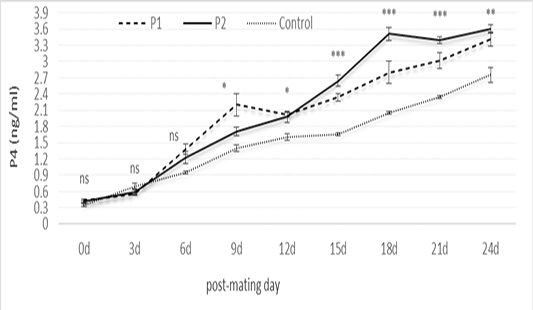
In domestic animals, the formation of complete CL with capacity of progesterone secretion is indicator of early pregnancy (Bulman and Lamming, 1978). Increasing P4 level improve the ability of interferon-τ (IFN) production for pregnancy regulation (Binelli et al., 2001). Also, P4 was reported to suppress the apoptosis in the luteal cells of bovine (Okuda et al., 2004). These findings indicated the possibility of PR improvement by increasing plasma P4 concentrations (Bó et al., 2002). In this respect, Van Cleeff et al. (1996) suggested that increasing P4 concentration could overcome the insensitivity of P4 receptors which may lead to increased PR. In accordance with improving PR in CIDR protocols, Mehni et al. (2012) found that the mean P4 concentration in dairy cattle after CIDR insertion (Day 5-19 after AI) was higher than untreated group. It is of interest to note that P4 concentration of both buffalo cows and heifers was ≥1 ng/ml in P1 and P2 on day 6 post-mating (after CIDR insertion). However, P4 level was < 1 ng/ml in control buffaloes. Colazo et al. (2004) and Muth-Spurlock et al. (2016) mentioned that the surge release of LH and estrus incidence need blood P4 concentration of ≥ 1 ng/ml to avoid the inhibitory mechanism of CIDR device administration. In similarity with the present study, Sandra et al. (2007) observed that the circulating P4 concentrations increased by 0.7 ng⁄ ml in CIDR treatment after AI in comparing the controls.
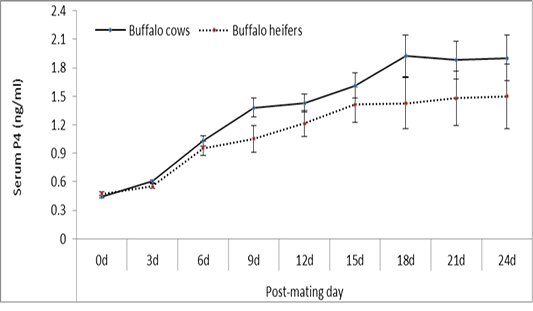
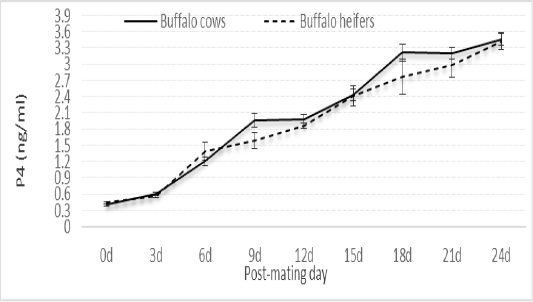
Many authors suggested that the rise of post-mating P4 level also by GnRH, leads to improved PR. In this context, GnRH analogue injection on day 13 post-mating in repeat breeder buffalo cows (Abo-Farw and Ghoneim, 2017) may stimulate the transformation of follicular cells to luteal cells, which was required at least 2 to 3 days for optimum P4 production (Stevenson et al., 1993). Also, Nussara et al. (2008) indicated that the administration of exogenous GnRH in luteal phase post inseminations in dairy cattle resulted in increased serum P4 concentration. This might be beneficial in reducing early embryonic mortality especially in infertile or heat-stressed or repeat breeding cows which might have less P4 concentration after insemination. These findings may indicate the positive effect of CIDR on elevating P4 level in CIDR treatment groups as compared to control ones on different post-mating days. In this respect, Chacher et al. (2017) found an association of blood P4 concentration with conception rate in lactating cows and heifers. In our study, P4 level increased in cows than in heifers on different post-mating days, regardless of CIDR treatment, but the differences in P4 between cows and heifers were not significant. In this way, Takkar et al. (1982) found that the mean P4 concentration of different days of the cycle did not differ significantly between heifers and cows.
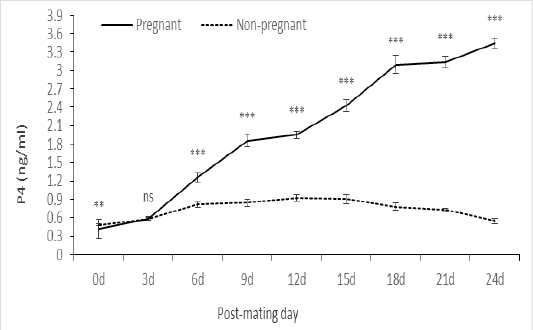
In accordance with the P4 profile on post-mating days for pregnant and non-pregnant animals in our study, Abo-Farw and Ghoneim (2017) reported that overall mean of P4 concentration on Day 23 and 25 post-mating was lower in non-pregnant (0.785±0.158 and 1.314±0.123 ng/ml) than in pregnant (6.679±0.218 and 6.381±0.247 ng/ml) buffaloes. Also, Raj et al. (2016) recorded a greater number of buffaloes became pregnant when P4 concentrations at the time of AI was below the suprabasal level and the pregnancy reduced when the P4 level is between suprabasal and 1 ng/ml. None of the cows become pregnant when the P4 level was more than 1 ng/ml. Mean values of serum P4 at estrus were 0.895±0.134 ng/ml in pregnant and 1.429±0.235 ng/ml in non-pregnant buffaloes. The lowest PR and P4 of controls presented in this study, particularly for buffalo-heifers, may suggest that increased serum P4 level may rise the PR, regardless of CIDR treatment (Mehni et al., 2012). Our results indicated that PR was positively affected by CIDR-treatments having the greatest effect on P4 level on different post-mating days. The CIDR treatment markedly affects serum P4 level and PR, whereas the administration of CIDR during days post-mating (day 5) increased serum P4 level in buffalo cows and heifers.
Generally, P4 is an essential hormone in the maintenance of pregnancy in cows. The higher P4 levels in the early pregnancy are related to the embryonic development and increase in interferon-τ production and PR (Beltman et al., 2009). Animals on day 5, with higher plasma P4 concentrations, had developmentally more advanced and viable embryos (Green et al., 2010). In this context, Leyan et al. (2013) indicated that the benefit of P4 supplementation on the fertility of cows required exogenous P4 supplementation to start between day 3-7 and the appropriate reproductive status of the treated cows. These findings support the observed higher P4 level after CIDR insertion in pregnant than non-pregnant in P1 and P2 in comparing with control, being higher in P2 than in P1. Also, P4 level was higher in pregnant animals in P2 than in P1, being higher than in pregnant control animals. In our study CIDR insertion from Day 5 to 9 post-mating resulted in lower PR than in those treated with CIDR (Day 5-18). However, CIDR treatment on day 5 until 12 after insemination was effective method to improve fertility in repeat breeder cows due to a direct effect of P4 on fetal development (Reza et al., 2012) and embryo viability (Leroy et al., 2008). The CIDR device improved PR by reducing embryonic losses in dairy heifers (Alnimer, 2009).
Generally, results of this study support the hypothesis that a CIDR device when properly used, on Day 5 to 18 post-mating increased P4 level in the majority of repeat breeder buffaloes within few days after CIDR removal and reduced embryonic losses. Green et al. (2010) discussed the positive effects of P4 on reducing embryonic mortality, stating that P4 concentration on Day 4 and 5 has a positive correlation with interferon-tau (IFN-s) production on Day 16 post-AI. Similarly, Mann and Lamming (2006) reported that P4 treatment at the interval from Day 5 to 9 post-AI increased the production of IFN-s by the embryo. Finally, Leroy et al. (2008) mentioned that early embryonic life is incapable of sub-optimal uterine micro-environment and inadequate CL function with reduced P4.