
Since plant extracts have long been known to be chitin inhibitor and agents for developmental arrest, chitinase genes and genes that are vital for starting the differentiation program of cells at discrete steps during development are major targets for biocide plant extracts. The current study evaluates the in vitro toxic effects of golden piller (Cupressus macrocarpa) and galangal (Alpinia officinarum) against Spodoptera frugiperda Sf9 cell line. Also, changes in gene expression levels of chitinase genes (SFch-1, SFch-2) and fibroblast growth factor receptor gene (SFbtl) were demonstrated. Cell sensitivity assay (MTT) showed that golden piller was more toxic than galangal in cell viability tests and more potent in the cell growth inhibition. The calculated LC50 were 120 µM and 200 µM for golden piller and galangal, respectively. Both plant extracts significantly reduced the gene expression levels of chitinase genes and SFbtl (p<0.05) following 72h of exposure to LC50. This work provides evidence of a viable use of these botanical extracts for pest control as well as highlight the mode of action during the process of chitin formation, degradation and cell proliferation.
Research Article · Volume 53, Issue 5, 25 July 2021 · Open Access
Effect of Extracts of Cupressus macrocarpa and Alpinia officinarum on Expression of Chitinase and FGF Receptor Genes in Spodoptera frugiperda Sf9 Cell Line
· · · ·
Affiliations & Notes ⌄
- 1Department of Entomology, Faculty of Science, Benha University, Benha, 13518, Egypt. 2Department of Biology, Faculty of Science, Jazan University, Jazan, Kingdom of Saudi Arabia. 3Department of Biology, Faculty of Science, University of Tabuk, 71491 Tabuk, Kingdom of Saudi Arabia. 4University of Swabi, Swabi 22621, Khyber Pakhtunkhwa 5Department of Zoology, University of Swabi, Swabi 22621, Khyber Pakhtunkhwa , * Corresponding author: saleemsbs@gmail.com, saleemsbs@uoswabi.edu.pk
Article Info ⌄
- Journal:
- Pakistan Journal of Zoology
- Published:
- 25 July 2021

From the article
- The botanical extracts tested proved to be strong cell growth inhibitor.
- Exposure to LC50 of the tested botanical extracts induced quantifiable effects, resulting in reduction of gene expression after 72h RT-qPCR analysis, showed that transcript levels for SFch-1 and SFch-2 genes were down-regulated.
- Moreover, down-regulation of SFbtl (Fibroblast growth factor receptor gene) was observed after exposure to LC50 of the tested botanical extracts.
- Although statistically significant changes in expression were detected, the levels of down-regulation were low and might indicate another mechanism for the toxicity of these extracts.
Selected from the article's own text.
Abstract
INTRODUCTION
Utilization of manufactured chemical pesticides is the most effective method for insect control in agricultural systems ; . Despite their viability at controlling insects, there is a genuine need to develop esoteric methodologies with lower environmental and non-target impacts . Biopesticides are an important group of naturally occurring, often slow-acting crop protectants that are generally more secure to people and nature than ordinary pesticides, and with insignificant leftover impacts . Biopesticides can be biochemical or microbial. Biochemical pesticides may incorporate plant-derived pesticides (botanicals) that can meddle with the development, feeding, or reproduction of pests or insect pheromones connected for mating interruption .
Over the past decades different industries have exhibited an expanded interest to create in vitro strategies to examine insecticide effects. Such methods are considered recently potential alternatives to conventional animal toxicity tests . They further diminish the requirement for tedious and exorbitant tests performed utilizing live animals or isolated organs .
Spodoptera frugiperda was not found in Asia and was limited to America and some other western countries. In 2019 it is reported in India and it is expected that it will reach and colonize neighbouring countries. It can reach Middle East. So this threat must be taken seriously and preparations should be made to cope with it . The commercially available Sf9 insect cell line derived from pupal ovarian tissue of S. frugiperda was used for in vitro assays to estimate the effect of different insecticides, and to test the effect of fungal metabolites, or the effect of some insect fungi that could be developed as biopesticides. Sf9 cell line was additionally used to contemplate Bacillus thuringiensis poisons and to investigate their mode of action . Botanical pesticides are plant derivatives that repel, inhibit and interfere with physiological activities or destroy pests . Moreover, the production of essential enzymes such as those responsible for moulting often interferes with botanical pesticides, which inhibits growth and development . In general, plant extracts have long been known to be chitin inhibitor and causing developmental arrest . Chitin is one of the most important biopolymers in nature . In insects, it is playing a canonical key role for supporting the cuticles of the epidermis, trachea, peritrophic membrane and lining the gut epithelium as scaffolding material . Insect growth and morphogenesis are strictly dependent on the capability to rebuild chitin containing structures, thus, insects repeatedly produce chitin synthases and Chitodextrinase enzymes in different tissues . Chitin synthesis and degradation requires strict control of the participating enzymes during development. All insect chitinases belonging to family 18 glycosylhydrolases have been detected in moulting fluid and gut tissues, furthermore, anticipated to the digestion of chitin present in the exoskeleton and peritrophic membrane in the gut to chitooligosaccharides . Insect’s chitinases homologues genes have been characterized and described from several insects including lepidopteran species ; ; ; .
Although, Fibroblast Growth Factors (FGFs) were first found in mammals, the discovery of the first FGF receptor (FGFR) gene in Drosophila melanogaster proposing that FGF signalling is evolutionary conserved and opened up the horizon of insect FGF research ; . The Drosophila genome encodes just two FGFRs, which are implicated in comparative cell settings as in vertebrates, for example, proliferation, cell survival, differentiation and cell migration . As a rule FGF signalling focuses on the transcription of genes that are vital for starting the differentiation program of cells at discrete steps during development ; .
The objective of this investigation was to test the lethal impact of two botanical extracts, golden piller (Cupressus macrocarpa) and galangal (Alpinia officinarum) using a cultured Sf9 insect cell line and MTT test to quantitatively evaluate cell proliferation during exposure to the selected botanical extracts. Furthermore, demonstrate the expression level of SFch-1, SFch-2 (chitinase genes) and SFbtl (Fibroblast growth factor receptor gene) after 72h. of exposure to LC50.
MATERIALS AND METHODS
Tested plants
The plants under examinations were initially acquired from Egypt. Quickly, the plant oils were separated by steam distillation using 300g of plants in 300ml of water for 4-6h. following the depicted strategy by ; . Oils were put away in dull glass bottles in the fridge until use.
Spodoptera frugiperda Sf9 cells
The Sf9 cells got from pupal ovarian tissue of S. frugiperda were bought from Invitrogen (Catalog no. B825-01). Cells were kept up at 27°C in25cm2 culture flasks in 5 ml without serum culture mediumSF-900 II SFM Invitrogen (Catalog no. 10902-096). Monolayer shaped cells were sub refined each 3– 4 days in the wake of segregating utilizing a scraper.
Cell sensitivity assay (MTT)
Sub cultured cells were gathered six days after sub refined and diluted with fresh medium to a thickness of 7.5x10⁴ cells/ml. Each well of a 96-well microtiter culture plate was stacked with100μl of cell solution containing 5μl of the tested compound solution. The final concentration range of botanical extracts was 0.4 to 500 μM. Each concentration tested consisted of three duplicates and the test was rehashed twice. Cell sensitivity assay (MTT) was performed after 72h of exposure as described by Borenfreund et al. (1988). The test medium was supplemented with 20μl of 2 mg/ml MTT dissolved in cell culture medium SF-900 II SFM, following overnight staining at 27 ºC, the staining solution was carefully removed and to solubilise the purple formazan crystals produced within the cell 150μl/well dimethylsulphoxide (DMSO) was added. The absorbance of each well was estimated at 540 nm using a microplate reader. Cell growth was expressed as a percentage of absorbance ratio: Absorbance in wells with botanical extracts treatment to control well (cells treated with zero concentration of botanical extracts). The inhibition rate (IR) was determined according to .
IR.= (1-At / Ac) x 100
At: absorbance value of tested wells.
Ac: absorbance value of control wells.
Selection of target genes
Detection of the target genes used in the present investigation was done by using UniProt website (http://www.uniprot.org/), output showed two genes of S. frugiperda related to chitinase identified as SFch-1 [NCBI Reference Sequence: AY525599.1], and SFch-2 [NCBI Reference Sequence AY527414.1]. Likewise, one gene of S. frugiperda related to Fibroblast growth factor receptor identified as SFbtl [NCBI Reference Sequence: AB247567.1].
RNA extraction and reverse transcriptase (RT- PCR)
Total RNA was isolated from a pellet of cultured cells using an RNeasy Plus minikit (Qiagen, Cat No./ID: 74134) following the manufacturer’s protocol. RNA integrity was evaluated on 1.5% agarose gel as described in , and quantified spectrophotometrically (NanoDrop, Labtech, ND-1000). cDNA syntheses was performed using i-Script™ reverse transcription supermix for RT-qPCR kit (BIO-RAD, Cat No./ID:170-8841).
Gene expression studies with (RT-qPCR)
cDNA prepared as explained in section above was used as a template. RT-qPCR was performed on the template in a final volume of 25μl. Each reaction contained: 12.5μl 2x Rotor-gene SYBR green PCR master mix solution (Qiagen Co.), forward and reverse primers (Table I) were added in a final concentration of 0.5mM, 9μl nuclease free water and 1μl of undiluted cDNA. To approve the primers, a standard curve dependent on a serial dilution of cDNA was done to determine the primer annealing efficiency, the presence of primer dimers and the production of a single PCR product. RT-qPCR conditions were as follows: 95 °C for 5 min, followed by 40 cycles of 95 °C for 15 sec., 55 °C for 30 sec. and 60 °C for 15 sec. Amplifications were carried out using three biological replicates of cDNA, and the mean values of three technical replicates were analyzed. The efficiency of the primers were equivalent and the relative transcript quantity was calculated according to the delta-delta Ct method , with Ct values of the respective target gene compared to those of the reference gene Actin (GenBank KT218672); this gene is a reliable reference gene for RT-qPCR in S. frugiperda , and hence used to normalize gene expression.
Statistical analysis
Analysis of probit regression was applied to estimate the 50% inhibition of cell growth, LC50 was calculated using Microsoft excel 2010. Linear regression analysis of dose-response data was performed to obtain the mathematical curve. Experimental data and qPCR results were analysed by ANOVA followed by Tukey Kramer Multiple Comparison; statistical differences are shown as different letters.
RESULTS
The tested botanical extracts significantly (p<0.05) inhibited cell growth. The concentrations of insecticides resulting in 50% inhibition of cell growth were: 120 μM, and 200 μM for golden piller and galangal respectively (Table II), and R2= 0.9. Relative potency and toxicity index % (Table II) were calculated according to . Effect was determined by MTT assay. The percentage of cells mortality was plotted against the tested concentrations and the LC50 values were determined, the response was dose-dependent, i.e. the cells mortality increases with the increase of the concentration.
Table I. Primers used in performing qRT-PCR.
| Gene | Primer sequence (5-3) | Amplicon size |
| SFch-1 | TGTTCCTCCTGTTCTTCGGC | 98bp |
| CTTGGTGGTGGACAGCAGAT | ||
| SFch-2 | GCAATTGAAGCGGACAGCAA | 97bp |
| GGATGTCCTCGATGCCGTAG | ||
| SFbtl | AGAACACGACGAGCGATTCA | 94bp |
| TTCCCAATGCACAGGGAGTC | ||
| Actin | ACGCCACGGTCTAGTTGAAG | 94bp |
| ATGGTGATCTTCGGGTTCCG |
Table II. Toxicity and relative potency against Sf9 cell lines.
| Concentrations (µM) | Control without treatment | Golden piller | Galangal | Relative potency and toxicity index %* based on | |
| Golden piller | Galangal | ||||
| LC50 | 0.0 | 120 μM | 200 μM | 1 | 0.6 |
| 1.7 | 1 | ||||
*Toxicity index= LC50 or LC90 of the efficient compound / LC50 or LC90 of the other compound ×100
Down-regulation of SFch-1 following 72h of exposure to LC50 of the tested compounds were demonstrated using RT-qPCR (Fig. 1A). Analysis showed a decrease in the abundance of SFch-1mRNA transcript. Gene down-regulation was shown to be significant (p<0.05) with expression of SFch-1 being reduced with -1.43 and - 2 fold in response to treatment with 120 μM, and 200 μM for golden piller and galangal, respectively, relative to control without treatment.
Furthermore, qPCR analysis revealed that SFch-2 mRNA transcript levels was also significantly (p < 0.05) down regulated following 72h of exposure to LC50 of the tested compounds (Fig. 1B). The abundance of SFch-2 mRNA transcript being -1.47 and -1.75 fold lower, respectively for golden piller and galangal, relative to control without treatment.
Not only did exposure to LC50 of the tested compounds cause down regulation of SFch-1 and SFch-2 genes, there was also evidence that SFbtl gene was down regulated (Fig. 1C). qPCR analysis revealed that after 72h of exposure transcript levels were significantly (p < 0.05) down regulated by -1.43 and -1.73 fold, respectively for golden piller and galangal, relative to control without treatment.
DISCUSSION
The broad utilization of the manufactured chemical insecticides cause biological imbalance due to disruption of beneficial species such as parasites and predators beside the loss of pollinating insects such as honey bees. Plant derivatives and natural products of plants are great options in contrast to synthetic insecticides currently used for insect control because they constitute rich sources of bioactive chemicals . Plant-derived materials are observed to be very effective against insecticide resistant insect pests, moreover, they are biodegradable .
Chitin is a polymer of N-acetylglucosamine, accounts for about 3–13% (w/w) of the insect dry weight . It works as platform material, supporting the cuticles of the epidermis and trachea as well as the peritrophic matrices coating the gut epithelium . Some insecticides target processes unique to insects, such as the biosynthesis of chitin, an intense, semitransparent polysaccharide that is the fundamental component of the insect’s exoskeleton, key insecticide target groups include insect growth regulators.
Cell differentiation and cell movements during the development of multicellular animals is controlled by intercellular signalling via growth factors . Several studies argue that FGF signalling is used in multi-step morphogenetic processes to achieve and maintain a transitional state of the cells required for the control of cell fate. These FGF receptors affect gene expression, cell shape and cell–cell interactions during mesoderm layer formation, caudal visceral muscle (CVM) formation, tracheal morphogenesis and glia differentiation .
The botanical extracts tested proved to be strong cell growth inhibitor. Data obtained in this context clearly demonstrated that golden piller is more toxic and potent than galangal, a likely explanation, may be due to variation of the photochemical structure of these oils ; . previous work done by showed that golden piller rich in alpha pinene (67.94%) and trans-caryophyllene (5.10%), while galangal rich in 1,8-cineole (72.33%) and 4-terpeniol (3.61%). Although, isolated compounds from the 2 oils are terpenoids, monoterpene and sesquiterpene, the number of methyl and hydroxyl groups in golden piller is greater than galangal , this could give another likely explanation of the higher toxicity of golden piller than galangal ; .
Exposure to LC50 of the tested botanical extracts induced quantifiable effects, resulting in reduction of gene expression after 72h RT-qPCR analysis, showed that transcript levels for SFch-1 and SFch-2 genes were down-regulated. Likely explanation, may be due to those 2 volatile oils belong to terpen group and may act as IGRs or juvenoids ; . The obtained results in this context were in agreement with the findings of many authors tested different plant extracts against various insects and they found severe damage in the integument, cuticular abnormalities, lack of differentiation between exocuticle and endocuticle, destruction of the basement membrane and appearance of vacuoles between cuticle and hypodermis and detachment of cuticle from hypodermis . Moreover, down-regulation of SFbtl (Fibroblast growth factor receptor gene) was observed after exposure to LC50 of the tested botanical extracts. Thus the reduction in SFbtl gene expression could give a likely explanation for inhibition of cell growth in this study, as the Fibroblast growth factor receptor control cell fate as well as proliferation, cell survival, differentiation and cell migration ; . Although statistically significant changes in expression were detected, the levels of down-regulation were low and might indicate another mechanism for the toxicity of these extracts. Some more work using illumina RNA-seq to demonstrate and understand the relationship between gene expression level and the exact mechanism with other genes and pathways should be done.
CONCLUSION
In conclusion, the outcomes introduced in this context, not just feature the mode of action of the tested botanical extracts during the process of chitin formation and degradation in S. frugiperda Sf9 cell line, it likewise gives another clarification for bioassays obtained results and malformations, and demonstrate the feasibility to develop bioassays to screen target genes for the construction of transgenic plants and bio-insecticides for pest control.
Statement of conflict of interest
The Authors have declared no conflict of interest.
Figures
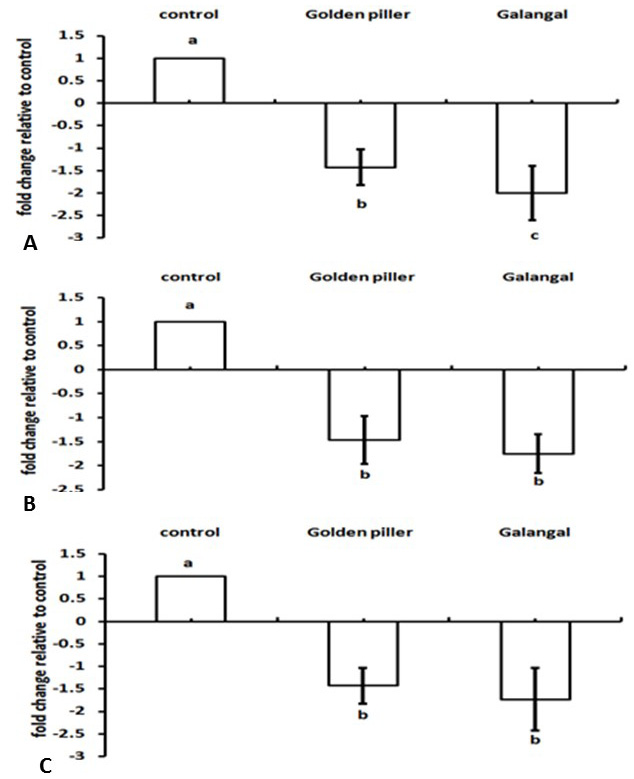
Transcript levels after normalization with Actin gene as an endogenous control 72 h post treatment. (A) SFch-1 mRNA, (B) SFch-2 mRNA, (C) SFbtl mRNA. Mean ± SEM of three replications are shown. Means with the different letters are significantly different (p= 0.05; ANOVA; with Tukey Kramer Multiple Comparison).
References
- Akhtar, Y., Yeoung, Y.-R. and Isman, M., 2008. Comparative bioactivity of selected extracts from meliaceae and some commercial botanical insecticides against two noctuid caterpillars, Trichoplusia ni and Pseudaletia unipuncta. Phytochem. Rev., 7: 77-88. https://doi.org/10.1007/s11101-006-9048-7[CrossRef]
- Aktar, W., Sengupta, D. and Chowdhury, A., 2009. Impact of pesticides use in agriculture: Their benefits and hazards. Interdiscip. Toxicol., 2: 1-12. https://doi.org/10.2478/v10102-009-0001-7[CrossRef]
- Avet-Rochex, A., Kaul, A.K., Gatt, A.P., McNeill, H. and Bateman, J.M., 2012. Concerted control of gliogenesis by inr/tor and fgf signalling in the drosophila post-embryonic brain. Development (Cambridge, Engl.), 139: 2763-2772. https://doi.org/10.1242/dev.074179[CrossRef]
- Barlow, S., Greig, J., Bridges, J., Carere, A., Carpy, A., Galli, C.L., Kleiner, J., Knudsen, I., Koeter, H. and Levy, L., 2002. Hazard identification by methods of animal-based toxicology. Fd. Chem. Toxicol., 40: 145-191. https://doi.org/10.1016/S0278-6915(01)00117-X[CrossRef]
- Borenfreund, E., Babich, H. and Martin-Alguacil, N., 1988. Comparisons of two in vitro cytotoxicity assays the neutral red (nr) and tetrazolium mtt tests. Toxicol. In Vitro, 2: 1-6. https://doi.org/10.1016/0887-2333(88)90030-6[CrossRef]
- Brent, C.S., Wang, M., Miao, Y.G. and Hull, J.J., 2016. Ecdysteroid and chitinase fluctuations in the western tarnished plant bug (lygus hesperus) prior to molt indicate roles in development. Arch. Insect Biochem. Physiol., 92: 108-126. https://doi.org/10.1002/arch.21322[CrossRef]
- Burguera, D., Marquez, Y., Racioppi, C., Permanyer, J., Torres-Méndez, A., Esposito, R., Albuixech-Crespo, B., Fanlo, L., D’Agostino, Y. and Gohr, A., 2017. Evolutionary recruitment of flexible esrp-dependent splicing programs into diverse embryonic morphogenetic processes. Nat. Commun., 8: 1799. https://doi.org/10.1038/s41467-017-01961-y[CrossRef]
- Eisenbrand, G., Pool-Zobel, B., Baker, V., Balls, M., Blaauboer, B., Boobis, A., Carere, A., Kevekordes, S., Lhuguenot, J.-C. and Pieters, R., 2002. Methods of in vitro toxicology. Fd. Chem. Toxicol., 40: 193-236. https://doi.org/10.1016/S0278-6915(01)00118-1[CrossRef]
- Firake, D. and Behere, G., 2020. Natural mortality of invasive fall armyworm, Spodoptera frugiperda (je smith) (lepidoptera: Noctuidae) in maize agroecosystems of northeast india. Biol. Contr., 148: 104303. https://doi.org/10.1016/j.biocontrol.2020.104303[CrossRef]
- Gahukar, R., 2014. Factors affecting content and bioefficacy of neem (Azadirachta indica a. Juss.) phytochemicals used in agricultural pest control: A review. Crop Protec., 62: 93-99. https://doi.org/10.1016/j.cropro.2014.04.014[CrossRef]
- Ghoneim, K., 2020. Impairing effectiveness of nerolidol, a sesquiterpene compound, on adult performance and reproductive potential of egyptian cotton leafworm, Spodoptera littoralis (Lepidoptera: Noctuidae). Egypt. Acad. J. biol. Sci., 13: 97-120. https://doi.org/10.21608/eajbsa.2020.80074[CrossRef]
- Grifoll-Romero, L., Pascual, S., Aragunde, H., Biarnés, X. and Planas, A., 2018. Chitin deacetylases: Structures, specificities, and biotech applications. Polymers, 10: 352. https://doi.org/10.3390/polym10040352[CrossRef]
- Hashem, A.S., Awadalla, S.S., Zayed, G.M., Maggi, F. and Benelli, G., 2018. Pimpinella anisum essential oil nanoemulsions against Tribolium castaneum insecticidal activity and mode of action. Environ. Sci. Pollut. Res., 25: 18802–18812. https://doi.org/10.1007/s11356-018-2068-1[CrossRef]
- Hikal, W.M., Baeshen, R.S. and Said-Al-Ahl, H.A., 2017. Botanical insecticide as simple extractives for pest control. Cogent Biol., 3: 1404274. https://doi.org/10.1080/23312025.2017.1404274[CrossRef]
- Kabiri, M. and Amiri-Besheli, B., 2012. Toxicity of palizin©, mospilan© and consult© on Agonoscena pistaciae burckhardt and lauterer (Hemiptera: Psyllidae), Oenopia conglobata L. (Coleoptera: Coccinellidae) and Psyllaephagus pistaciae ferrière (hymenoptera: Encyrtidae). Acad. J. Ent., 5: 99-107.
- Kadam, S., Ghosh, S. and Stathopoulos, A., 2012. Synchronous and symmetric migration of drosophila caudal visceral mesoderm cells requires dual input by two fgf ligands. Development (Cambridge Engl.), 139: 699-708. https://doi.org/10.1242/dev.068791[CrossRef]
- Kelkenberg, M., Odman-Naresh, J., Muthukrishnan, S. and Merzendorfer, H., 2015. Chitin is a necessary component to maintain the barrier function of the peritrophic matrix in the insect midgut. Insect Biochem. Mol. Biol., 56: 21-28. https://doi.org/10.1016/j.ibmb.2014.11.005[CrossRef]
- Khalaf, A.F.A., Hussein, K.T. and Shoukry, K.K., 2009. Biocidal activity of two botanical volatile oils against the larvae of Synthesiomyia nudiseta (Wulp) (Diptera: Muscidae). Egypt. Acad. J. biol. Sci., 2: 89-101. https://doi.org/10.21608/eajbsa.2009.15496[CrossRef]
- Klingseisen, A., Clark, I.B., Gryzik, T. and Müller, H.-A.J., 2009. Differential and overlapping functions of two closely related drosophila fgf8-like growth factors in mesoderm development. Development (Cambridge, Engl.), 136: 2393-2402. https://doi.org/10.1242/dev.035451[CrossRef]
- Kramer, K.J., Corpuz, L., Choi, H.K. and Muthukrishnan, S., 1993. Sequence of a cDNA and expression of the gene encoding epidermal and gut chitinases of Manduca sexta. Insect Biochem. Mol. Biol., 23: 691-701. https://doi.org/10.1016/0965-1748(93)90043-R[CrossRef]
- Kumar, M., Vivekanand, V. and Pareek, N., 2018. Structure, regulation, and potential applications of insect chitin-metabolizing enzymes. In: Trends in insect molecular biology and biotechnology (eds. D. Kumar and C. Gong). Springer International Publishing, Cham. pp. 295–316. https://doi.org/10.1007/978-3-319-61343-7_14[CrossRef]
- Liu, J.-W., Cai, M.-X., Xin, Y., Wu, Q.-S., Ma, J., Yang, P., Xie, H.-Y. and Huang, D.-S., 2010. Parthenolide induces proliferation inhibition and apoptosis of pancreatic cancer cells in vitro. J. exp. Clin. Cancer Res., 29: 108. https://doi.org/10.1186/1756-9966-29-108[CrossRef]
- Livak, K.J. and Schmittgen, T.D., 2001. Analysis of relative gene expression data using real-time quantitative pcr and the 2(-delta delta c(t)) method. Methods, 25: 402-408. https://doi.org/10.1006/meth.2001.1262[CrossRef]
- Marcus, C. and Lichtenstein, E.P., 1979. Biologically active components of anise: Toxicity and interactions with insecticides in insects. J. Agric. Fd. Chem., 27: 1217-1223. https://doi.org/10.1021/jf60226a077[CrossRef]
- Mehrabadi, M., Hussain, M. and Asgari, S., 2013. Micrornaome of Spodoptera frugiperda cells (sf9) and its alteration following baculovirus infection. J. Gen. Virol., 94: 1385-1397. https://doi.org/10.1099/vir.0.051060-0[CrossRef]
- Muha, V. and H.-A.J. Müller, 2013. Functions and mechanisms of fibroblast growth factor (fgf) signalling in Drosophila melanogaster. Int. J. mol. Sci., 14: 5920-5937. https://doi.org/10.3390/ijms14035920[CrossRef]
- Muthukrishnan, S., Merzendorfer, H., Arakane, Y. and Yang, Q., 2016. Chitin metabolic pathways in insects and their regulation. In: Extracellular composite matrices in arthropods (eds. B. Cohen and B. Moussian). Springer International Publishing, Cham. pp. 31–65. https://doi.org/10.1007/978-3-319-40740-1_2[CrossRef]
- Nauen, R., Stumpf, N. and Elbert, A., 2002. Toxicological and mechanistic studies on neonicotinoid cross resistance in q-type Bemisia tabaci (Hemiptera: Aleyrodidae). Pest Manage. Sci., 58: 868-875. https://doi.org/10.1002/ps.557[CrossRef]
- Obeng-Ofori, D., Reichmuth, C., Bekele, J. and Hassanali, A., 1997. Biological activity of 1, 8 cineole, a major component of essential oil of Ocimum kenyense (ayobangira) against stored product beetles. J. appl. ent., 121: 237-243. https://doi.org/10.1111/j.1439-0418.1997.tb01399.x[CrossRef]
- Ogah, E.O., 2013. Field evaluation of plant extracts in the management of Megalurothrips sjostedti and Maruca vitrata of cowpea in southeastern Nigeria. World Essays J., 1: 11-17.
- Regnault-Roger, C., Vincent, C. and Arnason, J.T., 2012. Essential oils in insect control: Low-risk products in a high-stakes world. Annu. Rev. Ent., 57: 405-424. https://doi.org/10.1146/annurev-ento-120710-100554[CrossRef]
- Saleh, M., Hajjar, J. and Rahmo, A., 2013. Effect of selected insecticides on sf9 insect cell line. Leban. Sci. J., 14: 115.
- Sambrook, J., 2001. Molecular cloning: a laboratory manual, 3rd ed. Cold Spring Harbor Laboratory Press, Cold Spring Harbor, N.Y.
- Sharma, R., Beer, K., Iwanov, K., Schmöhl, F., Beckmann, P.I. and Schröder, R., 2015. The single fgf receptor gene in the beetle Tribolium castaneum codes for two isoforms that integrate fgf8-and branchless-dependent signals. Dev. Biol., 402: 264-275. https://doi.org/10.1016/j.ydbio.2015.04.001[CrossRef]
- Shi, J.F., Mu, L.L., Guo, W.C. and Li, G.Q., 2016. Identification and hormone induction of putative chitin synthase genes and splice variants in Leptinotarsa decemlineata (Say). Arch. Insect Biochem. Physiol., 92: 242-258. https://doi.org/10.1002/arch.21331[CrossRef]
- Stork, T., Sheehan, A., Tasdemir-Yilmaz, O.E. and Freeman, M.R., 2014. Neuron-glia interactions through the heartless fgf receptor signaling pathway mediate morphogenesis of Drosophila astrocytes. Neuron, 83: 388-403. https://doi.org/10.1016/j.neuron.2014.06.026[CrossRef]
- Sun, J. and Stathopoulos, A., 2018. Fgf controls epithelial-mesenchymal transitions during gastrulation by regulating cell division and apicobasal polarity. Development (Cambridge Engl.), pp. 161927. https://doi.org/10.1242/dev.161927[CrossRef]
- Sun, Y.-P., 1950. Toxicity index-an improved method of comparing the relative 378 toxicity of insecticides. J. econ. Ent., 43: 45–53. https://doi.org/10.1093/jee/43.1.45[CrossRef]
- Tapondjou, A., Adler, C., Fontem, D., Bouda, H. and Reichmuth, C., 2005. Bioactivities of cymol and essential oils of Cupressus sempervirens and Eucalyptus saligna against Sitophilus zeamais motschulsky and Tribolium confusum du val. J. Stored Prod. Res., 41: 91-102. https://doi.org/10.1016/j.jspr.2004.01.004[CrossRef]
- Tawatsin, A., Asavadachanukorn, P., Thavara, U., Wongsinkongman, P., Bansidhi, J., Boonruad, T., Chavalittumrong, P., Soonthornchareonnon, N., Komalamisra, N. and Mulla, M.S., 2006. Repellency of essential oils extracted from plants in thailand against four mosquito vectors (Diptera: Culicidae) and oviposition deterrent effects against Aedes aegypti (Diptera: Culicidae). Southeast Asian J. Trop. Med. Public Hlth., 37: 915.
- Tripathi, Y., 1998. Phytopesticides, an ecofriendly approach for pest control. Ind. J. environ. Sci., 2: 63-71.
- Velasques, J., Cardoso, M.H., Abrantes, G., Frihling, B.E., Franco, O.L. and Migliolo, L., 2017. The rescue of botanical insecticides: A bioinspiration for new niches and needs. Pestic. Biochem. Physiol., 143: 14-25. https://doi.org/10.1016/j.pestbp.2017.10.003[CrossRef]
- Ware, G.W. and Whitacre, D.M., 2004. An introduction to insecticides. MeisterPro information resources, a division of Meister media worldwide, 4th edn. Willoughby, Ohio, USA.
- Weaver, D.K., Wells, C.D., Dunkel, F.V., Bertsch, W., Sing, S.E. and Sriharan, S., 1994. Insecticidal activity of floral, foliar, and root extracts of Tagetes minuta (Asterales: Asteraceae) against adult mexican bean weevils (Coleoptera: Bruchidae). J. econ. Ent., 87: 1718-1725. https://doi.org/10.1093/jee/87.6.1718[CrossRef]
- Zhang, L., Qiu, L.-Y., Yang, H.-L., Wang, H.-J., Zhou, M., Wang, S.-G. and Tang, B., 2017. Study on the effect of wing bud chitin metabolism and its developmental network genes in the brown planthopper, Nilaparvata lugens, by knockdown of TRE gene. Front. Physiol., 8: 750. https://doi.org/10.3389/fphys.2017.00750[CrossRef]
- Zhu, Q., Arakane, Y., Banerjee, D., Beeman, R.W., Kramer, K.J. and Muthukrishnan, S., 2008. Domain organization and phylogenetic analysis of the chitinase-like family of proteins in three species of insects. Insect Biochem. mol. Biol., 38: 452-466. https://doi.org/10.1016/j.ibmb.2007.06.010[CrossRef]
- Zhuo, W., Fang, Y., Kong, L., Li, X., Sima, Y. and Xu, S., 2014. Chitin synthase a: A novel epidermal development regulation gene in the larvae of Bombyx mori. Mol. Biol. Rep., 41: 4177-4186. https://doi.org/10.1007/s11033-014-3288-1[CrossRef]
Services
Article usage statistics
Loading…