
This study is directed to assess the impacts of either zinc oxide (ZnO) or nano-zinc oxide (n-ZnO) dietary supplementation on the growth trials, some serum biochemical parameters, and testicular functions in growing V-line male rabbits. A total of 45 V-line were randomly separated into 3 equal groups; the first group (acted as control) was fed on a plain ration, and the two other groups (second and third groups) were nourished for 3 months on a plain diet supplemented with 60 mg ZnO/ kg and 60 mg n-ZnO/ kg, respectively. Growth performances; body weight (BW), body weight gain (BWG), food consumption (FC), and food conversion ratio (FCR), as well as serum levels of superoxide dismutase (SOD), catalase (CAT), triiodothyronine (T3) and thyroxine (T4), and testosterone were recorded monthly. The study also extended to examine androgen receptor (AR) gene expression and microscopical structure of testicular tissue at the end of the 5th-month-old. Results revealed that the n-ZnO group exhibited significant (P ≤ 0.05) improvement over that of the ZnO group on all growth performances and serum biochemical parameters compared with the control group except for FC, T3, and T4, which were insignificantly changed. Moreover, AR gene expression and microscopical findings of the testis exhibited a significant improvement in the 2nd and 3rd groups compared to the control group. It could be concluded that either ZnO or n-ZnO dietary supplementation acts as an ameliorative tool for production and reproduction in growing V-line male rabbits however, the n-ZnO is more effective.
Research Article · Volume 11, Issue 12, 6 December 2023 · Open Access
Effect of Dietary Supplementation of Either Zinc Oxide or Nano-Zinc Oxide on Growth Performance, some Serum Biochemical Parameters, Androgen Receptor Gene Expression and Microscopical Structure of the Testis in Growing V-Line Male Rabbits
· · · ·
Affiliations & Notes ⌄
- 1Physiology Department, Faculty of Veterinary Medicine, Beni-Suef University, Beni-Suef 62511, Egypt. *Correspondence | Rehab M Reda, Physiology Department, Faculty of Veterinary Medicine, Beni-Suef University, Beni-Suef 62511, Egypt
- 2Email: rehababdelaziz56@gmail.com
Article Info ⌄
- Journal:
- Advances in Animal and Veterinary Sciences
- Published:
- 6 December 2023

From the article
- Moreover, the n-ZnO group exhibited significant (P ≤ 0.05) improvement over that of ZnO in previously estimated growth performance trials.
- In the current study (Table 2), ZnO and n-ZnO supplementation provoked a significant rise in serum levels of SOD and CAT as compared to the control group, and.
- Parameter Age (Months) Control group ZnO group n-ZnO group .
- Conclusively, ZnO and n-ZnO dietary supplementation at a dose of 60 mg/kg ration act as an ameliorative tool of production and reproduction in growing V-line male rabbits, however, n-ZnO is more effective.
Selected from the article's own text.
Abstract
INTRODUCTION
Rabbits are considered a good supply of highly animal protein sources. The economy of the rabbit industry depends on improving its productivity and reproductive efficiency . In this concern, Hambidge (1986) and El-Masry et al. (1994) recorded that early puberty and high fecundity improve the reproductive efficiency of rabbits. These criteria are considered good bases
for economic selection. Gupta et al. (2002) reported that growth performance in post-weaning rabbits is affected by several inherent and non-inherent factors. Inherent factors include disease tolerance, efficiency of feed conversion, genera and nonstandard growth rates, however, non-inherent factors incorporate factors like nourishment, management, control of disease and surrounding environment ; .
Zinc supplementation in animal diet is reported to play a crucial role in regulating many physiological functions relating to reproductive and productive efficiency in farm animals ; . In this respect, zinc supplementation is beneficial in combating stress , enhancing antioxidant activities , improving immune response and production of many hormones, including testosterone , thyrotrophic releasing hormone (TRH), thyroid stimulating hormone (TSH) and thyroid hormones (Brandao et al., 2006). Moreover, zinc is considered an anti-inflammatory agent by influencing the production and signaling of numerous inflammatory interleukins such as interleukin (IL-1 and IL-6) and tumor necrosis factor (TNF) . Besides, it enters the structure of various enzymes that regulate gene expression RNA polymerases, alcohol dehydrogenase, carbonic anhydrase, glutamic dehydrogenase, carboxypeptidase, lactic dehydrogenase, and alkaline phosphatase .
Recently, substantial development has been achieved in the employment of nanotechnology science in many fields, particularly mineral nutrition . Nanominerals, such as nano-zinc oxide (n-ZnO), are characterized by small size, high bioavailability, and broad surface area, which allow more cellular reactions ; . In this context, n-ZnO supplementation in rabbit ration with different levels as 30 mg/ kg n-ZnO , 50 to 400 mg /kg n-ZnO Selim et al. (2012) causes improvement in growth performance and reproduction. It has been reported that the n-ZnO can enhance immune responses, antioxidant activities, and lipid metabolism (Hafez et al., 2020; . Nevertheless, several reports revealed the negative influence of either zinc oxide (ZnO) or n-ZnO on antioxidant enzymes activity , T3, T4 , testosterone , growth as well as semen picture .
Based on the aforementioned studies, it seems that studies concerning the influences of ZnO and n-ZnO supplementation on animal production and reproduction are conflicting and determined by various factors such as Zn source , dose ; , duration of application , breed ; , species (Hassan et al., 2017; and age ; of treated animal. Consequently, more investigations are warranted to clarify such conflict. Therefore, the current research aimed to declare the influence of ZnO and n-ZnO dietary supplementation at a dosage of 60 mg/kg ration on a complex set of growth and reproductive performance parameters in growing V-line male rabbits. The growth performance trials involve BW, BWG, FC, and FCR. Besides, serum levels of SOD, CAT, T3, and T4 were also investigated. Reproductive performance trials include the determination of testosterone levels in serum, examination of AR expression and microscopical structure of testicular tissue.
MATERIALS and METHODS
The current research procedures were conducted in the lab animal unit of the Department of Physiology, Faculty of Veterinary Medicine, Beni-Suef University.
Ethical statement
The ethics of the handling and euthanizing of the animals were done under Approval No. 021-182. The approval was obtained from the Institutional Animal Care and Use Committee at Beni-Suef University. All animal experiments were subjected to the proper housing and maintenance conditions.
Animals
A total of 45 V-line breed clinically healthy growing male rabbits, obtained from a local supplier, were involved in these experiments. Their ages were around 6 weeks old, with a mean BW of 1.5 – 2 Kg. They were left for 2 weeks for acclimatization to the laboratory environment. Rabbits were individually housed in wired cages (40 x 50 x 50 cm) supplemented with a feed hopper and automatic watering system with nipples. Throughout this study, rabbits were kept under standard circumstances . Animals were kept on a balanced pelleted diet and water ad libitum. The plain ration included yellow corn, soybean, gluten, mineral salts, molasses, and premix of vitamins. The estimated chemical constituents of the ration were crude fiber (12.6%), digestible energy (2500) kcal /kg ration, and crude protein (17%), as described by NRC (1991).
Chemicals
ZnO was purchased from Alpha Chemika, INDIA, as a white powder nearly insoluble in water. ZnO nanoparticles were biosynthesized and characterized in the lab of Nano-materials, Faculty of Postgraduate Studies, Beni-Suef University, Egypt.
Experimental design
Animals were equally divided, randomly, into 3 comparable groups (15 rabbits/group) and received the following corresponding diets throughout the experimental period that extended for 3 months:-
a- 1st Group (Control): received plain diet.
b- 2nd Group: received a plain diet mixed with 60 mg ZnO/kg dry matter .
c- 3rd Group: received a plain diet mixed with 60 mg n-ZnO/kg dry matter .
Growth performance
BW, BWG, FC, and FCR were determined monthly (at the end of the 3rd, 4th, and 5th month of age). Experimental animals were deprived of feed for 12 hours before being subjected to weight to evade any intestinal content from the weighting process .
Blood sampling
Blood was individually collected monthly from the ear vein at 8.00-9.00 am to obtain sera, which were kept at -20°C till biochemical analysis .
Serum biochemical analysis
SOD (U/ml), CAT (U/L), T3 (ng/ml), T4 (ng/ml) and testosterone (ng/ml) were determined in rabbit sera using commercial kits; SOD kit (CAT. No. SD2521, bio-diagnostic Co., EGYPT), CAT kit (Cat. No. CA 25 17, bio-diagnostic Co., EGYPT), T3 ELISA kit (Cat. No. KET0006, Abbkine Co., China), Rabbit T4 ELISA kit (Cat. No. MBS777396, MyBioSource Co., USA) and Rabbit testosterone ELISA kit (Cat. No. CSB-E06927Rb, Cusabio Co., USA), respectively.
Tissue sampling
Immediately after the end of 5th month, 5 rabbits randomly selected from each group were euthanized randomly following the last blood sample collection, and the testes were harvested. The left testicle of each euthanized rabbit was immersed in formalin at 10% concentration, then sectioned, and subjected to staining with hematoxylin and eosin stain (HE) and inspected microscopically . The right testis was isolated and kept in liquid nitrogen for AR gene expression:
Determination of AR gene expression: Total RNA was separated from rabbit testis and complementary DNA (cDNA) was synthesized by one-step reverse transcription- RT-qPCR protocol using GoTaq® 1-Step RT-qPCR System kit, Promega, USA. The primer sequence of AR gene and ß-actin were F: 5′-TCC ACC TCC TCC AAG GAC AGT-3′, R: 5′-CCA ACG CCT CCA CAC CCA A-3′ and F: 5′-TCC TTC CTG GGC ATG GAG TC-3′, R: 5′-GGA TGT CCA CGT CGC ACT TC-3′ 5′-GGA TGT CCA CGT CGC ACT TC-3′, respectively . Analysis of RT-qPCR results were determined according to Livak and Schmittgen (2001) and Yuan et al. (2006).
Statistical assessment
All data were stated as average ± standard error. One-way analysis of variance (ANOVA) followed by Turkey’s and Duncan’s tests were used to signify values among the tested groups exploiting statistical software program (SPSS for Windows, version 25, USA). Alterations considered significant at P ≤ 0.05.
RESULTS AND DISCUSSION
Table (1) displayed that BW and BWG were significantly high (P ≤ 0.05) in both ZnO and n-ZnO dietary treated groups comparable to the control group. While FCR, decreased significantly (P ≤ 0.05) in ZnO and n-ZnO groups compared to the control one. Moreover, the n-ZnO group exhibited significant (P ≤ 0.05) improvement over that of ZnO in previously estimated growth performance trials. The results of FC, throughout the experimental period, were nearly similar in all groups. Such beneficial effects on growth performances consisted with previous researches ; ; . Zinc is essential for biological functions inside the animal body. It is vital for growth, normal feeding, antioxidant function, and for the activities of various metalloenzymes . The positive effects of Zn may be attributed to its crucial role in the normal formation and organization of important macromolecules such as DNA and RNA, which have a principal role in the development of bones and the synthesis of somatic proteins . On the contrary, other studies did not report any significant beneficial effect on the growth of rabbits nourished on a ration supplemented with ZnO at a dosage of 50, 100, 200, and 400 mg ZnO /kg ration and zinc bacitracin at a dosage of 83 mg/ per day for 81 days . The findings were attributed to the possibilities that zinc absorption inside the intestinal lumen may be inhibited by some antagonists such as excess amounts of Ca, Fe, unabsorbed fat, and dietary phytate that are found in plant-based diets such as soybean meal, wheat bran, and cottonseed meal .
Moreover, the significant (P ≤ 0.05) improvement in estimated growth performance trials in the n-ZnO treated group over that of the ZnO was supported by the record that zinc nanoparticles had a marked contribution as a mineral feed additive more than their bulk form . These findings are compatible with previous reports on different breeds of rabbits using various doses ; Tag-El Din, 2019; . It was suggested that the positive biological effect of nano-zinc over that of ZnO may be attributed to its properties such as wide surface area, bioactivity, and potential adsorbing action .
In the current study (Table 2), ZnO and n-ZnO supplementation provoked a significant rise in serum levels of SOD and CAT as compared to the control group, and
Table 1: Effect of ZnO and n-ZnO dietary supplementation on growth performance trials in growing V-line male rabbits (Mean ± SE).
| Parameter | Age (Months) | Control group | ZnO group | n-ZnO group |
| BW (g) | 3 | 2284.33±14.31 A | 2355.73± 19.97 B | 2419.86±15.03 C |
| 4 | 2833.53±11.03 A | 2978.80± 16.11 B | 3119.33± 12.89 C | |
| 5 | 3413.27±8.72 A | 3613.00± 17.42 B | 3878.00±19.56 C | |
| BWG (g) | 3 | 493.40± 10.11A | 552.13±11.05 B | 615.87±17.39 C |
| 4 | 549.20 ±10.22 A | 623.07± 17.29 B | 699.47 ±12.11 C | |
| 5 | 579.73 ± 8.29 A | 634.20± 15.49B | 758. 67 ± 21.35 C | |
| FC (g) | 3 | 1822.42±26.09A | 1818.72±22.09A | 1801.97±17.39A |
| 4 | 2120.89 ±9.11A | 2115.36 ±11.68A | 2112.09±11.88A | |
| 5 | 2236.37 ±15.84A | 2220.77±17.04A | 2216.33 ± 12.96A | |
| FCR | 3 | 3.71± 0.08A | 3.31 ± 0.07B | 2.96 ± 0.09C |
| 4 | 3.88± 0.06A | 3.43 ± 0.09B | 3.03 ± 0.06C | |
| 5 | 3.87 ± 0.06A | 3.53± 0.09B | 2.96 ± 0.09C |
-In the same raw, values having different capital letters differ significantly (P ≤ 0.05).
ZnO = Zinc Oxide, n-ZnO = nano-Zinc Oxide, BW = body weight, BWG = body weight gain, FC = food consumption, FCR = food conversion ratio
Table 2: Effect of ZnO and n-ZnO dietary supplementation on serum biochemical parameters and AR gene expression in growing V-line male rabbits (Mean ± SE).
| Parameter | Age (Months) | Control group | ZnO group | n-ZnO group |
| SOD (U/ml) | 3 | 1.33 ±0.04 A | 1.61 ±0.04 B | 1.79 ± 0.06 C |
| 4 | 1.23 ± 0.02 A | 1.74 ±0.03 B | 1.89 ± 0.04 C | |
| 5 | 1.33± 0.03 A | 1.81 ±0.02 B | 1.93 ± 0.05 C | |
| CAT (U/L) | 3 | 284.4± 8.86 A | 351.33± 6.92 B | 379.2 ± 5.63 C |
| 4 | 257.00± 4.01 A | 357.00 ± 3.75 B | 381.6 ± 4.89 C | |
| 5 | 260.40± 4.61 A | 362.80± 2.54 B | 397.20± 4.87 C | |
| T3 (ng/ml) | 3 | 1.28 ± 0.09 A` | 1.30 ± 0.09 A | 1.43 ± 0.1 A |
| 4 | 1.53 ± 0.04 A | 1.54± 0.03 A | 1.59± 0.03 A | |
| 5 | 1.07 ± 0.02 A` | 1.12 ± 0.03 A | 1.14 ± 0.03 A | |
| T4 (ng/ml) | 3 | 5.97 ± 0.13 A | 6.10 ± 0.11A | 6.27 ± 0.16 A |
| 4 | 6.07 ± 0.14 A | 6.26± 0.16 A | 6.39 ± 0.06A | |
| 5 | 5.03 ± 0.12 A | 5.33 ± 0.17 A | 5.43 ± 0.12A | |
| Testosterone (ng/ml) | 3 | 1.22± 0.02 A | 1.70 ± 0.03 B | 1.97± 0.03 C |
| 4 | 2.08 ± 0.02 A | 2.31 ± 0.03 B | 2.73 ± 0.06 C | |
| 5 | 2.39 ± 0.02 A | 2.72 ± 0.02 B | 2.97 ± 0.05 C | |
| AR gene (fold change) | 5 | 1.02 ± 0.03 A | 1.89± 0.05 B | 2.05 ± 0.03 C |
-In the same raw, values having different capital letters differ significantly (P ≤ 0.05).
ZnO = Zinc Oxide, n-ZnO = nano-Zinc Oxide, SOD = superoxide dismutase enzyme, CAT = catalase enzyme, T3 = triiodothyronine, T4 = thyroxine, AR = androgen receptor gene expression
their values were greater (P ≤ 0.05) in the 3rd group than 2nd group, throughout the experimental period. Likewise, zinc and n-ZnO supplementation in animal feed leads to high antioxidant activities of CAT, GSH-Px, and SOD. In this context, zinc is considered a component of more than 240 enzymes and an essential component in SOD . Furthermore, the significant (P ≤ 0.05) potent effects of n-zinc over ZnO in the present study (Table 1) can be attributed to the higher absorption and bioavailability of n-ZnO that obviously declared in several previous studies (Hafez et al., 2020; .
It is worth mentioning that thyroid hormones play a significant role in the improvement of growth performance , ROS production and consequently antioxidant activities (; ) . Therefore, it was expected that there would be an increase in serum levels of T3 and T4 in association with the improvement in growth performance and serum levels of SOD and CAT, but it was not the matter. Results of the current work (Table 2) didn’t exhibit any significant change in the serum levels of T3 and T4 among different groups during the experimental period. In this context, Zn , as well as nano-zinc , were reported to play an valuable role in maintaining normal levels of TRH, TSH, T3, and T4 and improve metabolism due to its stimulating effect on the activity of pituitary and hypothalamus. It was hypothesized that Zn deficiency is linked with motivated the activity and expression of hepatic T4-5’-monodeiodinase enzyme, which catalyzes the thyroid hormone inhibition . However, consumption of high amounts of zinc and nano-zinc may cause destructive effects on thyroid hormones.
It was also shown that ZnO and n-ZnO supplementation induced a significant (P ≤ 0.05) increase in serum testosterone level in comparison with the control group, and their values were higher (P ≤ 0.05) in the 3rd group over that of the 2nd group throughout the experimental period (Table 2). Data concerning the correlation between Zn sources, particularly n-Zn supplementation and serum testosterone levels in growing rabbits, seem to be scanty. However, a direct relationship between zinc supplementation and serum testosterone was reported in mature rabbits and mature male rats . It was suggested that zinc is essential for the production and secretion of testosterone from the Leydig cells and gonadotrophin releasing hormone ; . On the other hand, zinc nanoparticles (3rd group) showed a greater potential (P <0.05) on serum testosterone levels than the conventional sources (2nd group), suggesting higher intestinal absorption, biocompatibility, and bioavailability of nano-zinc, which was in agreement with previous researches (Hafez et al., 2020; .
Concerning the influence of ZnO and n-ZnO dietary supplementation on AR gene expression at the 5th month of age, it appeared that AR gene expression significantly amplified in the supplemented groups when compared with the control group with the greatest value (P ≤ 0.05) in n-ZnO group (Table 2). Within the available literature, there is no data concerning the influence of ZnO and n-ZnO dietary supplementation on AR gene expression in male rabbits. It is known that AR is a single nuclear receptor. It belongs to the nuclear receptor superfamily and is considered an active member of the steroid hormone that controls androgen actions via acting as a ligand-dependent transcription factor . The positive effects of ZnO on AR gene expression in the present study might be due to zinc being considered an antioxidant deactivating lipid, protein, and DNA peroxidation, consequently preventing down-regulation and inhibition of gene expression . On the other side, the significant influences of nano-zinc over zinc might be regarded as the higher physicochemical characteristics of n-ZnO absorption, bioavailability, and surface area (Hafez et al., 2020; .
At the end of 5th month of age, microscopical findings of V-line rabbit testicular tissue revealed that seminiferous tubules (ST) belonging to ZnO group Figure 1 (B) showed a limited number of spermatozoa, most of which are attached to Sertoli cells (early maturation). While ST of control group, Figure 1 (A) showed normal histological structures in which spermatogonial cells exhibited mitotic activity, incomplete spermatogonial cycle (immature) and interstitial cells of Leydig (LC) were dispersed in between. On the otherside, ST of n-ZnO group Figure 1 (C) showed spermatogenic activity with spermatid and spermatozoa in higher density than ZnO group.
Within the available literature, there is no data concerning the influence of dietary ZnO or n-ZnO supplementation on the microscopical picture of the testis in rabbits. However, the positive impacts of either ZnO or n-ZnO on the microscopical picture of the testis may be assigned to the improvement in antioxidant properties, serum testosterone level, and AR gene expression in the present study. Besides, the physicochemical properties of n-ZnO exert superior efficacy compared with organic or inorganic Zn ; . These results were compatible with previous researches declaring that Zn is essential in regulating many physiological processes stimulating spermatogenesis ;.
Conclusion
Conclusively, ZnO and n-ZnO dietary supplementation at a dose of 60 mg/kg ration act as an ameliorative tool of production and reproduction in growing V-line male rabbits, however, n-ZnO is more effective.
CONFLICT OF INTEREST
The authors declare that there is no conflict of interest.
Authors’ Contributions
All authors contributed equally to the design of the research, methodology, analysis of results, and writing of the manuscript.
Figures

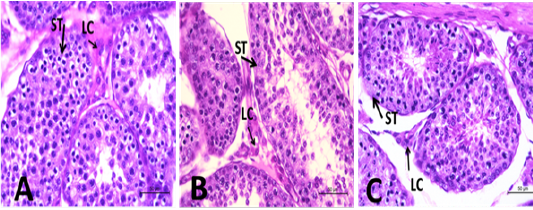
(A): Seminiferous tubules (ST) of the control group shows normal histological structure in which spermatogonial cells show mitotic activity, incomplete spermatogonial cycle (immature), and Leydig cells (LC) are dispersed in between (X 400). (B): ST of the ZnO group shows mitotic activity, immature spermatogonial cycle, and LC are dispersed in between. Few ST tubules show a limited number of spermatozoa most of which are attached to Sertoli cells (early maturation) (X 400). (C): ST of the n-ZnO group shows spermatogenic activity including spermatid and spermatozoa in high density (X 400).
References
- Abdel-Monem N., Elsebai A., El-Hady A., Mohamed A. (2021). Impact of dietary Zinc Oxide nano-particles on antioxidant status, liver and kidney functions in Alexandria chickens. Egypt. Poult. Sci. J., 41 (3): 675-690. https://doi.org/10.21608/epsj.2021.197911[CrossRef]
- Aihara K., Nishi Y., Hatano S. K., M., Yoshimitsu K., Takeichi N., Ito T., Ezaki H., Usui T. (1984). Zinc, copper, manganese, and selenium metabolism in thyroid disease. Am. J. Clin. Nutr., 1984; 40 (1):26-35. https://doi.org/10.1093/ajcn/40.1.26[CrossRef]
- Al-Dobaib S.N., Khalil M.H., Hashad M., Al-Saef A.M. (2007). Growth, carcass and ceacal traits in V- Line and crossbred rabbits fed diets containing discarded dates. World Rabbit. Sci., 15: 81- 90. https://doi.org/10.4995/wrs.2007.603[CrossRef]
- Alemneh T., Getabalew M. (2019). Factors influencing the growth and development of meat animals. Int. J. Animal Sci., 3 (3): 1048-1053.
- Alikwe P., Ojiezeh T., Olagboye S. (2011). Effects of Zinc supplement on rabbits performance and growth rate. J. Agric. Soc. Sci., 11: 46-50.
- Al-Sagheer A.A., Abdel-Rahman G., Ayyat M.S., Gabr H.A., Elsisi G.F. (2020). Productive performance response of growing rabbits to dietary protein reduction and supplementation of pyridoxine, protease, and zinc. An. Acad. Bras. Cienc., 92 (3):1-15. https://doi.org/10.1590/0001-3765202020180989[CrossRef]
- Attia Y., Hamed R., Abd El-Hamid A., Shahba H., Bovera F. (2015). Effect of inulin and mannanoligosaccharides compared with Zinc bacitracin on growing performance, nutrient digestibility and hematological profiles of growing rabbits. Anim. Prod. Sci., 55 (1): 80-86. https://doi.org/10.1071/AN13286[CrossRef]
- Bancroft J.D., Layton C. (2013). The hematoxylin and eosin. In: Theory and practice of histological techniques, Suvarna, S.K., Layton, C. and Bancroft, J.D., (eds.), Churchill Livingstone of El Sevier, Philadelphia, 7th ed., Ch. 10 and 11: 172-214.
- Bao Y.M., Choct M., Iji P.A., Bruerton K. (2009). Optimal dietary inclusion of organically complexed Zinc for broiler chickens. Br. Poult. Sci., 50: 95–102. https://doi.org/10.1080/00071660802590377[CrossRef]
- Brandao-Neto J., Saturnino A.C. R.D., Leite L. D., de Medeiros Rocha E. D., Marcos C. M. P., da Silva C.A.B. et al. (2006). Lack of acute Zinc effect on thyrotropin releasing hormone-stimulated thyroid-stimulating hormone secretion during oral Zinc tolerance test in healthy men. Nutr. Res., 26 (10):493-496. https://doi.org/10.1016/j.nutres.2006.08.010[CrossRef]
- Chrastinova L., Cobanova K., Chrenkova M., Polacikova M., Formelova Z., et al.. (2015). High dietary levels of Zinc for young rabbits. Slovak J. Anim. Sci., 2015; 48. 57-63.
- Duncan D. B. (1955). Multiple range and multiple F-test, Biomet., 11 (1-42): 38. https://doi.org/10.2307/3001478[CrossRef]
- El-dawy K.A., Rowida M.R., Deib M.M., Rashad D.M. (2016). Effects of the anabolic steroid, nandrolone-decanoate on reproductive performance of male rabbits. B.L.J., 11 (15): 186-199. https://doi.org/10.21608/blj.2016.48193[CrossRef]
- El-Masry K., Nasr A. (1994). Influences of season and dietary supplementation with selenium and vitamin e or Zinc on some blood constituents and semen quality of New Zealand white rabbit males. World Rabbit. Sci., 2: 79-86. https://doi.org/10.4995/wrs.1994.221[CrossRef]
- El-sisy G.A., Abdel-Razek A.M., Younis A.A. (2008). Effects of dietary Zinc or selenium supplementation on some reproductive hormone levels in male Baladi Goats. Glob. Vet.. 2:46-50.
- Farghali A., Khedr M., Khalek A. (2007). Catalytic decomposition of carbondioxide over freshly reduced activated CuFe 2O4 nano-crystals. J. Mater. Process. Technol., 181: 81-87. https://doi.org/10.1016/j.jmatprotec.2006.03.053[CrossRef]
- Gabr S.h., Younan G., Hamad M., Rehab I., Mervat Z. (2016). Effect of some natural antioxidants on growth performance, blood parameters and carcass traits of growing rabbits under egyptian summer condition. J. Anim. Poult. Prod., 7: 457-466. https://doi.org/10.21608/jappmu.2016.48755[CrossRef]
- Goma A. A., Tohamy H.G., El-Kazaz S.E., Soliman M.M., Shukry M., Elgazzar A.M., Rashed R.R. (2021). Insight study on the comparison between Zinc Oxide nanoparticles and its bulk impact on reproductive performance, antioxidant levels, gene expression, and histopathology of testes in male rats. Antioxid. J., 10 (1): 41-60. https://doi.org/10.3390/antiox10010041[CrossRef]
- Guerrero A., Pamplona R., Portero-Otín M., Barja G., López-Torres M. (1999). Effect of thyroid status on lipid composition and peroxidation in the mouse liver. Free Radic. Biol. Med., 26 (1-2): 73–80. https://doi.org/10.1016/S0891-5849(98)00173-7[CrossRef]
- Gupta B.R., Rao V.P., Reddy C.E., Satyanarayana A., Reddy P.P. (2002). Effect of genetic and non-genetic factors on post-weaning body weights and carcass traits of broiler rabbits. Glob. Sci. Res. J., 72: 70-74.
- Hafez A., Nassef E., Fahmy M., Elsabagh M., Bakr A., Hegazi E. (2020). Impact of dietary nano-Zinc Oxide on immune response and antioxidant defense of broiler chickens. Environ. Sci. Pollut. Res. Int., 27 (16): 19108 19114. https://doi.org/10.1007/s11356-019-04344-6[CrossRef]
- Halo M. Jr., Bułka K., Antos P.A., Gren A., Slanina T. et al.. (2021). The effect of ZnO nanoparticles on rabbit spermatozoa motility and viability parameters in vitro. Saudi J. Biol. Sci., 28 (12): 7450–7454. https://doi.org/10.1016/j.sjbs.2021.08.045[CrossRef]
- Hambidge K.M. (1986). Trace elements in human and animal nutrition. 5th (ed.) Maryland: Walter Mertz, 2:13-19. https://doi.org/10.1016/B978-0-08-092469-4.50005-4[CrossRef]
- Hameed H., Mahmood F.S., Al-Farha A. A. (2023). Nano-Zinc Oxide and Zinc sulfate in broilers: effect on thyroid hormones and internal intestinal environments. Egypt J. Vet. Sci., 54 (3): 347-358. https://doi.org/10.21608/ejvs.2023.183051.1419[CrossRef]
- Hassan F.A., Mahmoud R., ElAraby I.E. (2017). Growth performance, serum biochemical, economic evaluation and IL6 gene expression in growing rabbits fed diets supplemented with Zinc nanoparticles. Zagazig Vet. J., 45 (3): 238-249. https://doi.org/10.21608/zvjz.2017.7949[CrossRef]
- Jarosz M., Olbert M., Wyszogrodzka G., Młyniec K., Librowski T. (2017). Antioxidant and anti-inflammatory effects of zinc. Zinc-dependent NF-κB signaling. Inflammo-pharmacology, 25 (1):11-24. https://doi.org/10.1007/s10787-017-0309-4[CrossRef]
- Kamel D., Abdel-Khalek A., Gabr S. (2020). Effect of dietary zinc-oxide or nano-Zinc Oxide on growth performance, oxidative stress, and immunity of growing rabbits under hot climate conditions. J. Anim. Poult. Prod., 11: 565-571. https://doi.org/10.21608/jappmu.2020.161193[CrossRef]
- Krupova Z., Wolfova M., Krupa E., Volek Z. (2020). Economic values of rabbit traits in different production systems. Anim., 14 (9): 1943-1951. https://doi.org/10.1017/S1751731120000683[CrossRef]
- Kuckova K., Gresakova L., Takacsova M., Kandricakova A., Chrastinova L. et al. (2021). Changes in the antioxidant and mineral status of rabbits after administration of dietary Zinc and/or thyme extract. Front. Vet. Sci., 8: 740658-740669. https://doi.org/10.3389/fvets.2021.740658[CrossRef]
- Kulbacka J., Saczko J., Chwiłkowska A. (2009). Oxidative stress in cells damage processes. Pol. Merkur. Lekarski., 27: 44–47.
- Livak K. J., Schmittgen T. D. (2001). Analysis of relative gene expression datausing real-time quantitative PCR and the 2(-Delta Delta C(T)) Method. Methods(San Diego, Calif.), 25 (4): 402–408.
- Luabi N., Zayed N., Ali LQ. (2019). Zinc Oxide nanoparticles effect on thyroid and testosterone hormones in male rats. J. Phys. Conf. Ser., 1294 (6): 062034. https://doi.org/10.1088/1742-6596/1294/6/062034[CrossRef]
- Mancini A., Segni C. D., Raimondo S., Olivieri G., Silvestrini A., Meucci E., Currò D. (2016). Thyroid Hormones, oxidative stress, and inflammation. Mediators Inflamm., 12: 6757154-6757166. https://doi.org/10.1155/2016/6757154[CrossRef]
- Mangelsdorf D. J., Thummel C., Beato M., Herrlich P., Schutz G. et al. (1995). The nuclear receptor superfamily: the second decade. Cell., 83 (6): 835–839. https://doi.org/10.1016/0092-8674(95)90199-X[CrossRef]
- Marai I.F.M., Ayyat M. S., Abd El-Monem U.M. (2001). Growth performance and reproductive traits at first parity of NZW female rabbits as affected by heat stress and its alleviation, under egyptian conditions. Trop. Anim. Health Prod., 33: 451-462. https://doi.org/10.1023/A:1012772311177[CrossRef]
- NRC. (1991). Microlivestock: little – known small animals with a promising economic future. National Academies Press, Washington, D.C., 179 – 192.
- Ognik K., Stępniowska A., Cholewińska E., Kozłowski K. (2016). The effect of administration of copper nanoparticles to chickens in drinking water on estimated intestinal absorption of iron, zinc, and calcium. Poult. Sci., 95:2045-2051. https://doi.org/10.3382/ps/pew200[CrossRef]
- Prasad A. S. (2008). Clinical, immunological, anti-inflammatory and antioxidant roles of zinc. Exp. Gerontol., 43 (5): 370-377. https://doi.org/10.1016/j.exger.2007.10.013[CrossRef]
- Saaranen M.U.S., Kantola M., Saarikoski S., Vanha-Perttula T. (1987). Lead, magnesium, selenium and Zinc in human seminal fluid: comparison with semen parameters and fertility. Hum. Reprod., 2: 475-479. https://doi.org/10.1093/oxfordjournals.humrep.a136573[CrossRef]
- Selim N., Abdel-Khalek A., Gad S. M. (2012). Effect of supplemental zinc, magnesium or iron on performance and some physiological traits of growing rabbits. Asian J. Poult. Sci., 6 (1): 23-30. https://doi.org/10.3923/ajpsaj.2012.23.30[CrossRef]
- Swain P.S., Rajendran D., Rao S.B.N., Dominic G. (2016). Preparation and effects of nano mineral particle feeding in livestock: a review. Vet. World., 8 (7): 888-891. https://doi.org/10.14202/vetworld.2015.888-891[CrossRef]
- Tag-El Din N. (2019). Effects of dietary nano-Zinc and nanoselenium addition on productive and physiological performance of growing rabbits at fattening period. Egypt. J. Nutr. Feeds, 22 (1): 79-89. https://doi.org/10.21608/ejnf.2019.75842[CrossRef]
- Taha A.N., Ismail H.Kh. (2023). The impact of nano Zinc Oxide particles on the histology of the male reproductive system of adult male rabbits. Iraqi J. Vet. Med., 37 (1): 105-113. https://doi.org/10.33899/ijvs.2022.133632.2270[CrossRef]
- Tako E (2019).. Dietary trace minerals. J. Nutr., 11 (11): 2823-2826. https://doi.org/10.3390/nu11112823[CrossRef]
- Teixeira P. de F., dos S., dos Santos P. B., Pazos-Moura C. C. (2020). The role of thyroid hormone in metabolism and metabolic syndrome. Ther. Adv. Endocrinol. Metab., 11: 2042018820917869. https://doi.org/10.1177/2042018820917869[CrossRef]
- Yuan J. S., Reed A., Chen F., Stewart J.r. C.N. (2006). Statistical analysis of real-time PCR data. BMC Bioinform., 7: 85. https://doi.org/10.1016/j.csda.2005.11.017[CrossRef]
- Zearah S.A., Hamadie S., Awad A.N. (2016). Effect of Zinc supplementation on thyroids hormones in sera of diabetic patients type 2. Int. Res. J. Nat. Sci., 4 (1): 1-8.
Services
Article usage statistics
Loading…