
It is generally accepted that leaf litter covering plant seeds may be beneficial for seed survival, but it is unclear whether leaf litter contributes to the survival of Kmeria septentrionalis seeds in karst habitat. Herein, we investigated the seed removal of K. septentrionalis by rodents at different locations (beneath and away from the mother tree) using two treatments (leaf litter coverage and control) to clarify the effect of leaf litter coverage on seed survival. The average seed survival rate with leaf litter covering was substantially higher than that of the control (29.36±6.54% vs. 17.07±5.57%), as was seed survival time (9.38±0.74 d vs. 4.96±0.60 d). The average seed survival rates beneath the mother tree (21.14±5.82%) was lower than that away from the mother tree (25.29±6.48%). Seed survival rate was significantly affected by leaf litter (P<0.001). Finally, as all the seeds were completely consumed or removed by rodents, we deduced that leaf litter coverage only prolonged the seed survival time of K. septentrionalis but did not improve seed survival rate. Our results indicate that the higher predation rate of seeds by rodents may be the main reason for the endangerment of this plant.
Research Article · Volume 55, Issue 4, 31 May 2023 · Open Access
Effect of Leaf Litter on Seed Survival of Kmeria septentrionalis in Karst Habitat
· · · · · ·
Affiliations & Notes ⌄
- 1College of Chemistry and Bioengineering, Guangxi Normal University for Nationalities, Chongzuo 532200, Guangxi, China 2College of Biology and the Environment, Nanjing Forestry University, Nanjing, 210037, China 3Key Laboratory of Ecology of Rare and Endangered Species and Environmental Protection, Ministry of Education, Guangxi Normal University, Guilin, 541004, China. 4Management Bureau of Mulun National Nature Reserve, Huanjiang, 547100, China * Corresponding author: zhouqh@ioz.ac.cn
- 2luchangh
Article Info ⌄
- Journal:
- Pakistan Journal of Zoology
- Published:
- 31 May 2023

From the article
- The seed survival rates (29.36±6.54% vs. 17.07±5.57%, n=48) and time (9.38±0.74 d vs. 4.96±0.60 d) of the litter coverage group were greater than that of the control (Fig. 2), indicating that leaf litter coverage facilitated the survival of K. septentrionalis seeds early after placement.
- The seed survival rate beneath the mother tree was lower than that away from the mother tree in both litter coverage and control groups (Fig. 3), where the survival rates of differently treated seeds were significantly different beneath the mother tree of the study area (P= 0.048).
- Overall, the average seed survival rate beneath the mother tree (23.17±6.39%) was lower than that away from the mother tree (26.37±6.64%), indicating that the seeds spread far away from the mother tree were less likely of being preyed on by rodents.
- Leaf litter in the karst habitat was important in reducing predation of the endangered tree seeds by rodents (Fig. 2).
Selected from the article's own text.
Abstract
Introduction
Ecological interactions between plants and rodent seed predators are important mechanisms in the evolution of plant-animal mutualism ; . Seed transport by rodents not only helps disperse seeds and avoid parental competition ; , but also increases the chances that seeds reach a suitable location to germinate (Steele et al., 2014; . Seed removal by rodents is complex and varies with respect to seed size and abundance ; ; ; , seed chemical defenses ; , leaf litter , and location .
Leaf litter cover can influence seed removal by rodents and, thereby, influence seed fate ; . For example, in Prunus divaricata, seed survival
was greater with leaf litter cover than without (8.2% vs. 4.8%) . Leaf litter cover might increase rodent search time (and thus energy expenditure), thereby decreasing the chances of finding the seeds ; . However, leaf litter cover may only increase the seed survival time but not the survival rate ; . For exemple, seed survival of Quercus wutaishanica was independent of leaf cover, and all seeds were removed or consumed by rodents after 14 d . Thus, leaf litter may not always provide protection against seed predators. Furthermore, seed removal by rodents is influenced by the location of the seeds . For example, the seed survival rate outside a canopy can be greater than under , because the greater number of seeds under the mother tree may attract many seed predators ; .
The karst region of southwestern China is among the most spectacular examples of tropical-subtropical karst formations . Natural regeneration of trees typically depends on seed dispersal, often by rodents, to a distance away from the parental trees. Kmeria septentrionalis is an endemic and endangered tree species (Family Magnoliaceae) found in the karst region of the Guangxi Zhuang Autonomous Region (Luocheng, Huanjiang), Guizhou Province (Libo), and Yunnan Province (Malipo, Maguan) . This species is slow to recover because of seed-predator pressure, where low nutritional quality and lack of water in karst soils are not conducive for seed germination and seedling growth. Female plants bear 100-300 fruits where each fruit contains 4-14 seeds (mean±standard error: length, 1.14±0.15 cm; width, 0.49±0.06 cm; and weight, 0.23±0.03 g; n=30) with fleshy arils that turn red in autumn, when birds forage for the fruit and disperse the seeds . A large fraction of fruits fell beneath the mother plant, and approximately about 60% of these seeds are consumed by three species of rodents: Leopoldamys edwardsi, Rattus norvegicus, and R. flavipectus . This intense seed predation reduces the number of seeds available for subsequent germination. It is unclear whether seed predation is due to rock exposure in karsts, where seeds are more visible.
Here, we examined how seed survival is influenced by seed predation beneath and away from the mother tree as well as by being covered, and presumably hidden to some extent, by leaves, to better understand the influence of population dynamics of this endangered tree.
MATERIALS AND METHODS
Field experiments were performed in the Mulun National Nature Reserve (25°07′01″-25°12′22″N; 107°54′01″-108°05′51″E) in the Guangxi Zhuang Autonomous Region, southwest China (Fig. 1). The nature reserve has a typical karst landform consisting of peak-cluster depressions and valleys, and altitudes ranging between 300-1000 m above sea level. The regional climate is dominated by the mid-subtropical zonal monsoon with an average annual air temperature of approximately 19.3 °C, ranging from -5 °C in January to 26.7 °C in July. The annual rainfall averages at 920 mm, with the highest amount of rainfall occurring from June to September . The annual frost-free period lasts approximately 235-290 d, and the relative humidity is typically higher than 79% . The local vegetation is a mid-subtropical evergreen and deciduous broad-leaved mixed forest dominated by species such as K. septentrionalis, Lindera communis, Machilus pingii, and Loropetalum chinense .
Seed survival experiments were conducted from late September to late October 2019, when seeds naturally mature. Seeds with intact fleshy arils untouched by animals were collected from the ground or directly from the trees. Two seed treatments groups (covered with leaf litter at depth= 5 cm, and control) were placed beneath and away from the mother tree. Treatment seeds were placed into plastic Petri dishes (diameter= 90 mm) at intervals of at least 20 cm at each station. One hundred seeds were placed in each Petri dish. Twenty-four stations were set up at each location for each treatment group, with an interval of 10 m between any two stations to ensure the independence of the experimental units. Our experimental setup consisted of 48 stations and 9,600 seeds (48×200 seeds). Starting from the day after placement, seed removal was checked daily until all the seeds were removed or consumed. Based on the results of previous research and seed fragments, we confirmed that the K. septentrionalis seeds were consumed or removed by rodents. Seeds were considered to be removed by rodents when they missing from the Petri dishes or were gnawed and emptied ; . The survival rate was calculated as the proportion of the remaining seeds relative to the initial number of seeds.
Mann Whitney U tests were used to compare the differences in seed survival rates under different treatments at different locations. Generalized linear mixed models (lme4 package, version 3.2.5, R Core Team, 2016) were used to estimate the effect of leaf litter cover and location on the seed survival rate, with the day of the experiment and the location ID set as random factors. All data analysis and figure creation were performed using the R program, and the level of statistical significance was set at P<0.05.
Results
Most of the K. septentrionalis seeds were consumed or removed by rodents within 5 d after placement (Fig. 2). The seed survival rates (29.36±6.54% vs. 17.07±5.57%, n=48) and time (9.38±0.74 d vs. 4.96±0.60 d) of the litter coverage group were greater than that of the control (Fig. 2), indicating that leaf litter coverage facilitated the survival of K. septentrionalis seeds early after placement.
The seed survival rate beneath the mother tree was lower than that away from the mother tree in both litter coverage and control groups (Fig. 3), where the survival rates of differently treated seeds were significantly different beneath the mother tree of the study area (P= 0.048). Overall, the average seed survival rate beneath the mother tree (23.17±6.39%) was lower than that away from the mother tree (26.37±6.64%), indicating that the seeds spread far away from the mother tree were less likely of being preyed on by rodents. Furthermore, only leaf litter significantly affected seed survival rate (P<0.001) (Table I).
Table I. Summary of the generalized linear mixed models (GLMM) used to evaluate the effects of leaf litter and location on the seed removal rate.
| Variable | Estimate | Standard error | t-value | P value |
| Intercept | 0.217 | 0.078 | 2.774 | 0.006 |
| Litter coverage | 0.162 | 0.051 | 3.152 | 0.002 |
| Location | -0.026 | 0.05 | -0.528 | 0.6001 |
| Litter coverage*location | -0.017 | 0.032 | -0.528 | 0.597 |
Discussion
Leaf litter in the karst habitat was important in reducing predation of the endangered tree seeds by rodents (Fig. 2). Nevertheless, with an increase in placement time, seeds were found and completely consumed or removed by rodents, indicating that the mechanical protection of leaf litter cover on K. septentrionalis seeds was temporary. This implies delayed seed discovery time by rodents but no improvement in the final survival of these seeds. Simultaneously, our results proved that the high seed predation pressure on this endangered tree is not due to rock exposure in the karst.
Our results are similar to those of another study , but contradict others ; ; . These contradictory results may be due to the differences in seed characteristics. The seeds of K. septentrionalis contain a large number of volatile oils . Under extensive of experimentation, the seeds become dehydrated and turn black, emitting a strong aromatic smell . This may attract rodents that use smell as a clue to locate food and improve the seed search accuracy, thus reducing the survival time and number of the seeds. Previous studies have also found that the seeds which fall to the ground after the red aril dehydrates and turn black were more attractive to rodents than fresh seeds .
Many seed fragments were left around the Petri dishes covered by leaf litter, indicating that most of the seeds were consumed in situ but not removed by rodents. This may be because litter coverage affects the encounter rates between rodents and seeds, modifying seed predation and hoarding behaviors of rodents by extending the seed handling time and increasing the predated risk . Rodents inevitably choose to increase the number of seeds consumed in situ to make up for the increase in foraging time and the energy input . Brown (1988) reported that the decision to forage is based on harvest rate; this helps to explain why the seeds in the control were depleted first.
The seed survival rate was lower beneath the mother tree than that away from the mother tree (Fig. 3), suggesting that the seeds spread far away from the mother tree were less likely to be preyed on by rodents. This observation conforms to the Janzen-Connell hypothesis. Similar results were found for the fruit of Pouteria splendens . This similarity may be related to the uneven spatial distribution of food resources in karts landscapes. The vegetation phenology in the karst is greatly affected by rainfall , where the rainfall is low with evident temporal and spatial differences, resulting in an uneven distribution of food resources . Additionally, no other fruit distributed outside the canopy was found to be at the same stage of seed maturity as K. septentrionalis . The high spatial heterogeneity of food resources may increase the population density and activity of rodents under the mother tree, thus improving the probability of seeds being found and consumed.
Acknowledgements
We thank the staff of the Mulun National Nature Reserve for their contributions in the field. This study was supported by the National Natural Science Foundation of China (No.30970470; 31870514), Guangxi Natural Science Foundation (No.2019GXNSFDA245021), Key Laboratory of Ecology of Rare and Endangered Species and Environmental Protection Research Funds (No. 20201125), and Doctoral startup fund of Guangxi Normal University for Nationalities (2021BS002). The funders had no role in study design, data collection and analysis, decision to publish, or preparation of the manuscript.
Statement of conflict of interest
The authors have declared no conflict of interest.
Figures
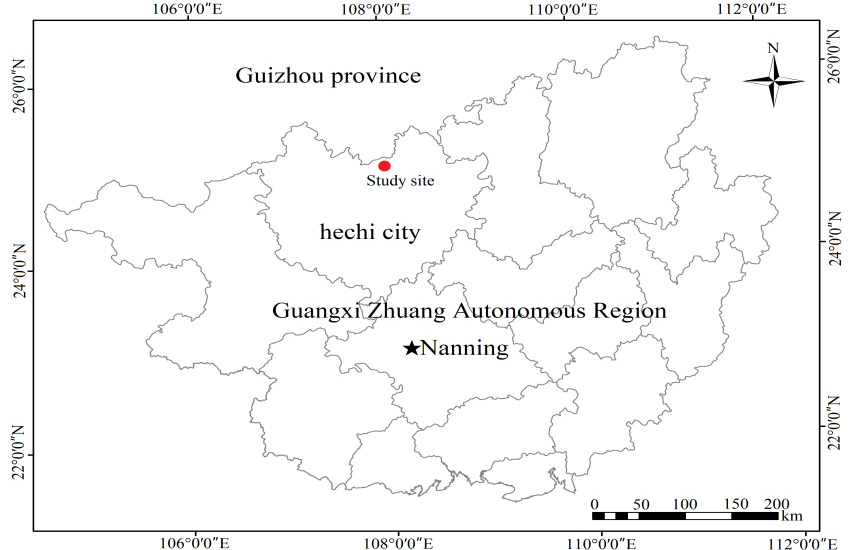
Location map of Mulun National Nature Reserve, China.
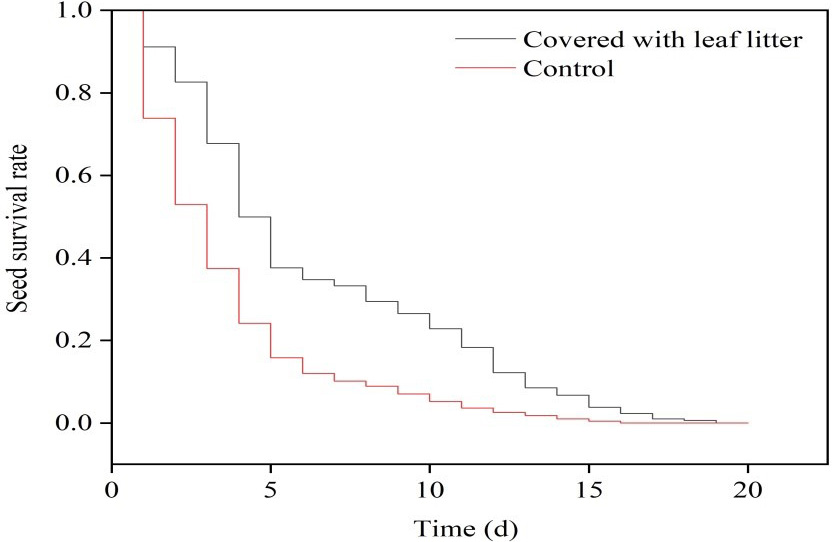
Seed removal rate of Kmeria septentrionalis after deposition at the seed stations under different treatments. Data are expressed as mean ± SE.
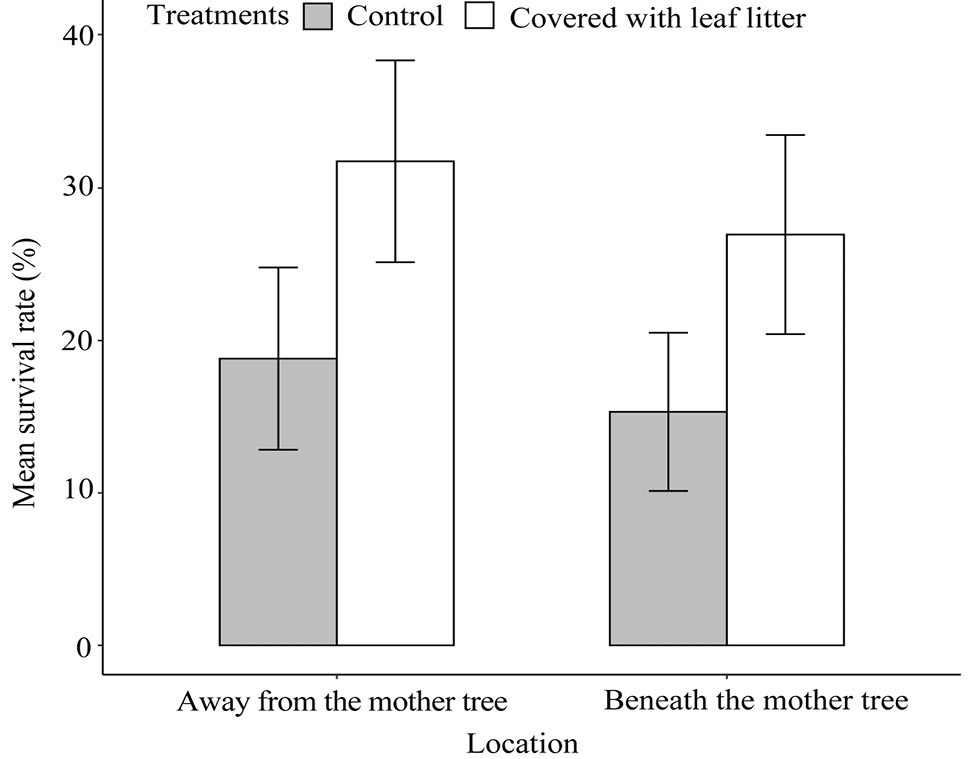
Seed removal rates of Kmeria septentrionalis in different location and treatment. Data are expressed as mean ± SE.
References
- Batisteli, A.F., Costa, R.O., and Christianini, A.V., 2020. Seed abundance affects seed removal of an alien and a native tree in the Brazilian savanna: Implications for biotic resistance. Aust. Ecol., 45: 1007-1015. https://doi.org/10.1111/aec.12922[CrossRef]
- Brown, J.S.,1988. Patch use as an indicator of habitat preference, predation risk, and competition. Behav. Ecol. Sociobiol., 22: 37-47. https://doi.org/10.1007/BF00395696[CrossRef]
- Cintra, R., 1997. Leaf litter effects on seed and seedling predation of the palm Astrocaryum murumuru and the legume tree Dipteryx micrantha in Amazonian forest. J. trop. Ecol., 13: 709-725. https://doi.org/10.1017/S0266467400010889[CrossRef]
- Clements, R., Sodhi, N.S., Schilthuizen, M., and Ng, P.K.L., 2006. Limestone karsts of Southeast Asia: imperiled arks of biodiversity. Bioscience, 56: 733-742. https://doi.org/10.1641/0006-3568(2006)56[733:LKOSAI]2.0.CO;2[CrossRef]
- Dylewski, Ł., Ortega, Y.K., Bogdziewicz, M., and Pearson, D.E., 2020. Seed size predicts global effects of small mammal seed predation on plant recruitment. Ecol. Lett., 23: 1024-1033. https://doi.org/10.1111/ele.13499[CrossRef]
- Fedriani, J.M., and Manzaneda, A.J., 2005. Pre-and post-dispersal seed predation by rodents: Balance of food and safety. Behav. Ecol., 16: 1018-1024. https://doi.org/10.1093/beheco/ari082[CrossRef]
- García, D., Martínez, I., and Obeso, J.R., 2007. Seed transfer among bird-dispersed trees and its consequences for post-dispersal seed fate. Basic appl. Ecol., 8: 533-543. https://doi.org/10.1016/j.baae.2006.11.002[CrossRef]
- Huang, P.X., Zhou, Y.H., Nai, J.Y., Li, W.G., and Liu, X.M., 2010. Extraction and analysis of volatile constituents from testa of rare and endangered plant Kmeria septentrionalis. Guihaia, 30: 691-695.
- Jansen, P.A., Visser, M.D., Joseph, W.S., Rutten, G., and Muller-Landau, H.C., 2014. Negative density dependence of seed dispersal and seedling recruitment in a Neotropical palm. Ecol. Lett., 17: 1111-1120. https://doi.org/10.1111/ele.12317[CrossRef]
- Kuprewicz, E.K., and García-Robledo, C., 2019. Deciphering seed dispersal decisions: Size, not tannin content, drives seed fate and survival in a tropical forest. Ecosphere, 10: e02551. https://doi.org/10.1002/ecs2.2551[CrossRef]
- Li, Y.H., Ma, G.Z., Zhou, Q.H., and Huang, Z.H., 2020. Ranging patterns and foraging patch utilization of Assamese macaques inhabiting limestone forests in southwest Guangxi, China. Glob. Ecol. Conserv., 21: e00816. https://doi.org/10.1016/j.gecco.2019.e00816[CrossRef]
- Lichti, N., Steele, M.A., and Swihart, R.K., 2017. Seed fate and decision-making processes in scatter hoarding rodents. Biol. Rev., 92: 474-504. https://doi.org/10.1111/brv.12240[CrossRef]
- Liu, L., Song, T.Q., Peng, W.X., Wang, K.L., Du, H., Lu, S.Y., and Zeng, F.P., 2012. Spatial heterogeneity of soil microbial biomass in Mulun National Nature Reserve in Karst area. Acta Ecol. Sin., 32: 207-214. https://doi.org/10.5846/stxb201011101618[CrossRef]
- Nathan, R., and Muller-Landau, H.C., 2000. Spatial patterns of seed dispersal, their determinants and consequences for recruitment. Trends Ecol. Evol., 15: 278-285. https://doi.org/10.1016/S0169-5347(00)01874-7[CrossRef]
- Pan, C.L., Nai, J.Y., Li, X.D., and Shi, H.M., 2008. Seed rain and natural regeneration of Kmeria septentrionalis in Mulun of Guangxi. Chinese J. Ecol., 27: 2235-2239.
- Pan, Y., Bai, B., Xiong, T.S., and Lu, C.H., 2016. Seed handling by primary frugivores differentially influence post-dispersal seed removal of Chinese yew by ground-dwelling animals. Integ. Zool., 11: 191-198. https://doi.org/10.1111/1749-4877.12189[CrossRef]
- Pardini, E.A., Patten, M.V., and Knight, T.M., 2017. Effects of seed density and proximity to refuge habitat on seed predation rates for a rare and a common Lupinus species. Am. J. Bot., 104: 389-398. https://doi.org/10.3732/ajb.1600290[CrossRef]
- Perea, R., Miguel, A.S., Martínez-Jauregui, M., Valbuena-Carabaña, M., and Gil, L., 2012. Effects of seed quality and seed location on the removal of acorns and beechnuts. Eur. J. For. Res., 131: 623-631. https://doi.org/10.1007/s10342-011-0536-y[CrossRef]
- R Core Team, 2016. R: A language and environment for statistical computing. R Foundation for Statistical Computing Available at http://www.R-project.org/
- Rusch, U.D., Midgley, J.J., and Anderson, B., 2013. Rodent consumption and caching behavior selects for specific seed traits. South Afr. J. Bot., 84: 83-87. https://doi.org/10.1016/j.sajb.2012.09.007[CrossRef]
- Shimada, T., Takahashi, A., Shibata, M., and Waribashi, T., 2015. Effects of within-plant variability in seed weight and tannin content on foraging behavior of seed consumers. Funct. Ecol., 29: 1513-1521. https://doi.org/10.1111/1365-2435.12464[CrossRef]
- Sotes, G.J., Bustamante, R.O., and Henríquez, C.A., 2018. Leaf litter is essential for seed survival of the endemic endangered tree Pouteria splendens (Sapotaceae) from central Chile. Web Ecol., 18: 1-5. https://doi.org/10.5194/we-18-1-2018[CrossRef]
- Steele, M.A., Contreras, T.A., Hadj-Chikh, L.Z., Agosta, S.J., Smallwood, P.D., and Tomlinson, C.N., 2014. Do scatter hoarders trade off increased predation risks for lower rates of cache pilferage? Behav. Ecol., 25: 206-215. https://doi.org/10.1093/beheco/art107[CrossRef]
- Sunyer, P., Muñoz, A., Bonal, R., and Espelta, J.M., 2013. The ecology of seed dispersal by small rodents: A role for predator and conspecific scents. Funct. Ecol., 27: 1313-1321. https://doi.org/10.1111/1365-2435.12143[CrossRef]
- Wang, B., Corlett, R.T., 2017. Scatter-hoarding rodents select different caching habitats for seeds with different traits. Ecosphere, 8: e01774. https://doi.org/10.1002/ecs2.1774[CrossRef]
- Wang, G.H., Pan, Y., Qin, G.L., Tan, W.N., and Lu, C.H., 2020. Effects of microhabitat on rodent-mediated seed removal of endangered Kmeria septentrionalis in the karst habitat. PeerJ., 8: e10378. https://doi.org/10.7717/peerj.10378[CrossRef]
- Wang, G.H., Yang, Z.X., Chen, P., Tan, W.N., and Lu, C.H., 2019. Seed dispersal of an endangered Kmeria septentrionalis by frugivorous birds in a karst habitat. Pakistan J. Zool., 51: 1195-1198. https://doi.org/10.17582/journal.pjz/2019.51.3.sc5[Full text][CrossRef]
- Yan, X.F., Yang, J., Si, B.B., Zhang, Q., and Zhang, K.W., 2011. Effects of litter and soil cover on Quercus liaotungensis seed predation and removal by animals. Chinese J. Ecol., 30: 2547-2553.
- Yu, F., Shi, X.X., Wei, K.L., and Wang, D.X., 2016. Leaf litter affects the survival and predation rates for large and small Pinus seeds in the Qinling Mountains, China. Israel J. Ecol. Evol., 61: 162-168. https://doi.org/10.1080/15659801.2016.1176689[CrossRef]
- Yu, F., Shi, X.X., Zhang, X., Yi, X.F., Wang, D.X., and Ma, J.M., 2017. Effects of selective logging on rodent-mediated seed dispersal. For. Ecol. Manage., 406: 147-154. https://doi.org/10.1016/j.foreco.2017.10.001[CrossRef]
- Zhang, M.M., Steele, M.A., and Yi, X.F., 2013. Reconsidering the effects of tannin on seed dispersal by rodents: Evidence from enclosure and field experiments with artificial seeds. Behav. Process., 100: 200-207. https://doi.org/10.1016/j.beproc.2013.09.010[CrossRef]
- Zhao, Y., Liu, Y., Wang, J.M., Zhang, Y.H., and Yang, Y.F., 2014. Effects of rodents and litter coverage on the seed fate of wild Prunus divaricata in wild fruit forest of Tianshan Mountain, Northwest China. Chinese J. appl. Ecol., 25: 2557-2562.
- Zhou, Q.H., Wei, F.W., Huang, C.M., Li, M., Ren, B.P., and Luo, B., 2007. Seasonal variation in the activity patterns and time budgets of Trachypithecus francoisi in the Nonggang Nature Reserve, China. Int. J. Primatol., 28: 657-671. https://doi.org/10.1007/s10764-007-9144-6[CrossRef]
Services
Article usage statistics
Loading…